Putting thought in the right place, part 2

CAP v2.1.2

In the last blog post, I discussed the Cognitive Action Pathways model, a schematic conceptual representation of the hierarchy of key components that underpin human thought and behaviour.

Small changes in the early processes within the Cognitive-Action Pathway model can snowball to effect every other part of the process. A real life example of this is ASD, or Autism Spectrum Disorder.

ASD has been present since time immemorial. Numerous bloggers speculate that Moses may have had ASD, while a couple of researchers proposed that Samson was on the spectrum (although their evidence was tenuous [1]). Thankfully, autism is no longer considered a form of demon possession or madness, or schizophrenia, or caused by emotionally distant “refrigerator mothers”, nor treated with inhumane experimental chemical and physical “treatments” [2, 3].

The autism spectrum is defined by two main characteristics: deficits in social communication and interaction, and restricted repetitive patterns of behaviour. People on the autism spectrum also tend to have abnormal sensitivity to stimuli, and other co-existing conditions like ADHD. The full diagnostic criteria can be found in DSM5. The new criteria are not without their critics [4-6], but overall, reflect the progress made in understanding the biological basis of autism.

ASD is recognized as a pervasive developmental disorder secondary to structural and functional changes in the brain that occur in the womb, and can be detected as early as a month after birth [7]. In the brain of a foetus that will be born with ASD, excess numbers of dysfunctional nerve cells are unable to form the correct synaptic scaffolding, leaving a brain that is large [8, 9], but out-of-sync. The reduced scaffolding leads to local over-connectivity within regions of the brain, and under-connectivity between the regions of the brain [10]. The majority of the abnormal cells and connections are within the frontal lobe, especially the dorsolateral prefrontal cortex and the medial prefrontal cortex [11], as well as the temporal lobes [12]. The cerebellum is also significantly linked to the autism spectrum [13]. There is also evidence that the amygdala and hippocampus, involved in emotional regulation and memory formation, are significantly effected in ASD [10].

There is also strong evidence for an over-active immune system in an autistic person compared to a neurotypical person, with changes demonstrated in all parts of the immune system, and the immune system in the brain as well as the rest of the body [14]. These immune changes contribute to the reduced ability of the brain to form new branches as well as develop new nerve cells or remove unnecessary cells.

There are a number of environmental and epigenetic associations linked to autism. These include disorders of folate metabolism [15, 16], pollutants [17], fever during pregnancy [18] and medications such as valproate and certain anti-depressants [19, 20] which are linked with an increase in autism[1]. Supplements such as folate [15, 21], omega-6 polyunsaturated fatty acids [22] and the use of paracetamol for fevers in pregnancy [18] have protective effects.

Although these factors are important, genes outweigh their influence by about 4:1. Twin studies suggest that between 70-90% of the risk of autism is genetic [23, 24]. Individual gene studies have only shown that each of the many single genes carry about a one percent chance each for the risk of autism [10]. It’s been proposed that the hundreds of genes linked with autism [10, 25] are not properly expressed (some are expressed too much, some not enough). The resulting proteins from the abnormal gene expression contribute to a different function of the cell’s machinery, altering the ability of a nerve cell to fully develop, and the ability of nerve cells to form connections with other nerve cells [26]. The effects are individually small, but collectively influential [24]. Autism is considered a complex genetic disorder involving rare mutations, complex gene × gene interactions, and copy number variants (CNVs) including deletions and duplications [27].

According to the Cognitive-Action Pathways model, the triad of the environment, epigenetics, and genes influence a number of processes that feed into our actions, thoughts, perceptions, personality and physiology. In ASD, the starting place is language processing.

New born babies from as young as two days old prefer listening to their own native language [28], which suggests that we are born already pre-wired for language. Auditory stimuli (sounds) are processed in the temporal lobes, including language processing. In neurotypical people, language processing is done predominantly on the left side, with some effect from the right side. But in people with autism, because of the abnormal wiring, there is only significant activity of the right temporal lobe [12]. Even more, from data so recent that it’s pending publication, loss of the processing of information of the left temporal lobe reversed the brains orientation to social and non-social sounds, like the sound of the babies name [7].

The change in the wiring of the left and right temporal lobes then alters the processing of language, specifically the social significance of language and other sounds. So already from a young age, people with autism will respond differently to environmental stimuli compared to a neurotypical person.

In the same way, the fusiform gyrus is part of the brain that processes faces. It’s quite specific to this task in a neurotypical person. However, the altered wiring of the brain in someone with autism causes a change, with different parts of the brain having to take up the load of facial processing [29].

Each time that one part of the brain can’t perform it’s normal function, the other parts take up the load. However that reduces the capacity for those parts of the brain to perform their own normal functions. In the case of the temporal lobes and the fusiform areas, this results in a reduced ability to discern subtleties especially those related to recognizing social cues. A neurotypical person and an autistic person could be standing in front of the same person, listening to the same words, and seeing the same facial expressions, but because of the way each persons brain processes the information, the perception of those words and cues can be completely different. This demonstrates how genetic changes can lead to changes in the perception of normal sensory input, resulting in differences in the physiological response, emotions, feelings, thoughts and actions, despite identical sensory input.

Physiology

The same changes that effect the cerebral cortex of the brain also have an influence on the deeper structures such as the hippocampus and the amygdala. The hippocampus is largely responsible for transforming working memory into longer term declarative memory. Studies comparing the size of the hippocampus in ASD children have shown an increase in size compared with typical developing children [30]. Combined with the deficits in the nerve cell structure of the cerebellum [13], autistic children and adults have a poor procedural memory (action learning, regulated by the cerebellum) and an overdeveloped declarative memory (for facts, regulated by the hippocampus). This has been termed the “Mnesic Imbalance Theory” [31].

The amygdala is also functionally and anatomically altered because of the changes to the nerve cells and their connections. The amygdala is larger in young children with ASD compared to typically developing children. As a result, young ASD children have higher levels of background anxiety than do neurotypical children [32]. It’s proposed that not only do ASD children have higher levels of background anxiety, they also have more difficulty in regulating their stress system, resulting in higher levels of stress compared to a neurotypical child exposed to the same stimulus [33].

Personality

On a chemical level, autism involves genes that encode for proteins involved in the transport of key neurotransmitters, serotonin and dopamine. Early evidence confirms the deficits of the serotonin and dopamine transporter systems in autism [34]. These neurotransmitters are integral to processing the signals of mood, stress and rewards within the brain, and as discussed in the last chapter, are significantly involved in the genesis of personality.

The abnormal neurotransmitter systems and the resulting deficiencies in processing stress and rewards signals contribute to a higher correlation of neuroticism and introverted personality styles in children with autism symptoms [35, 36].

So people with autism genes are going to process stress and rewards in a different way to the neurotypical population. As a result, their feelings, their thoughts and their resulting actions are tinged by the differences in personality through which all of the incoming signals are processed.

Actions

The underlying genes and neurobiology involved in autism also effect the final behavioural step, not only because genes and sensory input influence the personality and physiology undergirding our feelings and thoughts, but also because they cause physical changes to the cerebellum, the part of the brain involved in fine motor control and the integration of a number of higher level brain functions including working memory, behaviour and motivation [13, 37].

When Hans Asperger first described his cohort of ASD children, he noted that they all had a tendency to be clumsy and have poor handwriting [38]. This is a good example of how the underlying biology of ASD can effect the action stage independently of personality and physiology. The cerebellum in a person with ASD has reduced numbers of a particular cell called the Purkinje cells, effecting the output of the cerebellum and the refined co-ordination of the small muscles of the hands (amongst other things). Reduced co-ordination of the fine motor movements of the hands means that handwriting is less precise and therefore less neat.

A running joke when I talk to people is the notoriously illegible doctors handwriting. One of the doctors I used to work with had handwriting that seriously looked like someone had dipped a chicken’s toes in ink and let it scratch around for a while. My handwriting is messy – a crazy cursive-print hybrid – but at least it’s legible. I tell people that our handwriting is terrible because we spent six years at medical school having to take notes at 200 words a minute. But it might also be that the qualities that make for a good doctor tend to be found in Asperger’s Syndrome, so the medical school selection process is going to bias the sample towards ASD and the associated poor handwriting (Thankfully, those that go on to neurosurgery tend to have good hand-eye coordination).

But if your educational experience was anything like mine, handwriting was seen as one of the key performance indicators of school life. If your handwriting was poor, you were considered lazy or stupid. Even excluding the halo effect from the equation, poor handwriting means a student has to slow down to write neater but takes longer to complete the same task, or writes faster to complete the task in the allotted time but sacrificing legibility in doing so.

Either way, the neurobiology of ASD results in reduced ability to effectively communicate, leading to judgement from others and internal personal frustration, both of which feedback to the level of personality, molding future feelings, thoughts and actions.

Thought in ASD

By the time all the signals have gone through the various layers of perception, personality and physiology, they reach the conscious awareness level of our stream of thought. I hope by now that you will agree with me that thought is irrevocably dependent on all of the various levels below it in the Cognitive-Action Pathways Model. While thoughts are as unique as the individual that thinks them, the common genetic expression of ASD and the resulting patterns in personality, physiology and perception lead to some predictable patterns of thought in those sharing the same genes.

As a consequence of the differences in the signal processing, the memories that make their way to long-term storage are also going to be different. Memories and memory function are also different in ASD for other neurobiological reasons, as described earlier in the blog with the Mnesic Imbalance Theory.

Summary

The Cognitive-Action Pathways model is a way of describing the context of thoughts to other neurological processes, and how they all interact. It shows that conscious thoughts are one link of a longer chain of neurological functions between stimulus and action – simply one cog in the machine. The autistic spectrum provides a good example of how changes in genes and their expression can dramatically influence every aspect of a person’s life – how they experience the world, how they feel about those experiences, and how they think about them.

I used autism as an example because autism is a condition that’s pervasive, touching every aspect of a person’s life, and provides a good example of the extensive consequences from small genetic changes. But the same principles of the Cognitive-Action Pathways Model apply to all aspects of life, including conditions that are considered pathological, but also to our normal variations and idiosyncrasies. Small variations in the genes that code for our smell sensors or the processing of smells can change our preferences for certain foods just as much as cultural exposure. Our appreciation for music is often changed subtly between individuals because of changes in the structure of our ears or the nerves that we use to process the sounds. The genetic structure of the melanin pigment in our skin changes our interaction with our environment because of the amount of exposure to the sun we can handle.

So in summary, this blog was to set out the place that our thoughts have in the grand scheme of life. Thought is not the guiding or controlling force, it is simply a product of a number of underlying functions and variables.

References

  1. Mathew, S.K. and Pandian, J.D., Newer insights to the neurological diseases among biblical characters of old testament. Ann Indian Acad Neurol, 2010. 13(3): 164-6 doi: 10.4103/0972-2327.70873
  2. Wolff, S., The history of autism. Eur Child Adolesc Psychiatry, 2004. 13(4): 201-8 doi: 10.1007/s00787-004-0363-5
  3. WebMD: The history of autism. 2013 [cited 2013, August 14]; Available from: http://www.webmd.com/brain/autism/history-of-autism.
  4. Buxbaum, J.D. and Baron-Cohen, S., DSM-5: the debate continues. Mol Autism, 2013. 4(1): 11 doi: 10.1186/2040-2392-4-11
  5. Volkmar, F.R. and Reichow, B., Autism in DSM-5: progress and challenges. Mol Autism, 2013. 4(1): 13 doi: 10.1186/2040-2392-4-13
  6. Grzadzinski, R., et al., DSM-5 and autism spectrum disorders (ASDs): an opportunity for identifying ASD subtypes. Mol Autism, 2013. 4(1): 12 doi: 10.1186/2040-2392-4-12
  7. Pierce, K. Exploring the Causes of Autism – The Role of Genetics and The Environment (Keynote Symposium 11). in Asia Pacific Autism Conference. 2013. Adelaide, Australia: APAC 2013.
  8. Courchesne, E., et al., Evidence of brain overgrowth in the first year of life in autism. JAMA, 2003. 290(3): 337-44 doi: 10.1001/jama.290.3.337
  9. Shen, M.D., et al., Early brain enlargement and elevated extra-axial fluid in infants who develop autism spectrum disorder. Brain, 2013. 136(Pt 9): 2825-35 doi: 10.1093/brain/awt166
  10. Won, H., et al., Autism spectrum disorder causes, mechanisms, and treatments: focus on neuronal synapses. Front Mol Neurosci, 2013. 6: 19 doi: 10.3389/fnmol.2013.00019
  11. Courchesne, E., et al., Neuron number and size in prefrontal cortex of children with autism. JAMA, 2011. 306(18): 2001-10 doi: 10.1001/jama.2011.1638
  12. Eyler, L.T., et al., A failure of left temporal cortex to specialize for language is an early emerging and fundamental property of autism. Brain, 2012. 135(Pt 3): 949-60 doi: 10.1093/brain/awr364
  13. Fatemi, S.H., et al., Consensus paper: pathological role of the cerebellum in autism. Cerebellum, 2012. 11(3): 777-807 doi: 10.1007/s12311-012-0355-9
  14. Onore, C., et al., The role of immune dysfunction in the pathophysiology of autism. Brain Behav Immun, 2012. 26(3): 383-92 doi: 10.1016/j.bbi.2011.08.007
  15. Schmidt, R.J., et al., Maternal periconceptional folic acid intake and risk of autism spectrum disorders and developmental delay in the CHARGE (CHildhood Autism Risks from Genetics and Environment) case-control study. Am J Clin Nutr, 2012. 96(1): 80-9 doi: 10.3945/ajcn.110.004416
  16. Mbadiwe, T. and Millis, R.M., Epigenetics and Autism. Autism Res Treat, 2013. 2013: 826156 doi: 10.1155/2013/826156
  17. Volk, H.E., et al., Residential proximity to freeways and autism in the CHARGE study. Environ Health Perspect, 2011. 119(6): 873-7 doi: 10.1289/ehp.1002835
  18. Zerbo, O., et al., Is maternal influenza or fever during pregnancy associated with autism or developmental delays? Results from the CHARGE (CHildhood Autism Risks from Genetics and Environment) study. J Autism Dev Disord, 2013. 43(1): 25-33 doi: 10.1007/s10803-012-1540-x
  19. Rai, D., et al., Parental depression, maternal antidepressant use during pregnancy, and risk of autism spectrum disorders: population based case-control study. BMJ, 2013. 346: f2059 doi: 10.1136/bmj.f2059
  20. Christensen, J., et al., Prenatal valproate exposure and risk of autism spectrum disorders and childhood autism. JAMA, 2013. 309(16): 1696-703 doi: 10.1001/jama.2013.2270
  21. Suren, P., et al., Association between maternal use of folic acid supplements and risk of autism spectrum disorders in children. JAMA, 2013. 309(6): 570-7 doi: 10.1001/jama.2012.155925
  22. Lyall, K., et al., Maternal dietary fat intake in association with autism spectrum disorders. Am J Epidemiol, 2013. 178(2): 209-20 doi: 10.1093/aje/kws433
  23. Abrahams, B.S. and Geschwind, D.H., Advances in autism genetics: on the threshold of a new neurobiology. Nature Reviews Genetics, 2008. 9(5): 341-55
  24. Geschwind, D.H., Genetics of autism spectrum disorders. Trends Cogn Sci, 2011. 15(9): 409-16 doi: 10.1016/j.tics.2011.07.003
  25. Chow, M.L., et al., Age-dependent brain gene expression and copy number anomalies in autism suggest distinct pathological processes at young versus mature ages. PLoS Genet, 2012. 8(3): e1002592 doi: 10.1371/journal.pgen.1002592
  26. O’Roak, B.J., et al., Sporadic autism exomes reveal a highly interconnected protein network of de novo mutations. Nature, 2012. 485(7397): 246-50 doi: 10.1038/nature10989
  27. Stankiewicz, P. and Lupski, J.R., Structural variation in the human genome and its role in disease. Annu Rev Med, 2010. 61: 437-55 doi: 10.1146/annurev-med-100708-204735
  28. Moon, C., et al., Two-day-olds prefer their native language. Infant behavior and development, 1993. 16(4): 495-500
  29. Pierce, K., et al., Face processing occurs outside the fusiform `face area’ in autism: evidence from functional MRI. Brain, 2001. 124(10): 2059-73 doi: 10.1093/brain/124.10.2059
  30. Schumann, C.M., et al., The amygdala is enlarged in children but not adolescents with autism; the hippocampus is enlarged at all ages. J Neurosci, 2004. 24(28): 6392-401 doi: 10.1523/JNEUROSCI.1297-04.2004
  31. Romero-Munguía, M.A.n., Mnesic Imbalance and the Neuroanatomy of Autism Spectrum Disorders, in Autism – A Neurodevelopmental Journey from Genes to Behaviour, Eapen, V., (Ed). 2011 Edition 1st, InTech. p. 425-44.
  32. Bal, E., et al., Emotion recognition in children with autism spectrum disorders: relations to eye gaze and autonomic state. J Autism Dev Disord, 2010. 40(3): 358-70 doi: 10.1007/s10803-009-0884-3
  33. Harms, M.B., et al., Facial emotion recognition in autism spectrum disorders: a review of behavioral and neuroimaging studies. Neuropsychol Rev, 2010. 20(3): 290-322 doi: 10.1007/s11065-010-9138-6
  34. Nakamura, K., et al., Brain serotonin and dopamine transporter bindings in adults with high-functioning autism. Arch Gen Psychiatry, 2010. 67(1): 59-68 doi: 10.1001/archgenpsychiatry.2009.137
  35. Austin, E.J., Personality correlates of the broader autism phenotype as assessed by the Autism Spectrum Quotient (AQ). Personality and Individual Differences, 2005. 38(2): 451-60
  36. Wakabayashi, A., et al., Are autistic traits an independent personality dimension? A study of the Autism-Spectrum Quotient (AQ) and the NEO-PI-R. Personality and Individual Differences, 2006. 41: 873-83
  37. De Sousa, A., Towards an integrative theory of consciousness: part 1 (neurobiological and cognitive models). Mens Sana Monogr, 2013. 11(1): 100-50 doi: 10.4103/0973-1229.109335
  38. Wing, L., Asperger’s syndrome: a clinical account. Psychol Med, 1981. 11(1): 115-29 http://www.ncbi.nlm.nih.gov/pubmed/7208735

[1] A word of caution: While there’s good evidence that valproate increases the risk of autism, and a possible link between some anti-depressants and autism, that risk has to be balanced with the risk to the baby of having a mother with uncontrolled epilepsy or depression, which may very well be higher. If you’re taking these medications and you are pregnant, or want to become pregnant, consult your doctor BEFORE you stop or change your medications. Work out what’s right for you (and your baby) in your unique situation.

Dr Caroline Leaf: Putting thought in the right place

Following hard on the heels of her false assumption that our minds control our health, not our genes, and following the same theme, Dr Leaf had this to say today, “Everything is first a thought; the brain is being controlled with EVERY thought you think!”

Dr Caroline Leaf is a communication pathologist and a self-titled cognitive neuroscientist. Reading back through my blogs, this “thought controls the brain / mind controls matter” is a recurrent theme of hers. It is repeated multiple times in her books, like when she writes, “Thoughts influence every decision, word, action and physical reaction we make.” [1: p13] and “Our mind is designed to control the body, of which the brain is a part, not the other way around. Matter does not control us; we control matter through our thinking and choosing” [2: p33] just as a couple of examples.

So how does thought relate to the grand scheme of our brain and it’s processing? Does our thought really control our brain, or is it the other way around. Through all of the reading that I have done on neuroscience, I propose a model of the place of thought in relation to the rest of our brains information processing. It is based on the LIDA model, dual systems models, and other neuroscientific principles and processes.

We’ve all heard the phrase, “It’s just the tip of the iceberg.” It comes from the fact that icebergs are made of fresh water, which is nine-tenths less dense than seawater. As a result, ten percent of an iceberg sits above the waters surface with most of it hiding beneath.

The information processing of our brains is much the same. We may be aware of our conscious stream of thought, but there is a lot going on under the surface that makes our thoughts what they are, even though we can’t see the process underneath.

What’s going on under the surface is a complex interplay of our genes and their expression which controls the structure and function of our brains, which effects how we perceive information, how we process that information and combine it into our memories of the past, predictions of the future, and even the further perception of the present [3].

CAP v2.1.2
Genes, epigenetics and the environment
We start with the most fundamental level of our biological system, which is genetics. It becomes clear from looking at any textbook of biological sciences that genes are fundamental to who we are. From the simplest bacteria, fungi, protozoans and parasites, through to all plants, all animals and all of human kind – EVERY living thing has DNA. DNA is what defines life in the broadest sense.

Proteins are responsible for the size, shape and operation of the cell. They make each tissue structurally and functionally different, but still work together in a highly precise electrochemical synchrony. But ultimately, it’s our genes that hold all of the instructions to make every one of the proteins within our cells. Without our genes, we would be nothing more than a salty soup of random amino acids.

Epigenetics and the environment contribute to the way genes are expressed. Epigenetics are “tags” on the strand of DNA that act to promote or silence the expression of certain genes (I discuss this in more detail in chapter 12 of my book, https://www.smashwords.com/books/view/466848). Environmental factors (the components that make up the world external to our bodies) can influence genes and epigenetic markers. The environment can cause genetic mutations or new epigenetic marks that change the function of a particular gene, and depending on which cell they effect (a very active embryonic cell or a quiet adult cell) will largely determine the eventual outcome. The environment is more influential to our genetic expression than epigenetics.

Still, on average only about 25% of the expression of a complex trait is related to environmental factors. So while the environment is important, it is still outdone 3:1 by our genome.

Yes, epigenetics and the environment are important, but they influence, not control, the genome.

Perception
We live in a sensory world. The five senses are vital in providing the input we need for our brain to understand the world and meaningfully interact with it.

Different organs are needed to translate the optical, chemical or mechanical signals into electrical signals. Different parts of our brain then interpret these signals and their patterns.

Our genes significantly influence this process. For example, if someone is born with red-green colour blindness then how he or she interprets the world will always be subtly different to someone with normal vision. Or a person born with congenital deafness will always interpret his or her environment in a different way to someone with full hearing. I’ve highlighted these two conditions because they provide stark examples to help demonstrate the point, but there are many unique genetic expressions in each of the five senses that subtly alter the way each of us perceives the world around us.

So while we may all have the same photons of light hitting our retinas, or the same pressure waves of sound reaching our ears or touch on our skin, how our brains receive that information is slightly different for every individual. The information from the outside world is received by our sensory organs, but it is perceived by our brain, and even small differences in perception can have a big impact on the rest of the system.

Personality
Personality is “the combination of characteristics or qualities that form an individual’s distinctive character” [4]. Formally speaking, personality is, “defined as constitutionally based tendencies in thoughts, behaviors, and emotions that surface early in life, are relatively stable and follow intrinsic paths of development basically independent of environmental influences.” [5]

Professor Gregg Henriques explained it well in Psychology Today, “Personality traits are longstanding patterns of thoughts, feelings, and actions which tend to stabilize in adulthood and remain relatively fixed. There are five broad trait domains, one of which is labeled Neuroticism, and it generally corresponds to the sensitivity of the negative affect system, where a person high in Neuroticism is someone who is a worrier, easily upset, often down or irritable, and demonstrates high emotional reactivity to stress.” [6] The other four personality types are Extraversion, Agreeableness, Conscientiousness, and Openness to Experience.

Gene x environment studies suggest that personality is highly heritable, with up to 60% of personality influenced by genetics [7], predominantly through genes involved in the serotonin [8] and dopamine systems [9, 10]. The “non-shared environment” (influences outside of the home environment) contributes heavily to the remainder [11, 12].

Personality is like a filter for a camera lens, shaping the awareness of our emotional state for better or worse, thus influencing the flow on to our feelings (the awareness of our emotions), our thoughts, and our actions.

Physiology
Watkins describes physiology as streams of data that are provided from the different parts of your body, like the heart rate, your breathing rate, the oxygen in your blood, the position of your joints, the movement of your joints, even the filling of your bladder telling you that you need a break soon.

All of these signals are constantly being generated, and collated in different parts of the brain. Some researchers consider them positive and negative depending on the data stream and the signal its providing. They coalesce into emotion [13].

Emotion
According to Watkins, “emotion” is the sum of all the data streams of physiology, or what he described as “E-MOTIONEnergy in MOTION.” [13] In this context, think of emotion as a bulls-eye spirit-level of our body systems. The different forces of our physiology change the “level” constantly in different directions. Emotion is the bubble that marks the central point, telling us how far out of balance we are.

In the interest of full disclosure, I should mention that although emotion is a familiar concept, the work of literally thousands of brilliant minds has brought us no closer to a scientifically validated definition of the word “emotion”. Some psychologists and researchers consider it vague and unscientific, and would prefer that it not be used altogether [14].

I’ve retained it because I think it’s a well-recognised word that conceptually describes the balance of physiological forces.

Feelings
“Feelings” are the perception of emotion.

I discussed earlier in the chapter that what we perceive is different to what we “see” because the subtle genetic differences in our eyes and brains causes the information to be processed differently between individuals. The same applies to the perception of our emotion.

As I wrote earlier, personality is largely determined by our genetics with contributions from our environment [11, 12]. The emotional signal is filtered by our personality to give rise to our feelings. Classically, an optimistic personality is going to bias the emotional input in a positive, adaptive way while a pessimist or neurotic is going to bias the emotional signal in a maladaptive way

That’s not to say that an optimist can’t have depressed feelings, or a neurotic can’t have happy feelings. In the same way that a coloured lens will allow a lot of light through but filter certain wavelengths out, most of our emotional state of being will come through the filter of our personality but the feelings will be subtly biased one way or another.

Executive Functions
Executive function of the brain is defined as a complex cognitive process requiring the co-ordination of several sub-processes to achieve a particular goal [15]. These sub-processes can be variable but include working memory, attention, goal setting, maintaining and monitoring of goal directed action and action inhibition. In order to achieve these goals, the brain requires flexibility and coordination of a number of networks and lobes, although mainly the prefrontal cortex, parietal cortex, anterior cingulate and basal ganglia, and the while matter tracts that connect them.

Executive functions process the incoming information and decide on what goals are best given the context, then plan the goals, execute them to the motor cortices, and monitor the action. Research work from Marien et al [16] demonstrates that unconscious/implicit goals can divert resources away from conscious goals especially if it is emotionally salient or otherwise strongly related. They also confirm that conscious awareness is not necessary for executive function but that implicit goals can be formed and executed without conscious involvement.

Thoughts
Thoughts are essentially a stream of data projected into our conscious space. Baars [17, 18] noted that the conscious broadcast comes into working memory which then engages a wider area of the cerebral cortex necessary to most efficiently process the information signal. We perceive thought most commonly as either pictures or sounds in our head (“the inner monologue”), which corresponds to the slave systems of working memory. When you “see” an image in your mind, that’s the visuospatial sketchpad. When you listen to your inner monologue, that’s your phonological loop. When a song gets stuck in your head, that’s your phonological loop as well, but on repeat mode.

There is another slave system that Baddeley included in his model of working memory called the episodic buffer, “which binds together complex information from multiple sources and modalities. Together with the ability to create and manipulate novel representations, it creates a mental modeling space that enables the consideration of possible outcomes, hence providing the basis for planning future action.” [19]

Deep thinking is a projection from your brains executive systems (attention or the default mode network) to the central executive of working memory, which then recalls the relevant information from long-term memory and directs the information through the various parts of the slave systems of working memory to process the complex details involved. For example, visualizing a complex scene of a mountain stream in your mind would involve the executive brain directing the central executive of working memory to recall information about mountains and streams and associated details, and project them into the visuospatial sketchpad and phonological loop and combine them via the episodic buffer. The episodic buffer could also manipulate the scene if required to create plans, or think about the scene in new or unexpected ways (like imagining an elephant riding a bicycle along the riverbank).

Even though the scene appears as one continuous episode, it is actually broken up into multiple cognitive cycles, in the same way that images in a movie appear to be moving, but are really just multiple still frames played in sequence.

Action
Action is the final step in the process, the output, our tangible behaviour

Our behaviour is not the direct result of conscious thought, or our will (as considered in the sense of our conscious will).

We discussed this before when we talked about our choices in chapter 1. There are two main pathways that lead from sensory input to tangible behaviour – various automated pathways that take input from the thalamus, deep in the brain, and sent to motor circuits in the supplementary motor area and motor cortex of the brain. These can be anything from evasive “reflex” actions[1] to rehearsed, habituated motor movements, like driving. Then there is the second pathway, coming from the executive areas of our brain, that plan out options for action, which are reviewed by the pre-supplemental motor area and the default mode network.

This second pathway is amenable to conscious awareness. Like thought, the projection of different options for action into our consciousness helps to engage a wider area of cerebral cortex to process the data. Most of the possible plans for action have already been rejected by the implicit processing of our executive brain before consciousness is brought in to help. Once an option has been selected, the action is sent to the pre-supplementary motor area, the supplementary motor area, the basal ganglia and finally the motor cortex.

According to the model proposed by Bonn [20], the conscious network has some feedback from the control network of our brain, providing real time context to actions about to be executed, and a veto function, stopping some actions at the last minute before they are carried out. This is largely a function of the basal ganglia [21], with some assistance from working memory.

So as you can see, according to the CAP model, conscious thoughts are one link of a longer chain of neurological functions between stimulus and action – simply one cog in the machine. Thoughts are dependent on a number of processes that are both genetically and environmentally determined, beyond our conscious control. It’s simply wrong to assume that thoughts control the brain.

Dr Leaf is welcome to her opinion, but it is in contradiction to the overwhelming majority of neuroscientific knowledge

References

  1. Leaf, C., Who Switched Off My Brain? Controlling toxic thoughts and emotions. 2nd ed. 2009, Inprov, Ltd, Southlake, TX, USA:
  2. Leaf, C.M., Switch On Your Brain : The Key to Peak Happiness, Thinking, and Health. 2013, Baker Books, Grand Rapids, Michigan:
  3. Hao, X., et al., Individual differences in brain structure and resting brain function underlie cognitive styles: evidence from the embedded figures test. PLoS One, 2013. 8(12): e78089 doi: 10.1371/journal.pone.0078089
  4. Oxford Dictionary of English – 3rd Edition, 2010, Oxford University Press: Oxford, UK.
  5. De Pauw, S.S., et al., How temperament and personality contribute to the maladjustment of children with autism. J Autism Dev Disord, 2011. 41(2): 196-212 doi: 10.1007/s10803-010-1043-6
  6. Henriques, G. (When) Are You Neurotic? Theory of Knowledge: Psychology Today; 2012, 23 Nov 2012 [cited 2013 23 Nov 2012]; Available from: http://www.psychologytoday.com/blog/theory-knowledge/201211/when-are-you-neurotic.
  7. Vinkhuyzen, A.A., et al., Common SNPs explain some of the variation in the personality dimensions of neuroticism and extraversion. Transl Psychiatry, 2012. 2: e102 doi: 10.1038/tp.2012.27
  8. Caspi, A., et al., Genetic sensitivity to the environment: the case of the serotonin transporter gene and its implications for studying complex diseases and traits. Am J Psychiatry, 2010. 167(5): 509-27 doi: 10.1176/appi.ajp.2010.09101452
  9. Felten, A., et al., Genetically determined dopamine availability predicts disposition for depression. Brain Behav, 2011. 1(2): 109-18 doi: 10.1002/brb3.20
  10. Chen, C., et al., Contributions of dopamine-related genes and environmental factors to highly sensitive personality: a multi-step neuronal system-level approach. PLoS One, 2011. 6(7): e21636 doi: 10.1371/journal.pone.0021636
  11. Krueger, R.F., et al., The heritability of personality is not always 50%: gene-environment interactions and correlations between personality and parenting. J Pers, 2008. 76(6): 1485-522 doi: 10.1111/j.1467-6494.2008.00529.x
  12. Johnson, W., et al., Beyond Heritability: Twin Studies in Behavioral Research. Curr Dir Psychol Sci, 2010. 18(4): 217-20 doi: 10.1111/j.1467-8721.2009.01639.x
  13. Watkins, A. Being brilliant every single day – Part 1. 2012 [cited 2 March 2012]; Available from: http://www.youtube.com/watch?v=q06YIWCR2Js.
  14. Dixon, T., “Emotion”: The History of a Keyword in Crisis. Emot Rev, 2012. 4(4): 338-44 doi: 10.1177/1754073912445814
  15. Elliott, R., Executive functions and their disorders Imaging in clinical neuroscience. British Medical Bulletin, 2003. 65(1): 49-59
  16. Marien, H., et al., Unconscious goal activation and the hijacking of the executive function. J Pers Soc Psychol, 2012. 103(3): 399-415 doi: 10.1037/a0028955
  17. Baars, B.J. and Franklin, S., How conscious experience and working memory interact. Trends Cogn Sci, 2003. 7(4): 166-72 http://www.ncbi.nlm.nih.gov/pubmed/12691765 ; http://bit.ly/1a3ytQT
  18. Baars, B.J., Global workspace theory of consciousness: toward a cognitive neuroscience of human experience. Progress in brain research, 2005. 150: 45-53
  19. Repovs, G. and Baddeley, A., The multi-component model of working memory: explorations in experimental cognitive psychology. Neuroscience, 2006. 139(1): 5-21 doi: 10.1016/j.neuroscience.2005.12.061
  20. Bonn, G.B., Re-conceptualizing free will for the 21st century: acting independently with a limited role for consciousness. Front Psychol, 2013. 4: 920 doi: 10.3389/fpsyg.2013.00920
  21. Beste, C., et al., Response inhibition subprocesses and dopaminergic pathways: basal ganglia disease effects. Neuropsychologia, 2010. 48(2): 366-73 doi: 10.1016/j.neuropsychologia.2009.09.023

[1] We often describe rapid unconscious movements, especially to evade danger or to protect ourselves, as “reflexes”. Medically speaking, a true reflex is a spinal reflex, like the knee-jerk reflex. When a doctor taps the knee with the special hammer, the sudden stretch of the tendon passes a nerve impulse to the spinal cord, which is then passed to the muscle, which makes it contract. A true reflex doesn’t go to the brain at all.

Dr Caroline Leaf – Exacerbating the Stigma of Mental Illness

Screen Shot 2014-10-18 at 12.44.33 pm

It was late in the afternoon, you know, that time when the caffeine level has hit critical and the only way you can concentrate on the rest of the day is the promise you’ll be going home soon.

The person sitting in front of me was a new patient, a professional young woman in her late 20’s, of Pakistani descent. She wasn’t keen to discuss her problems, but she didn’t know what else to do. After talking to her for a few minutes, it was fairly obvious that she was suffering from Generalised Anxiety Disorder, and I literally mean suffering. She was always fearful but without any reason to be so. She couldn’t eat, she couldn’t sleep, her heart raced all the time.

I was actually really worried for her. She let me do some basic tests to rule out any physical cause that was contributing to her symptoms, but that was as far as she let me help her. Despite talking at length about her diagnosis, she could not accept the fact that she had a psychiatric condition, and did not accept any treatment for it. She chose not to follow up with me either. I only saw her twice.

Perhaps it was fear for her job, social isolation, or a cultural factor. Perhaps it was the anxiety itself. Whatever the reason, despite having severe ongoing symptoms, she could not accept that she was mentally ill. She was a victim twice over, suffering from both mental illness, and its stigma.

Unfortunately, this young lady is not an isolated case. Stigma follows mental illness like a shadow, an extra layer of unnecessary suffering, delaying proper diagnosis and treatment of diseases that respond best to early intervention.

What contributes to the stigma of mental illness? Fundamentally, the stigma of mental illness is based on ignorance. Ignorance breeds stereotypes, stereotypes give rise to prejudice, and prejudice results in discrimination. This ignorance usually takes three main forms; people with mental illness are homicidal maniacs who need to be feared; they have childlike perceptions of the world that should be marveled; or they are responsible for their illness because they have weak character [1].

Poor information from people who claim to be experts doesn’t help either. For example, on her social media feed today, Dr Caroline Leaf said, “Psychiatric labels lock people into mental ill-health; recognizing the mind can lead us into trouble and that our mind is powerful enough to lead us out frees us! 2 Timothy1:7 Teaching on mental health @TrinaEJenkins 1st Baptist Glenardin.”

Dr Caroline Leaf is a communication pathologist and self-titled cognitive neuroscientist. It’s disturbing enough that Dr Leaf, who did not train in cognitive neuroscience, medicine or psychology, can stand up in front of people and lecture as an “expert” in mental health. It’s even more disturbing when her views on mental health are antiquated and inane.

Today’s post, for example. Suggesting that psychiatric labels lock people in to mental ill-health is like saying that a medical diagnosis locks them into physical ill-health. It’s a nonsense. Does diagnosing someone with cancer lock them into cancer? It’s the opposite, isn’t it? Once the correct diagnosis is made, a person with cancer can receive the correct treatment. Failing to label the symptoms correctly simply allows the disease to continue unabated.

Mental illness is no different. A correct label opens the door to the correct treatment. Avoiding a label only results in an untreated illness, and more unnecessary suffering.

Dr Leaf’s suggestion that psychiatric labels lock people in to their illness is born out of a misguided belief about the power of words over our thoughts and our health in general, an echo of the pseudo-science of neuro-linguistic programming.

The second part of her post, that “recognizing the mind can lead us into trouble and that our mind is powerful enough to lead us out frees us” is also baseless. Her assumptions, that thought is the main driving force that controls our lives, and that fixing our thought patterns fixes our physical and psychological health, are fundamental to all of her teaching. I won’t go into it again here, but further information on how Dr Leaf’s theory of toxic thinking contradicts basic neuroscience can be found in a number of my blogs, and in the second half of my book [2].

I’ve also written on 2 Timothy 1:7 before, another of Dr Leaf’s favourite scriptures, a verse whose meaning has nothing to do with mental health, but seized upon by Dr Leaf because one English translation of the original Greek uses the words “a sound mind”.

So Dr Leaf believes that labelling someone as having a mental illness will lock them into that illness, an outdated, unscientific and purely illogical notion that is only going to increase the stigma of mental illness. If I were @TrinaEJenkins and the good parishioners of 1st Baptist Glenardin, I would be asking for my money back.

With due respect, and in all seriousness, the stigma of mental illness is already disproportionate. Mental illness can cause insurmountable suffering, and sometimes death, to those who are afflicted by it. The Christian church does not need misinformation compounding the suffering for those affected by poor mental health. Dr Leaf should not be lecturing anyone on mental health until she has been properly credentialed.

References

  1. Corrigan, P.W. and Watson, A.C., Understanding the impact of stigma on people with mental illness. World Psychiatry, 2002. 1(1): 16-20 http://www.ncbi.nlm.nih.gov/pubmed/16946807
  2. Pitt, C.E., Hold That Thought: Reappraising the work of Dr Caroline Leaf, 2014 Pitt Medical Trust, Brisbane, Australia, URL http://www.smashwords.com/books/view/466848

Dr Caroline Leaf and the cart-before-the-horse conundrum

Screen Shot 2014-10-05 at 6.54.03 pm

A chaotic mind filled with thoughts of anxiety, worry, etc. sends out the wrong signal right down to the level of our DNA

So says Dr Caroline Leaf, communication pathologist and self-titled cognitive neuroscientist.

Her Facebook factoids have varied in their quality lately, ranging from the almost reasonable, down to the outright ridiculous. Today’s contribution rates an 8.5 out of 10 on the pseudoscience scale.

The reason why it rates so high is for the same reason why many of her factoids, and indeed nearly all her teaching, rates the same: Dr Leaf has the relationship between the brain and the mind back to front.  Dr Leaf squarely puts the proverbial cart before the horse.

One would think if you were going to claim to be a cognitive neuroscientist, you would at least get the basic facts right. But Dr Leaf’s teaching, from her first book through to her last, is based on this idea that it’s the mind that is in control of the brain, hence why she thinks that thoughts can be so toxic.

Dr Leaf’s entire teaching heavily rests on her fallacious assumption that the mind is in control of the brain. Thoughts are only important if the mind controls the brain. Toxic thoughts can only affect our health if the mind controls the body. Controlling toxic thoughts is only worthwhile if our mind can influence our brain and body in positive or negative ways.

The problem for Dr Leaf is that there is no credible scientific evidence that the mind controls the brain. The only evidence she does tend to proffer is based on the work of other pseudoscientists, or she misinterprets or misquotes real scientific data to fit her erroneous working theory. For example, Dr Leaf refers to a paper titled, “Local and nonlocal effects of coherent heart frequencies on conformational changes of DNA” [1]. She says that this paper is, “An ingenuous experiment set up by the HeartMath Foundation (which) determined that genuine positive emotion, as reflected by a measure called ‘heart rate variability’, directed with intentionality towards someone actually changed the way the double helix DNA strand coils and uncoils. And this goes for both positive and negative emotions and intentions.” [2: p111] Actually, the experiment was based on faulty assumptions, and so full of flaws in their methodology and analysis, that it could show nothing at all [3]. All it could prove was that Dr Leaf was so desperate to grasp hold of anything that seemed to support her theory that she was willing to use a twenty-year-old study from a group of pseudoscientists that also believe in occult practices like ESP and telekinesis (http://psychotronics.org).

The concept that we have a soul that’s separate to, and controls our brain, is called dualism. Modern science gave up on dualism a long time ago. While psychological sciences have been slower to give up on the idea of our thoughts as influential, no credible scientist still holds on to the idea that we have an ethereal force that controls our biology. Dualism is untenable both scientifically and philosophically [4].

The reality is the exact opposite to what Dr Leaf teaches. Our brain is responsible for all of the functions that are traditionally associated with the mind/soul/spirit. For more in depth information, please see my essay: Dr Caroline Leaf, Dualism, and the Triune Being Hypothesis. Therefore, a “chaotic mind filled with thoughts of anxiety, worry, etc” doesn’t send signals down to our DNA. It’s our DNA and the many steps in it’s expression, and the interaction of our biology and our environment, that then causes our minds to be worried, anxious, chaotic etc.

Dr Leaf is welcome to hold any view she likes, but she cannot claim to be a cognitive neuroscientist while holding a view that is directly contradicted by actual cognitive neuroscience. Nor should she be welcome to speak as an expert when she clearly is not one.

For the sake of her audiences and the Christian church as a whole, Dr Leaf needs to revise her teaching and bring it into line with the facts established by real cognitive neuroscientists.

References

  1. Rein, G. and McCraty, R. Local and nonlocal effects of coherent heart frequencies on conformational changes of DNA. in Proc. Joint USPA/IAPR Psychotronics Conf., Milwaukee, WI. 1993.
  2. Leaf, C.M., Switch On Your Brain : The Key to Peak Happiness, Thinking, and Health. 2013, Baker Books, Grand Rapids, Michigan:
  3. Pitt, C.E., Hold That Thought: Reappraising the work of Dr Caroline Leaf, 2014 Pitt Medical Trust, Brisbane, Australia, URL http://www.smashwords.com/books/view/466848
  4. Bunge, M., The Mind-Body Problem, in Matter and Mind. 2010, Springer Netherlands. p. 143-57.

Dr Caroline Leaf and the brain control misstatement

Screen Shot 2014-09-30 at 7.18.22 pmScreen Shot 2014-09-30 at 7.18.40 pm

“Always give credit where credit’s due.”

Dr Leaf is a communication pathologist, and a self-titled cognitive neuroscientist. Yesterday, Dr Leaf made a couple of carefully worded statements on her social media feeds, which given the quality of her previous couple of neuroscience-based factoids, is a definite improvement.

First, she said that, “Your brain is being continuously rewired throughout your life …”. Yep, I can’t disagree with that one. The brain is a very dynamic tissue, constantly remodelling the synaptic wiring to process the information it receives on a daily basis. That’s why the brain is referred to as ‘plastic’, reflecting the property of plastic to be moulded into any shape.

Her next offering sounds really good too. It’s full of encouragement, positivity and hope … the classic feel-good quote: “You can bring your brain under your control, on the path to a better, healthier, stronger, safer and happier life.” Whether it’s true or not depends on how literally you interpret it.

If you loosely interpret it, then it sounds ok. Sure, we have some control over how we act, and if we live our life in the direction dictated by our values, then we will have a better, healthier, stronger, safer and happier life. Modern psychological theory and therapies confirm this [1].

However, what Dr Leaf actually said was, “You can bring your brain under your control”. Having some control over our actions is entirely different to bringing our brain under our control. We can control some of our actions, but we don’t control our brain any more than we ‘control’ our car.

When we say that we’re ‘controlling’ the car, what we actually mean is that we are controlling the speed and direction of the car. But there are thousands of electrical and mechanical actions that take place each second that are vital for the running of the car, and that we have absolutely no direct control over. It just takes one loose nut or faulty fuse to make the car steer wildly out of control, or stop functioning entirely, and then we’re not in control at all.

In the same way, various diseases or lesions in the brain show that brain is really in control, tic disorders for example. These can range from simple motor tics (sudden involuntary movements) to complex tic disorders, such as Tourette’s (best known for the involuntary tendencies to utter obscenities). Another common example are parasomnias – a group of disorders in which people perform complex behaviours during their sleep – sleep talking, sleep walking, or sleep eating.

The fact we don’t see all of the underlying processes in a fully functional brain simply provides the illusion of control. Our brain is driving, our stream of thought just steers it a little, but it doesn’t take much to upset that veneer of control we think we possess.

Ultimately, our brain is still responsible for our action. We don’t have a separate soul that is able to control our brain. Any decisions that we make are the result of our brain deciding on the most appropriate course of action and enacting it [2] (and see also ‘Dr Caroline Leaf, Dualism, and the Triune Being Hypothesis‘ for a more in-depth discussion on the subject of dualism). Therefore, we can’t ever bring our brain under control.

This is important because if we believe that we can bring our brain under control, then by simple logical extension, we can control everything our brain is responsible for – our emotions, our feelings, our thoughts, our memory, and every single action we make. This is Dr Leaf’s ultimate guiding philosophy, though it’s not how our neurobiology works. If we were to believe that we control our thoughts and feelings, we set up an unwinnable struggle against our very nature, like trying to fight the tides.

We are not in control of all our thoughts, feelings, emotions or all of our actions, and neither do we have to be. We just need to make room for our uncomfortable emotions, feelings and thoughts, and to move in the direction of those things we value.

So if you were to take Dr Leaf at her word, she still missed the mark with her post. It sounds ok in a very general sense, but closer inspection reveals a subtle but significant error.

Giving credit where credit’s due, Dr Leaf has tried to tighten up her social media statements. It’s commendable, but unfortunately she needs to bring her underlying philosophy closer to the accepted scientific position to further improve the quality of her teaching.

References

  1. Harris, R., Embracing Your Demons: an Overview of Acceptance and Commitment Therapy. Psychotherapy In Australia, 2006. 12(6): 1-8 http://www.actmindfully.com.au/upimages/Dr_Russ_Harris_-_A_Non-technical_Overview_of_ACT.pdf
  2. Haggard, P., Human volition: towards a neuroscience of will. Nat Rev Neurosci, 2008. 9(12): 934-46 doi: 10.1038/nrn2497

Dr Caroline Leaf and the case of the killer reactions

Screen Shot 2014-09-13 at 10.14.58 pm

Stress! Believe the media and seemingly every disease known to man is in some way linked to it. Heart disease = stress. Cancer = stress. Flatulence = stress.

Dr Caroline Leaf, Communication Pathologist and self-titled cognitive neuroscientist, has been of a similar opinion for the last couple of decades. Dr Leaf must have been kind enough to read my book, because after teaching for the last fifteen years that stress is toxic, a subtle shifting under the weight of evidence has appeared.

In her 2009 book [1], Dr Leaf wrote,
“The result of toxic thinking translates into stress in your body.” (p15)
“Stress is a global term for the extreme strain on your body’s systems as a result of toxic thinking.” (p15)
“Stress is a direct result of toxic thinking.” (p29)
“These stages of stress are scientifically significant because they illustrate how a single toxic thought causes extreme reactions in so many of our systems.” (p39)

In 2013, her position on stress hadn’t really changed that much: “Even a little bit of these negative levels of stress from a little bit of toxic thinking has far-reaching consequences for mental and physical health”, and “The association between stress and disease is a colossal 85 percent.” [2: p36-37]

Again in her 2009 book [1], Dr Leaf devotes an entire chapter to the alleged effects of the toxic stress pathway on our body (chapter 4, p39-43).

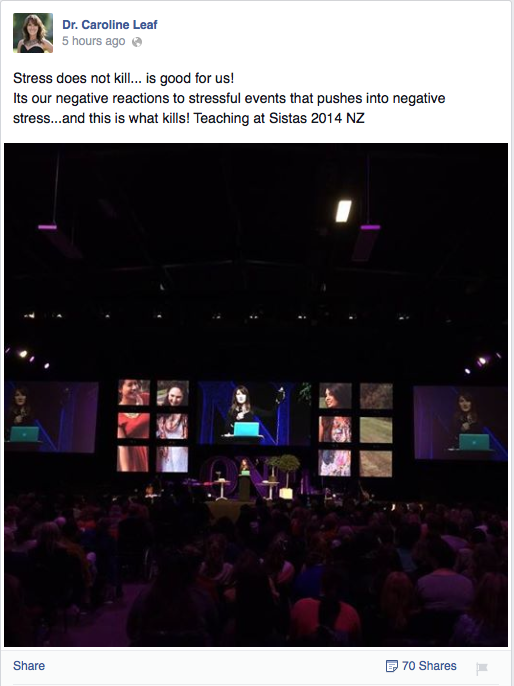
Now in her latest social media update, tucked in amongst the gratuitous selfies and holiday snaps, comes something that’s actually about mental health: “Stress does not kill… is good for us! Its our negative reactions to stressful events that pushes into negative stress…and this is what kills! Sistas 2014 NZ”

The problem for Dr Leaf is that any stress, whether it’s caused by our “negative” reactions or not, doesn’t actually kill us.

There is a phrase used in science, “Correlation does not equal causation”. This simply means that just because two things occur together, one doesn’t necessarily cause the other. For example, do my red watery eyes cause my hives? They always appear together, but they don’t cause each other. The common element that causes both of them is actually the cat that I’ve just patted.

Just because stress is correlated with certain illnesses does not mean that stress causes or contributes to those illnesses. In fact, one of Dr Leafs own pivotal references, an article by Cohen and colleagues in the Journal of the American Medical Association in 2007, discussed the weakness of assuming that stress causes most diseases. As they say, “Although stressors are often associated with illness, the majority of individuals confronted with traumatic events and chronic serious problems remain disease-free.” [3]

Even if it were true that it how we react to stress contributes to the outcome of that stress, Dr Leaf’s statement about our killer reactions incorrectly presumes that both how we cope with stress, and the physical outcome of stress are the result of our choices.

Our levels of stress, and the way we cope with our stress, is mostly caused by our genetics. Some people will be naturally less stressed, and some people will be naturally better at coping with stress (see chapter 5 of my book [4] for a full discussion on the science of resilience). Just because you’re more prone to stress doesn’t mean that it’s all down to your bad choices. Assumptions like these only add to your already high levels of stress.

That’s not to say that we don’t have a way to improve our responses. For those of us at the stressed end of the spectrum, successful psychological therapies such as Acceptance and Commitment Therapy will help to improve our coping, and certainly have been shown to improve (not cure) mental illnesses like anxiety and depression, and other chronic conditions like chronic pain (see [5] for a review).

ACT and other modern psychological therapies recognise that trying to change our thoughts doesn’t make any difference to how we cope. So like I said before, it’s partly true that how we react to normal life experience will help us live full and productive lives, but it’s not about fighting or changing our thoughts. It’s about being mentally flexible enough to make room for our thoughts and fears and move forward towards meaningful action. I’m sure that the ladies at ‘Sistas 2014’ wouldn’t be hearing that from Dr Leaf.

Anyways, I’m glad that Dr Leaf is changing her tune on stress, but there’s still more room for change before she meets up with current scientific understanding.

For an in-depth review of the teachings of Dr Leaf, visit http://www.smashwords.com/books/view/466848 where you can download a free copy of “Hold That Thought: Reappraising the work of Dr Caroline Leaf.

References

  1. Leaf, C., Who Switched Off My Brain? Controlling toxic thoughts and emotions. 2nd ed. 2009, Inprov, Ltd, Southlake, TX, USA:
  2. Leaf, C.M., Switch On Your Brain : The Key to Peak Happiness, Thinking, and Health. 2013, Baker Books, Grand Rapids, Michigan:
  3. Cohen, S., et al., Psychological stress and disease. JAMA: the journal of the American Medical Association, 2007. 298(14): 1685-7
  4. Pitt, C.E., Hold That Thought: Reappraising the work of Dr Caroline Leaf, 2014 Pitt Medical Trust, Brisbane, Australia, URL http://www.smashwords.com/books/view/466848
  5. Harris, R., Embracing Your Demons: an Overview of Acceptance and Commitment Therapy. Psychotherapy In Australia, 2006. 12(6): 1-8 http://www.actmindfully.com.au/upimages/Dr_Russ_Harris_-_A_Non-technical_Overview_of_ACT.pdf

Hold That Thought – Reappraising the work of Dr Caroline Leaf

Hold That Thought Cover

It’s been more than a few late nights in the making, but sixteen months and 68,000 words on, the early release of my new book is now available on line through Smashwords: https://www.smashwords.com/books/view/466848.  Apple iBook, Kindle, and a number of other platforms will come online soon.

Dr Caroline Leaf is a South African communication pathologist and self-titled cognitive neuroscientist, now based in the USA.  This book is an in-depth look at the current scientific understanding of thought, stress, free will and choice, as well as a thorough critique of Dr Leaf’s foundational teachings and the evidence she provides as proof of her hypotheses.

In the coming few days, I will make the text of the book available on this blog as well.  If you have any questions, send them in.  I’m happy to put up a FAQ page.  And as always, I’m happy to answer any legitimate criticism of my work, so long as it’s constructive and evidence based, not personal.

And as always, Dr Leaf herself is welcome to comment.  Indeed, I would value her feedback, and I’m sure any comment she wishes to make would be welcome by the Christian community as a whole.

Dr Caroline Leaf, Dualism, and the Triune Being Hypothesis

Executive Summary

The idea that humans have an immaterial soul, separate to the body, has spanned history and culture. This idea is known as dualism. The concept of the spirit is fundamental to the Christian church. Christians are usually taught that humans are a spirit, having a soul and living in a body (the Triune Being Hypothesis). The concept permeates the work of Dr Caroline Leaf, forming the basis for her assumptions that our minds can control matter.

However, the Bible does not state that the spirit and soul are separate to the body, only that they are linked in the earthly and supernatural realms. Over the last few decades, cognitive neuroscience has demonstrated that definable neural networks within the human brain mediate the components of the traditional soul. Religious belief and spiritual experiences are also heavily reliant on the human brain.

These findings, along with a number of other philosophical objections, prove that dualism is not compatible with science or philosophy. Dr Leaf’s reliance on the concept of dualism creates an intellectual dissonance between her teaching and neuroscience.

The notion that the soul and the spirit are separate to the body is also incorrect. However, quantum physics, and String Theory in particular, suggest that other dimensions and other universes exist, which may provide a scientifically plausible explanation of both natural and supernatural realms. It may be that our earthly body houses our natural spirit and soul within the brain, but that these are translocated to the celestial realm upon death. The challenge for the Christian church now is to unite the evidence of cognitive neuroscience with the description of the spirit, soul and body from scripture and further delineate the doctrine of humans as triune beings.

(Word count: 7256, including references)

Introduction

Are we a body with a mind, or a mind with a body?

It sounds a bit like the age-old chicken and the egg conundrum. In Ancient Greece, Plato proposed that human beings have an immaterial soul distinct from the material body while Descartes reinvigorated the idea in the 17th century. But the idea of the distinct immaterial soul is also found throughout different religions, and seems to be interwoven through the Bible as well.

For Dr Caroline Leaf, Communication Pathologist and self-titled Cognitive Neuroscientist, dualism is fundamental to her theory of “Mind over Matter”. In her 2013 book, “Switch On Your Brain”, Dr Leaf states that, “Our mind is designed to control the body, of which the brain is a part, not the other way around. Matter does not control us; we control matter through our thinking and choosing.” [1: p33] She has also made several similar public statements via her social media feeds, such as, “Don’t blame your physical brain for your decisions and actions. You control your brain!” (6/6/2014) and “Your mind is all powerful! Your brain simply captures what your mind dictates! 2 Timothy 1:7.” (11/5/2014)

I have previously blogged about the scriptural and scientific voracity of Dr Leaf’s various statements on the Mind-Body problem (see also “Dr Caroline Leaf and the Myth of the Blameless Brain“, and others). But when she published, “Your mind will adjust your body’s biology and behaviour to fit with your beliefs” (21/6/2014) I thought enough was enough. The concept of dualism not only permeates the teachings of Dr Leaf, but also significantly influences the current understanding of the Biblical principles of the soul and spirit. So, this topic deserves an in-depth review, to ensure that the thinking within the church aligns with both scripture and science.

The Triune Being Hypothesis

On the 9th of June 2014, Dr Leaf published another meme on her social media feeds, “We are triune beings designed to be lead by the Holy Spirit … who speaks to our spirit. Our spirit controls our soul/mind and our soul/mind controls our body.”

By virtue of growing up in a Christian family, going to a Christian school, and digesting thousands of sermons during my lifetime, I’m very familiar with the concept of humans as a triune being (“triune”, meaning “three in one”). The concept I’ve been taught is similar to Dr Leaf’s view: that humans consist of three separate but interlinked components, the ethereal spirit and soul, and the physical body. The soul, in turn, consists of the mind, will and emotions. The three-part design reflects the image of God who is, of course, a triune being (the Holy Trinity: Father, Son and Holy Spirit). The hypothesis proposes that the body is just an earthly dwelling for a being that is fundamentally spirit in nature, the soul being the intermediary between the two.

In keeping with the theme, this essay will be in three parts! First, I review the Biblical evidence relating to the body, soul and spirit. Second, I review the scientific evidence relating to the spirit and soul. And finally, I discuss how the scriptural and scientific evidence relates to our current understanding of dualism, the triune being hypothesis and the implications for Dr Leaf and Christianity more broadly.

The Bible on the Triune Being Hypothesis

One of the fundamental arguments used by those who support the idea of man as a triune being is the way the Apostle Paul used distinct words to describe body, soul and spirit within the same sentence. For example, in 1 Thessalonians 5:23, Paul wrote, “And the very God of peace sanctify you wholly; and I pray God your whole spirit and soul and body be preserved blameless unto the coming of our Lord Jesus Christ” (emphasis added).

The three words used in ancient Greek were pneuma (‘spirit’), psyche (‘soul’) and soma (‘body’). According to Thayer’s Greek Lexicon, the words pneuma (‘spirit’) and psyche (‘soul’) were often used indiscriminately. So although the Apostle Paul distinctly used the word pneuma separately to the word psyche as in 1 Thessalonians 5:23, most of the other New Testament writers weren’t so precise.

James wrote that without the spirit (pneuma), the body (soma) would die (James 2:26). This also suggests that the spirit is different to the body, but still integral to the whole person, although given the interchangeable use of the terms, James may have also been referring to the soul.

However, Jesus told the disciples in Matthew 10:28, “And fear not them which kill the body (soma), but are not able to kill the soul (psyche): but rather fear him which is able to destroy both soul (psyche) and body (soma) in hell.” This suggests that both the soul and the body maybe found in hell, a post-death spiritual dimension (see also Luke 12:5). So it seems that at least in some form, our supernatural selves also possess a body and mind.

This idea seems to have some backing in the form of the description given in the Bible of the resurrected body of Jesus. After Jesus was crucified and buried, scripture describes the empty tomb, and the multiple sightings of Jesus by the disciples up until the time that he ascended into heaven (Luke 24). He walked along the road to Emmaus with two disciples, Cleopas and probably Cleopas’ wife Mary (see also John 19:25). He then appeared in the middle of the group of disciples within an instant. He still possessed the defects caused by the crucifixion. He ate some broiled fish and some honeycomb (see Luke 24:42-43). He said to the disciples at this meeting with them, “Behold my hands and my feet, that it is I myself: handle me, and see; for a spirit hath not flesh and bones, as ye see me have.” (Luke 24:39) Not only did he have the same physical characteristics as his pre-resurrected body (same appearance, same gender etc), but he also had similar mental traits, such as self-awareness, memory of his pre-resurrection life, and emotions and connection to the people around him. However, he was not subject to the natural laws of physics, twice suddenly appearing in a closed room (John 20:19 and 26).

Therefore it appears that rather than being a spirit housed in a body and furnished with a soul, we are instead an inseparable combination of body, soul and spirit – three unique but indivisible parts – but in different dimensions depending on which side of eternity we currently reside.

1 Thessalonians 5:23 confirms, rather than precludes, this view. Reviewing the scripture again, Paul wrote, “And the very God of peace sanctify you wholly; and I pray God your whole spirit and soul and body be preserved blameless unto the coming of our Lord Jesus Christ.” Paul chooses to emphasize all three components of our triune being equally in his prayers and wishes. If only our spirit was to pass into the celestial realm, then Paul wouldn’t have needed to delineate the three parts of our triune composition, but could have instead written “And the very God of peace sanctify you wholly; and I pray God your whole spirit be preserved blameless unto the coming of our Lord Jesus Christ”. By penning, “whole spirit and soul and body be preserved blameless”, Paul seems to treat all three parts as equally important to our future with Christ.

It follows that if we believe that our heavenly body is an integral part with our spirit and soul on the celestial side of eternity, then it should follow that our spirit and our soul are part of, and dependent on, our earthly body on this side of eternity.

This proposal differs from the conventional wisdom at two fundamental points:

1. I suggest that the spirit is integral to, and dependent on our earthly body whilst we live on the earth,
and
2. I suggest that the whole person is translated across from the earthly realm to the celestial, rather than just the spirit.

Such suggestions are compatible with current scientific understanding. There is ample evidence of spiritual neural networks that complement the emotional and moral parts of our brain (this will be discussed further in a future section).

String Theory provides a plausible explanation of other dimensions and worlds in parallel with our own which could very easily explain a spiritual dimension. String Theory is the theory that the very fabric of the cosmos is made up of tiny vibrating loops of energy, which physicists call “strings”. These strings are almost impossibly small. Physicist Brian Greene said that, “Each of these strings is unimaginably small. In fact, if an atom were enlarged to the size of the solar system, a string would only be as large as a tree!” [2] It’s the shape and vibrational pattern of each of these strings that gives subatomic particles their properties, which in turn combine to make up everything we see in the universe, including ourselves.

In order for these strings to vibrate and move the way they are predicted to, String Theory postulates that there are actually 11 dimensions of space. In one of these dimensions, a string could become stretched out into a membrane, or a “brane” for short. I’ll let Brian Greene and colleagues explain it further.

BRIAN GREENE: The existence of giant membranes and extra dimensions would open up a startling new possibility, that our whole universe is living on a membrane, inside a much larger, higher dimensional space. It’s almost as if we were living inside … a loaf of bread? Our universe might be like a slice of bread, just one slice, in a much larger loaf that physicists sometimes call the “bulk.” And if these ideas are right, the bulk may have other slices, other universes, that are right next to ours, in effect, “parallel” universes. Not only would our universe be nothing special, but we could have a lot of neighbours. Some of them could resemble our universe, they might have matter and planets and, who knows, maybe even beings of a sort. Others certainly would be a lot stranger. They might be ruled by completely different laws of physics. Now, all of these other universes would exist within the extra dimensions of M-theory, dimensions that are all around us. Some even say they might be right next to us, less than a millimetre away. But if that’s true, why can’t I see them or touch them?
BURT OVRUT: If you have a brane living in a higher dimensional space, and your particles, your atoms, cannot get off the brane, it’s like trying to reach out, but you can’t touch anything. It might as well be on the other end of the universe.
JOSEPH LYKKEN: It’s a very powerful idea because if it’s right it means that our whole picture of the universe is clouded by the fact that we’re trapped on just a tiny slice of the higher dimensional universe.” [3]

Although it sounds preposterous, String Theory isn’t a fantasy of a few physicists who have watched too many sci-fi shows. String Theory is mathematically proven, and accepted by the majority of scientists.

What if our physical reality was one brane, the supernatural realm was a different brane, and heaven was another? Angels could be all around us, in a different dimension of space that we cannot ordinarily perceive, but who have the ability to move into our dimension if required. When we die, it’s possible that our whole person is transformed into a different dimension – the supernatural or celestial brane. The physical body remains like a snakeskin left after the snake has shed it.

My theory is only one of many possible theories. Ultimately, they all remain scientifically unprovable. While String Theory is well accepted by physicists all over the world, and the predictions of extra dimensions and branes are mathematically robust, my hypothesis that the supernatural realm is a dimension of space on a brane is conjecture, and would be impossible to test mathematically or scientifically. The concept of extra dimensions and branes is one way of explaining the Bible’s description that our spirit, soul and body remain together, but in a different realm to the physical reality that we currently experience.

Science on the Triune Being Hypothesis

So if it’s possible that we can live as a whole person, spirit, soul and body, in a celestial dimension, what makes up our spirit, soul and body in the physical dimension?

Biological science and neuroscience have uncovered many of the previously mysterious qualities that define us as human beings, although there is still much more to be uncovered.

  1. THE BODY

The body is our physical selves – our flesh and blood, sealed by our coating of skin. The body is so ultimately universal, I don’t want to waste space justifying the case for the normal. The obvious physical separation makes each person easy to delineate, although there are rare exceptions that challenge the division of body and soul/spirit.

In May 2014, Faith and Hope Howie were born in Sydney (Australia) [4]. They were born with two separate faces and two brains which merged into one brain stem. They had one body. While they were considered to be conjoined twins, in the strictest medical sense, they had a condition called disrosopus, resulting from the over-expression of a protein involved in the formation of the cranial structures [5]. The condition is extremely rare, and most children with the condition are either stillborn, or don’t survive for more than 24 hours after birth. That Faith and Hope survived for 19 days is a miracle in itself.

Strictly speaking, Faith and Hope were one baby that developed two brains, rather than being twins who failed to adequately separate. So did they have two souls or one? I don’t propose to answer this question here, but it will be worth pondering as we review the concept of the soul.

  1. THE SOUL

The soul is traditionally considered to consist of the mind, will and emotions. In the earthly realm, there is overwhelming evidence that all the parts of the traditional soul are found in the human brain.

a. The Mind

The mind is considered to be “a person’s ability to think and reason; the intellect.” [6] As we will discuss in more detail later, dualism suggests that the mind is an ethereal force separate to the body. But modern neuroscience has accumulated decades of evidence to the contrary. Our stream of consciousness is linked to the function of our working memory [7, 8]. Working memory in turn is heavily dependent on the part of the brain called the pre-frontal cortex and on a neurotransmitter called dopamine [9]. When dopamine-secreting nerve cells are damaged in the pre-frontal cortex, conditions involving disordered thought such as schizophrenia occur [9, 10]. Schizophrenia is best known for hallucinations, essentially hearing and/or seeing things that are not there. These symptoms are reversed by medications that enhance the dopamine response [11]. Lesions of the frontal lobe can also result in the loss of abstract thinking [9]. So it is fair to say that the function of the mind is dependent on the brain, specifically the pre-frontal cortex. If the function of the pre-frontal cortex is disrupted, either by damage to a group of cells, or by impairment of the signaling of those cells via disruption of the neurotransmitter dopamine, the patterns of thought change. These changes in the patterns of thought can be reversed if the impairment can be reversed. Therefore the mind is dependent on the brain. If the mind were independent of the brain, then the function of the mind would not be affected by damage or impairment to the physical brain.

Our stream of thought is a function of our working memory utilizing a wider area of the brains cortex to better process important information. Baars [7, 12] noted that the conscious broadcast comes into working memory which then engages a wider area of the cerebral cortex necessary to most efficiently process the information signal.

We perceive thought most commonly as either pictures or sounds in our head (“the inner monologue”), which corresponds to the slave systems of working memory. When you “see” an image in your mind, that’s the visuospatial sketchpad. When you listen to your inner monologue, that’s your phonological loop. When a song gets stuck in your head, that’s your phonological loop as well, but on repeat mode.

There is another slave system that Baddeley included in his model of working memory called the episodic buffer, “which binds together complex information from multiple sources and modalities. Together with the ability to create and manipulate novel representations, it creates a mental modeling space that enables the consideration of possible outcomes, hence providing the basis for planning future action.” [13]

Deep thinking is a projection from your brains executive systems (attention or the default mode network) to the central executive of working memory, which then recalls the relevant information from long-term memory and directs the information through the various parts of the slave systems of working memory to process the complex details involved. For example, visualizing a complex scene of a mountain stream in your mind would involve the executive brain directing the central executive of working memory to recall information about mountains and streams and associated details, and project them into the visuospatial sketchpad and phonological loop and combine them via the episodic buffer. The episodic buffer could also manipulate the scene if required to create plans, or think about the scene in new or unexpected ways (like imagining an elephant riding a bicycle along the riverbank).

Even though the scene appears as one continuous episode, it is actually broken up into multiple cognitive cycles, in the same way that images in a movie appear to be moving, but are really just multiple still frames played in sequence.

So our mind, also called our stream of thought, is simply a projection of information from our working memory, broadcast to our cerebral cortex, and our consciousness, for extra processing power. It is dependent on our pre-frontal cortex. When the pre-frontal cortex is damaged, our mind can experience defective output, as is the case in thought disorders such as schizophrenia.

b. The Will

The second part of our soul is our will, “the faculty by which a person decides on and initiates action.” [6] Like our mind, the feeling that we have free will is a ubiquitous human trait. Haggard observed, “Most adult humans have a strong feeling of voluntary control over their actions, and of acting ‘as they choose’. The capacity for voluntary action is so fundamental to our existence that social constraints on it, such as imprisonment and prohibition of certain actions, are carefully justified and heavily regulated.” [14]

Again, like the mind, our feeling of our will comes from our brain. Over three decades ago, Libet performed an experiment that demonstrated measurable neural activity occurring up to a full second before a test subject was consciously aware of the intention to act [15]. More recently, a study by Soon et al showed that predictable brain activity occurred up to eight seconds before a person was aware of their intention to act [16].  Haggard again, “Modern neuroscience rejects the traditional dualist view of volition as a causal chain from the conscious mind or ‘soul’ to the brain and body. Rather, volition involves brain networks making a series of complex, open decisions between alternative actions.” [14]

These brain networks initially involve the basal ganglia deep in the brain along with the dopamine rewards system, which provide a flexible interaction between the person’s current situation and the memory of previous similar situations. Also important are the frontal lobes in general, and the pre-Supplementary Motor Area (pre-SMA) in particular, which have crucial roles in keeping actions focused and ‘on task’, or in “binding intention and action”. Parts of the pre-SMA are also active in voluntary selection between alternative tasks and in switching between the selections. An area of the anterior frontomedian cortex, near the pre-SMA, was activated in veto trials more than in trials on which participants made an action. This brain activity might have a key role in self-control [14].

Damage to different areas of the frontal cortex and the other parts of the motor system can result in a number of different conditions, highlighting the role of the brain in our “voluntary” actions. For example, blockage of a small artery in the brain called the artery of Huebner may cause a stroke of the head of the Caudate Nucleus, resulting in the loss of voluntary movement, loss of motivation and loss of speech [17]. Psychosis and ADHD are also disorders of action output of the brain, both of which improve with medications that improve the function of the frontal lobes of the brain. In children with ADHD, the change can be dramatic in a short space of time, and research across the last few decades proves the effect is more than placebo [18, 19].

The feelings of intention and the sense of agency (planning to do or being about to do something, and the sense that one’s action has indeed caused a particular external event) are so fundamental to human experience that it’s hard to consider the alternative: that our ‘free will’ is by-and-large an illusion. Our brain has already reviewed a number of alternative actions for any particular situation, and by the time that our consciousness becomes aware of the decision our brain has made, our motor area of our brain has already primed the neuromuscular circuit in preparation to perform the action. At best, our ‘free will’ is more like a veto function rather than a full conscious control of our behaviour [20]. Multiple parts of our brain are involved in the planning and execution of our actions, especially the basal ganglia and the pre-SMA.

c. The Emotions

Emotions are a difficult concept to define. Despite being studied as a concept for more than a century, the definition of what constitutes an emotion remains elusive. Some academics and researchers believe that the term is so ambiguous that it’s useless to science and should be discarded [21]. I use a concept of emotions described by Dr Alan Watkins [22], which thinks of our emotional state as the sum total of the state of our different physiological systems, while feelings are the awareness, or the perception of our emotional state. However, I should stress that this is only one concept. Often the terms “emotion” and “feelings” are used interchangeably.

That said, neurobiology has still mapped specific feelings/emotions to different parts of the brain. The amygdala is often considered the seat of our fears, the anterior insula is responsible for the feeling of disgust, and the orbitofrontal and anterior cingulate cortex are involved in a broad range of different emotions [23].

Different moods have been linked to specific neurotransmitter systems in the physical brain. A predisposition to anxiety is often linked to variations in the genes for serotonin transport [24] while positive and negative affect (“joy / sadness”) are linked to the dopaminergic system [25].

What is clear is that scientifically speaking, our emotions and the perception of them is dependent on our physical brain.

Summarizing the Soul

Dualism’s view that the soul is an ethereal force separate to the body is redundant. The evidence from the scientific study of the brain makes it clear that every aspect of the traditional ‘soul’ – the mind, will and emotions – is housed in the brain.

3. THE SPIRIT

The scientific study of spirituality is on the leading edge of scientific progress.

Whether a spiritual realm exists is not something that can be tested scientifically. I’ve discussed the Biblical view of the triune being hypothesis earlier in this essay, and suggested that a spiritual realm is at least scientifically plausible depending on your interpretation of String Theory. Ultimately, it remains a matter of faith.

The existence of the spiritual realm may be debatable, but what’s well accepted is that human beings are fundamentally spiritual. Spiritual or mystical experiences are reported across all cultures [26], and throughout history, religions in various forms have spanned the globe, integral to civilizations and the forming of cultural identity. It’s therefore not surprising to find that the brain is a focal point for spiritual experience. Just as hunger, laughter, anger and many other characteristic human traits have their own unique pathways in the brain, so does the experience of the divine.

Spirituality can be defined as “an individual’s experience of and relationship with a fundamental, nonmaterial aspect of the universe that may be referred to in many ways – God, Higher Power, the Force, Mystery and the Transcendent and forms the way by which an individual finds meaning and relates to life, the universe and everything.” [27] On consideration, spirituality encompasses both episodic mystical experiences and ongoing religious beliefs.

Spiritual experiences involve multiple brain regions, and are mediated by a number of different neurotransmitters. In a study of Carmelite Nuns reliving a spiritual experience, Beauregard and Paquette observed activation of the right medial orbitofrontal cortex, the right medial prefrontal cortex, the right dorsal anterior cingulate cortex, the right middle temporal cortex and the left superior and inferior parietal lobes [26]. There is also evidence that dopamine and serotonin are important neurotransmitters in the religious experience [27]. More recent work on the function and connectivity of the medial orbitofrontal cortex shows all of these brain regions have strong connections to each other [28], and that together they function to encode and determine the predicted and real values of our choices. In particular, the medial orbitofrontal cortex helps to encode the anticipated rewards of incoming stimuli. The anticipated and actual values for the perceived stimuli are compared to give a prediction error, which serves as a teaching signal that can be used to improve future value assignments at the time of decision-making [29]. This is intrinsically linked to the limbic rewards system via dopamine, which partially explains the increase in dopamine during intense religious experiences.

Yet spiritual experiences are more than the rewards processing of incoming stimuli. Intense religious experiences have been reported during the aura of temporal lobe epilepsy, especially on the right side [27, 30]. It maybe that the right temporal lobe is largely responsible for the sensed presence of a higher being, and for the more intense religious experiences. Some scientists even went so far as to claim that complex weak magnetic stimulation of the right temporal cortex produced intense religious experiences [31], although this maybe more related to the suggestibility of the subjects rather than the temporal lobe “stimulation” [32]. Therefore, while it is likely that the right temporal lobe is involved in experiences of spirituality, there is no lab-based repeatable evidence to confirm or delineate it.

However, the cognitive and neuroanatomical correlates of religious belief have been delineated. Kapogiannis and colleagues summarized their work by stating that, “religious belief engages well-known brain networks performing abstract semantic processing, imagery, and intent-related and emotional theory of mind, processes known to occur at both implicit and explicit levels. Moreover, the process of adopting religious beliefs depends on cognitive-emotional interactions within the anterior insulae, particularly among religious subjects. The findings support the view that religiosity is integrated in cognitive processes and brain networks used in social cognition, rather than being sui generis.” [33]

If spirituality is indeed solely based on the structure and function of the human brain, what are the implications for organized religion?

To start with, it would mean that those with deficits in certain cognitive functions would experience spirituality to a lesser degree, or at least experience it to a different degree. In keeping with this hypothesis, Canadian researchers have shown that those people with mentalization deficits (reduction in the ability to understand the mental state of oneself and others which underlies overt behaviour), such as people on the Autism spectrum, are less likely to believe in a personal God [34]. On the flipside, other people would be naturally wired to the divine: intuitive and sensitive to the experience of the spiritual.

Moreover, even if a person is not naturally spiritual, one can train oneself to become more spiritual. The brain increases the neural connections within regions that are recurrently stimulated, which leads to expertise. For example, the mid-posterior hippocampus of London taxi drivers is much larger compared to London bus drivers. London taxi drivers are required to drive anywhere in London without maps, and so develop a much larger region of spatial knowledge than the bus drivers, who drive pre-determined routes [35]. Similarly, novices who meditate show increased growth of neural networks involved in the regulation of emotion [36]. It would follow that brain regions involved in the processing of spiritual experience would increase with regular spiritual practice, resulting in a greater sense of the presence of God and his joy.

On the other hand, if acceptance of God is dependent on the function of certain networks within our brain, then how does that affect the foundational principle of salvation? Is it justice if one is condemned to eternal damnation when one has less capacity to believe in the first place?

I cannot offer a definitive answer to that question. Maybe there is no definitive answer? Given that Jesus told Nicodemus, “For God sent not his Son into the world to condemn the world; but that the world through him might be saved” (John 3:17), and that Peter says about God, “The Lord is not slow in keeping his promise, as some understand slowness. Instead he is patient with you, not wanting anyone to perish, but everyone to come to repentance” (2 Peter 3:9), I trust that God will judge everyone fairly, but I’m not sure how the capacity of a person to accept salvation is judged. Perhaps that’s something that someone who’s theologically trained can comment on.

The Triune Being Hypothesis – A New Approach

In summary, while the Bible makes a distinction between body, soul and spirit, it maintains that they are inseparable parts of the same whole person. In the earthly realm, our spirit and the various aspects that traditionally constitute our soul are all enabled though various networks within our physical brain. The Bible also offers evidence that in the transition from the terrestrial to the celestial dimensions, the whole person is translocated and transformed, not just the spirit or soul. Like a reptile shedding its skin, our earthly body and brain remain after death but the person has been translocated into the celestial realm.

Dualism

Psychoneural or Cartesian dualism is the premise that matter and mind are distinct entities or substances; that the one can exist without the other; and that they may interact, but that neither can help explain the other.

Dualism appears self-evident. It seems to explain behavior; and it accounts for the survival of the soul after death. Our mind and our body also appear separate. We have direct knowledge of our mental states, but we do not have direct knowledge of our brain states, so by simple logic, our mental states are not identical with our brain states. Dualism seems to be the obvious model of choice.

Despite claiming to be a cognitive neuroscientist, Dr Leaf embraces dualism, expanding the original concept of a soul into the broader idea of the soul and spirit of the triune being hypothesis, complete with its own hierarchy, “We are triune beings designed to be lead by the Holy Spirit … who speaks to our spirit. Our spirit controls our soul/mind and our soul/mind controls our body.” (Dr Leaf social media post, 9/6/2014)

However, we know that executive functions, emotions and even spiritual experiences can be induced or improved by stimulating the responsible brain networks (electrically in the lab, or with medications). And pathological changes to the brain, such as tumours, strokes, or brain injuries, all have the capacity to change the emotional or cognitive function of the sufferer, depending on the location of the lesion within the brain. If the mind were truly separate to the brain, then changes to the physical brain would not influence the mind or soul. Therefore, medicine and cognitive neuroscience have shown that dualism is false.

Philosophically, dualism is also fatally flawed. According to Bunge [37], dualism fails on a number of counts:

1. Dualism is conceptually fuzzy: “the expression ‘mind-body interaction’ is an oxymoron because, by hypothesis, the immaterial mind is impregnable to physical stimuli, just as matter cannot be directly affected by thoughts or emotions. The very concept of an action is well defined only with reference to material things.”
2. Dualism is experimentally irrefutable: “since one cannot manipulate a nonmaterial thing, as the soul or mind is assumed to be, with material implements, such as lancets and pills.”
3. Dualism considers only the adult mind: “Hence it is inconsistent with developmental psychology, which shows how cognitive, emotional and social abilities develop (grow and decay) along with the brain and the individual’s social context.”
4. Dualism is inconsistent with cognitive ethology: “in particular primatology … comparative psychology and cognitive archaeology”.
5. Dualism violates physics: “in particular the law of conservation of energy. For instance, energy would be created if a decision to take a walk were an event in the nonmaterial soul. Moreover, dualism is inconsistent with the naturalistic ontology that underpins all of the factual sciences.”
6. Dualism confuses even investigators who are contributing to its demise: “in the cognitive, affective and social neuroscience literature one often reads sentences of the forms ‘N is the neural substratum (or correlate) of mental function M,’ and ‘Organ O subserves (or mediates, or instantiates) mental function M’ – as if functions were accidentally attached to organs, or were even prior to them, and organs were means in the service of functions … Why not say simply that the brain feels, emotes, cognizes, intends, plans, wills, and so on? Talk of substratum, correlate, subservience and mediation is just a relic of dualism, and it fosters the idea (functionalism) that what matters is function, which can be studied independently of stuff. But there is neither walking without legs nor breathing without lungs. In general, there is neither function without organ nor organ without functions.”
7. Dualism isolates psychology from most other disciplines: “insofar as none of them admits the stuff/function dichotomy.”
8. Dualism is barren at best, and counterproductive at worst, “In fact, it has spawn superstitions and pseudosciences galore … (and) has slowed down the progress of all the disciplines dealing with the mind.”

Bunge sums up the concept of dualism, “In short, psychoneural dualism is scientifically and philosophically untenable. Worse, it continues to be a major obstacle to the scientific investigation of the mind, as well as to the medical treatment of mental disorders.”

In short, dualism is dead.

Dualism and Dr Leaf

This damning evaluation of dualism poses significant ongoing problems for Dr Leaf and her teaching. Her proposition that “Our spirit controls our soul/mind and our soul/mind controls our body” is not supported by either science or by scripture. This significantly weakens her standing as a biblical and scientific authority, and highlights an intellectual dissonance between science, scripture, and her published work.

Unless Dr Leaf is prepared to review her position and change her teaching on the subject, the gap between her teaching and the accepted scientific position will only continue to widen, and her authority and respect will continue to weaken.

The New Triune Being Hypothesis and the Christian Church

For the Christian church, the Triune Being Hypothesis in its current form is now redundant. The review of the biblical evidence, and the current evidence from neuroscience, has disproven the triune being hypothesis insofar as there is no Biblical or scientific proof that the spirit, soul and body are separate entities. However, it’s reasonable to consider the spirit, soul and body as inseparable parts of the whole being, which are translocated together into the celestial realm upon death.

At the very least, the position of the Christian church on the nature of the soul/spirit requires review, and topic should be brought back to the table to be appropriately debated. It’s clear that the old, generally accepted hypothesis of the separate, immaterial soul/spirit is untenable with current scientific evidence. In this essay, I have proposed one theory which is at least plausible with current scientific understanding. However, there are many other theories that may be just as valid, and warrant consideration.

It’s my hope that with academic honesty and divine guidance, the truth of our triune nature can be further delineated.

References

  1. Leaf, C.M., Switch On Your Brain : The Key to Peak Happiness, Thinking, and Health. 2013, Baker Books, Grand Rapids, Michigan:
  2. Greene, B. The Elegant Universe: Part 2. [Transcript] 2003 [cited 2013, November 4]; Available from: http://www.pbs.org/wgbh/nova/physics/elegant-universe.html – elegant-universe-string.
  3. Greene, B. The Elegant Universe: Part 3. [Transcript] 2003 [cited 2014, June 28]; Available from: http://www.pbs.org/wgbh/nova/physics/elegant-universe.html – elegant-universe-dimensions.
  4. Lyons, K. and Mills, D., ‘Gone to play with the angels’: Conjoined twins Faith and Hope are laid to rest after family’s tearful memorial service in Sydney. Daily Mail, UK, 2014 June 2 http://www.dailymail.co.uk/news/article-2645824/Gone-play-angels-Faith-trying-attention-Hope-happy-just-hold-finger-rest-Family-conjoined-twins-pay-tearful-tributes-Sydney-memorial-service.html
  5. Zaghloul, N.A. and Brugmann, S.A., The emerging face of primary cilia. Genesis, 2011. 49(4): 231-46 doi: 10.1002/dvg.20728
  6. Oxford Dictionary of English – 3rd Edition, 2010, Oxford University Press: Oxford, UK.
  7. Baars, B.J. and Franklin, S., How conscious experience and working memory interact. Trends Cogn Sci, 2003. 7(4): 166-72 http://www.ncbi.nlm.nih.gov/pubmed/12691765 ; http://bit.ly/1a3ytQT
  8. Franklin, S., et al., Conceptual Commitments of the LIDA Model of Cognition. Journal of Artificial General Intelligence, 2013. 4(2): 1-22
  9. Arnsten, A.F., The neurobiology of thought: the groundbreaking discoveries of Patricia Goldman-Rakic 1937-2003. Cereb Cortex, 2013. 23(10): 2269-81 doi: 10.1093/cercor/bht195
  10. Goghari, V.M., et al., The functional neuroanatomy of symptom dimensions in schizophrenia: a qualitative and quantitative review of a persistent question. Neurosci Biobehav Rev, 2010. 34(3): 468-86 doi: 10.1016/j.neubiorev.2009.09.004
  11. Melnik, T., et al., Efficacy and safety of atypical antipsychotic drugs (quetiapine, risperidone, aripiprazole and paliperidone) compared with placebo or typical antipsychotic drugs for treating refractory schizophrenia: overview of systematic reviews. Sao Paulo Medical Journal, 2010. 128: 141-66 http://www.scielo.br/scielo.php?script=sci_arttext&pid=S1516-31802010000300007&nrm=iso
  12. Baars, B.J., Global workspace theory of consciousness: toward a cognitive neuroscience of human experience. Progress in brain research, 2005. 150: 45-53
  13. Repovs, G. and Baddeley, A., The multi-component model of working memory: explorations in experimental cognitive psychology. Neuroscience, 2006. 139(1): 5-21 doi: 10.1016/j.neuroscience.2005.12.061
  14. Haggard, P., Human volition: towards a neuroscience of will. Nat Rev Neurosci, 2008. 9(12): 934-46 doi: 10.1038/nrn2497
  15. Libet, B., et al., Time of conscious intention to act in relation to onset of cerebral activity (readiness-potential). The unconscious initiation of a freely voluntary act. Brain, 1983. 106 (Pt 3): 623-42 http://www.ncbi.nlm.nih.gov/pubmed/6640273
  16. Soon, C.S., et al., Unconscious determinants of free decisions in the human brain. Nat Neurosci, 2008. 11(5): 543-5 doi: 10.1038/nn.2112
  17. Espay, A.J. Frontal Lobe Syndromes. Medscape eMedicine 2012 [cited 2014, July 1]; Available from: http://emedicine.medscape.com/article/1135866-clinical – showall.
  18. Castells, X., et al., Amphetamines for Attention Deficit Hyperactivity Disorder (ADHD) in adults. Cochrane Database Syst Rev, 2011(6): CD007813 doi: 10.1002/14651858.CD007813.pub2
  19. Hodgkins, P., et al., The Pharmacology and Clinical Outcomes of Amphetamines to Treat ADHD. CNS drugs, 2012. 26(3): 245-68
  20. Bonn, G.B., Re-conceptualizing free will for the 21st century: acting independently with a limited role for consciousness. Front Psychol, 2013. 4: 920 doi: 10.3389/fpsyg.2013.00920
  21. Dixon, T., “Emotion”: The History of a Keyword in Crisis. Emot Rev, 2012. 4(4): 338-44 doi: 10.1177/1754073912445814
  22. Watkins, A. Being brilliant every single day – Part 1. 2012 [cited 2 March 2012]; Available from: http://www.youtube.com/watch?v=q06YIWCR2Js.
  23. Tamietto, M. and de Gelder, B., Neural bases of the non-conscious perception of emotional signals. Nat Rev Neurosci, 2010. 11(10): 697-709 doi: 10.1038/nrn2889
  24. Caspi, A., et al., Genetic sensitivity to the environment: the case of the serotonin transporter gene and its implications for studying complex diseases and traits. Am J Psychiatry, 2010. 167(5): 509-27 doi: 10.1176/appi.ajp.2010.09101452
  25. Felten, A., et al., Genetically determined dopamine availability predicts disposition for depression. Brain Behav, 2011. 1(2): 109-18 doi: 10.1002/brb3.20
  26. Beauregard, M. and Paquette, V., Neural correlates of a mystical experience in Carmelite nuns. Neurosci Lett, 2006. 405(3): 186-90 doi: 10.1016/j.neulet.2006.06.060
  27. Mohandas, E., Neurobiology of spirituality. Mens Sana Monogr, 2008. 6(1): 63-80 doi: 10.4103/0973-1229.33001
  28. Kahnt, T., et al., Connectivity-based parcellation of the human orbitofrontal cortex. J Neurosci, 2012. 32(18): 6240-50 doi: 10.1523/JNEUROSCI.0257-12.2012
  29. Plassmann, H., et al., Appetitive and aversive goal values are encoded in the medial orbitofrontal cortex at the time of decision making. J Neurosci, 2010. 30(32): 10799-808 doi: 10.1523/JNEUROSCI.0788-10.2010
  30. Devinsky, O. and Lai, G., Spirituality and religion in epilepsy. Epilepsy Behav, 2008. 12(4): 636-43 doi: 10.1016/j.yebeh.2007.11.011
  31. Persinger, M.A., et al., The electromagnetic induction of mystical and altered states within the laboratory. Journal of Consciousness Exploration & Research, 2010. 1(7)
  32. Granqvist, P., et al., Sensed presence and mystical experiences are predicted by suggestibility, not by the application of transcranial weak complex magnetic fields. Neurosci Lett, 2005. 379(1): 1-6 http://www.ncbi.nlm.nih.gov/pubmed/15849873
  33. Kapogiannis, D., et al., Cognitive and neural foundations of religious belief. Proc Natl Acad Sci U S A, 2009. 106(12): 4876-81 doi: 10.1073/pnas.0811717106
  34. Norenzayan, A., et al., Mentalizing deficits constrain belief in a personal God. PLoS One, 2012. 7(5): e36880 doi: 10.1371/journal.pone.0036880
  35. Maguire, E.A., et al., London taxi drivers and bus drivers: a structural MRI and neuropsychological analysis. Hippocampus, 2006. 16(12): 1091-101 doi: 10.1002/hipo.20233
  36. Holzel, B.K., et al., Mindfulness practice leads to increases in regional brain gray matter density. Psychiatry Res, 2011. 191(1): 36-43 doi: 10.1016/j.pscychresns.2010.08.006
  37. Bunge, M., The Mind-Body Problem, in Matter and Mind. 2010, Springer Netherlands. p. 143-57.

Postscript: There is a lot more to String Theory, and anyone interested in knowing more would be well served by reviewing the transcripts or watching the PBS series “The Elegant Universe”, hosted by Brian Greene.

Dr Caroline Leaf and the 98 Percent Myth

Dr Caroline Leaf believes that nearly all our diseases come from our thoughts.

Dr Caroline Leaf believes that nearly all our diseases come from our thoughts.

In the hustle and bustle of daily life, most people wouldn’t stop to consider what makes people sick.  In my profession, I get a front row seat.

In the average week, I get to see a number of different things.  Mostly “coughs, colds and sore holes” as the saying goes, although there are some rarer things too.  And sometimes, people present with problems that aren’t for the faint of heart (or stomach – beware of nail guns is all I can say).

Normally, the statistics of who comes in with what doesn’t make it beyond the desk of the academic or health bureaucrat.  The numbers aren’t as important as the people they represent.

But to Dr Caroline Leaf, Communication Pathologist and self-titled Cognitive Neuroscientist, the numbers are all important.  To support her theory of toxic thoughts, Dr Leaf has stated that “75 to 98% of mental and physical (and behavioural) illness comes from one’s thought life” [1: p37-38].  She has repeated that statement on her website, on Facebook, and at seminars.

As someone with a front row seat to the illnesses people have, I found such a statement perplexing.  In the average week, I don’t see anywhere near that number.  In general practices around Australia, the number of presentations for psychological illnesses is only about eight percent [2].

But Australian general practice is a small portion of medicine compared to the world’s total health burden.  Perhaps the global picture might be different?  The World Health Organization, the global authority on global health, published statistics in November 2013 on the global DALY statistics [3] (a DALY is a Disability Adjusted Life Year).  According to the WHO, all Mental and Behavioural Disorders accounted for only 7.2% of the global disease burden.

You don’t need a statistics degree to know that seven percent is a long way from seventy-five percent (and even further from 98%).

Perhaps a large portion of the other ninety-three percent of disease that was classified as physical disease was really caused by toxic thoughts?  Is that possible?  In short: No.

When considered in the global and historical context, the vast majority of illness is related to preventable diseases that are so rare in the modern western world because of generations of high quality public health and medical care.

In a recent peer-reviewed publication, Mara et al state, “At any given time close to half of the urban populations of Africa, Asia, and Latin America have a disease associated with poor sanitation, hygiene, and water.” [4] Bartram and Cairncross write that “While rarely discussed alongside the ‘big three’ attention-seekers of the international public health community—HIV/AIDS, tuberculosis, and malaria—one disease alone kills more young children each year than all three combined. It is diarrhoea, and the key to its control is hygiene, sanitation, and water.” [5] Hunter et al state that, “diarrhoeal disease is the second most common contributor to the disease burden in developing countries (as measured by disability-adjusted life years (DALYs)), and poor-quality drinking water is an important risk factor for diarrhoea.” [6]

Diarrhoeal disease in the developing world – the second most common contributor to disease in these countries, afflicting half of their population – has nothing to do with thought.  It’s related to the provision of toilets and clean running water.

We live in a society that prevents half of our illnesses because of internal plumbing.  Thoughts seem to significantly contribute to disease because most of our potential illness is prevented by our clean water and sewerage systems.  Remove those factors and thought would no longer appear to be so significant.

In the same manner, modern medicine has become so good at preventing diseases that thought may seem to be a major contributor, when in actual fact, most of the work in keeping us all alive has nothing to do with our own thought processes.  Like sanitation and clean water, the population wide practices of vaccination, and health screening such as pap smears, have also significantly reduced the impact of preventable disease.

Around the world, “Recent estimates of the global incidence of disease suggest that communicable diseases account for approximately 19% of global deaths” and that “2.5 million deaths of children annually (are) from vaccine-preventable diseases.” [7] Again, that’s a lot of deaths that are not related to thought life.

Since 1932, vaccinations in Australia have reduced the death rate from vaccine-preventable diseases by 99% [8].  Epidemiological evidence shows that when vaccine rates increase, sickness from communicable diseases decrease [9: Fig 2, p52 & Fig 8, p67].

Population based screening has also lead to a reduction in disease and death, especially in the case of population screening by pap smears for cervical cancer.  Canadian public health has some of the best historical figures on pap smear screening and cervical cancer. In Canada, as the population rate of pap smear screening increased, the death rate of women from cervical cancer decreased.  Overall, pap smear screening decreased the death rate from cervical cancer by 83%, from a peak of 13.5/100,000 in 1952 to only 2.2/100,000 in 2006, despite an increase in the population and at-risk behaviours for HPV infection (the major risk factor for cervical cancer) [10].

And around the world, the other major cause of preventable death is death in childbirth.  The risk of a woman dying in childbirth is a staggering one in six for countries like Afghanistan [11] which is the same as your odds playing Russian Roulette.  That’s compared to a maternal death rate of one in 30,000 in countries like Sweden.  The marked disparity is not related to the thought life of Afghani women in labour.  Countries that have a low maternal death rate all have professional midwifery care at birth.  Further improvements occur because of better access to hospital care, use of antibiotics, better surgical techniques, and universal access to the health system [11].  Again, unless one’s thought life directly changes the odds of a midwife appearing to help you deliver your baby, toxic thoughts are irrelevant as a cause of illness and death.

Unfortunately for Dr Leaf, her statement that “75 to 98 percent of mental, physical and behavioural illnesses come from toxic thoughts” is a myth, a gross exaggeration of the association of stress and illness.

In the global and historical context of human health, the majority of illness is caused by infectious disease, driven by a lack of infrastructure, public health programs and nursing and medical care.  To us in the wealthy, resource-rich western world, it may seem that our thought life has a significant effect on our health.  That’s only because we have midwives, hospitals, public health programs and internal plumbing, which stop the majority of death and disease before they have a chance to start.

Don’t worry about toxic thoughts.  Just be grateful for midwives and toilets.

References

1.         Leaf, C.M., Switch On Your Brain : The Key to Peak Happiness, Thinking, and Health. 2013, Baker Books, Grand Rapids, Michigan:

2.         FMRC. Public BEACH data. 2010  [cited 16JUL13]; Available from: <http://sydney.edu.au/medicine/fmrc/beach/data-reports/public%3E.

3.         World Health Organization, GLOBAL HEALTH ESTIMATES SUMMARY TABLES: DALYs by cause, age and sex, GHE_DALY_Global_2000_2011.xls, Editor 2013, World Health Organization,: Geneva, Switzerland.

4.         Mara, D., et al., Sanitation and health. PLoS Med, 2010. 7(11): e1000363 doi: 10.1371/journal.pmed.1000363

5.         Bartram, J. and Cairncross, S., Hygiene, sanitation, and water: forgotten foundations of health. PLoS Med, 2010. 7(11): e1000367 doi: 10.1371/journal.pmed.1000367

6.         Hunter, P.R., et al., Water supply and health. PLoS Med, 2010. 7(11): e1000361 doi: 10.1371/journal.pmed.1000361

7.         De Cock, K.M., et al., The new global health. Emerg Infect Dis, 2013. 19(8): 1192-7 doi: 10.3201/eid1908.130121

8.         Burgess, M., Immunisation: A public health success. NSW Public Health Bulletin, 2003. 14(1-2): 1-5

9.         Immunise Australia, Myths and Realities. Responding to arguments against vaccination, A guide for providers. 5th ed. 2013, Commonwealth of Australia, Department of Health and Ageing, Canberra:

10.       Dickinson, J.A., et al., Reduced cervical cancer incidence and mortality in Canada: national data from 1932 to 2006. BMC Public Health, 2012. 12: 992 doi: 10.1186/1471-2458-12-992

11.       Ronsmans, C., et al., Maternal mortality: who, when, where, and why. Lancet, 2006. 368(9542): 1189-200 doi: 10.1016/S0140-6736(06)69380-X

Bad choices cause brain damage?

“To err is human; to forgive, divine.”  Alexander Pope.

I’m not perfect.  At least, not the last time I checked.  And we’re all the same, aren’t we.  We all know through experience that we all stuff things up on a fairly regular basis.  We make bad choices.  We’re human!

Dr Caroline Leaf, Communication Pathologist and self-titled Cognitive Neuroscientist, believes that these bad choices literally cause brain damage.  Her fundamental assumption is that our thoughts control our brain [1: p33].  These thoughts can be healthy or they can be toxic.  Toxic thoughts “are thoughts that trigger negative and anxious emotions, which produce biochemicals that cause the body stress.” [2: p19]

Dr Leaf’s assumption is that thoughts and bad choices cause our brain cells to shrivel or die. “Once your body is truly in stress mode and the cortisol is flowing, dendrites start shrinking and even ‘falling off’” [2: p32].  She also says that, “We have two choices, we can let our thoughts become toxic and poisonous or we can detox our negative thoughts which will improve our emotional wholeness and even recover our physical health.” [2: p21]

It sounds a little extreme.  We all make bad choices, and we all experience stress.  When we’re stressed, do our memories really go missing, or the dendrites of nerve cells shake and fall like tree branches in a storm?  If we make a bad choice, do we really get brain damage?  Lets see what the scientific literature has to say.

Imagine walking along a path in a forest and you see a snake, only inches in front of you on the path.  What do you do? When faced with a high level of acute stress, the brain switches into a binary mode – fight/flight or freeze. Self-preservation has to kick in.  The only decision you have to make then and there is whether to run, to try and kill the snake before it kills you, or stop dead still and hope that the snake ignores you and slithers away.

At that point, most memory is redundant, as is a high-level analysis of snake species, or any other cognitive pursuit.  The brain doesn’t need them at that precise moment.  If they did engage, they would just get in the way.  Switching the thinking parts of your brain off focuses your attention on the immediate danger.  It’s an adaptive survival response.  Meantime, your memories and your theoretical knowledge about snakes don’t disappear.  They are still there, unchanged.  It is false to suggest that the memories “shrink”.

We’ve all experienced “mental block”.  Sometimes when we get into a situation, like an exam or a business meeting, our stress levels are high, and binary mode kicks in again, although this time it can be a hindrance.  This phenomenon of mental block under high stress was first proposed in 1908 and is currently known as the Yerkes-Dodson Law, a fundamental principle of the behavioural sciences [3].  Similar to the stress-productivity curve, Yerkes and Dodson proposed a U-shaped curve to represent the relationship between arousal (which could be either level of consciousness or stress) and behavioural performance.  At low arousal, there is poor performance.  At the mid-point of arousal, there is peak performance, and at high arousal, performance diminishes.

But again, our memories don’t shrink, and our nerve cell branches don’t fall off.  Once we reduce our level of arousal, we move away from the fight/flight/freeze mode, and everything is still there (and we perform better, according to Yerkes-Dodson).

Dr Leaf has a favourite analogy of “neurons as trees”.  And if neurons are trees, then the branches can “fall off”.  But neurons are not trees and dendrites are not tree branches.  The dendrites do not ‘fall off’ the neuron.  The neurons in the brain have mechanisms for ongoing brain plasticity – the ability of the brain to adapt to the challenges and changes in its internal and external environment that are constantly occurring.  If the brain needs to build a new circuit to encode a new piece of information, then it grows new dendrites and creates new synapses.  But the brain is limited by the amount of energy it can consume, and therefore the number of synapses it can maintain.  So the brain trims unnecessary dendrites, a process called “synaptic pruning”.

Synaptic pruning is a normal process. Chechik and Meilijson confirm that, “Human and animal studies show that mammalian brains undergoes massive synaptic pruning during childhood, removing about half of the synapses until puberty.” [4]

Synaptic pruning is not deleterious, but beneficial.  Chechik and Meilijson also note that, “synaptic overgrowth followed by judicial pruning along development improves the performance of an associative memory network with limited synaptic resources.” [4] So synaptic pruning is a normal physiological process, and occurs in all of us for many reasons, predominantly to improve the efficiency of our neural networks.  Perhaps synaptic pruning associated with the stress response is also an adaptive process?

Synaptic pruning also occurs in other physiological states that have nothing to do with stress or thought, such as the effects of oestrogen during the menstrual cycle and at menopause [5, 6].

A link between stress and dendrite loss has been discovered, but it is not consistent.  Some authors like Kopp and Rethelyi suggest that “severe stress for a prolonged period causes damage in hippocampal pyramidal neurons, especially in the CA3 and CA4 region and reductions in the length and arborization of their dendrites.” [7] However, Chen et al writes, “Whereas hippocampus-mediated memory deficits commonly were associated with—and perhaps result from—loss of synapse-bearing dendrites and dendritic spines, this association has not been universal so that the structure–function relationship underlying the effects of stress on hippocampal neurons has not been resolved.” [8]

It’s more accurate to think that chronic stress causes dendritic remodeling in animals [9], in which some nerve cells prune their synapses, which others grow them, and energy is diverted away from new nerve cell formation to the new synapses that are needed to cope with the stress.

A number of scientists have pointed out that patients with depression or anxiety, who normally have high levels of stress, have a smaller hippocampus and larger amygdala, so stress and depression must cause the smaller brain regions [9].  There may be some reduction in the number of synapses within the hippocampus and the frontal lobes of the brain, which may account for the change in size observed by a number of researchers.  But the modern thinking on these changes is that they are associated with depression, not caused by depression [10] (Correlation does not equal causation).

So, stress is associated with depression, but this is because genetic defects in one or multiple genes reduce the ability for the brain cells to produce synaptic branches.  It’s this decrease in the number of synapses that contributes to the typical changes in the brain seen at autopsy of patients who suffered from depression or anxiety [11].  The reduced ability of the nerve cells to grow synapses means that new branches can’t grow fast enough to process the stress signals properly [11, 12].  The poor signal transmission leads to a predisposition towards mood disorders like anxiety and depression [10, 11, 13-15], and less synaptic branches means both a smaller volume of the hippocampus, and an inability to process stress signals leads to a larger, overactive amygdala.

In summary, synaptic pruning is not due to toxic thinking or bad choices, unless every one of us engages in nothing but toxic thinking from early childhood to puberty, and menopause causes bad choices and toxic thoughts.  Stress doesn’t cause dendrites to fall off, but causes a reorganization of the dendrites to adapt to the new signals. The reduced capacity to form new dendrites makes those prone to mood disorders more vulnerable to stress, and depression or anxiety is the end result.

We are all bound to make bad choices and to have stress.  They don’t cause brain damage.  Which if you’re not perfect like me, is good news.

References

1.         Leaf, C.M., Switch On Your Brain : The Key to Peak Happiness, Thinking, and Health. 2013, Baker Books, Grand Rapids, Michigan

2.         Leaf, C., Who Switched Off My Brain? Controlling toxic thoughts and emotions. 2nd ed. 2009, Inprov, Ltd, Southlake, TX, USA:

3.         Cohen, R.A., Yerkes–Dodson Law, in Encyclopedia of Clinical Neuropsychology, Kreutzer, J.S., et al., Editors. 2011, Springer Science+Business Media LLC: New York ; London. p. 2737-8.

4.         Chechik, G., et al., Neuronal regulation: A mechanism for synaptic pruning during brain maturation. Neural Comput, 1999. 11(8): 2061-80  http://www.ncbi.nlm.nih.gov/pubmed/10578044

5.         Chen, J.R., et al., Gonadal hormones modulate the dendritic spine densities of primary cortical pyramidal neurons in adult female rat. Cereb Cortex, 2009. 19(11): 2719-27 doi: 10.1093/cercor/bhp048

6.         Dumitriu, D., et al., Estrogen and the aging brain: an elixir for the weary cortical network. Ann N Y Acad Sci, 2010. 1204: 104-12 doi: 10.1111/j.1749-6632.2010.05529.x

7.         Kopp, M.S. and Rethelyi, J., Where psychology meets physiology: chronic stress and premature mortality–the Central-Eastern European health paradox. Brain Res Bull, 2004. 62(5): 351-67 doi: 10.1016/j.brainresbull.2003.12.001

8.         Chen, Y., et al., Correlated memory defects and hippocampal dendritic spine loss after acute stress involve corticotropin-releasing hormone signaling. Proc Natl Acad Sci U S A, 2010. 107(29): 13123-8 doi: 10.1073/pnas.1003825107

9.         Karatsoreos, I.N. and McEwen, B.S., Psychobiological allostasis: resistance, resilience and vulnerability. Trends Cogn Sci, 2011. 15(12): 576-84 doi: 10.1016/j.tics.2011.10.005

10.       Palazidou, E., The neurobiology of depression. Br Med Bull, 2012. 101: 127-45 doi: 10.1093/bmb/lds004

11.       Karatsoreos, I.N. and McEwen, B.S., Resilience and vulnerability: a neurobiological perspective. F1000Prime Rep, 2013. 5: 13 doi: 10.12703/P5-13

12.       Russo, S.J., et al., Neurobiology of resilience. Nature neuroscience, 2012. 15(11): 1475-84

13.       Felten, A., et al., Genetically determined dopamine availability predicts disposition for depression. Brain Behav, 2011. 1(2): 109-18 doi: 10.1002/brb3.20

14.       Bradley, R.G., et al., Influence of child abuse on adult depression: moderation by the corticotropin-releasing hormone receptor gene. Arch Gen Psychiatry, 2008. 65(2): 190-200 doi: 10.1001/archgenpsychiatry.2007.26

15.       Hauger, R.L., et al., Role of CRF receptor signaling in stress vulnerability, anxiety, and depression. Ann N Y Acad Sci, 2009. 1179: 120-43 doi: 10.1111/j.1749-6632.2009.05011.x