Dr Caroline Leaf and the Brain Changes Meme

Screen Shot 2014-06-06 at 9.09.20 am

I swore on the Bible once.

One of my patients needed my testimony in a court case, and when I went to the lawyer’s offices to supply my statement, before they accepted it as official testimony, they asked me to swear on their Bible.  I’m not sure if the surprise I felt showed on my face.  I wasn’t expecting it, that’s for sure, since the only time I have seen people swear on the Bible was in cheesy American TV courtroom dramas.

It was a simple, but oddly surreal moment.  I placed my hand on the Bible and said, “I solemnly swear that I will tell the truth, the whole truth and nothing but the truth.”

We have heard it said so many times that we become blasé to the importance of those words.  But the truth is only true if it is, ”the whole truth and nothing but the truth”.

When Dr Leaf published her latest meme this morning, she was telling the truth.  She said via social media,

“Your brain changes as a result of your decisions.”

Dr Caroline Leaf is a Communication Pathologist and self-titled Cognitive Neuroscientist.  The on-going theme of her recent social media offerings is the “Mind over matter” meme: essentially our mind leads and our brain follows.  This was a fundamental argument in her most recent book too (see reference [1], pages 33 and 38).

The main problem for Dr Leaf is that real cognitive neuroscientists disagree, like Haggard,

“Modern neuroscience rejects the traditional dualist view of volition as a causal chain from the conscious mind or ‘soul’ to the brain and body.  Rather, volition involves brain networks making a series of complex, open decisions between alternative actions.” [2]

But didn’t I say in the beginning of this blog that Dr Leaf was telling the truth?  Yes, I did say that.  And she is telling the truth … she’s just not telling the whole truth.

It’s true that our brains change as a result of our decisions.  But the brain changes as a result of hundreds of different inputs and signals.  Our brain is constantly changing – growing new branches and pruning others.  Most of these changes occur subconsciously.  Only the tiniest fraction would be due to our conscious decision-making.  The true limiting factor of our brains ability to change is genetics, specifically the genes that code for the proteins that are integral to the nerve cells ability to grow the branches it needs to make the right connections.

So while it’s not technically untrue, if you take Dr Leaf’s meme at face value, you would get the impression that the mind controls the brain, which was her intention.

In actual fact, our psychology is dependent on our biology, and the brain is in control of the mind, not the other way around.

References

1.         Leaf, C.M., Switch On Your Brain : The Key to Peak Happiness, Thinking, and Health. 2013, Baker Books, Grand Rapids, Michigan:
2.         Haggard, P., Human volition: towards a neuroscience of will. Nat Rev Neurosci, 2008. 9(12): 934-46 doi: 10.1038/nrn2497

Dr Caroline Leaf on James 1:21 – Redux

So, we’ve all heard the saying, “If at first you don’t succeed, try and try again.”  Dr Leaf has certainly done that.

Dr Caroline Leaf is a Communication Pathologist and self-titled Cognitive Neuroscientist.  Not content to completely misinterpret James 1:21 only once, she posted on social media today, “James 1:21.  Our thoughts and perceptions have a direct and overwhelmingly significant effect on the cells of our body.”

If for nothing else, Dr Leaf at least gets points for persistence.  A week and a half ago, Dr Leaf again used James 1:21 to attempt to justify a meme on perception.  I’d love to know what version of the Bible that she’s using, because it seems that in her Bible, James 1:21 can be interpreted any way that one wants.

Lets recap: James 1:21 says,

“Wherefore lay apart all filthiness and superfluity of naughtiness, and receive with meekness the engrafted word, which is able to save your souls.” (KJV)

There are too many big words there for my liking, so I went through an on-line, widely used Greek lexicon, to look at the meanings of the words.  Then I translated them into something more understandable, to make sure that I didn’t miss the bit about perception.

Using the Strong’s dictionary and concordance built in to the Blue Letter Bible site (http://www.blueletterbible.org/Bible.cfm?b=Jas&c=1&v=21&t=KJV#s=1147021) I was able to translate the original Greek into something more manageable.

“Therefore shed all the morally defiling wickedness and excess malice, and, with meekness, embrace the teaching that is implanted by your mentors, which has the power to rescue your eternal soul.”

Wait … where did James talk about perception, and how our cells react to our thoughts?  Reviewing the scripture and its translation the second time around didn’t change anything, because there is nothing in James 1:21 that is in any way remotely connected to perception, thinking and our cells biological functioning.

Scripture is the inspired word of God, and “is useful for teaching, rebuking, correcting and training in righteousness, so that the servant of God may be thoroughly equipped for every good work.” (2 Tim 3:16-17, NIV)  What James is writing about is essential, and Christians need to embrace what he was teaching.

Which is why it is so important for Dr Leaf to interpret scripture correctly.  For the second time in two weeks, Dr Leaf has completely misapplied a scripture to one of her memes.  As if that isn’t concerning enough for a woman than regularly interprets scripture to audiences in the thousands every week, there isn’t any scientific evidence to back up her claim either.  As I have written about before, there is no evidence that the mind controls the brain.  Rather, our psychology is dependant on our biology.  More on this in future posts.  But the onus is on Dr Leaf to provide evidence to back up her claim.  I encourage her to publish specific evidence that she believes justifies her claims that our thoughts alter our cellular biology.

Otherwise, I think another popular phrase would better apply: “Quit while you’re ahead”.

UPDATE (17/6/2014)

Screen Shot 2014-06-17 at 10.45.44 pm

I was reviewing Dr Leaf’s posts tonight, and I came across this response that Dr Leaf posted on the 5th of June.  Clearly I wasn’t the only person who wondered exactly how James 1:21 applied to her meme.

Dr Leaf’s explained: “By ‘implanting the word of God your soul will be saved’ (James 1:21) – so by memorizing God’s Word we build healthy thoughts into our brain that improve the health of our cells.”

I’m sure that Dr Leaf thought she was climbing out of a hole, although I think she’s only dug herself deeper.

Firstly, while I’m not a trained theologian, I can read.  Dr Leaf reinterprets this long-suffering scripture again, “By ‘implanting the word of God your soul will be saved’.”  But that’s not what it says at all.  From the KJV which I originally quoted: ” … receive with meekness the engrafted word, which is able to save your souls.” (Emphasis added)  It’s a subtle but important difference.  My understanding is that salvation comes confession and repentance (Romans 10:9-10, 2 Corinthians 7:10).  The word of God is able to save souls, but as the Parable of the Sower (Luke 8:4-15) shows, it doesn’t always bear fruit.  Satan himself knows the Bible inside out, but he certainly isn’t saved.  Perhaps someone who is theologically trained can confirm the points here.  I’d certainly appreciate it.  But for now, I propose that Dr Leaf has misinterpreted this scripture again.

Dr Leaf goes on to claim that by memorizing scripture, “we build healthy thoughts in our brain that improve the health of our cells.”  Dr Leaf is really grasping at straws here.  The “soul” that James is referring to is psyche in the Greek, translated as “the seat of the feelings, desires, affections, aversions (our heart, soul etc.); the (human) soul in so far as it is constituted that by the right use of the aids offered it by God it can attain its highest end and secure eternal blessedness, the soul regarded as a moral being designed for everlasting life; the soul as an essence which differs from the body and is not dissolved by death (distinguished from other parts of the body)”. (http://www.blueletterbible.org/lang/lexicon/lexicon.cfm?Strongs=G5590&t=KJV)  So the word that James used has nothing to do with the body.

Dr Leaf has to apply her own set of assumptions to the scripture, that a saved soul must be healthy thoughts, and that healthy thoughts leads to healthy cells.  Its a myth that healthy thoughts lead to healthy cells (more on this in a future post).  To suggest that salvation and healthy thoughts are one and the same is also an assumption on Dr Leaf’s part, which I don’t think the scripture supports in any way.

So in short, Dr Leaf’s explanation really hasn’t helped her cause.  Her meme is still scripturally and scientifically baseless.

Dr Caroline Leaf on James 1:21

Screen Shot 2014-05-26 at 10.24.24 pm

What causes you to react to things the way you do? According to Dr Leaf, we react to things because of our perceptions, because James 1:21 says so.

Dr Caroline Leaf is a Communication Pathologist and self-titled Cognitive Neuroscientist. She posted on social media today that,

“James 1:21. How you react to events and circumstances of your life is based upon your perceptions.”

Just like her other social media memes, we’re supposed to smile and nod, and accept that it must be right on face value alone. Remember, “Trust me, I’m a cognitive neuroscientist”.

Ironically, Dr Leaf is on the right track with her meme. Perception is very important to how our brains process incoming information, although it is only one small part in a much larger picture. But that is for a future post.

What made me scratch my head about her post was the scripture reference that she tags onto the meme, as if it gives her factoid some automatic level of credibility. I never knew that James made any reference to reacting to life circumstances, so I looked up the scripture.

James 1:21 says, “Wherefore lay apart all filthiness and superfluity of naughtiness, and receive with meekness the engrafted word, which is able to save your souls.” (KJV)

There are too many big words there for my liking. But I also thought it would be a useful exercise to look at the meanings of the words to translate them into something more understandable, to make sure that I didn’t miss the bit about perception.

Using the Strong’s dictionary and concordance built in to the Blue Letter Bible site (http://www.blueletterbible.org/Bible.cfm?b=Jas&c=1&v=21&t=KJV#s=1147021) I was able to translate the original Greek into something more manageable.

“Therefore shed all the morally defiling wickedness and excess malice, and, with meekness, embrace the teaching that is implanted by your mentors, which has the power to rescue your eternal soul.”

Hmmm … perhaps I mistranslated, but I missed the part where James talked about perception, and how we react to circumstances.

Or more likely, it wasn’t in this scripture at all.

Scripture is the inspired word of God, and “is useful for teaching, rebuking, correcting and training in righteousness, so that the servant of God may be thoroughly equipped for every good work.” (2 Tim 3:16-17, NIV) What James is writing about is essential, and Christians need to embrace what he was teaching.

Unfortunately for Dr Leaf, her imprecise application of scripture doesn’t help anyone. It confuses her readers who look more deeply into either the scripture or the science, and are lost as to why they don’t meet up. Or it damages her reputation as a scientist or a teacher, since it isn’t clear exactly what she is trying to say or how she arrived at her conclusions.

I have not doubt that if Dr Leaf has something to share on social media many people that would like to hear it. But it has to be referenced properly if it is going to carry any weight.

Dr Caroline Leaf and the Sound Mind Meme

Screen Shot 2014-05-11 at 5.09.04 pm

Caroline Leaf is a brave woman.

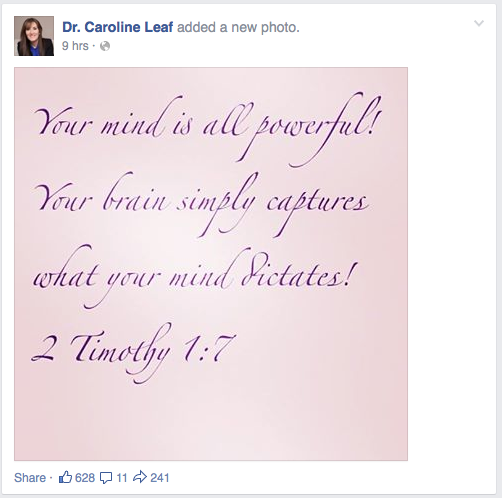
Dr Caroline Leaf is a Communication Pathologist and self-titled Cognitive Neuroscientist.  She regularly publishes memes on her social media sites like FaceBook and Instagram that are supposed to reinforce her main teaching.

Her recent post declared:

“Your mind is all-powerful.  Your brain simply captures what your mind dictates. 2 Timothy 1:7”

We’re supposed to smile and nod, and accept that it must be right on face value alone.  Like, “Trust me, I’m a cognitive neuroscientist”.

But if we peel away the thin veneer of trust that covers the surface of this meme, we see that there isn’t much in the way of substance that supports it.

For a start, the only reference that Dr Leaf supplies is the scripture from 2 Timothy 1:7. She’s used this scripture in her work before, stating in her 2013 book, “For now, rest in the assurance that what God has empowered you to do with your mind is more powerful and effective than any medication, any threat, any sickness, or any neurological challenge.  The scripture is clear on this: You do not have a spirit of fear but of love, power and a sound mind (2 Tim 1:7).” [1]

So, first things first: the scripture 2 Timothy 1:7 says: “For God hath not given us the spirit of fear; but of power, and of love, and of a sound mind.”  (KJV)  But what does it actually mean?

Studying the full context and the original Greek reveals that this verse is not a reference to our mental health, but to the courage to perform the work that God has given us.

The Greek word for “fear” in this scripture refers to “timidity, fearfulness, cowardice”, not to anxiety or terror.  The Greek word that was translated “of a sound mind” refers to “self-control, moderation”, not to serenity.  So Paul is telling Timothy that God doesn’t make him timid, but full of power, love and self-control.  Paul teaches that through the Holy Spirit, we have all the tools: power, love and the control to use them, so we don’t have to be afraid.

In addition, looking at the verse in its context, and in a different translation, shows it in a completely different light to the way Dr Leaf promotes it.  From the NIV, “I am reminded of your sincere faith, which first lived in your grandmother Lois and in your mother Eunice and, I am persuaded, now lives in you also.  For this reason I remind you to fan into flame the gift of God, which is in you through the laying on of my hands. For the Spirit God gave us does not make us timid, but gives us power, love and self-discipline. So do not be ashamed of the testimony about our Lord or of me his prisoner. Rather, join with me in suffering for the gospel, by the power of God.” (2 Timothy 1:5-8)

The scripture doesn’t say that our minds are more powerful than medication, sickness or “neurological challenge”.  It clearly doesn’t say that our mind is all-powerful, and that our brains simply capture what our minds dictate.  This scripture doesn’t have anything to do with our mental health (nor is there any scientific evidence to suggest that our mind is all-powerful or that the brain captures what our mind dictates, although that is another blog entirely (see also: Dr Caroline Leaf and the Myth of Mind Domination)).

Scripture is the inspired word of God.  It’s poor form to knowingly misquote someone to support your position, but it’s a very brave person that would misquote scripture for the sake of their argument.  And the inaccuracy of Dr Leaf’s use of both scripture and science surely calls into question the accuracy of all of her other memes.  Perhaps those who follow Dr Leaf’s social media feeds should also start taking them with more than a pinch of salt.

References

1.         Leaf, C.M., Switch On Your Brain : The Key to Peak Happiness, Thinking, and Health. 2013, Baker Books, Grand Rapids, Michigan:

(New Testament Greek lexicon used for the word search was the Blue Letter Bible Strongs Lexicon, Reference: Greek Lexicon: G1167 (KJV). Retrieved from http://www.blueletterbible.org/lang/lexicon/lexicon.cfm?Strongs=G1167&t=KJV and Greek Lexicon: G4995 (KJV). Retrieved from http://www.blueletterbible.org/lang/lexicon/lexicon.cfm?Strongs=G4995&t=KJV)

Dr Caroline Leaf and the Myth of Mind Domination

Screen Shot 2014-05-08 at 8.02.30 pm


“You control your brain … your brain does not control you!”

So says Dr Caroline Leaf, Communication Pathologist and self-titled Cognitive Neuroscientist.

You’d hope that Dr Leaf would know. She says on her website that “Since the early 1980‘s she has studied and researched the Mind-Brain connection.” And if you take what she says at face value, it sure sounds right. Of course we’re in control. My brain does what I tell it to do. Except that it actually doesn’t. Our brain has a lot more control over us than we realize.

First of all, our “free” will isn’t actually free at all, but constrained by a number of unseen, subconscious processes that are entirely dependent on our brain. It may seem like we’re in complete control of our choices, but our subconscious brain has already done most of the work for us. Even if we had complete freedom over our choices, our “free” will would still require an intact brain in order to carry out its wishes.

The “control” of our brain is very similar to our “control” when we drive a car. When we say that we’re “controlling” the car, what we actually mean is that we are controlling the speed and direction of the car. But there are thousands of electrical and mechanical actions that take place each second that are vital for the running of the car, and that we have absolutely no direct control over. It just takes one loose nut or faulty fuse to make the car steer wildly out of control, or stop functioning entirely, and then we’re not in control at all.

In the same way, various diseases or lesions in the brain show that brain is really in control. The fact we don’t see all of the underlying processes in a fully functional brain simply provides the illusion of control.

For example, there are a number of lesions of the parietal lobes within the brain that give rise to some unusual but intriguing conditions. One of which is a condition called “Alien Hand Syndrome”. Wegner describes two patients with Alien Hand Syndrome, a lady whose “left hand would tenaciously grope for and grasp any nearby object, pick and pull at her clothes, and even grasp her throat during sleep … She slept with the arm tied to prevent nocturnal misbehavior”, and a man who, “While playing checkers on one occasion, the left hand made a move he did not wish to make, and he corrected the move with the right hand; however, the left hand, to the patient’s frustration, repeated the false move. On other occasions, he turned the pages of the book with one hand while the other tried to close it; he shaved with the right hand while the left one unzipped his jacket” [1]. Alien Hand Syndrome demonstrates that our decision-making and our action sequences are controlled by two separate systems in our brains.

There are other conditions that also show that our brains control us more than we control them. A more common example are the tic disorders, such as simple motor tics (sudden involuntary movements) and complex tic disorders, such as Tourette’s (best known for the involuntary tendencies to utter obscenities). Even more common are parasomnias – a group of disorders in which people perform complex behaviours during their sleep – sleep talking, sleep walking, sleep eating. One of my patients once drove her car while asleep (Honestly, that’s no exaggeration!).

So at best, we only have partial control of our brain. Our brain is driving, our mind just steers it a little, but it doesn’t take much for that veneer of control that we think we possess.

The other way in which we appear to have control over our brain is through free will. Free will has been debated for years on philosophical grounds, but over three decades ago, Libet performed an experiment that demonstrated measurable and predictable brain activity occurring up to a full second before a test subject was consciously aware of the intention to act [2]. More recently, a study by Soon et al showed that predictable brain activity occurred up to eight seconds before a person was aware of their intention to act [3]. As Bonn says, “the gist of these findings is that our feeling of having consciously willed an act is illusory in many ways. It seems that the conscious awareness of intention that we place so much weight upon, that we naively think of as causal, is, in fact, a narrative construction that is formed well after the train of causation has been set in motion.” [4]

The Oracle explained it to Neo, “… you didn’t come here to make the choice. You’ve already made it. You’re here to try to understand why you made it.” (Matrix Reloaded, 2003)

Haggard concludes, “Modern neuroscience rejects the traditional dualist view of volition as a causal chain from the conscious mind or ‘soul’ to the brain and body. Rather, volition involves brain networks making a series of complex, open decisions between alternative actions.” [5]

This does not eliminate our capacity to choose, but frames it in a more realistic fashion. As Bonn points out, “Although we are not consciously aware of what is going on at every stage of the chain of neural events leading to action, there is room for a degree of conscious involvement if only to pull the emergency brake before it is too late. Thus, although it may not be the initial source of motivations and behavioral impulses, the part of the mind that is self-reflective; that can envision the self in causal and narrative contexts, may serve important monitoring and control functions.” [4]

Again, we have less control over our brain than we realize. We feel like we have made a choice, but more often than not, our brain already made the choice for us up to eight seconds beforehand, and the feeling of intention that we have is simply our conscious mind catching up – not making the choice, but finding a reason for why we made the choice.

It’s always nice when people who call themselves neuroscientists tell us what feels intuitively correct. In the cold, hard light of day, actual neuroscientists don’t tell us what’s intuitively correct, but what’s actually correct. It may seem like our mind is in control of our brain, but modern neuroscience confirms that our brain is the dominant force, while our mind just helps to steer a little.

References

  1. Wegner, D.M., Precis of the illusion of conscious will. Behavioral and Brain Sciences, 2004. 27(5): 649-59
  2. Libet, B., et al., Time of conscious intention to act in relation to onset of cerebral activity (readiness-potential). The unconscious initiation of a freely voluntary act. Brain, 1983. 106 (Pt 3): 623-42 http://www.ncbi.nlm.nih.gov/pubmed/6640273
  3. Soon, C.S., et al., Unconscious determinants of free decisions in the human brain. Nat Neurosci, 2008. 11(5): 543-5 doi: 10.1038/nn.2112
  4. Bonn, G.B., Re-conceptualizing free will for the 21st century: acting independently with a limited role for consciousness. Front Psychol, 2013. 4: 920 doi: 10.3389/fpsyg.2013.00920
  5. Haggard, P., Human volition: towards a neuroscience of will. Nat Rev Neurosci, 2008. 9(12): 934-46 doi: 10.1038/nrn2497


Dr Caroline Leaf and the 98 Percent Myth

Dr Caroline Leaf believes that nearly all our diseases come from our thoughts.

Dr Caroline Leaf believes that nearly all our diseases come from our thoughts.

In the hustle and bustle of daily life, most people wouldn’t stop to consider what makes people sick.  In my profession, I get a front row seat.

In the average week, I get to see a number of different things.  Mostly “coughs, colds and sore holes” as the saying goes, although there are some rarer things too.  And sometimes, people present with problems that aren’t for the faint of heart (or stomach – beware of nail guns is all I can say).

Normally, the statistics of who comes in with what doesn’t make it beyond the desk of the academic or health bureaucrat.  The numbers aren’t as important as the people they represent.

But to Dr Caroline Leaf, Communication Pathologist and self-titled Cognitive Neuroscientist, the numbers are all important.  To support her theory of toxic thoughts, Dr Leaf has stated that “75 to 98% of mental and physical (and behavioural) illness comes from one’s thought life” [1: p37-38].  She has repeated that statement on her website, on Facebook, and at seminars.

As someone with a front row seat to the illnesses people have, I found such a statement perplexing.  In the average week, I don’t see anywhere near that number.  In general practices around Australia, the number of presentations for psychological illnesses is only about eight percent [2].

But Australian general practice is a small portion of medicine compared to the world’s total health burden.  Perhaps the global picture might be different?  The World Health Organization, the global authority on global health, published statistics in November 2013 on the global DALY statistics [3] (a DALY is a Disability Adjusted Life Year).  According to the WHO, all Mental and Behavioural Disorders accounted for only 7.2% of the global disease burden.

You don’t need a statistics degree to know that seven percent is a long way from seventy-five percent (and even further from 98%).

Perhaps a large portion of the other ninety-three percent of disease that was classified as physical disease was really caused by toxic thoughts?  Is that possible?  In short: No.

When considered in the global and historical context, the vast majority of illness is related to preventable diseases that are so rare in the modern western world because of generations of high quality public health and medical care.

In a recent peer-reviewed publication, Mara et al state, “At any given time close to half of the urban populations of Africa, Asia, and Latin America have a disease associated with poor sanitation, hygiene, and water.” [4] Bartram and Cairncross write that “While rarely discussed alongside the ‘big three’ attention-seekers of the international public health community—HIV/AIDS, tuberculosis, and malaria—one disease alone kills more young children each year than all three combined. It is diarrhoea, and the key to its control is hygiene, sanitation, and water.” [5] Hunter et al state that, “diarrhoeal disease is the second most common contributor to the disease burden in developing countries (as measured by disability-adjusted life years (DALYs)), and poor-quality drinking water is an important risk factor for diarrhoea.” [6]

Diarrhoeal disease in the developing world – the second most common contributor to disease in these countries, afflicting half of their population – has nothing to do with thought.  It’s related to the provision of toilets and clean running water.

We live in a society that prevents half of our illnesses because of internal plumbing.  Thoughts seem to significantly contribute to disease because most of our potential illness is prevented by our clean water and sewerage systems.  Remove those factors and thought would no longer appear to be so significant.

In the same manner, modern medicine has become so good at preventing diseases that thought may seem to be a major contributor, when in actual fact, most of the work in keeping us all alive has nothing to do with our own thought processes.  Like sanitation and clean water, the population wide practices of vaccination, and health screening such as pap smears, have also significantly reduced the impact of preventable disease.

Around the world, “Recent estimates of the global incidence of disease suggest that communicable diseases account for approximately 19% of global deaths” and that “2.5 million deaths of children annually (are) from vaccine-preventable diseases.” [7] Again, that’s a lot of deaths that are not related to thought life.

Since 1932, vaccinations in Australia have reduced the death rate from vaccine-preventable diseases by 99% [8].  Epidemiological evidence shows that when vaccine rates increase, sickness from communicable diseases decrease [9: Fig 2, p52 & Fig 8, p67].

Population based screening has also lead to a reduction in disease and death, especially in the case of population screening by pap smears for cervical cancer.  Canadian public health has some of the best historical figures on pap smear screening and cervical cancer. In Canada, as the population rate of pap smear screening increased, the death rate of women from cervical cancer decreased.  Overall, pap smear screening decreased the death rate from cervical cancer by 83%, from a peak of 13.5/100,000 in 1952 to only 2.2/100,000 in 2006, despite an increase in the population and at-risk behaviours for HPV infection (the major risk factor for cervical cancer) [10].

And around the world, the other major cause of preventable death is death in childbirth.  The risk of a woman dying in childbirth is a staggering one in six for countries like Afghanistan [11] which is the same as your odds playing Russian Roulette.  That’s compared to a maternal death rate of one in 30,000 in countries like Sweden.  The marked disparity is not related to the thought life of Afghani women in labour.  Countries that have a low maternal death rate all have professional midwifery care at birth.  Further improvements occur because of better access to hospital care, use of antibiotics, better surgical techniques, and universal access to the health system [11].  Again, unless one’s thought life directly changes the odds of a midwife appearing to help you deliver your baby, toxic thoughts are irrelevant as a cause of illness and death.

Unfortunately for Dr Leaf, her statement that “75 to 98 percent of mental, physical and behavioural illnesses come from toxic thoughts” is a myth, a gross exaggeration of the association of stress and illness.

In the global and historical context of human health, the majority of illness is caused by infectious disease, driven by a lack of infrastructure, public health programs and nursing and medical care.  To us in the wealthy, resource-rich western world, it may seem that our thought life has a significant effect on our health.  That’s only because we have midwives, hospitals, public health programs and internal plumbing, which stop the majority of death and disease before they have a chance to start.

Don’t worry about toxic thoughts.  Just be grateful for midwives and toilets.

References

1.         Leaf, C.M., Switch On Your Brain : The Key to Peak Happiness, Thinking, and Health. 2013, Baker Books, Grand Rapids, Michigan:

2.         FMRC. Public BEACH data. 2010  [cited 16JUL13]; Available from: <http://sydney.edu.au/medicine/fmrc/beach/data-reports/public%3E.

3.         World Health Organization, GLOBAL HEALTH ESTIMATES SUMMARY TABLES: DALYs by cause, age and sex, GHE_DALY_Global_2000_2011.xls, Editor 2013, World Health Organization,: Geneva, Switzerland.

4.         Mara, D., et al., Sanitation and health. PLoS Med, 2010. 7(11): e1000363 doi: 10.1371/journal.pmed.1000363

5.         Bartram, J. and Cairncross, S., Hygiene, sanitation, and water: forgotten foundations of health. PLoS Med, 2010. 7(11): e1000367 doi: 10.1371/journal.pmed.1000367

6.         Hunter, P.R., et al., Water supply and health. PLoS Med, 2010. 7(11): e1000361 doi: 10.1371/journal.pmed.1000361

7.         De Cock, K.M., et al., The new global health. Emerg Infect Dis, 2013. 19(8): 1192-7 doi: 10.3201/eid1908.130121

8.         Burgess, M., Immunisation: A public health success. NSW Public Health Bulletin, 2003. 14(1-2): 1-5

9.         Immunise Australia, Myths and Realities. Responding to arguments against vaccination, A guide for providers. 5th ed. 2013, Commonwealth of Australia, Department of Health and Ageing, Canberra:

10.       Dickinson, J.A., et al., Reduced cervical cancer incidence and mortality in Canada: national data from 1932 to 2006. BMC Public Health, 2012. 12: 992 doi: 10.1186/1471-2458-12-992

11.       Ronsmans, C., et al., Maternal mortality: who, when, where, and why. Lancet, 2006. 368(9542): 1189-200 doi: 10.1016/S0140-6736(06)69380-X

Bad choices cause brain damage?

“To err is human; to forgive, divine.”  Alexander Pope.

I’m not perfect.  At least, not the last time I checked.  And we’re all the same, aren’t we.  We all know through experience that we all stuff things up on a fairly regular basis.  We make bad choices.  We’re human!

Dr Caroline Leaf, Communication Pathologist and self-titled Cognitive Neuroscientist, believes that these bad choices literally cause brain damage.  Her fundamental assumption is that our thoughts control our brain [1: p33].  These thoughts can be healthy or they can be toxic.  Toxic thoughts “are thoughts that trigger negative and anxious emotions, which produce biochemicals that cause the body stress.” [2: p19]

Dr Leaf’s assumption is that thoughts and bad choices cause our brain cells to shrivel or die. “Once your body is truly in stress mode and the cortisol is flowing, dendrites start shrinking and even ‘falling off’” [2: p32].  She also says that, “We have two choices, we can let our thoughts become toxic and poisonous or we can detox our negative thoughts which will improve our emotional wholeness and even recover our physical health.” [2: p21]

It sounds a little extreme.  We all make bad choices, and we all experience stress.  When we’re stressed, do our memories really go missing, or the dendrites of nerve cells shake and fall like tree branches in a storm?  If we make a bad choice, do we really get brain damage?  Lets see what the scientific literature has to say.

Imagine walking along a path in a forest and you see a snake, only inches in front of you on the path.  What do you do? When faced with a high level of acute stress, the brain switches into a binary mode – fight/flight or freeze. Self-preservation has to kick in.  The only decision you have to make then and there is whether to run, to try and kill the snake before it kills you, or stop dead still and hope that the snake ignores you and slithers away.

At that point, most memory is redundant, as is a high-level analysis of snake species, or any other cognitive pursuit.  The brain doesn’t need them at that precise moment.  If they did engage, they would just get in the way.  Switching the thinking parts of your brain off focuses your attention on the immediate danger.  It’s an adaptive survival response.  Meantime, your memories and your theoretical knowledge about snakes don’t disappear.  They are still there, unchanged.  It is false to suggest that the memories “shrink”.

We’ve all experienced “mental block”.  Sometimes when we get into a situation, like an exam or a business meeting, our stress levels are high, and binary mode kicks in again, although this time it can be a hindrance.  This phenomenon of mental block under high stress was first proposed in 1908 and is currently known as the Yerkes-Dodson Law, a fundamental principle of the behavioural sciences [3].  Similar to the stress-productivity curve, Yerkes and Dodson proposed a U-shaped curve to represent the relationship between arousal (which could be either level of consciousness or stress) and behavioural performance.  At low arousal, there is poor performance.  At the mid-point of arousal, there is peak performance, and at high arousal, performance diminishes.

But again, our memories don’t shrink, and our nerve cell branches don’t fall off.  Once we reduce our level of arousal, we move away from the fight/flight/freeze mode, and everything is still there (and we perform better, according to Yerkes-Dodson).

Dr Leaf has a favourite analogy of “neurons as trees”.  And if neurons are trees, then the branches can “fall off”.  But neurons are not trees and dendrites are not tree branches.  The dendrites do not ‘fall off’ the neuron.  The neurons in the brain have mechanisms for ongoing brain plasticity – the ability of the brain to adapt to the challenges and changes in its internal and external environment that are constantly occurring.  If the brain needs to build a new circuit to encode a new piece of information, then it grows new dendrites and creates new synapses.  But the brain is limited by the amount of energy it can consume, and therefore the number of synapses it can maintain.  So the brain trims unnecessary dendrites, a process called “synaptic pruning”.

Synaptic pruning is a normal process. Chechik and Meilijson confirm that, “Human and animal studies show that mammalian brains undergoes massive synaptic pruning during childhood, removing about half of the synapses until puberty.” [4]

Synaptic pruning is not deleterious, but beneficial.  Chechik and Meilijson also note that, “synaptic overgrowth followed by judicial pruning along development improves the performance of an associative memory network with limited synaptic resources.” [4] So synaptic pruning is a normal physiological process, and occurs in all of us for many reasons, predominantly to improve the efficiency of our neural networks.  Perhaps synaptic pruning associated with the stress response is also an adaptive process?

Synaptic pruning also occurs in other physiological states that have nothing to do with stress or thought, such as the effects of oestrogen during the menstrual cycle and at menopause [5, 6].

A link between stress and dendrite loss has been discovered, but it is not consistent.  Some authors like Kopp and Rethelyi suggest that “severe stress for a prolonged period causes damage in hippocampal pyramidal neurons, especially in the CA3 and CA4 region and reductions in the length and arborization of their dendrites.” [7] However, Chen et al writes, “Whereas hippocampus-mediated memory deficits commonly were associated with—and perhaps result from—loss of synapse-bearing dendrites and dendritic spines, this association has not been universal so that the structure–function relationship underlying the effects of stress on hippocampal neurons has not been resolved.” [8]

It’s more accurate to think that chronic stress causes dendritic remodeling in animals [9], in which some nerve cells prune their synapses, which others grow them, and energy is diverted away from new nerve cell formation to the new synapses that are needed to cope with the stress.

A number of scientists have pointed out that patients with depression or anxiety, who normally have high levels of stress, have a smaller hippocampus and larger amygdala, so stress and depression must cause the smaller brain regions [9].  There may be some reduction in the number of synapses within the hippocampus and the frontal lobes of the brain, which may account for the change in size observed by a number of researchers.  But the modern thinking on these changes is that they are associated with depression, not caused by depression [10] (Correlation does not equal causation).

So, stress is associated with depression, but this is because genetic defects in one or multiple genes reduce the ability for the brain cells to produce synaptic branches.  It’s this decrease in the number of synapses that contributes to the typical changes in the brain seen at autopsy of patients who suffered from depression or anxiety [11].  The reduced ability of the nerve cells to grow synapses means that new branches can’t grow fast enough to process the stress signals properly [11, 12].  The poor signal transmission leads to a predisposition towards mood disorders like anxiety and depression [10, 11, 13-15], and less synaptic branches means both a smaller volume of the hippocampus, and an inability to process stress signals leads to a larger, overactive amygdala.

In summary, synaptic pruning is not due to toxic thinking or bad choices, unless every one of us engages in nothing but toxic thinking from early childhood to puberty, and menopause causes bad choices and toxic thoughts.  Stress doesn’t cause dendrites to fall off, but causes a reorganization of the dendrites to adapt to the new signals. The reduced capacity to form new dendrites makes those prone to mood disorders more vulnerable to stress, and depression or anxiety is the end result.

We are all bound to make bad choices and to have stress.  They don’t cause brain damage.  Which if you’re not perfect like me, is good news.

References

1.         Leaf, C.M., Switch On Your Brain : The Key to Peak Happiness, Thinking, and Health. 2013, Baker Books, Grand Rapids, Michigan

2.         Leaf, C., Who Switched Off My Brain? Controlling toxic thoughts and emotions. 2nd ed. 2009, Inprov, Ltd, Southlake, TX, USA:

3.         Cohen, R.A., Yerkes–Dodson Law, in Encyclopedia of Clinical Neuropsychology, Kreutzer, J.S., et al., Editors. 2011, Springer Science+Business Media LLC: New York ; London. p. 2737-8.

4.         Chechik, G., et al., Neuronal regulation: A mechanism for synaptic pruning during brain maturation. Neural Comput, 1999. 11(8): 2061-80  http://www.ncbi.nlm.nih.gov/pubmed/10578044

5.         Chen, J.R., et al., Gonadal hormones modulate the dendritic spine densities of primary cortical pyramidal neurons in adult female rat. Cereb Cortex, 2009. 19(11): 2719-27 doi: 10.1093/cercor/bhp048

6.         Dumitriu, D., et al., Estrogen and the aging brain: an elixir for the weary cortical network. Ann N Y Acad Sci, 2010. 1204: 104-12 doi: 10.1111/j.1749-6632.2010.05529.x

7.         Kopp, M.S. and Rethelyi, J., Where psychology meets physiology: chronic stress and premature mortality–the Central-Eastern European health paradox. Brain Res Bull, 2004. 62(5): 351-67 doi: 10.1016/j.brainresbull.2003.12.001

8.         Chen, Y., et al., Correlated memory defects and hippocampal dendritic spine loss after acute stress involve corticotropin-releasing hormone signaling. Proc Natl Acad Sci U S A, 2010. 107(29): 13123-8 doi: 10.1073/pnas.1003825107

9.         Karatsoreos, I.N. and McEwen, B.S., Psychobiological allostasis: resistance, resilience and vulnerability. Trends Cogn Sci, 2011. 15(12): 576-84 doi: 10.1016/j.tics.2011.10.005

10.       Palazidou, E., The neurobiology of depression. Br Med Bull, 2012. 101: 127-45 doi: 10.1093/bmb/lds004

11.       Karatsoreos, I.N. and McEwen, B.S., Resilience and vulnerability: a neurobiological perspective. F1000Prime Rep, 2013. 5: 13 doi: 10.12703/P5-13

12.       Russo, S.J., et al., Neurobiology of resilience. Nature neuroscience, 2012. 15(11): 1475-84

13.       Felten, A., et al., Genetically determined dopamine availability predicts disposition for depression. Brain Behav, 2011. 1(2): 109-18 doi: 10.1002/brb3.20

14.       Bradley, R.G., et al., Influence of child abuse on adult depression: moderation by the corticotropin-releasing hormone receptor gene. Arch Gen Psychiatry, 2008. 65(2): 190-200 doi: 10.1001/archgenpsychiatry.2007.26

15.       Hauger, R.L., et al., Role of CRF receptor signaling in stress vulnerability, anxiety, and depression. Ann N Y Acad Sci, 2009. 1179: 120-43 doi: 10.1111/j.1749-6632.2009.05011.x

Dr Caroline Leaf and the myth of optimism bias

“What are little girls are made of?  Sugar and spice, and all things nice.”

It sounds sweet doesn’t it?  We like to connect with these rosy little memes that warm our cockles and make us feel good about the world and ourselves.  We think of all of the examples in our own experience, which seems to confirm the saying.  We may think of a few examples that don’t quite fit, but they’re just the exception that proves the rule.

It doesn’t seem to matter what the saying or proverb is, we usually just assume it’s true.  Think of some other examples:
“Blondes have more fun.”
“Women can’t read maps.”
“White guys can’t dance.”

In all of these things, we tend to experience what psychologists call confirmation bias (Princeton University, 2014), our own mini-delusion in which we fool ourselves into believing a half-truth.  It looks right on first glance, and we can easily think of a few confirming examples, so without deeper inspection, we assume it must be true.

When Dr Leaf proclaims that,

“Science shows we are wired for love with a natural optimism bias”

the same process kicks in.  But in truth, science doesn’t show anything of the sort.  What science shows is that we learn love and fear, and our genetics influences the way we see the world, our personality.

We are prewired to LEARN to love and fear.  It doesn’t come naturally.  We require exposure to both love and to fear for these emotions to develop.  The Bucharest Early Intervention Project is a study looking at the long-term psychological and physical health of children in Bucharest, one group who remained in an orphanage, and the other, a group of children that were eventually adopted.  Analysis of the cohort of the two groups of children showed that negative affect was the same for both groups.  However positive affect and emotional reactivity was significantly reduced in the institutionalised children (Bos et al., 2011).  This shows that children who lived in an institution all of their lives and given limited emotional stimulation had lower levels of positive affect (ie: love, happiness) compared to a child that was adopted.

The children in the institution did not have high positive affect because they were not shown love.  Those children who were adopted were higher on positive affect because they were shown love by their adopted parents.  Both groups were exposed to distress and fear during their time in the orphanage, so their negative affect was the same across both groups.  Thus, love and fear don’t come naturally.  They need to be learned.

Personality is “the combination of characteristics or qualities that form an individuals distinctive character.” (“Oxford Dictionary of English – 3rd Edition,” 2010) As Professor Greg Henriques wrote in psychology today, “Personality traits are longstanding patterns of thoughts, feelings, and actions which tend to stabilize in adulthood and remain relatively fixed. There are five broad trait domains, one of which is labeled Neuroticism, and it generally corresponds to the sensitivity of the negative affect system, where a person high in Neuroticism is someone who is a worrier, easily upset, often down or irritable, and demonstrates high emotional reactivity to stress.” (Henriques, 2012) Personality is heavily influenced by genetics, with up to 60% of our personality pre-determined by our genes (Vinkhuyzen et al., 2012), expressed through the function of the serotonin and dopamine transporter systems in our brain (Caspi, Hariri, Holmes, Uher, & Moffitt, 2010; Chen et al., 2011; Felten, Montag, Markett, Walter, & Reuter, 2011).

So some people *ARE* natural optimists – their genetic heritage blessed them with a rosy outlook and their early life experiences cemented it in.  These naturally optimistic people, and the people who know them, are the ones who take Dr Leaf’s word as truth because they see it in themselves or their friends.  But the fact that some people are naturally wired for pessimism or a neurotic personality disproves Dr Leaf’s assertion.

Its important that Dr Leaf’s misleading meme is seen for what it is.  If we assume that we’re all pre-wired for love and optimism, then those who are pessimistic must be deficient or deviant, and the fact they can’t change must mean they are incompetent or lazy.  If we know the truth, those who are less optimistic won’t be unnecessarily judged or marginalised.

I should point out that what I’ve said isn’t a free licence to be cranky or sullen all the time.  The natural pessimist still needs to be able to negotiate their way through life, and being a misery-guts makes it hard to get what you need from other people in any business, social or interpersonal relationship.  We have the ability to learn, and the person with a neurotic personality can still learn ways of dealing with people in a positive way.

But if you naturally see the glass half-empty, don’t tell yourself that you’re abnormal, or that you aren’t good enough.  You are who you are.  Accept who you are, because while there are weaknesses inherent to having neurotic personality traits, there are also strengths, such as the enhanced awareness of deception, or protection from gullibility (Forgas & East, 2008).

A good thing to have when searching for the truth.

 References

Bos, K., Zeanah, C. H., Fox, N. A., Drury, S. S., McLaughlin, K. A., & Nelson, C. A. (2011). Psychiatric outcomes in young children with a history of institutionalization. Harv Rev Psychiatry, 19(1), 15-24. doi: 10.3109/10673229.2011.549773

Caspi, A., Hariri, A. R., Holmes, A., Uher, R., & Moffitt, T. E. (2010). Genetic sensitivity to the environment: the case of the serotonin transporter gene and its implications for studying complex diseases and traits. Am J Psychiatry, 167(5), 509-527. doi: 10.1176/appi.ajp.2010.09101452

Chen, C., Chen, C., Moyzis, R., Stern, H., He, Q., Li, H., . . . Dong, Q. (2011). Contributions of dopamine-related genes and environmental factors to highly sensitive personality: a multi-step neuronal system-level approach. PLoS One, 6(7), e21636. doi: 10.1371/journal.pone.0021636

Felten, A., Montag, C., Markett, S., Walter, N. T., & Reuter, M. (2011). Genetically determined dopamine availability predicts disposition for depression. Brain Behav, 1(2), 109-118. doi: 10.1002/brb3.20

Forgas, J. P., & East, R. (2008). On being happy and gullible: Mood effects on skepticism and the detection of deception. Journal of Experimental Social Psychology, 44, 1362-1367.

Henriques, G. (2012). (When) Are You Neurotic?  Retrieved from http://www.psychologytoday.com/blog/theory-knowledge/201211/when-are-you-neurotic

Oxford Dictionary of English – 3rd Edition. (2010)   (3rd edition ed.). Oxford, UK: Oxford University Press.

Princeton University. (2014). Confirmation bias.   Retrieved January 10, 2014, from http://www.princeton.edu/~achaney/tmve/wiki100k/docs/Confirmation_bias.html

Vinkhuyzen, A. A., Pedersen, N. L., Yang, J., Lee, S. H., Magnusson, P. K., Iacono, W. G., . . . Wray, N. R. (2012). Common SNPs explain some of the variation in the personality dimensions of neuroticism and extraversion. Transl Psychiatry, 2, e102. doi: 10.1038/tp.2012.27

Dr Caroline Leaf – Contradicted by the latest research

This is my most popular post by far.  I truly appreciate the support and interest in this post, but I’ve discovered and documented a lot more about Dr Leaf’s ministry in the last two years.  I welcome you to read this post, but if you’d like a more current review of the ministry of Dr Caroline Leaf, a new and improved version is here:
Dr Caroline Leaf – Still Contradicted by the Latest Evidence, Scripture & Herself

* * * * *

Mr Mac Leaf, the husband of Dr Caroline Leaf, kindly took the time to respond to my series of posts on the teachings of Dr Leaf at Kings Christian Centre, on the Gold Coast, Australia, earlier this month. As I had intended, and as Mr Leaf requested, I published his  reply, complete and unabridged (here).

This blog is my reply.  It is heavily researched and thoroughly referenced.  I think it’s fair to say that while Dr Leaf draws her conclusions from some scientific documents, there is more than enough research that contradicts her statements and opinions.  I have only listed a small fraction, and only on some of the points she raised.

In fairness, the fields of neurology and neuroscience are vast and rapidly expanding, and it is impossible for one person to cover all of the literature on every subject.  This applies to myself and Dr Leaf.  However, I believe that the information I have read, and referenced from the latest peer-reviewed scholarly works, do not support Dr Leaf’s fundamental premises.  If I am correct, then the strength and validity of Dr Leaf’s published works should be called into question.

As before, I welcome any reply or rebuttal that Dr Leaf wishes to make, which I will publish in full if she requests.  In the interests of healthy public debate, and encouraging people to make their own informed decisions on the teachings of Dr Leaf, any comments regarding the response of Mr Leaf, Dr Leaf or myself, are welcome provided they are constructive.

This is a bit of a lengthy read, but I hope it is worthwhile.

Dear Mr Leaf,

Thank you very much for taking the time out to reply to some of the points raised in my blog.  I am more than happy to publish your response, and to publish any response you wish to make public.

ON INFORMED DECISIONS

I published my blog posts to open up discussion on the statements made by Dr Leaf at the two meetings that I attended at Kings Christian Centre on the Gold Coast.  As you rightly point out, people should be able to make informed decisions.  A robust discussion provides the information required for people to make an informed choice.  Any contributions to this discussion from either yourself or Dr Leaf would be most welcome.

I apologise if you interpreted my blogs as judgemental, or if you believe there are any misunderstandings.  You may or may not have read my final two paragraphs from the third post, in which I acknowledged that I may have misunderstood where she was coming from, but that I would welcome her response.  If there were any misunderstandings, it is likely because Dr Leaf did not make any attempt to reference any of the statements she made on the day.  You may argue that she was speaking to a lay audience, and referencing is therefore not necessary.  However, I have been to many workshops for the lay public by university professors, who have extensively referenced their information during their presentations.  A lay audience does not preclude providing references.  Rather, it augments the speakers authority and demonstrates the depth of their knowledge on the subject at hand.

YOUR DEFENCE

It’s interesting that you feel the need to resort to defence by association, and Ad Hominem dismissal as your primary counter to the points I raised.

Can you clarify how attending the same university as Dr Christaan Barnard, or a Nobel laureate, endorses her arguments or precludes her from criticism?  I attended the University of Queensland where Professor Ian Frazer was based.  He developed the Human Papilloma Virus vaccine and was the 2006 Australian of the Year.  Does that association enhance my argument?

Can you also clarify why a reference from a colleague was preferred to letting Dr Leaf’s statements and conclusions speak for themselves?  Dr Amua-Quarshie’s CV is certainly very impressive, no doubt about that, although he doesn’t list the papers he’s published.  (I’m assuming that to hold the title of Adjunct Professor, he’s published peer-reviewed articles.  Is he willing to list them, for the record?)

Whatever his credentials, his endorsement means very little, since both Dr Leaf and Dr Amua-Quarshie would know from their experience in research that expert opinion is one of the lowest forms of evidence, second worst only to testimonials [1].  Further, both he and Dr Leaf are obviously close friends which introduces possible bias.  His endorsement is noteworthy, but it can not validate every statement made by Dr Leaf.  Her statements should stand up on their own through the rigors of critical analysis.

On the subject of evidence, disparaging your critics is not a substitute for answering their criticism.  Your statement, “By your comments it is obvious that you have not kept up to date with the latest Scientific research” is an assumption that is somewhat arrogant, and ironic since Dr Leaf is content to use superseded references dating back to 1979 to justify her current hypotheses.

DR LEAF’S EVIDENCE

In the blog to which you referred, Dr Leaf makes a number of statements that are intended to support her case.  These include the following.

“A study by the American Medical Association found that stress is a factor in 75% of all illnesses and diseases that people suffer from today.”  She fails to reference this study.

“The association between stress and disease is a colossal 85% (Dr Brian Luke Seaward).”   But again, she fails to reference the quote.

“The International Agency for Research on Cancer and the World Health Organization has concluded that 80% of cancers are due to lifestyles and are not genetic, and they say this is a conservative number (Cancer statistics and views of causes Science News Vol.115, No 2 (Jan.13 1979), p.23).”  It’s good that she provides a reference to her statement.  However, referencing a journal on genetics from 1979 is the equivalent of attempting to use the land-speed record from 1979 to justify your current preference of car.  The technology has advanced significantly, and genetic discoveries are lightyears ahead of where they were more than three decades ago.

“According to Dr Bruce Lipton (The Biology of Belief, 2008), gene disorders like Huntington’s chorea, beta thalassemia, cystic fibrosis, to name just a few, affect less than 2% of the population. This means the vast majority of the worlds population come into this world with genes that should enable the to live a happy and healthy life. He says a staggering 98% of diseases are lifestyle choices and therefore, thinking.”  Even if it’s true that Huntingtons, CF etc account for 2% of all illnesses, they account for only a tiny fraction of genetic disease.  And concluding that the remaining 98% must therefore be lifestyle related is overly simplistic.  It ignores the genetic influence on all other diseases, other congenital, and environmental causes of disease.  I will fully outline this point soon.

Similarly, “According to W.C Willett (balancing lifestyle and genomics research for disease prevention Science (296) p 695-698, 2002) only 5% of cancer and cardiovascular patients can attribute their disease to hereditary factors.”  Science is clear that genes play a significant role in the development of cardiovascular disease and most cancers, certainly greater than 5%.  Again, I will discuss this further soon.

“According to the American Institute of health, it has been estimated that 75 – 90% of all visits to primary care physicians are for stress related problems (http://www.stress.org/americas.htm). Some of the latest stress statistics causing illness as a result of toxic thinking can be found at: http://www.naturalwellnesscare.com/stress-statistics.html”  These websites not peer-reviewed, and both suffer from a blatant pro-stress bias.

You’ll also have to forgive my confusion, but Dr Leaf also wrote, “Dr H.F. Nijhout (Metaphors and the Role of Genes and Development, 1990) genes control biology and not the other way around.”  So is she saying that genes DO control development?

EVIDENCE CONTRADICTING DR LEAF

Influence Of Thought On Health

Dr Leaf has categorically stated that “75 to 98% of all illnesses are the result of our thought life” on a number of occasions.  She repeated the same statement in her most recent book so it is something she is confident in.  However, in order to be true, this fact must be consistent across the whole of humanity.

And yet, in a recent peer-reviewed publication, Mara et al state, “At any given time close to half of the urban populations of Africa, Asia, and Latin America have a disease associated with poor sanitation, hygiene, and water.” [2]  Bartram and Cairncross write that “While rarely discussed alongside the ‘big three’ attention-seekers of the international public health community—HIV/AIDS, tuberculosis, and malaria—one disease alone kills more young children each year than all three combined. It is diarrhoea, and the key to its control is hygiene, sanitation, and water.” [3]  Hunter et al state that, “diarrhoeal disease is the second most common contributor to the disease burden in developing countries (as measured by disability-adjusted life years [DALYs]), and poor-quality drinking water is an important risk factor for diarrhoea.” [4]

Toilets and clean running water have nothing to do with stress or thought.  We live in a society that essentially prevents more than half of our illnesses because of internal plumbing, with additional benefits from vaccination and population screening.  If thoughts have any effect on our health, they are artificially magnified by our clean water and sewerage systems.  Remove those factors and any effects of thought on our health disappear from significance.  Dr Leaf’s assertion that 75 to 98% of human illness is thought-related is a clear exaggeration.

Let me be clear – I understand the significance of stress on health and the economy, but it is not the cause of 75-98% of all illnesses.  I’m not sure if there is a similar study in the US, but the latest Australian data suggests that all psychological illness only counts for 8% of visits to Australian primary care physicians [5].

In terms of cancer, I don’t have time to exhaustively list every cancer but of the top four listed in the review “Cancer Statistics 2013” [6] , here are the articles that list the gene x environment interactions:

  1. PROSTATE – There are only two risk factors for prostate cancer, familial aggregation and ethnic origin. No dietary or environmental cause has yet been identified [7].  It is most likely caused by multiple genes at various loci [8].
  2. BREAST – Genes make up 25% of the risk factors for breast cancer, and significantly interacted with parity (number of children born) [9].
  3. LUNG/BRONCHUS – Lung cancer is almost exclusively linked to smoking, but nicotine addiction has a strong hereditary link (50-75% genetic susceptibility) [10].
  4. COLORECTUM – Approximately one third of colorectal cancer is genetically linked [11].

So the most common cancer is not linked to any environmental factors at all, and the others have genetic influences of 25% to more than 50%.  This is far from being 2% or 5% as Dr Leaf’s sources state.

Also in terms of heart disease, the INTERHEART trial [12] lists the following as significant risk factors, and I have listed the available gene x environment interaction studies that have been done on these too:

  1. HIGH CHOLESTEROL – Genetic susceptibility accounts for 40-60% of the risk for high cholesterol [13].
  2. DIABETES – Genetic factors account for 88% of the risk for type 1 diabetes [14].  There is a strong genetic component of the risk of type 2 diabetes with 62-70% being attributable to genetics [15, 16].
  3. SMOKING – nicotine addiction has a strong hereditary link (50-75% genetic susceptibility) [10].
  4. HYPERTENSION – While part of a much greater mix of variables, genetics are still thought to contribute between 30% and 50% to the risk of developing high blood pressure [17].

So again, while genes are a part of a complex system, it is clear from the most recent evidence that genetics account for about 50% of the risk for cardiovascular disease, which again is a marked difference between the figures that Dr Leaf is using to base her assertions on.

Atrial Natriuretic Peptide

I am aware of research that’s studied the anxiolytic properties of Atrial Natriuretic Peptide.  For example, Wiedemann et al [18] did a trial using ANP to truncate panic attacks.  However, these experiments were done on only nine subjects, and the panic attacks were induced by cholecystokinin.  As such, the numbers are too small to have any real meaning.  And the settling is completely artificial.  Just as CCK excretion does not cause us all to have panic attacks every time we eat, ANP does not provide anxiolysis in normal day to day situations.  Besides, if ANP were really effective at reducing anxiety, then why do people suffering from congestive cardiac failure, who have supraphysiological levels of circulating ANP [19] , also suffer from a higher rate of anxiety and panic disorders than the general population? [20]

The Heart As A Mini-Brain

As for Heartmath, they advance the notion of the heart being a mini-brain to give themselves credibility.  It’s really no different to an article that I read the other day from a group of gut researchers [21] – “‘The gut is really your second brain,’ Greenblatt said. ‘There are more neurons in the GI tract than anywhere else except the brain.’”  The heart as a mini-brain and the gut as a mini-brain are both figurative expressions.  Neither are meant to be taken literally.  I welcome Dr Leaf to tender any further evidence in support of her claim.

Hard-Wired For Optimism

As for being wired for optimism, the brain is likely pre-wired with a template for all actions and emotions, which is the theory of protoconsciousness [22].  Indeed, neonatal reflexes often reflect common motor patterns.  If this is true, then the brain is pre-wired for both optimism and love, but also fear.  This explains the broad role of the amygdala in emotional learning [23] including fear learning.  It also means that a neonate needs to develop both love and fear.

A recent paper showed that the corticosterone response required to learn fear is suppressed in the neonate to facilitate attachment, but with enough stress, the corticosterone levels build to the point where amygdala fear learning can commence [24].  The fear circuits are already present, only their development is suppressed.  Analysis of the cohort of children in the Bucharest Early Intervention Project showed that negative affect was the same for both groups.  However positive affect and emotional reactivity was significantly reduced in the institutionalised children [25].  If the brain is truly wired for optimism and only fear is learned, then positive emotional reactivity should be the same in both groups and the negative affect should be enhanced in the institutionalised cohort.  That the result is reversed confirms that neonates and infants require adequate stimulation of both fear and love pathways to grow into an emotionally robust child, because the brain is pre-wired for both but requires further stimulation for adequate development.

The Mind-Brain Link

If the mind controls the brain and not the other way around as Dr Leaf suggests, why do anti-depressant medications correct depression or anxiety disorders?  There is high-level evidence to show this to be true [26-28].  The same can be said for recent research to show that medications which enhance NDMA receptors have been shown to improve the extinction of fear in anxiety disorders such as panic disorder, OCD, Social Anxiety Disorder, and PTSD [29].

If the mind controls the brain and not the other way around as Dr Leaf suggests, why do some people with acquired brain injuries or brain tumours develop acute personality changes or thought disorders?  Dr Leaf has done PhD research on patients with closed head injuries and treated them in clinical settings according to her CV.  She must be familiar with this effect.

One can only conclude that there is a bi-directional effect between the brain and the stream of thought, which is at odds with Dr Leaf’s statement that the mind controls the brain and not the other way around.

FURTHER CLARIFICATION

One further thing.  Can you clarify which of Dr Leaf’s peer-reviewed articles have definitively shown the academic improvement in the cohort of 100,000 students, as you and your referee have stated?  And can you provide a list of articles which have cited Dr Leaf’s Geodesic Information Processing Model?  Google Scholar did not display any articles that had cited it, which must be an error on Google’s part.  If her theory is widely used as you say, it must have been extensively cited.

I understand that you are both busy, but I believe that I have documented a number of observations, backed by recent peer-reviewed scientific literature, which directly contradict Dr Leaf’s teaching.  I have not had a chance to touch on many, many other points of disagreement.

For the benefit of Dr Leaf’s followers, and for the scientific and Christian community at large, I would appreciate your response.

I would be grateful if you could respond to the points raised and the literature which supports it, rather than an Ad Hominem dismissal or further defense by association.

Dr C. Edward Pitt

REFERENCES

1. Fowler, G., Evidence-based practice: Tools and techniques. Systems, settings, people: Workforce development challenges for the alcohol and other drugs field, 2001: 93-107.

2. Mara, D., et al., Sanitation and health. PLoS Med, 2010. 7(11): e1000363.

3. Bartram, J. and Cairncross, S., Hygiene, sanitation, and water: forgotten foundations of health. PLoS Med, 2010. 7(11): e1000367.

4. Hunter, P.R., et al., Water supply and health. PLoS Med, 2010. 7(11): e1000361.

5. FMRC. Public BEACH data. 2010  16JUL13]; Available from: <http://sydney.edu.au/medicine/fmrc/beach/data-reports/public&gt;.

6. Siegel, R., et al., Cancer statistics, 2013. CA Cancer J Clin, 2013. 63(1): 11-30.

7. Cussenot, O. and Valeri, A., Heterogeneity in genetic susceptibility to prostate cancer. Eur J Intern Med, 2001. 12(1): 11-6.

8. Alberti, C., Hereditary/familial versus sporadic prostate cancer: few indisputable genetic differences and many similar clinicopathological features. Eur Rev Med Pharmacol Sci, 2010. 14(1): 31-41.

9. Nickels, S., et al., Evidence of gene-environment interactions between common breast cancer susceptibility loci and established environmental risk factors. PLoS Genet, 2013. 9(3): e1003284.

10. Berrettini, W.H. and Doyle, G.A., The CHRNA5-A3-B4 gene cluster in nicotine addiction. Mol Psychiatry, 2012. 17(9): 856-66.

11. Hutter, C.M., et al., Characterization of gene-environment interactions for colorectal cancer susceptibility loci. Cancer Res, 2012. 72(8): 2036-44.

12. Yusuf, S., et al., Effect of potentially modifiable risk factors associated with myocardial infarction in 52 countries (the INTERHEART study): case-control study. Lancet, 2004. 364(9438): 937-52.

13. Asselbergs, F.W., et al., Large-scale gene-centric meta-analysis across 32 studies identifies multiple lipid loci. Am J Hum Genet, 2012. 91(5): 823-38.

14. Wu, Y.L., et al., Risk factors and primary prevention trials for type 1 diabetes. Int J Biol Sci, 2013. 9(7): 666-79.

15. Ali, O., Genetics of type 2 diabetes. World J Diabetes, 2013. 4(4): 114-23.

16. Murea, M., et al., Genetic and environmental factors associated with type 2 diabetes and diabetic vascular complications. Rev Diabet Stud, 2012. 9(1): 6-22.

17. Kunes, J. and Zicha, J., The interaction of genetic and environmental factors in the etiology of hypertension. Physiol Res, 2009. 58 Suppl 2: S33-41.

18. Wiedemann, K., et al., Anxiolyticlike effects of atrial natriuretic peptide on cholecystokinin tetrapeptide-induced panic attacks: preliminary findings. Arch Gen Psychiatry, 2001. 58(4): 371-7.

19. Ronco, C., Fluid overload : diagnosis and management. Contributions to nephrology,. 2010, Basel Switzerland ; New York: Karger. viii, 243 p.

20. Riegel, B., et al., State of the science: promoting self-care in persons with heart failure: a scientific statement from the American Heart Association. Circulation, 2009. 120(12): 1141-63.

21. Arnold, C. Gut feelings: the future of psychiatry may be inside your stomach. 2013  [cited 2013 Aug 22]; Available from: http://www.theverge.com/2013/8/21/4595712/gut-feelings-the-future-of-psychiatry-may-be-inside-your-stomach.

22. Hobson, J.A., REM sleep and dreaming: towards a theory of protoconsciousness. Nat Rev Neurosci, 2009. 10(11): 803-13.

23. Dalgleish, T., The emotional brain. Nat Rev Neurosci, 2004. 5(7): 583-9.

24. Landers, M.S. and Sullivan, R.M., The development and neurobiology of infant attachment and fear. Dev Neurosci, 2012. 34(2-3): 101-14.

25. Bos, K., et al., Psychiatric outcomes in young children with a history of institutionalization. Harv Rev Psychiatry, 2011. 19(1): 15-24.

26. Arroll, B., et al., Antidepressants versus placebo for depression in primary care. Cochrane Database Syst Rev, 2009(3): CD007954.

27. Soomro, G.M., et al., Selective serotonin re-uptake inhibitors (SSRIs) versus placebo for obsessive compulsive disorder (OCD). Cochrane Database Syst Rev, 2008(1): CD001765.

28. Kapczinski, F., et al., Antidepressants for generalized anxiety disorder. Cochrane Database Syst Rev, 2003(2): CD003592.

29. Davis, M., NMDA receptors and fear extinction: implications for cognitive behavioral therapy. Dialogues Clin Neurosci, 2011. 13(4): 463-74.

Mac Leaf responds to “Dr Caroline Leaf – Serious Questions, Few Answers”

Mr Mac Leaf, the husband of Dr Caroline Leaf, kindly took the time to respond to my series of posts on the teachings of Dr Leaf at Kings Christian Centre, on the Gold Coast, Australia, earlier this month.  As I had intended, and as Mr Leaf requested, here is his reply, complete and unabridged.  My further response is posted here.

In the interests of healthy public debate, and encouraging people to make their own informed decisions on the teachings of Dr Leaf, any comments regarding the response of Mr Leaf or my reply are welcome provided they are constructive.

Hi Dr C. Pit,

It is a pity you did not seek to clarify the comments you have posted above with us before you posted them. We hope you allow our comments to be displayed so that your readers can make informed decisions and not to judge Dr Leaf as you have done without getting accurate information. By your comments it is obvious that you have not kept up to date with the latest Scientific research.

Dr Leaf can call herself a Cognitive Neuroscientist because of her field research (published in peer evaluated Journals) …see the Science articles in the media/downloads section at drleaf.com. If you require, we can also send letters from her peers in the field of Neuroscience

She also developed the Geodesic Information Processing model theory.

Yes she does read a lot as the field of Neuroscience is constantly evolving and one has to be as informed as possible.

Some research links re the correlation between illness and thought are presented in Dr Leaf’s November the 30th blog at drleaf.com…blog. There are many more statistic correlation research links.

Dr Leaf has listed references differently in the different books and has a full list of references in the ‘thought life’ section at drleaf.com. The references were listed simply in that book for the lay person. This is an accepted literary format for the lay person. Subsequent books have fuller references.

The mini brain in the heart research can be found at Heartmath.org

Heartmath and Dr Don Colbert both reference the effect of ANF

The wired for optimism bias research has been evidenced by various scientific researchers
For easy access to this research please see the Google links to TED talks and Time Magazine’s article.

Please send us your E-mail address so that we can send you further documentation.

BELOW IS A LETTER OF REFERENCE FROM A MEDICAL PROFESSIONAL ENDORSING DR CAROLINE LEAF
My name is Dr Peter Amua-Quarshie and I am presently a full-time Adjunct Professor (lecturer) at the University of Wisconsin-Stout in Menomonie, Wisconsin. I have a B.Sc (Hons) in Medical Sciences (specializing in Neuropathology) and a Masters of Public Health (MPH), both degrees from the University of Leeds (UK). Additionally I have a medical degree (MB ChB) from the University of Ghana Medical School, Accra, Ghana, and a Master’s of Science (MS) in Behavioral and Neural Sciences from Rutgers University, Newark, New Jersey. I started teaching anatomy in the University of Leeds Medical School in 1996. I have taught Neurochemistry to graduate students and Neuroscience to undergraduates at Delaware State University and the University of Wisconsin respectively. I have known Dr. Caroline Leaf since 2006 and have worked closely with her since 2008 on various projects in the field of cognitive neuroscience.
Caroline Leaf received her training in Communication Pathology (BSC Logopaedics) at the University of Cape Town, South Africa. The University of Cape Town has produced many outstanding graduates, including Max Theiler, a Nobel Prize laureate in Physiology or Medicine and Christaan Barnard, the first person to successfully transplant a human heart. Caroline Leaf was a contemporary to the eminent neuroscientist Henry Markram, director of the Blue Brain Project and the new one billion Euro European Union Flagship Project, the Human Brain Project. As well having to study the cognition, she had to endure the rigor of the first 2 years of the medical course, in which she had to study neuroanatomy and neurophysiology. Dr. Leaf also holds a Master’s degree and PhD in Communication Pathology from the University of Pretoria, South Africa. In her Master’s degree her dissertation concentrated on cognitive neuroscience of Traumatic Brain Injury (Closed Head Injury). In developing her groundbreaking Geodesic Learning™ Theory (brain-compatible learning) in her ground breaking PhD thesis, she examined cognition and neurobiology of thinking. The Geodesic Learning™ Theory has been implemented among approximately 100,000 students in South Africa with great success. I have personally helped implement her Geodesic Learning™ Theory in a School District in the USA and was able to demonstrate quantitative improvement in scholastics across the board among the students. She is widely published in journal, book, DVD, television and the internet in the field of cognitive neuroscience in South Africa, USA and other parts of the world.
I have discussed neuroscientific subjects with her for multiple hours many times and have been thoroughly impressed with her knowledge and insight in neurobiology. However what really thrills me is revelation God gives her about the brain. She is an example to me of a neuroscientist who glorifies God in her pursuit of understanding the brain, and who is able to demonstrate that we are truly fearfully and wonderfully made (Psalm 139:14).

DR LEAF’s BIOGRAPHY

Since 1985, Dr Caroline Leaf, a Communication Pathologist and Audiologist, has worked in the area of Cognitive Neuroscience. She holds a Bsc Logopaedics with focus on in Neuroscience, Neuronanatomy and anatomy, Communication Pathology, Psychology, linguistics and audiology) , Masters in Communication Pathology She specialized in Traumatic Brain Injury and PhD in Communication Pathology (TBI) and Learning Disabilities focusing specifically on the Science and neuroscience of Thought as it pertains to thinking and learning. She developed a Cognitive Neuroscientific theory called the Geodesic Information Processing Theory for her PhD research and did some of the initial research back in the 1990’s showing how using non-traditional techniques, based on neuroscientific principles of neuroplasticity and neuropsychological principles, that the mind can change the brain and can effect behavioural change as seen academically, behaviorally and emotionally. A large part of her research in recent years has been to link scientific principles with scripture showing how science is catching up with the bible.

She applied the findings of her statistically proven research in clinical practice for nearly 20 years and now lectures and preaches around the world on these topics. She is a prolific author of many books, articles and scientific articles. She has been a featured guest of Enjoying Everyday Life with Joyce Meyer, and LIFE TODAY with James and Betty Robison, Marilyn Hickey, Sid Roth and TBN Doctor to Doctor, amongst many others. She has her own show on TBN called Switch on Your Brain.

Her passion is to help people see the link between science and scripture as a tangible way of controlling their thoughts and emotions, learning how to think and learn and finding their sense of purpose in life.

Caroline and her husband, Mac, live in Dallas, Texas with their four children.

Dr Leaf’s Qualifications

Web page: http://www.drleaf.com has my full qualifications and links to the Universities where I studied

Dr Leaf’s Reference list

1. Leaf, C.M. 1985. “Mind Mapping as a Therapeutic Intervention Technique”. Unpublished workshop manual.

2. Leaf, C.M. 1989. “Mind Mapping as a Therapeutic Technique” in Communiphon, South African Speech-Language-Hearing Association, 296, pp. 11-15.

3. Leaf, C.M. 1990. “Teaching Children to Make the Most of Their Minds: Mind Mapping” in Journal for Technical and Vocational Education in South Africa, 121, pp. 11-13.

4. Leaf, C.M. 1990. “Mind Mapping: A Therapeutic Technique for Closed Head Injury”. Masters Dissertation, University of Pretoria.

5. Leaf, C.M. 1992. “Evaluation and Remediation of High School Children’s Problems Using the Mind Mapping Therapeutic Approach” in Remedial Teaching, Unisa, 7/8, September 1992.

6. Leaf, C.M., Uys, I.C. and Louw, B. 1992. “The Mind Mapping Approach(MMA): A Culture and Language-Free Technique” in The South African Journal of Communication Disorders, Vol. 40, pp. 35-43.

7. Leaf, C.M. 1993. “The Mind Mapping Approach (MMA): Open the Door to Your Brain Power; Learn How to Learn” in Transvaal Association of Educators Journal (TAT).

8. Leaf, C.M. 1997. “The Mind Mapping Approach: A Model and Framework for Geodesic Learning”. Unpublished D.Phil Dissertation, University of Pretoria.

9. Leaf, C.M. 1997. “The Development of a Model for Geodesic Learning: The Geodesic Information Processing Model” in The South African Journal of Communication Disorders, Vol. 44, pp. 53-70.

10. Leaf, C.M. 1997. “The Move from Institution Based Rehabilitation (IBR) to Community Based Rehabilitation (CBR): A Paradigm Shift” in Therapy Africa, 1 (1) August 1997, p. 4.

11. Leaf, C.M. 1997. ‘”An Altered Perception of Learning: Geodesic Learning” in Therapy Africa, 1 (2), October 1997, p. 7.

12. Leaf, C.M., Uys, I. and Louw. B., 1997. “The Development of a Model for Geodesic Learning: the Geodesic Information Processing Model” in The South African Journal For Communication Disorders, 44.

13. Leaf, C.M. 1998. “An Altered Perception of Learning: Geodesic Learning: Part 2” in Therapy Africa, 2 (1), January/February 1998, p. 4.

14. Leaf, C.M., Uys, I.C. and Louw, B. 1998. “An Alternative Non-Traditional Approach to Learning: The Metacognitive-Mapping Approach” in The South African Journal of Communication Disorders, 45, pp. 87-102.

15. Leaf. C.M. 2002. Switch on Your Brain with the Metacognitive-Mapping Approach. Truth Publishing.

16. Leaf, C.M. 2005. Switch on Your Brain. Understand Your Unique Intelligence Profile and Maximize Your Potential. Tafelberg, Cape Town, SA

17. Leaf, C.M. 2008. Switch on Your Brain 5 Step Learning Process. Switch on Your Brain USA, Dallas.

18. Leaf, C.M. 2007. Who Switched Off My Brain? Controlling Toxic Thoughts and Emotions. Switch on Your Brain USA, Dallas.

19. Leaf, C.M. 2007. “Who Switched Off My Brain? Controlling Toxic Thoughts and Emotions”. DVD series. Switch on Your Brain, Johannesburg, SA.

20. Leaf, C.M., Copeland M. & Maccaro, J. 2007. “Your Body His temple. God’s Plan for Achieving Emotional Wholeness”. DVD series. Life Outreach International, Dallas.