Dr Caroline Leaf – Where Angels Fear To Tread

Screen Shot 2015-05-24 at 10.23.44 pm

After a day-trip to Movie World, and then a slight distraction by Eurovision, I had a quick look at Facebook before going about my evening chores. Upon reading Dr Leaf’s latest social media meme, I was aghast!

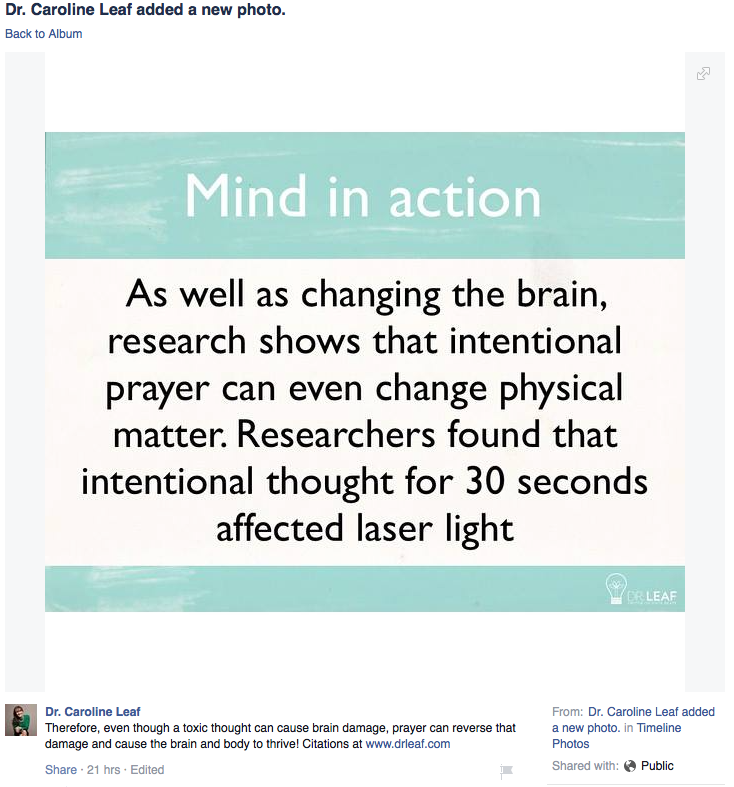
Dr Caroline Leaf is a communication pathologist and self-titled cognitive neuroscientist. Hiding in amongst her “Scientific Philosophy” was this juicy factoid: “Researchers found that intentional thought for 30 seconds affected laser light.” This is, apparently, also proof that prayer can change physical matter.

I actually thought it was God that changed physical matter if He agreed with our prayer requests, and not our prayers themselves, because if it was simply our prayer, then we wouldn’t need God. That’s probably a blog for another time. Still, it was her last statement that caught my attention. Intentional thought can change the properties of laser! I’d never heard that before! I had to find the references.

It turns out that the paper Dr Leaf is referring to is, “Testing nonlocal observation as a source of intuitive knowledge” [1]. In this experiment, Dr Dean Radin, a paranormal researcher, took 5 “experienced meditators” and 5 normal control subjects, and asked them to mentally interfere with a laser beam pointed at a light-reading CCD sensor inside a sealed box. He averaged out the intensity of the light pattern that was read by the CCD. He believed he found a difference in the amount of light that was read by the sensor when the meditators “blocked” the laser light compared to non-meditators and control runs.

In his original paper, Radin published the following graph of his results.

Screen Shot 2015-05-24 at 10.27.48 pm

The length of the bars represent a statistical value based on the results, not the actual results of the experiments. The simplest explanation is that the further down the bar goes, the greater the degree of interference to the laser light. Radin believed the effect was caused by the meditators literally interfering with the quantum mechanics of the photons in the laser beam, “observing” them from outside of the box, thus causing their wave function to collapse and stopping them from reaching the sensor.

However, notice that the first few experiments show a large effect, but that this diminishes as the experiments go along, and towards the end, the control groups and the meditator group is actually about the same, with no interference to the laser light at all. This effect is called the Decline Effect, and is common problem amongst studies of the paranormal. It’s a result of a phenomenon called ‘regression to the mean’, or in other words, the more times you perform an experiment, the more likely the results will line up with the true average. I think in Radin’s case, it also had a lot to do with his own expectations.

Radin himself was honest enough to discuss the effect in his paper. In his own words, “Although I had employed numerous design features to avoid artifacts (sic), and only four of the 10 control sessions conducted to that point had gone in the predicted direction, I still found it difficult to believe that the experimental effect was as easily repeatable as the results were suggesting. I knew that if I had trouble believing it, I could hardly expect anyone else to accept these results. So I found that my intentions for the experiment changed – I no longer hoped to observe results solely in the predicted direction, but rather I found myself hoping that some of the remaining sessions would go against the prediction, to validate that the methodology was not biased.” [1]

So, Radin probably caused the effect by wanting to see it. He excluded data that didn’t suit his hypothesis, citing a technical issue with the equipment, and instead focussed on the data set that still seemed to fit. He also performed the analysis of the data, which he biased with his own pre-conceived notions.

The other nail in the coffin for this paper is that it was a pilot study that was done by one researcher, which no one has since tried, or succeeded in, replicating. Indeed, the methodology for this research was based on a series of experiments done by a real physicist with better equipment, Professor Stanley Jeffers, a professor of physics at York University in Toronto, Canada, who performed the experiment about 74 times and found no effect [2].

So, Dr Leaf has cited this isolated, error prone, biased and unconfirmed paper of Radin’s as proof of the ability of thought to change physical matter, and indeed, as prayer’s ability to change physical matter.

This is simply more proof that Dr Leaf is prone to rush in where angels fear to tread, and latch on to any “research” that supports her ideas, no matter how tenuous or unscientific. She did the same thing when she cited a conference poster from a paranormal conference in the early 90’s, and claimed it was definitive proof that our thoughts can change our DNA. In actual fact, the paper was so full of flaws [3: Ch 13, The “ingenuous” experiment] that the only thing it could show was how desperate Dr Leaf is to try and justify her unscientific pet theories.

This tendency for Dr Leaf to rely on such poor science, and link it to fundamental Biblical concepts, dishonours science, the truth of the Bible, and her audience.

I think Dr Leaf would be wise to review her scientific philosophy and the “research” that she uses to justify it, rather than continuing to utilise tenuous and inaccurate articles from studies of the paranormal.

References

[1]        Radin D. Testing nonlocal observation as a source of intuitive knowledge. Explore 2008 Jan-Feb;4(1):25-35.

[2]        Alcock JE, Burns J, Freeman A. Psi wars: Getting to grips with the paranormal: Imprint Academic Charlottesville, VA, 2003.

[3]        Pitt CE. Hold That Thought: Reappraising the work of Dr Caroline Leaf. 1st ed. Brisbane, Australia: Pitt Medical Trust, 2014.

Going green – why envy is an adaptive process

The Bible says, in Job 5:2, “For wrath kills a foolish man, And envy slays a simple one.”

A German proverb goes, “Envy eats nothing, but its own heart.”

Dr Caroline Leaf, communication pathologist and self-titled cognitive neuroscientist, posted today on her social media feeds, “Jealousy and envy creates damage in the brain … but … celebrating others protects the brain!”

Yes, sometimes envy isn’t good for us. Emotions guide our thought process, and like all emotions that are out of balance, too much envy can cloud our better rational judgement and bias our perception of the world. Thankfully, envy doesn’t literally eat out our hearts or literally cause brain damage.

If anything, envy when experienced in a balanced way can actually improve our brain functioning. According to real cognitive neuroscientists, envy and regret are emotions that help us because they both fulfil the role of effectively evaluating our past actions, which improves our choices in the future. As Coricelli and Rustichini noted, “envy and regret, as well as their positive counterparts, share the common nature that is hypothesized in the functional role explanation: they are affective responses to the counterfactual evaluation of what we could have gotten had we made a different choice. Envy has, like regret, a functional explanation in adaptive learning.” [1]

When it comes to the human psyche, there is no black or white, good vs evil distinction between different feelings or emotions. B-grade life coaches and slick pseudoscience salespeople dumb down our emotions into a false dichotomy because it helps sell their message (and their books). Every emotion can be either helpful or unhelpful depending on their context in each individual.

As Skinner and Zimmer-Gembeck wrote, “Emotion is integral to all phases of the coping process, from vigilance, detection, and appraisals of threat to action readiness and coordinating responses during stressful encounters. However, adaptive coping does not rely exclusively on positive emotions nor on constant dampening of emotional reactions. In fact, emotions like anger have important adaptive functions, such as readying a person to sweep away an obstacle, as well communicating these intentions to others. Adaptive coping profits from flexible access to a range of genuine emotions as well as the ongoing cooperation of emotions with other components of the action system.” [2]

If you find your thoughts and feelings tinged by the greenish hue of envy, don’t worry, it’s not necessarily a bad thing. Your heart isn’t going to consume itself and you won’t sustain any brain damage. Use envy or regret as tools of learning, tools to help you evaluate your choices so that you make a better choice next time. Having balanced emotions is the key to learning and growing, coping with whatever obstacles life throws at us.

References

  1. Coricelli, G. and Rustichini, A., Counterfactual thinking and emotions: regret and envy learning. Philos Trans R Soc Lond B Biol Sci, 2010. 365(1538): 241-7 doi: 10.1098/rstb.2009.0159
  2. Skinner, E.A. and Zimmer-Gembeck, M.J., The development of coping. Annu Rev Psychol, 2007. 58: 119-44 doi: 10.1146/annurev.psych.58.110405.085705

Dr Caroline Leaf and the law of great power

Screen Shot 2014-12-05 at 12.37.55 am

Tonight as I was flicking through Facebook one last time, a post caught my eye. It read,

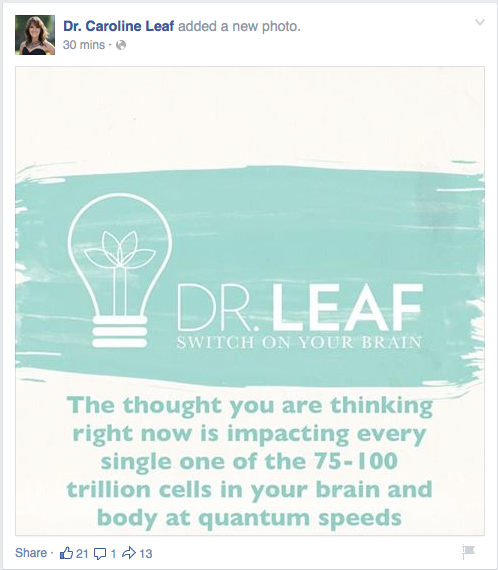
“The thought you are thinking right now is impacting every single one of the 75-100 trillion cells in your brain and body at quantum speeds”

Dr Leafs social media gem gave me an eerie sense of deja vu. It was only the end of October when she posted the same factoid on social media. Today’s version has been tweaked slightly, although in all fairness, I can’t describe it as an upgrade.

Dr Caroline Leaf is a communication pathologist and self-titled cognitive neuroscientist. On the 23rd of October 2014, she posted this on her social media stream, “Every thought you think impacts every one of the 75-100 trillion cells in your body at quantum speeds!”

On comparing the pair, Dr Leaf has added “brain” into the number of cells under the influence, and then massaged the opening slightly. I already had significant concern about the scientific validity of the previous meme in October. That hasn’t changed. Rather than improving the accuracy of her meme, Dr Leaf’s changes have left it missing the mark.

The fundamental fallacy that thoughts are the main controlling influence on our brain is still there. Thought is simply a conscious projection of one part of the overall function of our brain. Our brains function perfectly well without thought. Thought, on the other hand, doesn’t exist without the brain. Our brain cells influence our thoughts, not the other way around.

The myth of “quantum speeds” is still there. Our neurones interact with each other via electrochemical mechanisms. Like all other macroscopic objects, our brains follow the laws of classical physics. It’s not that quantum physics doesn’t apply to our brains, because quantum mechanics applies to all particles, but if you think you can explain macroscopic behaviour using quantum physics, then you should also try and explain Schrodingers Cat (see also chapter 13 of my book [1] for a longer discussion on quantum physics). Dr Leaf is particularly brave to make such bold statements about quantum physics when even quantum physicists find it mysterious.

What made me slightly embarrassed for Dr Leaf is the new part of her statement. In my blog on Dr Leaf’s previous attempt at this meme, I pointed out that Dr Leaf’s estimate of the number of cells in our body was more than three times that of the estimate of scientists at the Smithsonian (http://www.smithsonianmag.com/smart-news/there-are-372-trillion-cells-in-your-body-4941473/?no-ist). The fact that Dr Leaf so badly estimated, when all she needed to do was a one line Google search, suggested that she just made the number up. Failing to cite her source eroded at her credibility as a scientist.

Today, Dr Leaf still claims that there are 75-100 trillion cells in the brain and the body. The Smithsonian still hasn’t changed its estimate. Dr Leaf still hasn’t cited her source, and has ignored a world-renowned scientific institution. Perhaps Dr Leaf believes she knows more than the scientists at the Smithsonian? Perhaps she has a better reference? We’ll never know unless she cites it.

Taken as a whole, her meme is no closer to the truth than it was six weeks ago. Some may ask if it really matters. “Who cares if we have 37.2 trillion cells or 100 trillion cells or even 100 billion trillion”. “So what if our thoughts influence us or not.” If this was just a matter of a pedantic argument between some scientists over a coffee one morning,then I’d agree, it wouldn’t be so important. But Dr Leaf claims to be an expert, and more than 100,000 people read her memes on Facebook and many more on Twitter, Instagram, and the various other forms of social media she is connected to. Nearly every one of those people take Dr Leaf at her word. Ultimately the issue is trust.

If Dr Leaf can misreport such a simple, easily sourced fact, and not just once but twice now, then what does that mean for her other factoids and memes that she regularly posts on social media? If Dr Leaf incorrectly says that every thought we think impacts every cell in our body, then hundreds of thousands of people are wasting their mental and physical energy on trying to control their thoughts when it makes no real difference, and if anything might make their mental health worse [2, 3].

This is more than just a pedantic discussion over a trivial fact.  These memes matter to people, and can potentially influence the health and wellbeing of many thousands of lives.

Peter Parker, quoting Voltaire, said, “With great power comes great responsibility.”  Just because Spiderman said it doesn’t diminish the profundity of that statement.  This law of great power applies to Dr Leaf as much as it does to Spiderman.  I hope and pray that she gives this law of great power the consideration it deserves.

References

  1. Pitt, C.E., Hold That Thought: Reappraising the work of Dr Caroline Leaf, 2014 Pitt Medical Trust, Brisbane, Australia, URL http://www.smashwords.com/books/view/466848
  2. Garland, E.L., et al., Thought suppression, impaired regulation of urges, and Addiction-Stroop predict affect-modulated cue-reactivity among alcohol dependent adults. Biol Psychol, 2012. 89(1): 87-93 doi: 10.1016/j.biopsycho.2011.09.010
  3. Kavanagh, D.J., et al., Tests of the elaborated intrusion theory of craving and desire: Features of alcohol craving during treatment for an alcohol disorder. Br J Clin Psychol, 2009. 48(Pt 3): 241-54 doi: 10.1348/014466508X387071

Dr Caroline Leaf and the cart before the horse, take two

Screen Shot 2014-12-01 at 8.23.44 pm

In between her sightseeing in the UK and ballet concerts in the Ukraine, Dr Leaf, communication pathologist and self-titled cognitive neuroscientist, took the time to post some more memorable memes.

Today, Dr Leaf posted, “A chaotic mind filled with thoughts of anxiety, worry, etc. sends out the wrong signal right down to the level of our DNA.”

Hmmm, that one looked familiar … actually, Dr Leaf posted the exact same phrase on the 5th of October this year.  I’m all for recycling, but of renewable resources, not tired ideas.

This meme has been soundly rebuffed before, and the idea that the mind controls our DNA has been thoroughly dismantled.  Reposting it won’t make it any truer.

This meme is better off being put into the trash than the recycling bin.

(For more information on the rebuttal of the mind over matter meme, see also “Hold that thought: Reappraising the work of Dr Caroline Leaf“, “Dr Caroline Leaf: Putting thought in the right place” Part 1 and Part 2, “Dr Caroline Leaf and the matter of mind over genes“, “Dr Caroline Leaf, Dualism, and the Triune Being Hypothesis”, “Dr Caroline Leaf and the Myth of the Blameless Brain” and “Dr Caroline Leaf and the Myth of Mind Domination” just to name a few references).

Don’t stress about stress – Part 3: Coping

In our last two blogs, we’ve been looking at stress, and why stress is usually more helpful than harmful.

It’s not that stress can never be harmful. Stress can be a trigger to some illnesses (although not as many as the popular media often portrays). What is it that makes the difference between helpful and harmful? What is it that causes one person to surf the tsunami of sewerage that often confronts us in life, while another person sinks?

The answer lies in resilience.

WHAT IS RESILIENCE?

Resilience is the term given to the individual’s capacity to cope.

Researchers in the field of psychiatry often use the term resilience, which “is the capacity and dynamic process of adaptively overcoming stress and adversity while maintaining normal psychological and physical functioning” [1] although psychologists and social science researchers would use the term “coping”, which is defined by Compas et al as, “conscious and volitional efforts to regulate emotion, cognition, behavior, physiology, and the environment in response to stressful events or circumstances.” [2] Skinner and Zimmer-Gembeck define coping as, “action regulation under stress.” [3]

Considering the definitions used, the terms are essentially interchangeable. The other observation to be made here is that coping/resilience is an active process. It’s not something that happens despite of us – we actively cope with stress. In the face of a situation involving emotional arousal (danger or stress), we take steps to deal with our inner and outer environments (the physiological processes of our body, as well as the environment around us). Sometimes these steps are conscious and/or under our control. But theorists also consider automatic, unconscious, and involuntary responses to also be part of the coping spectrum [4].

WHAT CONTRIBUTES TO RESILIENCE?

Coping Strategies

What makes up those actions? What influences the action steps?

Psychologists have described hundreds of individual methods of coping through recent research, although there have been efforts to consolidate the plethora of individual coping strategies into “family” clusters, based on function. For example, a primary tier is to “Coordinate actions and contingencies in the environment” which involves “finding additional contingencies” which on the third level involves “reading, observation, and asking others.” [3] Table 1 in the paper by Skinner and Zimmer-Gembeck [3] summarize the many ways of coping and how they can be grouped together into families, and their corresponding adaptive process.

Personality factors

Coping strategies follow along the lines of personality type [5], as well as the stage of development in children [3]. Personality types such as Neuroticism and Openness have been well studied, with Neuroticism associated with maladaptive coping strategies, and Openness correlated with adaptive coping (in marital relationships [6] and in public speaking tasks [5]).

Further research has shown how personality significantly influences coping, with the severity of the stress, and the age and culture of a person influencing the strategy and strength of the coping response [4]. Of course, personality traits like neuroticism sound bad, but they confer their own strengths. For example, negative affect has protective benefits by enhancing the detection of deception [7].

Biological factors

The shared connection that personality types and coping responses have is in their shared genetics, with personality and coping styles influenced by common genes [8]. This makes perfect sense as it has been shown that changes in individual genes effect the ability of the brain to associate the correct value to rewards [9], which then influences both mood [10], and learning [11]. Even though environmental variables are important in determining personality and learning aspects of coping with stress, the brains underlying capacity to process the incoming signals correctly will significantly influence the direction and outcome of the learning process, which includes learning which coping strategies work best for each individual.

On a deeper level, there are several biological processes that make up the features of resilience. Animal studies on resilience, as a whole, have shown that resilience “is mediated not only by the absence of key molecular abnormalities that occur in susceptible animals to impair their coping ability, but also by the presence of distinct molecular adaptations that occur specifically in resilient individuals to help promote normal behavioral function.” [12] That is, resilient individuals have the full complement of critical components in the resilience pathway, and have some extra tools too.

Human studies thus far have shown strong links to genetic changes that affect the proteins in the stress system. Epigenetic mechanisms are involved, and the role of the environment is also significant, especially uncontrollable early childhood trauma. Wu et al list the current studies of genetic changes that effect resilience in humans [1: Table 1]. The proteins involved are responsible for the growth of new nerve pathways (BDNF), and for their function, especially within the stress system (CRHR1, FKBP5) and in control of mood and reward systems (COMT, DAT1, DRD2/4, 5-HTTLPR, the HTR group).

Wu et al [1] also summarised the currently known facts about epigenetic factors in resilience. Interestingly, they noted an animal study in which chronic stressors increased an epigenetic marker called histone acetylation in the hippocampus in mice, which enhanced the protective effects of the stress (epigenetics will be the subject of a future blog)

Resilience on a personal level

So coping and resilience are known protective factors for stress, and are more commonly deployed than most people realize. Despite all of the publicity that stress has generated, human beings remain remarkably unscathed. It’s estimated that, “in the general population, between 50 and 60% experience a severe trauma, yet the prevalence of illness is estimated to be only 7.8%.” [12] (Note: By ‘illness’, the authors were referring to Post Traumatic Stress Disorder, not all of human sickness).

But when it comes to recommending different coping strategies on an individual level, it is a much harder thing to do. What is adaptive in some situations and for some people is maladaptive in other situations and for other people.

For example, in animal studies, “stressed females tend to perform better than males on non-aversive cognitive or memory tasks … Conversely, in tests of acute stress or aversive conditioning, stress enhances learning in males and impairs it in females … the literature suggests that in cognitive domains females cope better with chronic forms of stress, whereas males tend to cope better with acute stress.” [12] So animal studies confirm a difference in the biological stress response between men and women. If these studies in animals can be extended to humans, it may explain the tendency for men to engage in “fight-or-fight” responses to stress where women usually move to “tend-and-befriend” mode [13].

Human studies on coping also demonstrate that what is good for one is not necessarily good for another. Connor-Smith and Flachsbart confirm that, “In particular, daily report and laboratory studies suggest that individuals high in sensitivity to threat may either benefit from disengagement or be harmed by engagement in the short term, with the opposite pattern appearing for individuals low in threat sensitivity.” [4]

So in other words, just because engaging may be a positive method of coping does not mean that it should be recommended to everyone. Some people will have more harm from trying to engage. Care should be taken when giving people advice about how to manage their stress. Ill-informed instructions can actually make things worse.

SUMMARY

It’s well established that stress can have negative impacts on your physical and mental health. But contrary to the popular view, stress is not always bad. As a number of authors point out, most people go through significant stress at some point in their lives, but only a fraction succumb to that stress.

The difference is the factors that make up resilience. Where we are along the stress spectrum (that is, whether you are wired to be more stressed, or more resistant to stress) depends on our genetic predisposition, which determines the physiology of our stress system and our personality, and the ways we learn to cope.

How we cope best depends on our individual traits and the situation. There is no one-size-fits-all. Pushing a person into a form of coping that’s not suitable can actually cause a lot of harm.

Remember, we normally find what coping strategies work for us automatically as our resilience is mostly innate, and we all go through severe stress at some point or another in our lives, but only a small fraction of us will succumb to that stress.

In the last blog in the series, we’ll have a brief look at what happens when stress overwhelms us … when stress is breaking bad.

References

  1. Wu, G., et al., Understanding resilience. Front Behav Neurosci, 2013. 7: 10 doi: 10.3389/fnbeh.2013.00010
  2. Compas, B.E., et al., Coping with stress during childhood and adolescence: problems, progress, and potential in theory and research. Psychol Bull, 2001. 127(1): 87-127 http://www.ncbi.nlm.nih.gov/pubmed/11271757
  3. Skinner, E.A. and Zimmer-Gembeck, M.J., The development of coping. Annu Rev Psychol, 2007. 58: 119-44 doi: 10.1146/annurev.psych.58.110405.085705
  4. Connor-Smith, J.K. and Flachsbart, C., Relations between personality and coping: a meta-analysis. Journal of personality and social psychology, 2007. 93(6): 1080
  5. Penley, J.A. and Tomaka, J., Associations among the Big Five, emotional responses, and coping with acute stress. Personality and individual differences, 2002. 32(7): 1215-28
  6. Bouchard, G., Cognitive appraisals, neuroticism, and openness as correlates of coping strategies: An integrative model of adptation to marital difficulties. Canadian Journal of Behavioural Science/Revue canadienne des sciences du comportement, 2003. 35(1): 1
  7. Forgas, J.P. and East, R., On being happy and gullible: Mood effects on skepticism and the detection of deception. Journal of Experimental Social Psychology, 2008. 44: 1362-7 http://bit.ly/Jm66a7
  8. Kato, K. and Pedersen, N.L., Personality and coping: A study of twins reared apart and twins reared together. Behavior Genetics, 2005. 35(2): 147-58 http://link.springer.com/article/10.1007%2Fs10519-004-1015-8
  9. Dreher, J.-C., et al., Variation in dopamine genes influences responsivity of the human reward system. Proceedings of the National Academy of Sciences, 2009. 106(2): 617-22
  10. Felten, A., et al., Genetically determined dopamine availability predicts disposition for depression. Brain Behav, 2011. 1(2): 109-18 doi: 10.1002/brb3.20
  11. Ullsperger, M., Genetic association studies of performance monitoring and learning from feedback: the role of dopamine and serotonin. Neuroscience & Biobehavioral Reviews, 2010. 34(5): 649-59
  12. Russo, S.J., et al., Neurobiology of resilience. Nature neuroscience, 2012. 15(11): 1475-84
  13. Verma, R., et al., Gender differences in stress response: Role of developmental and biological determinants. Ind Psychiatry J, 2011. 20(1): 4-10 doi: 10.4103/0972-6748.98407

Don’t stress about stress, part 2

ThatWhichDoesNotKillUs

In the last blog post, we looked at some of the different ways of looking at stress outside of the medical field – the stress on a guitar string, the power band of the car engine, and the action of gravity on our bodies. In this post, I want to expand on those metaphors, using them to help us understand how we can respond to stress, and why stress isn’t our enemy, but it actually brings out our best if managed in the right way.

One of the reasons why gravity gives you strong muscles and bones, and zero gravity gives you weak muscles and bones, is because of resistance.

Movement involves work. We do “work” everyday in simple everyday activities, because our muscles and bones have to apply a certain amount of force in order to overcome gravity. Our muscles adapt by growing the muscle fibres to provide that force, and bones remodel themselves to provide the maximum resistance to the loads that gravity and the muscles put through them. We’re not aware of this day-to-day because we never experience prolonged changes in our gravitational fields.

But when we need to do more work than our muscles are accustomed to, our muscle fibres increase in strength, first as the nerve networks that supply the muscles become more efficient, after about two weeks of ongoing training, the fibres themselves increase in size [1, 2]. The growth in muscle fibres is caused by three related factors: mechanical tension, muscle damage and metabolic stress [2]. Mechanical tension involves “force generation and stretch”. In other words, the muscle fibres are stretched just beyond their usual capacity, and they actively fight against the resistance. This damages the weaker muscle fibres, which are repaired. The remaining muscle fibres are forced to adapt by growing larger because of the stimulation of growth factors [2].

One of my favorite “Demotivator” posters says, “That which does not kill me postpones the inevitable” [3]. Of course, the phrase that they’ve parodied is, “That which does not kill us makes us stronger.” Why is there truth to that idiom? Adversity occurs when life circumstances come against us. In other words, adversity resists us. In the arm wrestle between adversity and overcoming, work is involved. We have to fight back.

In a similar way, we grow when adversity pushes us just beyond what we have done before, stretching us. We may sustain some damage in the process, but that helps to reduce our weaknesses, and forces us into growth as we heal. When we push back against adversity, the “cells” of our character grow.

Of course, we all know examples where muscles fail under intense or prolonged loads. I vividly remember the pictures of the UK’s Paula Radcliffe, succumbing to the grueling hills and scorching Athens heat with only four miles left in the 2004 Olympic Marathon. Muscle failure from excessive stretch or excessive endurance parallels the allostatic load response, which is what people commonly referred to as ‘stress’.

Scientific evidence that stress is positive

There have been recent studies in animals that demonstrate that stress is physically as well as mentally enhancing.

Neurogenesis is the process of new nerve cell formation. Studies of rodents placed under intermittent predictable stressors showed an increase in neurogenesis within the hippocampus, which is the part of the brain related to learning and memory. Along with this enhancement of neurogenesis, the function of the hippocampus increased, specifically hippocampal-dependent memory, with a reduction in depression and anxiety-like behaviours.

As Petrik et al noted in their review, “Contrary to stress always being ‘bad’, it has long been appreciated that stress has an important biological role, and recent research supports that some amount of stress at the right time is actually useful for learning and memory.” [4]

Lessons from stress

So what can we learn from stress? How do we use the stress that we are exposed to every day to make us grow strong and durable?

Firstly, like the guitar string, we need to learn when we are in tune, at the peak of our productivity. Or like the car engine, what it feels like to be in the power band. When we know where our sweet spot is, we can operate within it, achieving our best in life without doing ourselves harm. This is the first point that we need to identify on our own personal stress/productivity curve. This is the point of maximum productivity.

The other life principle to be gained from the car engine analogy is that not all of us are high performance engines. I would love to think that I’m a F1 racing engine – highly tuned, supreme power – but I recognise my limitations. I would even settle for a 5-litre V8, but I know that I’m probably more like a well-tuned V6. We are what we are. Sometimes we apply the most stress to ourselves when we try to drive in the power band of someone else’s engine. We need to accept who we are.

It seems logical that if too much stress is bad for us, then having little or no stress is good for us. But like the new guitar string, minimal stress makes us unproductive. Like zero gravity on the body, little or no stress makes us weak.

And we need to understand that a bit more stress is ok. It’s inevitable that we are going to be stressed beyond what we usually cope with at times. But without that challenge, there would be no growth. Challenges usually hurt. You can’t have growth without pain. In the muscle analogy, at the stretch at which peak growth occurs, muscle fibres tear and the lactic acid build up in the remaining cells can be very uncomfortable. The key is learning how far we can push ourselves before we start to falter and fail. This is the second point we need to discover on our personal stress/productivity curve. This is the point of maximum growth.

Once we understand our own individual points of maximum productivity and growth, we can use them as guides to our personal growth and achievement. Actually, I should specify that these are our starting points, since as we face challenges and experience growth, the points will change slightly. We can remap those points and continue in our pattern of growth and development.

Pushing ourselves into just enough stress to achieve growth, then pulling back to rest and restore, is a pattern of growth that is seen in many facets of the natural world and the human body. Body builders and athletes use this method all the time in their training. They push themselves with more repetitions and heavier weights, or longer or faster runs, then they pull back to consolidate their gains. During our adolescence, our bodies naturally go through growth spurts – periods of rapid growth followed by a plateau, before the next burst of growth hormone hits us again. Even tree rings demonstrate that growth and consolidation occur all the way through the natural world.

This is the Stressed-Rest cycle. The studies in animals on neurogenesis strengthen the theory, because it was the animals that experienced bursts of stress that showed enhanced neurogenesis, memory and reduced depression/anxiety behaviours.

If you want maximum personal growth, constant stress does not help. There has to be times of rest. Some people think that rest time is wasted time, reducing productivity. But as explained, without rest time, productivity rapidly falls away. Without rest, stress goes bad, leading to allostatic overload.

So in summary, excessive stress is bad. But if all stress were bad, then we would all crumple any time that something became difficult. So stress is not a force for evil. Stress is part of our normal everyday lives, and is vital if we are to see ongoing personal growth.

We know from living life that we all don’t fall in a heap when things go wrong. We have in-built ways of coping that help us to absorb troubles and adversities and like emotional photosynthesis – turn them into fuel for growth.

This is the science of resilience, the counterbalance to the forces of stress that help us cope and adapt in a rapidly changing natural and social environment, the Yang to allostatic overload’s Yin. A discussion on the science of stress is not complete without a discussion of resilience, which I’ll discuss in the next blog in this series.

References

  1. Hortobagyi, T. and Maffiuletti, N.A., Neural adaptations to electrical stimulation strength training. Eur J Appl Physiol, 2011. 111(10): 2439-49 doi: 10.1007/s00421-011-2012-2
  2. Schoenfeld, B.J., The mechanisms of muscle hypertrophy and their application to resistance training. J Strength Cond Res, 2010. 24(10): 2857-72 doi: 10.1519/JSC.0b013e3181e840f3
  3. Adversity. Demotivators [cited July 2013]; Available from: http://www.despair.com/adversity.html.
  4. Petrik, D., et al., The neurogenesis hypothesis of affective and anxiety disorders: are we mistaking the scaffolding for the building? Neuropharmacology, 2012. 62(1): 21-34 doi: 10.1016/j.neuropharm.2011.09.003

Don’t stress about stress – Part 1

Stress gets a bad rap. Everywhere you look, stress seems to be getting the blame. Though as Richard Shweder wrote in the New York Times, “Imprecise and evasive language may be a disaster for science but it is a boon in everyday life. ‘I am stressed out’ is non-accusatory, apolitical and detached. It is a good way to keep the peace and, at the same time, a low-cost way to complain.” [1]

Selye said that, “Everybody knows what stress is, but no one really knows.” [2] Hans Selye is considered the father of modern stress research. He was one of the first scientists to conceptualise and measure this ethereal force.

As with some of the most important discoveries in the history of science, Selye came upon the discovery of what he termed the “alarm reaction” incidentally when he was injecting rats with impure ovarian extract, and noted that they became sick. He looked further at the physical changes in the rats and noted an unusual cluster of changes to their adrenal glands, thymus, spleen and gut [3]. He was able to reproduce the same responses by exposing the rats to cold temperatures, surgical injury, spinal shock, excessive muscular exercise, or intoxications with sublethal doses of drugs such as adrenaline, morphine or formaldehyde [4]. After years of research, he confirmed that ongoing exposure to the same physical conditions or drugs would follow the same three-stage process of initial physical changes, recovery and adaptation, then eventually exhaustion (and death). He called this model the “General Adaptation Syndrome.” [4]

The General Adaptation model was groundbreaking, and the sheer volume of work done by Selye brought his theories to the forefront of the scientific community. With time, the theory slowly descended from its place of adulation as other evidence came to light [5], but it has remained foundational, and Selye is still revered as the father of modern stress research.

The term stress “generally refers to experiences that cause feelings of anxiety and frustration because they push us beyond our ability to successfully cope.” [6] Scientifically, stress has been difficult to define. Different researchers often use different definitions of stress depending on what they’re studying or what field of psychology or science they belong to [7].

I wanted to look at stress from a different perspective. In the next series of posts, I want to look at the basic concepts of stress and its functions in nature. I will spend some time looking at different ways of conceptualising stress, and look at how they offer is life lessons on how to approach our stress. I’ll then have a look at what it is that helps us cope with stress.

A broad concept of stress

To gain a better understanding of stress, it’s useful to step away from the medical concept of stress, and think about what the term means in other fields.

When an engineer thinks about stress, it’s usually in relation to a physical force on a material object. My son is a huge Mythbusters fan. He was watching an episode the other day where the Mythbusters were testing the myth of Pykrete, a material that was nothing but wood shavings and ice. They were testing to see whether it was more durable than ice alone, whether it was bulletproof, and whether it could be used to build a boat! [8] In order to test out these crazy claims, they made some in their workshop and compared it with normal ice. How did they test it? By stressing it – placing weights on the end of the block of the ice/pykrete until it broke. (In the end, pykrete was ten times stronger than ice, was bulletproof, and they made a fully operational motor-boat from it!)

So the mechanical definition of stress is, “pressure or tension exerted on a material object.” [9] There are a few illustrations of mechanical stress, in our bodies and in everyday life, that are good metaphors for stress in our lives.

The Classical Stress/Productivity Curve

I confess I am NOT a musician. I’ve never learnt to read music or play an instrument. But I do know that when you first put a new string on the guitar, it’s unstretched – there is literally no force on it at all. If all you did was tied the two ends of the string to the tone peg and the tuning peg, the string would remain limp and lifeless. It wouldn’t be able to do anything useful. It certainly wouldn’t play a note.

When the tuning peg is twisted a few times, there is some tightness in the wire. The string is now under tension (i.e. stress). It is now able to play a note of some form, so it can do some work and fulfill some of the function of a guitar string. But the pitch isn’t good enough – the note is out of tune.

With a small adjustment, the string reaches its optimal tension and can play the correct note! This is the point where the string is fulfilling its designed purpose. Optimal stress equals optimal function.

With further tightening of the string, the perfect pitch is lost, but the string can still produce a sound of some form. With more tension, the string can still make a noise, but it sounds awful, and the fibres inside the cord are starting to tear. If the string were wound further and further, it would eventually break.

If this ratio of the tension of the string versus the usefulness of the string were to be plotted as a graph, it would look like an upside down “U”. This is the classic stress/productivity curve.

StressProductivityCurve_Final

The Exponential Stress/Productivity Curve

The second metaphor that I think illustrates a different concept of the stress/productivity relationship is a car.

As well not being a musician, I am also NOT a mechanic! I know the important things like where the petrol goes, and how to drive them, but otherwise cars are very mysterious and powerful devices, their mystery is only exceeded by their power.

What I do know is that the engine is very much like the guitar string. As more petrol is fed into the engine, the engine gets more powerful. Soon, the engine finds its “power band”, a zone of maximum torque that can be achieved at moderate revolutions. As the engine is given more gas, the power output declines from the middle of the power band. If the engine was maxed out then the amount of functional power coming out is reduced.

This would plot as a similar graph to the U-curve of the stress/productivity curve. But cars not only have engines, but also a gearbox. The gears allow for multiplication of the work done (the productivity) for the same stress on the engine.

G-Force!

As a child, I didn’t dream of becoming an astronaut, but I was interested in space. The beauty of our night sky is as stunning as any forest, river or mountain. I would read of the astronauts in rockets and in space stations, floating around in zero gravity, swimming through the “air”. That sounded like a lot of fun.

But zero gravity isn’t particularly good for you. Some early astronauts had to be carried off their landing craft on stretchers because the effect of zero gravity would render these men weak and atrophied. They boarded the spacecraft at the peak of their physical strength and fitness, but after only a few weeks without gravity, their bodies resembled that of the elderly (although without the wrinkles) [10].

It’s a general principle of the human body that any tissue that isn’t needed shrinks in size – a process called atrophy. In zero gravity, the body doesn’t need as much muscle, so the muscles shrink. The body doesn’t need as much bone strength, so the bones weaken. There is no gravity to pull their blood away from their head, so the blood volume decreases. Because there is less muscle to pump blood to, and less blood to pump, the heart doesn’t work as hard, so the heart muscle atrophies. The net effect of zero gravity is to make you physically weak [10].

On the other hand, too much gravity is not great either. Animals can adapt to small amounts of hypergravity [11]. But large amounts aren’t so good. During astronaut training, NASA subjects the rookie spacemen to rigorous tests including placing them in a large centrifuge and spinning it very fast. The result is an increase in the gravitational forces applied to their bodies. The increased gravity makes everything in the body heavier and their blood is pulled towards the legs and away from the brain, which leads to what is known as G-LOC (Gravity-induced Loss Of Consciousness). In other words, the heart can’t fight the increased force of gravity and the brain loses its blood supply, which makes you pass out. Josh McHugh did an entertaining piece on his experience with G-LOC and the centrifuge in Wired (2003) [12].

In this sense, gravity is to us physically like stress is to us mentally. Without gravity, our physical bodies turn to mush as we slowly weaken from the inside. Too much gravity, and our physical bodies are slowly squashed by the invisible weight of the extra G’s. Our bodies work best at 1G.

In the next post in this series, I’ll look at how these different models of stress apply to our everyday.

References

  1. Shweder, R.A., America’s Latest Export: A Stressed-Out World. The New York Times, New York, 26 January 1997 http://www.nytimes.com/1997/01/26/weekinreview/america-s-latest-export-a-stressed-out-world.html
  2. What Is Stress. [cited 2013, July]; Available from: http://www.stress.org/what-is-stress/.
  3. Half a century of stress research: a tribute to Hans Selye by his students and associates. Experientia, 1985. 41(5): 559-78 http://www.ncbi.nlm.nih.gov/pubmed/3888652
  4. Selye, H., A syndrome produced by diverse nocuous agents. 1936. J Neuropsychiatry Clin Neurosci, 1998. 10(2): 230-1 http://www.ncbi.nlm.nih.gov/pubmed/9722327
  5. Fink, G., Encyclopedia of stress. 1st ed. 2000, Academic Press, San Diego:
  6. McEwen, B.S., Protective and damaging effects of stress mediators: central role of the brain. Dialogues Clin Neurosci, 2006. 8(4): 367-81 http://www.ncbi.nlm.nih.gov/pubmed/17290796
  7. Hackney, A.C., Stress and the neuroendocrine system: the role of exercise as a stressor and modifier of stress. Expert Rev Endocrinol Metab, 2006. 1(6): 783-92 doi: 10.1586/17446651.1.6.783
  8. Beyond Entertainment / Discovery Channel, The Alaska Special 2 (Season 7, Episode 2), Mythbusters: 2009 Discovery Channel, 44min. http://www.imdb.com/title/tt1427433/
  9. Oxford Dictionary of English – 3rd Edition, 2010, Oxford University Press: Oxford, UK.
  10. Gravity Hurts (So Good). NASA Science | Science News 2001 [cited July 2013]; Available from: http://science1.nasa.gov/science-news/science-at-nasa/2001/ast02aug_1/.
  11. van Loon, J.J., Hypergravity studies in the Netherlands. J Gravit Physiol, 2001. 8(1): P139-42 http://www.ncbi.nlm.nih.gov/pubmed/12650205
  12. McHugh, J., Surviving 7G. Wired, 2003. November(11),

Dr Caroline Leaf and the tongues trivia tall tales

Screen Shot 2014-11-12 at 9.29.17 pm

In every day life, if someone started talking in strings of indecipherable, chaotic syllables, you’d be giving them quite a lot of space, concerned about how much methamphetamine they’d been using.

In the average charismatic church, it’s just another service (the speaking in tongues, not the meth).

I’ve grown up in Pentecostal churches, and was baptised in the Holy Spirit when I was a child, so I forget how freaky it is for those who’ve never seen a whole church start talking or singing in tongues. For the uninitiated, the Bible talks about speaking in other tongues, which is a “New Testament phenomena where a person speaks in a language that is unknown to him. This language is either the language of angels or other earthly languages (1 Cor. 13:1). It occurred in Acts 2 at Pentecost and also in the Corinthian church as is described in 1 Corinthians 14. This New Testament gift was given by the Holy Spirit to the Christian church and is for the purpose of the edification of the Body of Christ as well as for glorifying the Lord.” (http://carm.org/speaking-in-tongues)

In scientific terms, speaking in tongues is referred to as “Glossolalia”, from the Greek, ‘glosso-‘ ~ ‘the tongue’ and ‘-lalia’ ~ ‘to speak, to chat’. Scientists who initially studied it in the 60’s and 70’s drew the conclusion that glossolalia was related to psychopathology (that people who spoke in tongues were crazy) [1, 2], and in later decades, it was thought to be caused by a form of temporal lobe epilepsy [3].

Earlier today, Dr Caroline Leaf, a communication pathologist and self-titled cognitive neuroscientist, declared that, “When we speak in tongues, research shows that the areas involved in discernment in the brain increase in activity, which means we increase in wisdom.”

I was fascinated to find this research for myself. Dr Leaf never references her social media memes, so I started looking through the medical literature on the subject from respected databases like PubMed, and search engines like Google Scholar.

Despite a thorough search, I was only able to find one article that studied the pattern of brain activity during speaking in tongues. The article, “The measurement of regional cerebral blood flow during glossolalia: A preliminary SPECT study” [4] took five healthy women, psychiatrically stable, long term members of their churches, who had all spoken in tongues for many years. They scanned their brain activity after a period of singing to gospel songs in English and compared it to their brain activity after the same amount of time praying in tongues (while listening to the same music as before).

What they found was that the brain was more active in the left superior parietal lobe, while there was a decrease in brain activity in the prefrontal cortices, left caudate nucleus and left temporal pole. There was a trend for an increase in the activity of the right amygdala, but this may have just been chance.

So are any of those brain regions responsible for discernment as Dr Leaf suggested?

Well, that all depends on how you define “discernment”. “Discernment” is not really a common neurobiological term. The standard term in the literature is “judgement”. The brain regions that are associated with evaluation and judgement are the amygdala and ventral portions of the striatum as well as the ventromedial prefrontal cortex (vmPFC), orbitofrontal cortex (OFC), the insula, the dorsal anterior cingulate cortex (dACC), and the periaqueductal gray (PAG) [5].

Are there any parts of the brain that match in the two lists? Only one – the ventromedial prefrontal cortex, or vmPFC for short. The prefrontal cortex is important in reasoning and decision-making, especially if there is uncertainty or novelty, while the vmPFC in particular is involved in the use of goal-relevant information in guiding responses, e.g., assigning value to choice options [6].

According to Dr Leaf, “When we speak in tongues, research shows that the areas involved in discernment in the brain increase in activity”. But that’s certainly not what the research paper said. The actual research is entirely the opposite.

Again, there are really only two reasonable explanations as to why the research contradicts Dr Leaf; either there is another piece of research which supports Dr Leaf’s assertion, or Dr Leaf is simply wrong.

At the risk of repeating myself, Dr Leaf needs to quote her sources when she is writing her little social media memes. Her meme may be perfectly justified by robust scientific evidence, but if she isn’t willing to share her sources, we’ll never know, and the only conclusion remaining is that Dr Leaf can’t interpret simple research.

So as it stands, there really isn’t any evidence that speaking in tongues makes you more discerning. By trying to claim otherwise, Dr Leaf further undermines her own reputation and credibility as an expert.

References

  1. Hine, V.H., Pentecostal glossolalia: towards a functional reinterpretation. Journal for the Scientific Study of Religion, 1969. 8: 212-26
  2. Brende, J.O. and Rinsley, D.B., Borderline disorder, altered states of consciousness, and glossolalia. J Am Acad Psychoanal, 1979. 7(2): 165-88 http://www.ncbi.nlm.nih.gov/pubmed/370074
  3. Persinger, M.A., Striking EEG profiles from single episodes of glossolalia and transcendental meditation. Perceptual and Motor Skills, 1984. 58: 127-33
  4. Newberg, A.B., et al., The measurement of regional cerebral blood flow during glossolalia: a preliminary SPECT study. Psychiatry Res, 2006. 148(1): 67-71 doi: 10.1016/j.pscychresns.2006.07.001
  5. Doré, B.P., et al., Social cognitive neuroscience: A review of core systems, in APA Handbook of Personality and Social Psychology, Mikulincer, M., et al., (Eds). 2014, American Psychological Association: Washington, DC. p. 693-720.
  6. Nicolle, A. and Goel, V., What is the role of ventromedial prefrontal cortex in emotional influences on reason?, in Emotion and Reasoning, Blanchette, I., (Ed). 2013, Psychology Press.

STOP THE PRESSES! Dr Leaf releases a new meme based on my correction, still doesn’t acknowledge source. (13 November 2014)

Screen Shot 2014-11-13 at 8.08.23 am


So, I can’t find fault on what Dr Leaf said here.  It fits with the paper I quoted from Newberg et al (2006).  Still, it begs the question of why Dr Leaf couldn’t have said this in the first place, and why she still isn’t willing to share her citations?

It also raises the other obvious question, why is it important to know what our brain does in glossolalia?  It’s only a study of 5 patients, and I’m sure that not all episodes of speaking in tongues is associated with decreased intentionality.  The research, being so small, isn’t a true reflection of the practice of speaking in tongues.  Lets hope that the future will bring more funding to better study this central tenet to the charismatic faith.

Putting thought in the right place, part 2

CAP v2.1.2

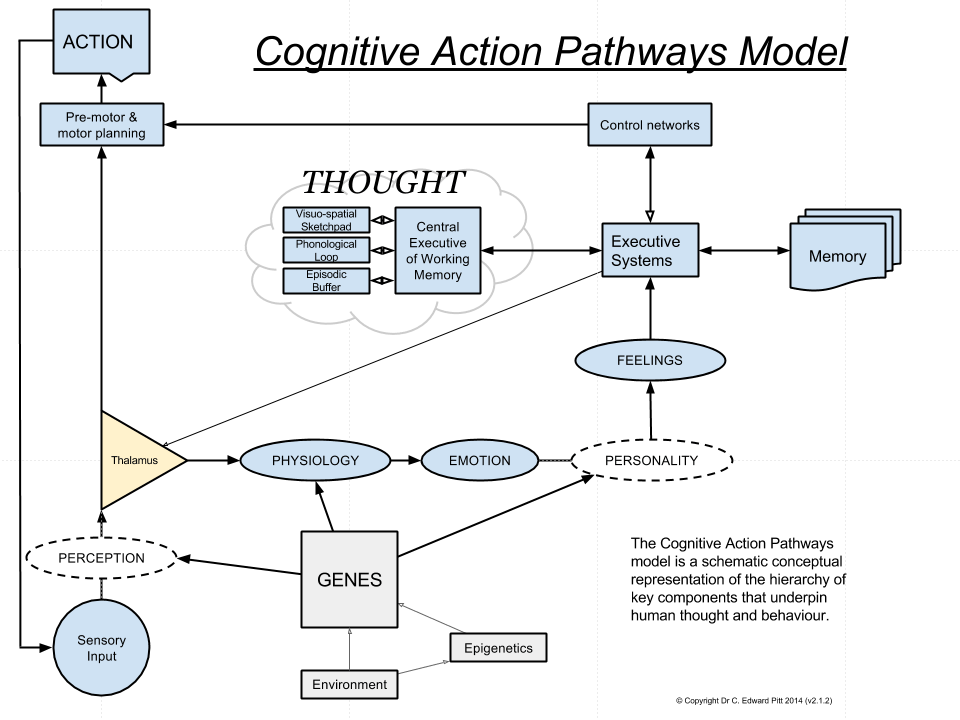
In the last blog post, I discussed the Cognitive Action Pathways model, a schematic conceptual representation of the hierarchy of key components that underpin human thought and behaviour.

Small changes in the early processes within the Cognitive-Action Pathway model can snowball to effect every other part of the process. A real life example of this is ASD, or Autism Spectrum Disorder.

ASD has been present since time immemorial. Numerous bloggers speculate that Moses may have had ASD, while a couple of researchers proposed that Samson was on the spectrum (although their evidence was tenuous [1]). Thankfully, autism is no longer considered a form of demon possession or madness, or schizophrenia, or caused by emotionally distant “refrigerator mothers”, nor treated with inhumane experimental chemical and physical “treatments” [2, 3].

The autism spectrum is defined by two main characteristics: deficits in social communication and interaction, and restricted repetitive patterns of behaviour. People on the autism spectrum also tend to have abnormal sensitivity to stimuli, and other co-existing conditions like ADHD. The full diagnostic criteria can be found in DSM5. The new criteria are not without their critics [4-6], but overall, reflect the progress made in understanding the biological basis of autism.

ASD is recognized as a pervasive developmental disorder secondary to structural and functional changes in the brain that occur in the womb, and can be detected as early as a month after birth [7]. In the brain of a foetus that will be born with ASD, excess numbers of dysfunctional nerve cells are unable to form the correct synaptic scaffolding, leaving a brain that is large [8, 9], but out-of-sync. The reduced scaffolding leads to local over-connectivity within regions of the brain, and under-connectivity between the regions of the brain [10]. The majority of the abnormal cells and connections are within the frontal lobe, especially the dorsolateral prefrontal cortex and the medial prefrontal cortex [11], as well as the temporal lobes [12]. The cerebellum is also significantly linked to the autism spectrum [13]. There is also evidence that the amygdala and hippocampus, involved in emotional regulation and memory formation, are significantly effected in ASD [10].

There is also strong evidence for an over-active immune system in an autistic person compared to a neurotypical person, with changes demonstrated in all parts of the immune system, and the immune system in the brain as well as the rest of the body [14]. These immune changes contribute to the reduced ability of the brain to form new branches as well as develop new nerve cells or remove unnecessary cells.

There are a number of environmental and epigenetic associations linked to autism. These include disorders of folate metabolism [15, 16], pollutants [17], fever during pregnancy [18] and medications such as valproate and certain anti-depressants [19, 20] which are linked with an increase in autism[1]. Supplements such as folate [15, 21], omega-6 polyunsaturated fatty acids [22] and the use of paracetamol for fevers in pregnancy [18] have protective effects.

Although these factors are important, genes outweigh their influence by about 4:1. Twin studies suggest that between 70-90% of the risk of autism is genetic [23, 24]. Individual gene studies have only shown that each of the many single genes carry about a one percent chance each for the risk of autism [10]. It’s been proposed that the hundreds of genes linked with autism [10, 25] are not properly expressed (some are expressed too much, some not enough). The resulting proteins from the abnormal gene expression contribute to a different function of the cell’s machinery, altering the ability of a nerve cell to fully develop, and the ability of nerve cells to form connections with other nerve cells [26]. The effects are individually small, but collectively influential [24]. Autism is considered a complex genetic disorder involving rare mutations, complex gene × gene interactions, and copy number variants (CNVs) including deletions and duplications [27].

According to the Cognitive-Action Pathways model, the triad of the environment, epigenetics, and genes influence a number of processes that feed into our actions, thoughts, perceptions, personality and physiology. In ASD, the starting place is language processing.

New born babies from as young as two days old prefer listening to their own native language [28], which suggests that we are born already pre-wired for language. Auditory stimuli (sounds) are processed in the temporal lobes, including language processing. In neurotypical people, language processing is done predominantly on the left side, with some effect from the right side. But in people with autism, because of the abnormal wiring, there is only significant activity of the right temporal lobe [12]. Even more, from data so recent that it’s pending publication, loss of the processing of information of the left temporal lobe reversed the brains orientation to social and non-social sounds, like the sound of the babies name [7].

The change in the wiring of the left and right temporal lobes then alters the processing of language, specifically the social significance of language and other sounds. So already from a young age, people with autism will respond differently to environmental stimuli compared to a neurotypical person.

In the same way, the fusiform gyrus is part of the brain that processes faces. It’s quite specific to this task in a neurotypical person. However, the altered wiring of the brain in someone with autism causes a change, with different parts of the brain having to take up the load of facial processing [29].

Each time that one part of the brain can’t perform it’s normal function, the other parts take up the load. However that reduces the capacity for those parts of the brain to perform their own normal functions. In the case of the temporal lobes and the fusiform areas, this results in a reduced ability to discern subtleties especially those related to recognizing social cues. A neurotypical person and an autistic person could be standing in front of the same person, listening to the same words, and seeing the same facial expressions, but because of the way each persons brain processes the information, the perception of those words and cues can be completely different. This demonstrates how genetic changes can lead to changes in the perception of normal sensory input, resulting in differences in the physiological response, emotions, feelings, thoughts and actions, despite identical sensory input.

Physiology

The same changes that effect the cerebral cortex of the brain also have an influence on the deeper structures such as the hippocampus and the amygdala. The hippocampus is largely responsible for transforming working memory into longer term declarative memory. Studies comparing the size of the hippocampus in ASD children have shown an increase in size compared with typical developing children [30]. Combined with the deficits in the nerve cell structure of the cerebellum [13], autistic children and adults have a poor procedural memory (action learning, regulated by the cerebellum) and an overdeveloped declarative memory (for facts, regulated by the hippocampus). This has been termed the “Mnesic Imbalance Theory” [31].

The amygdala is also functionally and anatomically altered because of the changes to the nerve cells and their connections. The amygdala is larger in young children with ASD compared to typically developing children. As a result, young ASD children have higher levels of background anxiety than do neurotypical children [32]. It’s proposed that not only do ASD children have higher levels of background anxiety, they also have more difficulty in regulating their stress system, resulting in higher levels of stress compared to a neurotypical child exposed to the same stimulus [33].

Personality

On a chemical level, autism involves genes that encode for proteins involved in the transport of key neurotransmitters, serotonin and dopamine. Early evidence confirms the deficits of the serotonin and dopamine transporter systems in autism [34]. These neurotransmitters are integral to processing the signals of mood, stress and rewards within the brain, and as discussed in the last chapter, are significantly involved in the genesis of personality.

The abnormal neurotransmitter systems and the resulting deficiencies in processing stress and rewards signals contribute to a higher correlation of neuroticism and introverted personality styles in children with autism symptoms [35, 36].

So people with autism genes are going to process stress and rewards in a different way to the neurotypical population. As a result, their feelings, their thoughts and their resulting actions are tinged by the differences in personality through which all of the incoming signals are processed.

Actions

The underlying genes and neurobiology involved in autism also effect the final behavioural step, not only because genes and sensory input influence the personality and physiology undergirding our feelings and thoughts, but also because they cause physical changes to the cerebellum, the part of the brain involved in fine motor control and the integration of a number of higher level brain functions including working memory, behaviour and motivation [13, 37].

When Hans Asperger first described his cohort of ASD children, he noted that they all had a tendency to be clumsy and have poor handwriting [38]. This is a good example of how the underlying biology of ASD can effect the action stage independently of personality and physiology. The cerebellum in a person with ASD has reduced numbers of a particular cell called the Purkinje cells, effecting the output of the cerebellum and the refined co-ordination of the small muscles of the hands (amongst other things). Reduced co-ordination of the fine motor movements of the hands means that handwriting is less precise and therefore less neat.

A running joke when I talk to people is the notoriously illegible doctors handwriting. One of the doctors I used to work with had handwriting that seriously looked like someone had dipped a chicken’s toes in ink and let it scratch around for a while. My handwriting is messy – a crazy cursive-print hybrid – but at least it’s legible. I tell people that our handwriting is terrible because we spent six years at medical school having to take notes at 200 words a minute. But it might also be that the qualities that make for a good doctor tend to be found in Asperger’s Syndrome, so the medical school selection process is going to bias the sample towards ASD and the associated poor handwriting (Thankfully, those that go on to neurosurgery tend to have good hand-eye coordination).

But if your educational experience was anything like mine, handwriting was seen as one of the key performance indicators of school life. If your handwriting was poor, you were considered lazy or stupid. Even excluding the halo effect from the equation, poor handwriting means a student has to slow down to write neater but takes longer to complete the same task, or writes faster to complete the task in the allotted time but sacrificing legibility in doing so.

Either way, the neurobiology of ASD results in reduced ability to effectively communicate, leading to judgement from others and internal personal frustration, both of which feedback to the level of personality, molding future feelings, thoughts and actions.

Thought in ASD

By the time all the signals have gone through the various layers of perception, personality and physiology, they reach the conscious awareness level of our stream of thought. I hope by now that you will agree with me that thought is irrevocably dependent on all of the various levels below it in the Cognitive-Action Pathways Model. While thoughts are as unique as the individual that thinks them, the common genetic expression of ASD and the resulting patterns in personality, physiology and perception lead to some predictable patterns of thought in those sharing the same genes.

As a consequence of the differences in the signal processing, the memories that make their way to long-term storage are also going to be different. Memories and memory function are also different in ASD for other neurobiological reasons, as described earlier in the blog with the Mnesic Imbalance Theory.

Summary

The Cognitive-Action Pathways model is a way of describing the context of thoughts to other neurological processes, and how they all interact. It shows that conscious thoughts are one link of a longer chain of neurological functions between stimulus and action – simply one cog in the machine. The autistic spectrum provides a good example of how changes in genes and their expression can dramatically influence every aspect of a person’s life – how they experience the world, how they feel about those experiences, and how they think about them.

I used autism as an example because autism is a condition that’s pervasive, touching every aspect of a person’s life, and provides a good example of the extensive consequences from small genetic changes. But the same principles of the Cognitive-Action Pathways Model apply to all aspects of life, including conditions that are considered pathological, but also to our normal variations and idiosyncrasies. Small variations in the genes that code for our smell sensors or the processing of smells can change our preferences for certain foods just as much as cultural exposure. Our appreciation for music is often changed subtly between individuals because of changes in the structure of our ears or the nerves that we use to process the sounds. The genetic structure of the melanin pigment in our skin changes our interaction with our environment because of the amount of exposure to the sun we can handle.

So in summary, this blog was to set out the place that our thoughts have in the grand scheme of life. Thought is not the guiding or controlling force, it is simply a product of a number of underlying functions and variables.

References

  1. Mathew, S.K. and Pandian, J.D., Newer insights to the neurological diseases among biblical characters of old testament. Ann Indian Acad Neurol, 2010. 13(3): 164-6 doi: 10.4103/0972-2327.70873
  2. Wolff, S., The history of autism. Eur Child Adolesc Psychiatry, 2004. 13(4): 201-8 doi: 10.1007/s00787-004-0363-5
  3. WebMD: The history of autism. 2013 [cited 2013, August 14]; Available from: http://www.webmd.com/brain/autism/history-of-autism.
  4. Buxbaum, J.D. and Baron-Cohen, S., DSM-5: the debate continues. Mol Autism, 2013. 4(1): 11 doi: 10.1186/2040-2392-4-11
  5. Volkmar, F.R. and Reichow, B., Autism in DSM-5: progress and challenges. Mol Autism, 2013. 4(1): 13 doi: 10.1186/2040-2392-4-13
  6. Grzadzinski, R., et al., DSM-5 and autism spectrum disorders (ASDs): an opportunity for identifying ASD subtypes. Mol Autism, 2013. 4(1): 12 doi: 10.1186/2040-2392-4-12
  7. Pierce, K. Exploring the Causes of Autism – The Role of Genetics and The Environment (Keynote Symposium 11). in Asia Pacific Autism Conference. 2013. Adelaide, Australia: APAC 2013.
  8. Courchesne, E., et al., Evidence of brain overgrowth in the first year of life in autism. JAMA, 2003. 290(3): 337-44 doi: 10.1001/jama.290.3.337
  9. Shen, M.D., et al., Early brain enlargement and elevated extra-axial fluid in infants who develop autism spectrum disorder. Brain, 2013. 136(Pt 9): 2825-35 doi: 10.1093/brain/awt166
  10. Won, H., et al., Autism spectrum disorder causes, mechanisms, and treatments: focus on neuronal synapses. Front Mol Neurosci, 2013. 6: 19 doi: 10.3389/fnmol.2013.00019
  11. Courchesne, E., et al., Neuron number and size in prefrontal cortex of children with autism. JAMA, 2011. 306(18): 2001-10 doi: 10.1001/jama.2011.1638
  12. Eyler, L.T., et al., A failure of left temporal cortex to specialize for language is an early emerging and fundamental property of autism. Brain, 2012. 135(Pt 3): 949-60 doi: 10.1093/brain/awr364
  13. Fatemi, S.H., et al., Consensus paper: pathological role of the cerebellum in autism. Cerebellum, 2012. 11(3): 777-807 doi: 10.1007/s12311-012-0355-9
  14. Onore, C., et al., The role of immune dysfunction in the pathophysiology of autism. Brain Behav Immun, 2012. 26(3): 383-92 doi: 10.1016/j.bbi.2011.08.007
  15. Schmidt, R.J., et al., Maternal periconceptional folic acid intake and risk of autism spectrum disorders and developmental delay in the CHARGE (CHildhood Autism Risks from Genetics and Environment) case-control study. Am J Clin Nutr, 2012. 96(1): 80-9 doi: 10.3945/ajcn.110.004416
  16. Mbadiwe, T. and Millis, R.M., Epigenetics and Autism. Autism Res Treat, 2013. 2013: 826156 doi: 10.1155/2013/826156
  17. Volk, H.E., et al., Residential proximity to freeways and autism in the CHARGE study. Environ Health Perspect, 2011. 119(6): 873-7 doi: 10.1289/ehp.1002835
  18. Zerbo, O., et al., Is maternal influenza or fever during pregnancy associated with autism or developmental delays? Results from the CHARGE (CHildhood Autism Risks from Genetics and Environment) study. J Autism Dev Disord, 2013. 43(1): 25-33 doi: 10.1007/s10803-012-1540-x
  19. Rai, D., et al., Parental depression, maternal antidepressant use during pregnancy, and risk of autism spectrum disorders: population based case-control study. BMJ, 2013. 346: f2059 doi: 10.1136/bmj.f2059
  20. Christensen, J., et al., Prenatal valproate exposure and risk of autism spectrum disorders and childhood autism. JAMA, 2013. 309(16): 1696-703 doi: 10.1001/jama.2013.2270
  21. Suren, P., et al., Association between maternal use of folic acid supplements and risk of autism spectrum disorders in children. JAMA, 2013. 309(6): 570-7 doi: 10.1001/jama.2012.155925
  22. Lyall, K., et al., Maternal dietary fat intake in association with autism spectrum disorders. Am J Epidemiol, 2013. 178(2): 209-20 doi: 10.1093/aje/kws433
  23. Abrahams, B.S. and Geschwind, D.H., Advances in autism genetics: on the threshold of a new neurobiology. Nature Reviews Genetics, 2008. 9(5): 341-55
  24. Geschwind, D.H., Genetics of autism spectrum disorders. Trends Cogn Sci, 2011. 15(9): 409-16 doi: 10.1016/j.tics.2011.07.003
  25. Chow, M.L., et al., Age-dependent brain gene expression and copy number anomalies in autism suggest distinct pathological processes at young versus mature ages. PLoS Genet, 2012. 8(3): e1002592 doi: 10.1371/journal.pgen.1002592
  26. O’Roak, B.J., et al., Sporadic autism exomes reveal a highly interconnected protein network of de novo mutations. Nature, 2012. 485(7397): 246-50 doi: 10.1038/nature10989
  27. Stankiewicz, P. and Lupski, J.R., Structural variation in the human genome and its role in disease. Annu Rev Med, 2010. 61: 437-55 doi: 10.1146/annurev-med-100708-204735
  28. Moon, C., et al., Two-day-olds prefer their native language. Infant behavior and development, 1993. 16(4): 495-500
  29. Pierce, K., et al., Face processing occurs outside the fusiform `face area’ in autism: evidence from functional MRI. Brain, 2001. 124(10): 2059-73 doi: 10.1093/brain/124.10.2059
  30. Schumann, C.M., et al., The amygdala is enlarged in children but not adolescents with autism; the hippocampus is enlarged at all ages. J Neurosci, 2004. 24(28): 6392-401 doi: 10.1523/JNEUROSCI.1297-04.2004
  31. Romero-Munguía, M.A.n., Mnesic Imbalance and the Neuroanatomy of Autism Spectrum Disorders, in Autism – A Neurodevelopmental Journey from Genes to Behaviour, Eapen, V., (Ed). 2011 Edition 1st, InTech. p. 425-44.
  32. Bal, E., et al., Emotion recognition in children with autism spectrum disorders: relations to eye gaze and autonomic state. J Autism Dev Disord, 2010. 40(3): 358-70 doi: 10.1007/s10803-009-0884-3
  33. Harms, M.B., et al., Facial emotion recognition in autism spectrum disorders: a review of behavioral and neuroimaging studies. Neuropsychol Rev, 2010. 20(3): 290-322 doi: 10.1007/s11065-010-9138-6
  34. Nakamura, K., et al., Brain serotonin and dopamine transporter bindings in adults with high-functioning autism. Arch Gen Psychiatry, 2010. 67(1): 59-68 doi: 10.1001/archgenpsychiatry.2009.137
  35. Austin, E.J., Personality correlates of the broader autism phenotype as assessed by the Autism Spectrum Quotient (AQ). Personality and Individual Differences, 2005. 38(2): 451-60
  36. Wakabayashi, A., et al., Are autistic traits an independent personality dimension? A study of the Autism-Spectrum Quotient (AQ) and the NEO-PI-R. Personality and Individual Differences, 2006. 41: 873-83
  37. De Sousa, A., Towards an integrative theory of consciousness: part 1 (neurobiological and cognitive models). Mens Sana Monogr, 2013. 11(1): 100-50 doi: 10.4103/0973-1229.109335
  38. Wing, L., Asperger’s syndrome: a clinical account. Psychol Med, 1981. 11(1): 115-29 http://www.ncbi.nlm.nih.gov/pubmed/7208735

[1] A word of caution: While there’s good evidence that valproate increases the risk of autism, and a possible link between some anti-depressants and autism, that risk has to be balanced with the risk to the baby of having a mother with uncontrolled epilepsy or depression, which may very well be higher. If you’re taking these medications and you are pregnant, or want to become pregnant, consult your doctor BEFORE you stop or change your medications. Work out what’s right for you (and your baby) in your unique situation.

Dr Caroline Leaf: Putting thought in the right place

Following hard on the heels of her false assumption that our minds control our health, not our genes, and following the same theme, Dr Leaf had this to say today, “Everything is first a thought; the brain is being controlled with EVERY thought you think!”

Dr Caroline Leaf is a communication pathologist and a self-titled cognitive neuroscientist. Reading back through my blogs, this “thought controls the brain / mind controls matter” is a recurrent theme of hers. It is repeated multiple times in her books, like when she writes, “Thoughts influence every decision, word, action and physical reaction we make.” [1: p13] and “Our mind is designed to control the body, of which the brain is a part, not the other way around. Matter does not control us; we control matter through our thinking and choosing” [2: p33] just as a couple of examples.

So how does thought relate to the grand scheme of our brain and it’s processing? Does our thought really control our brain, or is it the other way around. Through all of the reading that I have done on neuroscience, I propose a model of the place of thought in relation to the rest of our brains information processing. It is based on the LIDA model, dual systems models, and other neuroscientific principles and processes.

We’ve all heard the phrase, “It’s just the tip of the iceberg.” It comes from the fact that icebergs are made of fresh water, which is nine-tenths less dense than seawater. As a result, ten percent of an iceberg sits above the waters surface with most of it hiding beneath.

The information processing of our brains is much the same. We may be aware of our conscious stream of thought, but there is a lot going on under the surface that makes our thoughts what they are, even though we can’t see the process underneath.

What’s going on under the surface is a complex interplay of our genes and their expression which controls the structure and function of our brains, which effects how we perceive information, how we process that information and combine it into our memories of the past, predictions of the future, and even the further perception of the present [3].
CAP v2.1.2
Genes, epigenetics and the environment
We start with the most fundamental level of our biological system, which is genetics. It becomes clear from looking at any textbook of biological sciences that genes are fundamental to who we are. From the simplest bacteria, fungi, protozoans and parasites, through to all plants, all animals and all of human kind – EVERY living thing has DNA. DNA is what defines life in the broadest sense.

Proteins are responsible for the size, shape and operation of the cell. They make each tissue structurally and functionally different, but still work together in a highly precise electrochemical synchrony. But ultimately, it’s our genes that hold all of the instructions to make every one of the proteins within our cells. Without our genes, we would be nothing more than a salty soup of random amino acids.

Epigenetics and the environment contribute to the way genes are expressed. Epigenetics are “tags” on the strand of DNA that act to promote or silence the expression of certain genes (I discuss this in more detail in chapter 12 of my book, https://www.smashwords.com/books/view/466848). Environmental factors (the components that make up the world external to our bodies) can influence genes and epigenetic markers. The environment can cause genetic mutations or new epigenetic marks that change the function of a particular gene, and depending on which cell they effect (a very active embryonic cell or a quiet adult cell) will largely determine the eventual outcome. The environment is more influential to our genetic expression than epigenetics.

Still, on average only about 25% of the expression of a complex trait is related to environmental factors. So while the environment is important, it is still outdone 3:1 by our genome.

Yes, epigenetics and the environment are important, but they influence, not control, the genome.

Perception
We live in a sensory world. The five senses are vital in providing the input we need for our brain to understand the world and meaningfully interact with it.

Different organs are needed to translate the optical, chemical or mechanical signals into electrical signals. Different parts of our brain then interpret these signals and their patterns.

Our genes significantly influence this process. For example, if someone is born with red-green colour blindness then how he or she interprets the world will always be subtly different to someone with normal vision. Or a person born with congenital deafness will always interpret his or her environment in a different way to someone with full hearing. I’ve highlighted these two conditions because they provide stark examples to help demonstrate the point, but there are many unique genetic expressions in each of the five senses that subtly alter the way each of us perceives the world around us.

So while we may all have the same photons of light hitting our retinas, or the same pressure waves of sound reaching our ears or touch on our skin, how our brains receive that information is slightly different for every individual. The information from the outside world is received by our sensory organs, but it is perceived by our brain, and even small differences in perception can have a big impact on the rest of the system.

Personality
Personality is “the combination of characteristics or qualities that form an individual’s distinctive character” [4]. Formally speaking, personality is, “defined as constitutionally based tendencies in thoughts, behaviors, and emotions that surface early in life, are relatively stable and follow intrinsic paths of development basically independent of environmental influences.” [5]

Professor Gregg Henriques explained it well in Psychology Today, “Personality traits are longstanding patterns of thoughts, feelings, and actions which tend to stabilize in adulthood and remain relatively fixed. There are five broad trait domains, one of which is labeled Neuroticism, and it generally corresponds to the sensitivity of the negative affect system, where a person high in Neuroticism is someone who is a worrier, easily upset, often down or irritable, and demonstrates high emotional reactivity to stress.” [6] The other four personality types are Extraversion, Agreeableness, Conscientiousness, and Openness to Experience.

Gene x environment studies suggest that personality is highly heritable, with up to 60% of personality influenced by genetics [7], predominantly through genes involved in the serotonin [8] and dopamine systems [9, 10]. The “non-shared environment” (influences outside of the home environment) contributes heavily to the remainder [11, 12].

Personality is like a filter for a camera lens, shaping the awareness of our emotional state for better or worse, thus influencing the flow on to our feelings (the awareness of our emotions), our thoughts, and our actions.

Physiology
Watkins describes physiology as streams of data that are provided from the different parts of your body, like the heart rate, your breathing rate, the oxygen in your blood, the position of your joints, the movement of your joints, even the filling of your bladder telling you that you need a break soon.

All of these signals are constantly being generated, and collated in different parts of the brain. Some researchers consider them positive and negative depending on the data stream and the signal its providing. They coalesce into emotion [13].

Emotion
According to Watkins, “emotion” is the sum of all the data streams of physiology, or what he described as “E-MOTIONEnergy in MOTION.” [13] In this context, think of emotion as a bulls-eye spirit-level of our body systems. The different forces of our physiology change the “level” constantly in different directions. Emotion is the bubble that marks the central point, telling us how far out of balance we are.

In the interest of full disclosure, I should mention that although emotion is a familiar concept, the work of literally thousands of brilliant minds has brought us no closer to a scientifically validated definition of the word “emotion”. Some psychologists and researchers consider it vague and unscientific, and would prefer that it not be used altogether [14].

I’ve retained it because I think it’s a well-recognised word that conceptually describes the balance of physiological forces.

Feelings
“Feelings” are the perception of emotion.

I discussed earlier in the chapter that what we perceive is different to what we “see” because the subtle genetic differences in our eyes and brains causes the information to be processed differently between individuals. The same applies to the perception of our emotion.

As I wrote earlier, personality is largely determined by our genetics with contributions from our environment [11, 12]. The emotional signal is filtered by our personality to give rise to our feelings. Classically, an optimistic personality is going to bias the emotional input in a positive, adaptive way while a pessimist or neurotic is going to bias the emotional signal in a maladaptive way

That’s not to say that an optimist can’t have depressed feelings, or a neurotic can’t have happy feelings. In the same way that a coloured lens will allow a lot of light through but filter certain wavelengths out, most of our emotional state of being will come through the filter of our personality but the feelings will be subtly biased one way or another.

Executive Functions
Executive function of the brain is defined as a complex cognitive process requiring the co-ordination of several sub-processes to achieve a particular goal [15]. These sub-processes can be variable but include working memory, attention, goal setting, maintaining and monitoring of goal directed action and action inhibition. In order to achieve these goals, the brain requires flexibility and coordination of a number of networks and lobes, although mainly the prefrontal cortex, parietal cortex, anterior cingulate and basal ganglia, and the while matter tracts that connect them.

Executive functions process the incoming information and decide on what goals are best given the context, then plan the goals, execute them to the motor cortices, and monitor the action. Research work from Marien et al [16] demonstrates that unconscious/implicit goals can divert resources away from conscious goals especially if it is emotionally salient or otherwise strongly related. They also confirm that conscious awareness is not necessary for executive function but that implicit goals can be formed and executed without conscious involvement.

Thoughts
Thoughts are essentially a stream of data projected into our conscious space. Baars [17, 18] noted that the conscious broadcast comes into working memory which then engages a wider area of the cerebral cortex necessary to most efficiently process the information signal. We perceive thought most commonly as either pictures or sounds in our head (“the inner monologue”), which corresponds to the slave systems of working memory. When you “see” an image in your mind, that’s the visuospatial sketchpad. When you listen to your inner monologue, that’s your phonological loop. When a song gets stuck in your head, that’s your phonological loop as well, but on repeat mode.

There is another slave system that Baddeley included in his model of working memory called the episodic buffer, “which binds together complex information from multiple sources and modalities. Together with the ability to create and manipulate novel representations, it creates a mental modeling space that enables the consideration of possible outcomes, hence providing the basis for planning future action.” [19]

Deep thinking is a projection from your brains executive systems (attention or the default mode network) to the central executive of working memory, which then recalls the relevant information from long-term memory and directs the information through the various parts of the slave systems of working memory to process the complex details involved. For example, visualizing a complex scene of a mountain stream in your mind would involve the executive brain directing the central executive of working memory to recall information about mountains and streams and associated details, and project them into the visuospatial sketchpad and phonological loop and combine them via the episodic buffer. The episodic buffer could also manipulate the scene if required to create plans, or think about the scene in new or unexpected ways (like imagining an elephant riding a bicycle along the riverbank).

Even though the scene appears as one continuous episode, it is actually broken up into multiple cognitive cycles, in the same way that images in a movie appear to be moving, but are really just multiple still frames played in sequence.

Action
Action is the final step in the process, the output, our tangible behaviour

Our behaviour is not the direct result of conscious thought, or our will (as considered in the sense of our conscious will).

We discussed this before when we talked about our choices in chapter 1. There are two main pathways that lead from sensory input to tangible behaviour – various automated pathways that take input from the thalamus, deep in the brain, and sent to motor circuits in the supplementary motor area and motor cortex of the brain. These can be anything from evasive “reflex” actions[1] to rehearsed, habituated motor movements, like driving. Then there is the second pathway, coming from the executive areas of our brain, that plan out options for action, which are reviewed by the pre-supplemental motor area and the default mode network.

This second pathway is amenable to conscious awareness. Like thought, the projection of different options for action into our consciousness helps to engage a wider area of cerebral cortex to process the data. Most of the possible plans for action have already been rejected by the implicit processing of our executive brain before consciousness is brought in to help. Once an option has been selected, the action is sent to the pre-supplementary motor area, the supplementary motor area, the basal ganglia and finally the motor cortex.

According to the model proposed by Bonn [20], the conscious network has some feedback from the control network of our brain, providing real time context to actions about to be executed, and a veto function, stopping some actions at the last minute before they are carried out. This is largely a function of the basal ganglia [21], with some assistance from working memory.

So as you can see, according to the CAP model, conscious thoughts are one link of a longer chain of neurological functions between stimulus and action – simply one cog in the machine. Thoughts are dependent on a number of processes that are both genetically and environmentally determined, beyond our conscious control. It’s simply wrong to assume that thoughts control the brain.

Dr Leaf is welcome to her opinion, but it is in contradiction to the overwhelming majority of neuroscientific knowledge

References

  1. Leaf, C., Who Switched Off My Brain? Controlling toxic thoughts and emotions. 2nd ed. 2009, Inprov, Ltd, Southlake, TX, USA:
  2. Leaf, C.M., Switch On Your Brain : The Key to Peak Happiness, Thinking, and Health. 2013, Baker Books, Grand Rapids, Michigan:
  3. Hao, X., et al., Individual differences in brain structure and resting brain function underlie cognitive styles: evidence from the embedded figures test. PLoS One, 2013. 8(12): e78089 doi: 10.1371/journal.pone.0078089
  4. Oxford Dictionary of English – 3rd Edition, 2010, Oxford University Press: Oxford, UK.
  5. De Pauw, S.S., et al., How temperament and personality contribute to the maladjustment of children with autism. J Autism Dev Disord, 2011. 41(2): 196-212 doi: 10.1007/s10803-010-1043-6
  6. Henriques, G. (When) Are You Neurotic? Theory of Knowledge: Psychology Today; 2012, 23 Nov 2012 [cited 2013 23 Nov 2012]; Available from: http://www.psychologytoday.com/blog/theory-knowledge/201211/when-are-you-neurotic.
  7. Vinkhuyzen, A.A., et al., Common SNPs explain some of the variation in the personality dimensions of neuroticism and extraversion. Transl Psychiatry, 2012. 2: e102 doi: 10.1038/tp.2012.27
  8. Caspi, A., et al., Genetic sensitivity to the environment: the case of the serotonin transporter gene and its implications for studying complex diseases and traits. Am J Psychiatry, 2010. 167(5): 509-27 doi: 10.1176/appi.ajp.2010.09101452
  9. Felten, A., et al., Genetically determined dopamine availability predicts disposition for depression. Brain Behav, 2011. 1(2): 109-18 doi: 10.1002/brb3.20
  10. Chen, C., et al., Contributions of dopamine-related genes and environmental factors to highly sensitive personality: a multi-step neuronal system-level approach. PLoS One, 2011. 6(7): e21636 doi: 10.1371/journal.pone.0021636
  11. Krueger, R.F., et al., The heritability of personality is not always 50%: gene-environment interactions and correlations between personality and parenting. J Pers, 2008. 76(6): 1485-522 doi: 10.1111/j.1467-6494.2008.00529.x
  12. Johnson, W., et al., Beyond Heritability: Twin Studies in Behavioral Research. Curr Dir Psychol Sci, 2010. 18(4): 217-20 doi: 10.1111/j.1467-8721.2009.01639.x
  13. Watkins, A. Being brilliant every single day – Part 1. 2012 [cited 2 March 2012]; Available from: http://www.youtube.com/watch?v=q06YIWCR2Js.
  14. Dixon, T., “Emotion”: The History of a Keyword in Crisis. Emot Rev, 2012. 4(4): 338-44 doi: 10.1177/1754073912445814
  15. Elliott, R., Executive functions and their disorders Imaging in clinical neuroscience. British Medical Bulletin, 2003. 65(1): 49-59
  16. Marien, H., et al., Unconscious goal activation and the hijacking of the executive function. J Pers Soc Psychol, 2012. 103(3): 399-415 doi: 10.1037/a0028955
  17. Baars, B.J. and Franklin, S., How conscious experience and working memory interact. Trends Cogn Sci, 2003. 7(4): 166-72 http://www.ncbi.nlm.nih.gov/pubmed/12691765 ; http://bit.ly/1a3ytQT
  18. Baars, B.J., Global workspace theory of consciousness: toward a cognitive neuroscience of human experience. Progress in brain research, 2005. 150: 45-53
  19. Repovs, G. and Baddeley, A., The multi-component model of working memory: explorations in experimental cognitive psychology. Neuroscience, 2006. 139(1): 5-21 doi: 10.1016/j.neuroscience.2005.12.061
  20. Bonn, G.B., Re-conceptualizing free will for the 21st century: acting independently with a limited role for consciousness. Front Psychol, 2013. 4: 920 doi: 10.3389/fpsyg.2013.00920
  21. Beste, C., et al., Response inhibition subprocesses and dopaminergic pathways: basal ganglia disease effects. Neuropsychologia, 2010. 48(2): 366-73 doi: 10.1016/j.neuropsychologia.2009.09.023

[1] We often describe rapid unconscious movements, especially to evade danger or to protect ourselves, as “reflexes”. Medically speaking, a true reflex is a spinal reflex, like the knee-jerk reflex. When a doctor taps the knee with the special hammer, the sudden stretch of the tendon passes a nerve impulse to the spinal cord, which is then passed to the muscle, which makes it contract. A true reflex doesn’t go to the brain at all.