Dr Caroline Leaf: Putting thought in the right place

Following hard on the heels of her false assumption that our minds control our health, not our genes, and following the same theme, Dr Leaf had this to say today, “Everything is first a thought; the brain is being controlled with EVERY thought you think!”

Dr Caroline Leaf is a communication pathologist and a self-titled cognitive neuroscientist. Reading back through my blogs, this “thought controls the brain / mind controls matter” is a recurrent theme of hers. It is repeated multiple times in her books, like when she writes, “Thoughts influence every decision, word, action and physical reaction we make.” [1: p13] and “Our mind is designed to control the body, of which the brain is a part, not the other way around. Matter does not control us; we control matter through our thinking and choosing” [2: p33] just as a couple of examples.

So how does thought relate to the grand scheme of our brain and it’s processing? Does our thought really control our brain, or is it the other way around. Through all of the reading that I have done on neuroscience, I propose a model of the place of thought in relation to the rest of our brains information processing. It is based on the LIDA model, dual systems models, and other neuroscientific principles and processes.

We’ve all heard the phrase, “It’s just the tip of the iceberg.” It comes from the fact that icebergs are made of fresh water, which is nine-tenths less dense than seawater. As a result, ten percent of an iceberg sits above the waters surface with most of it hiding beneath.

The information processing of our brains is much the same. We may be aware of our conscious stream of thought, but there is a lot going on under the surface that makes our thoughts what they are, even though we can’t see the process underneath.

What’s going on under the surface is a complex interplay of our genes and their expression which controls the structure and function of our brains, which effects how we perceive information, how we process that information and combine it into our memories of the past, predictions of the future, and even the further perception of the present [3].

CAP v2.1.2
Genes, epigenetics and the environment
We start with the most fundamental level of our biological system, which is genetics. It becomes clear from looking at any textbook of biological sciences that genes are fundamental to who we are. From the simplest bacteria, fungi, protozoans and parasites, through to all plants, all animals and all of human kind – EVERY living thing has DNA. DNA is what defines life in the broadest sense.

Proteins are responsible for the size, shape and operation of the cell. They make each tissue structurally and functionally different, but still work together in a highly precise electrochemical synchrony. But ultimately, it’s our genes that hold all of the instructions to make every one of the proteins within our cells. Without our genes, we would be nothing more than a salty soup of random amino acids.

Epigenetics and the environment contribute to the way genes are expressed. Epigenetics are “tags” on the strand of DNA that act to promote or silence the expression of certain genes (I discuss this in more detail in chapter 12 of my book, https://www.smashwords.com/books/view/466848). Environmental factors (the components that make up the world external to our bodies) can influence genes and epigenetic markers. The environment can cause genetic mutations or new epigenetic marks that change the function of a particular gene, and depending on which cell they effect (a very active embryonic cell or a quiet adult cell) will largely determine the eventual outcome. The environment is more influential to our genetic expression than epigenetics.

Still, on average only about 25% of the expression of a complex trait is related to environmental factors. So while the environment is important, it is still outdone 3:1 by our genome.

Yes, epigenetics and the environment are important, but they influence, not control, the genome.

Perception
We live in a sensory world. The five senses are vital in providing the input we need for our brain to understand the world and meaningfully interact with it.

Different organs are needed to translate the optical, chemical or mechanical signals into electrical signals. Different parts of our brain then interpret these signals and their patterns.

Our genes significantly influence this process. For example, if someone is born with red-green colour blindness then how he or she interprets the world will always be subtly different to someone with normal vision. Or a person born with congenital deafness will always interpret his or her environment in a different way to someone with full hearing. I’ve highlighted these two conditions because they provide stark examples to help demonstrate the point, but there are many unique genetic expressions in each of the five senses that subtly alter the way each of us perceives the world around us.

So while we may all have the same photons of light hitting our retinas, or the same pressure waves of sound reaching our ears or touch on our skin, how our brains receive that information is slightly different for every individual. The information from the outside world is received by our sensory organs, but it is perceived by our brain, and even small differences in perception can have a big impact on the rest of the system.

Personality
Personality is “the combination of characteristics or qualities that form an individual’s distinctive character” [4]. Formally speaking, personality is, “defined as constitutionally based tendencies in thoughts, behaviors, and emotions that surface early in life, are relatively stable and follow intrinsic paths of development basically independent of environmental influences.” [5]

Professor Gregg Henriques explained it well in Psychology Today, “Personality traits are longstanding patterns of thoughts, feelings, and actions which tend to stabilize in adulthood and remain relatively fixed. There are five broad trait domains, one of which is labeled Neuroticism, and it generally corresponds to the sensitivity of the negative affect system, where a person high in Neuroticism is someone who is a worrier, easily upset, often down or irritable, and demonstrates high emotional reactivity to stress.” [6] The other four personality types are Extraversion, Agreeableness, Conscientiousness, and Openness to Experience.

Gene x environment studies suggest that personality is highly heritable, with up to 60% of personality influenced by genetics [7], predominantly through genes involved in the serotonin [8] and dopamine systems [9, 10]. The “non-shared environment” (influences outside of the home environment) contributes heavily to the remainder [11, 12].

Personality is like a filter for a camera lens, shaping the awareness of our emotional state for better or worse, thus influencing the flow on to our feelings (the awareness of our emotions), our thoughts, and our actions.

Physiology
Watkins describes physiology as streams of data that are provided from the different parts of your body, like the heart rate, your breathing rate, the oxygen in your blood, the position of your joints, the movement of your joints, even the filling of your bladder telling you that you need a break soon.

All of these signals are constantly being generated, and collated in different parts of the brain. Some researchers consider them positive and negative depending on the data stream and the signal its providing. They coalesce into emotion [13].

Emotion
According to Watkins, “emotion” is the sum of all the data streams of physiology, or what he described as “E-MOTIONEnergy in MOTION.” [13] In this context, think of emotion as a bulls-eye spirit-level of our body systems. The different forces of our physiology change the “level” constantly in different directions. Emotion is the bubble that marks the central point, telling us how far out of balance we are.

In the interest of full disclosure, I should mention that although emotion is a familiar concept, the work of literally thousands of brilliant minds has brought us no closer to a scientifically validated definition of the word “emotion”. Some psychologists and researchers consider it vague and unscientific, and would prefer that it not be used altogether [14].

I’ve retained it because I think it’s a well-recognised word that conceptually describes the balance of physiological forces.

Feelings
“Feelings” are the perception of emotion.

I discussed earlier in the chapter that what we perceive is different to what we “see” because the subtle genetic differences in our eyes and brains causes the information to be processed differently between individuals. The same applies to the perception of our emotion.

As I wrote earlier, personality is largely determined by our genetics with contributions from our environment [11, 12]. The emotional signal is filtered by our personality to give rise to our feelings. Classically, an optimistic personality is going to bias the emotional input in a positive, adaptive way while a pessimist or neurotic is going to bias the emotional signal in a maladaptive way

That’s not to say that an optimist can’t have depressed feelings, or a neurotic can’t have happy feelings. In the same way that a coloured lens will allow a lot of light through but filter certain wavelengths out, most of our emotional state of being will come through the filter of our personality but the feelings will be subtly biased one way or another.

Executive Functions
Executive function of the brain is defined as a complex cognitive process requiring the co-ordination of several sub-processes to achieve a particular goal [15]. These sub-processes can be variable but include working memory, attention, goal setting, maintaining and monitoring of goal directed action and action inhibition. In order to achieve these goals, the brain requires flexibility and coordination of a number of networks and lobes, although mainly the prefrontal cortex, parietal cortex, anterior cingulate and basal ganglia, and the while matter tracts that connect them.

Executive functions process the incoming information and decide on what goals are best given the context, then plan the goals, execute them to the motor cortices, and monitor the action. Research work from Marien et al [16] demonstrates that unconscious/implicit goals can divert resources away from conscious goals especially if it is emotionally salient or otherwise strongly related. They also confirm that conscious awareness is not necessary for executive function but that implicit goals can be formed and executed without conscious involvement.

Thoughts
Thoughts are essentially a stream of data projected into our conscious space. Baars [17, 18] noted that the conscious broadcast comes into working memory which then engages a wider area of the cerebral cortex necessary to most efficiently process the information signal. We perceive thought most commonly as either pictures or sounds in our head (“the inner monologue”), which corresponds to the slave systems of working memory. When you “see” an image in your mind, that’s the visuospatial sketchpad. When you listen to your inner monologue, that’s your phonological loop. When a song gets stuck in your head, that’s your phonological loop as well, but on repeat mode.

There is another slave system that Baddeley included in his model of working memory called the episodic buffer, “which binds together complex information from multiple sources and modalities. Together with the ability to create and manipulate novel representations, it creates a mental modeling space that enables the consideration of possible outcomes, hence providing the basis for planning future action.” [19]

Deep thinking is a projection from your brains executive systems (attention or the default mode network) to the central executive of working memory, which then recalls the relevant information from long-term memory and directs the information through the various parts of the slave systems of working memory to process the complex details involved. For example, visualizing a complex scene of a mountain stream in your mind would involve the executive brain directing the central executive of working memory to recall information about mountains and streams and associated details, and project them into the visuospatial sketchpad and phonological loop and combine them via the episodic buffer. The episodic buffer could also manipulate the scene if required to create plans, or think about the scene in new or unexpected ways (like imagining an elephant riding a bicycle along the riverbank).

Even though the scene appears as one continuous episode, it is actually broken up into multiple cognitive cycles, in the same way that images in a movie appear to be moving, but are really just multiple still frames played in sequence.

Action
Action is the final step in the process, the output, our tangible behaviour

Our behaviour is not the direct result of conscious thought, or our will (as considered in the sense of our conscious will).

We discussed this before when we talked about our choices in chapter 1. There are two main pathways that lead from sensory input to tangible behaviour – various automated pathways that take input from the thalamus, deep in the brain, and sent to motor circuits in the supplementary motor area and motor cortex of the brain. These can be anything from evasive “reflex” actions[1] to rehearsed, habituated motor movements, like driving. Then there is the second pathway, coming from the executive areas of our brain, that plan out options for action, which are reviewed by the pre-supplemental motor area and the default mode network.

This second pathway is amenable to conscious awareness. Like thought, the projection of different options for action into our consciousness helps to engage a wider area of cerebral cortex to process the data. Most of the possible plans for action have already been rejected by the implicit processing of our executive brain before consciousness is brought in to help. Once an option has been selected, the action is sent to the pre-supplementary motor area, the supplementary motor area, the basal ganglia and finally the motor cortex.

According to the model proposed by Bonn [20], the conscious network has some feedback from the control network of our brain, providing real time context to actions about to be executed, and a veto function, stopping some actions at the last minute before they are carried out. This is largely a function of the basal ganglia [21], with some assistance from working memory.

So as you can see, according to the CAP model, conscious thoughts are one link of a longer chain of neurological functions between stimulus and action – simply one cog in the machine. Thoughts are dependent on a number of processes that are both genetically and environmentally determined, beyond our conscious control. It’s simply wrong to assume that thoughts control the brain.

Dr Leaf is welcome to her opinion, but it is in contradiction to the overwhelming majority of neuroscientific knowledge

References

  1. Leaf, C., Who Switched Off My Brain? Controlling toxic thoughts and emotions. 2nd ed. 2009, Inprov, Ltd, Southlake, TX, USA:
  2. Leaf, C.M., Switch On Your Brain : The Key to Peak Happiness, Thinking, and Health. 2013, Baker Books, Grand Rapids, Michigan:
  3. Hao, X., et al., Individual differences in brain structure and resting brain function underlie cognitive styles: evidence from the embedded figures test. PLoS One, 2013. 8(12): e78089 doi: 10.1371/journal.pone.0078089
  4. Oxford Dictionary of English – 3rd Edition, 2010, Oxford University Press: Oxford, UK.
  5. De Pauw, S.S., et al., How temperament and personality contribute to the maladjustment of children with autism. J Autism Dev Disord, 2011. 41(2): 196-212 doi: 10.1007/s10803-010-1043-6
  6. Henriques, G. (When) Are You Neurotic? Theory of Knowledge: Psychology Today; 2012, 23 Nov 2012 [cited 2013 23 Nov 2012]; Available from: http://www.psychologytoday.com/blog/theory-knowledge/201211/when-are-you-neurotic.
  7. Vinkhuyzen, A.A., et al., Common SNPs explain some of the variation in the personality dimensions of neuroticism and extraversion. Transl Psychiatry, 2012. 2: e102 doi: 10.1038/tp.2012.27
  8. Caspi, A., et al., Genetic sensitivity to the environment: the case of the serotonin transporter gene and its implications for studying complex diseases and traits. Am J Psychiatry, 2010. 167(5): 509-27 doi: 10.1176/appi.ajp.2010.09101452
  9. Felten, A., et al., Genetically determined dopamine availability predicts disposition for depression. Brain Behav, 2011. 1(2): 109-18 doi: 10.1002/brb3.20
  10. Chen, C., et al., Contributions of dopamine-related genes and environmental factors to highly sensitive personality: a multi-step neuronal system-level approach. PLoS One, 2011. 6(7): e21636 doi: 10.1371/journal.pone.0021636
  11. Krueger, R.F., et al., The heritability of personality is not always 50%: gene-environment interactions and correlations between personality and parenting. J Pers, 2008. 76(6): 1485-522 doi: 10.1111/j.1467-6494.2008.00529.x
  12. Johnson, W., et al., Beyond Heritability: Twin Studies in Behavioral Research. Curr Dir Psychol Sci, 2010. 18(4): 217-20 doi: 10.1111/j.1467-8721.2009.01639.x
  13. Watkins, A. Being brilliant every single day – Part 1. 2012 [cited 2 March 2012]; Available from: http://www.youtube.com/watch?v=q06YIWCR2Js.
  14. Dixon, T., “Emotion”: The History of a Keyword in Crisis. Emot Rev, 2012. 4(4): 338-44 doi: 10.1177/1754073912445814
  15. Elliott, R., Executive functions and their disorders Imaging in clinical neuroscience. British Medical Bulletin, 2003. 65(1): 49-59
  16. Marien, H., et al., Unconscious goal activation and the hijacking of the executive function. J Pers Soc Psychol, 2012. 103(3): 399-415 doi: 10.1037/a0028955
  17. Baars, B.J. and Franklin, S., How conscious experience and working memory interact. Trends Cogn Sci, 2003. 7(4): 166-72 http://www.ncbi.nlm.nih.gov/pubmed/12691765 ; http://bit.ly/1a3ytQT
  18. Baars, B.J., Global workspace theory of consciousness: toward a cognitive neuroscience of human experience. Progress in brain research, 2005. 150: 45-53
  19. Repovs, G. and Baddeley, A., The multi-component model of working memory: explorations in experimental cognitive psychology. Neuroscience, 2006. 139(1): 5-21 doi: 10.1016/j.neuroscience.2005.12.061
  20. Bonn, G.B., Re-conceptualizing free will for the 21st century: acting independently with a limited role for consciousness. Front Psychol, 2013. 4: 920 doi: 10.3389/fpsyg.2013.00920
  21. Beste, C., et al., Response inhibition subprocesses and dopaminergic pathways: basal ganglia disease effects. Neuropsychologia, 2010. 48(2): 366-73 doi: 10.1016/j.neuropsychologia.2009.09.023

[1] We often describe rapid unconscious movements, especially to evade danger or to protect ourselves, as “reflexes”. Medically speaking, a true reflex is a spinal reflex, like the knee-jerk reflex. When a doctor taps the knee with the special hammer, the sudden stretch of the tendon passes a nerve impulse to the spinal cord, which is then passed to the muscle, which makes it contract. A true reflex doesn’t go to the brain at all.
Dr Caroline Leaf and the matter of mind over genes

Screen Shot 2014-11-07 at 8.13.45 pm

I think I might have to throw away my genetics textbook.

I was always taught that genes were the main driver behind health and disease, and I always thought it was a pretty good theory.

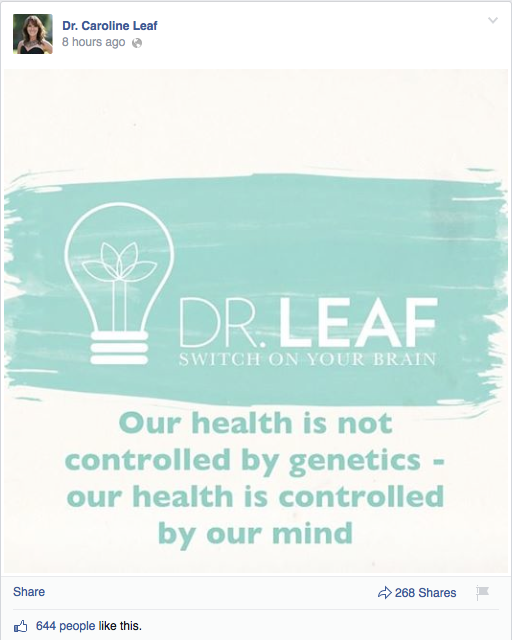
But not according to Dr Caroline Leaf, communication pathologist and self-titled cognitive neuroscientist, who said on her social media feeds today, “Our health is not controlled by genetics – our health is controlled by our mind.”

Taking her statement at face value, she appears to be saying that genes have nothing to do with our health. Dr Leaf has made some asinine statements in the past, but to suggest that genes are irrelevant to human health seemed so stupid that no one in their right mind would suggest such a thing.

Perhaps I was taking her statement the wrong way? I wanted to make sure I didn’t jump to any rash conclusions about Dr Leaf’s statement, so I pondered it at length. Could she be referring to ‘control’ in the absolute sense? How much control do genes have on our health? What about the mind?

After deliberating for a while, I still came to the conclusion that Dr Leaf’s statement was nonsense.

Unfortunately, Dr Leaf’s statement is, like so many of her previous Facebook memes, so vague as to be misleading. The meaning of ‘health’ and ‘controlled’ could be taken so many ways … which part of our health? How much regulation constitutes ‘control’? What about genetics?

Looking at her statement in more depth, it becomes clear that no matter which way Dr Leaf meant it, it’s still wrong. For example, all of human health is controlled, in part, by genetics. That’s because life itself is controlled by genetics. The human genome provides a blueprint for the construction of all of the proteins in all of the cells in our entire body. The expression of those genes determines exactly how our body will run. If the genes are wrong, if the translation of the gene code into a protein is wrong, or if too much or too little of a protein is made, all determines whether our body is functioning at its optimum level or not.

The stimulus for the expression of our genes is influenced by the environment in which we live. If I go out into the sun a lot, the UV light triggers my skin cells to make the protein melanin, which makes my skin go darker and helps to provide some protection against the damaging effects of the UV light.

While the environment plays a part of the expression of some genes, it’s wrong to say that genetics doesn’t control the process. If I go into the sun too much, I risk developing a melanoma, because the sun damages the genes in some of my skin cells, causing them to grow without control.

Genes are still responsible for the disease itself. Sometimes the trigger is from the environment, sometimes it’s not. There are some people with genes for melanoma who don’t need an environmental trigger, because they develop melanoma on skin that’s exposed to very little UV light, like the genital skin.

So fundamentally, even taking the environment into account, our health is controlled by our genetics.

The other part of Dr Leaf’s meme is also wrong. Our health is not controlled by our mind. Our genes are influenced by “the environment”, which according to the seminal paper by Ottman, “The environmental risk factor can be an exposure, either physical (e.g., radiation, temperature), chemical (e.g., polycyclic aromatic hydrocarbons), or biological (e.g., a virus); a behavior pattern (e.g., late age at first pregnancy); or a “life event” (e.g., job loss, injury). This is not intended as an exhaustive taxonomy of risk factors, but indicates as broad a definition as possible of environmental exposures.” [1]

Even if one considers the mind as part of the sub classification of “a behavior pattern”, it’s still pretty clear that most of the factors that make up our environment are not related to our mind at all but are related to the external world, of which we have minimal or no control over. Sure, we make choices, but our choices aren’t truly free. They’re constrained by the environment in which we find ourselves. In the same way, our mind may have some tiny influence on our health, but only insofar as our environment and our genes will allow.

When it all boils down, this meme of Dr Leaf’s is rested on her foundational presumption that our mind can control matter, a very strong theme throughout her most recent book [2], but which is still preposterous. Our thoughts are simply a function of our brain, which is in turn determined by the function of our nerve cells, which is in turn a function of our genes and their expression.

Our mind doesn’t control matter. Matter controls our mind.

I can keep my genetics textbooks after all.

References

  1. Ottman, R., Gene-environment interaction: definitions and study designs. Prev Med, 1996. 25(6): 764-70 http://www.ncbi.nlm.nih.gov/pubmed/8936580
  2. Leaf, C.M., Switch On Your Brain : The Key to Peak Happiness, Thinking, and Health. 2013, Baker Books, Grand Rapids, Michigan:

Understanding Thought – Part 3

What is thought?

We’re all familiar with thought, to be sure, just like we’re familiar with our own bodies. But just because we know our own bodies doesn’t make us all doctors. In the same way, we might know our own thoughts well, but that doesn’t make us experts in the science of thought.

But understanding thought is important. If we don’t know what thoughts are, then it’s very easy to be conned into believing the myriad of myths about thought perpetuated about them by every pop-psychologist and B-grade life coach.

This series of blogs is taken from my book Hold That Thought: Reappraising the work of Dr Caroline Leaf. We’ve looked at some basic neurobiology and the neurobiology of thought itself. Today we’ll discuss some psychological models of our thought processing, and the common brain states and functions that are usually confused with thought.

Other cognitive frameworks of thought

Dual Systems

A number of models of thought use a dual systems approach, explaining our cognitive process in terms of two systems.

System 1 involves a set of different subsystems that operate in parallel, delivering swift and intuitive judgments and decisions in response to our perceptions. System 1 is unconscious, automatic and guided by principles that are, to a significant extent, innately fixed and universal among humans.

System 2 is the system that involves “thought” as people typically think about it. It is both conscious and reflective in character, and proceeds in a slow, serial manner, according to principles that vary among both individuals and cultures [1]. This system is in harmony with the Global Workspace/LIDA concept of the cognitive cycle.

System 2 is generally held to be subject to intentional control, hence why thoughts can be volitional. System 2 can be guided by normative beliefs about proper reasoning methods. In other words, we can learn ways of thinking about our thoughts to handle them better. And one of the principal roles often attributed to system 2 is to override the unreflective responses that are issued automatically by system 1 in reasoning tasks, when these fall short of appropriate standards of rationality. We can use thought to modulate or suppress our intuitive responses, the concept of “think before you act”.

Neuroscience research confirms the neural networks involved with the dual systems, and have taken the theory further [2]. Not only can stimuli that are emotionally significant activate the lower, emotional parts of our brain, they can do so without us ever being consciously aware they were detected. For example, when test subjects had their visual cortex temporarily stunned by a transcranial magnetic stimulator, they could detect whether a face was happy or sad and even where it was on a grid without consciously sensing that they had “seen” a face [3]. Subconscious emotional stimuli can modulate our attention before we are aware of their perception [4].

Relational Frame Theory / Acceptance And Commitment Therapy

Relational frame theory, and the clinical approach based on it called Acceptance and Commitment Therapy, sees thoughts as contextual. This is interesting, as new neurobiological approaches such as neurocognitive networks are also girded by the developing view of cognition which is that cognition “is marked by both dynamic flexibility and context sensitivity.” [5]

Relational frame theory posits that “the core of human language and cognition is learning to relate events mutually and in combination not simply on the basis of their formal properties (e.g., size, shape) but also on the basis of arbitrary cues.” [6] Basically, we understand things in both concrete and abstract ways. “The gold coin is small” is referring to the tangible properties of the gold coin. “The gold coin is very valuable” is referring to the arbitrary properties of the gold coin, which are values that we define in our minds.

Hayes states, “A key RFT insight of clinical importance is that relational framing is regulated by two distinguishable features: the relational context and the functional context … The relational context determines what you think; the functional context determines the psychological impact of what you think.” [6]

So in terms of thought, what we think isn’t necessarily reliable. It’s contextual, and often abstract and arbitrary. The meanings and values that are placed on our thoughts are related to the context in which they came to us, and the impact is also arbitrary, a function of our minds and our language.

As William Shakespeare wrote, “for there is nothing either good or bad, but thinking makes it so.” [7] Thoughts are just that – thoughts. So while there is a mountain of published literature on “negative” or “positive” thoughts, such distinctions are subjective, arbitrary, and often entirely unhelpful.

We often become fused to the meaning of our thoughts. We begin to take them literally, without noticing the process of thinking itself. When the thoughts become painful, we don’t know how to handle them, and we run from them, or try to suppress them. But in fighting with the thoughts, we actually draw attention to them and make them more powerful. This makes them even more painful, and makes the avoidance worse. We then lose flexible contact with the present moment, as we become more and more consumed with the internal battle with our painful thoughts and subsequent emotions. Rather than looking around us, all we can do is focus on the pain or be anywhere else where difficult events are not occurring. [6]

The key in this battle is not to engage with the “negative” thoughts by pushing them away or trying to change them. Pushing the painful thoughts away makes them go away for a while, but it takes a lot of effort. The thoughts return as we tire, but we have less energy to resist them.

Try holding a fully inflated basketball under water. It’s possible, but the basketball wants to get back to the surface. Holding it down is hard work. You usually can’t do it for long. Fighting our thoughts is the same.

Harris describes the focus of Acceptance and Commitment Therapy, “around two main processes: developing acceptance of unwanted private experiences which are out of personal control, commitment and action towards living a valued life … In ACT, there is no attempt to try to reduce, change, avoid, suppress, or control these private experiences. Instead, clients learn to reduce the impact and influence of unwanted thoughts and feelings, through the effective use of mindfulness.” [8]

The first principle of ACT is to start treating thoughts as what they really are … just thoughts. This is simply done by learning to observe the process of thinking again, to realise that the words going through our minds are just words. They only have the meaning that we give to them. They only have the power that we allow them to have.

The key to overcoming thought patterns we don’t want isn’t to change them, it’s to remove their power. Trying to change them means engaging with them, which only makes them stronger. Disempowering them means seeing them for what they are. They may sound like Rottweiler’s but when you actually look, they’re more like Chihuahua’s with megaphones. When you understand that your thoughts are not in control, you can move forward into the actions that really bring change.  If you want to know more about ACT, or you would like to use ACT to help stop fighting your thoughts, there are a number of free resources that are a great starting point = http://www.actmindfully.com.au/free_resources

What is, and is not, a thought?

Thought, therefore, is simply a broadcast of one part of a deeper flow of information. Thought is not a controlling force. It’s not a case of, “I think, therefore, I am”, but, “I am, therefore, I think.”

Thoughts are often described in the peer-reviewed publications as the “stream of thought” or the “stream of consciousness”. According to Baars and Franklin, thoughts arise from the broadcast step of multiple cognitive cycles, but the conscious broadcast of our thought stream is limited to a single cognitive cycle at any given instant. Thus, even though it is considered a “stream”, our awareness of our thought is in a serial, sometimes disparate, sequence of frames [9].

There are some features of our stream of thought that differentiate it from other brain activity. We have a level of voluntary control over our stream of thought, even if it’s not direct [10]. It is also characterized by a metacognitive level – we have “thinking about thinking” [1, 11], and we have “awareness of awareness” [12].

Yet there are still many neurological functions that are confused with thoughts.

Brain activity

“Thoughts” are often confused for any brain activity. The stream of thought is sometimes referred to as the “stream of consciousness” but that’s a misnomer.

Consciousness has varying levels (coma, deep sleep, lucid dreaming, awake, and alert). Only some of these levels of consciousness allow thought. Therefore, it would be fair to say that thoughts are a form of activity of the brain, just like Toyotas are a form of car.

Brain activity is largely subconscious. It carries on in the background without our awareness [2]. There are multiple simultaneous streams of data being perceived all the time – sensation from our ears, skin, eyes and internal organs – that our brain filters out before it reaches our awareness. Background traffic noise, the pressure of your clothes on your skin, joint position, heart rate and breathing, for example. It’s not that these sensations are not present, but you only become aware of them when your attention is drawn to them. Those data streams are not thoughts in and of themselves because we lack awareness of them. They only become part of our thoughts when attention is paid to them. Since thoughts are characterized by metacognition, “awareness of awareness”, then neural activity we aren’t aware of cannot be considered thoughts.

The other problem with defining all brain activity as “thought” is that such as definition would also mean that seizures were thoughts, or brainstem reflexes were thoughts. We intuitively know that’s not the case.

Dreams

So what about dreams? We’re aware of dreams, aren’t we? Could dreams be considered thoughts?

Dreams are awareness of perception and emotion, similar to our state of awareness when we’re awake. But dreams occur in an altered state of consciousness (that is, we are asleep). Dreams also lack self-awareness. When you dream, you don’t realise that you’re dreaming. Secondary consciousness, the level of consciousness that we possess when we are awake, is defined in part as having awareness of awareness. It is more than just having awareness of perception and emotion. It is “self-reflection, insight, judgment or abstract thought that constitute secondary consciousness.” [12]

Memories

As I wrote earlier, memories aren’t just simple recall, but a complex system involving both conscious and unconscious elements. The conscious elements of memory are simply stored representations of events and experiences. They may become part of a thought broadcast, but they are not thoughts per se.

References

  1. Fletcher, L. and Carruthers, P., Metacognition and reasoning. Philos Trans R Soc Lond B Biol Sci, 2012. 367(1594): 1366-78 doi: 10.1098/rstb.2011.0413
  2. Tamietto, M. and de Gelder, B., Neural bases of the non-conscious perception of emotional signals. Nat Rev Neurosci, 2010. 11(10): 697-709 doi: 10.1038/nrn2889
  3. Jolij, J. and Lamme, V.A., Repression of unconscious information by conscious processing: evidence from affective blindsight induced by transcranial magnetic stimulation. Proc Natl Acad Sci U S A, 2005. 102(30): 10747-51 doi: 10.1073/pnas.0500834102
  4. Ohman, A., et al., Emotion drives attention: detecting the snake in the grass. J Exp Psychol Gen, 2001. 130(3): 466-78 http://www.ncbi.nlm.nih.gov/pubmed/11561921
  5. Meehan, T.P. and Bressler, S.L., Neurocognitive networks: findings, models, and theory. Neurosci Biobehav Rev, 2012. 36(10): 2232-47 doi: 10.1016/j.neubiorev.2012.08.002
  6. Hayes, S.C., et al., Acceptance and commitment therapy and contextual behavioral science: examining the progress of a distinctive model of behavioral and cognitive therapy. Behav Ther, 2013. 44(2): 180-98 doi: 10.1016/j.beth.2009.08.002
  7. Shakespeare, W., Hamlet, Act II, Scene 2.
  8. Harris, R., Embracing Your Demons: an Overview of Acceptance and Commitment Therapy. Psychotherapy In Australia, 2006. 12(6): 1-8 http://www.actmindfully.com.au/upimages/Dr_Russ_Harris_-_A_Non-technical_Overview_of_ACT.pdf
  9. Franklin, S., et al., Conceptual Commitments of the LIDA Model of Cognition. Journal of Artificial General Intelligence, 2013. 4(2): 1-22
  10. Bonn, G.B., Re-conceptualizing free will for the 21st century: acting independently with a limited role for consciousness. Front Psychol, 2013. 4: 920 doi: 10.3389/fpsyg.2013.00920
  11. Scott, B.M., Levy, M. G., Metacognition: Examining the components of a fuzzy concept. Educational Research eJournal, 2013. 2(2): 120-31 doi: 10.5838/erej.2013.22.04
  12. Hobson, J.A., REM sleep and dreaming: towards a theory of protoconsciousness. Nat Rev Neurosci, 2009. 10(11): 803-13 doi: 10.1038/nrn2716

Understanding Thought – Part 2, The Neuroscience of Thought

What is thought?

We’re all familiar with thought, to be sure, just like we’re familiar with our own bodies. But just because we know our own bodies doesn’t make us all doctors. In the same way, we might know our own thoughts well, but that doesn’t make us experts in the science of thought.

But understanding thought is important. If we don’t know what thoughts are, then it’s very easy to be conned into believing the myriad of myths about thought perpetuated about them by every pop-psychologist and B-grade life coach. This series of blogs is taken from my book Hold That Thought: Reappraising the work of Dr Caroline Leaf.

We’ve looked at some basic neurobiology, and today we’ll look at the neurobiology of thought itself. Later we’ll discuss some psychological models of our thought processing, and finally we’ll discuss the common brain states and functions that are usually confused with thought.

Neuroscience of thought

Global Workspace / Intelligent Distribution Agent Model

Building on Baddeley’s model of working memory, Baars proposed the Global Workspace theory [1], and Baars and Franklin went further by adding the Intelligent Distribution Agent model [2]. Central to this model is the “Cognitive cycle”, a nine-step description of the underlying process from perception through to action. In the model, implicit neural information processing is considered to be a continuing stream of cognitive cycles, overlapping so they act in parallel. The conscious broadcast of our thought stream is limited to a single cognitive cycle at any given instant, so while these thought cycles run in in parallel, our awareness of them is in the serial, sometimes disparate, streams of words or pictures in our minds. Baars and Franklin suggests that as many as ten cycles could be running per second [3], and since working-memory tasks occur on the order of seconds, several cognitive cycles may be needed for any given working memory task, especially if it has conscious components such as mental rehearsal [2].

In recent years, the Global Workspace/Intelligent Distribution Agent hypothesis has been updated to help facilitate the quest to create different forms of artificial intelligence. The LIDA (“Learning Intelligent Distribution Agent”) model incorporates the Global Workspace theory with the concepts of memory formation to create a single, broad, systems-level model of the mind.

Franklin et al summarise the process, “During each cognitive cycle the LIDA agent first makes sense of its current situation as best as it can by updating its representation of its current situation, both external and internal. By a competitive process, as specified by Global Workspace Theory, it then decides what portion of the represented situation is the most salient, the most in need of attention. Broadcasting this portion, the current contents of consciousness, enables the agent to chose an appropriate action and execute it, completing the cycle.” [4] Information within the cognitive cycle is broadcast to our consciousness in order to recruit a wider area of the brain to enhance the processing of that information [2, 5]. It’s the broadcasting of this portion of the information flow that renders it “conscious”.

Thought, therefore, is simply a broadcast of one part of a deeper flow of information. This is very important, as it means that thought is not an instigator or a controlling force. It’s not a case of, “I think, therefore, I am”, but, “I am, therefore, I think.”

Neural networks involved in the neurobiology of thought?

There is good evidence that working memory, and the attention required to select the information streams that fill the global workspace at any one moment, are intrinsically linked to a group of brain regions tagged as the Prefrontal Parietal Network [6]. Disease or damage to the PPN or impairment of the PPN in the lab impairs normal conscious function. Research-level brain imaging studies have strongly implicated the PPN in perceptual transitions, the conscious detection of stimuli in a range of modalities, sustaining percepts, and in metacognitive decisions (awareness of awareness) on those percepts. Finally, a reduction of conscious level when under general anesthesia is associated with a reduced lateral prefrontal activity [6].

Other neural networks have been defined that are also important in the neurophysiology of conscious awareness. When there are no external stimuli, the brain doesn’t just turn off. Some parts of the brain become even more active. The same parts of the brain are active when we daydream (what researchers call “stimulus independent thought”).

We have all experienced this at some point. Our body will be doing something while our brain is off somewhere else. I find this happens to me when I’m driving home from work. Going the same route every day means that I often drift into autopilot as I’m thinking about the events of the day or my stomach reminds me that I’m hungry, and five minutes later I pay attention to my surroundings and realise that I’m nearly home.

There are many other sentinel neurocognitive networks, among them: the default mode network, the central executive network, and the salience network. The central executive network is involved in actively working on an external task, which we think of as attention. The default mode network is involved in autobiographical retrieval and self-monitoring activity, the “stimulus independent thought”, or day-dreaming. The salience network acts as a switch between the two, figuring out which external stimuli need active attention and switching on the central executive network [7]. Whichever one of these networks is active at the time, that network is actively feeding information into the working memory, which is what we perceive as “thought”.

When the brain is engaged in a new or difficult task requiring active attention, the executive parts of the brain overtake the default mode network. But when attention is not actively required such as well-practiced tasks, or if our attention diminishes as with boring tasks, the Default Mode Network becomes dominant again. The switch between attention and the default mode network is strongly related to the neurotransmitter dopamine [8]. These networks heavily overlap with the Prefrontal Parietal Network and the global workspace model.

Recent neurobiological evidence confirms the role the default mode network in thought processing, specifically the part of the brain called the cingulate cortex.   This has been confirmed in studies in healthy subjects [9], and in people with formal thought disorders (especially auditory verbal hallucinations) [10]. Specifically, the DMN is often the part of the brain that is the most active in remembering the past, and using similar mechanisms, also the simulations of the future. It is linked to daydreaming and creativity especially when a problem is allowed to “incubate” for a while, while the brain is involved in another task that is more menial, or low stress. It’s theorised that the attentional and implicit networks in the brain are brought into a closer proximity and allowed to interact, which improved the likelihood that a novel solution would be discovered [11].

Research into the topics of thought and consciousness is ever-growing and expanding, and if you want to read more about these topic, they have been very well covered in a two part series from De Sousa, [12] and [13].

References

  1. Baars, B.J., A cognitive theory of consciousness. 1988, Cambridge University Press, Cambridge England ; New York:
  2. Baars, B.J. and Franklin, S., How conscious experience and working memory interact. Trends Cogn Sci, 2003. 7(4): 166-72 http://www.ncbi.nlm.nih.gov/pubmed/12691765 ; http://bit.ly/1a3ytQT
  3. Madl, T., et al., The timing of the cognitive cycle. PLoS One, 2011. 6(4): e14803 doi: 10.1371/journal.pone.0014803
  4. Franklin, S., et al., Conceptual Commitments of the LIDA Model of Cognition. Journal of Artificial General Intelligence, 2013. 4(2): 1-22
  5. Baars, B.J., Global workspace theory of consciousness: toward a cognitive neuroscience of human experience. Progress in brain research, 2005. 150: 45-53
  6. Bor, D. and Seth, A.K., Consciousness and the prefrontal parietal network: insights from attention, working memory, and chunking. Front Psychol, 2012. 3: 63 doi: 10.3389/fpsyg.2012.00063
  7. Meehan, T.P. and Bressler, S.L., Neurocognitive networks: findings, models, and theory. Neurosci Biobehav Rev, 2012. 36(10): 2232-47 doi: 10.1016/j.neubiorev.2012.08.002
  8. de Wit, S., et al., Reliance on habits at the expense of goal-directed control following dopamine precursor depletion. Psychopharmacology (Berl), 2012. 219(2): 621-31 doi: 10.1007/s00213-011-2563-2
  9. Shackman, A.J., et al., The integration of negative affect, pain and cognitive control in the cingulate cortex. Nat Rev Neurosci, 2011. 12(3): 154-67 doi: 10.1038/nrn2994
  10. Lutterveld, R.v., et al., Network analysis of auditory hallucinations in nonpsychotic individuals, in Auditory verbal hallucinations and the brain, Lutterveld, R.v., (Ed). 2013, University Medical Center Utrecht: The Netherlands. p. 117-37.
  11. Baird, B., et al., Inspired by distraction: mind wandering facilitates creative incubation. Psychol Sci, 2012. 23(10): 1117-22 doi: 10.1177/0956797612446024
  12. De Sousa, A., Towards an integrative theory of consciousness: part 1 (neurobiological and cognitive models). Mens Sana Monogr, 2013. 11(1): 100-50 doi: 10.4103/0973-1229.109335
  13. De Sousa, A., Towards an integrative theory of consciousness: part 2 (an anthology of various other models). Mens Sana Monogr, 2013. 11(1): 151-209 doi: 10.4103/0973-1229.109341

Understanding Thought – Part 1

WHAT IS THOUGHT?

We’re all familiar with thought, to be sure, just like we’re familiar with our own bodies. But just because we know our own bodies doesn’t make us all doctors. In the same way, we might know our own thoughts well, but that doesn’t make us experts in the science of thought.

But understanding thought is important. If we don’t know what thoughts are, then it’s very easy to be conned into believing the myriad of myths about thought perpetuated about them by every pop-psychologist and B-grade life coach.

This series of blogs is taken from my book Hold That Thought: Reappraising the work of Dr Caroline Leaf. We will look at some basic neurobiology first, then look at the neurobiology of thought itself. We’ll discuss some psychological models of our thought processing, and finally we’ll discuss the common brain states and functions that are usually confused with thought.

Neurobiology 101

The nerve cell

At the most fundamental level of our thought process is the nerve cell, also called a neuron. Nerve cells, like all cells in the body, have a nucleus containing the genetic material. The nucleus is surrounded by cytoplasm, a watery chemical soup that contains the functional proteins that make the cell run. A thin lipid layer called the cell membrane envelopes the nucleus and cytoplasm. The cell membrane contains important protein structures such as receptors that help the cell receive signals from other cells, and ion channels, which help the cell regulate its internal chemistry.

Compared to other cells, nerve cells have three unique structures that help them do their job. First are dendrites, which are spiny branches that protrude from the main cell body, which receive the signals from other nerve cells. Leading away from the cell body is a long thin tube called an axon which helps carry electrical signal from the dendrites, down to the some tentacle-like processes that end in little pods. These pods, called the terminal buttons of the axon, and then convey the electrical signal to another nerve cell by directing a burst of chemicals towards the dendrites of the next nerve cell in the chain.

In order for the signal to be successfully passed from the first nerve cell to the second, it must successfully traverse a small space called the synapse.

The synapse

Despite being very close to each other, no nerve cell touches another. Instead, the spray of chemicals that’s released from the terminal button of the axon floats across a space of about 20-40nM (a nanometre is one billionth of a metre).

There are a number of different chemicals that traverse synapses, but each terminal button has its own particular one. The most well known are serotonin, noradrenaline and dopamine.

If the signal from the first nerve is strong enough, then a critical amount of the chemical is released and will make it across the gap to the dendrites of the second nerve cell on the other side. The chemical interacts with specific receptors on the new dendrites, which cause them to open up to certain salts like sodium and potassium. As sodium and potassium move in and out of the cell, a new electrical current if formed in the second nerve cell, passing the signal down the line.

To prevent the chemicals in the synapse from over-stimulating the second nerve cell, enzymes breakdown the chemicals to clear the space before the next signal comes past.

Nerve pathways

Combining nerve cells and synapses together creates a nerve pathway, where the input signal is received by specialised nerve endings and is transmitted down the nerve cell across a synapse to the next nerve cell, across the next synapse to the next nerve cell, and on and on until the signal has reached the destination for the output of that signal.

And that’s it. The entire nervous system is just a combination of nerve cells and the synapses between them.

What gives the nervous system and brain the near-infinite flexibility, and air of mystery, is that there are eighty-six billion nerve cells in the average adult (male) brain. Each nerve cell has hundreds to thousands of synapses. It’s estimated that there are about 0.15 quadrillion (that’s 150,000,000,000,000) synapses throughout the average brain [1]. And that’s not including the nerve cells and synapses in the spinal cord, autonomic nervous system and throughout the body. Each of these cells and synapses connect in multiple directions and levels, and transmit signals through the sum of the exciting or inhibiting influences they receive from, and pass on to, other nerve cells.

Single nerve cells may have the appearances of trees with their axon trunks and dendritic branches. But altogether, the billions of connections would more resemble a box of cobwebs.

Higher order brain structures

But unlike a box of cobwebs, the brain has precise organisation to the myriad of connections. These areas can be defined either by their structure, or by their function.

Structurally, there are areas in the brain that are dominated by nerve cell bodies, formed into a little cluster, called a nucleus (different from the nucleus of each cell). Then there are groups of axons bundled together, called a tract, which behave like a data cable for your computer. Nuclei process multiple sources of signal and refine them. The refined signals are sent into the appropriate tract to be transmitted to either another set of nuclei for further refinement, or to distant structures to carry out their effect. The axons of the nerve cells that make up the tracts are usually covered in a thick white material called myelin. Myelin acts like insulation on a wire, improving the speed and accuracy of the communicated signal. Parts of the brains with lots of myelinated cells are described as “white matter”. The nuclei and the cerebral cortex (the outer covering of the brain) are unmyelinated cells, and are referred to as “grey matter”.

On a functional level, the brain is divided into parts depending on what information is processed, and how it gets processed. For example, the cerebral cortex is divided into primary areas for the senses and for motor functions, secondary areas and tertiary association areas. The primary sensory areas detect specific sensations, whereas the secondary areas make sense out of the signals in the primary areas. Association areas receive and analyze signals simultaneously from multiple regions of both the motor and sensory areas, as well as from the deeper parts of the brain [2]. The frontal lobe, and specifically pre-frontal cortex, is responsible for higher brain functions such as working memory, planning, decision making, executive attention and inhibitory control [3].

Everything our senses detect is essentially deconstructed, processed then reconstructed by our brains. For example, when reading this page, the image is decoded by our retina and sent through a number of pathways to finally reach the primary visual cortex at the back of our brain. The primary visual cortex has 6 layers of nerve cells which simultaneously encode the various aspects of the image (especially colour, intensity and movement of the signals) and this information is sent to the secondary association areas that detect patterns, both basic (lines are straight, curved, angled) and complex (two diagonal intersecting lines form an ‘x’). One part of the secondary association areas in the visual cortex (the Angular Gyrus) processes these patterns further into the patterns of written words. The information on the various patterns that were discerned by the secondary association areas then get sent to the tertiary association area for the senses where those visual patterns are combined with patterns processed from other sensory areas (hearing, touch and internal body sensations) to form a complex pattern of multimodal association [2]. In the case of reading, the tertiary association area allows comprehension of the written words that were previously only recognised as words by the secondary association areas.

In the recent decades, with the widespread adoption of non-invasive methods of studying the active living brain such as PET scanning and fMRI, researchers have discovered that rather than discrete parts of the brain lighting up with a specific task, entire networks involving multiple brain regions are activated. This has lead to the paradigm of neurocognitive networks, in which the brain is made up of multiple interconnected networks that “are dynamic entities that exist and evolve on multiple temporal as well as spatial scales” and “by virtue of both their anatomical and functional architectures, as well as the dynamics manifested through these architectures, large-scale network function underlies all cognitive ability.” [4]

Emotions and feelings

Emotions are a difficult concept to define. Despite being studied as a concept for more than a century, the definition of what constitutes an emotion remains elusive. Some academics and researchers believe that the term is so ambiguous that it’s useless to science and should be discarded [5].

I’ll discuss emotions further in chapter 2, but for now, it’s easiest to think of our emotional state as the sum total of our different physiological systems, and feelings are the awareness, or the perception of our emotional state.

Different parts of the brain are responsible for the awareness of these feelings. The amygdala is often considered the seat of our fears, the anterior insula is responsible for the feeling of disgust, and the orbitofrontal and anterior cingulate cortex are involved in a broad range of different emotions [6].

Different emotional states are linked with different neurotransmitters within the brain. For example, a predisposition to anxiety is often linked to variations in the genes for serotonin transport [7] while positive and negative affect (“joy / sadness”) are linked to the dopaminergic system [8].

Memories

Memories, like thoughts, are something that we’re all familiar with in our own way.

Memory is quite complicated. For a start, there’s more than one form of memory. You’ve probably heard of short term and long term memory. Short term memory is further thought of as sensory memory and working memory. Long term memory is divided into semantic and episodic memory. Memory is also classified as either declarative memory, also called explicit memory, and nondeclarative memory, also called implicit memory.

Squire and Wixted explain, “Nondeclarative memory is neither true nor false. It is dispositional and is expressed through performance rather than recollection. These forms of memory provide for myriad unconscious ways of responding to the world. In no small part, by virtue of the unconscious status of the nondeclarative forms of memory, they create some of the mystery of human experience. Here arise the dispositions, habits, and preferences that are inaccessible to conscious recollection but that nevertheless are shaped by past events, influence our behavior and mental life, and are an important part of who we are.” [9]

On the other hand, declarative memory “is the kind of memory that is referred to when the term memory is used in everyday language. Declarative memory allows remembered material to be compared and contrasted. The stored representations are flexible, accessible to awareness, and can guide performance in a variety of contexts. Declarative memory is representational. It provides a way of modeling the external world, and it is either true or false.” [9]

Working memory is a central part of the memory model. Information from feelings, stored memories and actions all converge in working memory. The model of working memory initially proposed by Baddeley involves a central executive, “a control system of limited attentional capacity that is responsible for the manipulation of information within working memory and for controlling two subsidiary storage systems: a phonological loop and a visuospatial sketchpad.”[10] Baddeley later added a third subsidiary system, the episodic buffer, “a limited capacity store that is capable of multi-dimensional coding, and that allows the binding of information to create integrated episodes.” [10]

Working memory is known to be distinct from other longer term memories that are dependent on part of the brain called the hippocampus, because patients with severe damage to the hippocampus can remember a small amount of information for a short time, but are not able to push that information into longer term memory functions to retain that information. Information in working memory doesn’t last for any more than a few minutes [9].

So, there are many forms of memory that are important to our lives and influence our behaviour that are “inaccessible to conscious recollection”. But even declarative memory, which is accessible to thought, doesn’t actually make up the thought itself. Memories are stored representations.

When memories are formed or retrieved, the information is processed in chunks. As Byrne pointed out, “We like to think that memory is similar to taking a photograph and placing that photograph into a filing cabinet drawer to be withdrawn later (recalled) as the ‘memory’ exactly the way it was placed there originally (stored). But memory is more like taking a picture and tearing it up into small pieces and putting the pieces in different drawers. The memory is then recalled by reconstructing the memory from the individual fragments of the memory.” [11] Recalling the original memory is an inaccurate process, because sometimes these pieces of the memory are lost, faded or mixed up with another [12]. This is why what we perceive and what we recall are often two different things entirely.

Why do we have memory then, if it’s so flawed at recalling information? Because memory is less about recalling the past, and more about imagining and planning the future. As Schacter writes, “The constructive episodic simulation hypothesis states that a critical function of a constructive memory system is to make information available in a flexible manner for simulation of future events. Specifically, the hypothesis holds that past and future events draw on similar information and rely on similar underlying processes, and that the episodic memory system supports the construction of future events by extracting and recombining stored information into a simulation of a novel event. While this adaptive function allows past information to be used flexibly when simulating alternative future scenarios, the flexibility of memory may also result in vulnerability to imagination-induced memory errors, where imaginary events are confused with actual events.” [13]

References

  1. Sukel, K. The Synapse – A Primer. 2013 [cited 2013, 28/06/2013]; Available from: http://www.dana.org/media/detail.aspx?id=31294.
  2. Hall, J.E. and Guyton, A.C., Guyton and Hall textbook of medical physiology. 12th ed. 2011, Saunders/Elsevier, Philadelphia, Pa.:
  3. Stuss, D.T. and Knight, R.T., Principles of frontal lobe function. 2nd ed. 2013, Oxford University Press, Oxford ; New York:
  4. Meehan, T.P. and Bressler, S.L., Neurocognitive networks: findings, models, and theory. Neurosci Biobehav Rev, 2012. 36(10): 2232-47 doi: 10.1016/j.neubiorev.2012.08.002
  5. Dixon, T., “Emotion”: The History of a Keyword in Crisis. Emot Rev, 2012. 4(4): 338-44 doi: 10.1177/1754073912445814
  6. Tamietto, M. and de Gelder, B., Neural bases of the non-conscious perception of emotional signals. Nat Rev Neurosci, 2010. 11(10): 697-709 doi: 10.1038/nrn2889
  7. Caspi, A., et al., Genetic sensitivity to the environment: the case of the serotonin transporter gene and its implications for studying complex diseases and traits. Am J Psychiatry, 2010. 167(5): 509-27 doi: 10.1176/appi.ajp.2010.09101452
  8. Felten, A., et al., Genetically determined dopamine availability predicts disposition for depression. Brain Behav, 2011. 1(2): 109-18 doi: 10.1002/brb3.20
  9. Squire, L.R. and Wixted, J.T., The cognitive neuroscience of human memory since H.M. Annu Rev Neurosci, 2011. 34: 259-88 doi: 10.1146/annurev-neuro-061010-113720
  10. Repovs, G. and Baddeley, A., The multi-component model of working memory: explorations in experimental cognitive psychology. Neuroscience, 2006. 139(1): 5-21 doi: 10.1016/j.neuroscience.2005.12.061
  11. Byrne, J.H. Learning and Memory (Section 4, Chapter 7). Neuroscience Online – an electronic textbook for the neurosciences 2013 [cited 2014, Jan 3]; Available from: http://neuroscience.uth.tmc.edu/s4/chapter07.html.
  12. Bonn, G.B., Re-conceptualizing free will for the 21st century: acting independently with a limited role for consciousness. Front Psychol, 2013. 4: 920 doi: 10.3389/fpsyg.2013.00920
  13. Schacter, D.L., et al., The future of memory: remembering, imagining, and the brain. Neuron, 2012. 76(4): 677-94 doi: 10.1016/j.neuron.2012.11.001

Dr Caroline Leaf – Exacerbating the Stigma of Mental Illness

Screen Shot 2014-10-18 at 12.44.33 pm

It was late in the afternoon, you know, that time when the caffeine level has hit critical and the only way you can concentrate on the rest of the day is the promise you’ll be going home soon.

The person sitting in front of me was a new patient, a professional young woman in her late 20’s, of Pakistani descent. She wasn’t keen to discuss her problems, but she didn’t know what else to do. After talking to her for a few minutes, it was fairly obvious that she was suffering from Generalised Anxiety Disorder, and I literally mean suffering. She was always fearful but without any reason to be so. She couldn’t eat, she couldn’t sleep, her heart raced all the time.

I was actually really worried for her. She let me do some basic tests to rule out any physical cause that was contributing to her symptoms, but that was as far as she let me help her. Despite talking at length about her diagnosis, she could not accept the fact that she had a psychiatric condition, and did not accept any treatment for it. She chose not to follow up with me either. I only saw her twice.

Perhaps it was fear for her job, social isolation, or a cultural factor. Perhaps it was the anxiety itself. Whatever the reason, despite having severe ongoing symptoms, she could not accept that she was mentally ill. She was a victim twice over, suffering from both mental illness, and its stigma.

Unfortunately, this young lady is not an isolated case. Stigma follows mental illness like a shadow, an extra layer of unnecessary suffering, delaying proper diagnosis and treatment of diseases that respond best to early intervention.

What contributes to the stigma of mental illness? Fundamentally, the stigma of mental illness is based on ignorance. Ignorance breeds stereotypes, stereotypes give rise to prejudice, and prejudice results in discrimination. This ignorance usually takes three main forms; people with mental illness are homicidal maniacs who need to be feared; they have childlike perceptions of the world that should be marveled; or they are responsible for their illness because they have weak character [1].

Poor information from people who claim to be experts doesn’t help either. For example, on her social media feed today, Dr Caroline Leaf said, “Psychiatric labels lock people into mental ill-health; recognizing the mind can lead us into trouble and that our mind is powerful enough to lead us out frees us! 2 Timothy1:7 Teaching on mental health @TrinaEJenkins 1st Baptist Glenardin.”

Dr Caroline Leaf is a communication pathologist and self-titled cognitive neuroscientist. It’s disturbing enough that Dr Leaf, who did not train in cognitive neuroscience, medicine or psychology, can stand up in front of people and lecture as an “expert” in mental health. It’s even more disturbing when her views on mental health are antiquated and inane.

Today’s post, for example. Suggesting that psychiatric labels lock people in to mental ill-health is like saying that a medical diagnosis locks them into physical ill-health. It’s a nonsense. Does diagnosing someone with cancer lock them into cancer? It’s the opposite, isn’t it? Once the correct diagnosis is made, a person with cancer can receive the correct treatment. Failing to label the symptoms correctly simply allows the disease to continue unabated.

Mental illness is no different. A correct label opens the door to the correct treatment. Avoiding a label only results in an untreated illness, and more unnecessary suffering.

Dr Leaf’s suggestion that psychiatric labels lock people in to their illness is born out of a misguided belief about the power of words over our thoughts and our health in general, an echo of the pseudo-science of neuro-linguistic programming.

The second part of her post, that “recognizing the mind can lead us into trouble and that our mind is powerful enough to lead us out frees us” is also baseless. Her assumptions, that thought is the main driving force that controls our lives, and that fixing our thought patterns fixes our physical and psychological health, are fundamental to all of her teaching. I won’t go into it again here, but further information on how Dr Leaf’s theory of toxic thinking contradicts basic neuroscience can be found in a number of my blogs, and in the second half of my book [2].

I’ve also written on 2 Timothy 1:7 before, another of Dr Leaf’s favourite scriptures, a verse whose meaning has nothing to do with mental health, but seized upon by Dr Leaf because one English translation of the original Greek uses the words “a sound mind”.

So Dr Leaf believes that labelling someone as having a mental illness will lock them into that illness, an outdated, unscientific and purely illogical notion that is only going to increase the stigma of mental illness. If I were @TrinaEJenkins and the good parishioners of 1st Baptist Glenardin, I would be asking for my money back.

With due respect, and in all seriousness, the stigma of mental illness is already disproportionate. Mental illness can cause insurmountable suffering, and sometimes death, to those who are afflicted by it. The Christian church does not need misinformation compounding the suffering for those affected by poor mental health. Dr Leaf should not be lecturing anyone on mental health until she has been properly credentialed.

References

  1. Corrigan, P.W. and Watson, A.C., Understanding the impact of stigma on people with mental illness. World Psychiatry, 2002. 1(1): 16-20 http://www.ncbi.nlm.nih.gov/pubmed/16946807
  2. Pitt, C.E., Hold That Thought: Reappraising the work of Dr Caroline Leaf, 2014 Pitt Medical Trust, Brisbane, Australia, URL http://www.smashwords.com/books/view/466848

Dr Caroline Leaf and the cart-before-the-horse conundrum

Screen Shot 2014-10-05 at 6.54.03 pm

A chaotic mind filled with thoughts of anxiety, worry, etc. sends out the wrong signal right down to the level of our DNA

So says Dr Caroline Leaf, communication pathologist and self-titled cognitive neuroscientist.

Her Facebook factoids have varied in their quality lately, ranging from the almost reasonable, down to the outright ridiculous. Today’s contribution rates an 8.5 out of 10 on the pseudoscience scale.

The reason why it rates so high is for the same reason why many of her factoids, and indeed nearly all her teaching, rates the same: Dr Leaf has the relationship between the brain and the mind back to front.  Dr Leaf squarely puts the proverbial cart before the horse.

One would think if you were going to claim to be a cognitive neuroscientist, you would at least get the basic facts right. But Dr Leaf’s teaching, from her first book through to her last, is based on this idea that it’s the mind that is in control of the brain, hence why she thinks that thoughts can be so toxic.

Dr Leaf’s entire teaching heavily rests on her fallacious assumption that the mind is in control of the brain. Thoughts are only important if the mind controls the brain. Toxic thoughts can only affect our health if the mind controls the body. Controlling toxic thoughts is only worthwhile if our mind can influence our brain and body in positive or negative ways.

The problem for Dr Leaf is that there is no credible scientific evidence that the mind controls the brain. The only evidence she does tend to proffer is based on the work of other pseudoscientists, or she misinterprets or misquotes real scientific data to fit her erroneous working theory. For example, Dr Leaf refers to a paper titled, “Local and nonlocal effects of coherent heart frequencies on conformational changes of DNA” [1]. She says that this paper is, “An ingenuous experiment set up by the HeartMath Foundation (which) determined that genuine positive emotion, as reflected by a measure called ‘heart rate variability’, directed with intentionality towards someone actually changed the way the double helix DNA strand coils and uncoils. And this goes for both positive and negative emotions and intentions.” [2: p111] Actually, the experiment was based on faulty assumptions, and so full of flaws in their methodology and analysis, that it could show nothing at all [3]. All it could prove was that Dr Leaf was so desperate to grasp hold of anything that seemed to support her theory that she was willing to use a twenty-year-old study from a group of pseudoscientists that also believe in occult practices like ESP and telekinesis (http://psychotronics.org).

The concept that we have a soul that’s separate to, and controls our brain, is called dualism. Modern science gave up on dualism a long time ago. While psychological sciences have been slower to give up on the idea of our thoughts as influential, no credible scientist still holds on to the idea that we have an ethereal force that controls our biology. Dualism is untenable both scientifically and philosophically [4].

The reality is the exact opposite to what Dr Leaf teaches. Our brain is responsible for all of the functions that are traditionally associated with the mind/soul/spirit. For more in depth information, please see my essay: Dr Caroline Leaf, Dualism, and the Triune Being Hypothesis. Therefore, a “chaotic mind filled with thoughts of anxiety, worry, etc” doesn’t send signals down to our DNA. It’s our DNA and the many steps in it’s expression, and the interaction of our biology and our environment, that then causes our minds to be worried, anxious, chaotic etc.

Dr Leaf is welcome to hold any view she likes, but she cannot claim to be a cognitive neuroscientist while holding a view that is directly contradicted by actual cognitive neuroscience. Nor should she be welcome to speak as an expert when she clearly is not one.

For the sake of her audiences and the Christian church as a whole, Dr Leaf needs to revise her teaching and bring it into line with the facts established by real cognitive neuroscientists.

References

  1. Rein, G. and McCraty, R. Local and nonlocal effects of coherent heart frequencies on conformational changes of DNA. in Proc. Joint USPA/IAPR Psychotronics Conf., Milwaukee, WI. 1993.
  2. Leaf, C.M., Switch On Your Brain : The Key to Peak Happiness, Thinking, and Health. 2013, Baker Books, Grand Rapids, Michigan:
  3. Pitt, C.E., Hold That Thought: Reappraising the work of Dr Caroline Leaf, 2014 Pitt Medical Trust, Brisbane, Australia, URL http://www.smashwords.com/books/view/466848
  4. Bunge, M., The Mind-Body Problem, in Matter and Mind. 2010, Springer Netherlands. p. 143-57.

Dr Caroline Leaf and the brain control misstatement

Screen Shot 2014-09-30 at 7.18.22 pmScreen Shot 2014-09-30 at 7.18.40 pm

“Always give credit where credit’s due.”

Dr Leaf is a communication pathologist, and a self-titled cognitive neuroscientist. Yesterday, Dr Leaf made a couple of carefully worded statements on her social media feeds, which given the quality of her previous couple of neuroscience-based factoids, is a definite improvement.

First, she said that, “Your brain is being continuously rewired throughout your life …”. Yep, I can’t disagree with that one. The brain is a very dynamic tissue, constantly remodelling the synaptic wiring to process the information it receives on a daily basis. That’s why the brain is referred to as ‘plastic’, reflecting the property of plastic to be moulded into any shape.

Her next offering sounds really good too. It’s full of encouragement, positivity and hope … the classic feel-good quote: “You can bring your brain under your control, on the path to a better, healthier, stronger, safer and happier life.” Whether it’s true or not depends on how literally you interpret it.

If you loosely interpret it, then it sounds ok. Sure, we have some control over how we act, and if we live our life in the direction dictated by our values, then we will have a better, healthier, stronger, safer and happier life. Modern psychological theory and therapies confirm this [1].

However, what Dr Leaf actually said was, “You can bring your brain under your control”. Having some control over our actions is entirely different to bringing our brain under our control. We can control some of our actions, but we don’t control our brain any more than we ‘control’ our car.

When we say that we’re ‘controlling’ the car, what we actually mean is that we are controlling the speed and direction of the car. But there are thousands of electrical and mechanical actions that take place each second that are vital for the running of the car, and that we have absolutely no direct control over. It just takes one loose nut or faulty fuse to make the car steer wildly out of control, or stop functioning entirely, and then we’re not in control at all.

In the same way, various diseases or lesions in the brain show that brain is really in control, tic disorders for example. These can range from simple motor tics (sudden involuntary movements) to complex tic disorders, such as Tourette’s (best known for the involuntary tendencies to utter obscenities). Another common example are parasomnias – a group of disorders in which people perform complex behaviours during their sleep – sleep talking, sleep walking, or sleep eating.

The fact we don’t see all of the underlying processes in a fully functional brain simply provides the illusion of control. Our brain is driving, our stream of thought just steers it a little, but it doesn’t take much to upset that veneer of control we think we possess.

Ultimately, our brain is still responsible for our action. We don’t have a separate soul that is able to control our brain. Any decisions that we make are the result of our brain deciding on the most appropriate course of action and enacting it [2] (and see also ‘Dr Caroline Leaf, Dualism, and the Triune Being Hypothesis‘ for a more in-depth discussion on the subject of dualism). Therefore, we can’t ever bring our brain under control.

This is important because if we believe that we can bring our brain under control, then by simple logical extension, we can control everything our brain is responsible for – our emotions, our feelings, our thoughts, our memory, and every single action we make. This is Dr Leaf’s ultimate guiding philosophy, though it’s not how our neurobiology works. If we were to believe that we control our thoughts and feelings, we set up an unwinnable struggle against our very nature, like trying to fight the tides.

We are not in control of all our thoughts, feelings, emotions or all of our actions, and neither do we have to be. We just need to make room for our uncomfortable emotions, feelings and thoughts, and to move in the direction of those things we value.

So if you were to take Dr Leaf at her word, she still missed the mark with her post. It sounds ok in a very general sense, but closer inspection reveals a subtle but significant error.

Giving credit where credit’s due, Dr Leaf has tried to tighten up her social media statements. It’s commendable, but unfortunately she needs to bring her underlying philosophy closer to the accepted scientific position to further improve the quality of her teaching.

References

  1. Harris, R., Embracing Your Demons: an Overview of Acceptance and Commitment Therapy. Psychotherapy In Australia, 2006. 12(6): 1-8 http://www.actmindfully.com.au/upimages/Dr_Russ_Harris_-_A_Non-technical_Overview_of_ACT.pdf
  2. Haggard, P., Human volition: towards a neuroscience of will. Nat Rev Neurosci, 2008. 9(12): 934-46 doi: 10.1038/nrn2497

Dr Caroline Leaf and the genetic fluctuations falsehood

Screen Shot 2014-09-27 at 12.47.37 am

While idling away on Facebook, as is my usual pass time, I came upon Dr Leaf’s Facebook feed. There were her usual self-indulgent holiday happy-snaps and another couple of Pinterest-style fluffy inspirational posts. Then this: “Our genetic makeup fluctuates by the minute based on what we are thinking and choosing”.

Dr Caroline Leaf is a South African born and trained, US based, communication pathologist. She also claims that she’s a cognitive neuroscientist. Given the quality of the posts on her social media pages recently, no one could ever take such a claim seriously.

To make sure we’re all clear about what she just said, I’m going to say it again: “Our genetic makeup fluctuates by the minute based on what we are thinking and choosing”. It was an astonishing, if not bewildering statement, especially coming from someone with a PhD level education. If Dr Leaf were a medical doctor and publically made a statement like that, her registration would be reconsidered.

The core of the statement, which pushes it so far beyond the boundaries of rational scientific thinking, is the phrase “Our genetic makeup fluctuates by the minute.”

DNA in our cells is like an old audio cassette tape. Audio cassette tape is a long magnetic stripe, storing the code which the tape player decodes as sound. DNA is a chemical string which has a sequence of “bases” off to the side. The full DNA molecule is made of two matching strings joined by chemical bonds between the bases (hence the name, “base pairs”). Depending on what the cell needs, it runs the DNA through a decoder to either copy it, or to ‘play’ it (i.e. using the information stored in the code to build new proteins).

Like the tape in an audio cassette, the code of the DNA is incredibly stable. The rate of DNA mutation is about 1 in 30 million base pairs [1]. DNA doesn’t ‘fluctuate’, (“rise and fall irregularly in number or amount” [2]). It’s not the stock market. The number of genes in each cell of my body does not rise or fall depending on whether I’m having a good hair day.

The other part of Dr Leaf’s statement, that our DNA “fluctuates … based on what we are thinking and choosing” is also scientific nonsense. The only way that your thoughts and choices are capable of inducing genetic mutations is if those thoughts or choices involve cigarette smoking or standing next to industrial sources of ionising radiation.

I think Dr Leaf is trying to say that our thoughts and choices can change our gene expression, which is the construction of new proteins from the instructions in the DNA code. However, gene expression has nothing to do with our thoughts and choices. IVF embryos are expressing genes like crazy as they grow from one cell to an embryo in just a petri dish. It doesn’t think or choose.

More often than not, our thoughts and our choices are the result of gene expression, not the cause of it. We don’t have any specific control over the process either. The process of genetic expression is dependant on a complex series of promoters and tags on the DNA, which are controlled by other proteins and DNA within the cell, not thought or choice.

The truth is that gene expression occurs moment-by-moment, regardless of what we think or don’t think, do or don’t do. Gene expression is simply DNA being read. Our genetic makeup, the DNA code, is stable. It does not fluctuate. There is no part of Dr Leaf’s statement that is scientifically accurate.

Ultimately, Dr Leaf continues on her pursuit of pseudoscience, an affront to the people who trust her to tell them the truth, and the God of all truth that she purportedly represents.

References

  1. Xue, Y., et al., Human Y chromosome base-substitution mutation rate measured by direct sequencing in a deep-rooting pedigree. Curr Biol, 2009. 19(17): 1453-7 doi: 10.1016/j.cub.2009.07.032
  2. Oxford Dictionary of English – 3rd Edition, 2010, Oxford University Press: Oxford, UK.

Dr Caroline Leaf and the Profound Simplicity Paradox

It was a guy called Charles Bukowski that said once, ‘Genius might be the ability to say a profound thing in a simple way’. It always grabs our attention when something is said that’s easy to understand, yet deeply meaningful. The simple yet profound juxtaposition draws our attention and exercises our cognition in a way that nothing else seems to match. Those that are able to utter pervasive truth in a few syllables are elevated to gurus, and their pearls of wisdom are endlessly reposted on Pinterest and Facebook.

Of course, for something to be profound, it doesn’t just need to be deep, but also true.

Dr Caroline Leaf is a communication pathologist and self-titled cognitive neuroscientist. Her social media feeds are littered with Pinterest profundities, and she adds her own sometimes for good measure. Today, she shared something which I’m sure she thinks is one of those strokes of genius that Charles Bukowski was talking about,

“What we say and do is based on what we have already built into our minds.”

Well, her statement is simple, but it’s certainly not profound. It’s a paint-by-numbers version of the neuroscience of behaviour, based on her underlying assumption that we are in full control of every thought and action that we ever have or do.

It’s nice story to tell. It seems to fit with our experience of our thoughts and of the attribution of every action we take with our feeling of conscious volition. It’s just that it’s not what real neuroscientists actually tell us is going on in our brain.

Our thoughts and our actions are based on a number of things, mostly beyond our conscious control. This is because our perception, physiological responses, and personalities are all strongly genetically determined, our memory systems are predominantly subconscious, and so is the vast majority of the processing our brain does on a second-by-second basis. Our thoughts and our feeling of our conscious ‘free will’ are the subconscious brain simply projecting a small sliver of that information stream to a wider area of the cerebral cortex for fine-tuning (I discuss this in much more detail in chapters 1, 2 and 6 of my book).

So what we say and do is not based on just based on what we have already built into our minds, because our actions are largely built on our genetics and our subconscious memories, which we don’t necessarily have control over either.

There will be some people who think that this sounds like a cop-out, just an excuse to avoid responsibility for our own actions. I would argue that this actually refines our responsibility to that which we can change, taking the focus away from those things that we cannot change. For example, there’s no point in suggesting that I’m a bad father because I can’t breastfeed my children. This is an extreme example of course, but chiding someone for not doing something that they can’t do because of their genetic predisposition is no different.

Rather than focusing unnecessary effort on trying to change what cannot be changed, we should look to work on the things that can be changed. Even then, we all have different strengths and weaknesses. Some people will take a long time to learn something that another person might pick up straight away.

It’s also important for people to understand that not everything you struggle with is related to your poor choices. There’s no point in wrestling with something that isn’t going to move. All you do is tire yourself, sapping you of energy that you could be using to effect change on the things you do have power over.

So on the surface, Dr Leaf’s statement may be simple, but it’s ultimately erroneous. Instead of being liberating, it can actually be oppressing. Those who are looking for something profound would be better served looking somewhere else on Pinterest.

Reference:
Pitt, C.E., Hold That Thought: Reappraising the work of Dr Caroline Leaf, 2014 Pitt Medical Trust, Brisbane, Australia, URL www.smashwords.com/books/view/466848