Understanding Thought – Part 1

WHAT IS THOUGHT?

We’re all familiar with thought, to be sure, just like we’re familiar with our own bodies. But just because we know our own bodies doesn’t make us all doctors. In the same way, we might know our own thoughts well, but that doesn’t make us experts in the science of thought.

But understanding thought is important. If we don’t know what thoughts are, then it’s very easy to be conned into believing the myriad of myths about thought perpetuated about them by every pop-psychologist and B-grade life coach.

This series of blogs is taken from my book Hold That Thought: Reappraising the work of Dr Caroline Leaf. We will look at some basic neurobiology first, then look at the neurobiology of thought itself. We’ll discuss some psychological models of our thought processing, and finally we’ll discuss the common brain states and functions that are usually confused with thought.

Neurobiology 101

The nerve cell

At the most fundamental level of our thought process is the nerve cell, also called a neuron. Nerve cells, like all cells in the body, have a nucleus containing the genetic material. The nucleus is surrounded by cytoplasm, a watery chemical soup that contains the functional proteins that make the cell run. A thin lipid layer called the cell membrane envelopes the nucleus and cytoplasm. The cell membrane contains important protein structures such as receptors that help the cell receive signals from other cells, and ion channels, which help the cell regulate its internal chemistry.

Compared to other cells, nerve cells have three unique structures that help them do their job. First are dendrites, which are spiny branches that protrude from the main cell body, which receive the signals from other nerve cells. Leading away from the cell body is a long thin tube called an axon which helps carry electrical signal from the dendrites, down to the some tentacle-like processes that end in little pods. These pods, called the terminal buttons of the axon, and then convey the electrical signal to another nerve cell by directing a burst of chemicals towards the dendrites of the next nerve cell in the chain.

In order for the signal to be successfully passed from the first nerve cell to the second, it must successfully traverse a small space called the synapse.

The synapse

Despite being very close to each other, no nerve cell touches another. Instead, the spray of chemicals that’s released from the terminal button of the axon floats across a space of about 20-40nM (a nanometre is one billionth of a metre).

There are a number of different chemicals that traverse synapses, but each terminal button has its own particular one. The most well known are serotonin, noradrenaline and dopamine.

If the signal from the first nerve is strong enough, then a critical amount of the chemical is released and will make it across the gap to the dendrites of the second nerve cell on the other side. The chemical interacts with specific receptors on the new dendrites, which cause them to open up to certain salts like sodium and potassium. As sodium and potassium move in and out of the cell, a new electrical current if formed in the second nerve cell, passing the signal down the line.

To prevent the chemicals in the synapse from over-stimulating the second nerve cell, enzymes breakdown the chemicals to clear the space before the next signal comes past.

Nerve pathways

Combining nerve cells and synapses together creates a nerve pathway, where the input signal is received by specialised nerve endings and is transmitted down the nerve cell across a synapse to the next nerve cell, across the next synapse to the next nerve cell, and on and on until the signal has reached the destination for the output of that signal.

And that’s it. The entire nervous system is just a combination of nerve cells and the synapses between them.

What gives the nervous system and brain the near-infinite flexibility, and air of mystery, is that there are eighty-six billion nerve cells in the average adult (male) brain. Each nerve cell has hundreds to thousands of synapses. It’s estimated that there are about 0.15 quadrillion (that’s 150,000,000,000,000) synapses throughout the average brain [1]. And that’s not including the nerve cells and synapses in the spinal cord, autonomic nervous system and throughout the body. Each of these cells and synapses connect in multiple directions and levels, and transmit signals through the sum of the exciting or inhibiting influences they receive from, and pass on to, other nerve cells.

Single nerve cells may have the appearances of trees with their axon trunks and dendritic branches. But altogether, the billions of connections would more resemble a box of cobwebs.

Higher order brain structures

But unlike a box of cobwebs, the brain has precise organisation to the myriad of connections. These areas can be defined either by their structure, or by their function.

Structurally, there are areas in the brain that are dominated by nerve cell bodies, formed into a little cluster, called a nucleus (different from the nucleus of each cell). Then there are groups of axons bundled together, called a tract, which behave like a data cable for your computer. Nuclei process multiple sources of signal and refine them. The refined signals are sent into the appropriate tract to be transmitted to either another set of nuclei for further refinement, or to distant structures to carry out their effect. The axons of the nerve cells that make up the tracts are usually covered in a thick white material called myelin. Myelin acts like insulation on a wire, improving the speed and accuracy of the communicated signal. Parts of the brains with lots of myelinated cells are described as “white matter”. The nuclei and the cerebral cortex (the outer covering of the brain) are unmyelinated cells, and are referred to as “grey matter”.

On a functional level, the brain is divided into parts depending on what information is processed, and how it gets processed. For example, the cerebral cortex is divided into primary areas for the senses and for motor functions, secondary areas and tertiary association areas. The primary sensory areas detect specific sensations, whereas the secondary areas make sense out of the signals in the primary areas. Association areas receive and analyze signals simultaneously from multiple regions of both the motor and sensory areas, as well as from the deeper parts of the brain [2]. The frontal lobe, and specifically pre-frontal cortex, is responsible for higher brain functions such as working memory, planning, decision making, executive attention and inhibitory control [3].

Everything our senses detect is essentially deconstructed, processed then reconstructed by our brains. For example, when reading this page, the image is decoded by our retina and sent through a number of pathways to finally reach the primary visual cortex at the back of our brain. The primary visual cortex has 6 layers of nerve cells which simultaneously encode the various aspects of the image (especially colour, intensity and movement of the signals) and this information is sent to the secondary association areas that detect patterns, both basic (lines are straight, curved, angled) and complex (two diagonal intersecting lines form an ‘x’). One part of the secondary association areas in the visual cortex (the Angular Gyrus) processes these patterns further into the patterns of written words. The information on the various patterns that were discerned by the secondary association areas then get sent to the tertiary association area for the senses where those visual patterns are combined with patterns processed from other sensory areas (hearing, touch and internal body sensations) to form a complex pattern of multimodal association [2]. In the case of reading, the tertiary association area allows comprehension of the written words that were previously only recognised as words by the secondary association areas.

In the recent decades, with the widespread adoption of non-invasive methods of studying the active living brain such as PET scanning and fMRI, researchers have discovered that rather than discrete parts of the brain lighting up with a specific task, entire networks involving multiple brain regions are activated. This has lead to the paradigm of neurocognitive networks, in which the brain is made up of multiple interconnected networks that “are dynamic entities that exist and evolve on multiple temporal as well as spatial scales” and “by virtue of both their anatomical and functional architectures, as well as the dynamics manifested through these architectures, large-scale network function underlies all cognitive ability.” [4]

Emotions and feelings

Emotions are a difficult concept to define. Despite being studied as a concept for more than a century, the definition of what constitutes an emotion remains elusive. Some academics and researchers believe that the term is so ambiguous that it’s useless to science and should be discarded [5].

I’ll discuss emotions further in chapter 2, but for now, it’s easiest to think of our emotional state as the sum total of our different physiological systems, and feelings are the awareness, or the perception of our emotional state.

Different parts of the brain are responsible for the awareness of these feelings. The amygdala is often considered the seat of our fears, the anterior insula is responsible for the feeling of disgust, and the orbitofrontal and anterior cingulate cortex are involved in a broad range of different emotions [6].

Different emotional states are linked with different neurotransmitters within the brain. For example, a predisposition to anxiety is often linked to variations in the genes for serotonin transport [7] while positive and negative affect (“joy / sadness”) are linked to the dopaminergic system [8].

Memories

Memories, like thoughts, are something that we’re all familiar with in our own way.

Memory is quite complicated. For a start, there’s more than one form of memory. You’ve probably heard of short term and long term memory. Short term memory is further thought of as sensory memory and working memory. Long term memory is divided into semantic and episodic memory. Memory is also classified as either declarative memory, also called explicit memory, and nondeclarative memory, also called implicit memory.

Squire and Wixted explain, “Nondeclarative memory is neither true nor false. It is dispositional and is expressed through performance rather than recollection. These forms of memory provide for myriad unconscious ways of responding to the world. In no small part, by virtue of the unconscious status of the nondeclarative forms of memory, they create some of the mystery of human experience. Here arise the dispositions, habits, and preferences that are inaccessible to conscious recollection but that nevertheless are shaped by past events, influence our behavior and mental life, and are an important part of who we are.” [9]

On the other hand, declarative memory “is the kind of memory that is referred to when the term memory is used in everyday language. Declarative memory allows remembered material to be compared and contrasted. The stored representations are flexible, accessible to awareness, and can guide performance in a variety of contexts. Declarative memory is representational. It provides a way of modeling the external world, and it is either true or false.” [9]

Working memory is a central part of the memory model. Information from feelings, stored memories and actions all converge in working memory. The model of working memory initially proposed by Baddeley involves a central executive, “a control system of limited attentional capacity that is responsible for the manipulation of information within working memory and for controlling two subsidiary storage systems: a phonological loop and a visuospatial sketchpad.”[10] Baddeley later added a third subsidiary system, the episodic buffer, “a limited capacity store that is capable of multi-dimensional coding, and that allows the binding of information to create integrated episodes.” [10]

Working memory is known to be distinct from other longer term memories that are dependent on part of the brain called the hippocampus, because patients with severe damage to the hippocampus can remember a small amount of information for a short time, but are not able to push that information into longer term memory functions to retain that information. Information in working memory doesn’t last for any more than a few minutes [9].

So, there are many forms of memory that are important to our lives and influence our behaviour that are “inaccessible to conscious recollection”. But even declarative memory, which is accessible to thought, doesn’t actually make up the thought itself. Memories are stored representations.

When memories are formed or retrieved, the information is processed in chunks. As Byrne pointed out, “We like to think that memory is similar to taking a photograph and placing that photograph into a filing cabinet drawer to be withdrawn later (recalled) as the ‘memory’ exactly the way it was placed there originally (stored). But memory is more like taking a picture and tearing it up into small pieces and putting the pieces in different drawers. The memory is then recalled by reconstructing the memory from the individual fragments of the memory.” [11] Recalling the original memory is an inaccurate process, because sometimes these pieces of the memory are lost, faded or mixed up with another [12]. This is why what we perceive and what we recall are often two different things entirely.

Why do we have memory then, if it’s so flawed at recalling information? Because memory is less about recalling the past, and more about imagining and planning the future. As Schacter writes, “The constructive episodic simulation hypothesis states that a critical function of a constructive memory system is to make information available in a flexible manner for simulation of future events. Specifically, the hypothesis holds that past and future events draw on similar information and rely on similar underlying processes, and that the episodic memory system supports the construction of future events by extracting and recombining stored information into a simulation of a novel event. While this adaptive function allows past information to be used flexibly when simulating alternative future scenarios, the flexibility of memory may also result in vulnerability to imagination-induced memory errors, where imaginary events are confused with actual events.” [13]

References

  1. Sukel, K. The Synapse – A Primer. 2013 [cited 2013, 28/06/2013]; Available from: http://www.dana.org/media/detail.aspx?id=31294.
  2. Hall, J.E. and Guyton, A.C., Guyton and Hall textbook of medical physiology. 12th ed. 2011, Saunders/Elsevier, Philadelphia, Pa.:
  3. Stuss, D.T. and Knight, R.T., Principles of frontal lobe function. 2nd ed. 2013, Oxford University Press, Oxford ; New York:
  4. Meehan, T.P. and Bressler, S.L., Neurocognitive networks: findings, models, and theory. Neurosci Biobehav Rev, 2012. 36(10): 2232-47 doi: 10.1016/j.neubiorev.2012.08.002
  5. Dixon, T., “Emotion”: The History of a Keyword in Crisis. Emot Rev, 2012. 4(4): 338-44 doi: 10.1177/1754073912445814
  6. Tamietto, M. and de Gelder, B., Neural bases of the non-conscious perception of emotional signals. Nat Rev Neurosci, 2010. 11(10): 697-709 doi: 10.1038/nrn2889
  7. Caspi, A., et al., Genetic sensitivity to the environment: the case of the serotonin transporter gene and its implications for studying complex diseases and traits. Am J Psychiatry, 2010. 167(5): 509-27 doi: 10.1176/appi.ajp.2010.09101452
  8. Felten, A., et al., Genetically determined dopamine availability predicts disposition for depression. Brain Behav, 2011. 1(2): 109-18 doi: 10.1002/brb3.20
  9. Squire, L.R. and Wixted, J.T., The cognitive neuroscience of human memory since H.M. Annu Rev Neurosci, 2011. 34: 259-88 doi: 10.1146/annurev-neuro-061010-113720
  10. Repovs, G. and Baddeley, A., The multi-component model of working memory: explorations in experimental cognitive psychology. Neuroscience, 2006. 139(1): 5-21 doi: 10.1016/j.neuroscience.2005.12.061
  11. Byrne, J.H. Learning and Memory (Section 4, Chapter 7). Neuroscience Online – an electronic textbook for the neurosciences 2013 [cited 2014, Jan 3]; Available from: http://neuroscience.uth.tmc.edu/s4/chapter07.html.
  12. Bonn, G.B., Re-conceptualizing free will for the 21st century: acting independently with a limited role for consciousness. Front Psychol, 2013. 4: 920 doi: 10.3389/fpsyg.2013.00920
  13. Schacter, D.L., et al., The future of memory: remembering, imagining, and the brain. Neuron, 2012. 76(4): 677-94 doi: 10.1016/j.neuron.2012.11.001

Labels – the good, the bad, and the ugly

Yesterday, I wrote a rebuttal to Dr Caroline Leaf’s social media post, that “Psychiatric labels lock people into mental ill-health.” In my rebuttal, I suggested that psychiatric labels don’t lock anyone into mental ill-health any more than a medical diagnosis locks people into physical ill-health.

In the feedback I received, one intelligent young lady commented that, “I understand your point completely, but I took her words differently. I have often seen people who use their diagnosis as an excuse. For example, a kid gets diagnosed with Autism or ADHD, and suddenly the parents are using that as an excuse for their bad behaviour instead of teaching and helping them to deal with it. Another example, an adult is diagnosed with something mild, but uses it as an excuse to no longer care about trying to get a job or trying to get treatment and make an effort to get better”.

I certainly understand where she’s coming from. I’ve seen it too. A diagnosis is used as an excuse for someone’s avoidance, or a tool to milk every drop of sympathy from another. Giving someone a label seems to hinder some people more than help them.

Thankfully, there’s more than one side to the label story. I wanted to use today’s post to discuss the good, the bad, and the ugly side of diagnostic labels.

First, lets look at the ugly side of a diagnostic label. There will always be emotional and social connotations to every diagnosis that a person receives. Sometimes that’s sympathy, and sometimes that’s stigma. If a young woman told her friends that she had breast cancer, I’m sure that news would be met with an outpouring of care and support. If the same young woman told the same friends that she had chlamydia or genital herpes, I’d bet that most of the responses would be blaming or shaming, which is one reason why no one tells other people they’ve got chlamydia or herpes.

The same goes for mental health. The media often portrays people with mental illness as either homicidal or weak [1]. So the general response to mental health diagnoses is either fear or contempt. Even those who are neutral towards mental health often don’t understand it, so it’s difficult for those with mental health issues to receive true empathy for their plight.

Then, there is the bad side of a label. Labels can be misused, intentionally or unintentionally, for all sorts of reasons. They can also be wrongly applied. It might be that someone uses their diagnosis to draw sympathy from people, or money, or help when they don’t really need it. They might use their label as an excuse to avoid certain things they don’t like. There are innumerable ways that people can milk secondary gain from their problems.

However, appropriate diagnosis can bring many benefits. For example, correct labelling brings with it understanding and empowerment.

A diagnosis can help us understand more about ourselves, or the person with the diagnosis. That child with ADHD isn’t just being naughty, but has difficulty regulating their behaviour. That person with Asperger’s isn’t being intentionally rude, but has trouble with social cues, understanding body language, and communicating in an empathic way. A correct diagnosis also helps us understand our own strengths and weaknesses. They help us recognise what it is about ourselves that we can’t change, what we can change, and what we need to change.

Once you understand what it is you can change and what you can’t change, it empowers you to change what you can for the better, and accept and adapt to what you can’t change. You stop wasting precious strength and time fighting what you can’t change. Instead, all of the effort that would have been needlessly spent on the unchangeable can be effectively spent on improving what needs to be, and can be, changed.

In fairness, I should point out that a diagnosis isn’t always needed to make positive change. Acceptance and Commitment Therapy is a form of psychological therapy that encourages flexibility to accept those parts of our lives that are uncomfortable, whether they have a label or not, and allow our values to shape our life direction. Sometimes we can spend so much energy looking for a diagnosis that we stagnate, forgoing the forward momentum of what we value to focus on having a label for the symptoms.

But where a diagnosis can be made without undue effort, it can provide clarity to what often seems to be a jumbled mess of dysfunctional traits.

So, sure, sometimes labels can be used for the wrong things. That doesn’t mean they’re not useful or we should stop using them. There may be a stigma to a diagnosis of herpes or depression, but there are also good treatments available. The diagnosis may provide a way of changing a life of ongoing suffering to a life fulfilled.

More often than not, a good diagnosis helps bring clarity to a situation, enabling understanding, acceptance and empowerment. Rather than locking people in, a correct label usually unlocks a person’s potential to grow despite the problems they face.

References

  1. Corrigan, P.W. and Watson, A.C., Understanding the impact of stigma on people with mental illness. World Psychiatry, 2002. 1(1): 16-20 http://www.ncbi.nlm.nih.gov/pubmed/16946807

Dr Caroline Leaf – Exacerbating the Stigma of Mental Illness

Screen Shot 2014-10-18 at 12.44.33 pm

It was late in the afternoon, you know, that time when the caffeine level has hit critical and the only way you can concentrate on the rest of the day is the promise you’ll be going home soon.

The person sitting in front of me was a new patient, a professional young woman in her late 20’s, of Pakistani descent. She wasn’t keen to discuss her problems, but she didn’t know what else to do. After talking to her for a few minutes, it was fairly obvious that she was suffering from Generalised Anxiety Disorder, and I literally mean suffering. She was always fearful but without any reason to be so. She couldn’t eat, she couldn’t sleep, her heart raced all the time.

I was actually really worried for her. She let me do some basic tests to rule out any physical cause that was contributing to her symptoms, but that was as far as she let me help her. Despite talking at length about her diagnosis, she could not accept the fact that she had a psychiatric condition, and did not accept any treatment for it. She chose not to follow up with me either. I only saw her twice.

Perhaps it was fear for her job, social isolation, or a cultural factor. Perhaps it was the anxiety itself. Whatever the reason, despite having severe ongoing symptoms, she could not accept that she was mentally ill. She was a victim twice over, suffering from both mental illness, and its stigma.

Unfortunately, this young lady is not an isolated case. Stigma follows mental illness like a shadow, an extra layer of unnecessary suffering, delaying proper diagnosis and treatment of diseases that respond best to early intervention.

What contributes to the stigma of mental illness? Fundamentally, the stigma of mental illness is based on ignorance. Ignorance breeds stereotypes, stereotypes give rise to prejudice, and prejudice results in discrimination. This ignorance usually takes three main forms; people with mental illness are homicidal maniacs who need to be feared; they have childlike perceptions of the world that should be marveled; or they are responsible for their illness because they have weak character [1].

Poor information from people who claim to be experts doesn’t help either. For example, on her social media feed today, Dr Caroline Leaf said, “Psychiatric labels lock people into mental ill-health; recognizing the mind can lead us into trouble and that our mind is powerful enough to lead us out frees us! 2 Timothy1:7 Teaching on mental health @TrinaEJenkins 1st Baptist Glenardin.”

Dr Caroline Leaf is a communication pathologist and self-titled cognitive neuroscientist. It’s disturbing enough that Dr Leaf, who did not train in cognitive neuroscience, medicine or psychology, can stand up in front of people and lecture as an “expert” in mental health. It’s even more disturbing when her views on mental health are antiquated and inane.

Today’s post, for example. Suggesting that psychiatric labels lock people in to mental ill-health is like saying that a medical diagnosis locks them into physical ill-health. It’s a nonsense. Does diagnosing someone with cancer lock them into cancer? It’s the opposite, isn’t it? Once the correct diagnosis is made, a person with cancer can receive the correct treatment. Failing to label the symptoms correctly simply allows the disease to continue unabated.

Mental illness is no different. A correct label opens the door to the correct treatment. Avoiding a label only results in an untreated illness, and more unnecessary suffering.

Dr Leaf’s suggestion that psychiatric labels lock people in to their illness is born out of a misguided belief about the power of words over our thoughts and our health in general, an echo of the pseudo-science of neuro-linguistic programming.

The second part of her post, that “recognizing the mind can lead us into trouble and that our mind is powerful enough to lead us out frees us” is also baseless. Her assumptions, that thought is the main driving force that controls our lives, and that fixing our thought patterns fixes our physical and psychological health, are fundamental to all of her teaching. I won’t go into it again here, but further information on how Dr Leaf’s theory of toxic thinking contradicts basic neuroscience can be found in a number of my blogs, and in the second half of my book [2].

I’ve also written on 2 Timothy 1:7 before, another of Dr Leaf’s favourite scriptures, a verse whose meaning has nothing to do with mental health, but seized upon by Dr Leaf because one English translation of the original Greek uses the words “a sound mind”.

So Dr Leaf believes that labelling someone as having a mental illness will lock them into that illness, an outdated, unscientific and purely illogical notion that is only going to increase the stigma of mental illness. If I were @TrinaEJenkins and the good parishioners of 1st Baptist Glenardin, I would be asking for my money back.

With due respect, and in all seriousness, the stigma of mental illness is already disproportionate. Mental illness can cause insurmountable suffering, and sometimes death, to those who are afflicted by it. The Christian church does not need misinformation compounding the suffering for those affected by poor mental health. Dr Leaf should not be lecturing anyone on mental health until she has been properly credentialed.

References

  1. Corrigan, P.W. and Watson, A.C., Understanding the impact of stigma on people with mental illness. World Psychiatry, 2002. 1(1): 16-20 http://www.ncbi.nlm.nih.gov/pubmed/16946807
  2. Pitt, C.E., Hold That Thought: Reappraising the work of Dr Caroline Leaf, 2014 Pitt Medical Trust, Brisbane, Australia, URL http://www.smashwords.com/books/view/466848

Dr Caroline Leaf and the cart-before-the-horse conundrum

Screen Shot 2014-10-05 at 6.54.03 pm

A chaotic mind filled with thoughts of anxiety, worry, etc. sends out the wrong signal right down to the level of our DNA

So says Dr Caroline Leaf, communication pathologist and self-titled cognitive neuroscientist.

Her Facebook factoids have varied in their quality lately, ranging from the almost reasonable, down to the outright ridiculous. Today’s contribution rates an 8.5 out of 10 on the pseudoscience scale.

The reason why it rates so high is for the same reason why many of her factoids, and indeed nearly all her teaching, rates the same: Dr Leaf has the relationship between the brain and the mind back to front.  Dr Leaf squarely puts the proverbial cart before the horse.

One would think if you were going to claim to be a cognitive neuroscientist, you would at least get the basic facts right. But Dr Leaf’s teaching, from her first book through to her last, is based on this idea that it’s the mind that is in control of the brain, hence why she thinks that thoughts can be so toxic.

Dr Leaf’s entire teaching heavily rests on her fallacious assumption that the mind is in control of the brain. Thoughts are only important if the mind controls the brain. Toxic thoughts can only affect our health if the mind controls the body. Controlling toxic thoughts is only worthwhile if our mind can influence our brain and body in positive or negative ways.

The problem for Dr Leaf is that there is no credible scientific evidence that the mind controls the brain. The only evidence she does tend to proffer is based on the work of other pseudoscientists, or she misinterprets or misquotes real scientific data to fit her erroneous working theory. For example, Dr Leaf refers to a paper titled, “Local and nonlocal effects of coherent heart frequencies on conformational changes of DNA” [1]. She says that this paper is, “An ingenuous experiment set up by the HeartMath Foundation (which) determined that genuine positive emotion, as reflected by a measure called ‘heart rate variability’, directed with intentionality towards someone actually changed the way the double helix DNA strand coils and uncoils. And this goes for both positive and negative emotions and intentions.” [2: p111] Actually, the experiment was based on faulty assumptions, and so full of flaws in their methodology and analysis, that it could show nothing at all [3]. All it could prove was that Dr Leaf was so desperate to grasp hold of anything that seemed to support her theory that she was willing to use a twenty-year-old study from a group of pseudoscientists that also believe in occult practices like ESP and telekinesis (http://psychotronics.org).

The concept that we have a soul that’s separate to, and controls our brain, is called dualism. Modern science gave up on dualism a long time ago. While psychological sciences have been slower to give up on the idea of our thoughts as influential, no credible scientist still holds on to the idea that we have an ethereal force that controls our biology. Dualism is untenable both scientifically and philosophically [4].

The reality is the exact opposite to what Dr Leaf teaches. Our brain is responsible for all of the functions that are traditionally associated with the mind/soul/spirit. For more in depth information, please see my essay: Dr Caroline Leaf, Dualism, and the Triune Being Hypothesis. Therefore, a “chaotic mind filled with thoughts of anxiety, worry, etc” doesn’t send signals down to our DNA. It’s our DNA and the many steps in it’s expression, and the interaction of our biology and our environment, that then causes our minds to be worried, anxious, chaotic etc.

Dr Leaf is welcome to hold any view she likes, but she cannot claim to be a cognitive neuroscientist while holding a view that is directly contradicted by actual cognitive neuroscience. Nor should she be welcome to speak as an expert when she clearly is not one.

For the sake of her audiences and the Christian church as a whole, Dr Leaf needs to revise her teaching and bring it into line with the facts established by real cognitive neuroscientists.

References

  1. Rein, G. and McCraty, R. Local and nonlocal effects of coherent heart frequencies on conformational changes of DNA. in Proc. Joint USPA/IAPR Psychotronics Conf., Milwaukee, WI. 1993.
  2. Leaf, C.M., Switch On Your Brain : The Key to Peak Happiness, Thinking, and Health. 2013, Baker Books, Grand Rapids, Michigan:
  3. Pitt, C.E., Hold That Thought: Reappraising the work of Dr Caroline Leaf, 2014 Pitt Medical Trust, Brisbane, Australia, URL http://www.smashwords.com/books/view/466848
  4. Bunge, M., The Mind-Body Problem, in Matter and Mind. 2010, Springer Netherlands. p. 143-57.

Dr Caroline Leaf and the Profound Simplicity Paradox

It was a guy called Charles Bukowski that said once, ‘Genius might be the ability to say a profound thing in a simple way’. It always grabs our attention when something is said that’s easy to understand, yet deeply meaningful. The simple yet profound juxtaposition draws our attention and exercises our cognition in a way that nothing else seems to match. Those that are able to utter pervasive truth in a few syllables are elevated to gurus, and their pearls of wisdom are endlessly reposted on Pinterest and Facebook.

Of course, for something to be profound, it doesn’t just need to be deep, but also true.

Dr Caroline Leaf is a communication pathologist and self-titled cognitive neuroscientist. Her social media feeds are littered with Pinterest profundities, and she adds her own sometimes for good measure. Today, she shared something which I’m sure she thinks is one of those strokes of genius that Charles Bukowski was talking about,

“What we say and do is based on what we have already built into our minds.”

Well, her statement is simple, but it’s certainly not profound. It’s a paint-by-numbers version of the neuroscience of behaviour, based on her underlying assumption that we are in full control of every thought and action that we ever have or do.

It’s nice story to tell. It seems to fit with our experience of our thoughts and of the attribution of every action we take with our feeling of conscious volition. It’s just that it’s not what real neuroscientists actually tell us is going on in our brain.

Our thoughts and our actions are based on a number of things, mostly beyond our conscious control. This is because our perception, physiological responses, and personalities are all strongly genetically determined, our memory systems are predominantly subconscious, and so is the vast majority of the processing our brain does on a second-by-second basis. Our thoughts and our feeling of our conscious ‘free will’ are the subconscious brain simply projecting a small sliver of that information stream to a wider area of the cerebral cortex for fine-tuning (I discuss this in much more detail in chapters 1, 2 and 6 of my book).

So what we say and do is not based on just based on what we have already built into our minds, because our actions are largely built on our genetics and our subconscious memories, which we don’t necessarily have control over either.

There will be some people who think that this sounds like a cop-out, just an excuse to avoid responsibility for our own actions. I would argue that this actually refines our responsibility to that which we can change, taking the focus away from those things that we cannot change. For example, there’s no point in suggesting that I’m a bad father because I can’t breastfeed my children. This is an extreme example of course, but chiding someone for not doing something that they can’t do because of their genetic predisposition is no different.

Rather than focusing unnecessary effort on trying to change what cannot be changed, we should look to work on the things that can be changed. Even then, we all have different strengths and weaknesses. Some people will take a long time to learn something that another person might pick up straight away.

It’s also important for people to understand that not everything you struggle with is related to your poor choices. There’s no point in wrestling with something that isn’t going to move. All you do is tire yourself, sapping you of energy that you could be using to effect change on the things you do have power over.

So on the surface, Dr Leaf’s statement may be simple, but it’s ultimately erroneous. Instead of being liberating, it can actually be oppressing. Those who are looking for something profound would be better served looking somewhere else on Pinterest.

Reference:
Pitt, C.E., Hold That Thought: Reappraising the work of Dr Caroline Leaf, 2014 Pitt Medical Trust, Brisbane, Australia, URL www.smashwords.com/books/view/466848

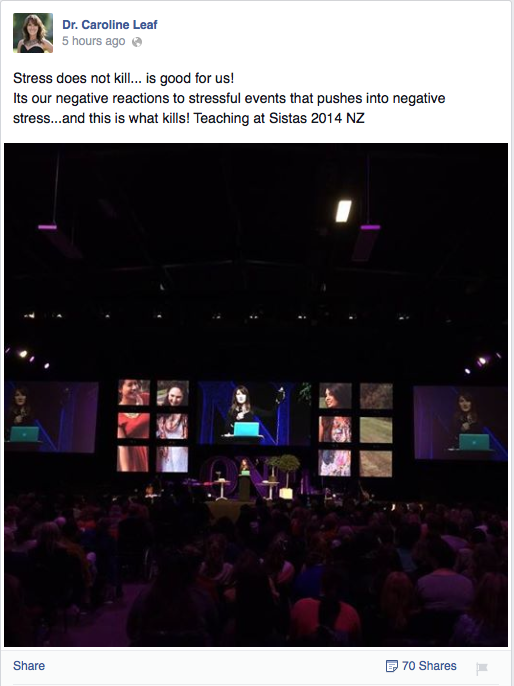
Dr Caroline Leaf and the case of the killer reactions

Screen Shot 2014-09-13 at 10.14.58 pm

Stress! Believe the media and seemingly every disease known to man is in some way linked to it. Heart disease = stress. Cancer = stress. Flatulence = stress.

Dr Caroline Leaf, Communication Pathologist and self-titled cognitive neuroscientist, has been of a similar opinion for the last couple of decades. Dr Leaf must have been kind enough to read my book, because after teaching for the last fifteen years that stress is toxic, a subtle shifting under the weight of evidence has appeared.

In her 2009 book [1], Dr Leaf wrote,
“The result of toxic thinking translates into stress in your body.” (p15)
“Stress is a global term for the extreme strain on your body’s systems as a result of toxic thinking.” (p15)
“Stress is a direct result of toxic thinking.” (p29)
“These stages of stress are scientifically significant because they illustrate how a single toxic thought causes extreme reactions in so many of our systems.” (p39)

In 2013, her position on stress hadn’t really changed that much: “Even a little bit of these negative levels of stress from a little bit of toxic thinking has far-reaching consequences for mental and physical health”, and “The association between stress and disease is a colossal 85 percent.” [2: p36-37]

Again in her 2009 book [1], Dr Leaf devotes an entire chapter to the alleged effects of the toxic stress pathway on our body (chapter 4, p39-43).

Now in her latest social media update, tucked in amongst the gratuitous selfies and holiday snaps, comes something that’s actually about mental health: “Stress does not kill… is good for us! Its our negative reactions to stressful events that pushes into negative stress…and this is what kills! Sistas 2014 NZ”

The problem for Dr Leaf is that any stress, whether it’s caused by our “negative” reactions or not, doesn’t actually kill us.

There is a phrase used in science, “Correlation does not equal causation”. This simply means that just because two things occur together, one doesn’t necessarily cause the other. For example, do my red watery eyes cause my hives? They always appear together, but they don’t cause each other. The common element that causes both of them is actually the cat that I’ve just patted.

Just because stress is correlated with certain illnesses does not mean that stress causes or contributes to those illnesses. In fact, one of Dr Leafs own pivotal references, an article by Cohen and colleagues in the Journal of the American Medical Association in 2007, discussed the weakness of assuming that stress causes most diseases. As they say, “Although stressors are often associated with illness, the majority of individuals confronted with traumatic events and chronic serious problems remain disease-free.” [3]

Even if it were true that it how we react to stress contributes to the outcome of that stress, Dr Leaf’s statement about our killer reactions incorrectly presumes that both how we cope with stress, and the physical outcome of stress are the result of our choices.

Our levels of stress, and the way we cope with our stress, is mostly caused by our genetics. Some people will be naturally less stressed, and some people will be naturally better at coping with stress (see chapter 5 of my book [4] for a full discussion on the science of resilience). Just because you’re more prone to stress doesn’t mean that it’s all down to your bad choices. Assumptions like these only add to your already high levels of stress.

That’s not to say that we don’t have a way to improve our responses. For those of us at the stressed end of the spectrum, successful psychological therapies such as Acceptance and Commitment Therapy will help to improve our coping, and certainly have been shown to improve (not cure) mental illnesses like anxiety and depression, and other chronic conditions like chronic pain (see [5] for a review).

ACT and other modern psychological therapies recognise that trying to change our thoughts doesn’t make any difference to how we cope. So like I said before, it’s partly true that how we react to normal life experience will help us live full and productive lives, but it’s not about fighting or changing our thoughts. It’s about being mentally flexible enough to make room for our thoughts and fears and move forward towards meaningful action. I’m sure that the ladies at ‘Sistas 2014’ wouldn’t be hearing that from Dr Leaf.

Anyways, I’m glad that Dr Leaf is changing her tune on stress, but there’s still more room for change before she meets up with current scientific understanding.

For an in-depth review of the teachings of Dr Leaf, visit http://www.smashwords.com/books/view/466848 where you can download a free copy of “Hold That Thought: Reappraising the work of Dr Caroline Leaf.

References

  1. Leaf, C., Who Switched Off My Brain? Controlling toxic thoughts and emotions. 2nd ed. 2009, Inprov, Ltd, Southlake, TX, USA:
  2. Leaf, C.M., Switch On Your Brain : The Key to Peak Happiness, Thinking, and Health. 2013, Baker Books, Grand Rapids, Michigan:
  3. Cohen, S., et al., Psychological stress and disease. JAMA: the journal of the American Medical Association, 2007. 298(14): 1685-7
  4. Pitt, C.E., Hold That Thought: Reappraising the work of Dr Caroline Leaf, 2014 Pitt Medical Trust, Brisbane, Australia, URL http://www.smashwords.com/books/view/466848
  5. Harris, R., Embracing Your Demons: an Overview of Acceptance and Commitment Therapy. Psychotherapy In Australia, 2006. 12(6): 1-8 http://www.actmindfully.com.au/upimages/Dr_Russ_Harris_-_A_Non-technical_Overview_of_ACT.pdf

Hold That Thought – Reappraising the work of Dr Caroline Leaf

Hold That Thought Cover

It’s been more than a few late nights in the making, but sixteen months and 68,000 words on, the early release of my new book is now available on line through Smashwords: https://www.smashwords.com/books/view/466848.  Apple iBook, Kindle, and a number of other platforms will come online soon.

Dr Caroline Leaf is a South African communication pathologist and self-titled cognitive neuroscientist, now based in the USA.  This book is an in-depth look at the current scientific understanding of thought, stress, free will and choice, as well as a thorough critique of Dr Leaf’s foundational teachings and the evidence she provides as proof of her hypotheses.

In the coming few days, I will make the text of the book available on this blog as well.  If you have any questions, send them in.  I’m happy to put up a FAQ page.  And as always, I’m happy to answer any legitimate criticism of my work, so long as it’s constructive and evidence based, not personal.

And as always, Dr Leaf herself is welcome to comment.  Indeed, I would value her feedback, and I’m sure any comment she wishes to make would be welcome by the Christian community as a whole.

Dr Caroline Leaf and the Myth of the Blameless Brain

Screen Shot 2014-06-06 at 4.10.33 pm

When I came back to Facebook this morning, I found this from Dr Leaf on my feed,

“Don’t blame your physical brain for your decisions and actions. You control your brain!”

Dr Caroline Leaf is a Communication Pathologist and a self-titled Cognitive Neuroscientist. Her post follows her theme of the last couple of weeks, the premise that the mind is the dominant cognitive force, controlling the physical brain, and indeed, all matter. I have written about the Myth of Mind Domination in a previous blog. But Dr Leaf’s latest offering here deserves special attention.

Lets think about her statement in more detail:

“Don’t blame your physical brain for your decisions and actions.”

What Dr Leaf is really saying is that the physical brain has no role in your choices or behaviour whatsoever, because if your physical brain had a role in the decisions and actions you make, it would also carry some blame for your poor decisions and actions.

“You control your brain.”

The question to ask here is, “Which part of ‘you’ controls your brain?” Her answer would be, “Your mind”, although she never says where the mind is. Certainly not in the physical brain or even in our physical body, since “Our mind is designed to control the body, of which the brain is a part, not the other way around.” [1: p33].

So an ethereal, disembodied force is in full control of our physical body, such that our brain has no role in the decisions we make or actions we take. Even at this stage of analysis, Dr Leaf’s statement is ludicrous. But wait, there’s more.

Dr Leaf’s statement puts her at odds with real Cognitive Neuroscientists. Professor Patrick Haggard is the Deputy Director of the Institute of Cognitive Neuroscience at the University College London. He has authored or co-authored over 350 peer-reviewed articles on the neuroscience of making choices. He writes, “Modern neuroscience rejects the traditional dualist view of volition as a causal chain from the conscious mind or ‘soul’ to the brain and body. Rather, volition involves brain networks making a series of complex, open decisions between alternative actions.” [2] Strike one for Dr Leaf.

Dr Leaf’s statement puts her at odds with herself. Two weeks ago when misinterpreting James 1:21, Dr Leaf wrote, “How you react to events and circumstances of your life is based upon your perceptions.” Perception is classically defined in neurobiology as conscious sensory experience [3: p8] although the work of cognitive neuroscientists has shown that perception can also be non-conscious [4, 5]. Either way, perception is based entirely on processing within the brain [3: p6-11]. So one week, Dr Leaf is saying that our brain determines how we behave, and then ten days later, she is telling us that our brain does not determine how we behave. Which is it? Strike two for Dr Leaf.

Finally, Dr Leaf’s statement is borderline insulting to the sufferers of congenital or acquired brain disorders. Would you tell a stroke patient that they shouldn’t blame their physical brain for their immobility, because they’re mind is in control of their brain? What about a child with Cerebral Palsy? Would you tell a mother of a child with Downs Syndrome that their child is having recurrent seizures because they aren’t using their mind properly to control their brain? Dr Leaf is doing exactly that. I find it incredible that she could be so insensitive, given her background as a speech pathologist working with patients with Acquired Brain Injury.

I imagine that her defence would be something along the lines of, “What I meant was, ‘don’t blame your normal physical brain for your decisions and actions. You control your functional brain.’” That sort of explanation would be less insulting to people with strokes or brain injuries, but it then undermines her whole premise. The hierarchy of the brain and the mind doesn’t change just because a part of the brain is damaged.

Besides, changes to brain function at any level can change the way a person thinks and behaves. The classic example was Phineas Gage, who in 1848, accidentally blasted an iron rod through his skull, damaging his left frontal lobe. History records that Gage’s well-mannered, pleasant demeanour changed suddenly into a fitful, irreverent, obstinate and capricious man whose workmates could no longer stand him [6]. Medical science has documented numerous cases of damage to the right ventromedial prefrontal cortex causing acquired sociopathy [7]. How can the mind be in control of the brain when an injury to the brain causes a sudden change in thought pattern and behaviour? Clearly one CAN blame the physical brain for one’s decisions and actions. Strike three. You’re out.

Dr Leaf is welcome to comment here. Perhaps she meant something completely different by her post, although there’s only so many ways that such a statement can be interpreted.

Ultimately, Dr Leaf’s love of posting pithy memes of dubious quality is now getting embarrassing. Being so far behind the knowledge of a subject in which she claims expertise is ignominious. Undermining her own premise and contradicting herself is just plain embarrassing. But to be so insensitive to some of the most vulnerable is poor form. I think she’d be well served by re-examining her facts and adjusting her teaching.

References

  1. Leaf, C.M., Switch On Your Brain : The Key to Peak Happiness, Thinking, and Health. 2013, Baker Books, Grand Rapids, Michigan:
  2. Haggard, P., Human volition: towards a neuroscience of will. Nat Rev Neurosci, 2008. 9(12): 934-46 doi: 10.1038/nrn2497
  3. Goldstein, E.B., Sensation and perception. 8th ed. 2010, Wadsworth, Cengage Learning, Belmont, CA:
  4. Kouider, S. and Dehaene, S., Levels of processing during non-conscious perception: a critical review of visual masking. Philos Trans R Soc Lond B Biol Sci, 2007. 362(1481): 857-75 doi: 10.1098/rstb.2007.2093
  5. Tamietto, M. and de Gelder, B., Neural bases of the non-conscious perception of emotional signals. Nat Rev Neurosci, 2010. 11(10): 697-709 doi: 10.1038/nrn2889
  6. Fumagalli, M. and Priori, A., Functional and clinical neuroanatomy of morality. Brain, 2012. 135(Pt 7): 2006-21 doi: 10.1093/brain/awr334
  7. Mendez, M.F., The neurobiology of moral behavior: review and neuropsychiatric implications. CNS Spectr, 2009. 14(11): 608-20 http://www.ncbi.nlm.nih.gov/pubmed/20173686


Dr Caroline Leaf on James 1:21 – Redux

So, we’ve all heard the saying, “If at first you don’t succeed, try and try again.”  Dr Leaf has certainly done that.

Dr Caroline Leaf is a Communication Pathologist and self-titled Cognitive Neuroscientist.  Not content to completely misinterpret James 1:21 only once, she posted on social media today, “James 1:21.  Our thoughts and perceptions have a direct and overwhelmingly significant effect on the cells of our body.”

If for nothing else, Dr Leaf at least gets points for persistence.  A week and a half ago, Dr Leaf again used James 1:21 to attempt to justify a meme on perception.  I’d love to know what version of the Bible that she’s using, because it seems that in her Bible, James 1:21 can be interpreted any way that one wants.

Lets recap: James 1:21 says,

“Wherefore lay apart all filthiness and superfluity of naughtiness, and receive with meekness the engrafted word, which is able to save your souls.” (KJV)

There are too many big words there for my liking, so I went through an on-line, widely used Greek lexicon, to look at the meanings of the words.  Then I translated them into something more understandable, to make sure that I didn’t miss the bit about perception.

Using the Strong’s dictionary and concordance built in to the Blue Letter Bible site (http://www.blueletterbible.org/Bible.cfm?b=Jas&c=1&v=21&t=KJV#s=1147021) I was able to translate the original Greek into something more manageable.

“Therefore shed all the morally defiling wickedness and excess malice, and, with meekness, embrace the teaching that is implanted by your mentors, which has the power to rescue your eternal soul.”

Wait … where did James talk about perception, and how our cells react to our thoughts?  Reviewing the scripture and its translation the second time around didn’t change anything, because there is nothing in James 1:21 that is in any way remotely connected to perception, thinking and our cells biological functioning.

Scripture is the inspired word of God, and “is useful for teaching, rebuking, correcting and training in righteousness, so that the servant of God may be thoroughly equipped for every good work.” (2 Tim 3:16-17, NIV)  What James is writing about is essential, and Christians need to embrace what he was teaching.

Which is why it is so important for Dr Leaf to interpret scripture correctly.  For the second time in two weeks, Dr Leaf has completely misapplied a scripture to one of her memes.  As if that isn’t concerning enough for a woman than regularly interprets scripture to audiences in the thousands every week, there isn’t any scientific evidence to back up her claim either.  As I have written about before, there is no evidence that the mind controls the brain.  Rather, our psychology is dependant on our biology.  More on this in future posts.  But the onus is on Dr Leaf to provide evidence to back up her claim.  I encourage her to publish specific evidence that she believes justifies her claims that our thoughts alter our cellular biology.

Otherwise, I think another popular phrase would better apply: “Quit while you’re ahead”.

UPDATE (17/6/2014)

Screen Shot 2014-06-17 at 10.45.44 pm

I was reviewing Dr Leaf’s posts tonight, and I came across this response that Dr Leaf posted on the 5th of June.  Clearly I wasn’t the only person who wondered exactly how James 1:21 applied to her meme.

Dr Leaf’s explained: “By ‘implanting the word of God your soul will be saved’ (James 1:21) – so by memorizing God’s Word we build healthy thoughts into our brain that improve the health of our cells.”

I’m sure that Dr Leaf thought she was climbing out of a hole, although I think she’s only dug herself deeper.

Firstly, while I’m not a trained theologian, I can read.  Dr Leaf reinterprets this long-suffering scripture again, “By ‘implanting the word of God your soul will be saved’.”  But that’s not what it says at all.  From the KJV which I originally quoted: ” … receive with meekness the engrafted word, which is able to save your souls.” (Emphasis added)  It’s a subtle but important difference.  My understanding is that salvation comes confession and repentance (Romans 10:9-10, 2 Corinthians 7:10).  The word of God is able to save souls, but as the Parable of the Sower (Luke 8:4-15) shows, it doesn’t always bear fruit.  Satan himself knows the Bible inside out, but he certainly isn’t saved.  Perhaps someone who is theologically trained can confirm the points here.  I’d certainly appreciate it.  But for now, I propose that Dr Leaf has misinterpreted this scripture again.

Dr Leaf goes on to claim that by memorizing scripture, “we build healthy thoughts in our brain that improve the health of our cells.”  Dr Leaf is really grasping at straws here.  The “soul” that James is referring to is psyche in the Greek, translated as “the seat of the feelings, desires, affections, aversions (our heart, soul etc.); the (human) soul in so far as it is constituted that by the right use of the aids offered it by God it can attain its highest end and secure eternal blessedness, the soul regarded as a moral being designed for everlasting life; the soul as an essence which differs from the body and is not dissolved by death (distinguished from other parts of the body)”. (http://www.blueletterbible.org/lang/lexicon/lexicon.cfm?Strongs=G5590&t=KJV)  So the word that James used has nothing to do with the body.

Dr Leaf has to apply her own set of assumptions to the scripture, that a saved soul must be healthy thoughts, and that healthy thoughts leads to healthy cells.  Its a myth that healthy thoughts lead to healthy cells (more on this in a future post).  To suggest that salvation and healthy thoughts are one and the same is also an assumption on Dr Leaf’s part, which I don’t think the scripture supports in any way.

So in short, Dr Leaf’s explanation really hasn’t helped her cause.  Her meme is still scripturally and scientifically baseless.

Dr Caroline Leaf and the 98 Percent Myth

Dr Caroline Leaf believes that nearly all our diseases come from our thoughts.

Dr Caroline Leaf believes that nearly all our diseases come from our thoughts.

In the hustle and bustle of daily life, most people wouldn’t stop to consider what makes people sick.  In my profession, I get a front row seat.

In the average week, I get to see a number of different things.  Mostly “coughs, colds and sore holes” as the saying goes, although there are some rarer things too.  And sometimes, people present with problems that aren’t for the faint of heart (or stomach – beware of nail guns is all I can say).

Normally, the statistics of who comes in with what doesn’t make it beyond the desk of the academic or health bureaucrat.  The numbers aren’t as important as the people they represent.

But to Dr Caroline Leaf, Communication Pathologist and self-titled Cognitive Neuroscientist, the numbers are all important.  To support her theory of toxic thoughts, Dr Leaf has stated that “75 to 98% of mental and physical (and behavioural) illness comes from one’s thought life” [1: p37-38].  She has repeated that statement on her website, on Facebook, and at seminars.

As someone with a front row seat to the illnesses people have, I found such a statement perplexing.  In the average week, I don’t see anywhere near that number.  In general practices around Australia, the number of presentations for psychological illnesses is only about eight percent [2].

But Australian general practice is a small portion of medicine compared to the world’s total health burden.  Perhaps the global picture might be different?  The World Health Organization, the global authority on global health, published statistics in November 2013 on the global DALY statistics [3] (a DALY is a Disability Adjusted Life Year).  According to the WHO, all Mental and Behavioural Disorders accounted for only 7.2% of the global disease burden.

You don’t need a statistics degree to know that seven percent is a long way from seventy-five percent (and even further from 98%).

Perhaps a large portion of the other ninety-three percent of disease that was classified as physical disease was really caused by toxic thoughts?  Is that possible?  In short: No.

When considered in the global and historical context, the vast majority of illness is related to preventable diseases that are so rare in the modern western world because of generations of high quality public health and medical care.

In a recent peer-reviewed publication, Mara et al state, “At any given time close to half of the urban populations of Africa, Asia, and Latin America have a disease associated with poor sanitation, hygiene, and water.” [4] Bartram and Cairncross write that “While rarely discussed alongside the ‘big three’ attention-seekers of the international public health community—HIV/AIDS, tuberculosis, and malaria—one disease alone kills more young children each year than all three combined. It is diarrhoea, and the key to its control is hygiene, sanitation, and water.” [5] Hunter et al state that, “diarrhoeal disease is the second most common contributor to the disease burden in developing countries (as measured by disability-adjusted life years (DALYs)), and poor-quality drinking water is an important risk factor for diarrhoea.” [6]

Diarrhoeal disease in the developing world – the second most common contributor to disease in these countries, afflicting half of their population – has nothing to do with thought.  It’s related to the provision of toilets and clean running water.

We live in a society that prevents half of our illnesses because of internal plumbing.  Thoughts seem to significantly contribute to disease because most of our potential illness is prevented by our clean water and sewerage systems.  Remove those factors and thought would no longer appear to be so significant.

In the same manner, modern medicine has become so good at preventing diseases that thought may seem to be a major contributor, when in actual fact, most of the work in keeping us all alive has nothing to do with our own thought processes.  Like sanitation and clean water, the population wide practices of vaccination, and health screening such as pap smears, have also significantly reduced the impact of preventable disease.

Around the world, “Recent estimates of the global incidence of disease suggest that communicable diseases account for approximately 19% of global deaths” and that “2.5 million deaths of children annually (are) from vaccine-preventable diseases.” [7] Again, that’s a lot of deaths that are not related to thought life.

Since 1932, vaccinations in Australia have reduced the death rate from vaccine-preventable diseases by 99% [8].  Epidemiological evidence shows that when vaccine rates increase, sickness from communicable diseases decrease [9: Fig 2, p52 & Fig 8, p67].

Population based screening has also lead to a reduction in disease and death, especially in the case of population screening by pap smears for cervical cancer.  Canadian public health has some of the best historical figures on pap smear screening and cervical cancer. In Canada, as the population rate of pap smear screening increased, the death rate of women from cervical cancer decreased.  Overall, pap smear screening decreased the death rate from cervical cancer by 83%, from a peak of 13.5/100,000 in 1952 to only 2.2/100,000 in 2006, despite an increase in the population and at-risk behaviours for HPV infection (the major risk factor for cervical cancer) [10].

And around the world, the other major cause of preventable death is death in childbirth.  The risk of a woman dying in childbirth is a staggering one in six for countries like Afghanistan [11] which is the same as your odds playing Russian Roulette.  That’s compared to a maternal death rate of one in 30,000 in countries like Sweden.  The marked disparity is not related to the thought life of Afghani women in labour.  Countries that have a low maternal death rate all have professional midwifery care at birth.  Further improvements occur because of better access to hospital care, use of antibiotics, better surgical techniques, and universal access to the health system [11].  Again, unless one’s thought life directly changes the odds of a midwife appearing to help you deliver your baby, toxic thoughts are irrelevant as a cause of illness and death.

Unfortunately for Dr Leaf, her statement that “75 to 98 percent of mental, physical and behavioural illnesses come from toxic thoughts” is a myth, a gross exaggeration of the association of stress and illness.

In the global and historical context of human health, the majority of illness is caused by infectious disease, driven by a lack of infrastructure, public health programs and nursing and medical care.  To us in the wealthy, resource-rich western world, it may seem that our thought life has a significant effect on our health.  That’s only because we have midwives, hospitals, public health programs and internal plumbing, which stop the majority of death and disease before they have a chance to start.

Don’t worry about toxic thoughts.  Just be grateful for midwives and toilets.

References

1.         Leaf, C.M., Switch On Your Brain : The Key to Peak Happiness, Thinking, and Health. 2013, Baker Books, Grand Rapids, Michigan:

2.         FMRC. Public BEACH data. 2010  [cited 16JUL13]; Available from: <http://sydney.edu.au/medicine/fmrc/beach/data-reports/public%3E.

3.         World Health Organization, GLOBAL HEALTH ESTIMATES SUMMARY TABLES: DALYs by cause, age and sex, GHE_DALY_Global_2000_2011.xls, Editor 2013, World Health Organization,: Geneva, Switzerland.

4.         Mara, D., et al., Sanitation and health. PLoS Med, 2010. 7(11): e1000363 doi: 10.1371/journal.pmed.1000363

5.         Bartram, J. and Cairncross, S., Hygiene, sanitation, and water: forgotten foundations of health. PLoS Med, 2010. 7(11): e1000367 doi: 10.1371/journal.pmed.1000367

6.         Hunter, P.R., et al., Water supply and health. PLoS Med, 2010. 7(11): e1000361 doi: 10.1371/journal.pmed.1000361

7.         De Cock, K.M., et al., The new global health. Emerg Infect Dis, 2013. 19(8): 1192-7 doi: 10.3201/eid1908.130121

8.         Burgess, M., Immunisation: A public health success. NSW Public Health Bulletin, 2003. 14(1-2): 1-5

9.         Immunise Australia, Myths and Realities. Responding to arguments against vaccination, A guide for providers. 5th ed. 2013, Commonwealth of Australia, Department of Health and Ageing, Canberra:

10.       Dickinson, J.A., et al., Reduced cervical cancer incidence and mortality in Canada: national data from 1932 to 2006. BMC Public Health, 2012. 12: 992 doi: 10.1186/1471-2458-12-992

11.       Ronsmans, C., et al., Maternal mortality: who, when, where, and why. Lancet, 2006. 368(9542): 1189-200 doi: 10.1016/S0140-6736(06)69380-X