Dr Caroline Leaf and the Sound Mind Meme

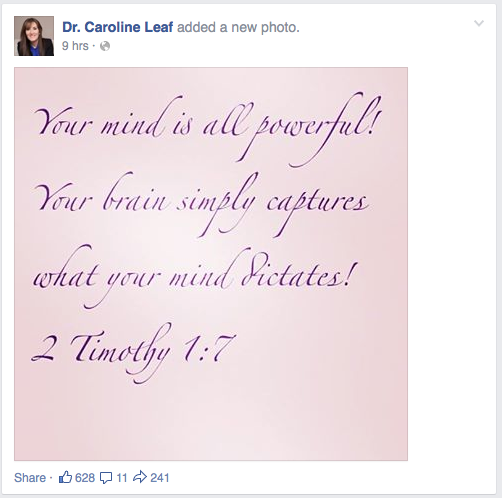
Screen Shot 2014-05-11 at 5.09.04 pm

Caroline Leaf is a brave woman.

Dr Caroline Leaf is a Communication Pathologist and self-titled Cognitive Neuroscientist.  She regularly publishes memes on her social media sites like FaceBook and Instagram that are supposed to reinforce her main teaching.

Her recent post declared:

“Your mind is all-powerful.  Your brain simply captures what your mind dictates. 2 Timothy 1:7”

We’re supposed to smile and nod, and accept that it must be right on face value alone.  Like, “Trust me, I’m a cognitive neuroscientist”.

But if we peel away the thin veneer of trust that covers the surface of this meme, we see that there isn’t much in the way of substance that supports it.

For a start, the only reference that Dr Leaf supplies is the scripture from 2 Timothy 1:7. She’s used this scripture in her work before, stating in her 2013 book, “For now, rest in the assurance that what God has empowered you to do with your mind is more powerful and effective than any medication, any threat, any sickness, or any neurological challenge.  The scripture is clear on this: You do not have a spirit of fear but of love, power and a sound mind (2 Tim 1:7).” [1]

So, first things first: the scripture 2 Timothy 1:7 says: “For God hath not given us the spirit of fear; but of power, and of love, and of a sound mind.”  (KJV)  But what does it actually mean?

Studying the full context and the original Greek reveals that this verse is not a reference to our mental health, but to the courage to perform the work that God has given us.

The Greek word for “fear” in this scripture refers to “timidity, fearfulness, cowardice”, not to anxiety or terror.  The Greek word that was translated “of a sound mind” refers to “self-control, moderation”, not to serenity.  So Paul is telling Timothy that God doesn’t make him timid, but full of power, love and self-control.  Paul teaches that through the Holy Spirit, we have all the tools: power, love and the control to use them, so we don’t have to be afraid.

In addition, looking at the verse in its context, and in a different translation, shows it in a completely different light to the way Dr Leaf promotes it.  From the NIV, “I am reminded of your sincere faith, which first lived in your grandmother Lois and in your mother Eunice and, I am persuaded, now lives in you also.  For this reason I remind you to fan into flame the gift of God, which is in you through the laying on of my hands. For the Spirit God gave us does not make us timid, but gives us power, love and self-discipline. So do not be ashamed of the testimony about our Lord or of me his prisoner. Rather, join with me in suffering for the gospel, by the power of God.” (2 Timothy 1:5-8)

The scripture doesn’t say that our minds are more powerful than medication, sickness or “neurological challenge”.  It clearly doesn’t say that our mind is all-powerful, and that our brains simply capture what our minds dictate.  This scripture doesn’t have anything to do with our mental health (nor is there any scientific evidence to suggest that our mind is all-powerful or that the brain captures what our mind dictates, although that is another blog entirely (see also: Dr Caroline Leaf and the Myth of Mind Domination)).

Scripture is the inspired word of God.  It’s poor form to knowingly misquote someone to support your position, but it’s a very brave person that would misquote scripture for the sake of their argument.  And the inaccuracy of Dr Leaf’s use of both scripture and science surely calls into question the accuracy of all of her other memes.  Perhaps those who follow Dr Leaf’s social media feeds should also start taking them with more than a pinch of salt.

References

1.         Leaf, C.M., Switch On Your Brain : The Key to Peak Happiness, Thinking, and Health. 2013, Baker Books, Grand Rapids, Michigan:

(New Testament Greek lexicon used for the word search was the Blue Letter Bible Strongs Lexicon, Reference: Greek Lexicon: G1167 (KJV). Retrieved from http://www.blueletterbible.org/lang/lexicon/lexicon.cfm?Strongs=G1167&t=KJV and Greek Lexicon: G4995 (KJV). Retrieved from http://www.blueletterbible.org/lang/lexicon/lexicon.cfm?Strongs=G4995&t=KJV)

Dr Caroline Leaf and the 98 Percent Myth

Dr Caroline Leaf believes that nearly all our diseases come from our thoughts.

Dr Caroline Leaf believes that nearly all our diseases come from our thoughts.

In the hustle and bustle of daily life, most people wouldn’t stop to consider what makes people sick.  In my profession, I get a front row seat.

In the average week, I get to see a number of different things.  Mostly “coughs, colds and sore holes” as the saying goes, although there are some rarer things too.  And sometimes, people present with problems that aren’t for the faint of heart (or stomach – beware of nail guns is all I can say).

Normally, the statistics of who comes in with what doesn’t make it beyond the desk of the academic or health bureaucrat.  The numbers aren’t as important as the people they represent.

But to Dr Caroline Leaf, Communication Pathologist and self-titled Cognitive Neuroscientist, the numbers are all important.  To support her theory of toxic thoughts, Dr Leaf has stated that “75 to 98% of mental and physical (and behavioural) illness comes from one’s thought life” [1: p37-38].  She has repeated that statement on her website, on Facebook, and at seminars.

As someone with a front row seat to the illnesses people have, I found such a statement perplexing.  In the average week, I don’t see anywhere near that number.  In general practices around Australia, the number of presentations for psychological illnesses is only about eight percent [2].

But Australian general practice is a small portion of medicine compared to the world’s total health burden.  Perhaps the global picture might be different?  The World Health Organization, the global authority on global health, published statistics in November 2013 on the global DALY statistics [3] (a DALY is a Disability Adjusted Life Year).  According to the WHO, all Mental and Behavioural Disorders accounted for only 7.2% of the global disease burden.

You don’t need a statistics degree to know that seven percent is a long way from seventy-five percent (and even further from 98%).

Perhaps a large portion of the other ninety-three percent of disease that was classified as physical disease was really caused by toxic thoughts?  Is that possible?  In short: No.

When considered in the global and historical context, the vast majority of illness is related to preventable diseases that are so rare in the modern western world because of generations of high quality public health and medical care.

In a recent peer-reviewed publication, Mara et al state, “At any given time close to half of the urban populations of Africa, Asia, and Latin America have a disease associated with poor sanitation, hygiene, and water.” [4] Bartram and Cairncross write that “While rarely discussed alongside the ‘big three’ attention-seekers of the international public health community—HIV/AIDS, tuberculosis, and malaria—one disease alone kills more young children each year than all three combined. It is diarrhoea, and the key to its control is hygiene, sanitation, and water.” [5] Hunter et al state that, “diarrhoeal disease is the second most common contributor to the disease burden in developing countries (as measured by disability-adjusted life years (DALYs)), and poor-quality drinking water is an important risk factor for diarrhoea.” [6]

Diarrhoeal disease in the developing world – the second most common contributor to disease in these countries, afflicting half of their population – has nothing to do with thought.  It’s related to the provision of toilets and clean running water.

We live in a society that prevents half of our illnesses because of internal plumbing.  Thoughts seem to significantly contribute to disease because most of our potential illness is prevented by our clean water and sewerage systems.  Remove those factors and thought would no longer appear to be so significant.

In the same manner, modern medicine has become so good at preventing diseases that thought may seem to be a major contributor, when in actual fact, most of the work in keeping us all alive has nothing to do with our own thought processes.  Like sanitation and clean water, the population wide practices of vaccination, and health screening such as pap smears, have also significantly reduced the impact of preventable disease.

Around the world, “Recent estimates of the global incidence of disease suggest that communicable diseases account for approximately 19% of global deaths” and that “2.5 million deaths of children annually (are) from vaccine-preventable diseases.” [7] Again, that’s a lot of deaths that are not related to thought life.

Since 1932, vaccinations in Australia have reduced the death rate from vaccine-preventable diseases by 99% [8].  Epidemiological evidence shows that when vaccine rates increase, sickness from communicable diseases decrease [9: Fig 2, p52 & Fig 8, p67].

Population based screening has also lead to a reduction in disease and death, especially in the case of population screening by pap smears for cervical cancer.  Canadian public health has some of the best historical figures on pap smear screening and cervical cancer. In Canada, as the population rate of pap smear screening increased, the death rate of women from cervical cancer decreased.  Overall, pap smear screening decreased the death rate from cervical cancer by 83%, from a peak of 13.5/100,000 in 1952 to only 2.2/100,000 in 2006, despite an increase in the population and at-risk behaviours for HPV infection (the major risk factor for cervical cancer) [10].

And around the world, the other major cause of preventable death is death in childbirth.  The risk of a woman dying in childbirth is a staggering one in six for countries like Afghanistan [11] which is the same as your odds playing Russian Roulette.  That’s compared to a maternal death rate of one in 30,000 in countries like Sweden.  The marked disparity is not related to the thought life of Afghani women in labour.  Countries that have a low maternal death rate all have professional midwifery care at birth.  Further improvements occur because of better access to hospital care, use of antibiotics, better surgical techniques, and universal access to the health system [11].  Again, unless one’s thought life directly changes the odds of a midwife appearing to help you deliver your baby, toxic thoughts are irrelevant as a cause of illness and death.

Unfortunately for Dr Leaf, her statement that “75 to 98 percent of mental, physical and behavioural illnesses come from toxic thoughts” is a myth, a gross exaggeration of the association of stress and illness.

In the global and historical context of human health, the majority of illness is caused by infectious disease, driven by a lack of infrastructure, public health programs and nursing and medical care.  To us in the wealthy, resource-rich western world, it may seem that our thought life has a significant effect on our health.  That’s only because we have midwives, hospitals, public health programs and internal plumbing, which stop the majority of death and disease before they have a chance to start.

Don’t worry about toxic thoughts.  Just be grateful for midwives and toilets.

References

1.         Leaf, C.M., Switch On Your Brain : The Key to Peak Happiness, Thinking, and Health. 2013, Baker Books, Grand Rapids, Michigan:

2.         FMRC. Public BEACH data. 2010  [cited 16JUL13]; Available from: <http://sydney.edu.au/medicine/fmrc/beach/data-reports/public%3E.

3.         World Health Organization, GLOBAL HEALTH ESTIMATES SUMMARY TABLES: DALYs by cause, age and sex, GHE_DALY_Global_2000_2011.xls, Editor 2013, World Health Organization,: Geneva, Switzerland.

4.         Mara, D., et al., Sanitation and health. PLoS Med, 2010. 7(11): e1000363 doi: 10.1371/journal.pmed.1000363

5.         Bartram, J. and Cairncross, S., Hygiene, sanitation, and water: forgotten foundations of health. PLoS Med, 2010. 7(11): e1000367 doi: 10.1371/journal.pmed.1000367

6.         Hunter, P.R., et al., Water supply and health. PLoS Med, 2010. 7(11): e1000361 doi: 10.1371/journal.pmed.1000361

7.         De Cock, K.M., et al., The new global health. Emerg Infect Dis, 2013. 19(8): 1192-7 doi: 10.3201/eid1908.130121

8.         Burgess, M., Immunisation: A public health success. NSW Public Health Bulletin, 2003. 14(1-2): 1-5

9.         Immunise Australia, Myths and Realities. Responding to arguments against vaccination, A guide for providers. 5th ed. 2013, Commonwealth of Australia, Department of Health and Ageing, Canberra:

10.       Dickinson, J.A., et al., Reduced cervical cancer incidence and mortality in Canada: national data from 1932 to 2006. BMC Public Health, 2012. 12: 992 doi: 10.1186/1471-2458-12-992

11.       Ronsmans, C., et al., Maternal mortality: who, when, where, and why. Lancet, 2006. 368(9542): 1189-200 doi: 10.1016/S0140-6736(06)69380-X

Dr Caroline Leaf – Contradicted by the latest research

This is my most popular post by far.  I truly appreciate the support and interest in this post, but I’ve discovered and documented a lot more about Dr Leaf’s ministry in the last two years.  I welcome you to read this post, but if you’d like a more current review of the ministry of Dr Caroline Leaf, a new and improved version is here:
Dr Caroline Leaf – Still Contradicted by the Latest Evidence, Scripture & Herself

* * * * *

Mr Mac Leaf, the husband of Dr Caroline Leaf, kindly took the time to respond to my series of posts on the teachings of Dr Leaf at Kings Christian Centre, on the Gold Coast, Australia, earlier this month. As I had intended, and as Mr Leaf requested, I published his  reply, complete and unabridged (here).

This blog is my reply.  It is heavily researched and thoroughly referenced.  I think it’s fair to say that while Dr Leaf draws her conclusions from some scientific documents, there is more than enough research that contradicts her statements and opinions.  I have only listed a small fraction, and only on some of the points she raised.

In fairness, the fields of neurology and neuroscience are vast and rapidly expanding, and it is impossible for one person to cover all of the literature on every subject.  This applies to myself and Dr Leaf.  However, I believe that the information I have read, and referenced from the latest peer-reviewed scholarly works, do not support Dr Leaf’s fundamental premises.  If I am correct, then the strength and validity of Dr Leaf’s published works should be called into question.

As before, I welcome any reply or rebuttal that Dr Leaf wishes to make, which I will publish in full if she requests.  In the interests of healthy public debate, and encouraging people to make their own informed decisions on the teachings of Dr Leaf, any comments regarding the response of Mr Leaf, Dr Leaf or myself, are welcome provided they are constructive.

This is a bit of a lengthy read, but I hope it is worthwhile.

Dear Mr Leaf,

Thank you very much for taking the time out to reply to some of the points raised in my blog.  I am more than happy to publish your response, and to publish any response you wish to make public.

ON INFORMED DECISIONS

I published my blog posts to open up discussion on the statements made by Dr Leaf at the two meetings that I attended at Kings Christian Centre on the Gold Coast.  As you rightly point out, people should be able to make informed decisions.  A robust discussion provides the information required for people to make an informed choice.  Any contributions to this discussion from either yourself or Dr Leaf would be most welcome.

I apologise if you interpreted my blogs as judgemental, or if you believe there are any misunderstandings.  You may or may not have read my final two paragraphs from the third post, in which I acknowledged that I may have misunderstood where she was coming from, but that I would welcome her response.  If there were any misunderstandings, it is likely because Dr Leaf did not make any attempt to reference any of the statements she made on the day.  You may argue that she was speaking to a lay audience, and referencing is therefore not necessary.  However, I have been to many workshops for the lay public by university professors, who have extensively referenced their information during their presentations.  A lay audience does not preclude providing references.  Rather, it augments the speakers authority and demonstrates the depth of their knowledge on the subject at hand.

YOUR DEFENCE

It’s interesting that you feel the need to resort to defence by association, and Ad Hominem dismissal as your primary counter to the points I raised.

Can you clarify how attending the same university as Dr Christaan Barnard, or a Nobel laureate, endorses her arguments or precludes her from criticism?  I attended the University of Queensland where Professor Ian Frazer was based.  He developed the Human Papilloma Virus vaccine and was the 2006 Australian of the Year.  Does that association enhance my argument?

Can you also clarify why a reference from a colleague was preferred to letting Dr Leaf’s statements and conclusions speak for themselves?  Dr Amua-Quarshie’s CV is certainly very impressive, no doubt about that, although he doesn’t list the papers he’s published.  (I’m assuming that to hold the title of Adjunct Professor, he’s published peer-reviewed articles.  Is he willing to list them, for the record?)

Whatever his credentials, his endorsement means very little, since both Dr Leaf and Dr Amua-Quarshie would know from their experience in research that expert opinion is one of the lowest forms of evidence, second worst only to testimonials [1].  Further, both he and Dr Leaf are obviously close friends which introduces possible bias.  His endorsement is noteworthy, but it can not validate every statement made by Dr Leaf.  Her statements should stand up on their own through the rigors of critical analysis.

On the subject of evidence, disparaging your critics is not a substitute for answering their criticism.  Your statement, “By your comments it is obvious that you have not kept up to date with the latest Scientific research” is an assumption that is somewhat arrogant, and ironic since Dr Leaf is content to use superseded references dating back to 1979 to justify her current hypotheses.

DR LEAF’S EVIDENCE

In the blog to which you referred, Dr Leaf makes a number of statements that are intended to support her case.  These include the following.

“A study by the American Medical Association found that stress is a factor in 75% of all illnesses and diseases that people suffer from today.”  She fails to reference this study.

“The association between stress and disease is a colossal 85% (Dr Brian Luke Seaward).”   But again, she fails to reference the quote.

“The International Agency for Research on Cancer and the World Health Organization has concluded that 80% of cancers are due to lifestyles and are not genetic, and they say this is a conservative number (Cancer statistics and views of causes Science News Vol.115, No 2 (Jan.13 1979), p.23).”  It’s good that she provides a reference to her statement.  However, referencing a journal on genetics from 1979 is the equivalent of attempting to use the land-speed record from 1979 to justify your current preference of car.  The technology has advanced significantly, and genetic discoveries are lightyears ahead of where they were more than three decades ago.

“According to Dr Bruce Lipton (The Biology of Belief, 2008), gene disorders like Huntington’s chorea, beta thalassemia, cystic fibrosis, to name just a few, affect less than 2% of the population. This means the vast majority of the worlds population come into this world with genes that should enable the to live a happy and healthy life. He says a staggering 98% of diseases are lifestyle choices and therefore, thinking.”  Even if it’s true that Huntingtons, CF etc account for 2% of all illnesses, they account for only a tiny fraction of genetic disease.  And concluding that the remaining 98% must therefore be lifestyle related is overly simplistic.  It ignores the genetic influence on all other diseases, other congenital, and environmental causes of disease.  I will fully outline this point soon.

Similarly, “According to W.C Willett (balancing lifestyle and genomics research for disease prevention Science (296) p 695-698, 2002) only 5% of cancer and cardiovascular patients can attribute their disease to hereditary factors.”  Science is clear that genes play a significant role in the development of cardiovascular disease and most cancers, certainly greater than 5%.  Again, I will discuss this further soon.

“According to the American Institute of health, it has been estimated that 75 – 90% of all visits to primary care physicians are for stress related problems (http://www.stress.org/americas.htm). Some of the latest stress statistics causing illness as a result of toxic thinking can be found at: http://www.naturalwellnesscare.com/stress-statistics.html”  These websites not peer-reviewed, and both suffer from a blatant pro-stress bias.

You’ll also have to forgive my confusion, but Dr Leaf also wrote, “Dr H.F. Nijhout (Metaphors and the Role of Genes and Development, 1990) genes control biology and not the other way around.”  So is she saying that genes DO control development?

EVIDENCE CONTRADICTING DR LEAF

Influence Of Thought On Health

Dr Leaf has categorically stated that “75 to 98% of all illnesses are the result of our thought life” on a number of occasions.  She repeated the same statement in her most recent book so it is something she is confident in.  However, in order to be true, this fact must be consistent across the whole of humanity.

And yet, in a recent peer-reviewed publication, Mara et al state, “At any given time close to half of the urban populations of Africa, Asia, and Latin America have a disease associated with poor sanitation, hygiene, and water.” [2]  Bartram and Cairncross write that “While rarely discussed alongside the ‘big three’ attention-seekers of the international public health community—HIV/AIDS, tuberculosis, and malaria—one disease alone kills more young children each year than all three combined. It is diarrhoea, and the key to its control is hygiene, sanitation, and water.” [3]  Hunter et al state that, “diarrhoeal disease is the second most common contributor to the disease burden in developing countries (as measured by disability-adjusted life years [DALYs]), and poor-quality drinking water is an important risk factor for diarrhoea.” [4]

Toilets and clean running water have nothing to do with stress or thought.  We live in a society that essentially prevents more than half of our illnesses because of internal plumbing, with additional benefits from vaccination and population screening.  If thoughts have any effect on our health, they are artificially magnified by our clean water and sewerage systems.  Remove those factors and any effects of thought on our health disappear from significance.  Dr Leaf’s assertion that 75 to 98% of human illness is thought-related is a clear exaggeration.

Let me be clear – I understand the significance of stress on health and the economy, but it is not the cause of 75-98% of all illnesses.  I’m not sure if there is a similar study in the US, but the latest Australian data suggests that all psychological illness only counts for 8% of visits to Australian primary care physicians [5].

In terms of cancer, I don’t have time to exhaustively list every cancer but of the top four listed in the review “Cancer Statistics 2013” [6] , here are the articles that list the gene x environment interactions:

  1. PROSTATE – There are only two risk factors for prostate cancer, familial aggregation and ethnic origin. No dietary or environmental cause has yet been identified [7].  It is most likely caused by multiple genes at various loci [8].
  2. BREAST – Genes make up 25% of the risk factors for breast cancer, and significantly interacted with parity (number of children born) [9].
  3. LUNG/BRONCHUS – Lung cancer is almost exclusively linked to smoking, but nicotine addiction has a strong hereditary link (50-75% genetic susceptibility) [10].
  4. COLORECTUM – Approximately one third of colorectal cancer is genetically linked [11].

So the most common cancer is not linked to any environmental factors at all, and the others have genetic influences of 25% to more than 50%.  This is far from being 2% or 5% as Dr Leaf’s sources state.

Also in terms of heart disease, the INTERHEART trial [12] lists the following as significant risk factors, and I have listed the available gene x environment interaction studies that have been done on these too:

  1. HIGH CHOLESTEROL – Genetic susceptibility accounts for 40-60% of the risk for high cholesterol [13].
  2. DIABETES – Genetic factors account for 88% of the risk for type 1 diabetes [14].  There is a strong genetic component of the risk of type 2 diabetes with 62-70% being attributable to genetics [15, 16].
  3. SMOKING – nicotine addiction has a strong hereditary link (50-75% genetic susceptibility) [10].
  4. HYPERTENSION – While part of a much greater mix of variables, genetics are still thought to contribute between 30% and 50% to the risk of developing high blood pressure [17].

So again, while genes are a part of a complex system, it is clear from the most recent evidence that genetics account for about 50% of the risk for cardiovascular disease, which again is a marked difference between the figures that Dr Leaf is using to base her assertions on.

Atrial Natriuretic Peptide

I am aware of research that’s studied the anxiolytic properties of Atrial Natriuretic Peptide.  For example, Wiedemann et al [18] did a trial using ANP to truncate panic attacks.  However, these experiments were done on only nine subjects, and the panic attacks were induced by cholecystokinin.  As such, the numbers are too small to have any real meaning.  And the settling is completely artificial.  Just as CCK excretion does not cause us all to have panic attacks every time we eat, ANP does not provide anxiolysis in normal day to day situations.  Besides, if ANP were really effective at reducing anxiety, then why do people suffering from congestive cardiac failure, who have supraphysiological levels of circulating ANP [19] , also suffer from a higher rate of anxiety and panic disorders than the general population? [20]

The Heart As A Mini-Brain

As for Heartmath, they advance the notion of the heart being a mini-brain to give themselves credibility.  It’s really no different to an article that I read the other day from a group of gut researchers [21] – “‘The gut is really your second brain,’ Greenblatt said. ‘There are more neurons in the GI tract than anywhere else except the brain.’”  The heart as a mini-brain and the gut as a mini-brain are both figurative expressions.  Neither are meant to be taken literally.  I welcome Dr Leaf to tender any further evidence in support of her claim.

Hard-Wired For Optimism

As for being wired for optimism, the brain is likely pre-wired with a template for all actions and emotions, which is the theory of protoconsciousness [22].  Indeed, neonatal reflexes often reflect common motor patterns.  If this is true, then the brain is pre-wired for both optimism and love, but also fear.  This explains the broad role of the amygdala in emotional learning [23] including fear learning.  It also means that a neonate needs to develop both love and fear.

A recent paper showed that the corticosterone response required to learn fear is suppressed in the neonate to facilitate attachment, but with enough stress, the corticosterone levels build to the point where amygdala fear learning can commence [24].  The fear circuits are already present, only their development is suppressed.  Analysis of the cohort of children in the Bucharest Early Intervention Project showed that negative affect was the same for both groups.  However positive affect and emotional reactivity was significantly reduced in the institutionalised children [25].  If the brain is truly wired for optimism and only fear is learned, then positive emotional reactivity should be the same in both groups and the negative affect should be enhanced in the institutionalised cohort.  That the result is reversed confirms that neonates and infants require adequate stimulation of both fear and love pathways to grow into an emotionally robust child, because the brain is pre-wired for both but requires further stimulation for adequate development.

The Mind-Brain Link

If the mind controls the brain and not the other way around as Dr Leaf suggests, why do anti-depressant medications correct depression or anxiety disorders?  There is high-level evidence to show this to be true [26-28].  The same can be said for recent research to show that medications which enhance NDMA receptors have been shown to improve the extinction of fear in anxiety disorders such as panic disorder, OCD, Social Anxiety Disorder, and PTSD [29].

If the mind controls the brain and not the other way around as Dr Leaf suggests, why do some people with acquired brain injuries or brain tumours develop acute personality changes or thought disorders?  Dr Leaf has done PhD research on patients with closed head injuries and treated them in clinical settings according to her CV.  She must be familiar with this effect.

One can only conclude that there is a bi-directional effect between the brain and the stream of thought, which is at odds with Dr Leaf’s statement that the mind controls the brain and not the other way around.

FURTHER CLARIFICATION

One further thing.  Can you clarify which of Dr Leaf’s peer-reviewed articles have definitively shown the academic improvement in the cohort of 100,000 students, as you and your referee have stated?  And can you provide a list of articles which have cited Dr Leaf’s Geodesic Information Processing Model?  Google Scholar did not display any articles that had cited it, which must be an error on Google’s part.  If her theory is widely used as you say, it must have been extensively cited.

I understand that you are both busy, but I believe that I have documented a number of observations, backed by recent peer-reviewed scientific literature, which directly contradict Dr Leaf’s teaching.  I have not had a chance to touch on many, many other points of disagreement.

For the benefit of Dr Leaf’s followers, and for the scientific and Christian community at large, I would appreciate your response.

I would be grateful if you could respond to the points raised and the literature which supports it, rather than an Ad Hominem dismissal or further defense by association.

Dr C. Edward Pitt

REFERENCES

1. Fowler, G., Evidence-based practice: Tools and techniques. Systems, settings, people: Workforce development challenges for the alcohol and other drugs field, 2001: 93-107.

2. Mara, D., et al., Sanitation and health. PLoS Med, 2010. 7(11): e1000363.

3. Bartram, J. and Cairncross, S., Hygiene, sanitation, and water: forgotten foundations of health. PLoS Med, 2010. 7(11): e1000367.

4. Hunter, P.R., et al., Water supply and health. PLoS Med, 2010. 7(11): e1000361.

5. FMRC. Public BEACH data. 2010  16JUL13]; Available from: <http://sydney.edu.au/medicine/fmrc/beach/data-reports/public&gt;.

6. Siegel, R., et al., Cancer statistics, 2013. CA Cancer J Clin, 2013. 63(1): 11-30.

7. Cussenot, O. and Valeri, A., Heterogeneity in genetic susceptibility to prostate cancer. Eur J Intern Med, 2001. 12(1): 11-6.

8. Alberti, C., Hereditary/familial versus sporadic prostate cancer: few indisputable genetic differences and many similar clinicopathological features. Eur Rev Med Pharmacol Sci, 2010. 14(1): 31-41.

9. Nickels, S., et al., Evidence of gene-environment interactions between common breast cancer susceptibility loci and established environmental risk factors. PLoS Genet, 2013. 9(3): e1003284.

10. Berrettini, W.H. and Doyle, G.A., The CHRNA5-A3-B4 gene cluster in nicotine addiction. Mol Psychiatry, 2012. 17(9): 856-66.

11. Hutter, C.M., et al., Characterization of gene-environment interactions for colorectal cancer susceptibility loci. Cancer Res, 2012. 72(8): 2036-44.

12. Yusuf, S., et al., Effect of potentially modifiable risk factors associated with myocardial infarction in 52 countries (the INTERHEART study): case-control study. Lancet, 2004. 364(9438): 937-52.

13. Asselbergs, F.W., et al., Large-scale gene-centric meta-analysis across 32 studies identifies multiple lipid loci. Am J Hum Genet, 2012. 91(5): 823-38.

14. Wu, Y.L., et al., Risk factors and primary prevention trials for type 1 diabetes. Int J Biol Sci, 2013. 9(7): 666-79.

15. Ali, O., Genetics of type 2 diabetes. World J Diabetes, 2013. 4(4): 114-23.

16. Murea, M., et al., Genetic and environmental factors associated with type 2 diabetes and diabetic vascular complications. Rev Diabet Stud, 2012. 9(1): 6-22.

17. Kunes, J. and Zicha, J., The interaction of genetic and environmental factors in the etiology of hypertension. Physiol Res, 2009. 58 Suppl 2: S33-41.

18. Wiedemann, K., et al., Anxiolyticlike effects of atrial natriuretic peptide on cholecystokinin tetrapeptide-induced panic attacks: preliminary findings. Arch Gen Psychiatry, 2001. 58(4): 371-7.

19. Ronco, C., Fluid overload : diagnosis and management. Contributions to nephrology,. 2010, Basel Switzerland ; New York: Karger. viii, 243 p.

20. Riegel, B., et al., State of the science: promoting self-care in persons with heart failure: a scientific statement from the American Heart Association. Circulation, 2009. 120(12): 1141-63.

21. Arnold, C. Gut feelings: the future of psychiatry may be inside your stomach. 2013  [cited 2013 Aug 22]; Available from: http://www.theverge.com/2013/8/21/4595712/gut-feelings-the-future-of-psychiatry-may-be-inside-your-stomach.

22. Hobson, J.A., REM sleep and dreaming: towards a theory of protoconsciousness. Nat Rev Neurosci, 2009. 10(11): 803-13.

23. Dalgleish, T., The emotional brain. Nat Rev Neurosci, 2004. 5(7): 583-9.

24. Landers, M.S. and Sullivan, R.M., The development and neurobiology of infant attachment and fear. Dev Neurosci, 2012. 34(2-3): 101-14.

25. Bos, K., et al., Psychiatric outcomes in young children with a history of institutionalization. Harv Rev Psychiatry, 2011. 19(1): 15-24.

26. Arroll, B., et al., Antidepressants versus placebo for depression in primary care. Cochrane Database Syst Rev, 2009(3): CD007954.

27. Soomro, G.M., et al., Selective serotonin re-uptake inhibitors (SSRIs) versus placebo for obsessive compulsive disorder (OCD). Cochrane Database Syst Rev, 2008(1): CD001765.

28. Kapczinski, F., et al., Antidepressants for generalized anxiety disorder. Cochrane Database Syst Rev, 2003(2): CD003592.

29. Davis, M., NMDA receptors and fear extinction: implications for cognitive behavioral therapy. Dialogues Clin Neurosci, 2011. 13(4): 463-74.

Dr Caroline Leaf – Serious questions, few answers (Part 3) – “Flirting with heresy”

Following on from the last 2 posts discussing the various teaching points of Dr Caroline Leaf at Kings Christian Church, here is my final post on the points that she raised.  Tonight, I conclude by proposing that in equating ‘toxic’ thoughts with sin, she seriously weakens her own argument, or she flirts with heresy.

TOXIC THOUGHTS ARE SIN

Probably the most disturbing of all she discussed was her point blank statement that, “Toxic thoughts are sin.”

This is an astounding claim, and it was said in such an off-handed manner. It was like she threw a grenade and calmly moved on. Her claim not only has psychological ramifications, but deep theological connotations.

Her statement has the effect of ADDING to the stress response of her audience. Indeed, it sets up a feedback loop of self-perpetualising existential distress – the spiritual struggle switch. Crum et al (2013) showed that negatively framing the concept of stress leads to an increase in the subjects stress response. What could be more stressing that telling a christian that they have sinned every time that have had a persistent stress?  More stress is then equated with more ‘sin’ which then gives rise to even more stress. And so the cycle continues.

She then attempted to redeem her statement by declaring that we can transcend the guilt from the sin of stress, because her 21-day brain detox program would fix it. But on the surface, it seems an arbitrary premise. Inducing guilt to then offer to fix it is like a supermarket marking up a price so they can claim to offer a discount when they reduce it again.

More importantly though, in making the link between stress and sin, she brings herself undone. She either unravels her entire argument, or she flirts with heresy. Because if a thought process which results in prolonged or severe fear/stress is a sin, then Jesus himself sinned.

In the Garden of Gethsemane, the gospels record that Jesus, the spotless lamb of God, about to be crucified for the sins of all mankind, was “overwhelmed with sorrow to the point of death” (Mark 14:34, Matthew 26:38), and became so distressed by the ordeal he was about to endure that he literally sweat drops of blood (Luke 22:44).

Where do you think Jesus was on the stress spectrum according to those accounts? I’d wager that it wasn’t “healthy stress”.Rev Bob Deffinbaugh wrote that,

“Jesus spent what appears to be at least three agonizing hours in prayer.” He also noted that, “Never before have we seen Jesus so emotionally distraught. He has faced a raging storm on the Sea of Galilee, totally composed and unruffled. He has faced demonic opposition, satanic temptation, and the grilling of Jerusalem’s religious leaders, with total composure. But here in the Garden, the disciples must have been greatly distressed by what (little) they saw. Here, Jesus cast Himself to the ground, agonizing in prayer.” (https://bible.org/seriespage/garden-gethsemane-luke-2239-46)

There is no other way to explain it – Jesus suffered severe and prolonged mental anguish to the point that it had physical effects. By Dr Leaf’s definition (Leaf 2009, p19), Jesus had “toxic” thoughts. So the crux is: either toxic thoughts and emotions are sinful, in which case Jesus was a sinner and our salvation is invalid, or toxic thoughts and emotions are not sinful, which directly contradicts her teaching.

There is at least one further example from the life of Jesus that significantly weakens Dr Leafs definition of ‘toxic’ thoughts. In her book, Dr Leaf states, “hostility and rage are at the top of the list of toxic emotions”, and that “Stress is the direct result of toxic thinking.” (Leaf 2009, p29-30)

In John 2:13-17, it says, “When it was almost time for the Jewish Passover, Jesus went up to Jerusalem. In the temple courts he found people selling cattle, sheep and doves, and others sitting at tables exchanging money. So he made a whip out of cords, and drove all from the temple courts, both sheep and cattle; he scattered the coins of the money changers and overturned their tables. To those who sold doves he said, “Get these out of here! Stop turning my Father’s house into a market!” His disciples remembered that it is written: “Zeal for your house will consume me.”

So Jesus saw the sellers and the money exchangers, then in a pre-meditated way, took small cords and fashioned a whip out of them, then proceeded to use that whip to violently and aggressively overturn the tables of the merchants and spill the money of the money changers. John adds a post-script – “Zeal for your house will consume me.”  So Jesus wasn’t mincing words. He drove them out of the temple in a rage.

Again, was Jesus acting in sin?  Of course not.  Instead, perhaps God has designed normal human beings to experience rage, anger and stress – emotions that are not curses passed down in genetic material and are not learned behaviours as a result of our sin nature.

Further, God himself displayed anger.  God also made us in his image, and in his likeness. Dr Leaf stated that we were designed to function in optimism and love, and again, negative emotions like anger and fear are learnt from living in sin. Yet it is interesting that God the Father regularly kindled his wrath, and smote Israelites or their enemies (Numbers 11:33, Deuteronomy 11:16-17, and in 2 Kings 23:25-27, “Notwithstanding the Lord turned not from the fierceness of his great wrath, wherewith his anger was kindled against Judah, because of all the provocations that Manasseh had provoked him withal.”)

If God regularly displayed anger throughout the Old Testament, and Jesus displayed it in the New Testament, then anger and rage can not be the perversion of God’s ultimate design as Dr Leaf proposes.

Therefore, ‘toxic’ thought is NOT sin, because Jesus suffered prolonged mental stress and anguish and he did not sin.  Emotions that are deemed to be toxic by Dr Leaf and her definition are not toxic, since both God and Jesus displayed them and they did not and do not sin. Such a suggestion is incongruent with the Christian faith.

We were made in the image of God, so therefore we mirror all the emotions of God, which includes anger.  This shows that Dr Leaf’s proposals and the assumptions on which they are based, are incongruent with a logical interpretation of scripture.

In conclusion, Dr Leaf has been gathering quite a following.  From the pulpit at least, her claims of evidence of studies from peer-reviewed sources have been lacking. From what I saw on Sunday last, her reputation is excessive, her arguments unsupported and her theology is questionable at best, dangerous at worst.

Personally, I would welcome Dr Leaf’s response to these posts.  I have written these posts over a few days from her teaching at one church, so perhaps I have misunderstood her.  I have not been able to go through all of her books in such a short time, so she may have references to her teaching.  But she needs to clarify each question that I’ve raised and respond with current peer-reviewed science and sound theological resources.

References

Crum, A. J., P. Salovey and S. Achor (2013). “Rethinking stress: the role of mindsets in determining the stress response.” J Pers Soc Psychol 104(4): 716-733.

Karatsoreos, I. N. and B. S. McEwen (2011). “Psychobiological allostasis: resistance, resilience and vulnerability.” Trends Cogn Sci 15(12): 576-584.

Leaf, C. (2009). Who Switched Off My Brain? Controlling toxic thoughts and emotions. Southlake, TX, USA, Inprov, Ltd.

Dr Caroline Leaf – Serious questions, few answers (Part 1)

Caroline Leaf. The name is popping up more and more around Christian circles. I was curious to hear her speak, since as a Christian and a (family) physician, I like to know how people integrate science and spirituality. So I took the opportunity to drive down to Kings Christian Church on the Gold Coast to hear what she had to say.

I left with more questions than answers.  And some serious concerns.

The following blog posts are a discussion on some of the points that she raised. I simply don’t have the time to go through all of them, although I’m seriously considering whether to do a formal review and response to her teaching.

I had to divide up the original post into three parts to make it more manageable. Here’s part 1, in which I review her academic qualifications, her link of thoughts and illness, our innate wiring, and the myth of the mini-brain.

Part 2 of this post will look further at the pecking order of the mind and brain, some miscellaneous issues, and her ‘professional’ opinion on ADHD.

Part 3 will examine her claim that “Toxic thoughts are sin” and why such a statement is incongruent with the Christian faith.

IS SHE A COGNITIVE NEUROSCIENTIST?

For a start, she was introduced as a cognitive neuroscientist. Her CV lists her degrees as a Bachelor of Science, Masters in Speech Therapy and Audiology, and a PhD in Communication Pathology. She did not advise where she has tenure or does her research. Her CV lists guest lectures at a few Universities (Wits, University of Pretoria, University of Cape Town, University of Western Cape Annual Education Conference, SASHLA, Rotary Foundation), but no tenure.

Admittedly, the definition of a cognitive neuroscientist is somewhat vague (http://careersinpsychology.org/becoming-a-cognitive-neuroscientist/) but the term ‘cognitive neuroscientist’ confers the idea that one is actively involved in cognitive neuroscientific research, or at least in the recent past.

So the question remains: is she really a cognitive neuroscientist, or is she just a woman with a PhD that reads a lot?

THE CORRELATION OF ILLNESS AND THOUGHT

The next thing to grab my attention was her statement: “75 to 98% of ALL illness is related to our thought life.” Somehow I doubt that. The influence of stress is high.  But I am a GP – I see sick people everyday, on the coal face, before they are collected in subspecialist clinics, or improve spontaneously. It’s a real stretch to ascribe stress to more than 30%. Looking at her book ‘Who Switched Off My Brain’ (Leaf 2009, p15), she says that 80% of all diseases are the result of our thought lives. So her own figures are conflicting. (The other thing is that, for a PhD recipient, she has poorly referenced her book!)

Besides, stress causes illness, but I’m not yet satisfied she’s proven that ‘negative’ thought and stress are the same thing.

THE MINI-BRAIN

She also claimed that the brain and the heart connect to every cell in your body. Again, it’s a bit of a stretch. Every cell needs to be bathed in nutrients from the blood which in turn is connected to the heart, and nerves are every where.  But there are many cells that are not innervated directly.

The only way that the brain or the heart are connected to every cell is simply because, technically, every cell is connected to every other cell. Like if everyone in a church stood up and held hands, the man in the front row would be “connected” to the woman in the back.

But she went further on her theory, by claiming that the heart has a mini-brain that directly influences the real brain – by making moral decisions on its own, and that it is part of our conscience. She justified her statement by saying that the heart has 40,000 interconnected nerve cells, and the heart is directly connected to the brain. But on that same logic, my rectum could be a mini-brain and be part of my conscience.

She alluded to the effect of ANF, atrial natriuretic factor. There are actually three natriuretic peptides. ANF, produced by the top two chambers of the heart, actually regulates blood pressure (http://www.cvphysiology.com/Blood%20Pressure/BP017.htm). If it has an effect on thought, it is secondary, not primary.

WIRED FOR OPTIMISM?

She also states that we are wired for optimism, and that emotions like fear are learned. That doesn’t make sense since I have seen research that shows a newborn baby is wired for pleasure and emotions like disgust. These pathways are developed and refined during childhood, but we are born with built-in templates for basic emotion.

I will have more in the next 24 hours, including her statement on the pecking order of the mind and brain, some miscellaneous issues, and her ‘professional’ opinion on ADHD.

REFERENCES

Leaf, C. (2009). Who Switched Off My Brain? Controlling toxic thoughts and emotions. Southlake, TX, USA, Inprov, Ltd.

Fear: Friend or Foe?

Fear.  Should we run, fight, or think?

I was lazily wasting time at Zarraffas this afternoon, and while I was savouring the richness and depth of my triple masai mocha, I was filling the time by flicking through Facebook.

I came upon a blog post by one of the best thinkers and writers I’m personally acquainted with, one Ruth Limkin, who shared the story of how she was given an opportunity to snorkel in a pristine area of ocean in the South Pacific that is limited to only a handful of people, such is the fragile beauty of the ecosystem there.  As she started swimming into the warm, calm, azure waters, she felt this sudden dread.

Five years ago in a similar situation, she misjudged the current, was swept into some coral, and sustained a laceration to her knee.  This left a lot of blood in the water which, quite reasonably, made her think that she had suddenly become shark bait.  She made it back to shore otherwise unscathed. But it left her with the implicit memory of that event.

This year, despite the obviously calm surroundings, she recalled that fear. Her brain told her to get out of there.  She did manage to overcome her fear though, and enjoyed the snorkelling!

Her lesson was that the pain of yesterday can become todays fear, which robs tomorrow of its promise.

I don’t disagree with Ruth.  I’m not intelligent enough to do that.  But I guess I come from a more medical and analytical perspective of this phenomenon, and I wanted to flesh out her point a bit further.

We all feel it at sometime or another – your heart pounds faster and heavier in your chest. Your breathing gets faster. Your muscles tighten. And your brain either says, “Run” or “Fight”, or sometimes it says nothing at all and we simply freeze up.

The human fear response is both rational and irrational.  We usually don’t understand why we are faced with conflicting realities of internal anxiety and external tranquility, feeling scared while looking at calm clear waters.  Sometimes when we take a step back, we can gain some understanding of why we have reacted the way we did, and cognitively overcome our fear.

B-grade pop-psychologists make us believe that courage is the absence of fear, and that the way to move forward is to eliminate or repress your fears.  But that approach is wrong for a couple of reasons.

There is a good reason why we have fear conditioning.  There is a part of the brain called the limbic system, which is integral to emotional processing.  Central to this is the amygdala, which is responsible for adding emotions to our experiences, especially fear and anger.  When something happens that has real or perceived negative consequences (we experience pain, or we think that there is a high chance that we will experience pain) the amygdala pairs that aversive sensation with the memory of the total experience.  This helps us learn from our mistakes [1].

For example, if a pre-historic man was walking through a forest and came across a sabre-toothed tiger, the fight-or-flight response would help him escape.  But the amygdala would attach the memory of the emotion to the memory of the event itself.  Next time the man walked through a similar forest, or even recalled that event in his mind, the emotion of the memory would also be recalled.  This is why Ruth felt uneasy despite the lack of danger.  Her surroundings triggered the emotional memory of the previous snorkelling experience.

But while unpleasant, fear does confer a survival advantage.  Without the same emotion being recalled, we wouldn’t remember what situations were dangerous and which were safe.  Recalling the emotion and realising there may be sabre-toothed tigers around, or strong currents and sharks, means that there is a much smaller chance of us becoming lunch.

There are two pathways in the brain that are involved in the fear response.  The direct pathway goes from the senses to the amygdala, bypassing the thinking parts of our brain entirely.  Again, this confers a survival advantage as the quicker you can prepare yourself for danger, the more likely you are to survive it.  The signal is not properly analysed, but it doesn’t need to be.  It is better to be wrong and live than to be right and eaten by something.

The second pathway from the senses to the cerebral cortex then back to the amygdala is more precise, but it is slower than the direct path.  It can downgrade the fear response if it is not appropriate.  Well, it can in most people.  Anxiety and panic disorders arise when the balance between the direct and indirect pathways is skewed in the direction of the amygdala.

If you think you may have an anxiety disorder or panic disorder, you should see a good GP.  There are specific forms of psychological therapy that you may need to engage with.  Some people also need medications to assist with the process.

For most people though, we can simply allow the recalled feeling of fear stop us from engaging in life.  When we sense fear, the natural reaction is to run or fight.  That is the direct pathway talking in our brain. The lesson from our neurobiology is that we have another choice.  We can let our cerebral cortex do its job, we can think about the situation, and allow our higher functions to downgrade our primitive reactions.

We also need to understand that fear is ok.  It is necessary, in fact.  Without it, we wouldn’t adapt to our surroundings or learn from our mistakes.  We should not avoid fear.  We should not fight fear.  But we should not let fear control us.

Nelson Mandela, a man who experienced great fear but greater hope, sums it up beautifully, and so gets the final word, “Courage is not the absence of fear, but the triumph over it.”

References
[1] Dalgleish, T., The emotional brain. Nat Rev Neurosci, 2004. 5(7): p. 583-9.