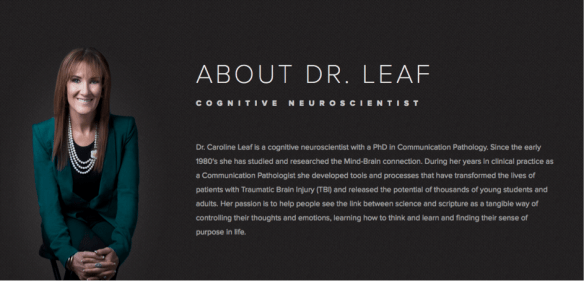
“Touching the hem of her garment” – A Review of Dr Caroline Leaf at Nexus Church, Brisbane, 2nd August 2015

Dr Caroline Leaf is a communication pathologist and a self-titled cognitive neuroscientist. She’s currently on tour through Queensland and New South Wales in Australia. Her only stop in Brisbane, my home town, was at Nexus, my former home church. Dr Leaf presented a keynote address at Nexus’s annual Designing Women conference yesterday, and was the guest speaker at their two morning services today.

This morning typified Brisbane winter – cloudless azure skies and a refreshingly cool breeze. In contrast to the air temperature, the hospitality at Nexus was warm and friendly. The worship, soulful and uplifting. I really enjoyed being there.

Then it was Dr Leaf’s turn. It’s amazing just how much misinformation one person can fit into a 30 minute sermon.

The main theme for her sermons was an exposition on the parable of the sower, linking the different ways people receive information, with the story of the woman with the issue of blood. Dr Leaf tried to prove that thought and faith are synonymous by linking verses at the beginning and of the story from the gospel of Mark (5:25-34) – “because she thought, ‘If I just touch his clothes, I will be healed.’” (v28) and “He said to her, ‘Daughter, your faith has healed you. Go in peace and be freed from your suffering.’” (v34).

The link is highly tenuous to start with. Faith is an action, whereas thought is not. We assume that action is always preceded by thought, but it is not. Action does not require thought. Many people act without thinking. This is explained in more detail in my discussion on the Cognitive Action Pathways model.

Though to try and make her explanation more plausible, Dr Leaf padded out the story by telling the Nexus crowds that it was only because the woman had spent 12 years in deep intellectual thinking, meditating on the scriptures, that Jesus could heal her. But that’s Dr Leaf’s conjecture. In truth, no one knows exactly what that woman was doing or thinking in the 12 years that preceded her healing. The Bible never says anything else about the woman, in either version of the story in Mark or Luke (8:43-48), other than “She had suffered a great deal under the care of many doctors and had spent all she had, yet instead of getting better she grew worse” (Mark 5:26). If you have to rely on pure speculation to make your sermon work, then that’s story-telling, not preaching.

The other part of her sermon was an attempt to link the parable of the sower to some neuroscience, specifically the role of hippocampal synaptogenesis in the formation of long term memory (or in English, the changes that take place to nerves in the brain when you hear information and try to remember it).

Dr Leaf interpreted the parable as describing four different types of listener – Listener 1, corresponding to the man who hears the word but the devil takes it away, Listener 2, who hears the word and receives it with joy, but it doesn’t take root, Listener 3 who hears the word but it gets choked out by worries, riches or pleasure, and Listener 4 who hears the word and retains it, and the word produces a harvest.

According to Dr Leaf, these types of listener correspond to different levels of nerve branch growth in the formation of long term memory – Listener 1 doesn’t get past 24 hours before the memory dissipates. Listener 2 only lasts about four to seven days but there isn’t enough emotional salience to continue the growth of the nerve branch. Listener 3 doesn’t get past fourteen days, while the 4th Listener makes it through to a full 21 days, Dr Leaf’s magic number for long term memory.

Sounds great … except that the encoding and consolidation of incoming information is much more complex, and doesn’t rely on just new nerve growth [1]. That, and her numbers are completely arbitrary – with some permanent long term memory encoded in a couple of days. In fact, some long-term memory doesn’t need new synaptic growth at all, just a state of high excitation of the nerve network, known as Long-Term Potentiation, which is reliant on a self-reinforcing chemical cascade (if you want more information on the neurobiology of memory, a good place to start is The Brain From Top To Bottom, maintained by McGill University in Canada).

So the bulk of her sermon was based on biblical conjecture and bad science. Dr Leaf also made a myriad of misleading or mistaken statements: we are wired for love not fear, we learn through the quantum zeno effect, every thought effects every one of our 75 trillion cells, your toxic thoughts poison other people in relationship with you because of quantum physics, and many, many others.

I’ve only really got room for a few extra-special mentions.

1. “The mind controls brain”, and “the non-conscious mind is not bound by time and space”

No actual cognitive neuroscientist would be caught dead making those sort of statements. Saying that the mind controls the brain is like saying that air controls your lungs. The mind is a function of the brain, because when the brain is changed in certain ways, structurally or chemically, the mind changes. This has been known about for over a century, at least as far back as Freud who experimented with cocaine and other “mind-altering” substances.

Therefore if the brain controls the mind, then the non-conscious mind must be bound by the physical universe, which includes space and time. To suggest anything otherwise is just science fiction.

Besides, Dr Leaf herself tells us in her book “The Gift In You” [2], that our brain controls our mind. Dr Leaf is simply contradicting her own teaching.

2. “75 to 98% of all physical, mental and emotional illness is caused by your thought life.”

This factoid has been thoroughly debunked. If you would like to read more, you can click here or see chapter 10 in my book [3].

Today, in the second service, Dr Leaf took her fiction a step further and categorically stated that “98% of cancer comes from your thought life”. What nonsense! There is no rational evidence for such a ridiculous statement, and I don’t think there is anything more insensitive to cancer victims and their families than to blame then for causing their own cancer.

3. Mental Health

(a) “Mental illness is worse in the last 50 years than ever before”

To try and prove this is true, Dr Leaf flashed up a slide of ‘horrifying statistics” on mental illness. She claims that,
“35-fold increase in mental illness in children”
“Our children are the first in human history to grow up under the shadow of ‘mental illness'”
“Dramatic increase in the number of mentally ill since 50’s … things are worse not better”
“Mental ill health worst its ever been in history of mankind”

Every one of these statements is patently false. Mental illness has been with humankind for ever. The ancient Egyptians were writing about hysteria in women some two thousand years before Christ [4]. It’s only been in the last century or so that mental illnesses have become seen for the biological entities that they are, and not some form of demon possession, criminal behaviour or sexual deviancy.

Dr Leaf was quick to malign the DSM (the Diagnostic and Statistical Manual of psychiatry), suggesting that it’s unscientific. The DSM isn’t perfect, true, but before the DSM, there was even less science to the diagnosis of mental illness. As Dr Leaf herself pointed out, mental illness was previously viewed philosophically or spiritually. There was no consistency in diagnosis and no collection of statistics.

The DSM, for all its faults, gave a framework for mental health diagnosis, but as the science has become more refined, and with increasing awareness and general acceptance of mental health conditions, more people have qualified and/or accepted a diagnosis.

Mental illness has always been there, but now we know what to look for, it’s no longer hidden or ignored.

(b) “Psychotropic medications cause damage to the brain”

While on the subject of mental health, Dr Leaf made the litigation-attracting statement that psychotropic medications (anti-depressants, anti-psychotics) cause damage to the brain. That’s a particularly bold statement to make without citations, or a medical degree, to back it up.

Rather than ‘causing’ damage to the brain, there is scientific evidence that psychotropic medications increase synaptogenesis (the growth of new nerve branches) [5-7], while the NICE guidelines in the UK reviewed the evidence for anti-depressants and found them to be an effective treatment for depression [8], not harmful as Dr Leaf suggests.

(c) Biological causes for psychiatric illnesses have not been proven.

Dr Leaf also made the preposterous claim that biological causes of psychiatric illness have never been proven, but again, changes to brain structure have been associated with psychiatric symptoms ever since a 13-pound, three-and-a-half foot iron rod went through Phineas Gage’s skull and frontal lobe in 1848, and his personality suddenly changed from pleasant and congenial to depressed and angry [9]. Personality changes represent early symptoms of brain tumours. Use of drugs such as crystal meth can cause paranoia and extreme aggression. You don’t even need to be a doctor to know that, you just need to watch ‘Breaking Bad‘. So examples of the biological basis of psychiatric symptoms are everywhere. There are no grounds for Dr Leaf’s assertion.

4. Toxic thinking causes dementia

Dr Leaf claimed at the end of both sermons that toxic thinking results in the tubular backbone of the new nerve branches becoming contorted, which caused the accumulation of the tau protein in the nerve cells, which was responsible for dementia of every type. This, too, is a fallacy. The accumulation of the tau protein is found only in Alzheimers, not in Lewy Body dementia or in vascular dementia. The abnormal tau protein is likely related to the loss of a intracellular clean-up enzyme system [10], but Alzheimers is more complicated than just tau protein deposition, and has nothing to do with toxic thinking.

At the conclusion of the second service, I was outside the church when Dr Leaf and her entourage left the church auditorium before the rest of the crowd did, and I approached them to shake her hand and introduce myself. It was the mature thing to do after all. When I was about two metres from her presidential detail, a woman stepped out in front of me, blocking my way.

“You can’t follow them,” she said. “They’re going inside” (ie: hiding in the green room).
“Really?” I said, somewhat caught off guard. “I was simply going to introduce myself.”
“No”, was the firm reply. “You’re not allowed.”

By that time, the presidential detail had disappeared into their fortified sanctuary. The woman with the issue of blood may have got to Jesus, but there was no way I was even getting close to Dr Leaf.

This was a common pattern … Dr Leaf made herself deliberately scarce before and after each service, only coming into the church when the service was well underway, and leaving as soon as she preached, under heavy guard. One has to ask why? What’s she got to be afraid of? Is she so insecure about her teaching that she couldn’t possibly risk speaking to someone and being exposed as intellectually brittle? Or is it that she’s so arrogant as to insist on avoiding the rank-and-file church goer?

The pattern of avoidance of anyone other than her devotees, and her tendency to block anyone who disagrees with her from her social media accounts, would strongly suggest the former, although since she is so insistent on hiding from regular people, it’s really anyone’s guess.

Not that it matters. Dr Leaf could be the nicest person in the world.  Her ministry doesn’t rest on her sociability, but its own Biblical and scientific merits, and on that alone, it has been found seriously wanting.

References

[1]        Citri A, Malenka RC. Synaptic plasticity: multiple forms, functions, and mechanisms. Neuropsychopharmacology : official publication of the American College of Neuropsychopharmacology 2008 Jan;33(1):18-41.
[2]        Leaf CM. The gift in you – discover new life through gifts hidden in your mind. Texas, USA: Inprov, Inc, 2009.
[3]        Pitt CE. Hold That Thought: Reappraising the work of Dr Caroline Leaf. 1st ed. Brisbane, Australia: Pitt Medical Trust, 2014.
[4]        Tasca C, Rapetti M, Carta MG, Fadda B. Women and hysteria in the history of mental health. Clinical practice and epidemiology in mental health : CP & EMH 2012;8:110-9.
[5]        Karatsoreos IN, McEwen BS. Resilience and vulnerability: a neurobiological perspective. F1000prime reports 2013;5:13.
[6]        Duric V, Duman RS. Depression and treatment response: dynamic interplay of signaling pathways and altered neural processes. Cellular and molecular life sciences : CMLS 2013 Jan;70(1):39-53.
[7]        Karatsoreos IN, McEwen BS. Psychobiological allostasis: resistance, resilience and vulnerability. Trends in cognitive sciences 2011 Dec;15(12):576-84.
[8]        Anderson I. Depression. The Treatment and Management of Depression in Adults (Update). NICE clinical guideline 90.2009. London: The British Psychological Society and The Royal College of Psychiatrists, 2010.
[9]        Kihlstrom JF. Social neuroscience: The footprints of Phineas Gage. Social Cognition 2010;28:757-82.
[10]      Tai HC, Serrano-Pozo A, Hashimoto T, Frosch MP, Spires-Jones TL, Hyman BT. The synaptic accumulation of hyperphosphorylated tau oligomers in Alzheimer disease is associated with dysfunction of the ubiquitin-proteasome system. The American journal of pathology 2012 Oct;181(4):1426-35.

Dr Caroline Leaf – Still Contradicted by the Latest Evidence, Scripture and Herself

Leaf Cognitive Neuroscientist

Dr Caroline Leaf is a communication pathologist, world renowned author, public speaker, and self-titled cognitive neuroscientist. Her influence continues to grow. She is regularly invited to speak at some of the world’s largest churches. She spoke at her first TEDx conference in February, and she’s about to host her own conference for the second time. She has more than 120,000 Facebook followers, with many more on Twitter and other social media platforms. And she continues to top the sales charts of Christian best sellers.

She is a self-marketing machine.

But there are cracks appearing. More and more, people are realizing that beneath the facade of her numerous Instagram posts, happy snaps, and the allure of popular success, Dr Leafs teachings on science and the Bible don’t match up with actual science and good theology. While many in the church adorn themselves with her teaching, a growing minority are starting to realise that the Emperor has no clothes.

Almost two years ago to the day, I sat in the congregation of Kings Christian Church on the Gold Coast, and heard Dr Leaf speak live for the first time. What I heard troubled me, and I blogged about my concerns to open a dialogue on Dr Leaf and her teaching. Her husband, Mr Mac Leaf, dismissed my concerns out of hand, which only steeled me to take further action. Now, two years of intense research, dozens of posts and a book later, people are starting to take notice.

Not that Dr Leaf has changed her tune. Her fundamental teaching still relies on the idea that our thoughts control our physical and mental health, and toxic thinking causes disease because our thoughts change our DNA and the expression of our genes through epigenetics. And, if we ‘detox’ our thoughts, we will be restored to the health that God intended. Dr Leaf is also expanding her ministry to the subject of mental health and she plans to release a book on food in early 2016.

Dr Leaf can spruik whatever she likes, but her claims of expertise and her scientific and scriptural legitimacy are crumbling.

This post is a little longer than usual, but I’ve divided it up for easier reading:

  1. Dr Leaf is contradicted by her own qualifications
  2. Dr Leaf is contradicted by science
  3. Dr Leaf is contradicted by scripture
  4. Dr Leaf is contradicted by Dr Leaf

1. Dr Leaf is contradicted by her own qualifications

In her books, on TV, at churches, and in promotional material, Dr Leaf describes herself as a ‘cognitive neuroscientist’.

However, Dr Leaf does not have formal qualifications in neuroscience, has not worked at a university as a neuroscientist, has not worked in any neuroscience research labs, nor has she published any papers in neuroscience journals.

Actually, Dr Leaf is trained as a communication pathologist. A communication pathologist is an allied health professional which seems to be unique to South Africa where Dr Leaf trained. It’s a synthesis of audiology and speech pathology. It qualified her to work as a therapist, which Dr Leaf did for children with traumatic brain injuries. Dr Leaf also researched a narrow band of educational psychology as part of her PhD, and she also worked in a number of schools and for educational boards in South Africa. Dr Leaf hasn’t performed any university based research since her PhD was published in 1997.

In contrast, true cognitive neuroscientists actively carry out research into the biological basis of thoughts and behaviours – either mapping behaviours to certain brain regions using electrical currents from the brain, or with functional brain imaging like fMRI, or stimulating or suppressing the activity of a region of the brain and seeing how a person responds.

Simply having some training in neuroanatomy and psychology doesn’t make you a cognitive neuroscientist. Completing a PhD that involved a model for learning doesn’t make you a cognitive neuroscientist. Reading a lot of books on neuroscience doesn’t make you a neuroscientist either, just like reading the Bible doesn’t automatically make you a Pastor.

So no matter how much Dr Leaf may try to convince us that she’s an expert cognitive neuroscientist, truth be told, she is not.

Of more concern is that Dr Leaf is also trying to position herself as an expert in the fields of mental health and nutrition. But if she can’t get her facts right in an area in which she’s had some training, then it’s unlikely Dr Leaf’s teaching will be reliable in areas that she’s had no formal training or experience whatsoever.

I might add, Dr Leaf’s insistence that she’s a cognitive neuroscientist and an expert on mental health and nutrition is also quite insulting for real psychologists, neuroscientists and nutritionists whose opinions are ignored in favour of a self-titled expert whose only ‘authority’ comes by popular demand, not training or experience.

2. Dr Leaf is contradicted by science

There are so many examples of Dr Leaf being directly contradicted by the science that she claims expertise in that I don’t have room in this blog to outline them all. What I can do in this limited space is to outline Dr Leaf’s most egregious and ironic fallacies as a taster.

The 98 percent

One of Dr Leaf’s most fundamental assertions is that “75 to 98 percent of mental and physical illness comes from ones thought life” [1]. She uses this little factoid all the time to justify her belief in the power of thoughts.

However, her statement is completely wrong. When considered in the historical and global context [2], most of human illness is related to preventable diseases that are so rare in the modern western world because of generations of high quality public health and medical care.

For example, Hunter et al state that, “diarrhoeal disease is the second most common contributor to the disease burden in developing countries (as measured by disability-adjusted life years (DALYs)), and poor-quality drinking water is an important risk factor for diarrhoea.” [3]

De Cock et al write, “Recent estimates of the global incidence of disease suggest that communicable diseases account for approximately 19% of global deaths” and that “2.5 million deaths of children annually (are) from vaccine-preventable diseases.” [4]

Routine screening with the much-maligned pap smear has decreased the death rate from cervical cancer in women by as much as 83% [5]. And having a competent midwife and obstetric support during childbirth can decrease the odds of dying in childbirth from 1 in 6 to less than 1 in 30,000 [6].

Midwives, vaccinations, pap smears, clean drinking water and internal plumbing have nothing to do with our individual thought life. We take all of this for granted in the first-world, so the impact of our thought life becomes artificially inflated. In reality, modern medicine and civil engineering, not our thought life, have everything to do with our good health..

Though what makes this meme such a good example of the weakness of Dr Leaf’s teaching is not just because it’s contradicted by actual science, but in trying to justify her conjecture, Dr Leaf has resorted to twisting, misquoting, and generally fudging information from her ‘sources’ in order to make them support her false conclusions.

For example, Dr Leaf quoted a source on genetics that was over thirty years old, from a time when genetic studies were still in the dark ages. She also misquotes her sources, significantly changing the meaning of the quotes in the process. One source didn’t even mention the figure she attributed to it. As if that’s not bad enough, Dr Leaf also cites biased sources, pseudoscientists, and other sources that directly contradict her assertion [7; Ch 10].

This pattern of relying on mistruths and factoids to paper over the gaping cracks in her irrational assertions is repeated throughout her teaching.

The heart is a mini-brain

Dr Leaf believes that the human heart acts as a mini-brain. She states that the heart has its own thought functions, is an electrophysiological regulator of every cell in the body, and is the source of the human conscience.

Such an assertion is ludicrous, and science proves it to be so – the “still small voice” comes from our brains [8-10], and everyday office-based medical tests prove that the electromagnetic signal from the heart is too small to have any meaningful influence on our body’s cells, let alone our thinking [7: Ch 11].

You control your DNA with your thoughts

Dr Leaf believes that our thinking can influence our DNA. She said this in her 2013 book [1: p35], and several times on her social media streams. The problem for Dr Leaf is that there is no credible scientific evidence that DNA is controlled by thoughts.

Her main evidence comes from a poster presentation at a 1993 psychotronics conference titled, “Local and nonlocal effects of coherent heart frequencies on conformational changes of DNA” [11]. She describes this paper as, “An ingenuous experiment set up by the HeartMath Foundation (which) determined that genuine positive emotion, as reflected by a measure called ‘heart rate variability’, directed with intentionality towards someone actually changed the way the double helix DNA strand coils and uncoils. And this goes for both positive and negative emotions and intentions.” [1: p111]

Actually, the experiment was based on faulty assumptions, and so full of flaws in the methodology and analysis, that it could show nothing at all [7: Ch 13]. All it could prove was that Dr Leaf was so desperate to grasp hold of anything that seemed to support her theory that she was willing to use a twenty-year-old study from a group of pseudoscientists that also believe in occult practices like ESP and telekinesis (http://psychotronics.org).

On and on, the same pattern continues. She claims that our thoughts are powerful enough to control our DNA and our brain, except that the opposite is true – it’s our DNA code, with some influence from our environment, that creates our pattern of neurons responsible for our stream of thoughts. She teaches that thoughts cause stress, when again, the evidence is the opposite – psychological stress starts as a subconscious process which changes our stream of thoughts. Dr Leaf teaches that in order to improve our mental and physical health, we need to fight any ‘negative’ or ‘toxic’ thoughts, when studies show that cognitive therapy isn’t effective when compared to behavioural activation. (This is explained in more detail, and with the appropriate references, in my book [7]).

Dr Leaf even goes so far as to say that our thoughts can control physical matter! [1: p33,38]

Over and over again, Dr Leaf’s teaching conflicts with modern science. That Dr Leaf also regularly misquotes her sources and relies on unpublished opinion from pseudoscientists and new-age practitioners also brings her reputation as an expert scientist into disrepute.

3. Dr Leaf is contradicted by scripture

In her books and on social media, Dr Leaf often quotes scripture in an attempt to reinforce her reputation as some form of Biblical expert. Everything’s fine when she simply quotes scripture, but problems arise when she tries to interpret it. Like her use of science, Dr Leaf often misquotes or paraphrases scripture, or uses it out of context, in order to try and Biblically justify her tenuous hypotheses.

2 Timothy 1:7

One of Dr Leaf’s favourites is 2 Timothy 1:7: “For God hath not given us the spirit of fear; but of power, and of love, and of a sound mind.” Dr Leaf interprets the phrases of “spirit of fear” and “a sound mind” as “anxiety” and “mental wholeness” respectively. For example, on the 12th of May 2014, she posted to her social media feeds, “Your mind is all-powerful. Your brain simply captures what your mind dictates. 2 Timothy 1:7” And in her book “Switch on your brain” [1], she said on page 33, “For now, rest in the assurance that what God has empowered you to do with your mind is more powerful and effective than any medication, any threat, any sickness, or any neurological challenge. The scripture is clear on this: You do not have a spirit of fear but of love, power and a sound mind (2 Tim 1:7).”

Simply checking the verse in its full context, and in a different translation, shows it in a completely different light to the way Dr Leaf promotes it. From the NIV, “I am reminded of your sincere faith, which first lived in your grandmother Lois and in your mother Eunice and, I am persuaded, now lives in you also. For this reason I remind you to fan into flame the gift of God, which is in you through the laying on of my hands. For the Spirit God gave us does not make us timid, but gives us power, love and self-discipline. So do not be ashamed of the testimony about our Lord or of me his prisoner. Rather, join with me in suffering for the gospel, by the power of God.” (2 Timothy 1:5-8)

The Greek word for “fear” in this scripture refers to “timidity, fearfulness, cowardice”, not to anxiety or terror. The Greek word that was translated “of a sound mind” refers to “self-control, moderation”, not to mental wholeness. So Paul is teaching Timothy that God doesn’t make him timid, but full of power, love and self-control. Paul is simply saying that through the Holy Spirit, we have all the tools: power, love and the control to use them, so we don’t have to be afraid.

This scripture has nothing to do with our mental health. It certainly doesn’t say that our minds are “more powerful and effective than any medication, any threat, any sickness, or any neurological challenge”. Dr Leaf’s use of this scripture is misleading.

Proverbs 23:7

Another favourite of Dr Leaf’s is Proverbs 23:7, “For as he thinketh in his heart, so is he”.

She used this scripture a number of times on her social media feeds, including on the 4/2/2015, “‘The more you believe in your own ability to succeed, the more likely it is that you will. Shawn Achor’ – ‘For as he thinketh in his heart, so is he …’ Proverbs 23:7”, and the 29/5/2015, “Mind In Action: ‘Genes cannot turn themselves on or off. In more scientific terms, genes are not ‘self-emergent’. Something in the environment has to trigger gene activity.’ Dr Bruce Lipton’ – That ‘something’ is your thoughts! Read Proverbs 23:7”. Dr Leaf also used the same scripture to try and explain how the woman with the issue of blood managed to obtain her healing [1: p111].

What’s interesting is how Dr Leaf only ever uses the first half of this verse. The whole verse (in the King James Version) reads, “For as he thinketh in his heart, so is he: Eat and drink, saith he to thee; but his heart is not with thee.”

So what’s with the second half of the verse? What’s the eating and drinking half of the verse got to do with our thought life?

The explanation is that this verse has nothing to do with our thought life at all. Dr Leaf has simply been misquoting it for years, and no one checked to see if she’s right. According to the Pulpit commentary found on the Bible Hub website, “The verb here used is שָׁעַר (shaar), ‘to estimate … to calculate’, and the clause is best rendered, ‘For as one that calculates with himself, so is he’. The meaning is that this niggardly host watches every morsel which his guest eats, and grudges what he appears to offer so liberally … He professes to make you welcome, and with seeming cordiality invites you to partake of the food upon his table. But his heart is not with thee. He is not glad to see you enjoy yourself, and his pressing invitation is empty verbiage with no heart in it.” (http://goo.gl/nvSYUh)

Thus, the scripture does not prove that our thoughts define us as Dr Leaf would suggest. Dr Leaf’s use of this scripture is misleading.

James 1:21

Another example, on the 26 May 2014 on her social media feeds, Dr Leaf said, “James 1:21 How you react to events and circumstances of your life is based upon your perceptions” and then a week later, “James 1:21 Our thoughts and perceptions have a direct and overwhelmingly significant effect of the cells of our body” (4/6/2014).

Except that James 1:21 actually says, “Wherefore lay apart all filthiness and superfluity of naughtiness, and receive with meekness the engrafted word, which is able to save your souls”, and has absolutely nothing to do with our perceptions and our cellular biology.

The same pattern is repeated on social media and in her books. Dr Leaf finds scriptures where one version mentions words like “thinking” or “choice”, isolates them from their context and reinterprets them to suit her meaning, rather the actual meaning of the verse in the original language and the original context.

4. Dr Leaf is contradicted by Dr Leaf

Not only is Dr Leaf’s teaching contrary to science and scripture, but even her own teaching contradicts itself. Dr Leaf also makes claims about her research and achievements that aren’t backed up by her published papers.

To gift or not to gift …

In her 2009 book, “The gift in you” [12], Dr Leaf teaches about the gifts that we have, specifically, our gifts are something uniquely hardwired into our brain, something that we cannot change even if we wanted to, and that it’s our brain structure that gives rise to the way in which we think, the actions that we take, and the gifts we are given from God.

On page 47, Dr Leaf said,

The mind is what the brain does, and we see the uniqueness of each mind through our gifts. This, in itself is delightful and, intriguing because, as you work out your gift and find out who you are, you will be developing your soul and spirit.” (Emphasis added)

This quote in and of itself isn’t actually that significant until we compare it to a quote from the first chapter of Dr Leaf’s 2013 book, “Switch on your brain.” [1]

“The first argument proposes that thoughts come from your brain as though your brain is generating all aspects of your mental experience. People who hold this view are called materialists. They believe that it is the chemicals and neurons that create the mind and that relationships between your thoughts and what you do can just be ignored.
So essentially, their perspective is that the brain creates what you are doing and what you are thinking. The mind is what the brain does, they believe, and the ramifications are significant. Take for example, the treatment of depression. In this reductionist view, depression is a chemical imbalance problem of a machinelike brain; therefore, the treatment is to add in the missing chemicals.
This view is biblically and scientifically incorrect.” [1: p31-32] (Emphasis added)

So … our gifts are hardwired into our brain and can’t be changed because our mind is what our brain does OR our brain is what our mind does, so our gifts aren’t uniquely hardwired into our brain, and we should be able to change our gifting if we want to, based on our choices. Which is it? It can’t be both. Dr Leaf’s fundamental philosophies are mutually exclusive.

Now, we all make innocent mistakes. No one is perfectly congruent in everything they say. But this isn’t just getting some minor facts wrong. These statements form the foundation for Dr Leaf’s major works, and are in print in two best selling books, from which she has used to present countless sermons and seminars around the globe.

To summarise, Dr Leaf has directly called her own beliefs and teaching “biblically and scientifically incorrect”, and not noticed. The confusion and embarrassment are palpable.

But wait, there’s more.

(Not) Making a Difference

From the pulpit, in her books, and in her promotional material, Dr Leaf refers to her ground-breaking research – how her “Switch On Your Brain 5 Step Learning Process” and the Geodesic Information Processing model (which underpins her program), have helped thousands of children to increase their learning and improve their academic results.

For example, Dr Leaf claims that, “The Switch On Your Brain with the 5-Step Learning Process® was assessed in a group of charter schools in the Dallas [sic]. The results showed that the students’ thinking, understanding and knowledge improved across the board. It was concluded that The Switch On Your Brain with the 5-Step Learning Process® positively changed the way the students and teachers thought and approached learning.” (http://drleaf.com/about/dr-leafs-research/ – Original emphasis)

In her TEDx talk, Dr Leaf stated, “I wasn’t sure if this was going to have the same impact cause until this point I’d been working one on one. Well I’m happy to tell you that we had the same kind of results … The minute that the teachers actually started applying the techniques, we altered the trend significantly.” and,
“I stand up here saying this with conviction because I have seen this over and over and over in so many different circumstances … in this country I worked in Dallas for three years in charter schools, and we found the same thing happening.” [13]

Though there is the minor problem of her research results not demonstrating any actual change.

In Dr Leaf’s first case, Dr Leaf herself admitted that the demonstrated improvement of her single patient was just as likely to be related to spontaneous improvement, and not Dr Leaf’s intervention. In Dr Leaf’s PhD thesis, the students improved almost as much in the year without Dr Leafs intervention as they did with her program. In the Dallas charter schools study, Dr Leaf’s intervention either disadvantaged the students or showed no significant difference. In academic circles, Dr Leaf’s research hasn’t so much as generated a stale whimper [14].

So while Dr Leaf may claim that her research has changed the learning and lives of thousands of students all over the world, but her own published research disputes her claims.

The Emperor has no clothes, but no one wants to say anything

In Hans Christian Andersen’s legendary tale, the Emperor was conned by two swindlers into believing that “they were weavers, and they said they could weave the most magnificent fabrics imaginable. Not only were their colors and patterns uncommonly fine, but clothes made of this cloth had a wonderful way of becoming invisible to anyone who was unfit for his office, or who was unusually stupid.”

If you don’t know the story, you can read it here. In the end, the Emperor was duped so badly that he paraded in front of all his subjects au naturel, but “Nobody would confess that he couldn’t see anything, for that would prove him either unfit for his position, or a fool. No costume the Emperor had worn before was ever such a complete success.”

My analogy here is not to suggest that Dr Leaf is deliberately conning the church. Rather, our natural instinct is to suppress our own judgement, even when it’s right, in favour of everyone else’s. We assume information to be true because others in authority tell us it is. We assume that the Emperor must be wearing something because the trusted ministers and noblemen are holding his imaginary train high in the air.

Likewise, it’s very natural for Christians to believe that Dr Leaf’s teaching must be ok because our pastors and leaders vouch for it. Our pastors and leaders vouch for Dr Leaf’s teaching because it’s been endorsed by world-renowned Christian leaders like Kenneth Copeland and Joyce Meyer. And no one wants to say anything, because they don’t want to look sheepish (or be ostracised). Dr Leaf’s ministry may look like a complete success, but only until someone finally says, “But, the Emperor has no clothes …”

It’s time to call Dr Leaf’s ministry for what it is. In my humble opinion, I suggest that Dr Leaf’s ministry is not based on scientific acumen, but on popularity and reputation. And her reputation, in turn, is based on slick self-promotion and an availability cascade (a self-reinforcing process by which an idea gains plausibility through repetition).

Dr Leaf’s teachings are not supported by science, nor by scripture. Her own fundamental philosophies contradict each other. Her assertions about her title and the results of her work are in conflict with her own official data.

Our church leaders need to come clean about why they publicly endorse Dr Leaf’s ministry. I can justify why I think Dr Leaf should not be preaching from our pulpits – in this and many other blog posts, and in my 68,000 word rebuttal to Dr Leaf’s published works. Can Kenneth Copeland and Joyce Meyer, or churches such as Cottonwood Church or Hillsong Church, produce evidence where they performed due diligence on Dr Leaf’s scientific credibility before endorsing her ministry? I would be happy to publish any responses they may be willing to make, complete and unabridged.

If Dr Leaf is preaching at your church, politely ask your pastor to produce his or her evidence that Dr Leaf’s teaching is scientifically and scripturally sound. If your church leaders can’t show that Dr Leaf’s teachings are scientifically and scripturally accurate, then politely ask them why she’s been invited to preach from their pulpit or to sell her wares in your church? Feel free to share your experiences in the comments section.

Critics and sceptics love to use any opportunity they can to embarrass the church, but by parading our own naivety, we’re simply embarrassing ourselves.

It’s time we dressed ourselves in God’s glory, not our own ignorance and ignominy.

References

[1]        Leaf CM. Switch On Your Brain : The Key to Peak Happiness, Thinking, and Health. Grand Rapids, Michigan: Baker Books, 2013.
[2]        World Health Organization. GLOBAL HEALTH ESTIMATES SUMMARY TABLES: DALYs by cause, age and sex. In: GHE_DALY_Global_2000_2011.xls, editor. Geneva, Switzerland: World Health Organization,, 2013.
[3]        Hunter PR, MacDonald AM, Carter RC. Water supply and health. PLoS medicine 2010;7(11):e1000361.
[4]        De Cock KM, Simone PM, Davison V, Slutsker L. The new global health. Emerging infectious diseases 2013 Aug;19(8):1192-7.
[5]        Dickinson JA, Stankiewicz A, Popadiuk C, Pogany L, Onysko J, Miller AB. Reduced cervical cancer incidence and mortality in Canada: national data from 1932 to 2006. BMC public health 2012;12:992.
[6]        Ronsmans C, Graham WJ, Lancet Maternal Survival Series steering g. Maternal mortality: who, when, where, and why. Lancet 2006 Sep 30;368(9542):1189-200.
[7]        Pitt CE. Hold That Thought: Reappraising the work of Dr Caroline Leaf. 1st ed. Brisbane, Australia: Pitt Medical Trust, 2014.
[8]        Mendez MF. The neurobiology of moral behavior: review and neuropsychiatric implications. CNS spectrums 2009 Nov;14(11):608-20.
[9]        Zysset S, Huber O, Ferstl E, von Cramon DY. The anterior frontomedian cortex and evaluative judgment: an fMRI study. NeuroImage 2002 Apr;15(4):983-91.
[10]      Glascher J, Adolphs R, Damasio H, et al. Lesion mapping of cognitive control and value-based decision making in the prefrontal cortex. Proceedings of the National Academy of Sciences of the United States of America 2012 Sep 4;109(36):14681-6.
[11]      Rein G, McCraty R. Local and nonlocal effects of coherent heart frequencies on conformational changes of DNA. Proc Joint USPA/IAPR Psychotronics Conf, Milwaukee, WI; 1993; 1993.
[12]      Leaf CM. The gift in you – discover new life through gifts hidden in your mind. Texas, USA: Inprov, Inc, 2009.
[13]      Leaf CM. Ridiculous | TEDx Oaks Christian School | 4 Feb 2015. YouTube: TEDx, 2015;20:03.
[14]      Pitt CE, The TEDx Users Guide to Dr Caroline Leaf, cedwardpittcom; 2015   Mar 26, https://cedwardpitt.com/2015/03/26/the-tedx-users-guide-to-dr-caroline-leaf/

Dr Caroline Leaf – Where Angels Fear To Tread

Screen Shot 2015-05-24 at 10.23.44 pm

After a day-trip to Movie World, and then a slight distraction by Eurovision, I had a quick look at Facebook before going about my evening chores. Upon reading Dr Leaf’s latest social media meme, I was aghast!

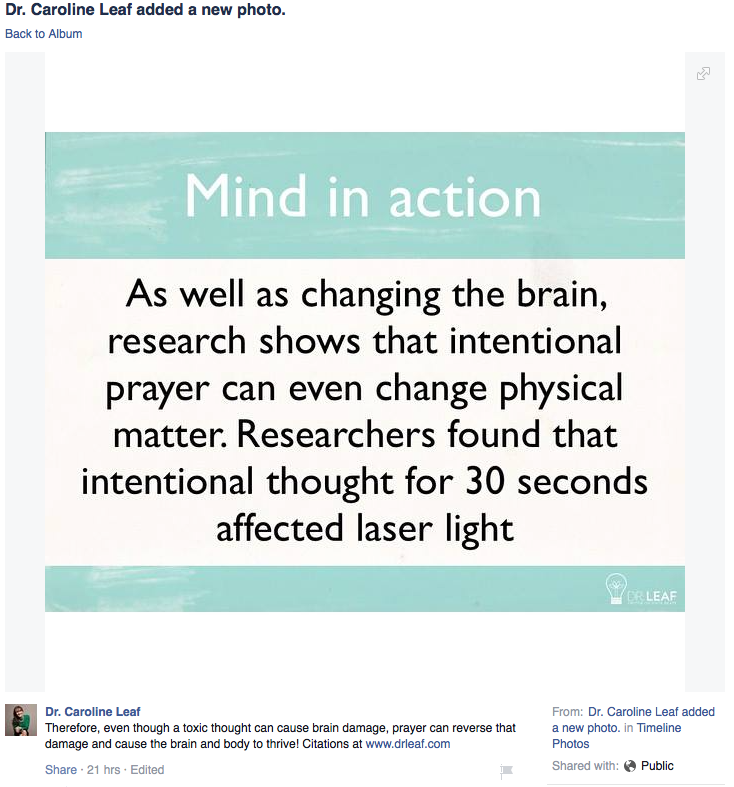
Dr Caroline Leaf is a communication pathologist and self-titled cognitive neuroscientist. Hiding in amongst her “Scientific Philosophy” was this juicy factoid: “Researchers found that intentional thought for 30 seconds affected laser light.” This is, apparently, also proof that prayer can change physical matter.

I actually thought it was God that changed physical matter if He agreed with our prayer requests, and not our prayers themselves, because if it was simply our prayer, then we wouldn’t need God. That’s probably a blog for another time. Still, it was her last statement that caught my attention. Intentional thought can change the properties of laser! I’d never heard that before! I had to find the references.

It turns out that the paper Dr Leaf is referring to is, “Testing nonlocal observation as a source of intuitive knowledge” [1]. In this experiment, Dr Dean Radin, a paranormal researcher, took 5 “experienced meditators” and 5 normal control subjects, and asked them to mentally interfere with a laser beam pointed at a light-reading CCD sensor inside a sealed box. He averaged out the intensity of the light pattern that was read by the CCD. He believed he found a difference in the amount of light that was read by the sensor when the meditators “blocked” the laser light compared to non-meditators and control runs.

In his original paper, Radin published the following graph of his results.

Screen Shot 2015-05-24 at 10.27.48 pm

The length of the bars represent a statistical value based on the results, not the actual results of the experiments. The simplest explanation is that the further down the bar goes, the greater the degree of interference to the laser light. Radin believed the effect was caused by the meditators literally interfering with the quantum mechanics of the photons in the laser beam, “observing” them from outside of the box, thus causing their wave function to collapse and stopping them from reaching the sensor.

However, notice that the first few experiments show a large effect, but that this diminishes as the experiments go along, and towards the end, the control groups and the meditator group is actually about the same, with no interference to the laser light at all. This effect is called the Decline Effect, and is common problem amongst studies of the paranormal. It’s a result of a phenomenon called ‘regression to the mean’, or in other words, the more times you perform an experiment, the more likely the results will line up with the true average. I think in Radin’s case, it also had a lot to do with his own expectations.

Radin himself was honest enough to discuss the effect in his paper. In his own words, “Although I had employed numerous design features to avoid artifacts (sic), and only four of the 10 control sessions conducted to that point had gone in the predicted direction, I still found it difficult to believe that the experimental effect was as easily repeatable as the results were suggesting. I knew that if I had trouble believing it, I could hardly expect anyone else to accept these results. So I found that my intentions for the experiment changed – I no longer hoped to observe results solely in the predicted direction, but rather I found myself hoping that some of the remaining sessions would go against the prediction, to validate that the methodology was not biased.” [1]

So, Radin probably caused the effect by wanting to see it. He excluded data that didn’t suit his hypothesis, citing a technical issue with the equipment, and instead focussed on the data set that still seemed to fit. He also performed the analysis of the data, which he biased with his own pre-conceived notions.

The other nail in the coffin for this paper is that it was a pilot study that was done by one researcher, which no one has since tried, or succeeded in, replicating. Indeed, the methodology for this research was based on a series of experiments done by a real physicist with better equipment, Professor Stanley Jeffers, a professor of physics at York University in Toronto, Canada, who performed the experiment about 74 times and found no effect [2].

So, Dr Leaf has cited this isolated, error prone, biased and unconfirmed paper of Radin’s as proof of the ability of thought to change physical matter, and indeed, as prayer’s ability to change physical matter.

This is simply more proof that Dr Leaf is prone to rush in where angels fear to tread, and latch on to any “research” that supports her ideas, no matter how tenuous or unscientific. She did the same thing when she cited a conference poster from a paranormal conference in the early 90’s, and claimed it was definitive proof that our thoughts can change our DNA. In actual fact, the paper was so full of flaws [3: Ch 13, The “ingenuous” experiment] that the only thing it could show was how desperate Dr Leaf is to try and justify her unscientific pet theories.

This tendency for Dr Leaf to rely on such poor science, and link it to fundamental Biblical concepts, dishonours science, the truth of the Bible, and her audience.

I think Dr Leaf would be wise to review her scientific philosophy and the “research” that she uses to justify it, rather than continuing to utilise tenuous and inaccurate articles from studies of the paranormal.

References

[1]        Radin D. Testing nonlocal observation as a source of intuitive knowledge. Explore 2008 Jan-Feb;4(1):25-35.

[2]        Alcock JE, Burns J, Freeman A. Psi wars: Getting to grips with the paranormal: Imprint Academic Charlottesville, VA, 2003.

[3]        Pitt CE. Hold That Thought: Reappraising the work of Dr Caroline Leaf. 1st ed. Brisbane, Australia: Pitt Medical Trust, 2014.

Dr Caroline Leaf – Contradicted by Dr Caroline Leaf

“Who am I?”

It’s one of life’s most fundamental questions. It’s such a quintessentially human question, one that speaks to the importance of our identity as individuals.

It’s a question that Dr Leaf thinks she has the answer to.

Dr Caroline Leaf is a communication pathologist and self-titled cognitive neuroscientist. Recently she launched an on-line program called “Perfectly You”, based on her 2009 book, “The Gift In You” [1]. In “The Gift In You”, Dr Leaf promised that by using her program, you could enable your gift and increase your intelligence to the level that you desire. According to Dr Leaf, your gift is something that’s hardwired into your brain, which makes your gift uniquely yours. For example, she wrote:

“Your gift lies in something so profound yet so simple that we tend to overlook it: the combination of your life experiences with the measurable structure of how your brain has been wired to think and process information.” (p24)

“Neurologically, you are not wired for someone else’s gift. You can try as hard as you want. You can listen to as many teachings as you possibly can. You can buy all the books with an instant formula for a business mogul’s success. You can adopt all of the popular motivational sayings. But even then, you will never have someone else’s gift.” (p11-12)

“You were not built to struggle. Your brain is wired to function according to a specific sequence. When you discover that sequence, that structure, you unlock great potential.” (p13)

“When you know how your gift is structured, how your brain is uniquely wired, and how to achieve lasting success, you will unlock your truth-value – your gift.” (p17)

“The exciting result of this plasticity of the brain that we hold power over is that no two brains are alike: We are uniquely, fearfully and wonderfully made (Psalm 139:14). There is diversity in brain structure and organisation and function, which results in the way we think and approach life.” (p18)

So according to Dr Leaf, our gifts are something that is uniquely hardwired into our brain, something that we cannot change even if we wanted to, and that brain structure gives rise to the way in which we think and the actions that we take.

Then, as I was rereading this book, I came across a sentence that I must have read before when I first got it, but which I hadn’t fully appreciated the significance of until now.

On page 47, Dr Leaf said,

The mind is what the brain does, and we see the uniqueness of each mind through our gifts. This, in itself is delightful and, intriguing because, as you work out your gift and find out who you are, you will be developing your soul and spirit.” (Emphasis added)

This quote in and of itself isn’t actually that significant until we compare it to a quote from the first chapter of Dr Leaf’s 2013 book, “Switch On You Brain.” [2]

“The first argument proposes that thoughts come from your brain as though your brain is generating all aspects of your mental experience. People who hold this view are called materialists. They believe that it is the chemicals and neurons that create the mind and that relationships between your thoughts and what you do can just be ignored.
So essentially, their perspective is that the brain creates what you are doing and what you are thinking. The mind is what the brain does, they believe, and the ramifications are significant. Take for example, the treatment of depression. In this reductionist view, depression is a chemical imbalance problem of a machinelike brain; therefore, the treatment is to add in the missing chemicals.
This view is biblically and scientifically incorrect.” [2: p31-32] (Emphasis added)

So … Dr Leaf believes that the mind is not what the brain does. So our gifts aren’t uniquely hardwired into our brain, and we should be able to change our gifting if we want to, since it isn’t our brain structures that give rise to the way in which we think and the actions that we take, but it’s all related to our choices.

This must be really embarrassing for Dr Leaf, to so directly call your own beliefs biblically and scientifically incorrect, and then not to notice.

Now, we all make innocent mistakes. No one is perfectly congruent in everything they say. But this isn’t just getting some minor facts wrong. These statements form the foundation for Dr Leaf’s teaching, and are in print in two best selling books, from which she has used to present to countless churches and seminars around the globe.

Which makes her major self-contradiction important for three reasons:

  1. It calls her self-titled expertise as a cognitive neuroscientist into question.
  2. It calls her teaching into question.
  3. It calls her ministry into question.

Firstly, in majorly contradicting herself, Dr Leaf shows desperately little basic knowledge about cognitive neuroscience. Even first year neuroscience students consistently know how the brain works, and are able to build on this to grow their knowledge about the brain. The fact that Dr Leaf can’t get her basic facts straight on something so fundamental as the relationship of the mind and the brain clearly demonstrates that she is not the expert in cognitive neuroscience that she claims to be.

Secondly, in majorly contradicting herself, Dr Leaf undermines all of her teaching. If she can’t be trusted to consistently state basic facts on which she is supposed to have high level training, then how can she be trusted with anything more complicated scientifically. Indeed, how can she be trusted to interpret scripture, in which she has no formal training. Thus, her whole ministry is now thrown into doubt. Dr Leaf may get some facts right in the rest of her writing and in her teaching, but unless you’re an expert in the field, it would be impossible to know. And since she doesn’t reference her work properly, it makes it impossible for the average person to go back to her sources and validate her teaching.

Thirdly, in majorly contradicting herself, Dr Leaf makes it very difficult for churches who have her ministering from their pulpits. Pastors aren’t experts in neuroscience or medicine. How are they supposed to have confidence that what Dr Leaf is saying? How can they be sure that what Dr Leaf is teaching to their congregations is factual or is contradicted by real scientists or her own teaching? How can they be sure that Dr Leaf is not causing some of their more vulnerable parishioners unnecessary harm because her teaching is contradicted by modern science and medicine?

Dr Leaf may believe that she has many answers, and is motivated by the best of intentions. However, to call your own beliefs “biblically and scientifically incorrect” does not instil confidence. Dr Leaf needs to take a serious look at her teaching and the quality of the science that undergirds it, and until that happens, the churches that have invited Dr Leaf to minister from their pulpits should seriously reconsider that decision.

References

  1. Leaf, C.M., The gift in you – discover new life through gifts hidden in your mind. 2009, Inprov, Inc, Texas, USA:
  2. Leaf, C.M., Switch On Your Brain : The Key to Peak Happiness, Thinking, and Health. 2013, Baker Books, Grand Rapids, Michigan:

Dr Caroline Leaf – It’s no joke

Screen Shot 2015-02-13 at 7.59.24 pm

So, stop me if you’ve heard this one … This guy walks into a bar, and says, “Owww, that bar is really hard.”

Ok, that was a bad joke. Hey, I’m no Robin Williams. Some people have the knack of being able to make people laugh in almost any situation. I can get a few laughs, but I’m not a naturally gifted comic.

Dr Caroline Leaf is a communication pathologist and a self-titled cognitive neuroscientist. She isn’t a comedian either.

Her post today was a light-hearted dig at giant lizards with a taste for organic free-range humans, or perhaps the fact that most people know being “all organic, gluten free” should be left to the sanctimonious foodies of San Francisco.

The other part of her post wasn’t meant to be funny, but certainly contained a healthy dose of irony. In trying to justify her bit of light comic relief, she posted another of her subtly erroneous factoids, this time claiming that, “Laughing 100-200 times a day is equal to 10 minutes of rowing or jogging!”

Not according to real scientists, who have worked out that laughing is actually the metabolic equivalent to sitting still at rest, while jogging or rowing burns between 6 to 23 times as much energy, depending on how fast you run or row [1].

That would mean that I would have to laugh for at least a whole hour a day (or about 700 times based on the average chortle) to be even close to the energy burnt by a light jog.

On the grand scale of things, this meme probably doesn’t really matter. These sort of factoids are thrown around on social media all the time, and it won’t make a big difference to the health and wellbeing of most people. But it does help establish a pattern. Dr Leaf habitually publishes memes and factoids that clearly deviate from the scientific truth, proving that Dr Leaf has become a cross between a science fiction author and life coach, not a credible scientific expert. From her social media memes to her TV shows, all of her teaching becomes tainted as untrustworthy.

While today’s meme may not be so serious, if Dr Leaf can’t get her facts straight, pretty soon the joke will be on her.

References

  1. Ainsworth, B.E., et al., 2011 Compendium of Physical Activities: a second update of codes and MET values. Med Sci Sports Exerc, 2011. 43(8): 1575-81 doi: 10.1249/MSS.0b013e31821ece12

Dr Caroline Leaf, behaviour and genetic destiny

Screen Shot 2014-12-23 at 10.32.41 pm

Today on her Facebook feed, Caroline Leaf posted a quote which said, “Your behavior can and does dictate your genetic destiny”. Dr Caroline Leaf is a communication pathologist and a self-titled cognitive neuroscientist. In isolation, it sounds like she has found confirmation of her view that our thoughts and behaviour control the physical properties of our DNA (Leaf, 2013, p35).

However, I wanted to look at the quote in a broader context, because in the broader context, the quote still doesn’t confirm Dr Leaf’s teaching.

The quote comes from an American doctor, Sharon Moalem. Dr Moalem is obviously a smart man. According to Wikipedia, “Dr. Moalem is an expert in the fields of rare diseases, neurogenetics, and biotechnology. He is the author of the New York Times bestselling book ‘Survival of the Sickest’ and ‘How Sex Works’. Moalem has cofounded two biotechnology companies and is the recipient of 19 patents for his inventions in biotechnology and human health.” (http://en.wikipedia.org/wiki/Sharon_Moalem)

It’s not that Dr Moalem’s quote is wrong. In the book from which the quote is taken, Dr Moalem discusses the expression of genes (Moalem, 2014). There is no doubt that our behaviour affects the expression of genes. For example, when the body encounters a high level of dietary iron (ie: we eat a big juicy steak), a series of steps activates a gene to promote the production of ferritin, a protein that helps to carry iron in the blood stream (Strachan and Read, 2011, p375-6). These changes in genetic expression are mostly protective (for example, ferritin is used to keep toxic elemental iron from damaging our tissues). There are some behaviours that will override the body’s protection, for example, excessive exposure to UV radiation will eventually lead to skin cancer. But overall, the changes in genetic expression that our behaviour causes are protective, and do not adversely affect our health.

Unlike Dr Leaf, Dr Moalem does not promote the notion that our behaviour changes the genes themselves. Neither does he promote that our behaviour, in isolation, is the only modifier of our genetic expression. The quote that Dr Leaf used came from the second chapter of Dr Moalem’s book, “Inheritance: How Our Genes Change Our Lives, and Our Lives Change Our Genes”. Really, the title says it all. Our behaviour influences our genetic destiny, but our genes influence our behaviour just as much, if not more.

For example, small variations in the genes that code for our smell sensors or the processing of smells can change our preferences for certain foods just as much as cultural exposure. Our appreciation for music is often changed subtly between individuals because of changes in the structure of our ears or the nerves that we use to process the sounds. The genetic structure of the melanin pigment in our skin changes our interaction with our environment because of the amount of exposure to the sun we can handle. Our genetic destiny is also largely influenced by our environment, most of which is also beyond our choice (Lobo and Shaw, 2008).

So your behaviour can and does influence your genetic destiny, but your genetic destiny is more influenced by our genes themselves, and the environment that is beyond our control.

Dr Leaf’s quote doesn’t look quite so supportive after all.

References

Leaf, C.M., (2013) Switch On Your Brain : The Key to Peak Happiness, Thinking, and Health, Baker Books, Grand Rapids, Michigan

Lobo, I. & Shaw, K. (2008) Phenotypic range of gene expression: Environmental influence. Nature Education 1(1):12

Moalem, S., (2014) Inheritance: How our genes change our lives and our lives change our genes, Grand Central Publishing, New York.

Strachan, T. and Read, A., (2011) Human Molecular Genetics. 4th ed. Garland Science, New York.

Going green – why envy is an adaptive process

The Bible says, in Job 5:2, “For wrath kills a foolish man, And envy slays a simple one.”

A German proverb goes, “Envy eats nothing, but its own heart.”

Dr Caroline Leaf, communication pathologist and self-titled cognitive neuroscientist, posted today on her social media feeds, “Jealousy and envy creates damage in the brain … but … celebrating others protects the brain!”

Yes, sometimes envy isn’t good for us. Emotions guide our thought process, and like all emotions that are out of balance, too much envy can cloud our better rational judgement and bias our perception of the world. Thankfully, envy doesn’t literally eat out our hearts or literally cause brain damage.

If anything, envy when experienced in a balanced way can actually improve our brain functioning. According to real cognitive neuroscientists, envy and regret are emotions that help us because they both fulfil the role of effectively evaluating our past actions, which improves our choices in the future. As Coricelli and Rustichini noted, “envy and regret, as well as their positive counterparts, share the common nature that is hypothesized in the functional role explanation: they are affective responses to the counterfactual evaluation of what we could have gotten had we made a different choice. Envy has, like regret, a functional explanation in adaptive learning.” [1]

When it comes to the human psyche, there is no black or white, good vs evil distinction between different feelings or emotions. B-grade life coaches and slick pseudoscience salespeople dumb down our emotions into a false dichotomy because it helps sell their message (and their books). Every emotion can be either helpful or unhelpful depending on their context in each individual.

As Skinner and Zimmer-Gembeck wrote, “Emotion is integral to all phases of the coping process, from vigilance, detection, and appraisals of threat to action readiness and coordinating responses during stressful encounters. However, adaptive coping does not rely exclusively on positive emotions nor on constant dampening of emotional reactions. In fact, emotions like anger have important adaptive functions, such as readying a person to sweep away an obstacle, as well communicating these intentions to others. Adaptive coping profits from flexible access to a range of genuine emotions as well as the ongoing cooperation of emotions with other components of the action system.” [2]

If you find your thoughts and feelings tinged by the greenish hue of envy, don’t worry, it’s not necessarily a bad thing. Your heart isn’t going to consume itself and you won’t sustain any brain damage. Use envy or regret as tools of learning, tools to help you evaluate your choices so that you make a better choice next time. Having balanced emotions is the key to learning and growing, coping with whatever obstacles life throws at us.

References

  1. Coricelli, G. and Rustichini, A., Counterfactual thinking and emotions: regret and envy learning. Philos Trans R Soc Lond B Biol Sci, 2010. 365(1538): 241-7 doi: 10.1098/rstb.2009.0159
  2. Skinner, E.A. and Zimmer-Gembeck, M.J., The development of coping. Annu Rev Psychol, 2007. 58: 119-44 doi: 10.1146/annurev.psych.58.110405.085705

Dr Caroline Leaf and the law of great power

Screen Shot 2014-12-05 at 12.37.55 am

Tonight as I was flicking through Facebook one last time, a post caught my eye. It read,

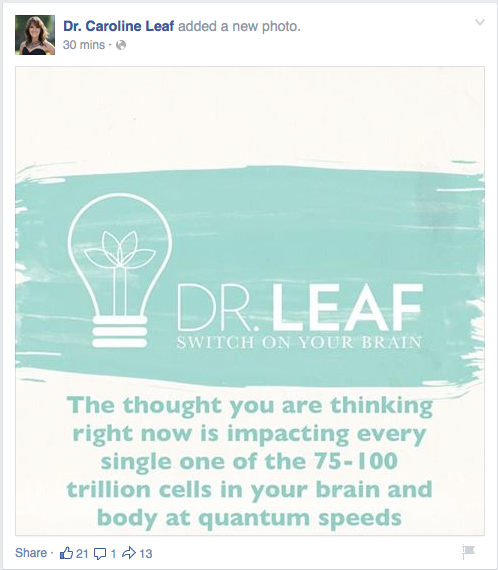
“The thought you are thinking right now is impacting every single one of the 75-100 trillion cells in your brain and body at quantum speeds”

Dr Leafs social media gem gave me an eerie sense of deja vu. It was only the end of October when she posted the same factoid on social media. Today’s version has been tweaked slightly, although in all fairness, I can’t describe it as an upgrade.

Dr Caroline Leaf is a communication pathologist and self-titled cognitive neuroscientist. On the 23rd of October 2014, she posted this on her social media stream, “Every thought you think impacts every one of the 75-100 trillion cells in your body at quantum speeds!”

On comparing the pair, Dr Leaf has added “brain” into the number of cells under the influence, and then massaged the opening slightly. I already had significant concern about the scientific validity of the previous meme in October. That hasn’t changed. Rather than improving the accuracy of her meme, Dr Leaf’s changes have left it missing the mark.

The fundamental fallacy that thoughts are the main controlling influence on our brain is still there. Thought is simply a conscious projection of one part of the overall function of our brain. Our brains function perfectly well without thought. Thought, on the other hand, doesn’t exist without the brain. Our brain cells influence our thoughts, not the other way around.

The myth of “quantum speeds” is still there. Our neurones interact with each other via electrochemical mechanisms. Like all other macroscopic objects, our brains follow the laws of classical physics. It’s not that quantum physics doesn’t apply to our brains, because quantum mechanics applies to all particles, but if you think you can explain macroscopic behaviour using quantum physics, then you should also try and explain Schrodingers Cat (see also chapter 13 of my book [1] for a longer discussion on quantum physics). Dr Leaf is particularly brave to make such bold statements about quantum physics when even quantum physicists find it mysterious.

What made me slightly embarrassed for Dr Leaf is the new part of her statement. In my blog on Dr Leaf’s previous attempt at this meme, I pointed out that Dr Leaf’s estimate of the number of cells in our body was more than three times that of the estimate of scientists at the Smithsonian (http://www.smithsonianmag.com/smart-news/there-are-372-trillion-cells-in-your-body-4941473/?no-ist). The fact that Dr Leaf so badly estimated, when all she needed to do was a one line Google search, suggested that she just made the number up. Failing to cite her source eroded at her credibility as a scientist.

Today, Dr Leaf still claims that there are 75-100 trillion cells in the brain and the body. The Smithsonian still hasn’t changed its estimate. Dr Leaf still hasn’t cited her source, and has ignored a world-renowned scientific institution. Perhaps Dr Leaf believes she knows more than the scientists at the Smithsonian? Perhaps she has a better reference? We’ll never know unless she cites it.

Taken as a whole, her meme is no closer to the truth than it was six weeks ago. Some may ask if it really matters. “Who cares if we have 37.2 trillion cells or 100 trillion cells or even 100 billion trillion”. “So what if our thoughts influence us or not.” If this was just a matter of a pedantic argument between some scientists over a coffee one morning,then I’d agree, it wouldn’t be so important. But Dr Leaf claims to be an expert, and more than 100,000 people read her memes on Facebook and many more on Twitter, Instagram, and the various other forms of social media she is connected to. Nearly every one of those people take Dr Leaf at her word. Ultimately the issue is trust.

If Dr Leaf can misreport such a simple, easily sourced fact, and not just once but twice now, then what does that mean for her other factoids and memes that she regularly posts on social media? If Dr Leaf incorrectly says that every thought we think impacts every cell in our body, then hundreds of thousands of people are wasting their mental and physical energy on trying to control their thoughts when it makes no real difference, and if anything might make their mental health worse [2, 3].

This is more than just a pedantic discussion over a trivial fact.  These memes matter to people, and can potentially influence the health and wellbeing of many thousands of lives.

Peter Parker, quoting Voltaire, said, “With great power comes great responsibility.”  Just because Spiderman said it doesn’t diminish the profundity of that statement.  This law of great power applies to Dr Leaf as much as it does to Spiderman.  I hope and pray that she gives this law of great power the consideration it deserves.

References

  1. Pitt, C.E., Hold That Thought: Reappraising the work of Dr Caroline Leaf, 2014 Pitt Medical Trust, Brisbane, Australia, URL http://www.smashwords.com/books/view/466848
  2. Garland, E.L., et al., Thought suppression, impaired regulation of urges, and Addiction-Stroop predict affect-modulated cue-reactivity among alcohol dependent adults. Biol Psychol, 2012. 89(1): 87-93 doi: 10.1016/j.biopsycho.2011.09.010
  3. Kavanagh, D.J., et al., Tests of the elaborated intrusion theory of craving and desire: Features of alcohol craving during treatment for an alcohol disorder. Br J Clin Psychol, 2009. 48(Pt 3): 241-54 doi: 10.1348/014466508X387071

Dr Caroline Leaf and the cart before the horse, take two

Screen Shot 2014-12-01 at 8.23.44 pm

In between her sightseeing in the UK and ballet concerts in the Ukraine, Dr Leaf, communication pathologist and self-titled cognitive neuroscientist, took the time to post some more memorable memes.

Today, Dr Leaf posted, “A chaotic mind filled with thoughts of anxiety, worry, etc. sends out the wrong signal right down to the level of our DNA.”

Hmmm, that one looked familiar … actually, Dr Leaf posted the exact same phrase on the 5th of October this year.  I’m all for recycling, but of renewable resources, not tired ideas.

This meme has been soundly rebuffed before, and the idea that the mind controls our DNA has been thoroughly dismantled.  Reposting it won’t make it any truer.

This meme is better off being put into the trash than the recycling bin.

(For more information on the rebuttal of the mind over matter meme, see also “Hold that thought: Reappraising the work of Dr Caroline Leaf“, “Dr Caroline Leaf: Putting thought in the right place” Part 1 and Part 2, “Dr Caroline Leaf and the matter of mind over genes“, “Dr Caroline Leaf, Dualism, and the Triune Being Hypothesis”, “Dr Caroline Leaf and the Myth of the Blameless Brain” and “Dr Caroline Leaf and the Myth of Mind Domination” just to name a few references).

Dr Caroline Leaf and the organic foods fallacy

Screen Shot 2014-11-28 at 1.13.59 am

Organic foods. They are amazingly popular. More than a million Australians buy organic foods regularly, and several million more buy it occasionally. The retail value of the organic market is estimated to be more than $1 billion annually. The assumption made by most people is that because it’s so popular, organic foods must be good for you, or at least have something going for them to make them worth all the hype.

Of course, just because something’s immensely popular and has a billion-dollar turnover doesn’t necessarily mean it’s beneficial (One Direction is a case-in-point).

In fact, despite organic foods being touted by their supporters as healthier, safer, and better for the environment than normal foods, actual scientific evidence fails to show any significant difference. I wrote about this earlier in the year (see: Borderline Narcissism and Organic Food). Since then, another large prospective trial deflated organic food’s bubble, with a British study showing no change in the incidence of cancer in women who always ate organic foods versus those who never ate organic foods [1].

The dearth of benefit from organic foods wouldn’t be so bad if they were just another guy in the line-up, something neutral and inert. Unfortunately, not only can organic produce be contaminated if farmed incorrectly [2, 3], but they come at an extraordinary premium, sometimes costing four times more than their conventional counterparts (Borderline Narcissism and Organic Food).

Dr Caroline Leaf is a communication pathologist and a self-titled cognitive neuroscientist. A couple of months ago, she let slip her intention to publish a book in 2015 about food. Who knows what she’ll actually say, but if today’s social media meme is anything to go by, it will likely follow the same pattern of her other teachings.

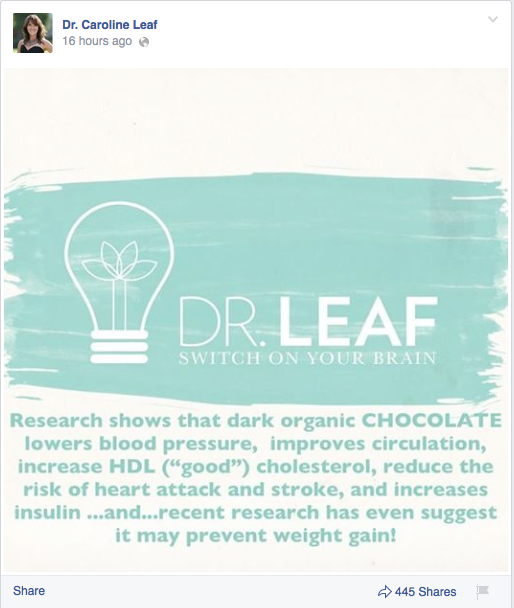
Today, she wrote, “Research shows that dark organic CHOCOLATE lowers blood pressure, improves circulation, increase HDL (“good”) cholesterol, reduce the risk of heart attack and stroke, and increases insulin … and … recent research has even suggest it may prevent weight gain!”

As I discussed recently, Dr Leaf does herself a disservice by not citing her sources. It’s very brave to write in a public forum that dark chocolate reduces the heart attack and stroke, since this could be interpreted as medical advice, which she is not qualified to give. As for the actual effects of dark chocolate, there is not a lot of quality evidence on dark chocolate on its own. A 2011 meta-analysis of general chocolate consumption on cardiovascular risk did indeed show a relative risk reduction of 37% [4]. But before you prescribe yourself two dark chocolate Lindt balls twice a day, consider that a relative risk reduction of 37% isn’t a big effect. Plus, the recommended 50 grams of 85% organic dark chocolate to attain the small benefit for your cardiovascular health contains just over 300 calories/1280 kJ (the average can of Coke contains 146 calories/ 600 kJ), and is 30% saturated fat (http://caloriecount.about.com/calories-green-blacks-organic-dark-chocolate-i110689). So any health benefit that may be associated with the poly-phenol content is likely nullified by the high saturated fat and calorie count.

What concerns me about Dr Leaf’s future foray into dietetics is that little word sitting quietly in her opening sentence: “organic”. Dr Leaf is an organic convert. But rather than act like a scientist that she claims to be, she preaches from her biases, ignoring the evidence that organic food is all hype and no substance, encouraging Christians everywhere to pay excessive amounts of money for something that’s of absolutely no benefit. Dr Leaf is welcome to eat whatever she chooses, but encouraging organic eating without clear benefit is more hindrance than help for most of her followers.

References

  1. Bradbury, K.E., et al., Organic food consumption and the incidence of cancer in a large prospective study of women in the United Kingdom. Br J Cancer, 2014. 110(9): 2321-6 doi: 10.1038/bjc.2014.148
  2. Mukherjee, A., et al., Association of farm management practices with risk of Escherichia coli contamination in pre-harvest produce grown in Minnesota and Wisconsin. Int J Food Microbiol, 2007. 120(3): 296-302 doi: 10.1016/j.ijfoodmicro.2007.09.007
  3. Sample, I., E coli outbreak: German organic farm officially identified. The Guardian, London, UK, 11 June 2011 http://www.theguardian.com/world/2011/jun/10/e-coli-bean-sprouts-blamed
  4. Buitrago-Lopez, A., et al., Chocolate consumption and cardiometabolic disorders: systematic review and meta-analysis. BMJ, 2011. 343: d4488 doi: 10.1136/bmj.d4488