Strong marketing can’t make up for weak ideas

Well Dr Leaf, 10 out of 10 for persistence.

Dr Caroline Leaf is a communication pathologist and a self-titled cognitive neuroscientist. In the last month or so, Dr Leaf has been hammering home her foundational belief that the mind is in control of the brain, and indeed, that your thoughts are the key to everything in life, a bit like 42 in “The Hitchhikers Guide to the Galaxy”. According to Dr Leaf, your thoughts are the answer to life, the universe, and everything.

Dr Leaf has attempted to prove her point through quotes from neuroscientists, from her own teaching, and from some published research. All she’s ended up proving is that she’s so desperate to prop up the concept that she’ll stoop to cherry-picking articles and massaging quotes. Poor form for a woman who promotes herself as a scientist.

Today’s meme is the spiritual justification of her position, expressed as a lovely little graphic with a verse from Proverbs 4:23. It’s a real Pinterest special. Most people would look at the pretty picture and accept the quote without question. It’s good marketing for sure.

Screen Shot 2016-06-24 at 5.51.29 PM

But if you strip back all of the eye-candy, is the meme still worth posting? Is Dr Leaf’s meme an accurate depiction of what Proverbs 4:23 truly means.

First things first, is the meme an accurate quote? In this case, it is. The Good News Bible really does say, “Be careful how you think; your life is shaped by your thoughts.” (https://www.biblegateway.com/passage/?search=Proverbs+4%3A23&version=GNT)

So the next question is, is the Good News version an accurate translation of the scripture? It’s interesting that nearly every other translation doesn’t mention thoughts and thinking at all:

New International Version = Above all else, guard your heart, for everything you do flows from it.
New Living Translation = Guard your heart above all else, for it determines the course of your life.
English Standard Version = Keep your heart with all vigilance, for from it flow the springs of life.
New American Standard Bible = Watch over your heart with all diligence, For from it flow the springs of life.
King James Bible = Keep thy heart with all diligence; for out of it are the issues of life.
Holman Christian Standard Bible = Guard your heart above all else, for it is the source of life.
International Standard Version = Above everything else guard your heart, because from it flow the springs of life.
NET Bible = Guard your heart with all vigilance, for from it are the sources of life.
Aramaic Bible in Plain English = Keep your heart with all caution because from it is the outgoing of life.
GOD’S WORD® Translation = Guard your heart more than anything else, because the source of your life flows from it.
JPS Tanakh 1917 = Above all that thou guardest keep thy heart; For out of it are the issues of life.
New American Standard 1977 = Watch over your heart with all diligence, For from it flow the springs of life.
Jubilee Bible 2000 = Above all else, guard thy heart; for out of it flows the issues of life.
King James 2000 Bible = Keep your heart with all diligence; for out of it are the issues of life.
American King James Version = Keep your heart with all diligence; for out of it are the issues of life.
American Standard Version = Keep thy heart with all diligence; For out of it are the issues of life.
Douay-Rheims Bible = With all watchfulness keep thy heart, because life issueth out from it.
Darby Bible Translation = Keep thy heart more than anything that is guarded; for out of it are the issues of life.
English Revised Version = Keep thy heart with all diligence; for out of it are the issues of life.
Webster’s Bible Translation = Keep thy heart with all diligence; for out of it are the issues of life.
World English Bible = Keep your heart with all diligence, for out of it is the wellspring of life.
Young’s Literal Translation = Above every charge keep thy heart, For out of it are the outgoings of life.

Nearly every other English translation refers to “the heart”. Obviously not the literal “heart”, that muscular blood pump in the middle of our chests, but the metaphoric heart, the human soul. So even on majority rules, the Good News Bible translation is looking shaky. Is there any further corroborating evidence to help us understand which version is the most correct?

The answer would be in the original Hebrew. The word for ‘heart’ in Proverbs 4:23 is לֵב (leb), and more broadly is a word relating to the soul, ‘inner man, mind, will, heart, understanding’ (https://www.blueletterbible.org/lang/lexicon/lexicon.cfm?Strongs=H3820&t=KJV). In some verses, the word in used in reference to what would be considered thoughts, but in many others, the word is used to describe a person’s feelings or motivations, or attitudes, or even specific intelligence and manual skills. For example:

Genesis 17:17: “Then Abraham fell upon his face, and laughed, and said in his heart, Shall a child be born unto him that is an hundred years old? and shall Sarah, that is ninety years old, bear?”
Genesis 42:28: “And he said unto his brethren, My money is restored; and, lo, it is even in my sack: and their heart failed them, and they were afraid, saying one to another, What is this that God hath done unto us?”
Exodus 8:32: “And Pharaoh hardened his heart at this time also, neither would he let the people go.”
Exodus 35:35: “Them hath he filled with wisdom of heart, to work all manner of work, of the engraver, and of the cunning workman, and of the embroiderer, in blue, and in purple, in scarlet, and in fine linen, and of the weaver, even of them that do any work, and of those that devise cunning work.”

So it appears the Good News Bible is actually a poor translation. Again, this is an example of Dr Leaf cherry picking something that suits her theory out of a bulk of divergent views. No matter how she tries to sell the concept, the idea that the mind controls your brain and that your thoughts control your destiny is scientifically and scripturally weak. Persistence and good marketing isn’t going to change that.

Dr Caroline Leaf and the mind-brain revisited again

Screen Shot 2016-06-01 at 8.05.14 PM

Dr Leaf’s theme for the week is the mind-brain link. In the last few days, Dr Leaf has posted memes claiming that the brain is seperate from, and subservient to, the mind. Despite evidence to the contrary, she continued the same theme today.

Dr Caroline Leaf is a communication pathologist and a self-titled cognitive neuroscientist. Her teaching is strongly influenced by one of her foundational philosophical positions; that the mind (the intellect, will and emotions) controls the body, which includes the brain. While this idea may be popular with philosophers, it’s not with neuroscientists.

Not that this bothers Dr Leaf, of course, since she’s not really a neuroscientist.

Today’s meme is more or less exactly the same as what she claimed over the previous couple of days, except today’s version is more verbose.

She said,

“Mind directs what the brain does, with the mind being our intellect, will and emotions (our soul realm). This is an interesting concept posing huge challenges and implications for our lives because what we do with our mind impacts our spirit and our body. We use our mind to pretty much do everything.”

At this point, I’m having a strong and nauseating sense of deja vu.

I know I’m going to be repeating myself, but to reinforce the message, lets go through Dr Leaf’s meme to show that it hasn’t gotten any righter with repetition.

“(The) Mind directs what the brain does” … The relationship of the mind to the brain is like the relationship of music and a musical instrument. Without a musical instrument, there is no music. In the same way, the mind is a product of the brain. It’s not independent from the brain. Without the brain, there is no mind. Indeed, changes to the structure or function of the brain often results in changes to the mind. Yesterday I used the example of medications. Caffeine makes us more alert, alcohol makes us sleepy or disinhibited. Marijuana makes it’s users relaxed and hungry, and sometimes paranoid. Pathological gambling, hypersexuality, and compulsive shopping together sound like a party weekend in Las Vegas, but they’re all side effects linked with Dopamine Agonist Drugs, which are used to treat Parkinson’s disease. If a pill affecting the brain can change the function of the mind, then it’s clear that the mind does not direct what the brain does.

“This is an interesting concept posing huge challenges and implications for our lives because what we do with our mind impacts our spirit and our body” … The relationship between our body, mind and spirit is interesting. I’ve written about this before in an essay on the triune being and dualism. But there are no great challenges here or implications here. If anything, knowing that our thoughts don’t have any real power over us is incredibly freeing. Rather than increasing our psychological distress in trying to suppress or control our thoughts, we can step back and focus on committed actions based on our values.

“We use our mind to pretty much do everything” … Actually, we don’t. Much of what we do, say, and even perceive, is related to functions of our brain that are entirely subconscious. This idea is summed up very nicely by Dr David Eagleman, best-selling author and a neuroscientist at Baylor College of Medicine in Texas;

” … take the vast, unconscious, automated processes that run under the hood of conscious awareness. We have discovered that the large majority of the brain’s activity takes place at this low level: the conscious part – the “me” that flickers to life when you wake up in the morning – is only a tiny bit of the operations. This understanding has given us a better understanding of the complex multiplicity that makes a person. A person is not a single entity of a single mind: a human is built of several parts, all of which compete to steer the ship of state. As a consequence, people are nuanced, complicated, contradictory. We act in ways that are sometimes difficult to detect by simple introspection. To know ourselves increasingly requires careful studies of the neural substrate of which we are composed.” https://goo.gl/uFKF47

So no matter which way Dr Leaf says it, it simply isn’t true that the mind controls the brain. As I said in my previous post, this is a fatal flaw for Dr Leaf’s teaching. That she keeps using this trope is entirely her choice and her right, but it certainly doesn’t aid her reputation as a credible neuroscientist.

Dr Caroline Leaf and the mind-brain revisited


Screen Shot 2016-05-29 at 10.25.58 PM

Dr Leaf has been promoting her food philosophy lately, but yesterday and today, she has come back to one of her favourite neuroscience topics.

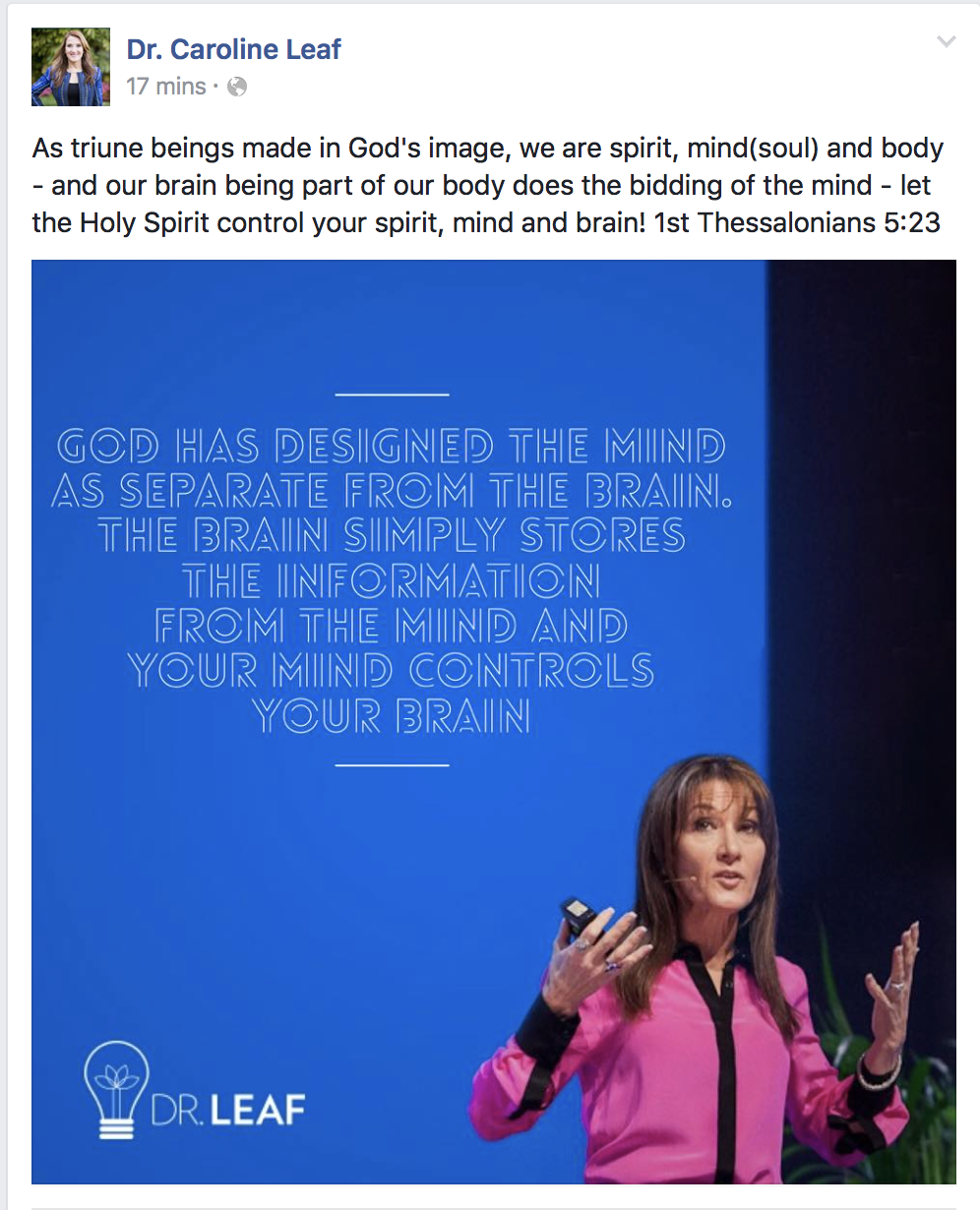
Dr Caroline Leaf is a communication pathologist and a self-titled cognitive neuroscientist. It’s her belief that “as triune beings made in God’s image, we are spirit, mind(soul) and body – and our brain being part of the body does the bidding of the mind …”.

This is one of the flaws that terminally weakens her teaching, and leads to scientifically irrational statements like yesterday’s meme:

“God has designed the mind as seperate from the brain. The brain simply stores the information from the mind and your mind controls your brain.”

On what basis does she make such a claim? I’ve reviewed the scripture relating to the triune being hypothesis. The Bible doesn’t say that our mind is seperate to our brain, nor that it dominates and controls our brain. Dr Leaf’s statement yesterday is simply assumption based on more assumption. It’s like an intellectual house of cards. The slightest puff of scrutiny and the whole thing comes crashing down on itself.

Screen Shot 2016-05-30 at 8.06.38 PM

To try and reinforce her message today, Dr Leaf quoted Dr Jeffrey Schwartz, psychiatrist and neuroscientist, “The mind has the ability to causally affect and change pathways in the brain.” Jeffrey M. Schwartz is an OCD researcher from the UCLA School of Medicine. It appears he lets his Buddhist anti-materialism philosophy cloud his scientific judgement.

Well Dr Leaf, I see your expert and I raise you. Dr David Eagleman is an author and neuroscientist at Baylor College of Medicine in Texas. He has written more than 100 scientific papers on neuroscience, and has published numerous best-selling non-fiction books including ‘Incognito, The Secret Lives of the Brain’ which was a New York Times best-seller. He isn’t an irrational anti-materialist.

He said, “It is clear at this point that we are irrevocably tied to the 3 pounds of strange computational material found within our skulls. The brain is utterly alien to us, and yet our personalities, hopes, fears and aspirations all depend on the integrity of this biological tissue. How do we know this? Because when the brain changes, we change. Our personality, decision-making, risk-aversion, the capacity to see colours or name animals – all these can change, in very specific ways, when the brain is altered by tumours, strokes, drugs, disease or trauma. As much as we like to think about the body and mind living separate existences, the mental is not separable from the physical.” https://goo.gl/uFKF47

This statement makes much more logical sense. The functions of the mind are all vulnerable to changes in the brain. Take medications as one particular example. Caffeine makes us more alert, alcohol makes us sleepy or disinhibited. Marijuana makes it’s users relaxed and hungry, and sometimes paranoid. Pathological gambling, hypersexuality, and compulsive shopping together sound like a party weekend in Las Vegas, but they’re all side effects linked with Dopamine Agonist Drugs, which are used to treat Parkinson’s disease. There are many other examples of many other physical and chemical changes in the brain that affect the mind.

Conversely, there is limited evidence of the effect of the mind on the brain. Sure, there is some evidence of experienced meditators who have larger areas in their brain dedicated to what they meditate on, but the same effect has been shown in other parts of the brain unrelated to our conscious awareness.

But since the mind is a function of the brain, whatever effect the ‘mind’ has on the brain is, in reality, just the brain effecting itself.

So Dr Leaf can cherry-pick from her favourite authors all she wants, but quoting a supportive neuroscientist doesn’t diminish the crushing weight of scientific evidence which opposes her philosophical assumptions. If she wants to continue to proffer such statements, she would be better served to come up with some actual evidence, not just biased opinion.

“Think and Eat Yourself Smart”: a pre-review

Update: Read my full review of “Think and Eat Yourself Smart” here.

Screen Shot 2016-03-30 at 6.55.43 PM

They say, “Never judge a book by its cover.”  What about judging it by its marketing?

Dr Caroline Leaf is a communication pathologist and self-titled cognitive neuroscientist.  She’s also a wannabe nutritionist.  Her latest book is “Think and Eat Yourself Smart”, due for official release at the end of April.

I haven’t read her book yet so I’m not really sure what she’s going to say.  It might be a well reasoned and soundly researched discussion about healthy eating, except there are some conflicting ideas that are appearing in Dr Leaf’s own marketing of the book, so I’m not holding out much promise.

For example, yesterday Dr Leaf suggested that “the mindset behind the meal – the thinking behind the meal – plays a dominant role in the process of human food related health issues, approximately 80 percent.”

This is bogus science.  It doesn’t matter if I’m convinced that eating a half gallon tub of ice cream is nutritious or not, it’s going to have the same nutritional effect on my body (namely, none).  It’s not 80 percent healthy because I believe it’s healthy.

Dr Leaf has made this assertion based on other bogus science – “How does thinking affect eating, and how does eating affect thinking? Research shows that 75 to 98% of current mental, physical, emotional and behavioural illnesses and issues come from our thought life; only 2 to 25% come from a combination of genetics and what enters our bodies through food, Medication, pollution, chemicals, and so on.”

Dr Leaf’s assertion that “75 to 98% of current mental, physical, emotional and behavioural illnesses and issues come from our thought life” is a favourite factoid of hers that forms the basis of most of her teaching.  Except that it’s wrong.  It has no basis in fact.  I’ve discussed this at length in several blogs and in my book (see here for a more detailed explanation of Dr Leaf’s 98% myth).

It’s unclear just how much of her book Dr Leaf has based on this false assumption, but the fact that it’s there in the first place sets a bad precedent for the rest of the book.

Only time will tell, of course.  I’d like to be proven wrong, but unfortunately, Dr Leafs latest book seems to be plagued with the same poor science as her other tomes.

Watch this space …

Dr Caroline Leaf – Increasing the stigma of mental illness again

Screen Shot 2016-03-19 at 9.02.05 PM

Let me tell you a story.

A couple of years ago, one of my patients was an elderly gentleman in his late seventies.  He was living in a nursing home at the time, but because of his history of psychosis, he remained on a treatment order – a requirement by law that if he was to remain outside of a mental facility, he had to have regular anti-psychotic medication every few weeks.

This man was on a treatment order because his disease caused him to have delusions.  He misinterpreted what was going on around him, and would not consider that he could be wrong.  In his particular case, he was convinced that his next-door neighbour was a paedophile, and he was planning to ambush his neighbour and castrate him.  Luckily the police had taken my patient into custody before he got the opportunity.  With treatment, my patient had clear thoughts, although needed close supervision.  Without his medication, he became confused and violent.

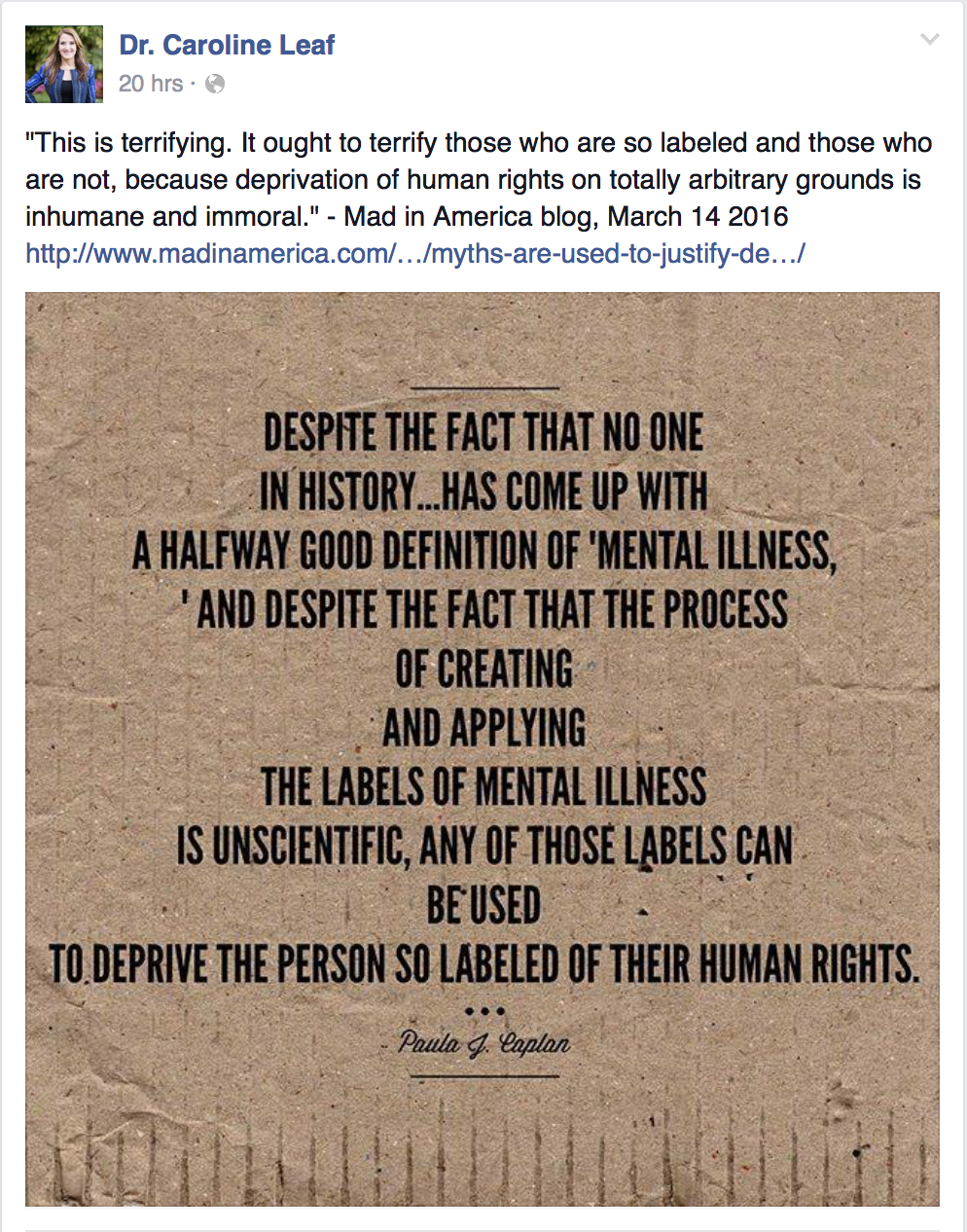
According to a post on the blog Mad in America and promoted by Dr Caroline Leaf, my patient’s diagnosis was spurious, and he was denied his basic human rights by being forced to take medications.

Dr Caroline Leaf is a communication pathologist and self-titled cognitive neuroscientist.  She is also a self-declared expert in mental health, despite not having any professional training in medicine, psychiatry, psychology or even cognitive neuroscience for that matter.

Indeed, if she had any experience or expertise in mental health, she would have recognised the basic factual errors and logical fallacies that riddled the post she quoted from.

Take the quote that Dr Leaf posted on social media.  The full quote from the Mad in America post is:

“Despite the fact that no one in history, not even the omnipotent American Psychiatric Association – which produces and profits mightily from the ‘Bible’ of mental disorders — has come up with a halfway good definition of “mental illness,” and despite the fact that the process of creating and applying the labels of mental illness is unscientific, any of those labels can be used to deprive the person so labeled of their human rights. This is terrifying. It ought to terrify those who are so labeled and those who are not, because deprivation of human rights on totally arbitrary grounds is inhumane and immoral.”

This is the same tired, emotionally laden and misleading rhetoric that’s so often barked in fervent paroxysms through the foaming lips of those opposed to modern psychiatric practice:

  1. There is no good definition of ‘mental illness’
  2. The American Psychiatric Association is just a profit-driven cabal
  3. The DSM5 (which the author alludes to as the ‘Bible’ of mental disorders) is unscientific
  4. Psychiatric diagnoses are unscientific
  5. Any psychiatric diagnosis can be used as a trigger to force people into unwanted treatments or incarceration
  6. Therefore psychiatric diagnosis and treatment is against basic humans rights and is inhumane and immoral.

Inhumane and immoral hey?  Tell that to my patients neighbour who almost became a eunuch except for that “inhumane and immoral treatment” of my former patient.

Caplan claims just don’t stand up to any rational scrutiny.

  1. There are lots of good definitions of mental illness … modern psychiatry critics just don’t like them. But take the definition used by the CDC, “Mental illness is defined as … ‘health conditions that are characterized by alterations in thinking, mood, or behavior (or some combination thereof) associated with distress and/or impaired functioning.’” There’s nothing wrong with this definition. It describes mental illness and helps differentiate mental illness from variations of mood, thought and behaviour that are part of the everyday human experience.
  1. The American Psychiatric Association isn’t the only group to have created a classification of psychiatric illnesses. The World Health Organisation publishes the International Classification of Diseases, or the ICD, which is also used for psychiatric diagnosis. Is the WHO an evil profit-driven junta too?
  1. The DSM, the ICD, and any other system of diagnosis, are simply different classification systems. Over the last century, clinicians have noted clusters of symptoms and have tried to classify them into common groups. How is that unscientific?  It’s no different to scientists looking at the different characteristics of various animals and creating a taxonomy, to provide a common system and language for clinicians and researchers across disciplines and across countries.The DSM system isn’t perfect, but what system ever is?  As knowledge of neuroscience grows, the classifications are reviewed and tightened in an ongoing process of improvement.  If those who oppose the DSM want to come up with something better, they’re welcome to put something forward.
  1. The old saying goes that medicine is an art and a science. Human beings, as nuanced as we are, often don’t fit into diagnostic criteria as easily as we would like. That doesn’t invalidate the diagnostic criteria or make the process unscientific as critics of modern psychiatry would have us believe, just like an unusual and hard-to-classify form of cancer doesn’t invalidate the other cancer classifications that are well defined.  Psychiatry, by it’s nature, relies on verbal report from patients rather than a clean-cut blood test or piece of tissue under a microscope, so at this stage in history, it seems imprecise.  That doesn’t make it any less scientific.
  1. The allegation that any psychiatric diagnosis can any be used to deprive the person so labeled of their human rights is utter nonsense. It’s a giant scarecrow – it seems really scary, but on closer inspection, it’s just a tarted-up mound of straw.People are never forced into treatments unless they really are “dangerous to themselves and/or others”.  This rule can’t be invoked willy-nilly.  There are multiple checks and balances, and a whole school of civil rights lawyers expectantly circling, ready for the whiff of blood in the water (http://www.mhrt.qld.gov.au/?page_id=2 is an example of the process in my home state, but each jurisdiction has their own version).

Caplan rightly pointed out that those with mental illness were less likely to be the perpetrators of violence and more likely to be the victims, but that doesn’t negate the need for protection of the community from those with mental illness who have shown violent intent and no capacity to control their behaviour.

If you want to find a group that really are suffering from inhumane and immoral deprivations of their human rights, then that would be Christians.  Around the globe, millions of Christians are oppressed, imprisoned, tortured, raped, and murdered every year.

Time and space preclude a full analysis of Caplan’s post, but what’s really important is that both the American Psychiatric Association and the U.S. Department of Health and Human Services’s Office of Civil Rights, an independent ombudsman, dismissed formal appeals by Caplan relating to her hysterical claims of inhumane forced psychiatric treatment.  Dr Leaf conveniently left that out of her social media post.

Instead, Dr Leaf chose to publish one of the most alarming quotes from an article heavy on scaremongering, from a disaffected author on an extremist blog.  If Dr Leaf was a real expert on mental health instead of being a self-declared one, she would have easily seen how nonsensical Caplan’s post was.

By posting this quote on social media today, it’s highly likely that Dr Leaf has caused harm to thousands of vulnerable Christians by unnecessarily increasing the stigma and fear of a mental health diagnosis.  This, in turn, is likely to lead to these same vulnerable Christians missing out on (drug and non-drug) treatment which would help them rise to their true potential in God and in life, leaving them trapped and suffering in their mental destitution.

Dr Leaf has a track record of misinformation when it comes to mental health.  Christians suffering mental illness need more support, not more stigma.  It’s time Dr Leaf stepped aside, and stopped making things worse.

Dr Caroline Leaf – Rogue Notion

Screen Shot 2016-02-12 at 7.26.25 AM

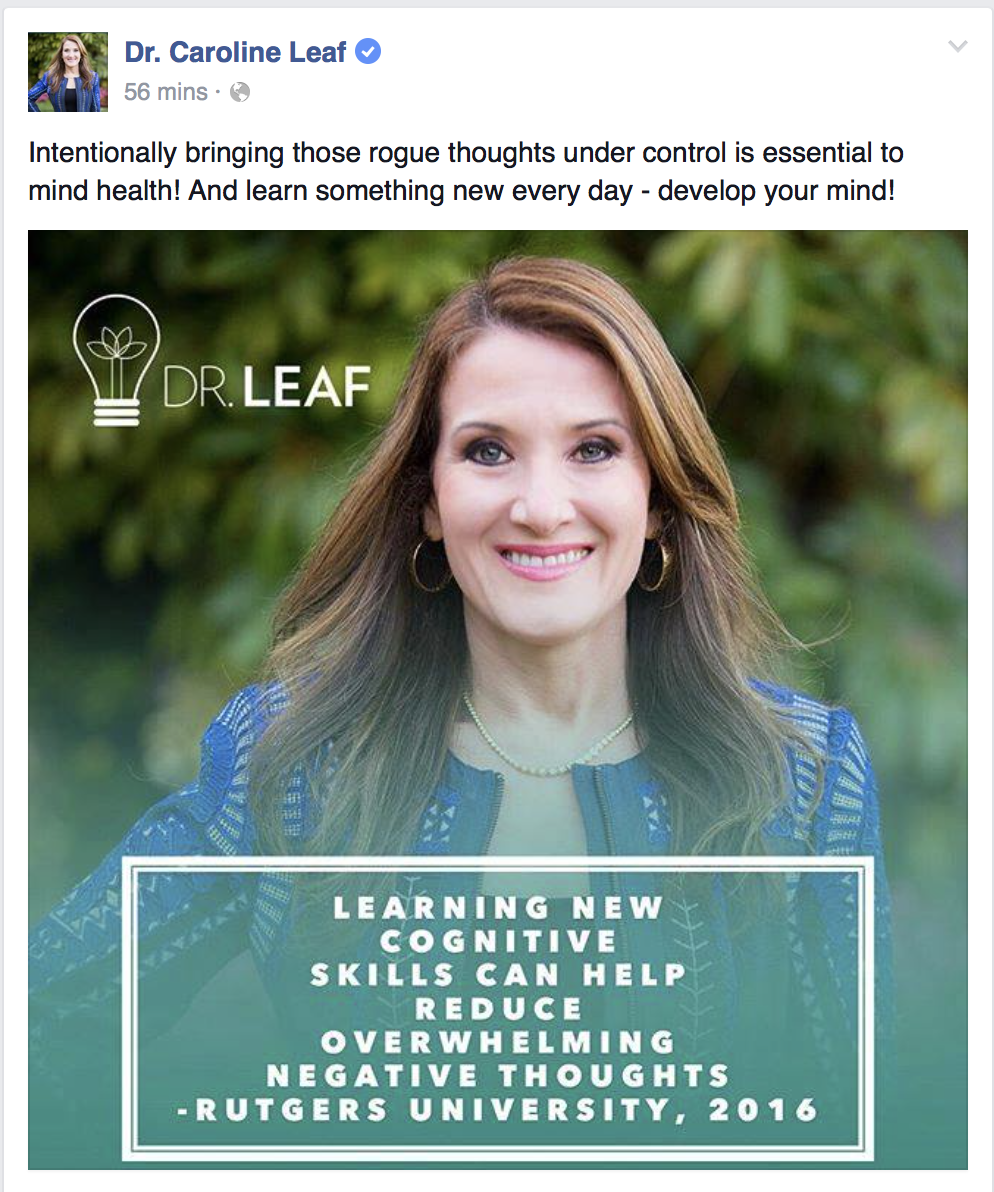
According to a new study by Rutgers University, “Learning new cognitive skills can help reduce overwhelming negative thoughts”. So said Dr Caroline Leaf, communication pathologist and self-titled cognitive neuroscientist. She also advised that “Intentionally bringing those rogue thoughts under control is essential to mind health! And learn something new every day – develop your mind!”

So … negative thoughts are what, like an evil spy organisation, running around causing wanton destruction, overwhelming your capacity to function?

If that’s the case, then new cognitive skills must be like Tom Cruise, running, jumping, shooting and kicking their way through the negative thoughts, saving the world and getting the girl.

It’s a popular concept. As I discussed in my previous post, the power of positive thinking is culturally sanctioned Western folk psychology. We implicitly accept the idea that we have to harness positive thoughts and stop negative thoughts if we’re to overcome life’s obstacles.

However, the only rogue notions here are Dr Leaf’s.

Dr Leaf’s post sounds authoritative and sciency, but is nothing else. It’s vague, and with a bit of deeper palpation, it’s actually wrong.

Dr Leaf has gone back to her bad habit of obfuscating her references, maybe because she’s getting lost in her own hubris, or more likely, it’s much easier for her audience to see that she’s just cut-and-pasted the opening by-line of a press release again if she actually disclosed her source.

Screen Shot 2016-02-12 at 4.17.09 PM

In fact, the article is about a study from Rutgers which studied two behavioural interventions (not cognitive ones), a form of mindfulness meditation and aerobic exercise. The original publication is in the journal Translational Psychiatry [1], if you want to check it out for yourself. This article isn’t about learning cognitive skills at all. Exercise and mindfulness meditation are tried and true behavioural methods of improving mood disorders like depression, which the authors combined to assess the benefit or otherwise. Neither intervention involved challenging or fighting thoughts, or suppressing ‘negative’ thoughts, or “intentionally bringing those rogue thoughts under control”.

Indeed, the mindfulness meditation used involves “the practice of attending to the present moment and allowing thoughts and emotions to pass without judgment.” [1] Mindfulness doesn’t try to control anything.  Rather than supporting Dr Leaf’s declaration that intentionally bringing thoughts under control is essential to mind health, this study contradicts it.

Cutting and pasting doesn’t make you an expert. It’s easy to take a sciency-sounding tag line and put it in a pretty little graphic. Everyone does it. 90% of Instagram and Facebook posts these days are faux-authoritative pseudo-science memes that aren’t worth the bytes they’re made of.

Junk science is like junk food. If that’s all you consume, then you eventually become an intellectual blob of lard, stuffed full of mistruths and logical fallacies, and incapable of understanding scientific truth for yourself. Dr Leaf’s audience deserves better than junk science and it’s about time that Dr Leaf stopped pretending to be an expert, and started acting like one.

Reference

[1]  Alderman BL, Olson RL, Brush CJ, Shors TJ. MAP training: combining meditation and aerobic exercise reduces depression and rumination while enhancing synchronized brain activity. Transl Psychiatry 2016;6:e726.

Dr Caroline Leaf and the nonsense of ‘negative’ thinking.

Screen Shot 2016-02-09 at 7.08.49 PM

The power of positive thinking. It’s like rust on our collective consciousness, an idea that’s seems virtually impossible to eradicate, slowly eating away at our collective psyche. The idea has become so ingrained in our culture that it’s part of our folklore and our idiom, and it continues to be deliberately perpetuated by success coaches, business leaders and others who make a very tidy living by peddling baseless optimism. It’s been repeated so often that the ‘power of positive thinking’ has become an Availability Cascade (a self-reinforcing process by which an idea gains plausibility through repetition).

Herbert and Forman summarise it nicely, “The ideas that thoughts and beliefs lead directly to feelings and behavior, and that to change one’s maladaptive behavior and subjective sense of well-being one must first change one’s cognitions, are central themes of Western folk psychology. We encourage friends to ‘look on the bright side’ of difficult situations in order to improve their distress. We seek to cultivate “positive attitudes” in our children in the belief that this will lead to better academic or athletic performance. Traditional cognitively-oriented models of CBT (e.g., CT, stress inoculation training, and rational emotive behavior therapy) build on these culturally sanctioned ideas by describing causal effects of cognitions on affect and behavior, and by interventions targeting distorted, dysfunctional, or otherwise maladaptive cognitions.” [1]

Dr Caroline Leaf is a communication pathologist and a self-titled cognitive neuroscientist. She is one of the many that continue to perpetuate the myth of positive and negative thinking.

Today’s social media meme was yet another promotion of this misguided idea, and to top it off, she misquoted scripture again in an attempt to reinforce it.

“If you randomly allow any negative thought into your mind damage can ensue on a mental & physical level. ‘We destroy every proud obstacle that keeps people from knowing God. We capture their rebellious thoughts and teach them to obey Christ.’ 2 Corinthians 10:5 NLT”

Lets quickly break meme down to see exactly why Dr Leaf is, yet again, misleading her audience.

1. The mind does not control the brain

Dr Leaf’s meme implies that negative thought damages us mentally and physically. The problem with that is that the mind doesn’t control our brain or our body, so negative thought can’t damage us mentally or physically.

Instead, it’s our brain that gives rise to, and controls our thoughts and feelings. We don’t see what goes on ‘under the hood’ so to speak, we only experience our thoughts and feelings, so we assume that regulate each other. But it’s our brain and a number of other processes that are responsible for generating both our thoughts and feelings (CAP blog).

‘Negative’ thoughts can sometimes be the result of damage to our brain, but ‘negative’ thoughts don’t damage the brain.

In fact, often the so-called ‘negative’ thoughts are actually good for us.

2. Negative thinking is normal and healthy

Dr Leaf’s meme also implies that we control the content of our thoughts by suggesting that we ‘allow’ negative thoughts into our minds. But negative thoughts are meant to be there, which is why we have them. ‘Negative’ thoughts have a positive function. We need them to survive.

For example, we have a fear response to prevent us from continually putting ourselves in danger. We have an anger response to motivate us through difficult obstacles. We have feelings of embarrassment to help maintain social cohesion. As Skinner and Zimmer-Gembeck state, “adaptive coping does not rely exclusively on positive emotions nor on constant dampening of emotional reactions. In fact, emotions like anger have important adaptive functions, such as readying a person to sweep away an obstacle, as well communicating these intentions to others. Adaptive coping profits from flexible access to a range of genuine emotions as well as the ongoing cooperation of emotions with other components of the action system.” [2]

Dr Leaf isn’t helping anyone with her meme today. She’s simply promoting an outdated and unscientific notion, encouraging her audience to suppress normal, helpful adaptive functions for fear of harm that’s not scientifically possible.

Then as if to add insult to injury, she follows up her misleading meme with an equally misleading misrepresentation of 2 Corinthians 10:5.

3. Taking every thought captive?

2 Corinthians 10:5 is Pauls famous scripture about taking every thought captive, a concept which seems to support Dr Leaf’s ideas, except that Paul isn’t speaking generally to us, but specifically about the Corinthian church. Look at the verse in context:

“By the humility and gentleness of Christ, I appeal to you – I, Paul, who am ‘timid’ when face to face with you, but ‘bold’ towards you when away! I beg you that when I come I may not have to be as bold as I expect to be towards some people who think that we live by the standards of this world. For though we live in the world, we do not wage war as the world does. The weapons we fight with are not the weapons of the world. On the contrary, they have divine power to demolish strongholds. We demolish arguments and every pretension that sets itself up against the knowledge of God, and we take captive every thought to make it obedient to Christ. And we will be ready to punish every act of disobedience, once your obedience is complete.
You are judging by appearances. If anyone is confident that they belong to Christ, they should consider again that we belong to Christ just as much as they do. So even if I boast somewhat freely about the authority the Lord gave us for building you up rather than tearing you down, I will not be ashamed of it. I do not want to seem to be trying to frighten you with my letters. For some say, ‘His letters are weighty and forceful, but in person he is unimpressive and his speaking amounts to nothing.’ Such people should realise that what we are in our letters when we are absent, we will be in our actions when we are present.” (NIV UK, 2 Corinthians 10:1-11)

This chapter is a specific rebuke to some of the Christians within the church at Corinth, and also a defence against some of the murmurings and accusations that some in that church were levelling at Paul. For example, in verse 2, “I beg you that when I come I may not have to be as bold as I expect to be towards some people who think that we live by the standards of this world.”

Verses 3-6 are a specific and authoritative rebuttal against the accusations levelled at Paul, paraphrased as, “You may speak against us and the church, but we have weapons that smash strongholds, and we’re coming to take down those pretensions of yours and take every thought of yours captive to make it obedient to Christ, and punish every act of disobedience …”

The specific nature of the verse is also supported by some Bible commentary: “But how does St. Paul meet the charge of being carnally minded in his high office? “Though we walk in the flesh [live a corporeal life], we do not war after the flesh,” or “according to the flesh,” the contrast being in the words “in” and “according.” And forthwith he proceeds to show the difference between walking in the flesh and warring according to the flesh. A warrior he is, an open and avowed warrior – a warrior who was to cast down imaginations and every high thing that exalteth itself against the knowledge of God, and bring into captivity every thought to the obedience of Christ; a warrior too who would punish these Judaizers if they continued their disorganizing work; but a prudent and considerate warrior, deferring the avenging blow till “I am assured of your submission” (Stanley) “that I may not confound the innocent with the guilty, the dupes with the deceivers.” What kind of a preacher he was he had shown long before; what kind of an apostle he was among apostles as to independence, self-support, and resignation of official rights in earthly matters, he had also shown; further yet, what kind of a sufferer and martyr he was had been portrayed.” (C. Lipscomb – http://biblehub.com/commentaries/homiletics/2_corinthians/10.htm)

Similarly, the translation from the original text is more specific than general. The verb used for “bringing into captivity” is aichmalōtízō, “to make captive: – lead away captive, bring into captivity” which is in the Present Active Participle form of the verb. The present tense represents a simple statement of fact or reality viewed as occurring in actual time. The active voice represents the subject as the doer or performer of the action. The Greek participle corresponds for the most part to the English participle, reflecting “-ing” or “-ed” being suffixed to the basic verb form. Actions completed but ongoing or commands are different verb tenses (see https://www.blueletterbible.org/help/greekverbs.cfm for a better explanation). So Paul wasn’t making a general statement, but a specific statement about what he would do in his present time, not the future.

So, Paul isn’t telling us to “bring every thought captive into obedience to Christ”. Dr Leaf is perpetuating a common scriptural misunderstanding.

A verse which better clarifies what God wants for our thought life is Paul’s exhortation to the Philippian church in Philippians 4:8, “Finally, brothers and sisters, whatever is true, whatever is noble, whatever is right, whatever is pure, whatever is lovely, whatever is admirable – if anything is excellent or praiseworthy – think about such things.” Both the context, and the form of the verb, suggest that this is an ongoing command. And it makes better sense too. If we spend all of our time trying to fight against every thought that comes into our head, we’d become exhausted, but we can divert attention to those things that are worthy of our attention. And in many ways, what Paul is encouraging is what would be considered now as simple meditation, which is more scientific than the power of positive thinking.

The moral of this story … ‘negative’ thoughts and feelings don’t do us damage, but trying to unnecessarily suppress them does.

References

[1]     Herbert, J.D. and Forman, E.M., The Evolution of Cognitive Behavior Therapy: The Rise of Psychological Acceptance and Mindfulness, in Acceptance and Mindfulness in Cognitive Behavior Therapy. 2011, John Wiley & Sons, Inc. p. 1-25.
[2]     Skinner EA, Zimmer-Gembeck MJ. The development of coping. Annual review of psychology 2007;58:119-44.

Christian male modelling

Zoolander

Some love him.  Some hate him.  It doesn’t change the fact that he was still “ridiculously good looking”.

Zoolander was one of those cult movies that polarised people into “absolutely love it” or “absolutely loathe it” camps.  I admit, I’m one of the former.  (“Moisture is the essence of wetness, and wetness is the essence of beauty”  … It still cracks me up!)

For those who aren’t familiar with the story, Derek Zoolander was a top male model who was famous for his different looks: “Blue Steel”, “Ferrari”, “Le Tigre” and the famous “Magnum”. They were all the same pose, of course, but everyone thought they were different. Except for evil fashion designer, Mugatu, who in a burst of rage at the climax of the movie, yells, “Who cares about Derek Zoolander anyway? The man has only one look … Blue Steel? Ferrari? Le Tigra? They’re the same face! Doesn’t anybody notice this? I feel like I’m taking crazy pills!”

There are times when I read Dr Leaf’s social media posts, and I feel the same as Mugatu.

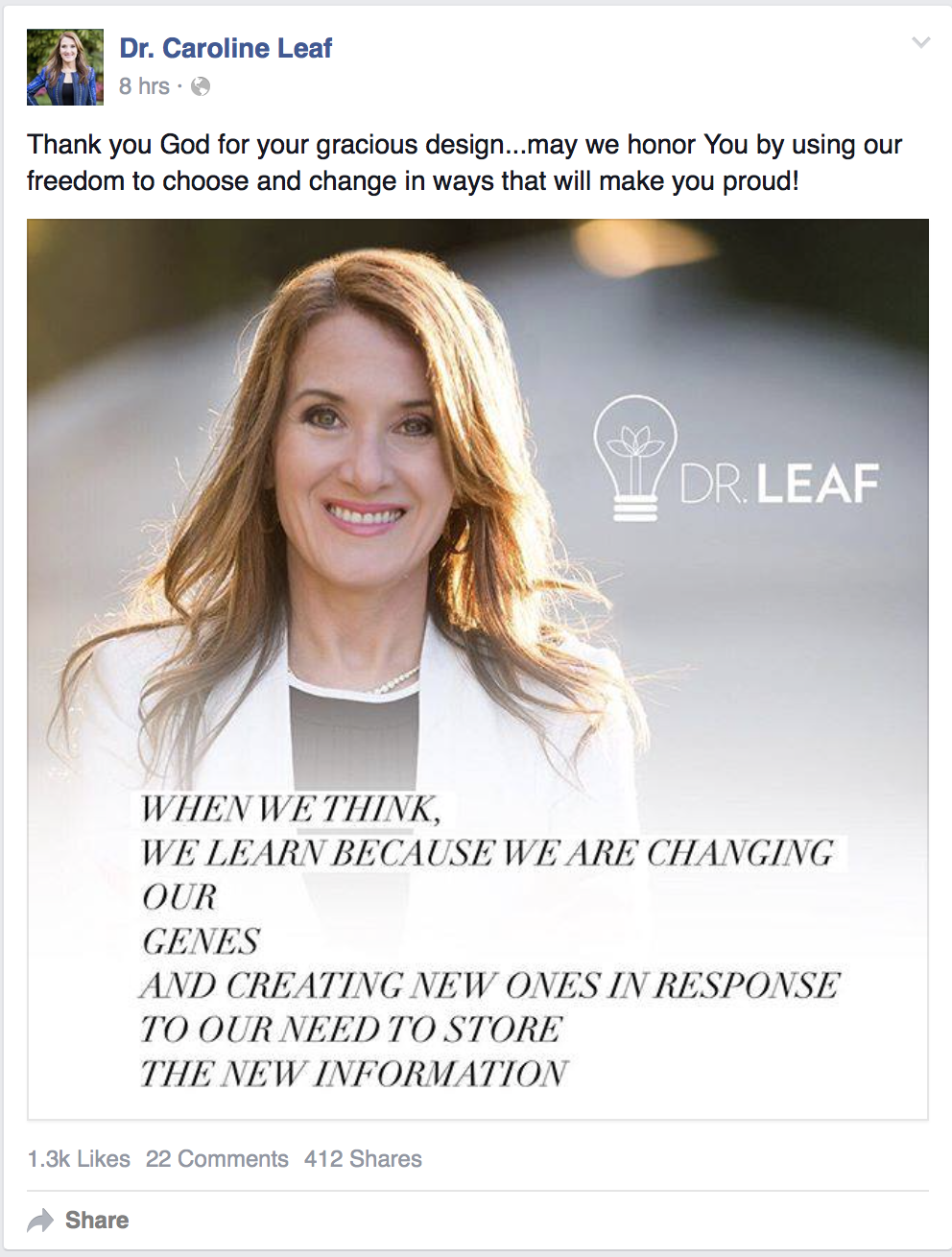
“Dr Leaf isn’t a scientific expert … ‘When we think, we learn because we are changing our genes and creating new ones’ … That’s not scientifically possible! Doesn’t anybody notice this? I feel like I’m taking crazy pills!”

Screen Shot 2016-01-28 at 9.57.06 PM

Dr Caroline Leaf is a communication pathologist and a self-titled cognitive neuroscientist.  If Dr Leaf was a legitimate scientist, she would know that our genes do not change when we process new information. Our genes are stable. They do not change unless there’s a mutation, which occurs in one out of every 30 million or so genes. We do not make new genes at will. Last year, scientists at MIT were reported to have shown that DNA breaks when new things are learnt, but in a normal nerve cell, these breaks are quickly repaired. That’s certainly interesting, but that’s not changing the DNA or making new genes. Making claims that we make new genes to hold new information is like saying that pigs fly.

Dr Leaf’s supporters would likely make a counter-argument that she probably didn’t mean that genes really change, or we make new genes, she’s just not worded her meme properly. Well, there are two responses to that, neither of which are any better for Dr Leaf. Because scientists who really are experts don’t make errors so large that you can spelunk through them. And, this isn’t the first time that Dr Leaf has made claims about how our genes fluctuate. She made a similar claim back in September 2014. Saying the same thing several times isn’t a mistake, it shows she really believes that we change our DNA code by the power of our thoughts.

Whether someone thinks DNA is changeable isn’t likely to cause any great harm to that person, but what is concerning is that Dr Leaf has been given her own show on the Christian cable TV network TBN to discuss mental health. She’s already proven that her knowledge of psychiatric medications is dangerously flawed. If Dr Leaf doesn’t know the basics of DNA, then giving her a platform to preach something that can effect whether a person might live or die is particularly perilous.

Dr Leaf’s rise is also a worrying symptom of a Christian church that is intellectually imploding. In a 2013 blog for the Huffington Post, Charles Reid wrote,

“Christians must provide effective witness against both extremes. But before Christianity can engage atheism it must first address the scientific illiteracy in its own house. For the greatest danger Christianity confronts at the present moment is not incipient persecution, but increasing marginalization and irrelevance. If Christians cannot engage reasonably and responsibly with science, there will be no place for them in the public life of advanced societies.”

Reid was paying particular attention to Ken Ham in this blog, but the principle remains the same. Scientifically illiterate Christians quickly lose credibility with people. We can’t meaningfully engage with a person who has a rudimentary understanding of biology by proudly tell them that we create new genes with the power of thought. That makes us sound like a male model.

For the sake of other Christians health and well-being, and for the sake of our credibility and our witness, we need to critically assess Dr Leaf’s work, not promote it as another gospel.

Mobile phone mothering – one more thing for mums to feel unnecessarily guilty about

Mothers.  They are probably the single most important group of people in the world.

It’s not that I’m belittling the role of fatherhood, or demeaning the amazing work that fathers do for their children, but simply put, we wouldn’t be here if it wasn’t for the tireless patience and sacrifice of our mums.  Nine months of nausea, sore breasts, swollen appendages and having your organs used as punching bags.  Then there’s the trauma of birth itself, which is rewarded with the full-time care of a screaming, incessantly ravenous alimentary canal which has taken the form of a baby.  Over the years, the screaming and the pooping become slightly more manageable, but most mothers remain the head chef, playmate, laundromat, ironing lady, teacher, taxi-driver, nurse and drill sergeant for their offspring.

Despite these daily feats of amazement, most mothers are haunted by this nagging sense of not being good enough – Mother Guilt.  As author Mia Redrick wrote,

“Mother’s guilt is real. Nearly all of us experience it. We are racked with guilt, feeling that our best isn’t good enough. We struggle when work commitments prevent us from attending school events and we are crushed by the looks of disappointment on our children’s faces. We wonder if choices we have made, such as what school to send our kids to, have not had far-reaching negative consequences, if a different path would have resulted in happier, more well-adjusted kids. We moms might feel guilty when we can’t afford something for our kids or are nagged by the feeling that we simply don’t spend enough time with them.”

Mothers seems to feel guilty about anything, and everything, for the whole day …

“The kids are in the bed again. I was sure I shushed them back to their beds at 2am, they must have snuck in during the wee hours. Tonight I will make sure they sleep all night in their own beds. How will they ever learn to sleep if I keep letting them come in to my bed?”
“Whose children get only eight hours of sleep a night? I am sure at this age they are meant to be getting 12 – 14 hours sleep. I am going to damage then for life. Maybe I should let them sleep in my bed so they get more sleep?”
“Oh so much sugar in EVERYTHING.  Don’t you read the articles? Don’t you hear the “experts”? Don’t you see those diagrams with spoonful upon spoonful of the deadly substance displayed, a visual representation of poison imprinted on your mind each and every time you take the bran flakes from the cupboard?”

And so it goes on.

Today, Dr Leaf added one more thing for mothers to feel guilty about – smartphones.

Screen Shot 2016-01-09 at 1.58.46 PM

“Mothers, put down your smartphones when caring for your babies! That’s the message from researchers, who have found that fragmented and chaotic maternal care can disrupt proper brain development, which can lead to emotional disorders later in life.”

She then exhorted her followers, “Lets get some real eye-to-eye contact going – dads included!”

Dr Caroline Leaf is a communication pathologist and self-titled cognitive neuroscientist.  Credit where credit’s due – in the past, Dr Leaf has pathologically avoided citing her references, but today, she cited the article itself and the news story that promoted it.

But again, like the meme she posted a couple of days ago about sadness making people sick, Dr Leaf has posted the opening paragraph of a promotional PR puff piece and made it sound like a scientific pronouncement.  When you actually read the journal article that the news story is promoting, it has nothing to do with smartphones.  Or indeed, human beings.

The research was performed entirely on rats.

The research itself, by Molet and colleagues [1], seemed entirely legitimate.  The rat pups raised in a more chaotic way appeared to have higher levels of anhedonia, because they didn’t engage as much in the things that rats normally find pleasurable, namely, drinking sugar water or playing with their rat buddies.

I’m not sure if you’ve ever seen a mother rat on a smartphone.  I certainly haven’t, which means that news article Dr Leaf took her meme from, the one published on Science Direct, made some pretty tenuous assumptions:

  1. Chaotic mothering to rat pups is the cause of rat anhedonia
  2. Rat mothering and human mothering have similar outcomes
  3. Smartphone use causes fragmented and chaotic maternal care
  4. Not using smartphones would improve outcomes.

There’s no evidence from this study, or any work that I know of, that definitively proves any one of these things.  There are a number of alternative explanations as to why those rat pups weren’t as happy as the control group, but even if the chaotic nurturing of the rat babies was THE cause of their unhappiness, human beings are completely different to rats in cages.  And there are many things, other than smartphones, that can strain the mother-baby relationship.  Excessive mother guilt for one.

Dr Leaf’s meme is a good example of just how misinformation can spread quickly through the internet.  The PR department of a university writes a puff piece on the article to promote the university and its research.  But no one wants to read about depressed rats – they need a better hook.  There’s a love-hate relationship with smartphones in our culture, and lots of Mommy-guilt, so they use a sentence about smartphones and mothering to grab people’s attention, even though the journal article had nothing to do with either.

Science Direct then simply republished the press release from the university without filtering it, where it’s then picked up by wannabe scientists and self-titled experts like Dr Leaf, who pass on the misinformation to hundreds of thousands of their followers.  Pretty soon, mothers everywhere are feeling guilty about looking at their phone instead of their children’s eyes, when it probably doesn’t make a blime bit of difference.

The take home messages:

  1. Unless you’re a rat, there’s no evidence that using your smartphone makes you a bad mother.
  2. Be wary of social media memes, and what you read on the internet.
  3. Dr Leaf is hurting her own credibility by reposting the opening paragraphs of sciencey promotional PR articles instead of reading the actual article first. We need experts to reduce the amount of misinformation clogging the internet, not increase it.

References

[1]        Molet J, Heins K, Zhuo X, et al. Fragmentation and high entropy of neonatal experience predict adolescent emotional outcome. Translational psychiatry 2016;6:e702.

Does sadness make you sick?

LeafMeme20160107

We’ve all heard of being “homesick”, or “heartsick”, or “lovesick”.   Sometimes when we’re extremely sad, we feel the knot in our stomachs, the pressure in our chests, or the confusion and distraction in our minds as the waves of sadness wash over and discombobulate us.

But can being sad really make you physically ill as well as emotionally distraught?

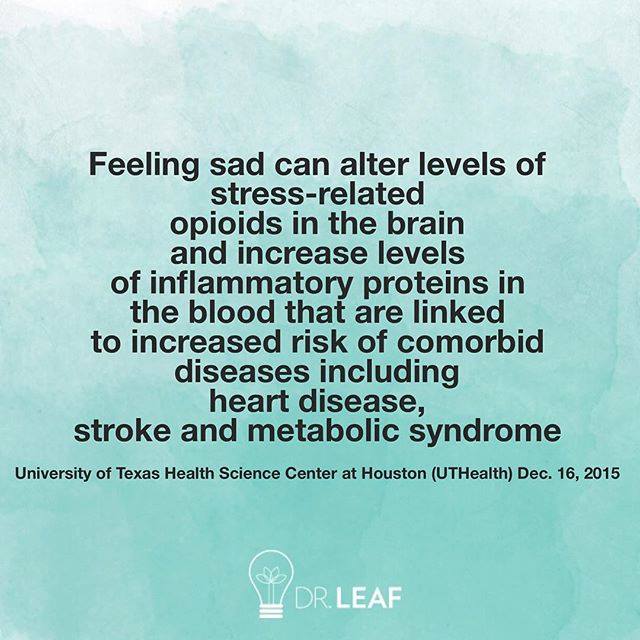
Dr Caroline Leaf declared today on her social media platforms that “Feeling sad can alter levels of stress-related opioids in the brain and increase levels of inflammatory proteins in the blood that are linked to increased risk of comorbid diseases including heart disease, stroke and metabolic syndrome.”

Dr Caroline Leaf is a communication pathologist and a self-titled cognitive neuroscientist.  She believes that our cognitive stream of thought determines our physical and mental health, and can even influence physical matter through the power of our minds.

She also added some further interpretation to her meme: “So this is more evidence that our thoughts do count: they have major epigenetic effects on the brain and body! We need to apply the principles in the Bible and listen to the Holy Spirit – no excuses this year!”

With all due respect to Dr Leaf, the study she quotes doesn’t prove anything of the sort.

Dr Leaf’s meme is a copy and paste of the opening paragraph of a news report published by the university’s PR people to promote their faculty.  This isn’t a scientific summary, it’s a hook to draw attention to an article which amounts to a PR puff piece.  If Dr Leaf had read further into the article, I don’t think she would have been quite so bold in claiming what she did.

The article discussed a study by Prossin and colleagues, published in Molecular Psychiatry [1].  You can read the original study here.  The study specifically measured the change in the level of the activity of the opioid neurotransmitter system and the amount of a pro-inflammatory cytokine IL-18 across two experimental mood states, and in two different groups of volunteers, people with depression, and those without.

For a start, it’s important to note that the study isn’t referring to normal day-to-day sadness.  This was an experimentally induced condition in which a sad memory was rehearsed so that the same feeling could be reproduced in a scanner, and the study was looking at the effect of this sad “mood” on people who were pathologically sad, that is, people diagnosed with major depression.

It’s well known that people with depression are at a higher risk of major illnesses, such as heart attacks, strokes and diabetes [2] The current study by Prossin et al looked experimentally at one possible link in the chain, a link between a neurotransmitter system that’s thought to change with emotional states, and one of the chemical mediators of inflammation.

They found that:

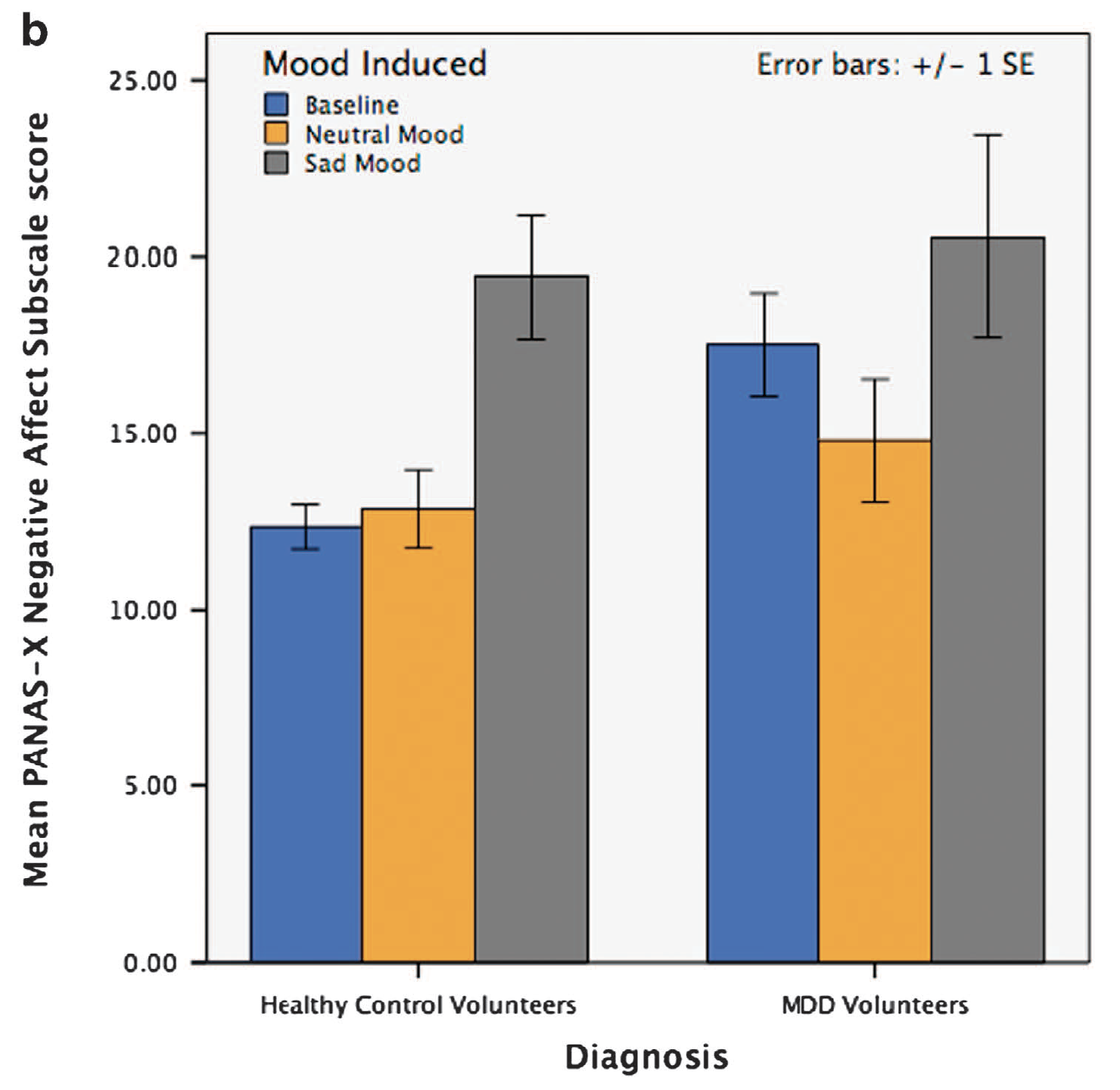
> Depressed people were much sadder to start with, and remained so throughout the different conditions.  The depressed people stayed sadder in the ‘neutral’ phase, and the healthy cohort couldn’t catch them in the ‘sad’ phase.
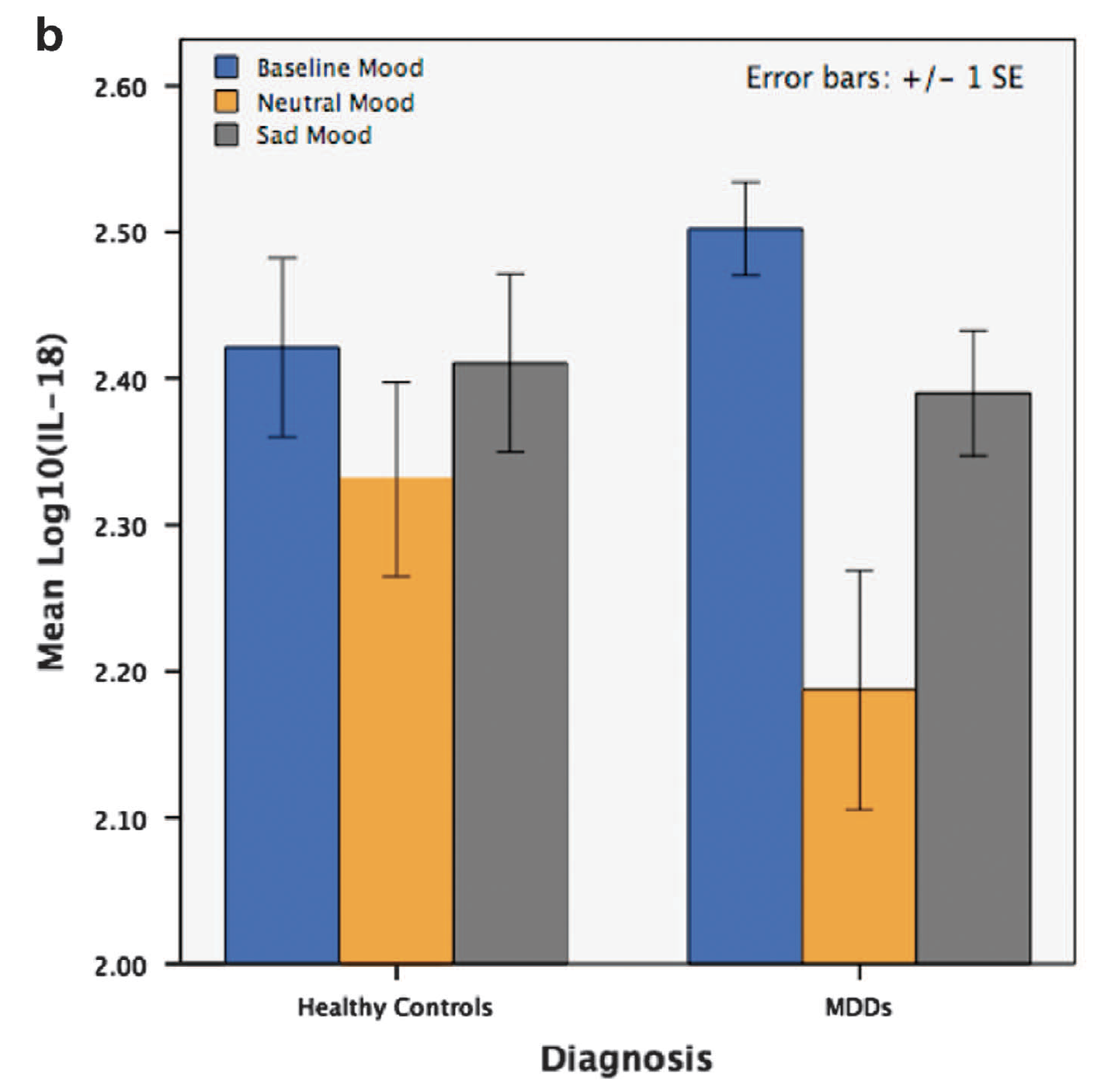
> Depressed people had a much higher level of the inflammatory marker to start with, and interestingly, this level dropped significantly with the induction of the neutral phase and the sad phase.  What was also interesting was that the level of the inflammatory marker was about the same in the baseline and the sad phase for the healthy volunteers.
> A completely different pattern of neurotransmitter release was seen in the two different groups.  People with depression had an increase in the neurotransmitter release over a large number of areas of the brain, whereas in the healthy controls with normal mood, the sad state actually resulted in a decreased amount of neurotransmitter release, and in a much smaller area within the brain.  This suggests that the opioid neurotransmitter system in the brains of depressed people is dysfunctional.

Affect/Sadness Scores - Prossin et al Molecular psychiatry 2015 Aug 18.

Affect/Sadness Scores – Prossin et al Molecular psychiatry 2015 Aug 18.

IL18 v Mood state/diagnosis - Prossin et al Molecular psychiatry 2015 Aug 18.

IL18 v Mood state/diagnosis – Prossin et al Molecular psychiatry 2015 Aug 18.

Effectively, the results of the study reflect what’s already known – the emotional dysregulation seen in people with depression is because of an underlying problem with the brain, not the other way around.  And, sadness in normal people is not associated with a significant change in the evil pro-inflammatory cytokine.

So, according to Prossin’s article,

  1. normal sadness in normal people is not associated with physical illnesses.
  2. sadness is abnormally processed in people who are depressed, which maybe related to an abnormal inflammatory response, which might explain the known link between depression and increased risk of illness

The article is not “more evidence that our thoughts do count.”  If anything, it shows that underlying biological processes are responsible for our thoughts and emotions and their downstream effects, not the thoughts and emotions themselves.

And unfortunately, it appears that Dr Leaf hasn’t got past the opening paragraph of a puff piece article before jumping to a conclusion which only fits her worldview, not the actual science.

References

[1]        Prossin AR, Koch AE, Campbell PL, Barichello T, Zalcman SS, Zubieta JK. Acute experimental changes in mood state regulate immune function in relation to central opioid neurotransmission: a model of human CNS-peripheral inflammatory interaction. Molecular psychiatry 2015 Aug 18.
[2]        Clarke DM, Currie KC. Depression, anxiety and their relationship with chronic diseases: a review of the epidemiology, risk and treatment evidence. Med J Aust 2009 Apr 6;190(7 Suppl):S54-60.