Dr Caroline Leaf – Feed your children manure???

Screen Shot 2015-03-19 at 11.27.57 pm

I was entertained somewhat by Dr Leaf’s latest Facebook post this evening. In it, there was a pairing of water and a pot-plant, and sugary drinks and a child, with the words, “If you give this (water) to your plants? Why give this (sugary beverages) to your children.”

Without looking too closely, one might think that Dr Leaf was making a good point. Water is good, and sugar is bad, right?

With just a little more thinking, one can see that the metaphor is pretty weak. Plants aren’t children. Following the same logic of the metaphor, I should feed my children manure instead of food, since it’s clearly good enough for the pot-plant.

What is worrying about this post is Dr Leaf’s linking of diet with our Christian morals. Dr Leaf tries to link the concept of drinking water to the worship of God, because your body is a temple, and “Whether you eat or drink, or whatever you do, do it all for the glory of God.” (1 Corinthians 10:31). By logical extrapolation, Dr Leaf is therefore saying that drinking Coke is dishonouring God and the temple he gave for you. If you drink Coke, then you’re a bad Christian.

Though that’s really only Dr Leaf’s interpretation, because the scripture that she quotes isn’t talking about the composition of the food you eat but about it’s relationship to the sacrifice to idols. As far as I was aware, Coke isn’t used in any worship of idols before it’s bottled and distributed. So really, I don’t think whether you drink coke or other sodas will have any bearing on your relationship with God.

Perhaps Dr Leaf would have better spent her time outlining the studies that back up her overly dramatic statement “that sugary drinks like soda and processed orange juice can cause neurochemical havoc in your brain” rather than just hoping people will take her at her word.

Lets be real … no one in their right mind is encouraging children to have more sugar, mainly because of the excess calories, and not the hysterical notion of “neurochemical havoc”. Dr Leaf’s trying to get it right, but her poor metaphor, and the linking of ones diet to ones honouring of God probably went a step too far.

It would be nice if Dr Leaf could reexamine her knowledge of nutritional science and the scriptures that she uses so that she doesn’t weaken her credibility with such posts in the future.

The truth about ADHD

ADHD is always a popular topic … and an apoplexic topic. Any mention of ADHD seems to induce everyone within ear-shot to uncontrollably expectorate their half-baked opinion on the subject, like the Tourette’s syndrome of ignorance.

I’ve heard them all over the years …

ADHD is over diagnosed.
ADHD is just a label for bad parenting.
ADHD is caused by sugar.
ADHD is caused by food colouring / preservatives / gluten / (any other fad ‘toxin’)
ADHD is cured by diet / meditation / supplements / swiss balls.
ADHD medication (Ritalin) is overused / irresponsible / lazy parenting / harmful / ungodly.
ADHD doesn’t exist in France.
ADHD doesn’t exist at all.

I could go on, but if I do, I’m just going to get myself in a tizz.

ADHD is the new AIDS. There is so much misinformation and discrimination surrounding ADHD in our modern enlightened society that the stigma is worse than the actual illness, which really says something about how badly ADHD is treated in our communities.

One of the cruellest aspects of the cultural mismanagement of ADHD is the fact that it maligns the sufferers while simultaneously isolating them from much needed support. Saying that children with ADHD should just behave themselves, or parents of children with ADHD should just have better parenting skills is victim blaming at its worst.

In order to counter the prevalent ignorance of ADHD, even just a little, I want to give a crash course on the science so that at least somewhere on the searchable web, there is a counterbalance to the thousands of misinformed arm-chair ‘experts’ whose only experience with ADHD is reading the misguided perspectives of other so-called ‘experts’.

ADHD stands for Attention Deficit Hyperactivity Disorder.

The current formal definition that must be matched to have a diagnosis of ADHD is:

  1. Inattention: Six or more symptoms of inattention for children up to age 16, or five or more for adolescents 17 and older and adults; symptoms of inattention have been present for at least 6 months, and they are inappropriate for developmental level:
    * Often fails to give close attention to details or makes careless mistakes in schoolwork, at work, or with other activities.
    * Often has trouble holding attention on tasks or play activities.
    * Often does not seem to listen when spoken to directly.
    * Often does not follow through on instructions and fails to finish schoolwork, chores, or duties in the workplace (e.g., loses focus, side-tracked).
    * Often has trouble organizing tasks and activities.
    * Often avoids, dislikes, or is reluctant to do tasks that require mental effort over a long period of time (such as schoolwork or homework).
    * Often loses things necessary for tasks and activities (e.g. school materials, pencils, books, tools, wallets, keys, paperwork, eyeglasses, mobile telephones).
    * Is often easily distracted
    * Is often forgetful in daily activities.
  1. Hyperactivity and Impulsivity: Six or more symptoms of hyperactivity-impulsivity for children up to age 16, or five or more for adolescents 17 and older and adults; symptoms of hyperactivity-impulsivity have been present for at least 6 months to an extent that is disruptive and inappropriate for the person’s developmental level:
    * Often fidgets with or taps hands or feet, or squirms in seat.
    * Often leaves seat in situations when remaining seated is expected.
    * Often runs about or climbs in situations where it is not appropriate (adolescents or adults may be limited to feeling restless).
    * Often unable to play or take part in leisure activities quietly.
    * Is often “on the go” acting as if “driven by a motor”.
    * Often talks excessively.
    * Often blurts out an answer before a question has been completed.
    * Often has trouble waiting his/her turn.
    * Often interrupts or intrudes on others (e.g., butts into conversations or games)

In addition, the following conditions must be met:
– Several inattentive or hyperactive-impulsive symptoms were present before age 12 years.
– Several symptoms are present in two or more setting, (e.g., at home, school or work; with friends or relatives; in other activities).
– There is clear evidence that the symptoms interfere with, or reduce the quality of, social, school, or work functioning.
– The symptoms do not happen only during the course of schizophrenia or another psychotic disorder.
– The symptoms are not better explained by another mental disorder (e.g. Mood Disorder, Anxiety Disorder, Dissociative Disorder, or a Personality Disorder.

(http://www.cdc.gov/ncbddd/adhd/diagnosis.html)

In Australia, ADHD cannot be formally diagnosed by anyone other than a paediatrician or a psychiatrist. So even as an experienced GP, I can’t officially diagnose it. The school counsellor or local naturopath can’t diagnose it. You can’t just pluck it out of the air. The diagnosis can only come from a medical specialist with at least a decade of university level training.

The official prevalence rate of ADHD (the number of people with a current diagnosis) is only 5%. According to some US based community surveys, nearly a half of those children are not on medication for it (http://www.cdc.gov/ncbddd/adhd/data.html). So much for Ritalin being overprescribed.

Stimulants vs nothing

ADHD is a predominantly genetic disorder which leads to specific structural deficiencies in the brain. Children with ADHD have a significant global reduction in the volume of grey matter, most prominently in a part of the brain called the right lentiform nucleus. These changes usually improve with age and improve with stimulant medication. There is also evidence of changes to the shape and size of other brain structures such as the amygdala and the thalamus (areas of the brain integral to sensory and emotional processing). Early evidence also exists which suggests changes in the white matter pathways connecting a number of critical brain regions. Studies investigating brain development have estimated that the frontal lobe development of ADHD children lags that of normal children by an average of about three years.

These changes in the brain are not caused by the child’s behaviour, since other studies have shown the same changes in the brains of unaffected first degree relatives (brothers or sisters), just to a milder degree.

Modern functional imaging techniques show that the brains of children with ADHD have abnormally low functioning in most of the brain structures related to attention and planning (numerous areas of the frontal cortex as well as the basal ganglia, thalamus and parietal cortices). At the same time, there is extra activity in portions of the brain related to the Default Mode Network (the day-dreaming part of your brain). So children with ADHD have brains in which the ‘day-dreaming’ network activity persists into, or emerges during, periods of task-related activity. This takes processing power away from the competing task-specific processing causing a deficit in performance. Studies show that Ritalin normalises this dysfunction.

The best evidence suggests that dopamine is the main neurotransmitter involved in ADHD. Other neurotransmitters are likely to be involved but the evidence is still being confirmed. Medications like Ritalin improve ADHD symptoms by increasing the amount of dopamine that the nerve cells have access to, improving the clarity of the signal between them.

Underlying all of these neural changes are genetics. While there have been no specific genes discovered in research thus far, twin studies have demonstrated a heritability of ADHD of up to 76%. The most significant environmental factors that are responsible for the remainder of the influence on ADHD are not nutritional factors such as sugar or food additives, but are low birth weight/prematurity and exposure to smoking during pregnancy.

Are there any better treatments for ADHD other than stimulants like Ritalin? Other non-stimulant medications are available although at this stage, Ritalin and Dexamphetamine still out-perform them. Cognitive therapies may mimic some of the brain changes of Ritalin but it is not clear whether the effectiveness of cognitive therapies are equal to or better than the stimulant medications. What is clear is that Ritalin doesn’t lead to a euphoric state (a “drug high”) when given orally. So children can not get addicted to Ritalin when used responsibly.

In summary, ADHD exists. It’s caused by the interaction of a number of genes and some environmental factors such as those related to prematurity, low birth weight and maternal smoking, which alter the growth and development of the brain, specifically the grey matter of the frontal cortex, the basal ganglia and thalamus, and the pathways which connect them. These structural changes cause the day-dreaming part of the brain to be more active and the attention and planning parts of the brain to be less active.

ADHD is not caused by food additives or sugar. There is no evidence that autoimmunity plays a significant part. Forcing your child to consume bone broth or stop eating gluten will not cure them.

ADHD is not caused by bad parenting. Ritalin is not evil. Medications like Ritalin and Dexamphetamine have been shown to improve the functioning of children with ADHD and improve their underlying neurological deficits.

It’s time to cut the crap. Our culture needs to stop victimising the child with ADHD and their parents, who already suffer enough from the ADHD without ignorant busy-bodies and self-titled experts chiming in and making their suffering even more pronounced. It’s time to stop judging those who choose the best for their child by medicating them, who do so in spite of the unfair and ill-informed criticism of everyone from their mother-in-law to the milkman when they do. It’s time to remove the stigma from one of the most common psychiatric disorders of childhood so that every child has an equal chance of growing into an adult that can realise their full potential.

That’s the truth about ADHD.

Bibliography:

Cortese, S. (2012). The neurobiology and genetics of Attention Deficit/Hyperactivity Disorder (ADHD): what every clinician should know. Eur J Paediatr Neurol, 16(5), 422-433. doi: 10.1016/j.ejpn.2012.01.009

Gluten mad!

Tonight as I was browsing Facebook again, I came across an article a person had posted on gluten. The article claimed that gluten is connected to depression, and indeed, nearly every other neurological disorder for good measure.

Gluten is a protein found in certain grains like wheat, barley and rye. Gluten also makes foods taste better and improves their texture, so it’s often added to everything else.

The “gluten is toxic” meme is a very catchy one that’s doing the rounds again. I first heard of the idea that gluten is the cause of nearly every disease when I was in medical school, when every person I knew who’d seen a naturopath was told they had gluten intolerance and were conned into an unappetising and restrictive diet which didn’t make any of them better.

The same meme is now making it’s way back around again now that the low-fat, sugar-free, zucchini broth-type diet fads are waning.

The proposed link between depression, anxiety and gluten is a new twist to the old story. But with depression becoming a preeminent disease in the 21st century, the link doesn’t surprise me.

So what does the evidence say? Is gluten the culprit behind the modern scourge of mental illness?

I certainly don’t think so, at least according to my interpretation of the medical literature. As far back as 2001, researchers studying the mental health of patients with coeliac disease noted that coeliac disease patients had much higher levels of anxiety and depression than healthy matched controls (up to about three to six times greater in one study), and after a year on a gluten free diet, there were no changes to the rates of anxiety and depression (Addolorato et al., 2001).

In more recent times, larger studies have been performed. Hauser, Janke, Klump, Gregor, and Hinz (2010) confirmed higher levels of anxiety in German female coeliac patients who were on a gluten free diet, compared to the normal controlled population. Mazzone et al. (2011) showed that children with coeliac disease on gluten-free diets for about 7 years on average still showed an increased rate of anxiety and depression symptoms and showed higher scores in “harm avoidance” and “somatic complaints” as compared to healthy control subjects.

A larger cross sectional survey was performed in the Netherlands in 2013, on 2265 adults with coeliac disease (van Hees, Van der Does, & Giltay, 2013). That survey showed that a significantly higher proportion of those with coeliac disease, despite being on a strict gluten free diet, reporting a higher rate of anxiety and depression compared to the general population. It also showed (albeit in a smaller subgroup of respondents) that poor adherence with a gluten free diet did not affect the likelihood of depressive symptoms.

To be fair, cross sectional surveys and longitudinal cohorts aren’t necessarily the strongest form of evidence, but it is the best we’ve currently got. There was a recent randomised controlled trial, a stronger form of evidence, looking at the effect the introduction of gluten had on depressive symptoms in people who did not have coeliac disease but reported gluten sensitivity and were controlled on a gluten free diet (Peters, Biesiekierski, Yelland, Muir, & Gibson, 2014). While this showed some worsening of depressive symptoms in those subjects given gluten, the exposure was short, the effect was moderate, and the results should be considered cautiously given the small number of subjects reduced the power of the study.

Given the weight of evidence, I can’t help but be sceptical of books touting the ‘gluten = depression’ theory, books like “Grain Brain”. It’s author, American neurologist Dr David Perlmutter, attests that more than 38 different diseases are caused by gluten, including autism and depression. If you believe the celebrity chiropractor who reviewed Perlmutter’s work (http://www.glutenfreesociety.org/gluten-free-society-blog/gluten-leaky-brain-the-connection-to-depression/), increased intestinal permeability and intestinal dysbiosis (“leaky gut” and bad gut bacteria) combine to increase inflammation in the blood and in the brain, causing depression.

But correlation does not equal causation. Just because brain diseases, inflammation and gut problems tend to occur together does not prove that gut problems cause inflammation and brain problems. Rather, the evidence suggests that it’s the other way around, with all of the processes linked to genetics.

For example, autism is related to a number of genes that both reduce the proteins that help nerve cells grow branches (Won, Mah, & Kim, 2013), and at the same time, switch on a low grade form of inflammation (Onore, Careaga, & Ashwood, 2012). I believe it’s the pre-existing inflammation that adds to the cellular dysfunction of the brain and at the same time, promoting low grade inflammation of a number of organs, including the gut. It’s the pre-existing inflammation that causes the gut to become “leaky”, not the “leaky” gut causing the inflammation.

Because if gluten was the primary cause, then why do people with coeliac disease who do not eat gluten report more depressive and anxious symptoms than control groups who do eat gluten? Why would those with coeliac disease who are eating sporadic gluten be just as depressed as those patients who do not?

If you don’t have coeliac disease, then gluten free diets are just like Amway products. You really don’t need them, and you could probably do much better without them. All you’re really doing is just making someone else obscenely rich.

Not only are you wasting your money, but you might also be harming your health by eating gluten free foods, since most foods that are stripped of gluten are also stripped of most of their other nutrients.

As Nash and Slutzky (2014) summarise, “Every major change in our diet carries with it the possibility of unforeseen risks. Many readers — the general public, as well as medical professionals — accept what they read at first glance. Myths have been part of our medical lore for millennia. Those jumping on the gluten-free/high-fat bandwagon may be disappointed when their symptoms are not mitigated; more critically, they may be at increased risk for other, more dangerous ailments.”

If you really think you feel better off gluten, then talk to your doctor or registered dietician to make sure you remain healthy off it.

References

Addolorato, G., Capristo, E., Ghittoni, G., Valeri, C., Masciana, R., Ancona, C., & Gasbarrini, G. (2001). Anxiety but not depression decreases in coeliac patients after one-year gluten-free diet: a longitudinal study. Scand J Gastroenterol, 36(5), 502-506.

Hauser, W., Janke, K. H., Klump, B., Gregor, M., & Hinz, A. (2010). Anxiety and depression in adult patients with celiac disease on a gluten-free diet. World J Gastroenterol, 16(22), 2780-2787.

Mazzone, L., Reale, L., Spina, M., Guarnera, M., Lionetti, E., Martorana, S., & Mazzone, D. (2011). Compliant gluten-free children with celiac disease: an evaluation of psychological distress. BMC Pediatr, 11, 46. doi: 10.1186/1471-2431-11-46

Nash, D. T., & Slutzky, A. R. (2014). Gluten sensitivity: new epidemic or new myth? Every major change in our diet carries with it the possibility of unforeseen risks. Am J Cardiol, 114(10), 1621-1622. doi: 10.1016/j.amjcard.2014.08.024

Onore, C., Careaga, M., & Ashwood, P. (2012). The role of immune dysfunction in the pathophysiology of autism. Brain Behav Immun, 26(3), 383-392. doi: 10.1016/j.bbi.2011.08.007

Peters, S. L., Biesiekierski, J. R., Yelland, G. W., Muir, J. G., & Gibson, P. R. (2014). Randomised clinical trial: gluten may cause depression in subjects with non-coeliac gluten sensitivity – an exploratory clinical study. Aliment Pharmacol Ther, 39(10), 1104-1112. doi: 10.1111/apt.12730

van Hees, N. J., Van der Does, W., & Giltay, E. J. (2013). Coeliac disease, diet adherence and depressive symptoms. J Psychosom Res, 74(2), 155-160. doi: 10.1016/j.jpsychores.2012.11.007

Won, H., Mah, W., & Kim, E. (2013). Autism spectrum disorder causes, mechanisms, and treatments: focus on neuronal synapses. Front Mol Neurosci, 6, 19. doi: 10.3389/fnmol.2013.00019

Dr Caroline Leaf – It’s no joke

Screen Shot 2015-02-13 at 7.59.24 pm

So, stop me if you’ve heard this one … This guy walks into a bar, and says, “Owww, that bar is really hard.”

Ok, that was a bad joke. Hey, I’m no Robin Williams. Some people have the knack of being able to make people laugh in almost any situation. I can get a few laughs, but I’m not a naturally gifted comic.

Dr Caroline Leaf is a communication pathologist and a self-titled cognitive neuroscientist. She isn’t a comedian either.

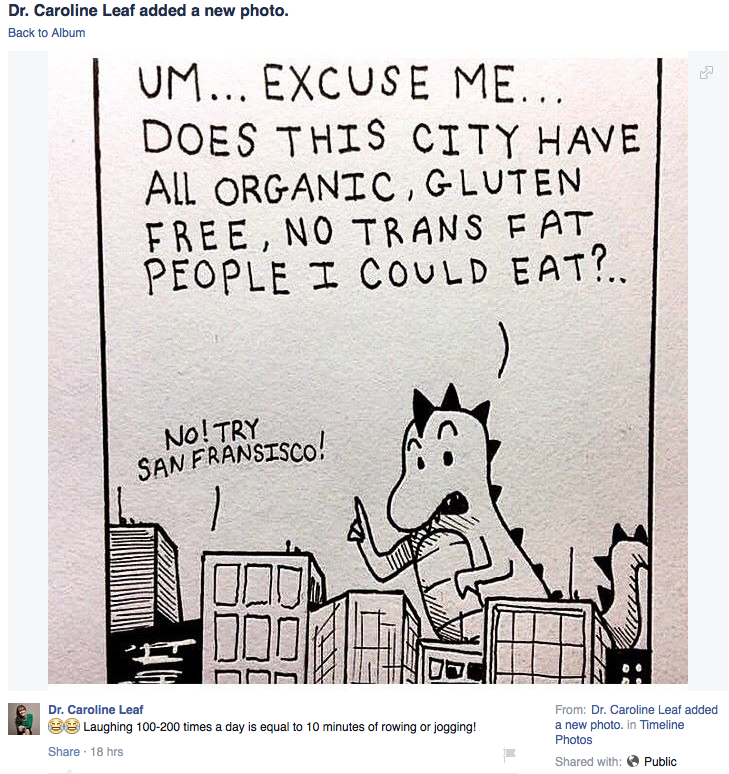
Her post today was a light-hearted dig at giant lizards with a taste for organic free-range humans, or perhaps the fact that most people know being “all organic, gluten free” should be left to the sanctimonious foodies of San Francisco.

The other part of her post wasn’t meant to be funny, but certainly contained a healthy dose of irony. In trying to justify her bit of light comic relief, she posted another of her subtly erroneous factoids, this time claiming that, “Laughing 100-200 times a day is equal to 10 minutes of rowing or jogging!”

Not according to real scientists, who have worked out that laughing is actually the metabolic equivalent to sitting still at rest, while jogging or rowing burns between 6 to 23 times as much energy, depending on how fast you run or row [1].

That would mean that I would have to laugh for at least a whole hour a day (or about 700 times based on the average chortle) to be even close to the energy burnt by a light jog.

On the grand scale of things, this meme probably doesn’t really matter. These sort of factoids are thrown around on social media all the time, and it won’t make a big difference to the health and wellbeing of most people. But it does help establish a pattern. Dr Leaf habitually publishes memes and factoids that clearly deviate from the scientific truth, proving that Dr Leaf has become a cross between a science fiction author and life coach, not a credible scientific expert. From her social media memes to her TV shows, all of her teaching becomes tainted as untrustworthy.

While today’s meme may not be so serious, if Dr Leaf can’t get her facts straight, pretty soon the joke will be on her.

References

  1. Ainsworth, B.E., et al., 2011 Compendium of Physical Activities: a second update of codes and MET values. Med Sci Sports Exerc, 2011. 43(8): 1575-81 doi: 10.1249/MSS.0b013e31821ece12

Fats and Figures: Re-examining saturated fat and what’s really good for your heart

Fats and Figures cover 1400

A Facebook friend forwarded me an article a few weeks back and asked for my humble medical opinion.

The article was entitled, “World Renowned Heart Surgeon Speaks Out On What Really Causes Heart Disease”. It was written by a man who said he was a heart surgeon, and who claimed to be coming clean on the real reason why our world has an epidemic of obesity and heart disease despite the low fat advice of the medical profession.

It’s a highly controversial topic right now. For decades, the western world was under the impression that fat was tobaccos right hand man in a war on good health. Standard medical dogma was that high cholesterol was bad, and that saturated fat was its main source. Evil butter was replaced with angelic margarine. Fatty red meat was always served with a generous side portion of guilt. Low fat became high fashion.

Today, the pendulum of public opinion has swung back with such amazing ferocity, it’s become more like a wrecking ball. Fat has returned to the fold as friend instead of foe. The once mighty cholesterol lowering medications called statins have become seen as another example of pharmaceutical company profits-before-patients. Sugar has become the new villain, and along with it, the nebulous concept of “inflammation” as the key mechanism of heart disease and strokes, and nearly every other medical ailment.

What started off as a three-paragraph reply on Facebook has evolved into a short eBook, which you can download for free from Smashwords (https://www.smashwords.com/books/view/514719)

In today’s post, I want to look at six things that, over the years, have been touted as contributing to or preventing heart disease, and see what the evidence says. The results may be surprising!

1. Is saturated fat bad? Is polyunsaturated fat good?

According to a meta-analysis of observational studies on dietary fats by Chowdhury et al. (2014), relative risks for coronary disease were 1.02 (95% CI, 0.97 to 1.07) for saturated fats, 0.99 (CI, 0.89 to 1.09) for monounsaturated, 0.93 (CI, 0.84 to 1.02) for long-chain n-3 polyunsaturated, 1.01 (CI, 0.96 to 1.07) for n-6 polyunsaturated, and 1.16 (CI, 1.06 to 1.27) for trans fatty acids. The total number of patients in all of the trials was more than half a million. This is pretty convincing evidence that saturated fats aren’t as bad as first believed.

What does all this mean? In statistical terms, a relative risk is the incidence of disease in one group compared to the incidence of disease in another. The risk of the disease in the two groups is the same if the relative risk = 1. A relative risk of 7.0 means that the experiment group has seven times the risk of a control group. A relative risk of 0.5 would mean the experiment group has half the risk of the control group. The confidence interval is a range of numbers in which there is a 95% chance that the true relative risk is in the interval. A result is “statistically significant” when the confidence interval (CI) does not cross the number 1.

So going back to the study by Chowdhury et al. (2014), only 2% more patients in the group with the highest saturated fat consumption had heart disease compared to the lowest saturated fat consumption. The confidence interval crossed 1, so that result may have been due to chance alone. For trans fatty acid consumption, 16% more people had heart disease in the higher consumption group compared to the lower consumption group, which was probably a real effect and not due to chance (the confidence interval did not cross 1). Simply put, trans-fats are bad. Saturated fats probably aren’t.

The same meta-analysis by Chowdhury et al. (2014) also reviewed supplementation with PUFA’s on the overall risk of heart disease. They found that in 27 randomised controlled trials with more than 100,000 people, relative risks for coronary disease were 0.97 (CI, 0.69 to 1.36) for alpha-linolenic acid supplements, 0.94 (CI, 0.86 to 1.03) for long-chain n-3 polyunsaturated acid supplements, and 0.89 (CI, 0.71 to 1.12) for n-6 polyunsaturated fatty acid supplements. In this case, there was a trend in favour of supplementation with omega-3 and omega-6 supplements, but it was small, and may have been due to chance. This is confirmed by other reviews (Rizos, Ntzani, Bika, Kostapanos, & Elisaf, 2012; Schwingshackl & Hoffmann, 2014)

So it appears that it doesn’t matter what fat you consume, saturated or polyunsaturated, or whether you supplement with fish oils or eat lots of fish, your cardiovascular risk is much the same. The only thing that’s definitely clear is that you should avoid trans-fats.

2. Is sugar bad for you?

That depends.

When we think of sugar, we think of sucrose, a carbohydrate made up of one glucose and one fructose molecule. There are many carbohydrates, which are just various combinations of different numbers of glucose/fructose molecules, sucrose being one type.

Sugar consumption is thought to be the modern scourge, it’s consumption linked to everything from cancer to gallstones. It’s been recently become the villain of cardiovascular disease as well. It’s thought to cause insulin resistance, inflammation and an increase in the fats circulating in the blood stream. So, is it as bad as they say? The evidence is surprising.

First of all, sugar doesn’t make you fat. Rather, it’s the calories you consume that make you fat. Te Morenga, Mallard, and Mann (2013) conclude their meta-analysis of dietary sugar and body weight, “Among free living people involving ad libitum diets, intake of free sugars or sugar sweetened beverages is a determinant of body weight. The change in body fatness that occurs with modifying intakes seems to be mediated via changes in energy intakes, since isoenergetic exchange of sugars with other carbohydrates was not associated with weight change.”

The intake of sugar and glucose don’t cause an increase in inflammation or cholesterol in healthy people. In a study on effects of sugar consumption on the biomarkers of healthy people, Jameel, Phang, Wood, and Garg (2014) found that consumption of sucrose and glucose actually decreased cholesterol. Fructose increased cholesterol, though interestingly, the Total:HDL ratio (which is prognostic for heart disease) did not change significantly with the consumption of any form of sugar. They also found that fructose was associated with an increase in inflammation, but glucose and sucrose reduced inflammation.

On the other hand, a study by Isordia-Salas et al. (2014) showed a small but significant association between those with high blood glucose level and inflammation, though they also found an association between inflammation and BMI (the body-mass index), so it’s not clear what the causal factor is.

There seems to be a clearer association between blood glucose after meals in those who have abnormal glucose metabolism. In patients with pre-diabetes, higher levels of blood glucose two hours after eating were associated with increased risk of death from cardiovascular disease and all causes (Coutinho, Gerstein, Wang, & Yusuf, 1999; Decode Study Group, 2003; Lind et al., 2014).

To melt your brain a little more, just because high glucose levels are associated with higher mortality doesn’t mean the lower the glucose, the better. In the study by the Decode Study Group (2003), low blood glucose had a higher mortality than normal glucose levels, and a meta-analysis by Noto, Goto, Tsujimoto, and Noda (2013) showed that low carbohydrate diets have a 30% increase in all-cause mortality.

How do you pull all of these seemingly contradictory studies together? The bottom line appears to be, according to the evidence so far, that consumption of sugar does not cause inflammation or significantly increase the risk of heart disease in healthy people who are able to metabolise it properly.

In those people who have abnormal glucose metabolism, the higher the glucose is after a meal (a measure of how well the body processes glucose), then the higher the risk is of inflammation, heart disease, and all-cause mortality.

The distinction between who has normal glucose metabolism and who has dysfunctional glucose metabolism is probably related to genetics. A study by Sousa, Lopes, Hueb, Krieger, and Pereira (2011) showed that genetic information was able to predict 5-year incidence of major cardiovascular events and overall mortality in non-diabetic individuals, even after adjustment for the persons blood sugar. Those without diabetes but who had a high genetic risk had a similar incidence of cardiovascular events compared to diabetics. So if you have the genes, your body doesn’t process the glucose properly and your risk is increased, even if you aren’t bad enough to have a diagnosis of diabetes.

Thus it appears that sugar is not the bad guy that everyone makes it out to be. Excess sugar will make you fat, but so will excess everything-else. It probably won’t kill you unless you’re genetically pre-disposed to handle it poorly. And there’s the rub, because we don’t have the capacity to test for that clinically yet.

So the last word on sugar is that it’s a sometimes food. You may be lucky enough to handle large amounts of sugar, but the best advice at this time is don’t tempt fate by eating large quantities of it.

3. Is obesity bad for you?

Again, that depends.

It used to be thought that obesity posed a linear risk, that is, the fatter you were the higher your risk of heart attacks, cancer, diabetes, everything. Then in 2013, a meta-analysis by Flegal, Kit, Orpana, and Graubard (2013) showed that people who were overweight (but not obese) had better survival than those who were normal weight.

Later in 2013, Kramer, Zinman, and Retnakaran (2013) published a meta-analysis which showed that metabolically unhealthy people of normal BMI were at greater risk of cardiovascular disease than metabolically healthy obese people.

Last year a paper by Barry et al. (2014) showed that those who were unfit were twice as likely to die compared to people who were fit, irrespective of their BMI.

So obesity doesn’t seem to be the problem after all, rather it’s a persons ability to handle blood sugar, cholesterol and blood pressure that’s the problem. It seems that more people with obesity have these metabolic problems, but correlation does not equal causation. There’s probably a undetermined factor that links obesity and metabolic dysfunction.

I’m not suggesting that we should all get fatter. Obesity has problems of its own, unrelated to metabolic issues, that make it problematic. We should still be careful about our weight. The take-home message is that skinny does not necessarily mean healthy and that focusing on what the scales are saying may be distracting us from the real problem.

4. Is meat bad for you? Should we be vegetarians?

In a word, no.

In the two available meta-analyses of the studies on red meat consumption (Larsson & Orsini, 2014), and red meat vs white meat vs all meat (Abete, Romaguera, Vieira, Lopez de Munain, & Norat, 2014), there was a statistical but moderate increase in death and heart disease from processed meats.

There was a trend towards a higher death rate in those who ate the most red meat, but the trend wasn’t statistically significant (i.e.: may have been related to chance). There was no trend associated with white meat consumption. So it appears that as long as it’s not processed meat, red meat isn’t as bad as people first thought.

Meat might not be particularly bad, but are vegetarian diets better? Again, probably not. The meta-analysis by Huang et al. (2012) shows that there’s a positive trend for vegetarian diets, though again, that might be attributable to chance as the results are not statistically significant.

The take-away message? Even though the trends may be related to chance, the trend is favourable for vegetables and not as favourable for red meat. So eat more veggies, eat less red meat, but don’t let some sanctimonious vegan convince you that meat is noxious and vile.

5. Is alcohol good for you?

A different meme recently came around my Facebook feed, entitled, “Is Drinking Wine Better Than Going To The Gym? According To Scientists, Yes!” For a while there, I had fantasies about giving my membership card back to the gym and heading down to the local bottle shop for my daily workout instead.

Disappointingly, it turns out that red wine isn’t better than exercise according to the research that I uncovered. However, my research did suggest that the daily exercise of wine drinking is still beneficial, and not just red wine, but alcohol of any form. Ronksley, Brien, Turner, Mukamal, and Ghali (2011) showed about two standard drinks of alcohol daily conferred a 25% reduction in deaths from heart disease (relative risk 0.75 (0.68 to 0.81)), and a small but statistically strong reduction in death from all causes of 13% (relative risk 0.87 (0.83 to 0.92)). The risk reduction of coronary heart disease from alcohol was also confirmed in a more recent study by Roerecke and Rehm (2014), who showed that death from heart disease was reduced by 36% for those who consistently consumed less than three standard drinks a day (relative risk 0.64 (0.53 to 0.71)).

The effect applies to consistent daily consumption, not to drinking in a cluster pattern (binging or weekend-drinking only, for example). And there’s a gender difference, women having the maximum beneficial effect at about one drink a day, and two drinks a day in men.

6. Is exercise good for you?

In a word, yes!

I’ve never seen a study that showed exercise was harmful. Exercise improves overall metabolism, decreases cardiovascular disease, improves mood and memory and increases your lifespan, amongst many other things. If exercise came in pill form, it would be labelled a wonder-drug.

As discussed earlier, fit people have a better rate of survival compared to unfit people, whether they’re obese or not (Barry et al., 2014). And the key to fitness is exercise. In a large meta-analysis by Samitz, Egger, and Zwahlen (2011), 80 studies involving more than 1.3 million subjects in total were analysed, showing that the highest levels of exercise had an all cause mortality reduction of 35% (relative risk 0.65 (0.6 to 0.71)).

There’s always debate about what form of exercise is best. Are you better to do weights, do interval training, or run for hours? Honestly, it probably doesn’t matter that much in the end. What is important is that you work hard enough to elevate your heart rate and break a sweat. If you aren’t very fit, it won’t take much exercise to do that. If you are very fit, it probably will. But for the average person, you don’t have to jump straight into a boot camp style program and work so hard that you’re puking everywhere, and so sore afterwards that you can’t move for a week. Common sense prevails!

References

Abete, I., Romaguera, D., Vieira, A. R., Lopez de Munain, A., & Norat, T. (2014). Association between total, processed, red and white meat consumption and all-cause, CVD and IHD mortality: a meta-analysis of cohort studies. Br J Nutr, 112(5), 762-775. doi: 10.1017/S000711451400124X

Barry, V. W., Baruth, M., Beets, M. W., Durstine, J. L., Liu, J., & Blair, S. N. (2014). Fitness vs. fatness on all-cause mortality: a meta-analysis. Prog Cardiovasc Dis, 56(4), 382-390. doi: 10.1016/j.pcad.2013.09.002

Chowdhury, R., Warnakula, S., Kunutsor, S., Crowe, F., Ward, H. A., Johnson, L., . . . Di Angelantonio, E. (2014). Association of dietary, circulating, and supplement fatty acids with coronary risk: a systematic review and meta-analysis. Ann Intern Med, 160(6), 398-406. doi: 10.7326/M13-1788

Coutinho, M., Gerstein, H. C., Wang, Y., & Yusuf, S. (1999). The relationship between glucose and incident cardiovascular events. A metaregression analysis of published data from 20 studies of 95,783 individuals followed for 12.4 years. Diabetes Care, 22(2), 233-240.

Decode Study Group, E. D. E. G. (2003). Is the current definition for diabetes relevant to mortality risk from all causes and cardiovascular and noncardiovascular diseases? Diabetes Care, 26(3), 688-696.

Flegal, K. M., Kit, B. K., Orpana, H., & Graubard, B. I. (2013). Association of all-cause mortality with overweight and obesity using standard body mass index categories: a systematic review and meta-analysis. JAMA, 309(1), 71-82. doi: 10.1001/jama.2012.113905

Huang, T., Yang, B., Zheng, J., Li, G., Wahlqvist, M. L., & Li, D. (2012). Cardiovascular disease mortality and cancer incidence in vegetarians: a meta-analysis and systematic review. Ann Nutr Metab, 60(4), 233-240. doi: 10.1159/000337301

Isordia-Salas, I., Galvan-Plata, M. E., Leanos-Miranda, A., Aguilar-Sosa, E., Anaya-Gomez, F., Majluf-Cruz, A., & Santiago-German, D. (2014). Proinflammatory and prothrombotic state in subjects with different glucose tolerance status before cardiovascular disease. J Diabetes Res, 2014, 631902. doi: 10.1155/2014/631902

Jameel, F., Phang, M., Wood, L. G., & Garg, M. L. (2014). Acute effects of feeding fructose, glucose and sucrose on blood lipid levels and systemic inflammation. Lipids Health Dis, 13(1), 195. doi: 10.1186/1476-511X-13-195

Kramer, C. K., Zinman, B., & Retnakaran, R. (2013). Are metabolically healthy overweight and obesity benign conditions?: A systematic review and meta-analysis. Ann Intern Med, 159(11), 758-769. doi: 10.7326/0003-4819-159-11-201312030-00008

Larsson, S. C., & Orsini, N. (2014). Red meat and processed meat consumption and all-cause mortality: a meta-analysis. Am J Epidemiol, 179(3), 282-289. doi: 10.1093/aje/kwt261

Lind, M., Tuomilehto, J., Uusitupa, M., Nerman, O., Eriksson, J., Ilanne-Parikka, P., . . . Lindstrom, J. (2014). The association between HbA1c, fasting glucose, 1-hour glucose and 2-hour glucose during an oral glucose tolerance test and cardiovascular disease in individuals with elevated risk for diabetes. PLoS One, 9(10), e109506. doi: 10.1371/journal.pone.0109506

Noto, H., Goto, A., Tsujimoto, T., & Noda, M. (2013). Low-carbohydrate diets and all-cause mortality: a systematic review and meta-analysis of observational studies. PLoS One, 8(1), e55030. doi: 10.1371/journal.pone.0055030

Rizos, E. C., Ntzani, E. E., Bika, E., Kostapanos, M. S., & Elisaf, M. S. (2012). Association between omega-3 fatty acid supplementation and risk of major cardiovascular disease events: a systematic review and meta-analysis. JAMA, 308(10), 1024-1033. doi: 10.1001/2012.jama.11374

Roerecke, M., & Rehm, J. (2014). Alcohol consumption, drinking patterns, and ischemic heart disease: a narrative review of meta-analyses and a systematic review and meta-analysis of the impact of heavy drinking occasions on risk for moderate drinkers. BMC Med, 12(1), 182. doi: 10.1186/s12916-014-0182-6

Ronksley, P. E., Brien, S. E., Turner, B. J., Mukamal, K. J., & Ghali, W. A. (2011). Association of alcohol consumption with selected cardiovascular disease outcomes: a systematic review and meta-analysis. BMJ, 342, d671. doi: 10.1136/bmj.d671

Samitz, G., Egger, M., & Zwahlen, M. (2011). Domains of physical activity and all-cause mortality: systematic review and dose-response meta-analysis of cohort studies. Int J Epidemiol, 40(5), 1382-1400. doi: 10.1093/ije/dyr112

Schwingshackl, L., & Hoffmann, G. (2014). Dietary fatty acids in the secondary prevention of coronary heart disease: a systematic review, meta-analysis and meta-regression. BMJ Open, 4(4), e004487. doi: 10.1136/bmjopen-2013-004487

Sousa, A. G., Lopes, N. H., Hueb, W. A., Krieger, J. E., & Pereira, A. C. (2011). Genetic variants of diabetes risk and incident cardiovascular events in chronic coronary artery disease. PLoS One, 6(1), e16341. doi: 10.1371/journal.pone.0016341

Te Morenga, L., Mallard, S., & Mann, J. (2013). Dietary sugars and body weight: systematic review and meta-analyses of randomised controlled trials and cohort studies. BMJ, 346, e7492. doi: 10.1136/bmj.e7492


Dr Caroline Leaf and dualism revisited

Screen Shot 2015-01-18 at 9.05.13 pm

Are we a body with a mind, or a mind with a body?

This may sound like a chicken-and-egg type of conundrum, but it’s a deep philosophical question. The concept of the separation of the mind from the body is known as dualism, and has been debated for centuries because the answer to that question then guides a lot of other philosophies and theories.

Dr Caroline Leaf is a communication pathologist and a self-titled cognitive neuroscientist. She believes that the body and brain are separate from the mind, which significantly influences her teaching. Take, for example, her social media meme-of-the-day today. She posted that, “The brain does not change itself… our MIND changes the brain”. If one assumes that the mind is separate from our brain, then its plausible that the mind influences the brain.

Except that it doesn’t. Our mind is a product of our brain, not a separate entity. Neurological damage from injuries or tumours, electrical stimulation of the brain in the lab, the effect of illicit drugs on the brain like LSD or marijuana, and everyday examples like the changes to our thinking under the influence of caffeine or alcohol, all prove that changes to the structure and function of the brain change thought patterns. It isn’t the other way around. Every brain changes itself too – the brain of an embryo or foetus undergoes massive changes but foetuses don’t have streams of conscious thought. Dr Leaf’s meme is scientifically misguided.

Perhaps what is more worrying is Dr Leaf’s use of scripture to try and justify her view that the mind and the brain are separate. To introduce her meme, Dr Leaf wrote, “Read Luke 16:19-31 to see that the mind is separate from the brain – this is God’s divine design.”

There are a number of scriptures that theologians use to discuss the biblical basis for the separation of the body and soul, but Luke 16:19-31 isn’t one of them. That passage is the parable of Lazarus and the rich man.

It says:

‘There was a rich man who was dressed in purple and fine linen and lived in luxury every day. At his gate was laid a beggar named Lazarus, covered with sores and longing to eat what fell from the rich man’s table. Even the dogs came and licked his sores.
‘The time came when the beggar died and the angels carried him to Abraham’s side. The rich man also died and was buried. In Hades, where he was in torment, he looked up and saw Abraham far away, with Lazarus by his side. So he called to him, “Father Abraham, have pity on me and send Lazarus to dip the tip of his finger in water and cool my tongue, because I am in agony in this fire.”
‘But Abraham replied, “Son, remember that in your lifetime you received your good things, while Lazarus received bad things, but now he is comforted here and you are in agony. And besides all this, between us and you a great chasm has been set in place, so that those who want to go from here to you cannot, nor can anyone cross over from there to us.”
‘He answered, “Then I beg you, father, send Lazarus to my family, for I have five brothers. Let him warn them, so that they will not also come to this place of torment.”
‘Abraham replied, “They have Moses and the Prophets; let them listen to them.”
‘“No, father Abraham,” he said, “but if someone from the dead goes to them, they will repent.”
‘He said to him, “If they do not listen to Moses and the Prophets, they will not be convinced even if someone rises from the dead.”’ (Luke 16:19-31, NIV)

I’m not sure exactly where the convincing proof of the separation of our mind and our body is found in this passage. This is a description of the afterlife, and in this parable, the rich man was very specific about memories (“I have five brothers …”) as well as physical sensations (“I am in agony in this fire”) and even parts of the body (Lazarus’s finger, his tongue). Jesus isn’t telling a story of how the mind is separate to the body, but of a different dimension in which the body and the mind are still together. This passage isn’t proof for the concept of dualism, but against it.

Dualism also has a number of fatal scientific and philosophical flaws, in particular that dualism is conceptually fuzzy, experimentally irrefutable, considers only the adult mind, and violates physics, in particular the law of conservation of energy.

So Dr Leaf bases her teaching on a scientifically and philosophically untenable concept and then attempts to use a scripture which refutes dualism in her attempt to support it. That’s audacious, but then to claim that it’s God’s divine design is, at best, a little brazen.

Dualism may be one of her fundamental philosophies, but I think Dr Leaf should review the basis for it, and possibly reconsider her reliance on it.

For a more in-depth discussion on Dr Leaf and dualism, please see my essay: Dr Caroline Leaf, Dualism, and the Triune Being Hypothesis

Dr Caroline Leaf and the obesity overstatement

Screen Shot 2015-01-16 at 1.36.01 am

Caroline Leaf is on the nutritional warpath.

Our society isn’t the best when it comes to eating right. Fast food and junk food are more attractive options than fresh food, and nearly everyone knows it. Today, the internet is flooded with celebrity chefs and self-titled experts attempting to leverage some profit by advocating their own brand of diet or herb as the simple solution to what is a deceptively complex problem.

Dr Caroline Leaf is a communication pathologist and self-titled cognitive neuroscientist. In recent times she has also jumped on to the nutritional bandwagon, advocating organic gluten free recipes through food-selfies, and reposting Jamie Oliver quotes.

Today’s meme follows a similar line, where she has reposted an image which fits with her personal cognitive bias – a picture of french-fries in a cigarette packet, accompanied by the tag line, “THE OBESITY DEATH RATE IS OVERTAKING CIGARETTE SMOKING. Consume with caution”.

The image is a case study in overstatement. According to the most recent Global Burden of Disease data (currently 2010), the death rate associated with cigarette smoking is currently 91.4 per 100,000 population while the death rate associated with a high BMI is only 48.1 per 100,000 population. Even extrapolating the figures to the current year, the predicted rates would still be 89.1 vs 51.9 respectively, which are still a long way apart. On the current trends, obesity won’t overtake smoking as a global cause of death until 2055. So saying the obesity death rate is overtaking cigarette smoking is like saying that Christmas is coming – it’s technically true, but it’s still a long way off.

Screen Shot 2015-01-16 at 1.24.17 am

There are a couple of reasons why deaths associated with obesity are rising while the deaths associated with cigarette smoking are falling. The most obvious is that cigarette smoking is decreasing, but treatments for smoking related illnesses are also concurrently improving, so less people are getting sick from cigarette smoking and those that do are less likely to die.

Of course, it’s no secret that more people, especially in the western world, are getting fatter. The old assumption was that obesity contributed to metabolic syndrome which then caused heart disease and type 2 diabetes and a concomitant rise in deaths. However, new evidence casts serious doubt over these assumptions.

In a meta-analysis of the association of mortality to BMI, Flegal, Kit, Orpana, and Graubard (2013) showed that overweight people have a slightly lower death rate than normal weight people, those with mild obesity have the same risk of death as normal weight people, and that the overall risk of all classes of obesity was small (relative risk 1.18 (95% CI, 1.12-1.25)). As a comparison, the risk of death from cigarette smoking is up to 2.66 (Shavelle, Paculdo, Strauss, & Kush, 2008)**.

The key to understanding this paradox is found in another meta-analysis, by Kramer, Zinman, and Retnakaran (2013) They showed that obesity and metabolic dysfunction are separate entities, with metabolically healthy obese people having the same risk of death as metabolically healthy people of normal weight (RR 1.19 (95% CI 0.98 to 1.38)) while metabolically unhealthy people with a normal weight had a risk three times that (RR 3.14 (95% CI, 2.36 to 3.93)).

So the key isn’t whether someone’s obese or not, the key is whether someone’s metabolically healthy or not (which is another blog for another time). According to the latest scientific evidence, the obesity death rate probably isn’t related to obesity after all.

Dr Leaf might be on the nutritional warpath with the right intentions, but her lack of expertise and willingness to fact-check is showing with every meme. If she wants to continue portraying herself as an expert in the area of food and nutrition, she needs to move away from her personal biases and start promoting proper science.

References

Flegal, K. M., Kit, B. K., Orpana, H., & Graubard, B. I. (2013). Association of all-cause mortality with overweight and obesity using standard body mass index categories: a systematic review and meta-analysis. JAMA, 309(1), 71-82. doi: 10.1001/jama.2012.113905

Kramer, C. K., Zinman, B., & Retnakaran, R. (2013). Are metabolically healthy overweight and obesity benign conditions?: A systematic review and meta-analysis. Ann Intern Med, 159(11), 758-769. doi: 10.7326/0003-4819-159-11-201312030-00008

Shavelle, R. M., Paculdo, D. R., Strauss, D. J., & Kush, S. J. (2008). Smoking habit and mortality: a meta-analysis. J Insur Med, 40(3-4), 170-178.

Graph data: Institute for Health Metrics and Evaluation (IHME). GBD Database. Seattle, WA: IHME, University of Washington, 2014. Available from http://www.healthdata.org/search-gbd-data. Accessed 15/1/2015

** This means that a smoker is more than twice as likely to die compared to a non-smoker, but an obese person’s risk is only about one fifth more likely to die compared to a person with a normal body mass index.

Drink up or work out? Is alcohol really better than exercise?

Runners-Wine-Club

An article came through my Facebook feed today which grabbed my attention. Entitled, “Is Drinking Wine Better Than Going To The Gym? According To Scientists, Yes!“, the article suggested that red wine with it’s particular blend of anti-oxidants was in fact proven by scientists to be more beneficial to you than slogging it out at the gym.

I tend to prefer drinking red wine to going to the gym, as do a lot of other people it seems, given the viral-esque proliferation of this article through social media. If it were true that red wine was equivalent to exercise then I needed to rescind my newly acquired gym membership and swap it for a wine club membership post-haste. If it were true …

Even though my aching legs wanted it to be true, my sceptical brain held sway. I needed to find the answer to this vital question. If it were true, it would be a good excuse to enjoy a glass of red on a more regular basis. I could even come up with my own little euphemism for it … yes … I would call it “my daily workout”! My thighs would be much happier.

I took a deep breath and started to have a look through the published medical literature, looking to see if there were large studies or meta-analyses on red wine, exercise and all cause mortality. Interestingly there were a few studies on red wine, but mostly looking at its anti-oxidant effects, and not on the overall health benefit. However, there were a number of papers on the effects of alcohol consumption more broadly and its effect on heart disease and deaths from any cause. The study by Ronksley, Brien, Turner, Mukamal, and Ghali (2011) showed about two standard drinks of alcohol daily conferred a 25% reduction in deaths from heart disease (relative risk 0.75 (95% Confidence Interval 0.68 to 0.81)).  The study also showed a small but statistically strong reduction in all-cause mortality of 13% (relative risk 0.87 (0.83 to 0.92)). The risk reduction of coronary heart disease from alcohol was also confirmed in a more recent study by Roerecke and Rehm (2014), who showed that death from heart disease was reduced by 36% for those who consistently consumed less than three standard drinks a day (relative risk 0.64 (0.53 to 0.71)). So far so good … “my daily workout” was looking promising.

What about exercise? Well, a meta-analysis by Samitz, Egger, and Zwahlen (2011) analysed 80 studies involving more than 1.3 million subjects in total, and found that the highest levels of exercise had an all cause mortality reduction of 35% (relative risk 0.65 (0.6 to 0.71)). Damn! 35% beats 13% … I couldn’t give up in the gym just yet. I could feel my legs silently groaning.

In fairness, the article by Samitz and colleagues found that 150 minutes per week of moderate to vigorous exercise a week had a relative risk of mortality of 0.86 (0.8 to 0.92), so that’s comparable to the benefit conferred by 2 standard drinks a day in the study by Ronksley et al. Strictly speaking, the numbers aren’t directly analogous as each study is limited by the vagaries of the statistics they pooled. Red wine isn’t better than going to the gym as the Facebook article suggested, but they are probably comparable.

So, what to do with this information? I’ve decided that I need to adopt two daily workouts. Two standard drinks of alcohol a day is more than likely going to reduce my mortality, as will 25-30 minutes or more a day of moderate intensity exercise. I’m not exactly sure what the combined effect of both workouts will be on my longevity, but I’m pretty sure it won’t make things worse.

Cheers!

References

Roerecke, M., & Rehm, J. (2014). Alcohol consumption, drinking patterns, and ischemic heart disease: a narrative review of meta-analyses and a systematic review and meta-analysis of the impact of heavy drinking occasions on risk for moderate drinkers. BMC Med, 12(1), 182. doi: 10.1186/s12916-014-0182-6

Ronksley, P. E., Brien, S. E., Turner, B. J., Mukamal, K. J., & Ghali, W. A. (2011). Association of alcohol consumption with selected cardiovascular disease outcomes: a systematic review and meta-analysis. BMJ, 342, d671. doi: 10.1136/bmj.d671

Samitz, G., Egger, M., & Zwahlen, M. (2011). Domains of physical activity and all-cause mortality: systematic review and dose-response meta-analysis of cohort studies. Int J Epidemiol, 40(5), 1382-1400. doi: 10.1093/ije/dyr112

One note of caution: Roerecke and Rehm (2014) note that the relative risk from alcohol is a J-shaped curve. More than three standard drinks a day increases the risk from alcohol, especially for women, which is in keeping with the Australian national guidelines for alcohol consumption (http://www.alcohol.gov.au/internet/alcohol/publishing.nsf/Content/guide-adult).

If you’re concerned about your drinking and you want help, talk to your local GP, local community health service, call the alcohol helpline in your state (for Australian state-based helplines, see http://www.alcohol.gov.au/internet/alcohol/publishing.nsf/Content/guide-adult) or visit the DrinkWise website https://www.drinkwise.org.au/drinking-and-you/support-services-adults/#

Looking backward, moving forwards

I used to think that with each new year, I was getting wiser.

In reality, I’m probably just getting older … like sun-baked plastic, slowly growing more rigid, cracked and brittle with each passing day. Which is why I no longer blog about subjects like the eleven steps to self-attainment or the seven habits of highly effective nose pickers, or new years resolutions in three easy payments. Call me a grumpy old man, but I’ve been down that road. Hey, if it lights your candle, then I wish you all the best. But to everyone else, if you’re happy to humour a cantankerous old sceptic, I’d like to share my musings on a year that was more morbid than magical.

2014 was quite a year. After suffering from depression for most of the three previous years, I was hoping that 2014 was going to be a year of consolidation. It turned out quite the opposite. I celebrated a birthday milestone with a party that was one of the most amazing experiences of my life, and is still remembered fondly by those who could. That, and I published my second book. In terms of highlights, that was it.

Otherwise, it was a year of adversity. Nearly every one of my family members was in hospital this year at some point. And death came for my wife’s mum, Robin Williams, the cricketer Phillip Hughes, and everyday heroes like Tori Johnson and Katrina Dawson in Sydney’s Lindt Cafe siege. In late October, I nearly lost my wife. Many of my friends suffered untold tragedies too.

I’m not going to sugar-coat it, 2014 was a tough year. In the shower this morning, where I get all of my best thinking done, I was contemplating the year that was, and how I was going to move forward. 2014 had left me emotionally bruised and bleeding, and I will carry some of the scars forever. Though while I may be broken, in many ways, that’s not such a bad thing. Brokenness changes your perspective. I’m more grateful for my family. I can empathise on a deeper level with my patients in their distress. I’ve come to understand the wilderness experience of the soul.

I’ve come to realise that goals without deeper values undergirding them are vacuous and futile.

I have a deeper understanding of the grace of God, who despite my brokenness, misery and existential despair, was holding me up and bringing me through. He was my lifeguard, keeping my head above water, swimming me to shore.

Hmmm, perhaps I’m not as rigid or as brittle as I thought.

In 2015, I won’t be making any silly resolutions trying to better myself, because in being broken, I can finally see what’s truly valuable in my life. I may be limping, but at least I’m finally limping in the right direction.

If you’re broken and limping too, let’s limp together into a new year that is richer and more fulfilling than the last.

The joy of Christmas

It’s Christmas morning!

I’m currently sweltering in the North Queensland heat and humidity, listening to the screaming and fighting amongst my kids, longing for air conditioning, silence and a cold drink.

It’s easy for the meaning of Christmas, a celebration of selfless giving, to become about what we get for ourselves, or about using Christmas as a marketing opportunity.

The antidote is gratitude.

It’s more than just saying thanks for the presents we receive. It’s being thankful for family to give presents to, for the masses of food that we tend to consume, for living in a country that is abundant in resources, is not at war, and that still values Christian traditions. It’s being thankful for a benevolent God that showed his extreme love for us by sending his son as the ultimate Christmas present.

Yes, it’s even being thankful for noise and heat and sweat.

2014 has been a difficult year. But as much as there has been many tragedies, griefs and sorrows, there are still many things we can be grateful for.

I hope that this Yuletide season, you experience the true joy of Christmas through gratitude, and that you have a safe and prosperous new year in 2015.