Book review: “Think and Eat Yourself Smart” by Dr Caroline Leaf

ThinkAndEatYourselfSmart_Cover_Web

Think and Eat Yourself Smart
Dr Caroline Leaf
328 pages, Published by Baker Books USA

My rating: 2 / 10

As a society, we are obsessed with food.  With copious food blogs, celebrity chefs and reality cooking shows, food has become more about our social status and self-identity than about nourishment.

Food has always been intimately connected to our health and well-being, and the modern food obsession has taken that to extreme levels as well.   Organic, paleo, sugarless, raw food, cleansing and other popular diets have morphed into ‘movements’, the polite shorthand way of describing popular obsessions that are borderline cults.

Trying to cash in on this wave of cultural orthorexia is Dr Caroline Leaf with her latest book, “Think and Eat Yourself Smart”, published in early April by Baker Books.

Dr Leaf describes the book as “an attempt to reintroduce a culture of thinking and effort back into eating, one based on diligently stewarding the body and world God entrusted to us.  In the spirit of renewing the mind, it is a lifestyle book that seeks to reimagine what we eat within an integrated spirit, mind and body framework.”

And that would be fine in theory, though in practice, Dr Leaf uses the book more as a vehicle for divulging her personal food preferences and her socio-political ideology while recycling most of her dubious brain science.

But before we go any further, let me issue a disclaimer: There’ll be some who will look this review and assume I’m being critical of Dr Leaf’s book for the sake of being critical.  I recognise that I’m not Dr Leaf’s number one fan, however, I want to say from the outset of this review that I have approached this as dispassionately and objectively as I can.

“Think and Eat Yourself Smart” is certainly not all bad.  Dr Leaf raises some legitimate issues.  For example, she’s critical of the vitamin and supplement industry and the staggering cost of supplements compared to their very limited benefits.  She discusses the previous dietary advice regarding low-fat foods, and how the misguided attempt to reduce our dietary fat intake lead to a compensatory increase in starch and sugars.  She also discussed the current concerns about too much sugar and refined carbohydrates, and raises the very real problem of food waste and food security.  The recipes at the back of the book contain the usual over-rated hipster foodie ingredients like dandelion, kale, quinoa and chia seeds to maintain Dr Leaf’s foodie creds, although some of the recipes themselves sound alright.

Unfortunately, every truth is outweighed by a multiplex of factoids and misrepresentations.  Dr Leaf clearly favours organic food, which despite her claims, have not been shown to be better tasting, more nutritious, less toxic, and better for the environment.  She’s clearly against genetically modified organisms (or GMO’s), a stance which is more populist than scientific.

Dr Leaf’s underlying premises are also deeply flawed.  It’s clear that she’s been heavily influenced by the work of Michael Pollan and other post-modern food gurus of the same ilk.  She’s critical of modern food systems including all food processing, food transportation, and supermarkets, claiming that modern agriculture and food processing destroys all nutrients and taste.  Dr Leaf claims that “Real food is food grown the way God intended: fresh and nutritious, predominantly local, seasonal, grass-fed, as wild as possible, free of synthetic chemicals, whole or minimally processed, and ecologically diverse.” (p29)

Dr Leaf’s definition of “real food” is nothing more than a romanticised post-modern social construct, and claiming it’s God’s idea doesn’t make it any less misleading.  Of course we want our food to be fresh, and we also want it to be nutritious.  But fresh and nutritious are not dependent on being local, seasonal, ecologically diverse (whatever that means), grass-fed and wild.  In fact, how something can be grass-fed and wild seems contradictory.  Processing food makes it safer, and in most cases, more nutritious that the unprocessed farm gate versions.  There’s virtually no pesticide residues left on conventional produce either, so that’s a moot point.

In fact, modern food is actually easier to eat and digest, more nutritious, tastier, safer, and longer lasting than ever before in human history. Today’s canned and frozen foods are infinitely healthier than in the past, and in some cases, more nutritious than the vegetables straight off the farm (canned tomatoes, for example, because nutrients are more easily absorbed from cooked tomatoes).  Dr Leaf’s idealised view of our agrarian past is false, and the notion that we should return to it is inane.

Dr Leaf also spends a great deal of time trying relate our nutritional health to our thinking.  I discussed this in the pre-review of the book, here.  She claims that “Research shows that 75 to 98% of current mental, physical, emotional and behavioural illnesses and issues come from our thought life; only 2 to 25% come from a combination of genetics and what enters our bodies through food, Medication, pollution, chemicals, and so on.  These statistics show that the mindset behind the meal – the thinking behind the meal – plays a dominant role in the process of human food related health issues, approximately 80 percent.” (p84)

Again, this is a false premise based on bogus science.  75 to 98% of current mental, physical, emotional and behavioural illnesses and issues do not come from our thought life.  What you think and how you feel makes no difference to how your body processes the nutrients you put into it.

This excessive focus on the power of thought is a segue back to her previous teaching, a justification as to why she as a self-titled cognitive neuroscientist should be writing about food.  Unfortunately, the information contained in the second part of the book makes it obvious that she’s not an expert on either.

Sure, Dr Leaf discusses responsibility and choices which are important to what we put in our mouths, but there are so many other variables that are more intrinsic to our individual diets than just personal responsibility.  Like, poverty, income, education, cooking skills or geographic location for example.

Dr Leaf claims that how you think changes how you eat, and how you eat changes how you think.  Except the last part of that statement is mutually exclusive to her premise that the mind is separate to the brain and controls the brain.  What you put in your mouth might change the function of your brain, but how can that change the way you think if the mind is separate to the brain?

This paradox is the death-knell to her books credibility and usefulness.  Not that it makes any difference to Dr Leaf, who conveniently forgets this central tenet of her teaching whenever it suits her.

The advice she provides is also off-track.  The answer to processed food isn’t to plant your own garden, or raise your own chickens, or join a local agro-economic food co-op.  That sort of advice is impractical for the vast majority of her audience.  It excludes everyone who lives in a modern city, or who, like me, has an uncanny ability to kill all but the hardiest of plants.  Even her exhortation to eat “real food” is unnecessarily complicated.

Ultimately, Dr Leaf’s advice isn’t dangerous, but just old and confusing.  Most of the useful information she gives is obscured by the plethora of unnecessary and irrelevant opinions and factoids.  It’s also nothing new.  There have been countless books and blogs written by real nutritionists and dieticians that say the same essential things in much simpler ways.  Even John Oliver did a better job of explaining problems associated with sugar and our modern food systems (* Warning * – Strong language and adult themes).  He’s an agnostic satirical comedian who doesn’t pretend to be a scientific expert, and he still get’s the message across more effectively than Dr Leaf.

To conclude, if you want sound nutritional advice, I’d suggest you head for books by actual dieticians. Professor Rosemary Stanton is one author I would recommend. She’s a Professor of Nutritional Science and Visiting Fellow of the School of Medicinal Sciences at the University of New South Wales.  She’s published hundreds of academic and consumer articles including 33 books on good nutrition.  She’s been lecturing and writing about good food for longer than I’ve been alive.

In contrast, Dr Leaf’s book “Think and Eat Yourself Smart” is a repackaging of stale opinion and dubious science by an author who isn’t a nutritionist, or even a cognitive neuroscientist for that matter.  There might be some helpful advice in there, but it would be difficult for an average reader to pick out what’s beneficial and what’s bogus.

To that end, “Think and Eat Yourself Smart” is a lot like a frozen microwave dinner.  It looks good on the packaging, but what you get on the inside isn’t the same.  There’s a few nutritional morsels, to be sure, but most of it is just offal and gristle that’s been homogenised to an unrecognisable mush and then reassembled.

If you’re a Dr Leaf devotee, or you’re interested in her socio-political views, then by all means, buy this book.  If you want sound nutritional advice, look elsewhere.

 

Echinacea: No better than blessings

Back in the sixth century AD, most of Europe was succumbing to the bubonic plague.  One of the first signs of the plague was sneezing, and so as legend has it, Pope Gregory the Great was the first to say “God bless you” when anyone sneezed, presumably as a pre-emptive death rite.

The practice of saying “Bless you” to any and all steternatory reflexes spread across Europe just as quickly as the plague did, and then to other parts of the world where they developed their own local variation (for example, apparently people in Arabic countries say, “Alhamdulillah,” which means, “praise be to God.” Hindus say, “Live!” or “Live well!”).  There were also some superstitious meanings attached.  For example, people can to believe that a sneeze was someone’s soul detaching itself and exiting the body, and saying “Bless you” would stop Satan from stealing their untethered soul (http://goo.gl/znyyuY).

These days, we know that the humble sneeze has nothing to do with detaching souls or the Bubonic Plague, but interestingly, the cultural phenomenon of blessing people every time they sneeze is something that lives on.

While it’s not the only reason people sneeze, we know that the main cause for sneezing, especially at this time of year, is viruses.  There are lots of different home and herbal remedies that people swear by for colds and flus.  I hear about them every winter.  Last year I reviewed the effectiveness for Olive Leaf Extract.  Another popular herbal remedy is Echinacea.

Echinacea is a family of perennial flowering plants which are in the same broad class as sunflowers.  Early botanists gave the flowers the name Echinacea, from the Greek root word is rooted in the Greek word ‘echinos’ because the distinct spiky appearance and feel of the flower heads looks a little like an echidna or hedgehog.

Traditionally, Echinacea products are thought to enhance the action of the white blood cells, which in turn, is supposed to help the body fight off various sorts of infections.  There are many different variations of Echinacea products that are available for consumers, but these vary widely in composition. They contain different extracts from different bits of different Echinacea species which result in vastly different chemical compositions between the products.

So, do Echinacea products work?  Are they worth the money people are spending on them?

As I was poking around the internet today, I came across this article in Natural News.  The article boasted: “Echinacea preparation as effective as Tamiflu in early flu cases in large clinical trial” … “Echinaforce Hotdrink has here been demonstrated as attractive therapy for acute influenza treatment with better safety and comparable efficacy profile to the neuraminidase inhibitor Oseltamivir.” (Oseltamivir is also known as Tamiflu, the gold standard influenza treatment).

That sounded promising, until I looked at the actual paper the article was referencing.  Natural News failed to report the most important paragraph, “This study was sponsored by A. Vogel Bioforce AG, Roggwil, Switzerland, manufacturer of Echinaforce Hotdrink. R. Schoop is an employee of Bioforce AG, and K. Rauš and P. Klein have received honorarium funds from the study sponsor.” [1]  In other words, this journal article was the scientific equivalent of an infomercial.  No particularly independent or trustworthy results there.

What about independent trials into Echinacea?  Do they show any benefit?

Ah, that would be “no”.  Echinacea products have been reviewed several times in the past [2-4] and the same conclusion has been reached every time.  In fact, a Cochrane review (the gold standard of clinical research) was published on the use of Echinacea for the common cold in 2014 [5].  The best that it could say for Echinacea was that there was a weak trend towards benefit for prevention of colds, but there was also a trend towards people dropping out of the study because of side effects.  There was no evidence at all for treating a cold with Echinacea.

In biostatistics lingo, ‘trend’ means there was a small blip one way or another, but it could be entirely related to random chance.

The bottom line is that there’s no strong evidence that Echinacea does anything for a cold or influenza.  In terms of health benefits, taking Echinacea for a cold is equivalent to saying “bless me” whenever you sneeze.  At least blessings don’t cost $15 dollars a bottle.

So when you’re inevitably struck down by the modern plague of common colds this winter, stick to rest, fluids, and some paracetamol.  They’re much more of a blessing than Echinacea supplements.

References

[1]        Raus K, Pleschka S, Klein P, Schoop R, Fisher P. Effect of an Echinacea-Based Hot Drink Versus Oseltamivir in Influenza Treatment: A Randomized, Double-Blind, Double-Dummy, Multicenter, Noninferiority Clinical Trial. Curr Ther Res Clin Exp 2015 Dec;77:66-72.
[2]        Barnes J, Anderson LA, Gibbons S, Phillipson JD. Echinacea species (Echinacea angustifolia (DC.) Hell., Echinacea pallida (Nutt.) Nutt.,Echinacea purpurea (L.) Moench): a review of their chemistry, pharmacology and clinical properties. J Pharm Pharmacol 2005 Aug;57(8):929-54.
[3]        Hart A, Dey P. Echinacea for prevention of the common cold: an illustrative overview of how information from different systematic reviews is summarised on the internet. Preventive medicine 2009 Aug-Sep;49(2-3):78-82.
[4]        Allan GM, Arroll B. Prevention and treatment of the common cold: making sense of the evidence. CMAJ : Canadian Medical Association journal = journal de l’Association medicale canadienne 2014 Feb 18;186(3):190-9.
[5]        Karsch-Volk M, Barrett B, Kiefer D, Bauer R, Ardjomand-Woelkart K, Linde K. Echinacea for preventing and treating the common cold. The Cochrane database of systematic reviews 2014;2:CD000530.

“Think and Eat Yourself Smart”: a pre-review

Update: Read my full review of “Think and Eat Yourself Smart” here.

Screen Shot 2016-03-30 at 6.55.43 PM

They say, “Never judge a book by its cover.”  What about judging it by its marketing?

Dr Caroline Leaf is a communication pathologist and self-titled cognitive neuroscientist.  She’s also a wannabe nutritionist.  Her latest book is “Think and Eat Yourself Smart”, due for official release at the end of April.

I haven’t read her book yet so I’m not really sure what she’s going to say.  It might be a well reasoned and soundly researched discussion about healthy eating, except there are some conflicting ideas that are appearing in Dr Leaf’s own marketing of the book, so I’m not holding out much promise.

For example, yesterday Dr Leaf suggested that “the mindset behind the meal – the thinking behind the meal – plays a dominant role in the process of human food related health issues, approximately 80 percent.”

This is bogus science.  It doesn’t matter if I’m convinced that eating a half gallon tub of ice cream is nutritious or not, it’s going to have the same nutritional effect on my body (namely, none).  It’s not 80 percent healthy because I believe it’s healthy.

Dr Leaf has made this assertion based on other bogus science – “How does thinking affect eating, and how does eating affect thinking? Research shows that 75 to 98% of current mental, physical, emotional and behavioural illnesses and issues come from our thought life; only 2 to 25% come from a combination of genetics and what enters our bodies through food, Medication, pollution, chemicals, and so on.”

Dr Leaf’s assertion that “75 to 98% of current mental, physical, emotional and behavioural illnesses and issues come from our thought life” is a favourite factoid of hers that forms the basis of most of her teaching.  Except that it’s wrong.  It has no basis in fact.  I’ve discussed this at length in several blogs and in my book (see here for a more detailed explanation of Dr Leaf’s 98% myth).

It’s unclear just how much of her book Dr Leaf has based on this false assumption, but the fact that it’s there in the first place sets a bad precedent for the rest of the book.

Only time will tell, of course.  I’d like to be proven wrong, but unfortunately, Dr Leafs latest book seems to be plagued with the same poor science as her other tomes.

Watch this space …

Is sunshine healthy again?

  • New study claims avoiding the sun is as dangerous as smoking
  • Study found women in Sweden who had greatest sun exposure had lowest risk of dying from heart disease/stroke and death overall
  • But study failed to consider exercise as possible cause of improved health in cohort
  • UV exposure clearly linked to cancer risk
  • Safe sun exposure for most people still a few minutes of sunlight to face, arms and hands in the morning and evening

I live in Queensland.  Queensland is the Sunshine State, so named because we boast about having the most hours of sunshine than any other state in Australia (we actually don’t have the most sunshine in Australia, but we like to remain pleasantly deluded).

We’re blessed with temperatures that vary from pleasantly warm to oppressive and humid, but with an outdoor climate and a coastline that boasts some of the world’s most beautiful beaches, traditionally, Queenslanders have enjoyed lots of time in the sun.

In the 1960’s and 70’s, it was fashionable, and even considered healthy, to have a deep brown tan, even if that meant burning yourself to a lobster-red colour in order to achieve it.  Then in the 1980’s, we had a rethink because of the large number of skin cancers that were appearing.  I remember being at school in the 1980’s and being indoctrinated with the “Slip Slop Slap” mantra, “Slip on a shirt, slop on some sunscreen, and slap on a hat”.

Now, in the mid twenty-teens, the trend in sun avoidance behaviour has almost led us back to the Victorian era of full body swimsuits, enormous hats and constant shade seeking.  Tan’s are considered unhealthy, and if you get burnt enough to peel, everyone tells you that you’re going to die of melanoma.

If the trend continues, the next generation will be anaemic zombies whose only light exposure will be from LED devices.  Actually, come to think of it, that IS the current generation …

Given our carcinophobic sun-avoidance, I was surprised to see an article come across my social media feed entitled, “Avoiding sun as dangerous as smoking”.

Oh my goodness, was this another thing we’ve been get wrong all these years?  Should I start promoting tans again?  Should I be in my backyard in my underwear trying to get one myself?

As it turns out, I can keep my clothes on, much to the relief of my neighbours.

The study in question is a 20 year follow up of nearly 30,000 women in Sweden [1].  They measured their sun exposure habits at entry to the study, and throughout the two decades of follow up, and they found a nice linear relationship between their sun exposure and their overall mortality.

Screen Shot 2016-03-26 at 4.19.27 PM

The authors stated that, “Nonsmokers who avoided sun exposure had a life expectancy similar to smokers in the highest sun exposure group, indicating that avoidance of sun exposure is a risk factor for death of a similar magnitude as smoking.”

This is sometimes where reading medical literature can be confusing.  I can imagine some people thinking, “Well, that means if I want to spend all day on the beach, I can protect myself by taking up smoking.”  So let’s take a step back here before we swap our sunblock for a packet of ciggies.  We have to be careful in how we apply this information from this study.

For a start, this research was done on women living in Sweden, where the climate is slightly different from living in the tropics.  There isn’t much sun in Sweden, and when it does come out, it’s not very intense.  That’s a big different from living in climates like Queensland where standing in the sun for an hour does to us what my microwave does to my leftovers.

We know that UV radiation is bad for us.  Tanning beds increase the risk of melanoma [2] and sunscreen decreases it [3].  When the current study broke down their numbers, the all-cause mortality related to sun-exposure was lower, but the cancer risk was higher.

Despite the risk of cancer increasing with sun-exposure, the cardiovascular causes of death were much lower, but this may be nothing to do with sun-exposure at all, but may be all to do with exercise, something the study failed to account for as an independent variable.  Time outside is usually going to be active time – exercising, gardening, walking, etc., and it may simply have been that those women who had the most sun exposure also did the most exercise or were the most active, which is common sense.

So the article isn’t able to prove that the health benefits which they ascribe to sunlight aren’t from something else.  Their cohort of subjects also doesn’t allow for a broad application of the results given their lack of UV intensity in their climate compared to other parts of the world.

I don’t think this study is enough to reverse the current wisdom about sun exposure.  It’s ok to have a few minutes of exposure to sunlight on your face, arms and hands most of the year, although some people in areas of higher latitudes (closer to the poles than the Equator) may need some more sun exposure in winter.  Look at information from a cancer council in your area for locally appropriate information.

So, keep your pants on, and the rest of your clothes for that matter.  We don’t need to expose ourselves and get a tan to live a longer life.

References

[1]        Lindqvist PG, Epstein E, Nielsen K, Landin-Olsson M, Ingvar C, Olsson H. Avoidance of sun exposure as a risk factor for major causes of death: a competing risk analysis of the Melanoma in Southern Sweden cohort. Journal of internal medicine 2016 Mar 16.
[2]        Boniol M, Autier P, Boyle P, Gandini S. Cutaneous melanoma attributable to sunbed use: systematic review and meta-analysis. Bmj 2012;345:e4757.
[3]        Green AC, Williams GM, Logan V, Strutton GM. Reduced melanoma after regular sunscreen use: randomized trial follow-up. Journal of clinical oncology : official journal of the American Society of Clinical Oncology 2011 Jan 20;29(3):257-63.

Dr Caroline Leaf – Increasing the stigma of mental illness again

Screen Shot 2016-03-19 at 9.02.05 PM

Let me tell you a story.

A couple of years ago, one of my patients was an elderly gentleman in his late seventies.  He was living in a nursing home at the time, but because of his history of psychosis, he remained on a treatment order – a requirement by law that if he was to remain outside of a mental facility, he had to have regular anti-psychotic medication every few weeks.

This man was on a treatment order because his disease caused him to have delusions.  He misinterpreted what was going on around him, and would not consider that he could be wrong.  In his particular case, he was convinced that his next-door neighbour was a paedophile, and he was planning to ambush his neighbour and castrate him.  Luckily the police had taken my patient into custody before he got the opportunity.  With treatment, my patient had clear thoughts, although needed close supervision.  Without his medication, he became confused and violent.

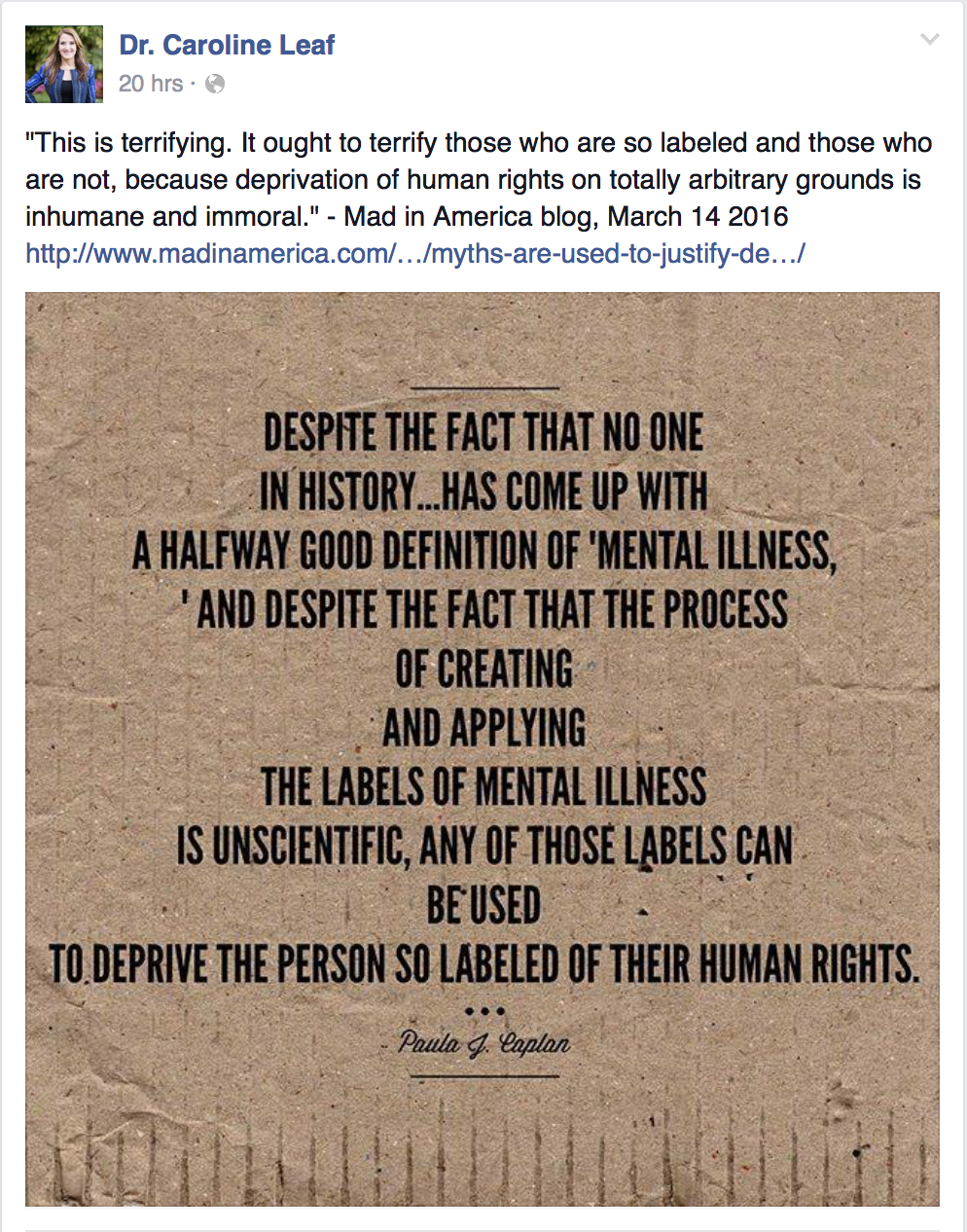
According to a post on the blog Mad in America and promoted by Dr Caroline Leaf, my patient’s diagnosis was spurious, and he was denied his basic human rights by being forced to take medications.

Dr Caroline Leaf is a communication pathologist and self-titled cognitive neuroscientist.  She is also a self-declared expert in mental health, despite not having any professional training in medicine, psychiatry, psychology or even cognitive neuroscience for that matter.

Indeed, if she had any experience or expertise in mental health, she would have recognised the basic factual errors and logical fallacies that riddled the post she quoted from.

Take the quote that Dr Leaf posted on social media.  The full quote from the Mad in America post is:

“Despite the fact that no one in history, not even the omnipotent American Psychiatric Association – which produces and profits mightily from the ‘Bible’ of mental disorders — has come up with a halfway good definition of “mental illness,” and despite the fact that the process of creating and applying the labels of mental illness is unscientific, any of those labels can be used to deprive the person so labeled of their human rights. This is terrifying. It ought to terrify those who are so labeled and those who are not, because deprivation of human rights on totally arbitrary grounds is inhumane and immoral.”

This is the same tired, emotionally laden and misleading rhetoric that’s so often barked in fervent paroxysms through the foaming lips of those opposed to modern psychiatric practice:

  1. There is no good definition of ‘mental illness’
  2. The American Psychiatric Association is just a profit-driven cabal
  3. The DSM5 (which the author alludes to as the ‘Bible’ of mental disorders) is unscientific
  4. Psychiatric diagnoses are unscientific
  5. Any psychiatric diagnosis can be used as a trigger to force people into unwanted treatments or incarceration
  6. Therefore psychiatric diagnosis and treatment is against basic humans rights and is inhumane and immoral.

Inhumane and immoral hey?  Tell that to my patients neighbour who almost became a eunuch except for that “inhumane and immoral treatment” of my former patient.

Caplan claims just don’t stand up to any rational scrutiny.

  1. There are lots of good definitions of mental illness … modern psychiatry critics just don’t like them. But take the definition used by the CDC, “Mental illness is defined as … ‘health conditions that are characterized by alterations in thinking, mood, or behavior (or some combination thereof) associated with distress and/or impaired functioning.’” There’s nothing wrong with this definition. It describes mental illness and helps differentiate mental illness from variations of mood, thought and behaviour that are part of the everyday human experience.
  1. The American Psychiatric Association isn’t the only group to have created a classification of psychiatric illnesses. The World Health Organisation publishes the International Classification of Diseases, or the ICD, which is also used for psychiatric diagnosis. Is the WHO an evil profit-driven junta too?
  1. The DSM, the ICD, and any other system of diagnosis, are simply different classification systems. Over the last century, clinicians have noted clusters of symptoms and have tried to classify them into common groups. How is that unscientific?  It’s no different to scientists looking at the different characteristics of various animals and creating a taxonomy, to provide a common system and language for clinicians and researchers across disciplines and across countries.The DSM system isn’t perfect, but what system ever is?  As knowledge of neuroscience grows, the classifications are reviewed and tightened in an ongoing process of improvement.  If those who oppose the DSM want to come up with something better, they’re welcome to put something forward.
  1. The old saying goes that medicine is an art and a science. Human beings, as nuanced as we are, often don’t fit into diagnostic criteria as easily as we would like. That doesn’t invalidate the diagnostic criteria or make the process unscientific as critics of modern psychiatry would have us believe, just like an unusual and hard-to-classify form of cancer doesn’t invalidate the other cancer classifications that are well defined.  Psychiatry, by it’s nature, relies on verbal report from patients rather than a clean-cut blood test or piece of tissue under a microscope, so at this stage in history, it seems imprecise.  That doesn’t make it any less scientific.
  1. The allegation that any psychiatric diagnosis can any be used to deprive the person so labeled of their human rights is utter nonsense. It’s a giant scarecrow – it seems really scary, but on closer inspection, it’s just a tarted-up mound of straw.People are never forced into treatments unless they really are “dangerous to themselves and/or others”.  This rule can’t be invoked willy-nilly.  There are multiple checks and balances, and a whole school of civil rights lawyers expectantly circling, ready for the whiff of blood in the water (http://www.mhrt.qld.gov.au/?page_id=2 is an example of the process in my home state, but each jurisdiction has their own version).

Caplan rightly pointed out that those with mental illness were less likely to be the perpetrators of violence and more likely to be the victims, but that doesn’t negate the need for protection of the community from those with mental illness who have shown violent intent and no capacity to control their behaviour.

If you want to find a group that really are suffering from inhumane and immoral deprivations of their human rights, then that would be Christians.  Around the globe, millions of Christians are oppressed, imprisoned, tortured, raped, and murdered every year.

Time and space preclude a full analysis of Caplan’s post, but what’s really important is that both the American Psychiatric Association and the U.S. Department of Health and Human Services’s Office of Civil Rights, an independent ombudsman, dismissed formal appeals by Caplan relating to her hysterical claims of inhumane forced psychiatric treatment.  Dr Leaf conveniently left that out of her social media post.

Instead, Dr Leaf chose to publish one of the most alarming quotes from an article heavy on scaremongering, from a disaffected author on an extremist blog.  If Dr Leaf was a real expert on mental health instead of being a self-declared one, she would have easily seen how nonsensical Caplan’s post was.

By posting this quote on social media today, it’s highly likely that Dr Leaf has caused harm to thousands of vulnerable Christians by unnecessarily increasing the stigma and fear of a mental health diagnosis.  This, in turn, is likely to lead to these same vulnerable Christians missing out on (drug and non-drug) treatment which would help them rise to their true potential in God and in life, leaving them trapped and suffering in their mental destitution.

Dr Leaf has a track record of misinformation when it comes to mental health.  Christians suffering mental illness need more support, not more stigma.  It’s time Dr Leaf stepped aside, and stopped making things worse.

Lies in the name of God are still lies

Let’s be honest, we all lie, and we lie a lot.

It’s ok, we’re all friends here.  You can admit it – lying is a regular part of everyday social cohesion.  We don’t call it lying, we call it tact, but it’s still lying.

Like when we automatically say to the mother of a newborn baby, “Oh, your baby’s adorable”.  Sure, most of them are, but there are some newborns that, shall we say, need to grow into their features.

Or when a patient walks in and asks, “Hey, have you lost some weight?!”  No, I’ve actually gained five kilos, but thanks for your flattery.

Even some of the most brutally honest people still figure out they have to lie at some point.  My children, for example.  They have absolutely no diplomacy filter between their brains and their mouths, “Aw, Dad … you stink”, or “Dad, you’re really fat.  You need to exercise.”  But when their butt’s on the line, things change, “I only ate one biscuit …”, or, “He started it …”.

Adults are no better.  Sometimes when things are important enough to us, we bend the truth to fit our world-view.  It’s often subconscious, though confirmation bias of our opinions can also be overt.

Sometimes we’re right, sometimes we’re wrong, and sometimes there is no right or wrong, but our beliefs shape our interpretation of the world, and the language and actions that stem from them.  And most of the time, it doesn’t really matter.
“Chocolate is the nicest flavour of ice-cream”.
“Beer is better than cider.”
“The Broncos shouldn’t have lost the NRL Grand Final.”
“Holden’s are better than Ford’s at Bathurst.”
“Donald Trump is a great guy.” **

Hey, if you think Donald Trump is a great guy, then you’re welcome to your opinion.  It ultimately makes no difference, if you like Trump, or I like vanilla ice-cream, or if you’re a ‘Ford guy’.

Though what about when someone in the public sphere lies, or allows their opinion to shape their version of truth?  Is ‘a little white lie’ ever truly acceptable?

For example, is it justifiable if news reporters lie about themselves or their motives to get to the truth of a story?  For example, in an article written as an ethical primer for journalism students at Indiana University, Henry McNulty recalled an expose he was part of in which reporters posed as couples trying to get into the local real estate market.  The investigation exposed some inherent racial prejudice amongst the realtors, and eventually lead to the state governor ordering a formal investigation into real estate discrimination.

While he noted that the investigation had noble goals and positive outcomes for the community, he also concluded that the end should never justify the means.
“Credibility is our most important asset.  And if we deceive people in order to do our job, we’ve compromised that credibility before a word is written”, he said.

In recent times, the Safe School’s program has come under intense scrutiny.  For those not familiar with it, the Safe Schools program was touted by its supporters as an evidence-based anti-bullying program for mid-late primary school students, although its primary agenda appears to be in promoting the Lesbian-Gay-Bisexual-Transgender (LGBT) lifestyle and ideology.  Or as one commentator put it, “In reality, the debate is between those who support the right to childhood and children’s bodily dignity, the right to an education that educates, not indoctrinates, versus those who believe Marxist activism constitutes sound school curriculum.”

A post came up on my Facebook feed in the last couple of days, titled, “Gender Ideology Harms Children”.  It was published by the American College of Pediatricians, which sounds like an official body, except that the American Academy of Pediatrics is the peak body of paediatricians in America. Then the style of language of the statement was inconsistent with that used by most peak bodies – this statement by the American College of Pediatricians was very strongly partisan.  I couldn’t help but wonder who the American College of Pediatricians actually were.

As it turns out, the American College of Pediatricians are a group that promote a very conservative agenda under the guise of official medical and scientific opinion.

In their core values, they state that their college:
“A: Recognizes that there are absolutes and scientific truths that transcend relative social considerations of the day.
B: Recognizes that good medical science cannot exist in a moral vacuum and pledges to promote such science.”

I’m all for good science, but one has to wonder if they’re going about it the right way, because while they declare their pledge to scientific truth, their next core value is essentially an opinion:
“C: Recognizes the fundamental mother-father family unit, within the context of marriage, to be the optimal setting for the development and nurturing of children and pledges to promote this unit.”

As much as I agree with and share most of their values, their pledge to opinion-based science is somewhat duplicitous, because opinion-based science isn’t absolute truth, it’s still a version of truth relative to their values and presumptions.

The irony hasn’t escaped some of the colleges critics, who have highlighted some of the factual errors and bad science that inevitably occurs when one tries to fit scientific findings into a set of values rather than drawing conclusions from the science.

In fairness, I’m not saying that the LGBT community is faultless either.  I’m sure that an in-depth study of their sources would find some over-zealous misinterpretations of scientific data as well.

My point is that we tend to look for information that suits our own pre-conceived notions, and the Christian community can get itself into trouble by doing this.  Christian lobby groups and church leaders need to be wary selectively accepting ‘scientific’ information that conforms to their world-view.  They need to, in all diligence, ensure that the data they cite really does support their position, not cherry-pick or over-extrapolate.  Otherwise they’re no better than the moral relativists on the other side of the political spectrum, or journalists who would justify mistruth to achieve a higher goal, or my eleven-year-old denying his biscuit binge.

One critic of the American College of Pediatricians wrote something very incisive in the title of his blog, “Lies in the name of God are still lies.”

It’s a fair call.  Misleading with the best of intentions is still misleading.  We may have the best of intentions, and feel justified in picking the science that conforms to our world-view.

Even so, God called us to speak the truth, because Jesus was the way, truth and life, and it’s the truth that sets us free.  And our credibility is our witness.  If we deceive people in order to do our job, we’ve compromised that witness before a word is written.

That’s the honest truth.

** The opinions expressed here do not necessarily represent those of the authors, and are for illustrative purposes only … except the bit about the Broncos … but the rest is just illustrative. 

Let boys be non-stigmatised boys

Boys will be boys ...

“When I was a boy …”

Many a stirring yarn has been started with those exact words, as aging men relive their childhood adventures with sentimental grandiosity increasingly taking over from detail as each passing year blends in with the blur of distant memories.

Ps Greg Gibson wrote an article that caught my attention as it floated across my Facebook feed last night.  Gibson is a pastor in Knoxville, Tennessee.  His “when I was a boy” story recalled his happy times as an energetic child, a serene innocence punctuated by two years of Ritalin-induced misery.

His point: “I think we should let boys be boys, and non-medicated ones at that. Therefore, parents, if at all possible, don’t medicate your boys.”

I think I understand what he’s trying to say, that it’s ok to be an energetic child and to see the extra energy as a strength to harness, not a weakness to control.

That would be fine, except that in trying to normalise energetic behaviour, he also winds up demonising Ritalin.  It may not have been his intention, but whenever someone respected in the community says something negative about stimulant medication or ADHD, it reinforces the oppressive stigma attached to those who suffer from it.

Ps Gibson’s fundamental assumption, that normal but energetic children are being misdiagnosed as ADHD and therefore unnecessarily medicated, happens far less often than the opposite – children with ADHD are misdiagnosed as energetic children that just need to be taught how to control themselves.

Personally, I don’t know of any parent who ever wanted to medicate their child with Ritalin.  If anything, it’s the opposite, because if your child’s on Ritalin, then you must be a lazy parent, or given them too much sugar, or too much screen time, or not hugged them enough as babies, or didn’t practice vaginal seeding, or whatever other form of parent-guilt is being perpetrated by the media at the time. Parents will do everything they can in their power to avoid using Ritalin, because of a culture that blames and shames.

Unfortunately, this means that children who could be helped by Ritalin or other stimulant medication are left behind, because ADHD isn’t the mislabeling of normal energetic children who just need better structure, or better posture, or who learn differently.  ADHD is a real disability, a dysfunctional lack of planning and control that’s abnormal compared to other children, affecting their entire lives.

For example, these children find it hard to play with other kids because they can’t follow basic social rules like the rules of games, or waiting their turn.  These children find school difficult, because they can’t concentrate for long enough to focus on completing a multi-step task, or have a long enough attention span to make new memories for words or facts.

One of my patients, a little boy about seven years old, was brought in by his mother because a chiropractor wanted me to arrange a blood test on his behalf.  When I asked why, the mother said the little boy had dyslexia which the chiropractor was ‘treating’ (actually, this chiropractor was blaming a disease that didn’t exist, and wanted me to arrange a test that was resigned to the pages of history, but that’s another story).  When I talked to the mother about the child’s symptoms, it was pretty obvious that he had ADHD, amongst other things.  After seeing a developmental paediatrician to confirm the diagnosis, and taking Ritalin for just one week, his reading improved three whole reading levels, and after a month, he had not only caught up, but had passed a number of his class-mates.

This is a real life example of how ADHD can hold children back, and how stimulant medication can help.  While there are always exceptions to the rule, stimulant medications help more often than they hinder.  They’re sometimes the difference between a child meeting his full learning potential, or being unnecessarily held back, languishing at the bottom of his class as his peers go further ahead in leaps and bounds.

Our culture needs to move on.  We need to stop our social prejudices making life more difficult than it already is for children and their families who battle with ADHD.  We need to see that medications for ADHD can be the difference between a life of learning and a life unfairly held back.

Let’s change the tune.  Rather than saying, “Let boys be non-medicated boys”, how about we say, “Let boys be non-stigmatised boys.”  It’s only through the break-down of the stigma surrounding ADHD and stimulant medications, that all boys (and girls) can truly meet their full potential, whether they have ADHD or are just a bit more energetic.

If you want more information on ADHD and its treatments, this is a good place to start: http://www.rch.org.au/kidsinfo/fact_sheets/ADHD_an_overview/

If you are concerned that you or your child might have ADHD, talk to your local GP or paediatrician.

Dr Caroline Leaf – Rogue Notion

Screen Shot 2016-02-12 at 7.26.25 AM

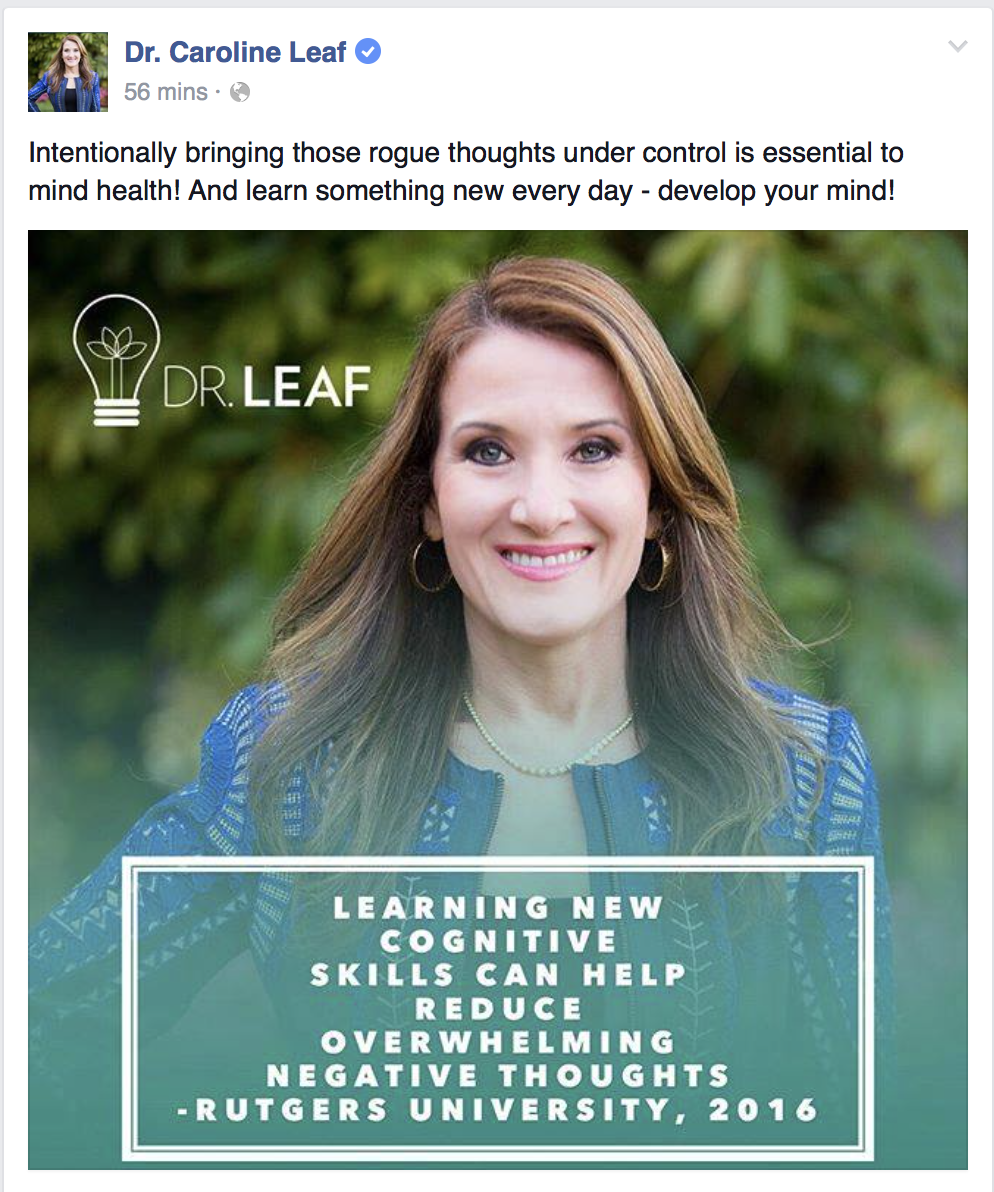
According to a new study by Rutgers University, “Learning new cognitive skills can help reduce overwhelming negative thoughts”. So said Dr Caroline Leaf, communication pathologist and self-titled cognitive neuroscientist. She also advised that “Intentionally bringing those rogue thoughts under control is essential to mind health! And learn something new every day – develop your mind!”

So … negative thoughts are what, like an evil spy organisation, running around causing wanton destruction, overwhelming your capacity to function?

If that’s the case, then new cognitive skills must be like Tom Cruise, running, jumping, shooting and kicking their way through the negative thoughts, saving the world and getting the girl.

It’s a popular concept. As I discussed in my previous post, the power of positive thinking is culturally sanctioned Western folk psychology. We implicitly accept the idea that we have to harness positive thoughts and stop negative thoughts if we’re to overcome life’s obstacles.

However, the only rogue notions here are Dr Leaf’s.

Dr Leaf’s post sounds authoritative and sciency, but is nothing else. It’s vague, and with a bit of deeper palpation, it’s actually wrong.

Dr Leaf has gone back to her bad habit of obfuscating her references, maybe because she’s getting lost in her own hubris, or more likely, it’s much easier for her audience to see that she’s just cut-and-pasted the opening by-line of a press release again if she actually disclosed her source.

Screen Shot 2016-02-12 at 4.17.09 PM

In fact, the article is about a study from Rutgers which studied two behavioural interventions (not cognitive ones), a form of mindfulness meditation and aerobic exercise. The original publication is in the journal Translational Psychiatry [1], if you want to check it out for yourself. This article isn’t about learning cognitive skills at all. Exercise and mindfulness meditation are tried and true behavioural methods of improving mood disorders like depression, which the authors combined to assess the benefit or otherwise. Neither intervention involved challenging or fighting thoughts, or suppressing ‘negative’ thoughts, or “intentionally bringing those rogue thoughts under control”.

Indeed, the mindfulness meditation used involves “the practice of attending to the present moment and allowing thoughts and emotions to pass without judgment.” [1] Mindfulness doesn’t try to control anything.  Rather than supporting Dr Leaf’s declaration that intentionally bringing thoughts under control is essential to mind health, this study contradicts it.

Cutting and pasting doesn’t make you an expert. It’s easy to take a sciency-sounding tag line and put it in a pretty little graphic. Everyone does it. 90% of Instagram and Facebook posts these days are faux-authoritative pseudo-science memes that aren’t worth the bytes they’re made of.

Junk science is like junk food. If that’s all you consume, then you eventually become an intellectual blob of lard, stuffed full of mistruths and logical fallacies, and incapable of understanding scientific truth for yourself. Dr Leaf’s audience deserves better than junk science and it’s about time that Dr Leaf stopped pretending to be an expert, and started acting like one.

Reference

[1]  Alderman BL, Olson RL, Brush CJ, Shors TJ. MAP training: combining meditation and aerobic exercise reduces depression and rumination while enhancing synchronized brain activity. Transl Psychiatry 2016;6:e726.

Dr Caroline Leaf and the nonsense of ‘negative’ thinking.

Screen Shot 2016-02-09 at 7.08.49 PM

The power of positive thinking. It’s like rust on our collective consciousness, an idea that’s seems virtually impossible to eradicate, slowly eating away at our collective psyche. The idea has become so ingrained in our culture that it’s part of our folklore and our idiom, and it continues to be deliberately perpetuated by success coaches, business leaders and others who make a very tidy living by peddling baseless optimism. It’s been repeated so often that the ‘power of positive thinking’ has become an Availability Cascade (a self-reinforcing process by which an idea gains plausibility through repetition).

Herbert and Forman summarise it nicely, “The ideas that thoughts and beliefs lead directly to feelings and behavior, and that to change one’s maladaptive behavior and subjective sense of well-being one must first change one’s cognitions, are central themes of Western folk psychology. We encourage friends to ‘look on the bright side’ of difficult situations in order to improve their distress. We seek to cultivate “positive attitudes” in our children in the belief that this will lead to better academic or athletic performance. Traditional cognitively-oriented models of CBT (e.g., CT, stress inoculation training, and rational emotive behavior therapy) build on these culturally sanctioned ideas by describing causal effects of cognitions on affect and behavior, and by interventions targeting distorted, dysfunctional, or otherwise maladaptive cognitions.” [1]

Dr Caroline Leaf is a communication pathologist and a self-titled cognitive neuroscientist. She is one of the many that continue to perpetuate the myth of positive and negative thinking.

Today’s social media meme was yet another promotion of this misguided idea, and to top it off, she misquoted scripture again in an attempt to reinforce it.

“If you randomly allow any negative thought into your mind damage can ensue on a mental & physical level. ‘We destroy every proud obstacle that keeps people from knowing God. We capture their rebellious thoughts and teach them to obey Christ.’ 2 Corinthians 10:5 NLT”

Lets quickly break meme down to see exactly why Dr Leaf is, yet again, misleading her audience.

1. The mind does not control the brain

Dr Leaf’s meme implies that negative thought damages us mentally and physically. The problem with that is that the mind doesn’t control our brain or our body, so negative thought can’t damage us mentally or physically.

Instead, it’s our brain that gives rise to, and controls our thoughts and feelings. We don’t see what goes on ‘under the hood’ so to speak, we only experience our thoughts and feelings, so we assume that regulate each other. But it’s our brain and a number of other processes that are responsible for generating both our thoughts and feelings (CAP blog).

‘Negative’ thoughts can sometimes be the result of damage to our brain, but ‘negative’ thoughts don’t damage the brain.

In fact, often the so-called ‘negative’ thoughts are actually good for us.

2. Negative thinking is normal and healthy

Dr Leaf’s meme also implies that we control the content of our thoughts by suggesting that we ‘allow’ negative thoughts into our minds. But negative thoughts are meant to be there, which is why we have them. ‘Negative’ thoughts have a positive function. We need them to survive.

For example, we have a fear response to prevent us from continually putting ourselves in danger. We have an anger response to motivate us through difficult obstacles. We have feelings of embarrassment to help maintain social cohesion. As Skinner and Zimmer-Gembeck state, “adaptive coping does not rely exclusively on positive emotions nor on constant dampening of emotional reactions. In fact, emotions like anger have important adaptive functions, such as readying a person to sweep away an obstacle, as well communicating these intentions to others. Adaptive coping profits from flexible access to a range of genuine emotions as well as the ongoing cooperation of emotions with other components of the action system.” [2]

Dr Leaf isn’t helping anyone with her meme today. She’s simply promoting an outdated and unscientific notion, encouraging her audience to suppress normal, helpful adaptive functions for fear of harm that’s not scientifically possible.

Then as if to add insult to injury, she follows up her misleading meme with an equally misleading misrepresentation of 2 Corinthians 10:5.

3. Taking every thought captive?

2 Corinthians 10:5 is Pauls famous scripture about taking every thought captive, a concept which seems to support Dr Leaf’s ideas, except that Paul isn’t speaking generally to us, but specifically about the Corinthian church. Look at the verse in context:

“By the humility and gentleness of Christ, I appeal to you – I, Paul, who am ‘timid’ when face to face with you, but ‘bold’ towards you when away! I beg you that when I come I may not have to be as bold as I expect to be towards some people who think that we live by the standards of this world. For though we live in the world, we do not wage war as the world does. The weapons we fight with are not the weapons of the world. On the contrary, they have divine power to demolish strongholds. We demolish arguments and every pretension that sets itself up against the knowledge of God, and we take captive every thought to make it obedient to Christ. And we will be ready to punish every act of disobedience, once your obedience is complete.
You are judging by appearances. If anyone is confident that they belong to Christ, they should consider again that we belong to Christ just as much as they do. So even if I boast somewhat freely about the authority the Lord gave us for building you up rather than tearing you down, I will not be ashamed of it. I do not want to seem to be trying to frighten you with my letters. For some say, ‘His letters are weighty and forceful, but in person he is unimpressive and his speaking amounts to nothing.’ Such people should realise that what we are in our letters when we are absent, we will be in our actions when we are present.” (NIV UK, 2 Corinthians 10:1-11)

This chapter is a specific rebuke to some of the Christians within the church at Corinth, and also a defence against some of the murmurings and accusations that some in that church were levelling at Paul. For example, in verse 2, “I beg you that when I come I may not have to be as bold as I expect to be towards some people who think that we live by the standards of this world.”

Verses 3-6 are a specific and authoritative rebuttal against the accusations levelled at Paul, paraphrased as, “You may speak against us and the church, but we have weapons that smash strongholds, and we’re coming to take down those pretensions of yours and take every thought of yours captive to make it obedient to Christ, and punish every act of disobedience …”

The specific nature of the verse is also supported by some Bible commentary: “But how does St. Paul meet the charge of being carnally minded in his high office? “Though we walk in the flesh [live a corporeal life], we do not war after the flesh,” or “according to the flesh,” the contrast being in the words “in” and “according.” And forthwith he proceeds to show the difference between walking in the flesh and warring according to the flesh. A warrior he is, an open and avowed warrior – a warrior who was to cast down imaginations and every high thing that exalteth itself against the knowledge of God, and bring into captivity every thought to the obedience of Christ; a warrior too who would punish these Judaizers if they continued their disorganizing work; but a prudent and considerate warrior, deferring the avenging blow till “I am assured of your submission” (Stanley) “that I may not confound the innocent with the guilty, the dupes with the deceivers.” What kind of a preacher he was he had shown long before; what kind of an apostle he was among apostles as to independence, self-support, and resignation of official rights in earthly matters, he had also shown; further yet, what kind of a sufferer and martyr he was had been portrayed.” (C. Lipscomb – http://biblehub.com/commentaries/homiletics/2_corinthians/10.htm)

Similarly, the translation from the original text is more specific than general. The verb used for “bringing into captivity” is aichmalōtízō, “to make captive: – lead away captive, bring into captivity” which is in the Present Active Participle form of the verb. The present tense represents a simple statement of fact or reality viewed as occurring in actual time. The active voice represents the subject as the doer or performer of the action. The Greek participle corresponds for the most part to the English participle, reflecting “-ing” or “-ed” being suffixed to the basic verb form. Actions completed but ongoing or commands are different verb tenses (see https://www.blueletterbible.org/help/greekverbs.cfm for a better explanation). So Paul wasn’t making a general statement, but a specific statement about what he would do in his present time, not the future.

So, Paul isn’t telling us to “bring every thought captive into obedience to Christ”. Dr Leaf is perpetuating a common scriptural misunderstanding.

A verse which better clarifies what God wants for our thought life is Paul’s exhortation to the Philippian church in Philippians 4:8, “Finally, brothers and sisters, whatever is true, whatever is noble, whatever is right, whatever is pure, whatever is lovely, whatever is admirable – if anything is excellent or praiseworthy – think about such things.” Both the context, and the form of the verb, suggest that this is an ongoing command. And it makes better sense too. If we spend all of our time trying to fight against every thought that comes into our head, we’d become exhausted, but we can divert attention to those things that are worthy of our attention. And in many ways, what Paul is encouraging is what would be considered now as simple meditation, which is more scientific than the power of positive thinking.

The moral of this story … ‘negative’ thoughts and feelings don’t do us damage, but trying to unnecessarily suppress them does.

References

[1]     Herbert, J.D. and Forman, E.M., The Evolution of Cognitive Behavior Therapy: The Rise of Psychological Acceptance and Mindfulness, in Acceptance and Mindfulness in Cognitive Behavior Therapy. 2011, John Wiley & Sons, Inc. p. 1-25.
[2]     Skinner EA, Zimmer-Gembeck MJ. The development of coping. Annual review of psychology 2007;58:119-44.

Cutting through the Paleo hype

Paleo-Diet-Meal-Plan1

Fad diets come and go. One of the most popular fad diets of recent times is Paleo.

The Palaeolithic diet, also called the ‘Stone Age diet’, or simply ‘Paleo’, is as controversial as it is popular. It’s been increasing in popularity over the last few years, and has had some amazing claims made of it by wellness bloggers and celebrity chefs. Advocates like ‘Paleo’ Pete Evans of MKR fame, claim that the Palaeolithic diet could prevent or cure poly-cystic ovarian syndrome, autism, mental illness, dementia and obesity [1].

So what does the published medical literature say? Is there really good research evidence to support the vast and extravagant claims of Paleo?

About 10 months ago, I started reviewing the medical research to try and answer that very question. My review of the medical literature turned up some interesting results, and so rather than post it just as a blog, I thought I would submit it to a peer-reviewed medical journal for publication. After a very nervous 9-month gestation of submission, review, and resubmission, my article was published today in Australian Family Physician [2].

So, why Paleo, and what’s the evidence?

Why Paleo?

The rationale for the Palaeolithic diet stems from the Evolutionary Discordance hypothesis – that human evolution ceased 10,000 years ago, and our stone-age genetics are unequipped to cope with our modern diet and lifestyle, leading to “diseases of civilization” [3-9]. Thus, only foods that were available to hunter-gatherer groups are optimal for human health – “could I eat this if I were naked with a sharp stick on the savanna?” [10] Therefore meat, fruits and vegetables are acceptable, but grains and dairy products are not [11].

Such views have drawn criticism from anthropologists, who argue that that there is no blanket prescription of an evolutionarily appropriate diet, but rather that human eating habits are primarily learned through behavioural, social and physiological mechanisms [12]. Other commentators have noted that the claims of the Palaeolithic diet are unsupported by scientific and historical evidence [13].

So the Palaeolithic diet is probably nothing like the actual palaeolithic diet. But pragmatically speaking, is a diet sans dairy and refined carbohydrates beneficial, even if it’s not historically accurate?

Published evidence on the Palaeolithic Diet

While the proponents of the Palaeolithic diet claim that it’s evidence based, there are only a limited number of controlled clinical trials comparing the Palaeolithic diet to accepted diets such as the Diabetic diet or the Mediterranean diet.

Looking at the studies as a whole, the Palaeolithic diet was often associated with increased satiety independent of caloric or macronutrient composition. In other words, gram for gram, or calorie for calorie, the Paleo diets tended to make people fuller, and therefore tend to eat less. Of course, that may have also been because the Paleo diet was considered less palatable and more difficult to adhere to [14]. A number of studies also showed improvements in body weight, waist circumference, blood pressure and blood lipids. Some studies showed improvements in blood sugar control, and some did not.

The main draw back of clinical studies of Paleo is that the studies were short, with different designs and without enough subjects to give the studies any statistical strength. The strongest of the studies, by Mellburg et al, showed no long-term differences between the Palaeolithic diet and a control diet after two years [15].

The other thing to note is that, in the studies that measured them, there was no significant difference in inflammatory markers as a result of consuming a Palaeolithic diet. So supporters of Paleo don’t have any grounds to claim that Paleo can treat autoimmune or inflammatory diseases. No clinical study on Paleo has looked at mental illness or complex developmental disorders such as autism.

Other factors also need to be considered when thinking about Paleo. Modelling of the cost of the Palaeolithic diet suggests that it is approximately 10% more expensive than an essential diet of similar nutritional value, which may limit Paleo’s usefulness for those on a low income [16]. Calcium deficiency also remains a significant issue with the Palaeolithic diet, with the study by Osterdahl et al (2008) demonstrating a calcium intake about 50% of the recommended dietary intake [17]. Uncorrected, this could increase a patients risk of osteoporosis [18].

To Paleo or not to Paleo?

The bottom line is the Paleo diet is currently over-hyped and under-researched. There are some positive findings, but these positive findings should be tempered by the lack of power of these studies, which were limited by their small numbers, heterogeneity, and short duration.

If Paleo is to be taken seriously, larger independent trials with consistent methodology and longer duration are required to confirm the initial promise in these early studies. But for now, claims that the Palaeolithic diet could treat or prevent conditions such as autism, dementia and mental illness are not supported by clinical research.

If you’re considering going on the Palaeolithic diet, I would encourage you to talk with an accredited dietician or your GP first, and make sure that it’s right for you. Or you could just eat more vegetables and drink more water, which is probably just as healthy in the long run, but without the weight of celebrity expectations.

Comparison of the current Australian Dietary Guidelines Recommendations [19] to the Palaeolithic diet [17]

Australian Dietary Guidelines The Palaeolithic Diet
Enjoy a wide variety of nutritious foods from these five groups every day:  
Plenty of vegetables, including different types and colours, and legumes/beans Ad libitum fresh vegetables and fruits
Fruit
Grain (cereal) foods, mostly wholegrain and/or high cereal fibre varieties, such as bread, cereals, rice, pasta, noodles, polenta, couscous, oats, quinoa and barley All cereals / grain products prohibited, including maize and rice
Lean meats and poultry, fish, eggs, tofu, nuts and seeds, and legumes/beans Ad libitum lean meats and poultry, fish, eggs, tofu, nuts and seeds, but all legumes prohibited
Milk, yoghurt, cheese and/or their alternatives, mostly reduced fat (reduced fat milks are not suitable for children under 2 years) All dairy products prohibited
And drink plenty of water. Ad libitum water (mineral water allowed if tap water unavailable)

References

[1]        Duck S. Paleo diet: Health experts slam chef Pete Evans for pushing extreme views. Sunday Herald Sun. 2014 December 7.
[2]        Pitt CE. Cutting through the Paleo hype: The evidence for the Palaeolithic diet. Australian Family Physician 2016 Jan/Feb;45(1):35-38.
[3]        Konner M, Eaton SB. Paleolithic nutrition: twenty-five years later. Nutrition in clinical practice : official publication of the American Society for Parenteral and Enteral Nutrition 2010 Dec;25(6):594-602.
[4]        Eaton SB, Eaton SB, 3rd, Konner MJ. Paleolithic nutrition revisited: a twelve-year retrospective on its nature and implications. European journal of clinical nutrition 1997 Apr;51(4):207-16.
[5]        Eaton SB, Konner M. Paleolithic nutrition. A consideration of its nature and current implications. The New England journal of medicine 1985 Jan 31;312(5):283-9.
[6]        Kuipers RS, Luxwolda MF, Dijck-Brouwer DA, et al. Estimated macronutrient and fatty acid intakes from an East African Paleolithic diet. The British journal of nutrition 2010 Dec;104(11):1666-87.
[7]        Eaton SB, Konner MJ, Cordain L. Diet-dependent acid load, Paleolithic [corrected] nutrition, and evolutionary health promotion. The American journal of clinical nutrition 2010 Feb;91(2):295-7.
[8]        O’Keefe JH, Jr., Cordain L. Cardiovascular disease resulting from a diet and lifestyle at odds with our Paleolithic genome: how to become a 21st-century hunter-gatherer. Mayo Clinic proceedings 2004 Jan;79(1):101-08.
[9]        Eaton SB, Eaton SB, 3rd, Sinclair AJ, Cordain L, Mann NJ. Dietary intake of long-chain polyunsaturated fatty acids during the paleolithic. World review of nutrition and dietetics 1998;83:12-23.
[10]      Audette RV, Gilchrist T. Neanderthin : eat like a caveman to achieve a lean, strong, healthy body. 1st St. Martin’s Press ed. New York: St. Martin’s, 1999.
[11]      Lindeberg S. Paleolithic diets as a model for prevention and treatment of Western disease. American journal of human biology : the official journal of the Human Biology Council 2012 Mar-Apr;24(2):110-5.
[12]      Turner BL, Thompson AL. Beyond the Paleolithic prescription: incorporating diversity and flexibility in the study of human diet evolution. Nutrition reviews 2013 Aug;71(8):501-10.
[13]      Knight C. “Most people are simply not designed to eat pasta”: evolutionary explanations for obesity in the low-carbohydrate diet movement. Public understanding of science 2011 Sep;20(5):706-19.
[14]      Jonsson T, Granfeldt Y, Lindeberg S, Hallberg AC. Subjective satiety and other experiences of a Paleolithic diet compared to a diabetes diet in patients with type 2 diabetes. Nutrition journal 2013;12:105.
[15]      Mellberg C, Sandberg S, Ryberg M, et al. Long-term effects of a Palaeolithic-type diet in obese postmenopausal women: a 2-year randomized trial. European journal of clinical nutrition 2014 Mar;68(3):350-7.
[16]      Metzgar M, Rideout TC, Fontes-Villalba M, Kuipers RS. The feasibility of a Paleolithic diet for low-income consumers. Nutrition research 2011 Jun;31(6):444-51.
[17]      Osterdahl M, Kocturk T, Koochek A, Wandell PE. Effects of a short-term intervention with a paleolithic diet in healthy volunteers. European journal of clinical nutrition 2008 May;62(5):682-85.
[18]      Warensjo E, Byberg L, Melhus H, et al. Dietary calcium intake and risk of fracture and osteoporosis: prospective longitudinal cohort study. BMJ 2011;342:d1473.
[19]      National Health and Medical Research Council. Australian Dietary Guidelines. Canberra: National Health and Medical Research Council; 2013.