Dr Caroline Leaf and her Genesis moment

screen-shot-2017-02-19-at-4-39-16-pm

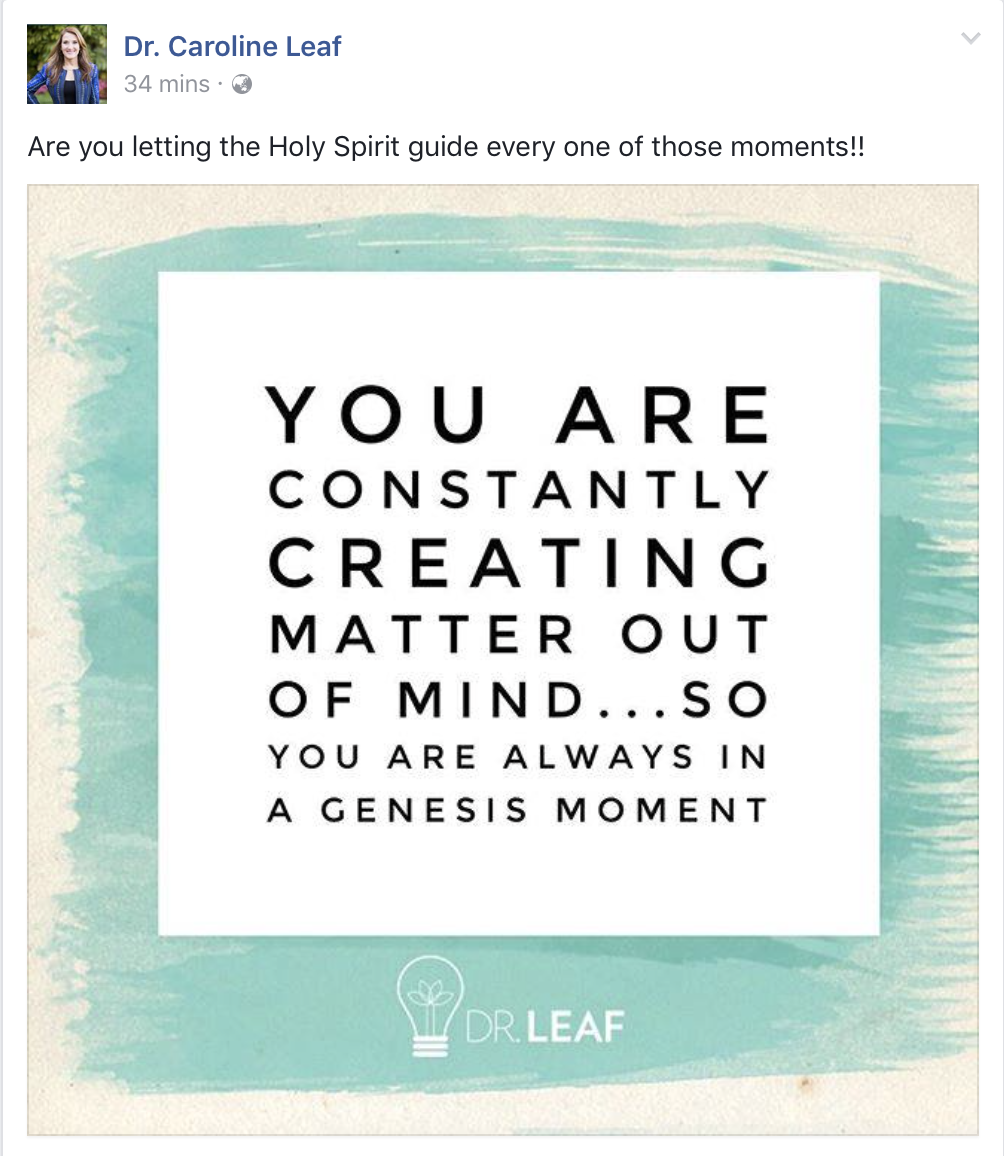
Dr Leaf, communication pathologist and self-titled cognitive neuroscientist, had this to say on social media earlier today: “You are constantly creating matter out of mind … so you are always in a Genesis moment.”

Wow! Just wow! She may not have crossed the line into heresy, but she is pretty much right on top of it.

Because again, she has claimed that we can do with our minds what only God can do. We can not create matter.  The only being that has every created matter is God himself, in Genesis. In adding her little “Genesis moment” comment, she’s essentially equating our mind with God’s.

She might as well just come out and say, “We create matter with our minds, so we are like God”.

There’s a real Genesis moment where people thought they were like God: “‘You will not certainly die,’ the serpent said to the woman. ‘For God knows that when you eat from it your eyes will be opened, and you will be like God, knowing good and evil.’”  We all know how that eventually turned out.

Ultimately it begs the question, where are the church leaders? I don’t hear anyone denouncing Dr Leaf’s comparison of our mind to God’s. How much is too much? When will they say, “Enough’s enough”?

It should have been said already, but sadly, with every unscientific, unscriptural meme that Dr Leaf publishes, the impotence and inaction of the church to becomes more and more painfully obvious.

Please church leadership, please take a stand, before it’s too late.

The confused teaching of Dr Caroline Leaf

screen-shot-2016-11-03-at-12-53-18-am

Dr Leaf released her latest e-mail newsletter today.  I decided to follow up with a brief review of this week’s instalment after her last e-mail newsletter completely misrepresented Ephesians 4:16, the function of the hypothalamus and the effect of stress on the population,

Dr Leaf was true to her usual form.  Her fundamental assumptions remain subtly skewed, forcing each layer of argument into an unbalanced and unstable alignment, and the more she tried to justify herself, the more unstable her arguments became, until eventually they toppled.

There was the obligatory dig at the medical profession, another smug ad hominem dismissal claiming that doctors have ‘negligible training in nutrition’, so doctors don’t understand the ‘whole approach’ that Dr Leaf and other so-called ‘progressive’ food thinkers have.  In reality, doctors have a lot of nutritional training, a darn-sight more than communication pathologists and self-titled cognitive neuroscientists.

And again, Dr Leaf demonstrates her paucity of knowledge or respect for the scripture by again misquoting Proverbs 23:7.  You don’t need to be a Biblical scholar to be able to read a verse of scripture in context, and in context, “as he thinks in his heart [mind], so is he” has got nothing to do with our mind or our thoughts (as I’ve discussed before https://cedwardpitt.com/2015/05/30/dr-caroline-leaf-manhandling-scriptures-again/).

But the critical error which invalidates Dr Leaf’s essay this week is the intellectual dissonance she creates by making two paradoxical claims.

“Your mind, or soul, has one foot in the door of the spirit and one foot in the door of the body. The mind creates coherence between the spirit of man and the body of man, and therefore influences and controls brain/body function and health, and influences spiritual development. Your mind, with its intellectual ability to choose and its emotional authority, controls all physical aspects.”

and

“Fasting has been shown to enhance brain function, and reduce the risk factors for coronary artery disease, stroke, insulin sensitivity and blood pressure. For instance, restricting calories can support the induction of sirtuin-1 (SIRT1), an enzyme that regulates gene expression and enhances learning and memory.”

Essentially, Dr Leaf is saying in one breath that the mind is separate to the physical brain but controls all of the function of the physical brain and the body, but then moments later says that changes in the body alters the function of the brain which then alters the function of the mind.

So which is it?  You can’t have it both ways?  It’s impossible for the mind to control all physical aspects of the brain if the mind is vulnerable to changes in the brain and body.

The dilemma of Dr Leaf’s mind-brain paradox stems from her defective set of assumptions on the triune being.

“You are intrinsically, brilliantly, and intricately designed with a spirit, soul and body (Genesis 1:26; 1 Thessalonians 5:23). This is known as our triune nature.  Our triune nature is divided into different components. Your spirit is your ‘true you’, or what I call your PerfectlyYou. The spirit has three parts: intuition, conscience and communion (worship). Your soul, which is your mind, also has three parts: intellect, will and emotions. Lastly, your body has three parts: the ectoderm, mesoderm and endoderm, from which the brain and the body form.”

Dr Leaf’s ideas about the triune being are Biblically and scientifically tenuous—more conjecture on Dr Leaf’s part than hard science or solid theology (Read here for more information on this https://cedwardpitt.com/2014/07/25/dr-caroline-leaf-dualism-and-the-triune-being-hypothesis/)  Yet she bases her entire ministry on these shaky assumptions, cherry picking studies and manipulating facts to suit her arguments and ignoring the glaring contradictions that inevitably arise.

So Dr Leaf’s latest offering to her followers again demonstrates the confusion and contradiction that plagues her teaching—layer upon layer of cherry-picked factoids manipulated to prop up her tenuous assumptions. Dr Leaf would do better by listening to scientists and doctors rather than arrogantly dismissing them.

The soul, stress, sugar and spin

screen-shot-2016-10-29-at-11-27-52-am

Stress and sugar.  In our post-modern society’s orthorexic narrative, these are two of the biggest villains.  So combining them into a diabolical duo reinforces their evil even more.

Dr Caroline Leaf is a communication pathologist, self-titled cognitive neuroscientist and Christian life coach.  In her latest newsletter to her adoring fans, Dr Leaf has accused sugar and stress of mass murder, with our soul’s approach to stress as their accomplice.

I’m sure Dr Leaf means well, but just because she’s not trying to frighten sales out of the gullible and vulnerable doesn’t mean she gets a free pass on the accuracy of her information.

To boil it down, Dr Leaf’s argument goes something like this:

Our choices turn good stress into bad stress
Bad stress releases excess cortisol which leads to disease and death
Therefore our choices to stress causes disease and death

We control our choices through our minds
Therefore, our mind is the key to stress illness
(oh, and sugar …)

The arguments seem plausible on the surface.  Most people have heard enough about stress to know about ‘good’ stress and ‘bad’ stress.  It doesn’t seem too much of a stretch to say that ‘bad’ stress is a significant cause of disease and death.  In the middle of her essay, Dr Leaf jumps from stress to sugar with no preceding link, but again, most people have heard that sugar is unhealthy, so they would probably just accept that statement too.

Unfortunately for Dr Leaf, her article has several critical errors which turn her well-meaning educational essay into a science-fiction short story.

To start with, her essay is built on the dysfunctional premise that the mind controls the brain, so each higher argument or premise is fundamentally skewed from the outset, and in doing so, Dr Leaf simply creates a circular argument of distorted factoids.

For example, her opening sentence: “The hypothalamus is a central player in how the mind (soul) controls the body’s reaction to stress and foods.”  The hypothalamus is a part of the limbic system deep in the brain.  It’s the main pathway from the brain to the endocrine system as Dr Leaf goes on to correctly assert, but essentially it runs on auto-pilot, responding automatically to information already being processed at a level beyond the reach of our conscious awareness and control.  For example, the hypothalamus regulates our body temperature, but it does so without our conscious control.  We can not consciously will our body temperature up or down just with our minds.

It’s the same with the stress response – there are many times where people have a subconscious stress response, where their mind feels like there’s nothing to be afraid of, but their hypothalamus is still priming their system for fight or flight.  White coat hypertension is a prime example.  White coat hypertension, or “White Coat Syndrome” is the phenomenon of people having high blood pressure in their doctor’s office but not at home.  Patients will say to me all the time, “I don’t know why my blood pressure is so high in here.  I feel fine.  I know there’s nothing to be afraid of here.”  But while their conscious mind is relaxed, their deeper subconscious brain remembers those injections that hurt, or that one time a doctor stuck the tongue depressor too far down their throat and they felt like they choked on it, and their hypothalamus is preparing them for whatever nastiness the doctor has for them this time.

Dr Leaf’s statement fails because she wrongly equates our brain with our mind, a subtle perversion which doesn’t just invalidate her premise, but significantly skews the essay as a whole.

As a quick aside, Dr Leaf also says that the hypothalamus “integrates signals from the mind and body, sending them throughout our bodies so that we can react in an appropriate and functional manner, ‘so that the whole body is healthy and growing and full of love’ (Eph. 4:16 NLT)”.  Ephesians 4:16 isn’t talking about the physical body, but about the body of Christ.  You don’t need to be a Biblical scholar to know this, you just have to be able to read.  Here is what the Bible says, “And He Himself gave some to be apostles, some prophets, some evangelists, and some pastors and teachers, for the equipping of the saints for the work of ministry, for the edifying of the body of Christ, till we all come to the unity of the faith and of the knowledge of the Son of God, to a perfect man, to the measure of the stature of the fullness of Christ; that we should no longer be children, tossed to and fro and carried about with every wind of doctrine, by the trickery of men, in the cunning craftiness of deceitful plotting, but, speaking the truth in love, may grow up in all things into Him who is the head — Christ — from whom the whole body, joined and knit together by what every joint supplies, according to the effective working by which every part does its share, causes growth of the body for the edifying of itself in love.” (Ephesians 4:11-16, emphasis added).

There’s no subtlety about this misuse of scripture.  Even non-Christians would be able to figure out that this verse has nothing to do with the physical body.  Dr Leaf has demonstrated that she either doesn’t read the Bible or doesn’t understand it.  Either way, this is a shameful indictment on Dr Leaf’s claim that she’s a “Biblical expert”, and should be ringing alarm bells for every pastor that is considering letting her get behind the pulpit of their church.

Dr Leaf rolls on with her list of medical misinformation.  Some of it is subtle (the “stages of stress”, also termed the General Adaptation Model, is an outdated model of the stress response [1], and CRF and ACTH are released during all stages of stress, not just stage 1).  Some of it is outlandish, like her claim that high levels of stress leads to Cushing’s Syndrome (see http://emedicine.medscape.com/article/2233083-overview#a4 for a list of the causes of Cushing’s Syndrome and note that stress isn’t on the list).

Dr Leaf’s also suggested that it was solely our perception of stress that was the key factor in the outcome of stress, making reference to “a study” showing a 43% increase in mortality if you thought stress was bad.  This is an example of cherry-picking at it’s finest, where one study’s findings are misrepresented to try and support one’s pre-existing position.  Dr Leaf didn’t bother to list her references at the end of the article, instead expecting people to find it for themselves, but I’ve previously seen the study she’s referring to.  Keller and colleagues published the study in 2012 [2].  Their survey suggested a correlation between overall mortality and the combination of lots of stress and the belief that stress is bad.  But remember, correlation does not equal causation, a golden rule which Dr Leaf is quick to ignore when the correlation suits her argument.  The Keller study, while interesting, did not control for the impact of neuroticism, the “negative” personality type which is largely genetically determined and is independently associated with a higher mortality [3-9].  It does not prove that thinking about your stress in a better way makes you live longer.

Dr Leaf went on to claim that “the researchers estimated that the 18,200 people who died, died from the belief that stress is bad for you—that is more than two thousand deaths a year.”  Even here, Dr Leaf manages to get her facts wrong.  The authors actually wrote, “Using these cumulative hazards at the end of the study follow-up period under the assumption of causality, it was estimated that the excess deaths attributable to this combination of stress measures over the study period was 182,079 (controlling for all other covariates), or about 20,231 deaths per year (over 9 years).”

Dr Leaf can’t even get her vexatious arguments right.  Not that the number really matters, because notice how the authors described the magic number as an “assumption of causality”.  Basically the authors said, ‘Well, IF this was the cause of death, then these would be the numbers of deaths attributable.’  They NEVER said that anyone actually died because of their beliefs about stress.  Indeed, the results showed that just believing that stress was bad didn’t make any difference to the mortality rate as Dr Leaf suggested – it was the interaction of high stress AND the belief it was bad that was associated with a higher mortality.  But why let pesky issues like methodological rigour get in the way of sensationalist hyperbole.

Then in the penultimate paragraph, Dr Leaf suddenly decides to throw sugar into the mix.  Somehow without justification, stress is bad and therefore sugar is also bad, and they both throw the hypothalamus and the rest of the body into toxicity.

Dr Caroline Leaf is promoted, by herself and by many in the Christian church, as a Biblical and scientific expert, but in one short promotional essay, Dr Leaf makes multiple critical scientific and exegetical errors.  In other words, her errors in discussing scientific findings and basic Biblical text are so massive that they are incongruent with her claim to be an expert.

Something needs to change – either Dr Leaf revises her knowledge and improves her accuracy, or she needs to stop misleading people from pulpits, both virtual and real.

References

[1]        McEwen BS. Stressed or stressed out: what is the difference? Journal of psychiatry & neuroscience : JPN 2005 Sep;30(5):315-8.
[2]        Keller A, Litzelman K, Wisk LE, et al. Does the perception that stress affects health matter? The association with health and mortality. Health Psychol 2012 Sep;31(5):677-84
[3]        Okbay A, Baselmans BM, De Neve JE, et al. Genetic variants associated with subjective well-being, depressive symptoms, and neuroticism identified through genome-wide analyses. Nature genetics 2016 Apr 18.
[4]        Servaas MN, Riese H, Renken RJ, et al. The effect of criticism on functional brain connectivity and associations with neuroticism. PloS one 2013;8(7):e69606.
[5]        Hansell NK, Wright MJ, Medland SE, et al. Genetic co-morbidity between neuroticism, anxiety/depression and somatic distress in a population sample of adolescent and young adult twins. Psychological medicine 2012 Jun;42(6):1249-60.
[6]        Koelsch S, Enge J, Jentschke S. Cardiac signatures of personality. PloS one 2012;7(2):e31441.
[7]        Vinkhuyzen AA, Pedersen NL, Yang J, et al. Common SNPs explain some of the variation in the personality dimensions of neuroticism and extraversion. Translational psychiatry 2012;2:e102.
[8]        Gonda X, Fountoulakis KN, Juhasz G, et al. Association of the s allele of the 5-HTTLPR with neuroticism-related traits and temperaments in a psychiatrically healthy population. Eur Arch Psychiatry Clin Neurosci 2009 Mar;259(2):106-13.
[9]        Lahey BB. Public health significance of neuroticism. Am Psychol 2009 May-Jun;64(4):241-56.

The Secret Teaching of Dr Caroline Leaf

Unless you’ve lived under a rock for the decade, “The Secret” is no secret.  We’ve all heard of the book or the movie, or the countless gurus that promote how they’ve made millions of dollars and found untold happiness by unlocking the power of the Law of Attraction.  You can have that same success too if you buy their book or attend their seminar, or sign up to be part of their network marketing scheme.

Let’s be honest, we’ve probably all, at some point, indulged someone telling us that we just need to think positive or visualise our goal and it will be ours.  It’s even something that many preachers over the years have sold to us in various guises, like hyper-faith, name it and claim it, sowing your seed.

The Secret claims that if we understand we’re all energy, one with the universe and its power, then we can leverage that power to create or receive anything we want with our thoughts.  We just need to think positively and visualise it.  It’s a repackaging of the human potential movement, new age philosophy and cosmic consciousness, all of which is a repackaging of pantheism and Eastern religious teaching.

The author, Rhonda Byrne, (who I’m embarrassed to say is Australian) wrote, “If you’re feeling good, it is because you are thinking good thoughts.”  Ok, but what about when you’re thinking good thoughts and you still feel bad?  What exactly are ‘good thoughts’ anyway?

She also wrote, “Remember that your thoughts are the primary cause of everything.”  So the rise of ISIS is because of my thoughts.  Donald Trump might be President … my thoughts.  An oceanic tectonic shift cuts the undersea trunk line taking out the internet for half the eastern seaboard … Sorry, my bad, I was having negative thoughts again.

So The Secret really doesn’t make a lot of objective sense.  I could go on, but it’s been taken down well enough by a number of commentators and critics over the last decade or so (https://skeptoid.com/episodes/4096; http://www.christianitytoday.com/ct/2007/june/20.71.html), so I’m not going to reinvent the wheel.  But suffice to say, The Secret fundamentally sells the power of thought to shape our reality … wait, that sounds oddly familiar.  Dr Leaf said the same thing at TD Jakes’ church, the Potter’s House, only this week.

leaf-the-secret

@bishopjakes proudly shared this Instagram post which Dr Leaf duly forwarded to her adoring fans.  “You can shape your reality by the way you think” was even the title of her message.  (She followed it up with an e-mail to her subscribers saying the exact same thing …)

img_5295_trimmed

Dr Leaf’s teaching is eerily similar to The Secret in many other ways.  That quote from before: “Remember that your thoughts are the primary cause of everything” sounds remarkably similar to “Thoughts influence every decision, word, action and physical reaction we make.” (Who Switched Off My Brain, p13)

There are lots of others.  From The Secret:

“Everything else you see and experience in this world is effect, and that includes your feelings. The cause is always your thoughts.”

“Every thought of yours is a real thing – a force.”

“Everything else you see and experience in this world is effect, and that includes your feelings. The cause is always your thoughts.”

“Food cannot cause you to put on weight, unless you think it can.” (This one made me giggle more than the others … yep, those three bottles of Coke I just drank have absolutely no effect on my waistline because I believe that excessive soda consumption is slimming …)

“Your imagination is an extremely powerful tool.”

“Quantum physicists tell us that the entire universe emerged from thought!”

“Quantum physics … says that you can’t have a universe without mind entering into it, and that the mind is actually shaping the very thing that is perceived.”

“The amazing work and discoveries of the quantum physicists over the last eighty years has brought us a greater understanding of the unfathomable power of the human mind to create.”

“Thoughts are magnetic, and thoughts have a frequency. As you think thoughts, they are sent out into the Universe, and they magnetically attract all like things that are on the same frequency. Everything sent out returns to the source – you.”

“There are no limits to what you can create for you, because your ability to think is unlimited!”

Compare that to just a small sample of Dr Leaf’s work:

“Our mind is designed to control the body, not the other way around.  Matter does not control us; we control matter through our thinking and choosing.” (Switch On Your Brain, p33)

“Research shows that 75 to 98 percent of mental, physical and behavioral illness comes from ones thought life.” (Switch On Your Brain, p33)

“DNA actually changes shape according to our thoughts.” (Switch On Your Brain, p35)

“Whatever you are thinking about affects every cell in your body.” (Switch On Your Brain, p94)

“Everything you do and say is first a thought in your physical brain.  You think, then you do, which cycles back to the original thought, changing it and the thoughts connected to it in a dynamic interrelationship.  If your thinking is off … then your communication though what you do and say is off, and vice versa.” (Switch On Your Brain, pp98-99)

“Quantum theory converts science’s conception of humans from being mere cogs in a gigantic, mechanical machine to being freethinking agents whose conscious, free choices affect the physical world.” (Switch On Your Brain: p120-1)

“Thought signals seem to move faster than the speed of light and in ways that classical physics cannot explain.  This means our mind controls matter, and is therefore a creative force.” (Switch On Your Brain, p121)

“These statistics show that the mindset behind the meal – the thinking behind the meal – plays a dominant role in the process of food-related health issues …” (Think and Eat Yourself Smart, p84)

The only difference between The Secret and Dr Leaf’s ministry is Dr Leaf’s claim that science and scripture support it, though lexical contortions of scripture, and cherry-picked pseudoscience does not qualify as supporting evidence.

In the last ten years since The Secret was published, many critics have lined up to pull it apart, some prominent Christians included.  So they should, because The Secret is an abhorrent, unscientific concoction of new age humanism, or as one critic astutely put it, “spiritual narcissism”.

I’ve dissected Dr Leaf’s teaching over the last three-and-a-bit years and shown that her science is wanting, and her scripture is tenuous.  As this week’s sermon aptly demonstrates, Dr Leaf’s teaching appears to be a lukewarm re-serving of The Secret, sprinkled with some scripture and pseudoscience to try and make it more palatable for the Christian church.  Despite the shared narratives of self-obsession and magical thinking, the Christian church still fawns over Dr Leaf.  It’s embarrassing to see the same Christian leaders and media outlets lambaste The Secret but unquestioningly accept the same message woven through Dr Leaf’s teaching.  Dr Leaf’s teaching is so close to The Secret I’m surprised Rhonda Byrne hasn’t asked for royalties.

“The only thing necessary for the triumph of evil is for good men to do nothing”.  The same goes for ignorance—the only thing necessary for the triumph of ignorance is for smart men (and women) to do nothing.  We also need consistency.  Rejecting The Secret but accepting the same teaching from Dr Leaf creates a cultural cognitive dissonance amongst the Church that’s unhealthy.

Church, it’s time to stand against mistruth no matter what the source.

Bibliography

Byrne, R., The Secret, Atria Books, New York. 2006 ISBN 978-1-58270-170-7

Leaf C., Who Switched Off My Brain? Controlling toxic thoughts and emotions. 2nd ed. Southlake, TX, USA: Inprov, Ltd, 2009.

Leaf C.M., Switch On Your Brain: The Key to Peak Happiness, Thinking, and Health. Grand Rapids, Michigan: Baker Books, 2013.

Leaf C.M., Think and Eat Yourself Smart. USA: Baker Books, 2016.

Dr Caroline Leaf and those three little words

mind-creates-matter-james-1_2

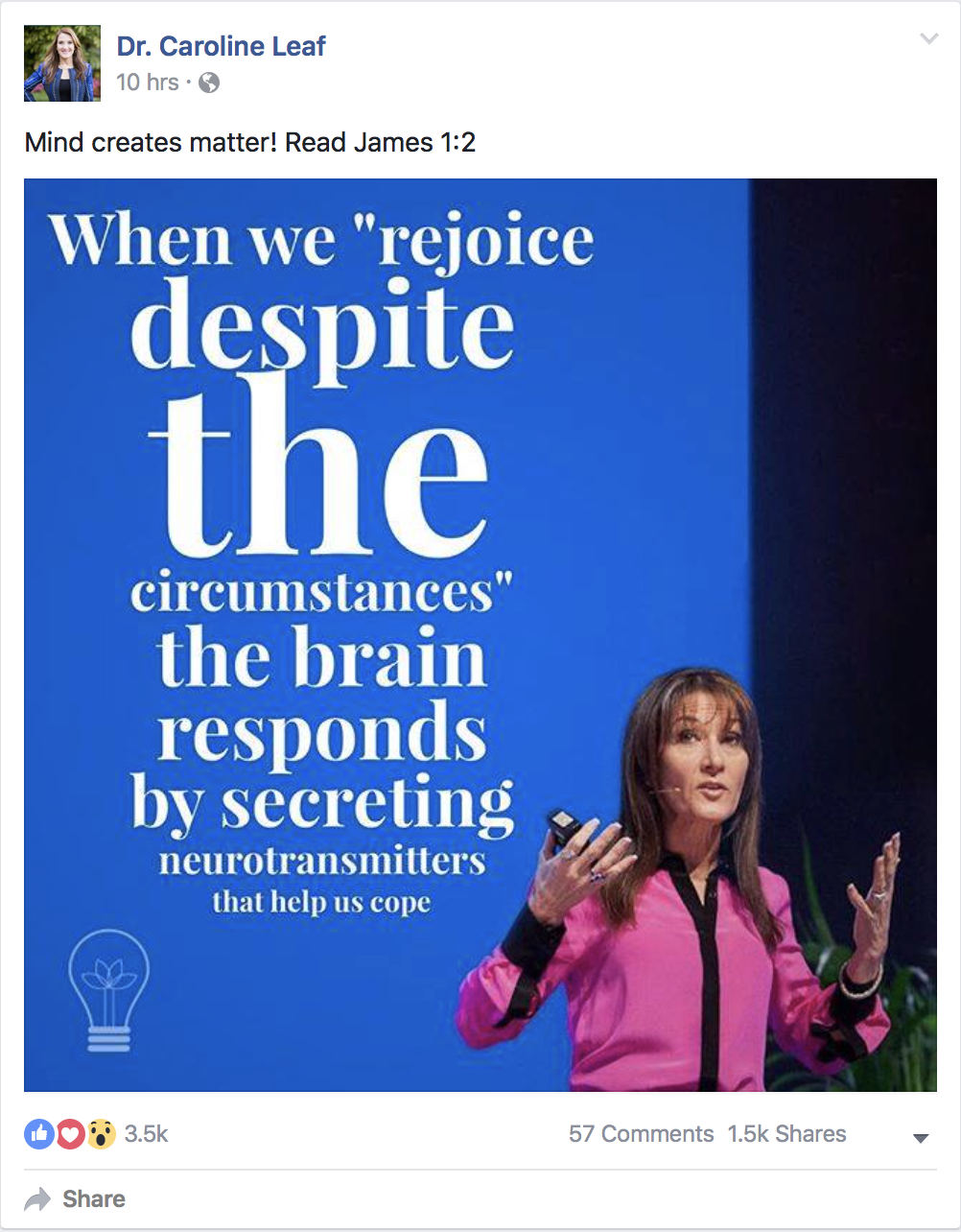
Dr Caroline Leaf, communication pathologist and self-titled cognitive neuroscientist, broke the most fundamental rules of both science and Christian teaching in her social media post today.

“Mind creates matter!  Read James 1:2”

Dr Leaf’s statement not only violates the laws of physics, but it also contradicts the Bible by elevating the human mind to the level of God himself.

  1. In our physical universe, matter, like energy, is conserved. It can not be created or destroyed.  The amount of matter that goes in to a chemical reaction is the same amount at the end of a chemical reaction.  Suggesting that our mind ‘creates’ matter violates this basic law known by every high school chemistry student.
    http://www.youtube.com/watch?v=2S6e11NBwiw
  2. There are only two explanations for the creation of matter – the Big Bang or God’s creation. Most Christians believe the second explanation, that God was the only being to create matter which he did during the six days of creation.  By saying that our minds create matter, Dr Leaf is saying that our minds have the same amount of power that God does, a suggestion that’s incongruent with basic Biblical truth.

So much for being a scientific and Biblical expert.  In just three little words, Dr Leaf manages to violate the most basic principles of science and Christianity.

To add salt to the wound, Dr Leaf tries to justify her unscientific heresy by referencing James 1:2, as if tagging a scripture will somehow vindicate her.  Except James 1:2 says, “My brethren, count it all joy when you fall into various trials”.  Well, that’s awkward … James 1:2 has nothing to do with matter or the mind.

Her meme is just as irrelevant and unscientific.

“When we ‘rejoice despite the circumstances’, the brain responds by secreting neurotransitters that help us cope.”

Ummm … the brain does everything by releasing neurotransmitters.  That’s how the brain works.  It releases neurotransmitters when awake or asleep, active or resting.  There are no specific neurotransmitters just for coping, or for when we ‘rejoice despite the circumstances’.   Her statement is meaningless.

There would many in Dr Leaf’s camp that would try and defend her statement by claiming that it was a poor choice of words perhaps, or that it was meant to be taken metaphorically not literally.  Sure, if that’s how you want to continue to delude yourself, then be my guest, but really there isn’t much wriggle room here.  How else can you interpret the words ‘create’ and ‘matter’?  You can’t really misrepresent it as matters of fact, or matters of law, or a state of affairs.  Dr Leaf meant it as the mass noun form of the word, “physical substance in general, as distinct from mind and spirit; (in physics) that which occupies space and possesses rest mass”.  And the word ‘create’ … we all know the meaning of that word, “to bring (something) into existence”.  It wouldn’t make any sense to say that the mind causes matter to happen as a result of one’s actions, or that the mind invests matter with a title of nobility.  It might be common to metaphorically say, “mind over matter” but there’s no metaphorical meaning for “mind creates matter”.

And so with just three little words, Dr Leaf contradicts the most basic of all principles of science and Christianity, and aptly demonstrates the irreconcilable deviation of her teaching from reality.  She has shown how willing she is to take an irrelevant scripture and try to use it to justify a misguided pseudoscientific proclamation.  Today’s meme calls her claim as a Biblical and scientific expert into serious question.

Strong marketing can’t make up for weak ideas

Well Dr Leaf, 10 out of 10 for persistence.

Dr Caroline Leaf is a communication pathologist and a self-titled cognitive neuroscientist. In the last month or so, Dr Leaf has been hammering home her foundational belief that the mind is in control of the brain, and indeed, that your thoughts are the key to everything in life, a bit like 42 in “The Hitchhikers Guide to the Galaxy”. According to Dr Leaf, your thoughts are the answer to life, the universe, and everything.

Dr Leaf has attempted to prove her point through quotes from neuroscientists, from her own teaching, and from some published research. All she’s ended up proving is that she’s so desperate to prop up the concept that she’ll stoop to cherry-picking articles and massaging quotes. Poor form for a woman who promotes herself as a scientist.

Today’s meme is the spiritual justification of her position, expressed as a lovely little graphic with a verse from Proverbs 4:23. It’s a real Pinterest special. Most people would look at the pretty picture and accept the quote without question. It’s good marketing for sure.

Screen Shot 2016-06-24 at 5.51.29 PM

But if you strip back all of the eye-candy, is the meme still worth posting? Is Dr Leaf’s meme an accurate depiction of what Proverbs 4:23 truly means.

First things first, is the meme an accurate quote? In this case, it is. The Good News Bible really does say, “Be careful how you think; your life is shaped by your thoughts.” (https://www.biblegateway.com/passage/?search=Proverbs+4%3A23&version=GNT)

So the next question is, is the Good News version an accurate translation of the scripture? It’s interesting that nearly every other translation doesn’t mention thoughts and thinking at all:

New International Version = Above all else, guard your heart, for everything you do flows from it.
New Living Translation = Guard your heart above all else, for it determines the course of your life.
English Standard Version = Keep your heart with all vigilance, for from it flow the springs of life.
New American Standard Bible = Watch over your heart with all diligence, For from it flow the springs of life.
King James Bible = Keep thy heart with all diligence; for out of it are the issues of life.
Holman Christian Standard Bible = Guard your heart above all else, for it is the source of life.
International Standard Version = Above everything else guard your heart, because from it flow the springs of life.
NET Bible = Guard your heart with all vigilance, for from it are the sources of life.
Aramaic Bible in Plain English = Keep your heart with all caution because from it is the outgoing of life.
GOD’S WORD® Translation = Guard your heart more than anything else, because the source of your life flows from it.
JPS Tanakh 1917 = Above all that thou guardest keep thy heart; For out of it are the issues of life.
New American Standard 1977 = Watch over your heart with all diligence, For from it flow the springs of life.
Jubilee Bible 2000 = Above all else, guard thy heart; for out of it flows the issues of life.
King James 2000 Bible = Keep your heart with all diligence; for out of it are the issues of life.
American King James Version = Keep your heart with all diligence; for out of it are the issues of life.
American Standard Version = Keep thy heart with all diligence; For out of it are the issues of life.
Douay-Rheims Bible = With all watchfulness keep thy heart, because life issueth out from it.
Darby Bible Translation = Keep thy heart more than anything that is guarded; for out of it are the issues of life.
English Revised Version = Keep thy heart with all diligence; for out of it are the issues of life.
Webster’s Bible Translation = Keep thy heart with all diligence; for out of it are the issues of life.
World English Bible = Keep your heart with all diligence, for out of it is the wellspring of life.
Young’s Literal Translation = Above every charge keep thy heart, For out of it are the outgoings of life.

Nearly every other English translation refers to “the heart”. Obviously not the literal “heart”, that muscular blood pump in the middle of our chests, but the metaphoric heart, the human soul. So even on majority rules, the Good News Bible translation is looking shaky. Is there any further corroborating evidence to help us understand which version is the most correct?

The answer would be in the original Hebrew. The word for ‘heart’ in Proverbs 4:23 is לֵב (leb), and more broadly is a word relating to the soul, ‘inner man, mind, will, heart, understanding’ (https://www.blueletterbible.org/lang/lexicon/lexicon.cfm?Strongs=H3820&t=KJV). In some verses, the word in used in reference to what would be considered thoughts, but in many others, the word is used to describe a person’s feelings or motivations, or attitudes, or even specific intelligence and manual skills. For example:

Genesis 17:17: “Then Abraham fell upon his face, and laughed, and said in his heart, Shall a child be born unto him that is an hundred years old? and shall Sarah, that is ninety years old, bear?”
Genesis 42:28: “And he said unto his brethren, My money is restored; and, lo, it is even in my sack: and their heart failed them, and they were afraid, saying one to another, What is this that God hath done unto us?”
Exodus 8:32: “And Pharaoh hardened his heart at this time also, neither would he let the people go.”
Exodus 35:35: “Them hath he filled with wisdom of heart, to work all manner of work, of the engraver, and of the cunning workman, and of the embroiderer, in blue, and in purple, in scarlet, and in fine linen, and of the weaver, even of them that do any work, and of those that devise cunning work.”

So it appears the Good News Bible is actually a poor translation. Again, this is an example of Dr Leaf cherry picking something that suits her theory out of a bulk of divergent views. No matter how she tries to sell the concept, the idea that the mind controls your brain and that your thoughts control your destiny is scientifically and scripturally weak. Persistence and good marketing isn’t going to change that.

Lies in the name of God are still lies

Let’s be honest, we all lie, and we lie a lot.

It’s ok, we’re all friends here.  You can admit it – lying is a regular part of everyday social cohesion.  We don’t call it lying, we call it tact, but it’s still lying.

Like when we automatically say to the mother of a newborn baby, “Oh, your baby’s adorable”.  Sure, most of them are, but there are some newborns that, shall we say, need to grow into their features.

Or when a patient walks in and asks, “Hey, have you lost some weight?!”  No, I’ve actually gained five kilos, but thanks for your flattery.

Even some of the most brutally honest people still figure out they have to lie at some point.  My children, for example.  They have absolutely no diplomacy filter between their brains and their mouths, “Aw, Dad … you stink”, or “Dad, you’re really fat.  You need to exercise.”  But when their butt’s on the line, things change, “I only ate one biscuit …”, or, “He started it …”.

Adults are no better.  Sometimes when things are important enough to us, we bend the truth to fit our world-view.  It’s often subconscious, though confirmation bias of our opinions can also be overt.

Sometimes we’re right, sometimes we’re wrong, and sometimes there is no right or wrong, but our beliefs shape our interpretation of the world, and the language and actions that stem from them.  And most of the time, it doesn’t really matter.
“Chocolate is the nicest flavour of ice-cream”.
“Beer is better than cider.”
“The Broncos shouldn’t have lost the NRL Grand Final.”
“Holden’s are better than Ford’s at Bathurst.”
“Donald Trump is a great guy.” **

Hey, if you think Donald Trump is a great guy, then you’re welcome to your opinion.  It ultimately makes no difference, if you like Trump, or I like vanilla ice-cream, or if you’re a ‘Ford guy’.

Though what about when someone in the public sphere lies, or allows their opinion to shape their version of truth?  Is ‘a little white lie’ ever truly acceptable?

For example, is it justifiable if news reporters lie about themselves or their motives to get to the truth of a story?  For example, in an article written as an ethical primer for journalism students at Indiana University, Henry McNulty recalled an expose he was part of in which reporters posed as couples trying to get into the local real estate market.  The investigation exposed some inherent racial prejudice amongst the realtors, and eventually lead to the state governor ordering a formal investigation into real estate discrimination.

While he noted that the investigation had noble goals and positive outcomes for the community, he also concluded that the end should never justify the means.
“Credibility is our most important asset.  And if we deceive people in order to do our job, we’ve compromised that credibility before a word is written”, he said.

In recent times, the Safe School’s program has come under intense scrutiny.  For those not familiar with it, the Safe Schools program was touted by its supporters as an evidence-based anti-bullying program for mid-late primary school students, although its primary agenda appears to be in promoting the Lesbian-Gay-Bisexual-Transgender (LGBT) lifestyle and ideology.  Or as one commentator put it, “In reality, the debate is between those who support the right to childhood and children’s bodily dignity, the right to an education that educates, not indoctrinates, versus those who believe Marxist activism constitutes sound school curriculum.”

A post came up on my Facebook feed in the last couple of days, titled, “Gender Ideology Harms Children”.  It was published by the American College of Pediatricians, which sounds like an official body, except that the American Academy of Pediatrics is the peak body of paediatricians in America. Then the style of language of the statement was inconsistent with that used by most peak bodies – this statement by the American College of Pediatricians was very strongly partisan.  I couldn’t help but wonder who the American College of Pediatricians actually were.

As it turns out, the American College of Pediatricians are a group that promote a very conservative agenda under the guise of official medical and scientific opinion.

In their core values, they state that their college:
“A: Recognizes that there are absolutes and scientific truths that transcend relative social considerations of the day.
B: Recognizes that good medical science cannot exist in a moral vacuum and pledges to promote such science.”

I’m all for good science, but one has to wonder if they’re going about it the right way, because while they declare their pledge to scientific truth, their next core value is essentially an opinion:
“C: Recognizes the fundamental mother-father family unit, within the context of marriage, to be the optimal setting for the development and nurturing of children and pledges to promote this unit.”

As much as I agree with and share most of their values, their pledge to opinion-based science is somewhat duplicitous, because opinion-based science isn’t absolute truth, it’s still a version of truth relative to their values and presumptions.

The irony hasn’t escaped some of the colleges critics, who have highlighted some of the factual errors and bad science that inevitably occurs when one tries to fit scientific findings into a set of values rather than drawing conclusions from the science.

In fairness, I’m not saying that the LGBT community is faultless either.  I’m sure that an in-depth study of their sources would find some over-zealous misinterpretations of scientific data as well.

My point is that we tend to look for information that suits our own pre-conceived notions, and the Christian community can get itself into trouble by doing this.  Christian lobby groups and church leaders need to be wary selectively accepting ‘scientific’ information that conforms to their world-view.  They need to, in all diligence, ensure that the data they cite really does support their position, not cherry-pick or over-extrapolate.  Otherwise they’re no better than the moral relativists on the other side of the political spectrum, or journalists who would justify mistruth to achieve a higher goal, or my eleven-year-old denying his biscuit binge.

One critic of the American College of Pediatricians wrote something very incisive in the title of his blog, “Lies in the name of God are still lies.”

It’s a fair call.  Misleading with the best of intentions is still misleading.  We may have the best of intentions, and feel justified in picking the science that conforms to our world-view.

Even so, God called us to speak the truth, because Jesus was the way, truth and life, and it’s the truth that sets us free.  And our credibility is our witness.  If we deceive people in order to do our job, we’ve compromised that witness before a word is written.

That’s the honest truth.

** The opinions expressed here do not necessarily represent those of the authors, and are for illustrative purposes only … except the bit about the Broncos … but the rest is just illustrative. 

Christian male modelling

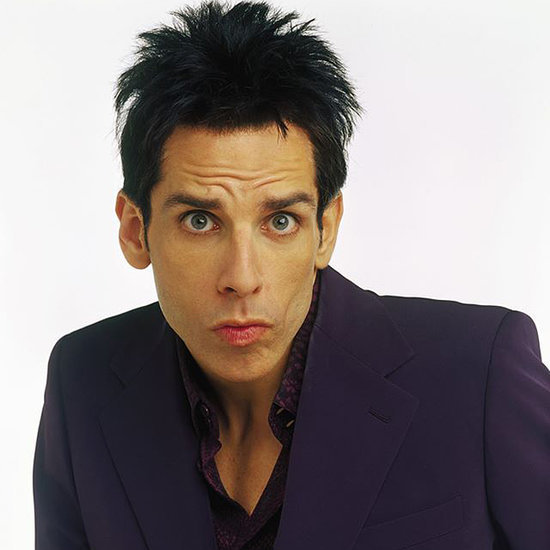
Zoolander

Some love him.  Some hate him.  It doesn’t change the fact that he was still “ridiculously good looking”.

Zoolander was one of those cult movies that polarised people into “absolutely love it” or “absolutely loathe it” camps.  I admit, I’m one of the former.  (“Moisture is the essence of wetness, and wetness is the essence of beauty”  … It still cracks me up!)

For those who aren’t familiar with the story, Derek Zoolander was a top male model who was famous for his different looks: “Blue Steel”, “Ferrari”, “Le Tigre” and the famous “Magnum”. They were all the same pose, of course, but everyone thought they were different. Except for evil fashion designer, Mugatu, who in a burst of rage at the climax of the movie, yells, “Who cares about Derek Zoolander anyway? The man has only one look … Blue Steel? Ferrari? Le Tigra? They’re the same face! Doesn’t anybody notice this? I feel like I’m taking crazy pills!”

There are times when I read Dr Leaf’s social media posts, and I feel the same as Mugatu.

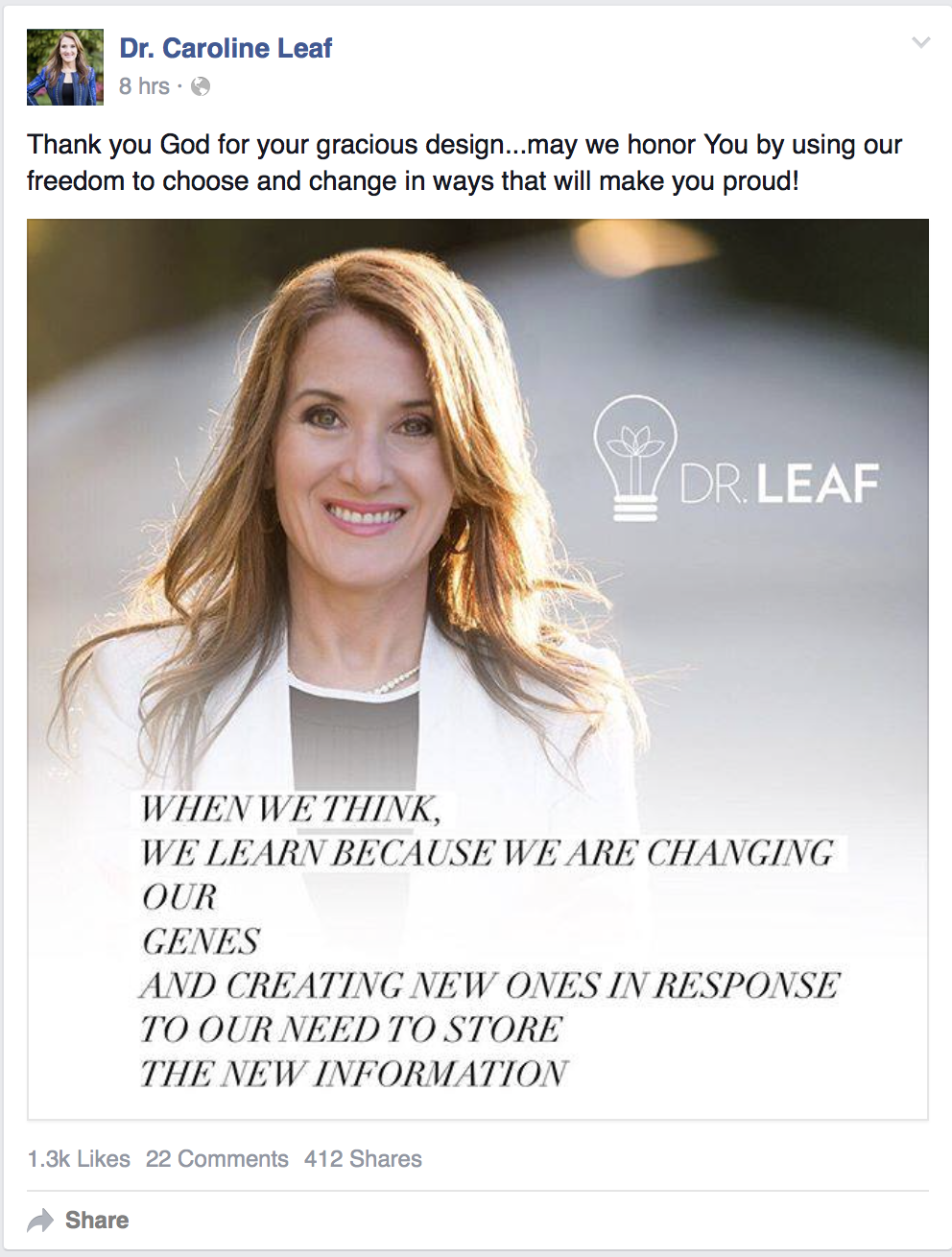
“Dr Leaf isn’t a scientific expert … ‘When we think, we learn because we are changing our genes and creating new ones’ … That’s not scientifically possible! Doesn’t anybody notice this? I feel like I’m taking crazy pills!”

Screen Shot 2016-01-28 at 9.57.06 PM

Dr Caroline Leaf is a communication pathologist and a self-titled cognitive neuroscientist.  If Dr Leaf was a legitimate scientist, she would know that our genes do not change when we process new information. Our genes are stable. They do not change unless there’s a mutation, which occurs in one out of every 30 million or so genes. We do not make new genes at will. Last year, scientists at MIT were reported to have shown that DNA breaks when new things are learnt, but in a normal nerve cell, these breaks are quickly repaired. That’s certainly interesting, but that’s not changing the DNA or making new genes. Making claims that we make new genes to hold new information is like saying that pigs fly.

Dr Leaf’s supporters would likely make a counter-argument that she probably didn’t mean that genes really change, or we make new genes, she’s just not worded her meme properly. Well, there are two responses to that, neither of which are any better for Dr Leaf. Because scientists who really are experts don’t make errors so large that you can spelunk through them. And, this isn’t the first time that Dr Leaf has made claims about how our genes fluctuate. She made a similar claim back in September 2014. Saying the same thing several times isn’t a mistake, it shows she really believes that we change our DNA code by the power of our thoughts.

Whether someone thinks DNA is changeable isn’t likely to cause any great harm to that person, but what is concerning is that Dr Leaf has been given her own show on the Christian cable TV network TBN to discuss mental health. She’s already proven that her knowledge of psychiatric medications is dangerously flawed. If Dr Leaf doesn’t know the basics of DNA, then giving her a platform to preach something that can effect whether a person might live or die is particularly perilous.

Dr Leaf’s rise is also a worrying symptom of a Christian church that is intellectually imploding. In a 2013 blog for the Huffington Post, Charles Reid wrote,

“Christians must provide effective witness against both extremes. But before Christianity can engage atheism it must first address the scientific illiteracy in its own house. For the greatest danger Christianity confronts at the present moment is not incipient persecution, but increasing marginalization and irrelevance. If Christians cannot engage reasonably and responsibly with science, there will be no place for them in the public life of advanced societies.”

Reid was paying particular attention to Ken Ham in this blog, but the principle remains the same. Scientifically illiterate Christians quickly lose credibility with people. We can’t meaningfully engage with a person who has a rudimentary understanding of biology by proudly tell them that we create new genes with the power of thought. That makes us sound like a male model.

For the sake of other Christians health and well-being, and for the sake of our credibility and our witness, we need to critically assess Dr Leaf’s work, not promote it as another gospel.

Why we need Christ at the beginning of Christmas

ChristmasLights

The tinsel has been adorning shopping centres for weeks now, while houses glow with festive spirit and the rainbow of thousands of tiny bulbs.  And yet it’s only now, with Christmas less than a week away, that I’ve had enough of a chance to slow down and contemplate the place of Christmas in the world of 2015.

It’s certainly a different world now than it used to be.  I remember only a few years ago, the meaning of Christmas seemed to be drowning in a rampant flood of commercialism.  This year, the meaning of Christmas seems like it’s being assaulted by rampant secularism on one hand, and a terrorism-related pervading sense of apprehension on the other.

Jason Wilson recently wrote an opinion piece for The Guardian Australia.  The tone was a bit hubristic, but the conclusion was fair:

“It has long since stopped being a primarily religious event in Western culture, so the secular left does not need to be too concerned about reclaiming Christmas for themselves.  And the way to do that is to insist on the enactment of its deepest meaning for Christians and secularists alike, which is a radical generosity – to refugees, to those who do not share our faith (or lack thereof), and even to our political enemies.”

Wilson is right on both counts; Christmas is, and always has been about radical generosity, and Christmas has lost its traditional Christian roots.

What I’ve been pondering is whether it’s possible to have radical generosity without “Christ” as the first part of “Christmas”?

After all, Christmas is Christmas because of the ultimate example of radical generosity, the son of God giving himself as the ultimate sacrifice to a world who despised, tortured and killed him.  Whether you’re a Christian or an atheist, the moral of the Christmas story is a universal principle that we can all aspire to.

There’s also a lot more about Christmas that can inspire us, especially to those of us who do celebrate the deeper spiritual meanings of our Saviour’s birth.

Jesus taught that he was “the way, the truth and the life”.  It seems that the average western Christian has forgotten this fundamental.  Jesus gives life a direction, a unity of purpose that should fuse us together into a unified body, inspired by and continually pursuing the truth of the gospel.  Instead, it seems that we’re scattered, running in different directions like spooked horses, ignoring the common truth of the gospel and blindly accepting every alluring pseudo-profound notion, so long as it has a bit of out-of-context scripture mixed in.

Jesus also taught that he was the light of the world.  Paris, Kenya, Nigeria, the Lindt Café, or San Bernardino … it seems that we’re being overwhelmed by darkness.  Evil seems to be touching all corners of the globe at the hands of ISIS, Al-Shabaab, Boko Haram, or just lone wolves with tar-pitch souls and itchy trigger fingers.  It seems that any one could be a victim of the new terrorism, that no one is ever truly safe.

The thing about darkness is it’s not a force of its own.  Darkness is only present because of an absence of light.  It’s human to fight darkness with more darkness – radical Muslims have waged war on the West, and it’s natural to retaliate against other Muslims.  But adding darkness to darkness doesn’t enlighten.  We need to add light.  As Christians, we need to be the light that Jesus shines into the darkest places.

It isn’t easy.  I’m certainly not going to pretend that I have it all worked out, or put myself up as a shining example of love and tolerance.

Not that anyone can do it all on their own either.  It takes thousands of little bulbs to light up a prize-winning Christmas-lights display.  And it takes all of us working as the body of Christ to overcome the darkness.  Whether your bulb is dull and flickering, or powering brightly, if we all give God our best, he will put us together to become the perfect display of his light.

This year, put your little light on display by putting Christ at the beginning of Christmas.

And have a very Merry Christmas (and a safe holiday season)!

The Prospering Soul – Christians and Anxiety

When you say the word “anxiety”, it can mean different things to different people. To a lot of people, anxiety is the same as being a little frightened. To others, it’s being really scared, but with good reason (like if you have to give a speech and you’re afraid of public speaking).

Medically speaking, anxiety isn’t just being frightened or stressed. After all, it’s normal to be frightened or stressed. God made us so that we could experience fear, because a little bit of fear is actually protective. There are dangers all around us, and if we had no fear at all, we’d end up becoming lunch for a wild animal, or road-kill. So there’s nothing wrong with a little bit of anxiety – in the right amount, for the right reason.

But anxiety in the wrong amount or for the wrong reason, can disrupt our day-to-day tasks and make it hard to live a rich and fulfilling life. That’s the anxiety that we’ll be talking about today.

The official description of anxiety reflects this idea of the wrong amount of anxiety about the wrong things: “… marked symptoms of anxiety accompanied by either general apprehension (i.e. ‘free-floating anxiety’) or worry focused on multiple everyday events, most often concerning family, health, finances, and school or work, together with additional symptoms such as muscular tension or motor restlessness, sympathetic autonomic over-activity, subjective experience of nervousness, difficulty maintaining concentration, irritability, or sleep disturbance. The symptoms are present more days than not for at least several months and result in significant distress or significant impairment in personal, family, social, educational, occupational, or other important areas of functioning.” (This is taken from the beta-version of the latest WHO diagnostic guidelines, the ICD-11, but has yet to be formally ratified).

There are six main disorders that come under the “anxiety disorders” umbrella, reflecting either an abnormal focus of anxiety or an abnormal intensity:
1. Panic Disorder (abnormally intense anxiety episodes)
2. Social Anxiety Disorder (abnormal anxiety of social interactions)
3. Post-traumatic Stress Disorder (abnormally intense episodes of anxiety following trauma)
4. Obsessive-Compulsive Disorder (abnormally intense and abnormally focussed anxiety resulting in compulsive behaviours)
5. Specific phobias (abnormally focussed anxiety on one particular trigger), and
6. Generalised Anxiety Disorder (abnormal anxiety of everything)

The common underlying theme of anxiety is uncertainty. Grupe and Nitschke wrote, “Anxiety is a future-orientated emotion, and anticipating or ‘pre-viewing’ the future induces anxiety largely because the future is intrinsically uncertain.” [1]

The dysfunctional approach to uncertainty that underlies anxiety is in turn related to genetic changes which affect the structure and function of the brain, primarily in the regions of the amygdala and the pre-frontal cortex, which then alters the processing of our brain in five different areas:
> Inflated estimates of threat cost and probability
> Hypervigilance
> Deficient safety learning
> Behavioural and cognitive avoidance
> Heightened reactivity to threat uncertainty

In simpler language:
> the brain thinks that threats are more likely and will be worse than they are
> the brain spends more time looking for possible threats
> the brain fails to learn what conditions are safe, which is aggravated by
> the brain over-using avoidance as a coping mechanism, and
> the brain assumes that unavoidable uncertainty is more likely to be bad.

It’s important to understand at this point that anxiety disorders aren’t the result of poor personal choices. They are the result of a genetic predisposition to increased vulnerability to early life stress, and to chronic stress [2].

The other way of looking at it is that some people are blessed with amazing tools for resilience [3, 4].

It’s not to say that our choices have no impact at all, but we need to be realistic about this. Everyone will experience stressful situations at some point in their lives, and everyone will also make dumb choices in their lives. Some people are naturally better equipped to handle this, whereas some people have genes that make them more vulnerable. It’s wrong to blame yourself, or allow other people to blame you, for experiencing anxiety, just as it’s wrong for other people to assume that if one person can cope with the same level of stress, then everyone else should too.

It’s not to say that you shouldn’t fight back though. Just because your facing a mountain doesn’t mean to say you can’t climb it. It will be hard work, and you’ll need good training and support, but you can still climb that mountain.

Managing anxiety is very similar to managing depression like we discussed in a previous post. Following the tap model, there’s overflow when there is too much going into the system, the system is too small to handle it, and the processing of the input is too slow. So managing anxiety involves reducing the amount of stress going into the system, increasing the systems capacity through learning resilience and coping skills, and sometimes by improving the systems processing power with medications.

Reducing the input – stress management

Sometimes the best way of coping with anxiety is to reduce the stress that’s fanning the flames. It mightn’t seem to come naturally, but as we discussed in the last chapter, there are a few basic skills that are common to all stress management techniques that can form the platform of ongoing better skills in this area.

Engaging the “vagal brake” as proposed by the “Polyvagal Theory” [5] is as important in anxiety as it is in depression. By performing these techniques, the activity of the vagus nerve on the heart via the parasympathetic “rest-and-digest” nervous system is increased, which not only slows down the heart, but enhances the activity of other automatic parts of our metabolism. Some of the techniques allow a relaxed body to have a relaxed brain which can cope better with whatever is confronting it. The full list will be a blog for another time, but the simplest technique is to breathe!

It’s really simple. Sit in a comfortable position. Take slow, deep breaths, right to the bottom of your lungs and expanding your chest forward through the central “heart” area. Count to five as you breathe in (five seconds, not one to five as quickly as possible) and then count to five as you breathe out. Keep doing this, slowly, deeply and rhythmically, in and out. Pretty simple! This will help to improve the efficiency of your heart and lungs, and reduce your stress levels.

Remember, B.R.E.A.T.H.E. = Breathe Rhythmically Evenly And Through the Heart Everyday.

Increasing capacity – coping and resilience

Like with depression, anxiety responds well to psychological therapies which help to increase coping skills and enhance our innate capacity for resilience. And like depression, anxiety improves with CBT and ACT [6, 7], which enhance the activity of the pre-frontal regions of the brain [8]. For anxiety, CBT teaches new skills to handle uncertain situations, and to re-evaluate the chances of bad things happening and what would happen if they do. ACT puts the train of anxious thoughts and feelings in their place, and teaches engagement with the present moment, and a future focusing on values, and accepting the discomfort of uncertainty by removing the distress associated with it.

Practicing each of these skill sets is like practicing any other skill. Eventually, with enough practice, they start to become more like a reflex, and we start to cope with stress and anxiety better automatically.

Increased processing – Medications

Sometimes, to achieve long-term successful management of anxiety, a little extras help is needed in the form of medication. Like depression, the main group of medications used are the Selective Serotonin Reuptake Inhibitors (or SSRI’s for short). Medications appear to reduce the over-activity of a number of brain regions collectively called the limbic system [8], which are involved with many innate and automatic functions, but in its simplest form, the limbic system controls many of our emotions and motivations, including fear, anger and certain aspects of pleasure-seeking [9]. So essentially, SSRI’s help the anxious brain to make better sense of the incoming signals.

There are other medications commonly used for anxiety treatment, collectively called benzodiazepines. Most people wouldn’t have heard that term before, but would have heard of the most famous member of the benzo family, Valium. Benzos are like having a bit too much alcohol – they slow down the activity of the brain, and induce a feeling of relaxation. When used appropriately (i.e.: in low doses and in the short term), they can be helpful in taking the edge off quite distressing feelings of anxiety or panic. But benzos are not a cure, and after a while, the body builds a tolerance to them, where a higher dose is required to achieve the same effect. Continued long term use eventually creates dependence where a person finds it difficult to cope without them.

The final way to help manage anxiety is prayer. Like for depression, there is limited scientific information on the effects of prayer on, although a small randomised controlled trial did show that prayer with a prayer counsellor over a period of a number of weeks was more effective than no treatment [10].

Though given that anxiety is a future orientated emotion, excessively anticipating possible unwelcome scenarios and consequences, it’s easy to see why prayer should work well for anxiety. Trusting that God has the future in hand and knowing “that in all things God works for the good of those who love him, who have been called according to his purpose” (Romans 8:28) means that the future is less uncertain. The Bible also encourages us, “Do not be anxious about anything, but in every situation, by prayer and petition, with thanksgiving, present your requests to God. And the peace of God, which transcends all understanding, will guard your hearts and your minds in Christ Jesus.” (Philippians 4:6-7) When we give the future to God, he will give us peace in return.

Again, like in the case of depression, it’s sometimes hard for Christians to understand how strong Christians can suffer from anxiety in the first place. After all, we’ve just read how God gives us peace. And the Bible says that the fruit of the Spirit is peace (Galatians 5:22).

So when you’re filled with the opposite, when all you feel is overwhelming fear, it makes you feel like a faithless failure. Christians without anxiety assume that Christians with anxiety aren’t living in the Spirit. And it’s the logical conclusion to draw after all – if the fruit of the Spirit is peace, and you’re not filled with peace, then you mustn’t be full of the Spirit.

But like depression, when you look through the greatest heroes in the Bible, you see a pattern where at one point or another in their lives, they went through physical and emotional destitution, including mind-numbing fear … Moses argued with God about how weak and timid he was (Exodus 3 and 4), Elijah ran for his life in panic and asked God to kill him, twice, over the period of a couple of months after Queen Jezebel threatened him (1 Kings 18 and 19). Peter had spent three years with Jesus, the Messiah himself, hearing him speak and watching him perform miracle after miracle after miracle. But Peter denied his Messiah three times when he was confronted with possible arrest (John 18).

For the same pattern is also seen in King David, Gideon, and a number of other great leaders through the Bible. The take home message is this: it’s human nature to suffer from disease and dysfunction. Sometimes it’s physical dysfunction. Sometimes it’s emotional dysfunction. It’s not a personal or spiritual failure to have a physical illness. Why should mental illness be treated any different?

As the stories of Moses, Elijah and Peter testify, being a strong Christian doesn’t make you impervious to fear and anxiety. Hey, we’re all broken in some way, otherwise why would we need God’s strength and salvation? Having anxiety simply changes your capacity to experience God’s peace. As I said in the last chapter, closing your eyes doesn’t stop the light, it just stops you experiencing the light. Being anxious doesn’t stop God’s peace, it just makes it harder to experience God’s peace.

In summary some anxiety, at the right time and at the right intensity, is normal. It’s not unhealthy or sinful to experience some anxiety. Anxiety at the wrong time or at the wrong intensity, can disrupt our day-to-day tasks and make it hard to live a rich and fulfilling life. Anxiety related to a dysfunctional approach to uncertainty, and is a future-orientated emotion because anticipating or ‘pre-viewing’ the future induces anxiety largely because the future is intrinsically uncertain. Anxiety disorders can be debilitating.

Like depression, anxiety disorders can be managed in four main ways, by reducing the amount of stress coming in with stress management techniques, by increasing capacity to cope with psychological therapies like CBT and ACT, and sometimes by using medications, which help the brain to process the uncertainty of each situation more effectively. Prayer is can also useful to helping to manage anxiety.

Christians are not immune from anxiety disorders, and it’s important for the church to understand that Christians who suffer from anxiety are not weak, backsliding or faith-deficient. Having anxiety is not because of making poor choices. Though if you have anxiety, trust in the promises of the Bible, that God has the future under control.

References

[1]        Grupe DW, Nitschke JB. Uncertainty and anticipation in anxiety: an integrated neurobiological and psychological perspective. Nature reviews Neuroscience 2013 Jul;14(7):488-501.
[2]        Duman EA, Canli T. Influence of life stress, 5-HTTLPR genotype, and SLC6A4 methylation on gene expression and stress response in healthy Caucasian males. Biol Mood Anxiety Disord 2015;5:2.
[3]        Wu G, Feder A, Cohen H, et al. Understanding resilience. Frontiers in behavioral neuroscience 2013;7:10.
[4]        Russo SJ, Murrough JW, Han M-H, Charney DS, Nestler EJ. Neurobiology of resilience. Nature neuroscience 2012 November;15(11):1475-84.
[5]        Porges SW. The polyvagal perspective. Biological psychology 2007 Feb;74(2):116-43.
[6]        James AC, James G, Cowdrey FA, Soler A, Choke A. Cognitive behavioural therapy for anxiety disorders in children and adolescents. The Cochrane database of systematic reviews 2013;6:CD004690.
[7]        Swain J, Hancock K, Hainsworth C, Bowman J. Acceptance and commitment therapy in the treatment of anxiety: a systematic review. Clinical psychology review 2013 Dec;33(8):965-78.
[8]        Quide Y, Witteveen AB, El-Hage W, Veltman DJ, Olff M. Differences between effects of psychological versus pharmacological treatments on functional and morphological brain alterations in anxiety disorders and major depressive disorder: a systematic review. Neuroscience and biobehavioral reviews 2012 Jan;36(1):626-44.
[9]        Sokolowski K, Corbin JG. Wired for behaviors: from development to function of innate limbic system circuitry. Frontiers in molecular neuroscience 2012;5:55.
[10]      Boelens PA, Reeves RR, Replogle WH, Koenig HG. A randomized trial of the effect of prayer on depression and anxiety. Int J Psychiatry Med 2009;39(4):377-92.

If you’re suffering from anxiety or any other mental health difficulties and if you want help, see your GP or a psychologist, or if you’re in Australia, 24 hour telephone counselling is available through:

 Lifeline = 13 11 14 – or – Beyond Blue = 1300 22 4636