Dr Caroline Leaf and the mind-brain revisited again

Screen Shot 2016-06-01 at 8.05.14 PM

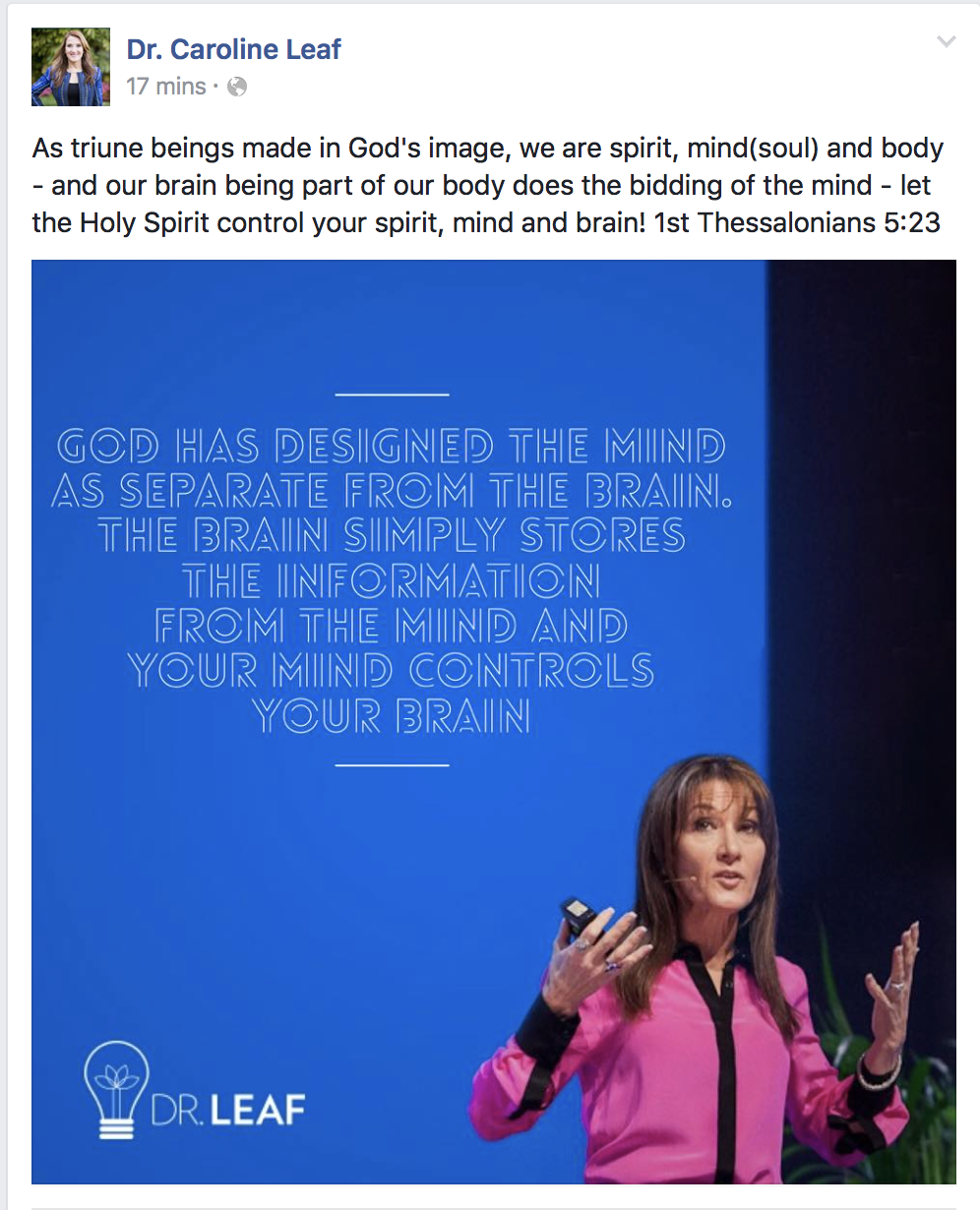
Dr Leaf’s theme for the week is the mind-brain link. In the last few days, Dr Leaf has posted memes claiming that the brain is seperate from, and subservient to, the mind. Despite evidence to the contrary, she continued the same theme today.

Dr Caroline Leaf is a communication pathologist and a self-titled cognitive neuroscientist. Her teaching is strongly influenced by one of her foundational philosophical positions; that the mind (the intellect, will and emotions) controls the body, which includes the brain. While this idea may be popular with philosophers, it’s not with neuroscientists.

Not that this bothers Dr Leaf, of course, since she’s not really a neuroscientist.

Today’s meme is more or less exactly the same as what she claimed over the previous couple of days, except today’s version is more verbose.

She said,

“Mind directs what the brain does, with the mind being our intellect, will and emotions (our soul realm). This is an interesting concept posing huge challenges and implications for our lives because what we do with our mind impacts our spirit and our body. We use our mind to pretty much do everything.”

At this point, I’m having a strong and nauseating sense of deja vu.

I know I’m going to be repeating myself, but to reinforce the message, lets go through Dr Leaf’s meme to show that it hasn’t gotten any righter with repetition.

“(The) Mind directs what the brain does” … The relationship of the mind to the brain is like the relationship of music and a musical instrument. Without a musical instrument, there is no music. In the same way, the mind is a product of the brain. It’s not independent from the brain. Without the brain, there is no mind. Indeed, changes to the structure or function of the brain often results in changes to the mind. Yesterday I used the example of medications. Caffeine makes us more alert, alcohol makes us sleepy or disinhibited. Marijuana makes it’s users relaxed and hungry, and sometimes paranoid. Pathological gambling, hypersexuality, and compulsive shopping together sound like a party weekend in Las Vegas, but they’re all side effects linked with Dopamine Agonist Drugs, which are used to treat Parkinson’s disease. If a pill affecting the brain can change the function of the mind, then it’s clear that the mind does not direct what the brain does.

“This is an interesting concept posing huge challenges and implications for our lives because what we do with our mind impacts our spirit and our body” … The relationship between our body, mind and spirit is interesting. I’ve written about this before in an essay on the triune being and dualism. But there are no great challenges here or implications here. If anything, knowing that our thoughts don’t have any real power over us is incredibly freeing. Rather than increasing our psychological distress in trying to suppress or control our thoughts, we can step back and focus on committed actions based on our values.

“We use our mind to pretty much do everything” … Actually, we don’t. Much of what we do, say, and even perceive, is related to functions of our brain that are entirely subconscious. This idea is summed up very nicely by Dr David Eagleman, best-selling author and a neuroscientist at Baylor College of Medicine in Texas;

” … take the vast, unconscious, automated processes that run under the hood of conscious awareness. We have discovered that the large majority of the brain’s activity takes place at this low level: the conscious part – the “me” that flickers to life when you wake up in the morning – is only a tiny bit of the operations. This understanding has given us a better understanding of the complex multiplicity that makes a person. A person is not a single entity of a single mind: a human is built of several parts, all of which compete to steer the ship of state. As a consequence, people are nuanced, complicated, contradictory. We act in ways that are sometimes difficult to detect by simple introspection. To know ourselves increasingly requires careful studies of the neural substrate of which we are composed.” https://goo.gl/uFKF47

So no matter which way Dr Leaf says it, it simply isn’t true that the mind controls the brain. As I said in my previous post, this is a fatal flaw for Dr Leaf’s teaching. That she keeps using this trope is entirely her choice and her right, but it certainly doesn’t aid her reputation as a credible neuroscientist.

Dr Caroline Leaf and the mind-brain revisited


Screen Shot 2016-05-29 at 10.25.58 PM

Dr Leaf has been promoting her food philosophy lately, but yesterday and today, she has come back to one of her favourite neuroscience topics.

Dr Caroline Leaf is a communication pathologist and a self-titled cognitive neuroscientist. It’s her belief that “as triune beings made in God’s image, we are spirit, mind(soul) and body – and our brain being part of the body does the bidding of the mind …”.

This is one of the flaws that terminally weakens her teaching, and leads to scientifically irrational statements like yesterday’s meme:

“God has designed the mind as seperate from the brain. The brain simply stores the information from the mind and your mind controls your brain.”

On what basis does she make such a claim? I’ve reviewed the scripture relating to the triune being hypothesis. The Bible doesn’t say that our mind is seperate to our brain, nor that it dominates and controls our brain. Dr Leaf’s statement yesterday is simply assumption based on more assumption. It’s like an intellectual house of cards. The slightest puff of scrutiny and the whole thing comes crashing down on itself.

Screen Shot 2016-05-30 at 8.06.38 PM

To try and reinforce her message today, Dr Leaf quoted Dr Jeffrey Schwartz, psychiatrist and neuroscientist, “The mind has the ability to causally affect and change pathways in the brain.” Jeffrey M. Schwartz is an OCD researcher from the UCLA School of Medicine. It appears he lets his Buddhist anti-materialism philosophy cloud his scientific judgement.

Well Dr Leaf, I see your expert and I raise you. Dr David Eagleman is an author and neuroscientist at Baylor College of Medicine in Texas. He has written more than 100 scientific papers on neuroscience, and has published numerous best-selling non-fiction books including ‘Incognito, The Secret Lives of the Brain’ which was a New York Times best-seller. He isn’t an irrational anti-materialist.

He said, “It is clear at this point that we are irrevocably tied to the 3 pounds of strange computational material found within our skulls. The brain is utterly alien to us, and yet our personalities, hopes, fears and aspirations all depend on the integrity of this biological tissue. How do we know this? Because when the brain changes, we change. Our personality, decision-making, risk-aversion, the capacity to see colours or name animals – all these can change, in very specific ways, when the brain is altered by tumours, strokes, drugs, disease or trauma. As much as we like to think about the body and mind living separate existences, the mental is not separable from the physical.” https://goo.gl/uFKF47

This statement makes much more logical sense. The functions of the mind are all vulnerable to changes in the brain. Take medications as one particular example. Caffeine makes us more alert, alcohol makes us sleepy or disinhibited. Marijuana makes it’s users relaxed and hungry, and sometimes paranoid. Pathological gambling, hypersexuality, and compulsive shopping together sound like a party weekend in Las Vegas, but they’re all side effects linked with Dopamine Agonist Drugs, which are used to treat Parkinson’s disease. There are many other examples of many other physical and chemical changes in the brain that affect the mind.

Conversely, there is limited evidence of the effect of the mind on the brain. Sure, there is some evidence of experienced meditators who have larger areas in their brain dedicated to what they meditate on, but the same effect has been shown in other parts of the brain unrelated to our conscious awareness.

But since the mind is a function of the brain, whatever effect the ‘mind’ has on the brain is, in reality, just the brain effecting itself.

So Dr Leaf can cherry-pick from her favourite authors all she wants, but quoting a supportive neuroscientist doesn’t diminish the crushing weight of scientific evidence which opposes her philosophical assumptions. If she wants to continue to proffer such statements, she would be better served to come up with some actual evidence, not just biased opinion.

Running of the Elephants – Why thought suppression doesn’t work

Have you ever found yourself about to give a speech or sit an exam, and one of your friends tries to calm you down by saying, “Stop worrying … just don’t think about it!”  Does that ever work?  Not usually!  The more you try to intentionally block it from your mind, the more it wants to pop up again.

Why is that?  It seems intuitive that if you don’t want to think about something, all you need to do is to take control and block it out of your mind, right?

One of Hollywood’s better movies in recent times was “Inception”.  In one of the key early scenes, Arthur is explaining to Saito why inception is impossible,

Saito: If you can steal an idea, why can’t you plant one there instead?
Arthur: Okay, this is me, planting an idea in your mind. I say: don’t think about elephants. What are you thinking about?
Saito: Elephants?”

This is a great little dialogue about thought suppression.  Thought suppression is the process of consciously trying to avoid certain thoughts, either by trying to replace the unwanted thought with another thought, or simply trying to repress the unwanted thought.

Our minds tend to focus on the content of a subject.  If the subject is elephants, no matter what words I put in front of it, your mind will think about elephants.  Like if I say, “I love elephants, or I say “Don’t think about elephants”, your brain hears, “blah blah blah elephants.”  And having been sensitized to the idea of not thinking about elephants, when your mind inevitably brings it up again, you’re primed to pay even more attention to it, “D’oh, I’ve just thought about elephants again … stop thinking about elephants …”.

This phenomenon is even more pronounced if your mind has already been focusing on the subject.  If you’re mind is going over and over a speech you have to give and I say, “Oh, don’t worry about that speech”, all your mind registers is, “blah blah blah SPEECH”.

Although it’s been discussed in the psychological sciences for decades, it’s only been since the late 1980’s that considerable attention has been given to the concept of thought suppression.  Despite our natural tendencies to try it or recommend it to people, the conclusion of nearly all the research is the same: thought suppression doesn’t work.

Wenzlaff and Wegner, two American psychology researchers, looked at all of the different research on thought suppression and came to the following conclusion,

“What has compelled the interest of the scientific and clinical communities is that suppression is not simply an ineffective tactic of mental control; it is counterproductive, helping assure the very state of mind one had hoped to avoid. The problem of thought suppression is aggravated by its intuitive appeal and apparent simplicity, which help mask its false promises.” [1]

I’m not really sure why we naturally gravitate to thought suppression.  Perhaps it’s part of our natural delusion of control.  Perhaps it’s a throwback from the pop-psychology assumptions that we can control our destiny, or the common myth that our mind is in control of our brain.

Whatever the reason, as time has passed, researchers are coming to understand why thought suppression is so unhelpful.  This quote from Magee and his colleagues helps to explain why:

“This shift in focus parallels advances in cognitive theories of intrusive thoughts, which suggest that having intrusive thoughts is a normative phenomenon; instead, the way an individual interprets those thoughts is expected to lead to benign versus serious outcomes … Similarly, having difficulties with thought suppression is a common experience … it is the way an individual interprets that experience that may be key. Previous discussions of thought suppression have frequently implied that people having difficulties with thought suppression often ascribe negative meaning to their difficulties.” [2]

We naturally struggle to suppress intrusive thoughts because intrusive thoughts are normal.  Trying to suppress them is like trying to suppress any other normal biological process.  Try to stop breathing for any length of time and you’ll see what I mean – it’s impossible, and trying is simply counterproductive.

The key is how we react to or feel about our thoughts.  If we feel like our thoughts might be somehow causing us harm, then our failure to stop them from bubbling up to the surface of our consciousness is going to cause us distress.  It’s a double whammy – we’re stressed because we’re expecting the negative consequences of our thoughts, and we’re distressed by our ‘failure’ to stop them.

Since it first started more than a century ago, the death toll from the famous Pamplona event, “Running of the Bulls” currently stands at 13.  Countless others have been gored and trampled.  Who are the people who get injured during the event?  Certainly not the smart ones standing behind the barriers on the edge of the streets, or the ones watching it broadcast on TV?  Only the morons who try to outrun the pack of foot-long bony skewers attached to the half-ton lumps of very cranky steak.

Similarly, the best way to manage our thoughts is to learn not to fight with them in the first place.  By non-judgmentally observing them, we can simply observe our thoughts for what they are … just thoughts.  By stepping back from our thoughts and giving them room, we find that they don’t have any real power over us.  Stepping back away from our thoughts and letting them be is the skill of defusion, one part of the process of psychological acceptance.  It’s the first step in living a life abundant in meaning and significance.

So just remember: don’t try to suppress an unwelcome thought.  Having intrusive thoughts is actually a normal process, not a sign of disease or mental weakness.  They’re not toxic or harmful, they’re just thoughts.  Give them space, like you would a charging angry bull (or elephant!)

References

[1]        Wenzlaff RM, Wegner DM. Thought suppression. Annual review of psychology 2000;51(1):59-91.
[2]        Magee JC, Harden KP, Teachman BA. Psychopathology and thought suppression: a quantitative review. Clinical psychology review 2012 Apr;32(3):189-201.

Anti-depressants – Not the messiah

 “He’s not the messiah, he’s a very naughty boy, now go away!” 

 Ah, Monty Python – six university students with a penchant for satire who changed the face of comedy.  They say that “Imitation is the sincerest form of flattery”, and if that’s the case, Monty Python should be very flattered!  Nearly five decades later, you still hear people throwing around lines from their sketches and getting a laugh.

Their movie, “The Life of Brian” remains one of the most critically acclaimed and most controversial of all movies.  It was the story of Brian, born in the stable next door to Jesus, and who later in life unintentionally becomes the focus of a bunch of people who mistakenly believe he’s the messiah.  One morning he opens his window to find a large crowd of people waiting for him outside his house, leaving his mother to try and dismiss the crowd with that now famous rebuke.

The crowd at Brian’s window aptly demonstrates a quirk in our collective psyche.  We humans have a bipolar tendency to latch on to something that seems like a good idea at the time and blow it’s benefits out of all proportion, only to later discover it wasn’t as good as our overblown expectations and unfairly despise it on the rebound.

Anti-depressant medications are a bit like Monty Python’s Brian.  Back in the late 1980’s when Prozac first came on the market, doctors saw it as the mental health messiah.  Prozac improved cases of long-standing severe depression and was much safer in overdose compared to older classes of psychiatric medications.  The idea that depression and other mental illnesses were related to chemical imbalances fit nicely with the cultural shift away from the Freudian psychotherapy model that was prevalent at the time.  People were describing life changing experiences on Prozac: “One morning I woke up and really did want to live … It was as if the miasma of depression had lifted off me, in the same way that the fog in San Francisco rises as the day wears on.” [1]  Prescribing for Prozac and other SSRI anti-depressants took off.

Fast forward to the present day, where the pendulum has swung back violently.  Anti-depressants are considered by some to be nothing more than over-prescribed placebo medications used by a pill-happy, time-poor culture demanding simple cures for complex problems.  Some commentators have gone so far as to label anti-depressants as an evil tool of the corrupt capitalist psychiatric establishment.

“Anti-depressants are not the messiah, they’re very naughty boys, now go away!” they exclaim.

But are anti-depressants really the enemy, or could they still be friendly, even if they’re not the messiah?

In the Medical Journal of Australia this month, two Australian psychiatrists, Christopher Davey and Andrew Chanen, carefully review the place of anti-depressants in modern medicine [2].  It’s a very balanced and pragmatic view.

They bring together all the evidence to show that while anti-depressants aren’t the elixir of happiness that we once assumed, they also don’t deserve the accusation that they’re nothing but fakes.

When drugs are scientifically tested, they’re usually studied in placebo-controlled trials.  The medications are given to one target group of people and a fake medicine is given to a similar group.  In the best trials, the patients aren’t aware of which they’re actually getting, and the physicians aren’t aware either.  That way personal bias and expectations can be reduced.  To reduce these biases even further, other scientists can pool all of the quality research on a topic in what’s called a meta-analysis.

Trials on anti-depressants initially showed very strong positive results, or in other words, the patients on the drug did much better than those on the placebo.  Anti-depressants lost a lot of their shine in the last decade or so as researchers began pointing out that the placebo effect, the number of patients improving on the fake medicine, was also very high.

There was also the serious, and largely legitimate accusation that drug companies ignored trials with less favourable results to make their drugs look better.  The reputation of anti-depressants was forever tarnished.

One of the most out-spoken critics of anti-depressants, Harvard psychologist Irving Kirsch, tried to show that when all of the trials on anti-depressants were taken together, the placebo effect wasn’t just close to the effectiveness of the real medicine, but was actually the same.

The problem with Kirsch’s analysis is that not all trials are created equal.  Some have negative results because they were poor trials in the first place.  When experts reapplied Kirsch’s methods to the best quality trials, the results suggested that anti-depressants are still effective, but for moderate and severe depression [1].  Anti-depressants for mild depression weren’t of great benefit.

This is take home point number one: Don’t believe the hype.  Anti-depressants are useful, but not for all cases of depression. #happypillshelp

So if anti-depressants aren’t useful for all cases of depression, are other therapies better? This is where psychological therapies come in to the equation.  Those who are the most vocal opponents of modern psychiatry and psychiatric medications are also the most vocal promoters of the benefits of talking therapies.  They won’t admit it, but there’s usually an ideological bias or financial incentive driving the feverish worship of talking therapies and their overzealous defence.

Though in the cold hard light of evidence-based science, talking therapies aren’t much of a panacea either.  Pim Cuijpers, a professor of Clinical Psychology in Amsterdam lead a team who reviewed the effectiveness of trials of psychotherapy, and found that their effectiveness has also been overstated over the last few decades.  Quality studies show that talking therapies are equivalent in effectiveness compared to anti-depressants for depression [3].

What’s important to understand about talking therapies in general is that any benefit they have is related to changing behaviour, but that’s not dependent on changing your thoughts first [4-6].  Talking and thinking differently is fine, but unless that results in a change to your actions, there will probably be little benefit.

This is take home message number two: Talking therapies help, but you don’t need to change your thinking, you need to change your actions. #walkthetalk

The million-dollar question is how to apply all of this.  If talking therapies have the same benefit as anti-depressants, then do we go for tablets before talking or the other way around?  Are both together more powerful than each one alone?

In their paper, Davey and Chanen outline what has become the generally accepted pecking order for anti-depressant therapy.  They recommend that all patients should be offered talking treatments where it’s available.  Medication should only be considered if:

  1. a person’s depression is moderate or severe;
  2. a person doesn’t want to engage with talking therapies; or
  3. talking therapies haven’t worked.

Some overseas guidelines recommend this order based on projected bang for your buck.  While talking therapies are initially more expensive, they seem to have a more durable effect than medications, which are initially cheaper and easier, but have a greater cost with prolonged use [7].  In other words, if you learn better resilience and coping skills, you’re less likely to fall back into depression, compared to the use of the medications.

This is take home message number three: Use talking therapies first, with medications as a back up. #skillsthenpills

At this point in history, we seem to finally be finding some balance.  Just as anti-depressants aren’t the messiah, they’re not the devil either, despite the vocal minority doing their best to demonise them.

With a few decades of research and clinical experience since Prozac was first released on to the market, we’re finally getting an accurate picture of the place of talking therapies and medications in the treatment of depression.  Both are equally effective, and each have their place in the management of mental illness in our modern world.

References

[1]        Mukherjee S. Post Prozac Nation – The Science and History of Treating Depression. The New York Times. 2012 Apr 19
[2]        Davey CG, Chanen AM. The unfulfilled promise of the antidepressant medications. Med J Aust 2016 May 16;204(9):348-50.
[3]        Cuijpers P, van Straten A, Bohlmeijer E, Hollon SD, Andersson G. The effects of psychotherapy for adult depression are overestimated: a meta-analysis of study quality and effect size. Psychological medicine 2010 Feb;40(2):211-23.
[4]        Herbert JD, Forman EM. The Evolution of Cognitive Behavior Therapy: The Rise of Psychological Acceptance and Mindfulness. Acceptance and Mindfulness in Cognitive Behavior Therapy: John Wiley & Sons, Inc., 2011;1-25.
[5]        Longmore RJ, Worrell M. Do we need to challenge thoughts in cognitive behavior therapy? Clinical psychology review 2007 Mar;27(2):173-87.
[6]        Dobson KS, Hollon SD, Dimidjian S, et al. Randomized trial of behavioral activation, cognitive therapy, and antidepressant medication in the prevention of relapse and recurrence in major depression. Journal of consulting and clinical psychology 2008 Jun;76(3):468-77.
[7]        Anderson I. Depression. The Treatment and Management of Depression in Adults (Update). NICE clinical guideline 90.2009. London: The British Psychological Society and The Royal College of Psychiatrists, 2010.

IMPORTANT

If you have questions about what treatment type might be better for you in your situation, please talk to your local GP, psychologist or psychiatrist, or if you need urgent crisis support, then:

In Australia

  • you can call either Lifeline on 13 11 14,
  • BeyondBlue provides a number of different support options
  • the BeyondBlue Support Service provides advice and support via telephone 24/7 (call 1300 22 4636)
  • daily web chat (between 3pm–12am)
  • email (with a response provided within 24 hours) via their website https://www.beyondblue.org.au/about-us/contact-us.

In the US
-> call the National Suicide Prevention Lifeline by calling 1-800-273-TALK (8255).

In New Zealand
-> call Lifeline Aotearoa 24/7 Helpline on 0800 543 354

In the UK
-> Samaritans offer a 24 hour help line, on 116 123.


Dr Caroline Leaf and the struggle spiral

Screen Shot 2016-05-04 at 12.01.10 AM

In Proverbs 12:25, the incredibly wise King Solomon wrote that, “Worry weighs us down; a cheerful word picks us up.”

Today, Dr Leaf posted to her social media stream that “An undisciplined mind is filled with worries, fears and distorted perceptions – These lead to degeneration of the mind and body.”

Well, that’s about as uplifting as a lead balloon.

Dr Caroline Leaf is a communication pathologist and a self-titled cognitive neuroscientist.  I’m sure her heart was in the right place when she posted her latest jewel of wisdom, but it may not be as encouraging or as helpful as she may have intended.

The biggest problem is her opening premise, “An undisciplined mind is filled with worries, fears and distorted perceptions”.  So … that’s not really accurate. The normal human mind is filled with worries, fears and distorted perceptions. It really doesn’t matter whether you discipline your mind or not, you won’t shift these ‘negative’ thoughts.

That’s because we’re meant to experience appropriate levels of fear and worry.  They’re a survival mechanism.  Without a certain amount of fear, we’d end up as a Darwin Award.  And as human beings, we’re naturally inclined to so many different cognitive biases that there’s a very long list (although ironically, those with the strongest confirmation bias will probably be the least likely to accept this).

By erroneously linking normal cognitive function to the concept of mental ill-discipline, Dr Leaf is simply setting people up for an unrealistic struggle with their normal psyche as they unnecessarily try to discipline it.

And for the people who really do struggle with excessive or inappropriate worry, fear or incorrect perceptions – i.e. people who suffer from formal anxiety disorders – this sort of statement is misleading because again, their issue isn’t mental ill-discipline. Anxiety is the result of a genetic predisposition and increased vulnerability to stress.

The second part of Dr Leafs meme is as unhelpful as the first.  For a start, it’s not true that worries, fears and distorted perceptions cause degeneration of the mind and body.  There may be a correlation between stress and some long term health problems, but correlation does not equal causation.  As Cohen and colleagues noted, “Although stressors are often associated with illness, the majority of individuals confronted with traumatic events and chronic serious problems remain disease-free.” [1]  Dr Leaf’s claim seems little more than a scare tactic, which can only lead to increased anxiety not increased motivation.

The important things to remember here are:
1. Experiencing worries, fears and distorted perceptions is normal, and not something that can be changed by disciplining your mind.  Don’t fall into the trap of trying to treat something that isn’t a disease.
2. If you do suffer from an anxiety disorder, don’t blame yourself.  That sets up a spiral of struggle.  Thoughts are just words. They have no power over you unless you engage with them.  Instead of trying to repress every worry and every fear, allow your thoughts to bubble away in the background, and instead, focus your energy on taking values based committed action which will ultimately help you live a life of meaning, not just struggling.

References

[1]     Cohen S, Janicki-Deverts D, Miller GE. Psychological stress and disease. JAMA: the journal of the American Medical Association 2007;298(14):1685-87.

Can an aspirin a day keep the psychiatrist away?

Screen Shot 2016-05-02 at 8.47.28 PM

Floating across my Facebook feed this morning was an article on the possible link between depression and inflammation.  Its premise was that depression, the joyless soul-sucking disease affecting millions of people around the world, is related to inflammation.  If that were true, might mean that we could cure depression with medications that stop inflammation.  Maybe we should be consuming an aspirin a day to keep the doctor away, and not the proverbial apple?

Inflammation is a hot topic right now.  Inflammation in the medical sense refers to a normal body process to promote healing and recovery from sickness or injury.  It’s a complex dance of chemical signals which is triggered by damage to tissue.  Inflammation is essential to life. Without it, we would be unable to repair our tissues if they were damaged.

When tissues are damaged, a number of local cells in the damaged area release pro-inflammatory cytokines which then trigger a cascade of responses; increase in the size of the local blood vessels to allow greater blood flow to the area, attracting pus-cells (neutrophils) to the area, and increasing the ‘leakiness’ of the blood vessels to allow the pus cells into the area. This response is governed by a number of chemical mediators throughout the body, including histamine, serotonin, complement system, kinins, substance P, prostaglandins and leukotrienes, cytokines and nitric oxide. Anti-inflammatory cytokines balance out the process, keeping the pro-inflammatory cytokines in check so that the process doesn’t spiral out of control.

Despite the literal plethora of chemical reactions going on simultaneously, most of the time the reaction eventually runs out of noxious agents, the anti-inflammatory cytokines dampen down the reaction, and the tissue returns to either normal, or at least functional.  Though inflammation isn’t just limited to repairing damage but also preparing for damage –psychological stress prepares the inflammation system for potential damage.  Physical stress triggers the inflammation system to repair any damage.

Chronic inflammation occurs when the acute illness or injury does not fully resolve and continues to smoulder, the natural healing pathway is obstructed, or the body remains in a psychological state in which it is always expecting a fight.  In chronic inflammation, the processes of active inflammation, tissue destruction and attempts at healing occur simultaneously. In terms of cytokines, the anti-inflammatory cytokines can’t balance out the excess pro-inflammatory cytokines.

There’s a theory about depression which is gaining momentum within the scientific community, that depression and a number of other psychiatric and neurodegenerative conditions are the result of chronic inflammation which occurs because of chronic stress.

Remember when I said before that psychological stress readies the inflammatory system for potential damage?  Well, what if that damage never comes?  If there’s chronic psychological stress, the system is constantly being worn down, and never getting a chance to recover.  This seems to make sense – chronic stress reduces new nerve cell production and growth, and may interfere with the action of nerve growth factors like BDNF and neurotransmitters like serotonin.  Hence why this article by Feelguide seems to ring true.

But is it true?  Is depression fundamentally an inflammatory disease, and if so, can we treat it with medications that decrease inflammation, like aspirin?

Let’s go through the various statements made in the Feelguide article and see what the medical evidence says.

First, a necessary correction to avoid confusion.  The Feelguide article says that, “New research is revealing that many cases of depression are caused by an allergic reaction to inflammation.”  Depression is not an allergic reaction.  A true allergy is an antibody response which releases a chemical called histamine from cells called mast cells.  If the current theory about depression and inflammation is true, then depression is related to cytokines, chemicals that are entirely different to histamine.  It may be really annoying to sneeze like you’re demon possessed if a cat’s been in the same room a week ago, but it’s not going to make you depressed.

Is inflammation caused by obesity, high sugar diets, high quantities of trans fats, unhealthy diets in general?  There’s limited evidence that the foods you eat result in inflammation.  Most of the positive data comes from observational studies which are relatively weak.  Better, stronger studies generally give conflicting information [1].  For example, if high fat, sugary foods were really the cause of low grade inflammation, then diets like the Palaeolithic diet, which replace sugary, fatty processed foods with a bucket load of vegetables should improve inflammation.  Yet there have been no statistically significant changes in inflammatory markers recorded in subjects following the Palaeolithic diet [2].

The Feelguide article claims that, “By treating the inflammatory symptoms of depression – rather than the neurological ones – researchers and doctors are opening up an exciting new dimension in the fight against what has become a global epidemic”, but let’s not get too excited.  Again, there’s precious little evidence that medications or supplements reported to reduce inflammation make any difference to depression.  For example, the article mentions omega-3 and curcumin as having some benefit in the treatment of depression, which is half-right.  There’s some evidentiary support that EPA-predominant omega-3 supplements may have some effect on depression, but none at all for DHA omega-3’s [3] or curcumin [4].

When it comes to other medications with an anti-inflammatory effect, the results are similarly mixed.  The issue seems to be the specific cellular action of the medication on a particular immune cell in the brain called the microglial cell.  For example, normal anti-inflammatory medications like aspirin and other Non-Steroidal Anti-Inflammatory Drugs (NSAID’s) increased the activity of these special microglial cells which resulted in an increase in depressive symptoms in otherwise healthy individuals, whereas a medication called minocycline has been noted to decrease the activity of these microglia, and reduced the risk of depressive symptoms (in animal studies at least) [5].

So we really can’t say whether medications believed to have an anti-inflammatory effect really have any significant benefit.  As neuroscientists, Dr Dora Brites and Dr Adelaide Fernandes wrote,

“Nevertheless, we should be cautious in believing that depression can be treated by therapies targeting inflammation. Further studies are required to evaluate whether a combined therapy with anti-inflammatory compounds and antidepressants will result in additional clinical benefits.” [5]

That’s really because we don’t know whether inflammation causes depression, or if depression causes inflammation.  The article by Feelguide seem pretty confident, but the science is still a long way from being settled.

The final word is this:
1. Depression is complicated and still poorly understood.
2. It may be related to inflammation, but please don’t rely on herbs or medications that claim to have anti-inflammatory or “immune boosting” properties.
3. If you really want to try and treat your depression without pharmaceutical medications, take some EPA Omega 3 supplements by all means, although I’d encourage you to exercise and engage with a good psychologist too, both of which have more evidence of benefit overall.

References

[1]        Minihane AM, Vinoy S, Russell WR, et al. Low-grade inflammation, diet composition and health: current research evidence and its translation. The British journal of nutrition 2015 Oct 14;114(7):999-1012.
[2]        Pitt CE. Cutting through the Paleo hype: The evidence for the Palaeolithic diet. Aust Fam Physician 2016 Jan-Feb;45(1):35-8.
[3]        Hallahan B, Ryan T, Hibbeln JR, et al. Efficacy of omega-3 highly unsaturated fatty acids in the treatment of depression. The British journal of psychiatry : the journal of mental science 2016 Apr 21.
[4]        Andrade C. A critical examination of studies on curcumin for depression. J Clin Psychiatry 2014 Oct;75(10):e1110-2.
[5]        Brites D, Fernandes A. Neuroinflammation and Depression: Microglia Activation, Extracellular Microvesicles and microRNA Dysregulation. Front Cell Neurosci 2015;9:476.

Book review: “Think and Eat Yourself Smart” by Dr Caroline Leaf

ThinkAndEatYourselfSmart_Cover_Web

Think and Eat Yourself Smart
Dr Caroline Leaf
328 pages, Published by Baker Books USA

My rating: 2 / 10

As a society, we are obsessed with food.  With copious food blogs, celebrity chefs and reality cooking shows, food has become more about our social status and self-identity than about nourishment.

Food has always been intimately connected to our health and well-being, and the modern food obsession has taken that to extreme levels as well.   Organic, paleo, sugarless, raw food, cleansing and other popular diets have morphed into ‘movements’, the polite shorthand way of describing popular obsessions that are borderline cults.

Trying to cash in on this wave of cultural orthorexia is Dr Caroline Leaf with her latest book, “Think and Eat Yourself Smart”, published in early April by Baker Books.

Dr Leaf describes the book as “an attempt to reintroduce a culture of thinking and effort back into eating, one based on diligently stewarding the body and world God entrusted to us.  In the spirit of renewing the mind, it is a lifestyle book that seeks to reimagine what we eat within an integrated spirit, mind and body framework.”

And that would be fine in theory, though in practice, Dr Leaf uses the book more as a vehicle for divulging her personal food preferences and her socio-political ideology while recycling most of her dubious brain science.

But before we go any further, let me issue a disclaimer: There’ll be some who will look this review and assume I’m being critical of Dr Leaf’s book for the sake of being critical.  I recognise that I’m not Dr Leaf’s number one fan, however, I want to say from the outset of this review that I have approached this as dispassionately and objectively as I can.

“Think and Eat Yourself Smart” is certainly not all bad.  Dr Leaf raises some legitimate issues.  For example, she’s critical of the vitamin and supplement industry and the staggering cost of supplements compared to their very limited benefits.  She discusses the previous dietary advice regarding low-fat foods, and how the misguided attempt to reduce our dietary fat intake lead to a compensatory increase in starch and sugars.  She also discussed the current concerns about too much sugar and refined carbohydrates, and raises the very real problem of food waste and food security.  The recipes at the back of the book contain the usual over-rated hipster foodie ingredients like dandelion, kale, quinoa and chia seeds to maintain Dr Leaf’s foodie creds, although some of the recipes themselves sound alright.

Unfortunately, every truth is outweighed by a multiplex of factoids and misrepresentations.  Dr Leaf clearly favours organic food, which despite her claims, have not been shown to be better tasting, more nutritious, less toxic, and better for the environment.  She’s clearly against genetically modified organisms (or GMO’s), a stance which is more populist than scientific.

Dr Leaf’s underlying premises are also deeply flawed.  It’s clear that she’s been heavily influenced by the work of Michael Pollan and other post-modern food gurus of the same ilk.  She’s critical of modern food systems including all food processing, food transportation, and supermarkets, claiming that modern agriculture and food processing destroys all nutrients and taste.  Dr Leaf claims that “Real food is food grown the way God intended: fresh and nutritious, predominantly local, seasonal, grass-fed, as wild as possible, free of synthetic chemicals, whole or minimally processed, and ecologically diverse.” (p29)

Dr Leaf’s definition of “real food” is nothing more than a romanticised post-modern social construct, and claiming it’s God’s idea doesn’t make it any less misleading.  Of course we want our food to be fresh, and we also want it to be nutritious.  But fresh and nutritious are not dependent on being local, seasonal, ecologically diverse (whatever that means), grass-fed and wild.  In fact, how something can be grass-fed and wild seems contradictory.  Processing food makes it safer, and in most cases, more nutritious that the unprocessed farm gate versions.  There’s virtually no pesticide residues left on conventional produce either, so that’s a moot point.

In fact, modern food is actually easier to eat and digest, more nutritious, tastier, safer, and longer lasting than ever before in human history. Today’s canned and frozen foods are infinitely healthier than in the past, and in some cases, more nutritious than the vegetables straight off the farm (canned tomatoes, for example, because nutrients are more easily absorbed from cooked tomatoes).  Dr Leaf’s idealised view of our agrarian past is false, and the notion that we should return to it is inane.

Dr Leaf also spends a great deal of time trying relate our nutritional health to our thinking.  I discussed this in the pre-review of the book, here.  She claims that “Research shows that 75 to 98% of current mental, physical, emotional and behavioural illnesses and issues come from our thought life; only 2 to 25% come from a combination of genetics and what enters our bodies through food, Medication, pollution, chemicals, and so on.  These statistics show that the mindset behind the meal – the thinking behind the meal – plays a dominant role in the process of human food related health issues, approximately 80 percent.” (p84)

Again, this is a false premise based on bogus science.  75 to 98% of current mental, physical, emotional and behavioural illnesses and issues do not come from our thought life.  What you think and how you feel makes no difference to how your body processes the nutrients you put into it.

This excessive focus on the power of thought is a segue back to her previous teaching, a justification as to why she as a self-titled cognitive neuroscientist should be writing about food.  Unfortunately, the information contained in the second part of the book makes it obvious that she’s not an expert on either.

Sure, Dr Leaf discusses responsibility and choices which are important to what we put in our mouths, but there are so many other variables that are more intrinsic to our individual diets than just personal responsibility.  Like, poverty, income, education, cooking skills or geographic location for example.

Dr Leaf claims that how you think changes how you eat, and how you eat changes how you think.  Except the last part of that statement is mutually exclusive to her premise that the mind is separate to the brain and controls the brain.  What you put in your mouth might change the function of your brain, but how can that change the way you think if the mind is separate to the brain?

This paradox is the death-knell to her books credibility and usefulness.  Not that it makes any difference to Dr Leaf, who conveniently forgets this central tenet of her teaching whenever it suits her.

The advice she provides is also off-track.  The answer to processed food isn’t to plant your own garden, or raise your own chickens, or join a local agro-economic food co-op.  That sort of advice is impractical for the vast majority of her audience.  It excludes everyone who lives in a modern city, or who, like me, has an uncanny ability to kill all but the hardiest of plants.  Even her exhortation to eat “real food” is unnecessarily complicated.

Ultimately, Dr Leaf’s advice isn’t dangerous, but just old and confusing.  Most of the useful information she gives is obscured by the plethora of unnecessary and irrelevant opinions and factoids.  It’s also nothing new.  There have been countless books and blogs written by real nutritionists and dieticians that say the same essential things in much simpler ways.  Even John Oliver did a better job of explaining problems associated with sugar and our modern food systems (* Warning * – Strong language and adult themes).  He’s an agnostic satirical comedian who doesn’t pretend to be a scientific expert, and he still get’s the message across more effectively than Dr Leaf.

To conclude, if you want sound nutritional advice, I’d suggest you head for books by actual dieticians. Professor Rosemary Stanton is one author I would recommend. She’s a Professor of Nutritional Science and Visiting Fellow of the School of Medicinal Sciences at the University of New South Wales.  She’s published hundreds of academic and consumer articles including 33 books on good nutrition.  She’s been lecturing and writing about good food for longer than I’ve been alive.

In contrast, Dr Leaf’s book “Think and Eat Yourself Smart” is a repackaging of stale opinion and dubious science by an author who isn’t a nutritionist, or even a cognitive neuroscientist for that matter.  There might be some helpful advice in there, but it would be difficult for an average reader to pick out what’s beneficial and what’s bogus.

To that end, “Think and Eat Yourself Smart” is a lot like a frozen microwave dinner.  It looks good on the packaging, but what you get on the inside isn’t the same.  There’s a few nutritional morsels, to be sure, but most of it is just offal and gristle that’s been homogenised to an unrecognisable mush and then reassembled.

If you’re a Dr Leaf devotee, or you’re interested in her socio-political views, then by all means, buy this book.  If you want sound nutritional advice, look elsewhere.


Dr Caroline Leaf – Increasing the stigma of mental illness again

Screen Shot 2016-03-19 at 9.02.05 PM

Let me tell you a story.

A couple of years ago, one of my patients was an elderly gentleman in his late seventies.  He was living in a nursing home at the time, but because of his history of psychosis, he remained on a treatment order – a requirement by law that if he was to remain outside of a mental facility, he had to have regular anti-psychotic medication every few weeks.

This man was on a treatment order because his disease caused him to have delusions.  He misinterpreted what was going on around him, and would not consider that he could be wrong.  In his particular case, he was convinced that his next-door neighbour was a paedophile, and he was planning to ambush his neighbour and castrate him.  Luckily the police had taken my patient into custody before he got the opportunity.  With treatment, my patient had clear thoughts, although needed close supervision.  Without his medication, he became confused and violent.

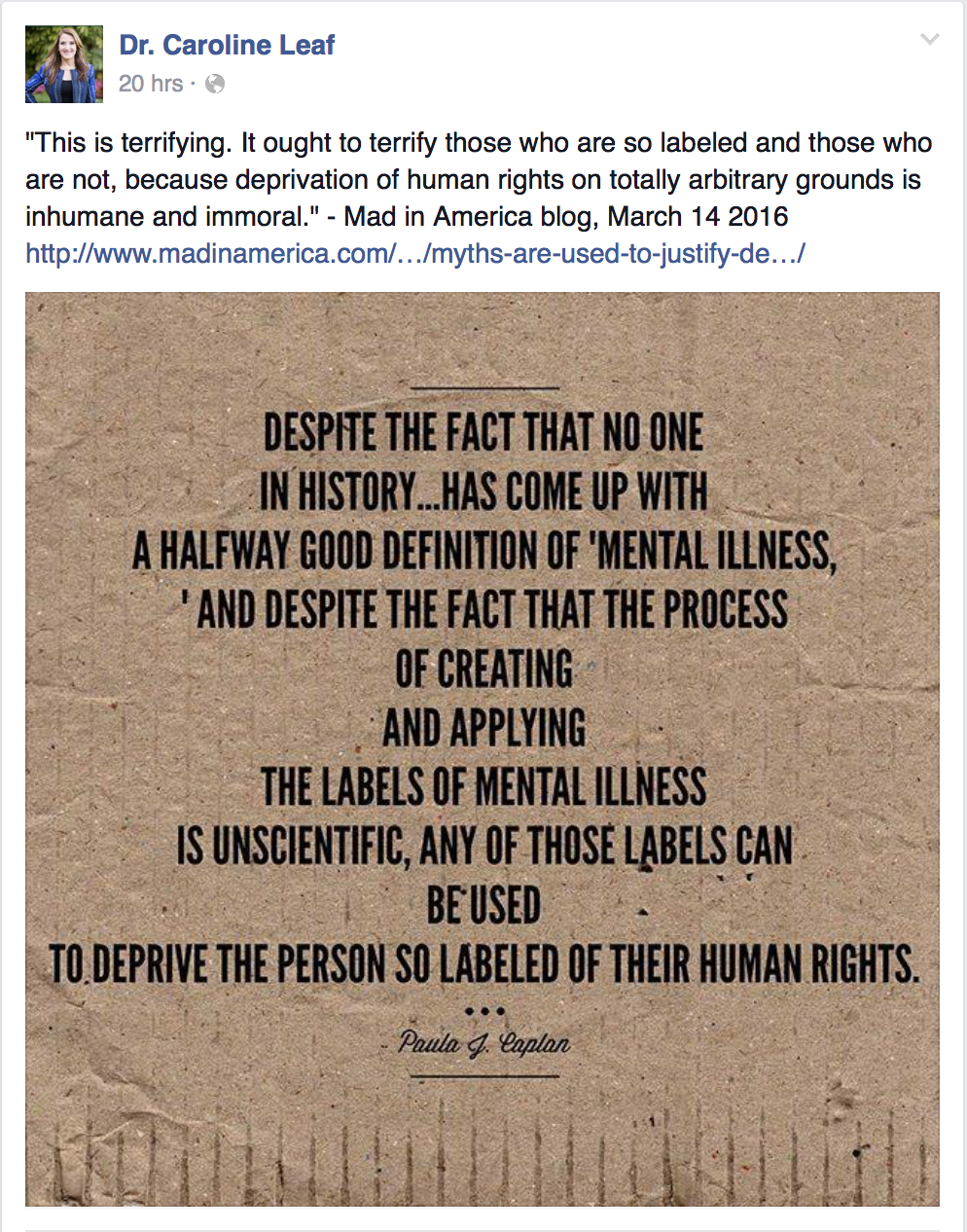
According to a post on the blog Mad in America and promoted by Dr Caroline Leaf, my patient’s diagnosis was spurious, and he was denied his basic human rights by being forced to take medications.

Dr Caroline Leaf is a communication pathologist and self-titled cognitive neuroscientist.  She is also a self-declared expert in mental health, despite not having any professional training in medicine, psychiatry, psychology or even cognitive neuroscience for that matter.

Indeed, if she had any experience or expertise in mental health, she would have recognised the basic factual errors and logical fallacies that riddled the post she quoted from.

Take the quote that Dr Leaf posted on social media.  The full quote from the Mad in America post is:

“Despite the fact that no one in history, not even the omnipotent American Psychiatric Association – which produces and profits mightily from the ‘Bible’ of mental disorders — has come up with a halfway good definition of “mental illness,” and despite the fact that the process of creating and applying the labels of mental illness is unscientific, any of those labels can be used to deprive the person so labeled of their human rights. This is terrifying. It ought to terrify those who are so labeled and those who are not, because deprivation of human rights on totally arbitrary grounds is inhumane and immoral.”

This is the same tired, emotionally laden and misleading rhetoric that’s so often barked in fervent paroxysms through the foaming lips of those opposed to modern psychiatric practice:

  1. There is no good definition of ‘mental illness’
  2. The American Psychiatric Association is just a profit-driven cabal
  3. The DSM5 (which the author alludes to as the ‘Bible’ of mental disorders) is unscientific
  4. Psychiatric diagnoses are unscientific
  5. Any psychiatric diagnosis can be used as a trigger to force people into unwanted treatments or incarceration
  6. Therefore psychiatric diagnosis and treatment is against basic humans rights and is inhumane and immoral.

Inhumane and immoral hey?  Tell that to my patients neighbour who almost became a eunuch except for that “inhumane and immoral treatment” of my former patient.

Caplan claims just don’t stand up to any rational scrutiny.

  1. There are lots of good definitions of mental illness … modern psychiatry critics just don’t like them. But take the definition used by the CDC, “Mental illness is defined as … ‘health conditions that are characterized by alterations in thinking, mood, or behavior (or some combination thereof) associated with distress and/or impaired functioning.’” There’s nothing wrong with this definition. It describes mental illness and helps differentiate mental illness from variations of mood, thought and behaviour that are part of the everyday human experience.
  1. The American Psychiatric Association isn’t the only group to have created a classification of psychiatric illnesses. The World Health Organisation publishes the International Classification of Diseases, or the ICD, which is also used for psychiatric diagnosis. Is the WHO an evil profit-driven junta too?
  1. The DSM, the ICD, and any other system of diagnosis, are simply different classification systems. Over the last century, clinicians have noted clusters of symptoms and have tried to classify them into common groups. How is that unscientific?  It’s no different to scientists looking at the different characteristics of various animals and creating a taxonomy, to provide a common system and language for clinicians and researchers across disciplines and across countries.The DSM system isn’t perfect, but what system ever is?  As knowledge of neuroscience grows, the classifications are reviewed and tightened in an ongoing process of improvement.  If those who oppose the DSM want to come up with something better, they’re welcome to put something forward.
  1. The old saying goes that medicine is an art and a science. Human beings, as nuanced as we are, often don’t fit into diagnostic criteria as easily as we would like. That doesn’t invalidate the diagnostic criteria or make the process unscientific as critics of modern psychiatry would have us believe, just like an unusual and hard-to-classify form of cancer doesn’t invalidate the other cancer classifications that are well defined.  Psychiatry, by it’s nature, relies on verbal report from patients rather than a clean-cut blood test or piece of tissue under a microscope, so at this stage in history, it seems imprecise.  That doesn’t make it any less scientific.
  1. The allegation that any psychiatric diagnosis can any be used to deprive the person so labeled of their human rights is utter nonsense. It’s a giant scarecrow – it seems really scary, but on closer inspection, it’s just a tarted-up mound of straw.People are never forced into treatments unless they really are “dangerous to themselves and/or others”.  This rule can’t be invoked willy-nilly.  There are multiple checks and balances, and a whole school of civil rights lawyers expectantly circling, ready for the whiff of blood in the water (http://www.mhrt.qld.gov.au/?page_id=2 is an example of the process in my home state, but each jurisdiction has their own version).

Caplan rightly pointed out that those with mental illness were less likely to be the perpetrators of violence and more likely to be the victims, but that doesn’t negate the need for protection of the community from those with mental illness who have shown violent intent and no capacity to control their behaviour.

If you want to find a group that really are suffering from inhumane and immoral deprivations of their human rights, then that would be Christians.  Around the globe, millions of Christians are oppressed, imprisoned, tortured, raped, and murdered every year.

Time and space preclude a full analysis of Caplan’s post, but what’s really important is that both the American Psychiatric Association and the U.S. Department of Health and Human Services’s Office of Civil Rights, an independent ombudsman, dismissed formal appeals by Caplan relating to her hysterical claims of inhumane forced psychiatric treatment.  Dr Leaf conveniently left that out of her social media post.

Instead, Dr Leaf chose to publish one of the most alarming quotes from an article heavy on scaremongering, from a disaffected author on an extremist blog.  If Dr Leaf was a real expert on mental health instead of being a self-declared one, she would have easily seen how nonsensical Caplan’s post was.

By posting this quote on social media today, it’s highly likely that Dr Leaf has caused harm to thousands of vulnerable Christians by unnecessarily increasing the stigma and fear of a mental health diagnosis.  This, in turn, is likely to lead to these same vulnerable Christians missing out on (drug and non-drug) treatment which would help them rise to their true potential in God and in life, leaving them trapped and suffering in their mental destitution.

Dr Leaf has a track record of misinformation when it comes to mental health.  Christians suffering mental illness need more support, not more stigma.  It’s time Dr Leaf stepped aside, and stopped making things worse.

Lies in the name of God are still lies

Let’s be honest, we all lie, and we lie a lot.

It’s ok, we’re all friends here.  You can admit it – lying is a regular part of everyday social cohesion.  We don’t call it lying, we call it tact, but it’s still lying.

Like when we automatically say to the mother of a newborn baby, “Oh, your baby’s adorable”.  Sure, most of them are, but there are some newborns that, shall we say, need to grow into their features.

Or when a patient walks in and asks, “Hey, have you lost some weight?!”  No, I’ve actually gained five kilos, but thanks for your flattery.

Even some of the most brutally honest people still figure out they have to lie at some point.  My children, for example.  They have absolutely no diplomacy filter between their brains and their mouths, “Aw, Dad … you stink”, or “Dad, you’re really fat.  You need to exercise.”  But when their butt’s on the line, things change, “I only ate one biscuit …”, or, “He started it …”.

Adults are no better.  Sometimes when things are important enough to us, we bend the truth to fit our world-view.  It’s often subconscious, though confirmation bias of our opinions can also be overt.

Sometimes we’re right, sometimes we’re wrong, and sometimes there is no right or wrong, but our beliefs shape our interpretation of the world, and the language and actions that stem from them.  And most of the time, it doesn’t really matter.
“Chocolate is the nicest flavour of ice-cream”.
“Beer is better than cider.”
“The Broncos shouldn’t have lost the NRL Grand Final.”
“Holden’s are better than Ford’s at Bathurst.”
“Donald Trump is a great guy.” **

Hey, if you think Donald Trump is a great guy, then you’re welcome to your opinion.  It ultimately makes no difference, if you like Trump, or I like vanilla ice-cream, or if you’re a ‘Ford guy’.

Though what about when someone in the public sphere lies, or allows their opinion to shape their version of truth?  Is ‘a little white lie’ ever truly acceptable?

For example, is it justifiable if news reporters lie about themselves or their motives to get to the truth of a story?  For example, in an article written as an ethical primer for journalism students at Indiana University, Henry McNulty recalled an expose he was part of in which reporters posed as couples trying to get into the local real estate market.  The investigation exposed some inherent racial prejudice amongst the realtors, and eventually lead to the state governor ordering a formal investigation into real estate discrimination.

While he noted that the investigation had noble goals and positive outcomes for the community, he also concluded that the end should never justify the means.
“Credibility is our most important asset.  And if we deceive people in order to do our job, we’ve compromised that credibility before a word is written”, he said.

In recent times, the Safe School’s program has come under intense scrutiny.  For those not familiar with it, the Safe Schools program was touted by its supporters as an evidence-based anti-bullying program for mid-late primary school students, although its primary agenda appears to be in promoting the Lesbian-Gay-Bisexual-Transgender (LGBT) lifestyle and ideology.  Or as one commentator put it, “In reality, the debate is between those who support the right to childhood and children’s bodily dignity, the right to an education that educates, not indoctrinates, versus those who believe Marxist activism constitutes sound school curriculum.”

A post came up on my Facebook feed in the last couple of days, titled, “Gender Ideology Harms Children”.  It was published by the American College of Pediatricians, which sounds like an official body, except that the American Academy of Pediatrics is the peak body of paediatricians in America. Then the style of language of the statement was inconsistent with that used by most peak bodies – this statement by the American College of Pediatricians was very strongly partisan.  I couldn’t help but wonder who the American College of Pediatricians actually were.

As it turns out, the American College of Pediatricians are a group that promote a very conservative agenda under the guise of official medical and scientific opinion.

In their core values, they state that their college:
“A: Recognizes that there are absolutes and scientific truths that transcend relative social considerations of the day.
B: Recognizes that good medical science cannot exist in a moral vacuum and pledges to promote such science.”

I’m all for good science, but one has to wonder if they’re going about it the right way, because while they declare their pledge to scientific truth, their next core value is essentially an opinion:
“C: Recognizes the fundamental mother-father family unit, within the context of marriage, to be the optimal setting for the development and nurturing of children and pledges to promote this unit.”

As much as I agree with and share most of their values, their pledge to opinion-based science is somewhat duplicitous, because opinion-based science isn’t absolute truth, it’s still a version of truth relative to their values and presumptions.

The irony hasn’t escaped some of the colleges critics, who have highlighted some of the factual errors and bad science that inevitably occurs when one tries to fit scientific findings into a set of values rather than drawing conclusions from the science.

In fairness, I’m not saying that the LGBT community is faultless either.  I’m sure that an in-depth study of their sources would find some over-zealous misinterpretations of scientific data as well.

My point is that we tend to look for information that suits our own pre-conceived notions, and the Christian community can get itself into trouble by doing this.  Christian lobby groups and church leaders need to be wary selectively accepting ‘scientific’ information that conforms to their world-view.  They need to, in all diligence, ensure that the data they cite really does support their position, not cherry-pick or over-extrapolate.  Otherwise they’re no better than the moral relativists on the other side of the political spectrum, or journalists who would justify mistruth to achieve a higher goal, or my eleven-year-old denying his biscuit binge.

One critic of the American College of Pediatricians wrote something very incisive in the title of his blog, “Lies in the name of God are still lies.”

It’s a fair call.  Misleading with the best of intentions is still misleading.  We may have the best of intentions, and feel justified in picking the science that conforms to our world-view.

Even so, God called us to speak the truth, because Jesus was the way, truth and life, and it’s the truth that sets us free.  And our credibility is our witness.  If we deceive people in order to do our job, we’ve compromised that witness before a word is written.

That’s the honest truth.

** The opinions expressed here do not necessarily represent those of the authors, and are for illustrative purposes only … except the bit about the Broncos … but the rest is just illustrative. 

Let boys be non-stigmatised boys

Boys will be boys ...

“When I was a boy …”

Many a stirring yarn has been started with those exact words, as aging men relive their childhood adventures with sentimental grandiosity increasingly taking over from detail as each passing year blends in with the blur of distant memories.

Ps Greg Gibson wrote an article that caught my attention as it floated across my Facebook feed last night.  Gibson is a pastor in Knoxville, Tennessee.  His “when I was a boy” story recalled his happy times as an energetic child, a serene innocence punctuated by two years of Ritalin-induced misery.

His point: “I think we should let boys be boys, and non-medicated ones at that. Therefore, parents, if at all possible, don’t medicate your boys.”

I think I understand what he’s trying to say, that it’s ok to be an energetic child and to see the extra energy as a strength to harness, not a weakness to control.

That would be fine, except that in trying to normalise energetic behaviour, he also winds up demonising Ritalin.  It may not have been his intention, but whenever someone respected in the community says something negative about stimulant medication or ADHD, it reinforces the oppressive stigma attached to those who suffer from it.

Ps Gibson’s fundamental assumption, that normal but energetic children are being misdiagnosed as ADHD and therefore unnecessarily medicated, happens far less often than the opposite – children with ADHD are misdiagnosed as energetic children that just need to be taught how to control themselves.

Personally, I don’t know of any parent who ever wanted to medicate their child with Ritalin.  If anything, it’s the opposite, because if your child’s on Ritalin, then you must be a lazy parent, or given them too much sugar, or too much screen time, or not hugged them enough as babies, or didn’t practice vaginal seeding, or whatever other form of parent-guilt is being perpetrated by the media at the time. Parents will do everything they can in their power to avoid using Ritalin, because of a culture that blames and shames.

Unfortunately, this means that children who could be helped by Ritalin or other stimulant medication are left behind, because ADHD isn’t the mislabeling of normal energetic children who just need better structure, or better posture, or who learn differently.  ADHD is a real disability, a dysfunctional lack of planning and control that’s abnormal compared to other children, affecting their entire lives.

For example, these children find it hard to play with other kids because they can’t follow basic social rules like the rules of games, or waiting their turn.  These children find school difficult, because they can’t concentrate for long enough to focus on completing a multi-step task, or have a long enough attention span to make new memories for words or facts.

One of my patients, a little boy about seven years old, was brought in by his mother because a chiropractor wanted me to arrange a blood test on his behalf.  When I asked why, the mother said the little boy had dyslexia which the chiropractor was ‘treating’ (actually, this chiropractor was blaming a disease that didn’t exist, and wanted me to arrange a test that was resigned to the pages of history, but that’s another story).  When I talked to the mother about the child’s symptoms, it was pretty obvious that he had ADHD, amongst other things.  After seeing a developmental paediatrician to confirm the diagnosis, and taking Ritalin for just one week, his reading improved three whole reading levels, and after a month, he had not only caught up, but had passed a number of his class-mates.

This is a real life example of how ADHD can hold children back, and how stimulant medication can help.  While there are always exceptions to the rule, stimulant medications help more often than they hinder.  They’re sometimes the difference between a child meeting his full learning potential, or being unnecessarily held back, languishing at the bottom of his class as his peers go further ahead in leaps and bounds.

Our culture needs to move on.  We need to stop our social prejudices making life more difficult than it already is for children and their families who battle with ADHD.  We need to see that medications for ADHD can be the difference between a life of learning and a life unfairly held back.

Let’s change the tune.  Rather than saying, “Let boys be non-medicated boys”, how about we say, “Let boys be non-stigmatised boys.”  It’s only through the break-down of the stigma surrounding ADHD and stimulant medications, that all boys (and girls) can truly meet their full potential, whether they have ADHD or are just a bit more energetic.

If you want more information on ADHD and its treatments, this is a good place to start: http://www.rch.org.au/kidsinfo/fact_sheets/ADHD_an_overview/

If you are concerned that you or your child might have ADHD, talk to your local GP or paediatrician.