MIND CHANGES BRAIN? READ THIS …

Screen Shot 2016-06-21 at 9.45.03 PM

They say that if you want something badly enough, you can make it happen … you just have to believe in it to make it work.  Wish upon a star, believe in yourself, speak positively, think things into being … it’s the sort of magical thinking that forms the backbone of Hollywood scripts and self-help books everywhere.

But that’s not how science works.  In the real world, believing in something doesn’t make it magically happen.  Holding onto a belief and trying to make it work leads to bias and error.  Instead of finding the truth, you end up fooling yourself into believing a lie.

This is the trap that Dr Leaf has fallen into as she continually tries to perpetuate the unscientific notion that the mind changes the brain.

Dr Caroline Leaf is a communication pathologist and a self-titled cognitive neuroscientist.  Her philosophical assumptions start with the concept that the mind is separate from and controls the physical brain, and continue to unravel from there.

The problem is that Dr Leaf can’t (or won’t) take a hint.  I’ve discussed the mind-brain link in other blogs in recent times (here and here), but yet Dr Leaf continues to insist that the mind can change the brain.  It’s as if she believes that if she says it for long enough it might actually come true.

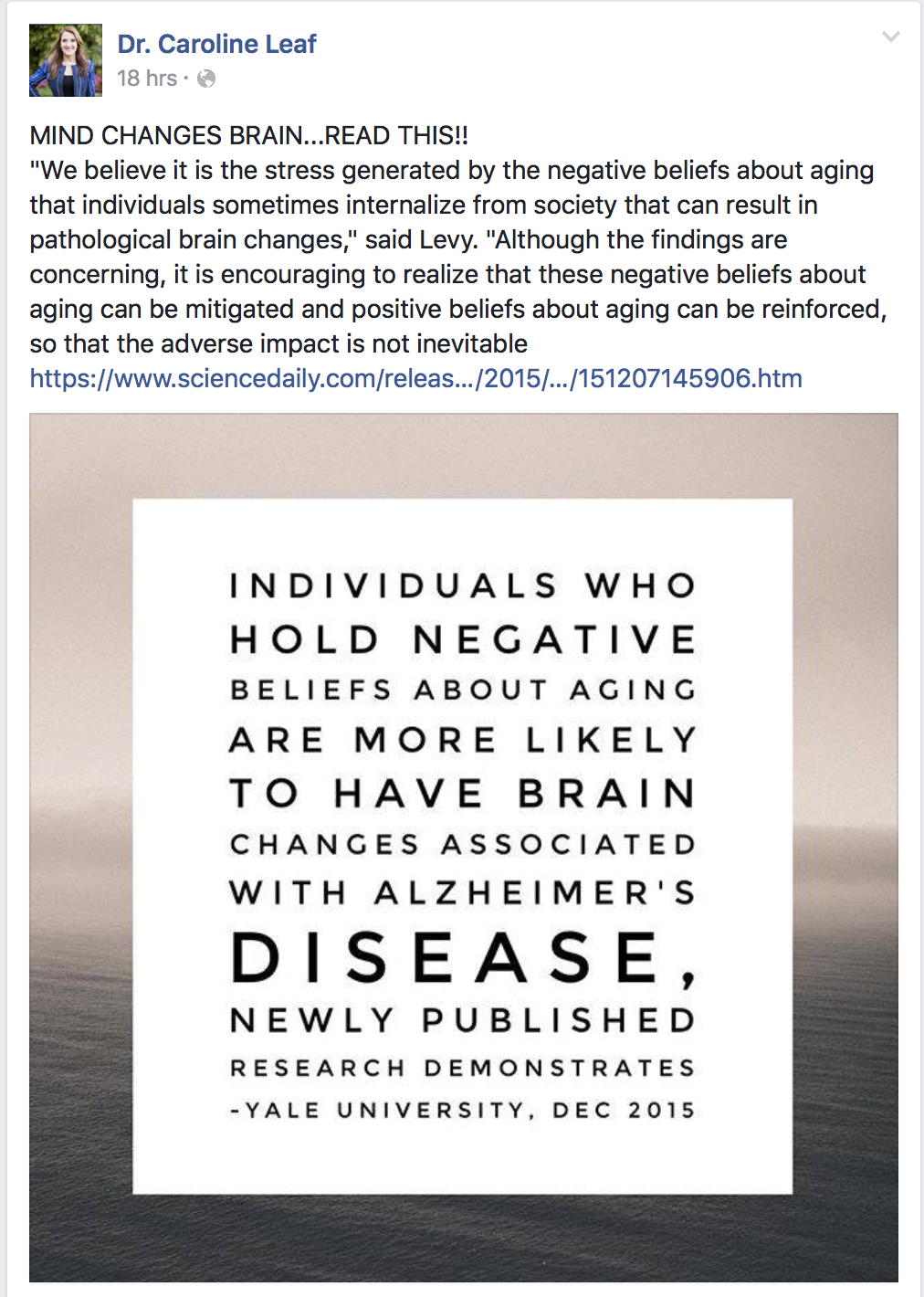
Today, Dr Leaf claimed that “newly published” research from Yale claimed that, “Individuals who hold negative beliefs about aging are more likely to have brain changes associated with Alzheimer’s disease.”  Except that this research is not really new since it was published last year, and Dr Leaf tried to draw the same tenuous conclusions then as she’s doing now.

She quoted from the interview that one of the authors did for the PR puff piece that promoted the scientific article:

“We believe it is the stress generated by the negative beliefs about aging that individuals sometimes internalize from society that can result in pathological brain changes,” said Levy. “Although the findings are concerning, it is encouraging to realize that these negative beliefs about aging can be mitigated and positive beliefs about aging can be reinforced, so that the adverse impact is not inevitable”.

Well, the issue is clearly settled then, all over bar the shouting.  Except that the promotional article doesn’t go through all of the flaws in the methodology of the study or the alternative explanations to their findings.  Like that the study by Levy, “A Culture-Brain Link: Negative Age Stereotypes Predict Alzheimer’s Disease Biomarkers” [1], only showed a weak correlation between a single historical sample of attitude towards aging and some changes in the brain that are known to be markers for Alzheimer Dementia some three decades later.

They certainly didn’t show that stress, or a person’s attitude to aging, in anyway causes Alzheimer Dementia.  And they didn’t correct for genetics in this study which is the major contributor to the risk of developing Alzheimer’s [2].  So no matter what Dr Leaf or the Yale PR department thinks, the results of the study mean very little.

But why let the lack of ACTUAL EVIDENCE get in the way of a good story.

It’s sad to see someone of the standing of Dr Leaf’s shamelessly demoralise themselves, scrambling to defend the indefensible, hoping beyond hope that what they believe will become the truth if they try hard enough.  It doesn’t matter how much Dr Leaf wants to believe that the mind changes the brain, that’s not what science says, and clutching at straws citing weak single studies and tangential press releases isn’t going to alter that.

References
[1]        Levy BR, Slade MD, Ferrucci L, Zonderman AB, Troncoso J, Resnick SM. A Culture-Brain Link: Negative Age Stereotypes Predict Alzheimer’s Disease Biomarkers. Psychology and Aging 2015;30(4).
[2]        Reitz C, Brayne C, Mayeux R. Epidemiology of Alzheimer disease. Nat Rev Neurol 2011 Mar;7(3):137-52.

Dr Caroline Leaf and the mind-brain revisited again

Screen Shot 2016-06-01 at 8.05.14 PM

Dr Leaf’s theme for the week is the mind-brain link. In the last few days, Dr Leaf has posted memes claiming that the brain is seperate from, and subservient to, the mind. Despite evidence to the contrary, she continued the same theme today.

Dr Caroline Leaf is a communication pathologist and a self-titled cognitive neuroscientist. Her teaching is strongly influenced by one of her foundational philosophical positions; that the mind (the intellect, will and emotions) controls the body, which includes the brain. While this idea may be popular with philosophers, it’s not with neuroscientists.

Not that this bothers Dr Leaf, of course, since she’s not really a neuroscientist.

Today’s meme is more or less exactly the same as what she claimed over the previous couple of days, except today’s version is more verbose.

She said,

“Mind directs what the brain does, with the mind being our intellect, will and emotions (our soul realm). This is an interesting concept posing huge challenges and implications for our lives because what we do with our mind impacts our spirit and our body. We use our mind to pretty much do everything.”

At this point, I’m having a strong and nauseating sense of deja vu.

I know I’m going to be repeating myself, but to reinforce the message, lets go through Dr Leaf’s meme to show that it hasn’t gotten any righter with repetition.

“(The) Mind directs what the brain does” … The relationship of the mind to the brain is like the relationship of music and a musical instrument. Without a musical instrument, there is no music. In the same way, the mind is a product of the brain. It’s not independent from the brain. Without the brain, there is no mind. Indeed, changes to the structure or function of the brain often results in changes to the mind. Yesterday I used the example of medications. Caffeine makes us more alert, alcohol makes us sleepy or disinhibited. Marijuana makes it’s users relaxed and hungry, and sometimes paranoid. Pathological gambling, hypersexuality, and compulsive shopping together sound like a party weekend in Las Vegas, but they’re all side effects linked with Dopamine Agonist Drugs, which are used to treat Parkinson’s disease. If a pill affecting the brain can change the function of the mind, then it’s clear that the mind does not direct what the brain does.

“This is an interesting concept posing huge challenges and implications for our lives because what we do with our mind impacts our spirit and our body” … The relationship between our body, mind and spirit is interesting. I’ve written about this before in an essay on the triune being and dualism. But there are no great challenges here or implications here. If anything, knowing that our thoughts don’t have any real power over us is incredibly freeing. Rather than increasing our psychological distress in trying to suppress or control our thoughts, we can step back and focus on committed actions based on our values.

“We use our mind to pretty much do everything” … Actually, we don’t. Much of what we do, say, and even perceive, is related to functions of our brain that are entirely subconscious. This idea is summed up very nicely by Dr David Eagleman, best-selling author and a neuroscientist at Baylor College of Medicine in Texas;

” … take the vast, unconscious, automated processes that run under the hood of conscious awareness. We have discovered that the large majority of the brain’s activity takes place at this low level: the conscious part – the “me” that flickers to life when you wake up in the morning – is only a tiny bit of the operations. This understanding has given us a better understanding of the complex multiplicity that makes a person. A person is not a single entity of a single mind: a human is built of several parts, all of which compete to steer the ship of state. As a consequence, people are nuanced, complicated, contradictory. We act in ways that are sometimes difficult to detect by simple introspection. To know ourselves increasingly requires careful studies of the neural substrate of which we are composed.” https://goo.gl/uFKF47

So no matter which way Dr Leaf says it, it simply isn’t true that the mind controls the brain. As I said in my previous post, this is a fatal flaw for Dr Leaf’s teaching. That she keeps using this trope is entirely her choice and her right, but it certainly doesn’t aid her reputation as a credible neuroscientist.

Dr Caroline Leaf and the mind-brain revisited


Screen Shot 2016-05-29 at 10.25.58 PM

Dr Leaf has been promoting her food philosophy lately, but yesterday and today, she has come back to one of her favourite neuroscience topics.

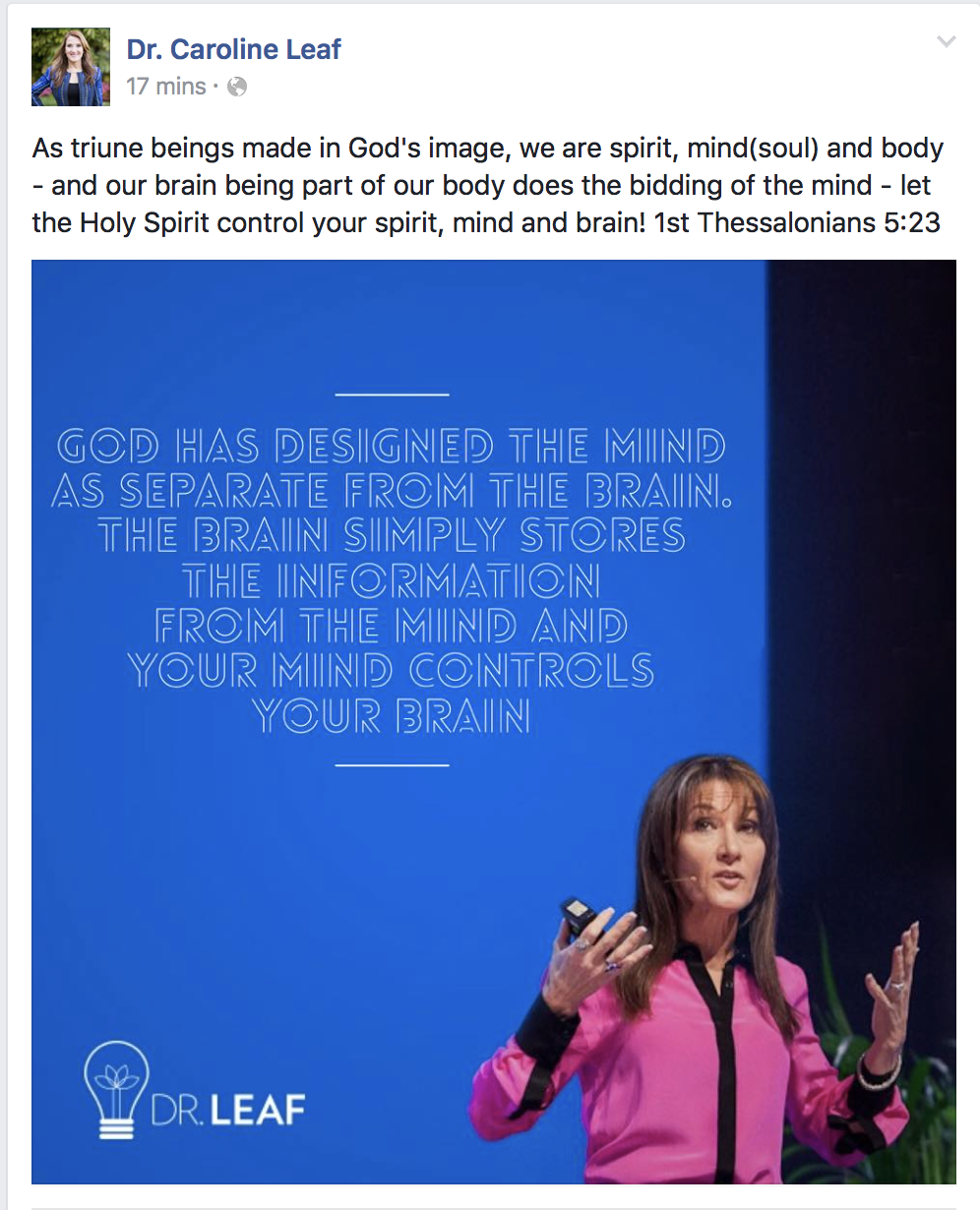
Dr Caroline Leaf is a communication pathologist and a self-titled cognitive neuroscientist. It’s her belief that “as triune beings made in God’s image, we are spirit, mind(soul) and body – and our brain being part of the body does the bidding of the mind …”.

This is one of the flaws that terminally weakens her teaching, and leads to scientifically irrational statements like yesterday’s meme:

“God has designed the mind as seperate from the brain. The brain simply stores the information from the mind and your mind controls your brain.”

On what basis does she make such a claim? I’ve reviewed the scripture relating to the triune being hypothesis. The Bible doesn’t say that our mind is seperate to our brain, nor that it dominates and controls our brain. Dr Leaf’s statement yesterday is simply assumption based on more assumption. It’s like an intellectual house of cards. The slightest puff of scrutiny and the whole thing comes crashing down on itself.

Screen Shot 2016-05-30 at 8.06.38 PM

To try and reinforce her message today, Dr Leaf quoted Dr Jeffrey Schwartz, psychiatrist and neuroscientist, “The mind has the ability to causally affect and change pathways in the brain.” Jeffrey M. Schwartz is an OCD researcher from the UCLA School of Medicine. It appears he lets his Buddhist anti-materialism philosophy cloud his scientific judgement.

Well Dr Leaf, I see your expert and I raise you. Dr David Eagleman is an author and neuroscientist at Baylor College of Medicine in Texas. He has written more than 100 scientific papers on neuroscience, and has published numerous best-selling non-fiction books including ‘Incognito, The Secret Lives of the Brain’ which was a New York Times best-seller. He isn’t an irrational anti-materialist.

He said, “It is clear at this point that we are irrevocably tied to the 3 pounds of strange computational material found within our skulls. The brain is utterly alien to us, and yet our personalities, hopes, fears and aspirations all depend on the integrity of this biological tissue. How do we know this? Because when the brain changes, we change. Our personality, decision-making, risk-aversion, the capacity to see colours or name animals – all these can change, in very specific ways, when the brain is altered by tumours, strokes, drugs, disease or trauma. As much as we like to think about the body and mind living separate existences, the mental is not separable from the physical.” https://goo.gl/uFKF47

This statement makes much more logical sense. The functions of the mind are all vulnerable to changes in the brain. Take medications as one particular example. Caffeine makes us more alert, alcohol makes us sleepy or disinhibited. Marijuana makes it’s users relaxed and hungry, and sometimes paranoid. Pathological gambling, hypersexuality, and compulsive shopping together sound like a party weekend in Las Vegas, but they’re all side effects linked with Dopamine Agonist Drugs, which are used to treat Parkinson’s disease. There are many other examples of many other physical and chemical changes in the brain that affect the mind.

Conversely, there is limited evidence of the effect of the mind on the brain. Sure, there is some evidence of experienced meditators who have larger areas in their brain dedicated to what they meditate on, but the same effect has been shown in other parts of the brain unrelated to our conscious awareness.

But since the mind is a function of the brain, whatever effect the ‘mind’ has on the brain is, in reality, just the brain effecting itself.

So Dr Leaf can cherry-pick from her favourite authors all she wants, but quoting a supportive neuroscientist doesn’t diminish the crushing weight of scientific evidence which opposes her philosophical assumptions. If she wants to continue to proffer such statements, she would be better served to come up with some actual evidence, not just biased opinion.

Anti-depressants – Not the messiah

 “He’s not the messiah, he’s a very naughty boy, now go away!” 

 Ah, Monty Python – six university students with a penchant for satire who changed the face of comedy.  They say that “Imitation is the sincerest form of flattery”, and if that’s the case, Monty Python should be very flattered!  Nearly five decades later, you still hear people throwing around lines from their sketches and getting a laugh.

Their movie, “The Life of Brian” remains one of the most critically acclaimed and most controversial of all movies.  It was the story of Brian, born in the stable next door to Jesus, and who later in life unintentionally becomes the focus of a bunch of people who mistakenly believe he’s the messiah.  One morning he opens his window to find a large crowd of people waiting for him outside his house, leaving his mother to try and dismiss the crowd with that now famous rebuke.

The crowd at Brian’s window aptly demonstrates a quirk in our collective psyche.  We humans have a bipolar tendency to latch on to something that seems like a good idea at the time and blow it’s benefits out of all proportion, only to later discover it wasn’t as good as our overblown expectations and unfairly despise it on the rebound.

Anti-depressant medications are a bit like Monty Python’s Brian.  Back in the late 1980’s when Prozac first came on the market, doctors saw it as the mental health messiah.  Prozac improved cases of long-standing severe depression and was much safer in overdose compared to older classes of psychiatric medications.  The idea that depression and other mental illnesses were related to chemical imbalances fit nicely with the cultural shift away from the Freudian psychotherapy model that was prevalent at the time.  People were describing life changing experiences on Prozac: “One morning I woke up and really did want to live … It was as if the miasma of depression had lifted off me, in the same way that the fog in San Francisco rises as the day wears on.” [1]  Prescribing for Prozac and other SSRI anti-depressants took off.

Fast forward to the present day, where the pendulum has swung back violently.  Anti-depressants are considered by some to be nothing more than over-prescribed placebo medications used by a pill-happy, time-poor culture demanding simple cures for complex problems.  Some commentators have gone so far as to label anti-depressants as an evil tool of the corrupt capitalist psychiatric establishment.

“Anti-depressants are not the messiah, they’re very naughty boys, now go away!” they exclaim.

But are anti-depressants really the enemy, or could they still be friendly, even if they’re not the messiah?

In the Medical Journal of Australia this month, two Australian psychiatrists, Christopher Davey and Andrew Chanen, carefully review the place of anti-depressants in modern medicine [2].  It’s a very balanced and pragmatic view.

They bring together all the evidence to show that while anti-depressants aren’t the elixir of happiness that we once assumed, they also don’t deserve the accusation that they’re nothing but fakes.

When drugs are scientifically tested, they’re usually studied in placebo-controlled trials.  The medications are given to one target group of people and a fake medicine is given to a similar group.  In the best trials, the patients aren’t aware of which they’re actually getting, and the physicians aren’t aware either.  That way personal bias and expectations can be reduced.  To reduce these biases even further, other scientists can pool all of the quality research on a topic in what’s called a meta-analysis.

Trials on anti-depressants initially showed very strong positive results, or in other words, the patients on the drug did much better than those on the placebo.  Anti-depressants lost a lot of their shine in the last decade or so as researchers began pointing out that the placebo effect, the number of patients improving on the fake medicine, was also very high.

There was also the serious, and largely legitimate accusation that drug companies ignored trials with less favourable results to make their drugs look better.  The reputation of anti-depressants was forever tarnished.

One of the most out-spoken critics of anti-depressants, Harvard psychologist Irving Kirsch, tried to show that when all of the trials on anti-depressants were taken together, the placebo effect wasn’t just close to the effectiveness of the real medicine, but was actually the same.

The problem with Kirsch’s analysis is that not all trials are created equal.  Some have negative results because they were poor trials in the first place.  When experts reapplied Kirsch’s methods to the best quality trials, the results suggested that anti-depressants are still effective, but for moderate and severe depression [1].  Anti-depressants for mild depression weren’t of great benefit.

This is take home point number one: Don’t believe the hype.  Anti-depressants are useful, but not for all cases of depression. #happypillshelp

So if anti-depressants aren’t useful for all cases of depression, are other therapies better? This is where psychological therapies come in to the equation.  Those who are the most vocal opponents of modern psychiatry and psychiatric medications are also the most vocal promoters of the benefits of talking therapies.  They won’t admit it, but there’s usually an ideological bias or financial incentive driving the feverish worship of talking therapies and their overzealous defence.

Though in the cold hard light of evidence-based science, talking therapies aren’t much of a panacea either.  Pim Cuijpers, a professor of Clinical Psychology in Amsterdam lead a team who reviewed the effectiveness of trials of psychotherapy, and found that their effectiveness has also been overstated over the last few decades.  Quality studies show that talking therapies are equivalent in effectiveness compared to anti-depressants for depression [3].

What’s important to understand about talking therapies in general is that any benefit they have is related to changing behaviour, but that’s not dependent on changing your thoughts first [4-6].  Talking and thinking differently is fine, but unless that results in a change to your actions, there will probably be little benefit.

This is take home message number two: Talking therapies help, but you don’t need to change your thinking, you need to change your actions. #walkthetalk

The million-dollar question is how to apply all of this.  If talking therapies have the same benefit as anti-depressants, then do we go for tablets before talking or the other way around?  Are both together more powerful than each one alone?

In their paper, Davey and Chanen outline what has become the generally accepted pecking order for anti-depressant therapy.  They recommend that all patients should be offered talking treatments where it’s available.  Medication should only be considered if:

  1. a person’s depression is moderate or severe;
  2. a person doesn’t want to engage with talking therapies; or
  3. talking therapies haven’t worked.

Some overseas guidelines recommend this order based on projected bang for your buck.  While talking therapies are initially more expensive, they seem to have a more durable effect than medications, which are initially cheaper and easier, but have a greater cost with prolonged use [7].  In other words, if you learn better resilience and coping skills, you’re less likely to fall back into depression, compared to the use of the medications.

This is take home message number three: Use talking therapies first, with medications as a back up. #skillsthenpills

At this point in history, we seem to finally be finding some balance.  Just as anti-depressants aren’t the messiah, they’re not the devil either, despite the vocal minority doing their best to demonise them.

With a few decades of research and clinical experience since Prozac was first released on to the market, we’re finally getting an accurate picture of the place of talking therapies and medications in the treatment of depression.  Both are equally effective, and each have their place in the management of mental illness in our modern world.

References

[1]        Mukherjee S. Post Prozac Nation – The Science and History of Treating Depression. The New York Times. 2012 Apr 19
[2]        Davey CG, Chanen AM. The unfulfilled promise of the antidepressant medications. Med J Aust 2016 May 16;204(9):348-50.
[3]        Cuijpers P, van Straten A, Bohlmeijer E, Hollon SD, Andersson G. The effects of psychotherapy for adult depression are overestimated: a meta-analysis of study quality and effect size. Psychological medicine 2010 Feb;40(2):211-23.
[4]        Herbert JD, Forman EM. The Evolution of Cognitive Behavior Therapy: The Rise of Psychological Acceptance and Mindfulness. Acceptance and Mindfulness in Cognitive Behavior Therapy: John Wiley & Sons, Inc., 2011;1-25.
[5]        Longmore RJ, Worrell M. Do we need to challenge thoughts in cognitive behavior therapy? Clinical psychology review 2007 Mar;27(2):173-87.
[6]        Dobson KS, Hollon SD, Dimidjian S, et al. Randomized trial of behavioral activation, cognitive therapy, and antidepressant medication in the prevention of relapse and recurrence in major depression. Journal of consulting and clinical psychology 2008 Jun;76(3):468-77.
[7]        Anderson I. Depression. The Treatment and Management of Depression in Adults (Update). NICE clinical guideline 90.2009. London: The British Psychological Society and The Royal College of Psychiatrists, 2010.

IMPORTANT

If you have questions about what treatment type might be better for you in your situation, please talk to your local GP, psychologist or psychiatrist, or if you need urgent crisis support, then:

In Australia

  • you can call either Lifeline on 13 11 14,
  • BeyondBlue provides a number of different support options
  • the BeyondBlue Support Service provides advice and support via telephone 24/7 (call 1300 22 4636)
  • daily web chat (between 3pm–12am)
  • email (with a response provided within 24 hours) via their website https://www.beyondblue.org.au/about-us/contact-us.

In the US
-> call the National Suicide Prevention Lifeline by calling 1-800-273-TALK (8255).

In New Zealand
-> call Lifeline Aotearoa 24/7 Helpline on 0800 543 354

In the UK
-> Samaritans offer a 24 hour help line, on 116 123.


Dr Caroline Leaf and the nonsense of ‘negative’ thinking.

Screen Shot 2016-02-09 at 7.08.49 PM

The power of positive thinking. It’s like rust on our collective consciousness, an idea that’s seems virtually impossible to eradicate, slowly eating away at our collective psyche. The idea has become so ingrained in our culture that it’s part of our folklore and our idiom, and it continues to be deliberately perpetuated by success coaches, business leaders and others who make a very tidy living by peddling baseless optimism. It’s been repeated so often that the ‘power of positive thinking’ has become an Availability Cascade (a self-reinforcing process by which an idea gains plausibility through repetition).

Herbert and Forman summarise it nicely, “The ideas that thoughts and beliefs lead directly to feelings and behavior, and that to change one’s maladaptive behavior and subjective sense of well-being one must first change one’s cognitions, are central themes of Western folk psychology. We encourage friends to ‘look on the bright side’ of difficult situations in order to improve their distress. We seek to cultivate “positive attitudes” in our children in the belief that this will lead to better academic or athletic performance. Traditional cognitively-oriented models of CBT (e.g., CT, stress inoculation training, and rational emotive behavior therapy) build on these culturally sanctioned ideas by describing causal effects of cognitions on affect and behavior, and by interventions targeting distorted, dysfunctional, or otherwise maladaptive cognitions.” [1]

Dr Caroline Leaf is a communication pathologist and a self-titled cognitive neuroscientist. She is one of the many that continue to perpetuate the myth of positive and negative thinking.

Today’s social media meme was yet another promotion of this misguided idea, and to top it off, she misquoted scripture again in an attempt to reinforce it.

“If you randomly allow any negative thought into your mind damage can ensue on a mental & physical level. ‘We destroy every proud obstacle that keeps people from knowing God. We capture their rebellious thoughts and teach them to obey Christ.’ 2 Corinthians 10:5 NLT”

Lets quickly break meme down to see exactly why Dr Leaf is, yet again, misleading her audience.

1. The mind does not control the brain

Dr Leaf’s meme implies that negative thought damages us mentally and physically. The problem with that is that the mind doesn’t control our brain or our body, so negative thought can’t damage us mentally or physically.

Instead, it’s our brain that gives rise to, and controls our thoughts and feelings. We don’t see what goes on ‘under the hood’ so to speak, we only experience our thoughts and feelings, so we assume that regulate each other. But it’s our brain and a number of other processes that are responsible for generating both our thoughts and feelings (CAP blog).

‘Negative’ thoughts can sometimes be the result of damage to our brain, but ‘negative’ thoughts don’t damage the brain.

In fact, often the so-called ‘negative’ thoughts are actually good for us.

2. Negative thinking is normal and healthy

Dr Leaf’s meme also implies that we control the content of our thoughts by suggesting that we ‘allow’ negative thoughts into our minds. But negative thoughts are meant to be there, which is why we have them. ‘Negative’ thoughts have a positive function. We need them to survive.

For example, we have a fear response to prevent us from continually putting ourselves in danger. We have an anger response to motivate us through difficult obstacles. We have feelings of embarrassment to help maintain social cohesion. As Skinner and Zimmer-Gembeck state, “adaptive coping does not rely exclusively on positive emotions nor on constant dampening of emotional reactions. In fact, emotions like anger have important adaptive functions, such as readying a person to sweep away an obstacle, as well communicating these intentions to others. Adaptive coping profits from flexible access to a range of genuine emotions as well as the ongoing cooperation of emotions with other components of the action system.” [2]

Dr Leaf isn’t helping anyone with her meme today. She’s simply promoting an outdated and unscientific notion, encouraging her audience to suppress normal, helpful adaptive functions for fear of harm that’s not scientifically possible.

Then as if to add insult to injury, she follows up her misleading meme with an equally misleading misrepresentation of 2 Corinthians 10:5.

3. Taking every thought captive?

2 Corinthians 10:5 is Pauls famous scripture about taking every thought captive, a concept which seems to support Dr Leaf’s ideas, except that Paul isn’t speaking generally to us, but specifically about the Corinthian church. Look at the verse in context:

“By the humility and gentleness of Christ, I appeal to you – I, Paul, who am ‘timid’ when face to face with you, but ‘bold’ towards you when away! I beg you that when I come I may not have to be as bold as I expect to be towards some people who think that we live by the standards of this world. For though we live in the world, we do not wage war as the world does. The weapons we fight with are not the weapons of the world. On the contrary, they have divine power to demolish strongholds. We demolish arguments and every pretension that sets itself up against the knowledge of God, and we take captive every thought to make it obedient to Christ. And we will be ready to punish every act of disobedience, once your obedience is complete.
You are judging by appearances. If anyone is confident that they belong to Christ, they should consider again that we belong to Christ just as much as they do. So even if I boast somewhat freely about the authority the Lord gave us for building you up rather than tearing you down, I will not be ashamed of it. I do not want to seem to be trying to frighten you with my letters. For some say, ‘His letters are weighty and forceful, but in person he is unimpressive and his speaking amounts to nothing.’ Such people should realise that what we are in our letters when we are absent, we will be in our actions when we are present.” (NIV UK, 2 Corinthians 10:1-11)

This chapter is a specific rebuke to some of the Christians within the church at Corinth, and also a defence against some of the murmurings and accusations that some in that church were levelling at Paul. For example, in verse 2, “I beg you that when I come I may not have to be as bold as I expect to be towards some people who think that we live by the standards of this world.”

Verses 3-6 are a specific and authoritative rebuttal against the accusations levelled at Paul, paraphrased as, “You may speak against us and the church, but we have weapons that smash strongholds, and we’re coming to take down those pretensions of yours and take every thought of yours captive to make it obedient to Christ, and punish every act of disobedience …”

The specific nature of the verse is also supported by some Bible commentary: “But how does St. Paul meet the charge of being carnally minded in his high office? “Though we walk in the flesh [live a corporeal life], we do not war after the flesh,” or “according to the flesh,” the contrast being in the words “in” and “according.” And forthwith he proceeds to show the difference between walking in the flesh and warring according to the flesh. A warrior he is, an open and avowed warrior – a warrior who was to cast down imaginations and every high thing that exalteth itself against the knowledge of God, and bring into captivity every thought to the obedience of Christ; a warrior too who would punish these Judaizers if they continued their disorganizing work; but a prudent and considerate warrior, deferring the avenging blow till “I am assured of your submission” (Stanley) “that I may not confound the innocent with the guilty, the dupes with the deceivers.” What kind of a preacher he was he had shown long before; what kind of an apostle he was among apostles as to independence, self-support, and resignation of official rights in earthly matters, he had also shown; further yet, what kind of a sufferer and martyr he was had been portrayed.” (C. Lipscomb – http://biblehub.com/commentaries/homiletics/2_corinthians/10.htm)

Similarly, the translation from the original text is more specific than general. The verb used for “bringing into captivity” is aichmalōtízō, “to make captive: – lead away captive, bring into captivity” which is in the Present Active Participle form of the verb. The present tense represents a simple statement of fact or reality viewed as occurring in actual time. The active voice represents the subject as the doer or performer of the action. The Greek participle corresponds for the most part to the English participle, reflecting “-ing” or “-ed” being suffixed to the basic verb form. Actions completed but ongoing or commands are different verb tenses (see https://www.blueletterbible.org/help/greekverbs.cfm for a better explanation). So Paul wasn’t making a general statement, but a specific statement about what he would do in his present time, not the future.

So, Paul isn’t telling us to “bring every thought captive into obedience to Christ”. Dr Leaf is perpetuating a common scriptural misunderstanding.

A verse which better clarifies what God wants for our thought life is Paul’s exhortation to the Philippian church in Philippians 4:8, “Finally, brothers and sisters, whatever is true, whatever is noble, whatever is right, whatever is pure, whatever is lovely, whatever is admirable – if anything is excellent or praiseworthy – think about such things.” Both the context, and the form of the verb, suggest that this is an ongoing command. And it makes better sense too. If we spend all of our time trying to fight against every thought that comes into our head, we’d become exhausted, but we can divert attention to those things that are worthy of our attention. And in many ways, what Paul is encouraging is what would be considered now as simple meditation, which is more scientific than the power of positive thinking.

The moral of this story … ‘negative’ thoughts and feelings don’t do us damage, but trying to unnecessarily suppress them does.

References

[1]     Herbert, J.D. and Forman, E.M., The Evolution of Cognitive Behavior Therapy: The Rise of Psychological Acceptance and Mindfulness, in Acceptance and Mindfulness in Cognitive Behavior Therapy. 2011, John Wiley & Sons, Inc. p. 1-25.
[2]     Skinner EA, Zimmer-Gembeck MJ. The development of coping. Annual review of psychology 2007;58:119-44.

Dr Caroline Leaf – The mystery of he said/she said is no longer a mystery

This weeks edition of New Scientist magazine carried an article entitled “Scans prove there’s no such thing as a ‘male’ or ‘female’ brain” [1].  The article was inspired by a journal article published in the PNAS last month [2], which reviewed the scans of 1400 different people to see if there were specific differences in the neuroanatomy of the brains of men and women (i.e., are there ‘male’ and ‘female’ brains, or are the commonly accepted male/female differences just a myth, or a cultural, not biological phenomenon?)

According to the article, there is an “extensive overlap between the distributions of females and males for all gray matter, white matter, and connections assessed. Moreover, analyses of internal consistency reveal that brains with features that are consistently at one end of the ‘maleness-femaleness’ continuum are rare. Rather, most brains are comprised of unique ‘mosaics’ of features.” [2]

So essentially, there’s no strong biological basis for gender differences after all.  “This means that, averaged across many people, sex differences in brain structure do exist, but an individual brain is likely to be just that: individual, with a mix of features. ‘There are not two types of brain,’ says Joel.” [1]

This news is a blow to one of Dr Leaf’s less renowned books, “Who switched off your brain? Solving the mystery of he said/she said” [3].

Dr Caroline Leaf is a communication pathologist and a self-titled cognitive neuroscientist.  Her ‘he said/she said’ book is based on the idea that there are definitive characteristics of the male and female brain which define each gender.  From her conclusion on page 211,

“Men and women are different.  Both the physical anatomy and functional strategy of our brains are different.  We can’t attribute this to social engineering, cultural norms or our up-bringing.  We’ve been created different – it’s in our fundamental design.  Our parents, our communities, and the cultural context of our childhood and adolescence certainly have a prominent developmental role in each of our lives.  But your brain has been fashioned in a specific way that shapes your ‘true you’ long before any of these other factors have had the opportunity to exercise their influence on you.”

As a quick aside, this quote shows the confusion in Dr Leaf’s teaching.  As I’ve discussed before in other blogs, Dr Leaf contradicts herself by claiming that our brain determines our gifts and our behaviours in some books (like ‘He said/she said’ and ‘The gift in you’) but then claims that our thought life controls our brains and our physical reality in the rest of her teaching.  So which is it?

But this quote also sounds the death knell for her book, in light of the recent scientific evidence to the contrary.  Which is a shame, since out of all of her books, this one initially seemed the most scientifically robust.

Even though the book is based on a now defunct theory, I wonder if the thrust of her book still holds true to a point.  We’ve all been created to be different, and we should celebrate those differences and how they complement other people around us.  It just so happens that those differences aren’t inherent to our gender, but to us as individuals, uniquely designed by God “for good works, which God prepared in advance for us to do” (Ephesians 2:10).

So, yes, the mystery of he said/she said has been solved, but not quite as Dr Leaf envisaged.

References

[1]        Hamzelou J. Scans prove there’s no such thing as a ‘male’ or ‘female’ brain. New Scientist. 2015 Dec 5.
[2]        Joel D, Berman Z, Tavor I, et al. Sex beyond the genitalia: The human brain mosaic. Proceedings of the National Academy of Sciences of the United States of America 2015 Nov 30.
[3]        Leaf CM. Who swithced off your brain: Solving the mystery of he said/she said. Texas, USA: Inprov, Ltd, 2011.

Dr Caroline Leaf and the Me-Too approach to mental health

Screen Shot 2015-11-13 at 3.44.33 pm

Since her recent less-than-successful attempt at portraying herself as a mental health expert, Dr Leaf has been laying low on social media, sticking to bland, innocuous quotes or passages of scripture.

Today, she thought it was safe enough to pop her head up from the trenches to fire off another opinionated volley on mental well-being, with a quote from one of her favourite authors, Peter Kinderman:

“It’s our framework of understanding the world, not our brains and not even the events that happen to us – not nature and not nurture – that determines our thoughts, emotions, behaviours and, therefore, our mental health.”

Dr Leaf is a communication pathologist and self-titled cognitive neuroscientist. Without any training or professional experience in mental illness, she has also taken it upon herself to act as an expert on mental health within the Christian church.

Unfortunately, posting quotes like today’s offering only further destroys her flagging credibility among those with professional psychiatric experience, and adds to the confusion of the rest of the Christian church when it comes to understanding mental illness.

There are two main problems with Dr Leaf’s meme: the quote itself and it’s source.

The quote itself is wafer-thin, unable to stand up to even the most basic interrogation. For example, we know through basic common sense that the brain changes how we think, our moods, our emotions and our behaviours. We change our mood, our emotions and our alertness every time we have a cup of coffee, or a glass of wine. Hallucinogenic medications like LSD definitely change our framework of understanding the world. Coffee, alcohol, and illicit substances like LSD all change the mood or experience of the person using them because they all temporarily alter the function of the users brain.

Though it’s not just external substances that change how we experience our external and internal worlds, but our own internal hormonal ecosystem changes our emotions, our moods, our thoughts and our behaviours. This isn’t so obvious for most men as our hormones are fairly constant, though testicular failure is known to result in reduced energy, vitality, or stamina; depressed mood or diminished sense of well-being; increased irritability; and difficulty concentrating and other cognitive problems. For the female gender, monthly hormonal changes can sometimes result in sudden, marked changes in emotions, moods, thoughts and behaviours.

There are a lot of other reasons why the brain controls the mind, and our mental health, which I’ve also discussed numerous times in other blogs (here, here and here)

If you aren’t satisfied with a common sense approach, then consider the scientific evidence that personality, the name that we give to our inbuilt ‘framework of understanding the world’ is largely genetic, and dependent on the function of various neurotransmitter systems [1-4].

So to suggest that the brain is not responsible for our moods, our emotions, our thoughts and our behaviours isn’t supported by the weight of scientific evidence.

The quote by Kinderman doesn’t stop there, but suggests that “not even the events that happen to us … determines our thoughts, emotions, behaviours”, something that also flies in the face of current scientific evidence. For example, the other forty percent of personality is determined by our environment (specifically the ‘non-shared’ environment, the environment outside of our parental influence) [5, 6]. And common psychiatric illnesses are associated with early childhood adversity, such as schizophrenia [7] and ADHD [8]. So again, the quote is unscientific.

Who then is this Kinderman guy, and why does he disagree with the scientific literature?

Peter Kinderman is a Professor of Psychology at University of Liverpool, and the President-elect of the British Psychological Society. He’s a highly outspoken critic of modern psychiatry and what he perceives to be the medicalisation of normal moods and emotions and overuse of medications to treat these non-existent diagnoses. Kinderman believes that it’s our learning history that shapes the paths that our lives take, and so if we simply understand our personal models of the world and how they were shaped by the events and experiences to which we’ve been exposed, we can simply think our way out of any disease process [9].

Kinderman has come out in favour of talking treatments for psychosis in schizophrenia instead of medication, when there’s no scientific proof of benefit for psychosocial therapies in schizophrenia [10, 11] (and here).

This, and his staunch opposition of the DSM5 as invalid, makes me concerned about his bias against modern psychiatry, despite it’s many advances, scientifically and clinically.

However, I’m surprised that Kinderman would make such a statement because it’s such an asinine argument, I find it hard to believe that it came from a professor of psychology. Kinderman would surely recognise the role of biology in our mental health and wellbeing, even if he doesn’t agree with how it’s managed. Perhaps there’s an alternative explanation. Perhaps Kinderman didn’t say what Dr Leaf has claimed?

The answer is, he does, and he doesn’t.

Dr Leaf has quoted Kinderman correctly. Today’s quote is taken directly out of Kindermans 2014 book, “The New Laws of Psychology” [9], on the penultimate page of his introduction. So he does say that our brains and our experiences aren’t relevant for our mental health. But then again, in a blog on the militant anti-psychiatry blog ‘Mad in America’, Kinderman wrote this:

“I’ve spent much of my professional life studying psychological aspects of mental health problems. Inevitably, this has also meant discussing the role of biology. I hope I’ve made some progress in understanding these issues, in working out how the two relate to each other, and the implications for services. That’s my academic day-job. But it’s not just academic for me. I’m probably not untypical of most people reading this; I can see clear examples of how my experiences may have affected my own mental health, but I can also see reasons to suspect biological, heritable, traits. As in all aspects of human behaviour, both nature and nurture are involved and they have been intimately entwined in a complex interactive dance throughout my childhood and adult life.” http://www.madinamerica.com/2015/03/brain-baked-beans/

So he seems confused, both recognising that biological traits influence psychiatric illness, then denying it.

Personally, I disagree with the quote from his book, although I’m just a suburban GP from Australia, so what would I know, right? Though I think the evidence I’ve cited is on my side, and Kinderman is not without his critics who are more than his academic equal.

It also concerns me because the logical conclusion of this line of thinking is that psychiatric illnesses have no biological basis, and therefore psychiatric medications have no place in treatment of them. But as I outlined previously, there is good evidence for the beneficial effects of medications for schizophrenia and ADHD amongst other mental health disorders.

Dr Leaf continues to ignore the scientific evidence for the biological basis for mental ill-health, medications for their treatment, and even the most basic of all that our mind is a product of our brain. Instead, she’s nailed her colours to her mast and aligned herself with outspoken authors on the fringe of modern neuroscience. Rather than addressing the science behind her opposition to modern psychiatry and neuroscience, she has resorted to hiding behind their quotes, a ‘me-too’ commentator, rather than an actual expert.

Of more importance is the confusion that this brings to the vulnerable Christians who follow her social media “fan sites”. The more Dr Leaf criticises psychiatric medications and condemns their prescription and usage, the more likely it is that someone will come to serious harm when they inappropriately cease their medications. And if Dr Leaf won’t come to her senses, our church leaders are going to have to take action, before it’s too late.

References

[1]        Vinkhuyzen AA, Pedersen NL, Yang J, et al. Common SNPs explain some of the variation in the personality dimensions of neuroticism and extraversion. Translational psychiatry 2012;2:e102.
[2]        Chen C, Chen C, Moyzis R, et al. Contributions of dopamine-related genes and environmental factors to highly sensitive personality: a multi-step neuronal system-level approach. PloS one 2011;6(7):e21636.
[3]        Caspi A, Hariri AR, Holmes A, Uher R, Moffitt TE. Genetic sensitivity to the environment: the case of the serotonin transporter gene and its implications for studying complex diseases and traits. The American journal of psychiatry 2010 May;167(5):509-27.
[4]        Felten A, Montag C, Markett S, Walter NT, Reuter M. Genetically determined dopamine availability predicts disposition for depression. Brain and behavior 2011 Nov;1(2):109-18.
[5]        Krueger RF, South S, Johnson W, Iacono W. The heritability of personality is not always 50%: gene-environment interactions and correlations between personality and parenting. Journal of personality 2008 Dec;76(6):1485-522.
[6]        Johnson W, Turkheimer E, Gottesman, II, Bouchard TJ, Jr. Beyond Heritability: Twin Studies in Behavioral Research. Current directions in psychological science 2010 Aug 1;18(4):217-20.
[7]        Howes OD, Murray RM. Schizophrenia: an integrated sociodevelopmental-cognitive model. Lancet 2014 May 10;383(9929):1677-87.
[8]        Thapar A, Cooper M, Eyre O, Langley K. What have we learnt about the causes of ADHD? Journal of child psychology and psychiatry, and allied disciplines 2013 Jan;54(1):3-16.
[9]        Kinderman P. The New Laws of Psychology: Why Nature and Nurture Alone Can’t Explain Human Behaviour: Robinson, 2014.
[10]      Buckley LA, Maayan N, Soares-Weiser K, Adams CE. Supportive therapy for schizophrenia. The Cochrane database of systematic reviews 2015;4:CD004716.
[11]      Jones C, Hacker D, Cormac I, Meaden A, Irving CB. Cognitive behaviour therapy versus other psychosocial treatments for schizophrenia. The Cochrane database of systematic reviews 2012;4:CD008712.

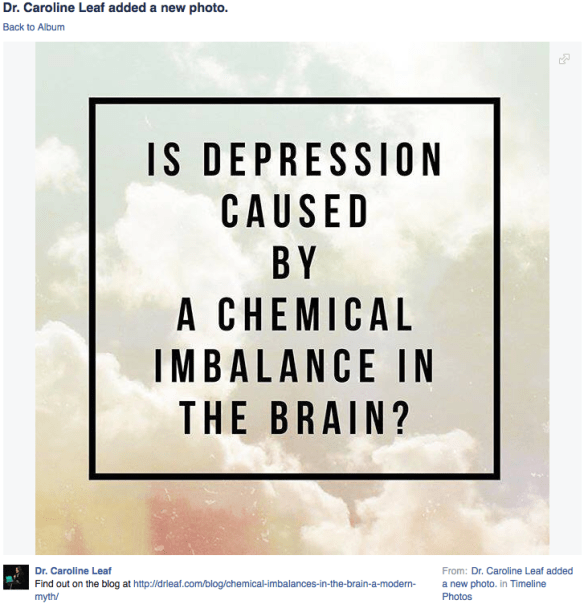
Dr Caroline Leaf and the Myth of the Chemical Imbalance Myth

Screen Shot 2015-10-27 at 2.49.38 am

There are lots of medical myths that people believe.

“I have acne because I eat too much chocolate, or my face isn’t clean enough”

“Stomach ulcers are because of stress”

“I coughed up some yellow phlegm, so I must need antibiotics right?”

“My baby’s fevers are because of teething.”

Is the “chemical imbalance” theory one of them?

Dr Leaf is a communication pathologist and self-titled cognitive neuroscientist. A couple of weeks ago she opened a proverbial can of worms by quoting the out-spoken Peter Gøtzsche, claiming that psychiatric drugs are the third leading cause of death after heart disease and cancer. This did not go down well, and Dr Leaf had to issue three separate statements on social media to try and justify herself and attempt to rescue her rapidly deteriorating credibility.

Not that she issued an apology, mind you, or retracted her statement.

Today, Dr Leaf published a blog on psychiatric medications … but again, not to apologise but to further justify why she’s right, and nearly every other doctor and scientist in the world is not. Worse than that, she went so far as to accuse doctors of deliberately prescribing “clearly dangerous” drugs, which she claims have no therapeutic effects, just because of some overcooked drug-company sponsored dinner and a few pens. More on that later.

Her post is a defiant deflection, a logically flawed and factually inaccurate criticism of modern psychiatry and psychopharmacology – not fueled by research, but largely based on the books of disgruntled fringe psychiatrists and researchers with an axe to grind.

Dr Leaf doesn’t discuss the actual science of the medications that she’s so against, but simply tries to create a smokescreen of distrust.

A good example of all that is wrong with this post is contained in the opening paragraph.

Today, it has become commonplace to say that people have chemical imbalances in their brain, most notably a disruption in the proper production of dopamine (for “diseases” like ADHD) and serotonin (for “diseases” like depression). These people, it is supposed, need drugs to “cure” these chemical imbalances, hence the terms “antipsychotics” or “antidepressants”.

The first thing to note is how Dr Leaf uses the term “cure”. No doctor ever uses the word “cure”, especially when talking about complex diseases. This is a pejorative term implying that modern medicine is only interested in permanently fixing things. But it’s a straw man fallacy, a false premise that Dr Leaf then uses to cast the medical model as impotent and futile. Nice try, but no one in medicine ever promises cure, and no doctor in their right mind would ever be so narrow-minded as to suggest that drugs are the only treatment for every condition. That doesn’t mean that drugs aren’t useful, nor that the medical model is broken. As we’ll discuss soon, medications are extremely helpful for certain conditions, when used carefully, as are non-drug treatments like CBT.

Dr Leaf also puts inverted commas around the word “diseases” as if to suggest that ADHD and depression aren’t diseases, an act which smacks of petulance and willful ignorance, and is insulting to those who have or who have ever suffered from ADHD and depression.   Last week, Dr Leaf was happy to share that her eldest daughter suffered from bulimia and depression, but now she’s suggesting that depression isn’t really a disease. So what is it then? Malingering? Personal weakness? Bad parenting?

It’s really surprising that someone claiming to be a cognitive neuroscientist would ignore strong scientific evidence.  For example, ADHD is associated with dopamine dysfunction as well as the dysfunction a number of other neurotransmitters [1-3]. And depression is associated with a decrease in the growth factor BDNF, (known as the neurotrophic hypothesis of depression) [4-6]. Schizophrenia, which Dr Leaf conveniently failed to mention, is clearly related to dopamine dysfunction in nerve cells of the pre-frontal cortex and the striatum, two parts of the brain that are incredibly important for how your brain processes incoming and outgoing signals [7-9].

There’s nothing to suppose here .. there’s ample evidence that psychiatric diseases are related to dysfunction within the brain, commonly with the function of neurotransmitters among other things. Call it whatever you like, the truth doesn’t change. “Chemical imbalance” is just an easy phrase for the general public to remember.

Dr Leaf then tries to suggest that psychiatric drugs don’t fix chemical imbalances but create them, citing the 1950’s observations of French researchers Deniker and Delay who noted that the first anti-psychotic, chlorpromazine, caused symptoms of Parkinson’s Disease. And indeed it did, but this wasn’t a new disease, just evidence that it worked.

Psychosis, a pathological state involving hallucinations and delusions, is because of an excess of the neurotransmitter called dopamine. Dopamine is the neurotransmitter that’s used by the nerve cells deep in the brain in a part called the basal ganglia, which acts like a central mail delivery centre for incoming and outgoing signals from other parts of the brain. The function of the nerves in one part of the basal ganglia are responsible for sending sensory signals to the frontal lobes of the brain. In another part, the signals are important for smooth movements of our muscles. Proper function depends on just the right amount of dopamine – too much and you get psychosis. Not enough and you get Parkinson’s disease symptoms.

The French researchers were simply noting the side-effects of too much medication blocking the action of dopamine in the basal ganglia – the psychosis had improved, but the blockade of dopamine was just too much in some patients, who had the opposite symptoms.

Again, Dr Leaf’s position is diametrically opposed to the published science [10, 11], and if anything, her claim contradicts her fundamental argument. After all, if chemical imbalances are myths, then how can chlorpromazine create a “new neurological syndrome” because of a chemical imbalance?

Dr Leaf then launches into a discussion on the history of the DSM and psychiatric medications. This is just the first in her ad hominem attacks on the medical profession –  playing the man, not the ball if you will. If she can discredit the doctors that prescribe the medication, then she indirectly discredits the medications.  This appears desperate and ultimately serves to weaken her case.

“It was just assumed that since these drugs affected brain chemistry in a certain way, the opposite reaction must be the result of the disease, notwithstanding the fact that this has never been adequately proven.”

The history of medicine is littered with cures being found without the disease being fully understood. Take Edward Jenner, for example, who is the founder of the modern technique of vaccination. He didn’t know why his smallpox vaccine worked, only that it did. Electron microscopes and a modern understanding of the immune system were centuries away, but Jenner saved billions of lives through his observation that prior vaccination with a small sample of cowpox virus would protect against smallpox [12].

When amphetamines, known to increase dopamine concentrations in the brain, caused psychotic symptoms and reserpine, a dopamine blocker, improved psychosis, it stood to reason that dopamine was a good candidate as a cause of psychosis and schizophrenia. Decades of research have gone on to further confirm and delineate the link [7]. Again, this is not “an overly simplistic explanation of chemical imbalances”. It is well proven, and rather complex.

Dr Leaf also makes the astounding accusation that psychiatrists inflicted suffering and caused “a public health disaster” by creating the DSM. The DSM, the ‘Diagnostic and Statistical Manual’ is an agreed-upon standard classification for psychiatric diagnoses. It is nothing more than a system of classification. It allows psychiatrists and researchers to speak a common language and attempt some coherence among their diagnoses.

Dr Leaf wrote, “… institutions like the American Psychiatric Association and the DSM would define what is normal, in turn telling us what it means to suffer and, essentially, what it means to be human. They medicalized misery, and today millions are suffering because of their actions, creating a public health disaster.”

That’s like saying that classifying the different types of cancer causes cancer. And that millions of people are suffering from cancer because doctors know to call it ‘cancer’. People have been suffering long before the DSM came along. The DSM doesn’t tell people they’re suffering, and it certainly doesn’t define what it is to be human. Such statements are disingenuous and melodramatic.

But wait, there’s more. “Today a psychiatrist can be praised for drugging a depressed person with mind-altering substances and, if these do not work, institutionalizing them and shocking their brain with ECT (electroconvulsive therapy). It is even an acceptable and commonplace practice to imprison mentally ill persons, drug them and lock them in solitary confinement, compelling them to live their days marinating in their own excrement.”

Dr Leaf is again playing to the fears of the public who have watched too many movies and only think of ‘One Flew Over the Cuckoo’s Nest’, ‘Shutter Island’ or scenes from ’12 Monkeys’. There are more oversight boards and lawyers than there are psychiatric patients, and the only people who are institutionalised are those who are clearly a danger to themselves or others. And while institutionalised, they are not subjected to random bouts of electrical shock as if some doctor is wandering around with a medical grade cattle prod, zapping people and laughing maniacally. Nor is anyone locked in solitary confinement and forced “to live their days marinating in their own excrement”.

The paranoid accusations continue some more. Dr Leaf accuses all psychiatrists of ignorance, and then accuses primary care physicians of negligence, by claiming that we prescribe medications that we do not understand because of the bribes and a pretty smile from a pharmaceutical rep.

Again, Dr Leaf contradicts her own argument:

Despite the recognition amongst many psychiatrists and medical health professionals that the chemical imbalance theory is not valid, drug companies like Eli Lilly still claim that ‘antipsychotic medicines are believed to work by balancing the chemical found naturally in the brain’.

Except that antipsychotic medications DO balance the naturally occurring chemical in the brain (dopamine) as we discussed earlier. What the … a drug company telling doctors how their drug works! How dare they tell the truth!

I find it disturbing that Dr Leaf would stoop so low as to insult the entire medical profession, especially every GP and family physician the world over.

Hey, I’m not above criticism. It’s important to have a good long look at ourselves from time to time, to review our practice, and make sure we’re treating our patients in the best possible way. The RACGP, the peak body of Australian GP’s, invited Prof Gøtzsche to present his opinions on anti-depressant medications so that GP’s could decide for themselves if they should adjust their prescribing.

But to suggest that primary care physicians are stupid, ignorant, incompetent and money hungry … that we would sell our soul for a drug company branded pen … is insulting. Though the irony of her statement, “we do not ask ourselves if these doctors really understand all the implications of using these substances. Not even the psychiatrists understand these drugs” is clearly lost on Dr Leaf.  It’s certainly clear from the rest of her essay that Dr Leaf has no idea how these medications work or what benefits they have for those who suffer from mental ill-health.

There’s a lot more to discuss in response to Dr Leaf’s diatribe, but for the sake of brevity, I’ll try and discuss just a couple of other important themes.

Dr Leaf continues to try to make the medications sound useless and poisonous. She has several paragraphs on the placebo effect, making the false argument that the effect of the medications is just because someone tells you it will work. Of course, the placebo effect is part of the therapeutic effect, but that’s the same for all treatments, even Dr Leaf’s programs … “So, if the pastor or cell-group leader says that these programs are safe and will fix your toxic thinking, even though they get most of their information from the author, we believe wholeheartedly in what he or she may say and are more inclined to believe the program will work for us. These beliefs, which ignore actual scientific results, are buttressed by a flood of distorted and biased news reports, press releases and scientific journal articles on supposed toxic thoughts, and have transformed the theory into church dogma. So, obviously, if we experience negative side effects and do not feel the program is working, it must be something wrong with us, not the program.” Is that a fair statement?

Dr Leaf then plays the fear card again by listing all of the potential side effects from psychiatric medications. Dr Leaf is right in saying that psychiatric medications have serious proven long term side effects, and we should be careful.

For instance, if you knew that thrombocytopenia, anaphylaxis, cutaneous hypersensitivity reactions including skin rashes, angioedema and Stevens Johnson syndrome, bronchospasm and hepatic dysfunction were the potential side effects for a medication, would you take it? Most people wouldn’t.  Reading the list makes that drug sound really dangerous.  We should be up in arms about such a potentially harmful drug being put up for sale … except that this list of side effects isn’t a psychiatric drug at all, but’s actually the side effect profile of paracetamol (acetaminophen in the US). People take paracetamol all the time without even thinking about it.

Saying that we shouldn’t take medications because of potential side effects is a scarecrow argument, a scary sounding straw man fallacy. All drugs have serious proven long term side effects. Licencing and prescribing a medication depends on the overall balance of the good and the harm that a medication does. And no one has ever hidden these side effects from the public as if there is a giant conspiracy from the doctors and the pharmaceutical companies. They’re right there in the product information (here is the product information for fluoxetine. See for yourself).

Whilst it’s true that these side effects do happen, we know that they happen infrequently, just like we know that people win lotteries infrequently. Even so, the medications are not just doled out like sweets at a candy store. You require a minimum of ten years of university level education to be able to prescribe them.

Patients ALWAYS have a right to ask questions about possible benefits and side effects, and in my practice, I tell my patients the pros and the cons before prescribing, and I give them the choice of whether they want them or not. No one is ever forced into taking them.

Finally, Dr Leaf makes a number of irrational statements and flawed arguments in her final page of ranting. Let me quickly go through some of the honourable mentions:

* “Most people recover from depression without antidepressants” – true, because most cases of depression are mild. That doesn’t mean to say that antidepressants shouldn’t be used for severe depression, just like most people recover from upper respiratory infections without antibiotics, but that doesn’t mean that we shouldn’t use antibiotics for severe tonsillitis or pneumonia.
* “Antidepressants are no better than placebos” – It’s a controversial topic right now. There are many pushing the barrow that SSRI medications are no better than a sugar pill. But Dr Leaf has conveniently ignored several Cochrane reviews (the best of medical evidence) that shows anti-depressants work for a variety of disorders [13-15], but that psychological therapy might not [16].
* Equating antidepressants and antipsychotics with illicit drugs, and claiming that “more people die from overdoses of psychiatric drugs than illicit drugs” – This is Reductio ad absurdum – the logical conclusion from this argument is that illicit drugs are safer than psychiatric drugs. And therefore we should not give people psychiatric drugs since we don’t give people the ‘safer’ illicit drugs. But that conclusion is absurd, and when you think about it, the whole thing is based on hidden false premises – people rarely die of illicit drug overdoses because they’re illegal and are hard to come by. And also, people who use illicit drugs are not usually suicidal, whereas those given psychiatric medications sometimes are suicidal, and sometimes use them to try and commit suicide. But modern psychiatric drugs are much less dangerous in overdose than their old counterparts.  It should also be noted here that more overdose suicide attempts are with paracetamol or ibuprofen than with psychiatric medications [19], but I don’t see paracetamol or ibuprofen being demonised.
* Psychiatric medications are part of a neo-liberal capitalist plot to keep the rich, richer and the poor, poorer – To me, this looks like Dr Leaf clutching at straws. Her statement, “By emphasizing that the problem lies within an individual’s biology, we are less inclined to look at their experiences and the social context of why they are feeling the way they feel. We look at the mythical chemical imbalance instead of economic exploitation, violence and inept political structures” is false.   Schizophrenia is often seriously discussed in terms of neurodevelopment and not just ‘chemical imbalances’ [17, 18]. So it’s just plain wrong to suggest that researchers don’t look at the “economic exploitation, violence and inept political structures”. Oh, and Dr Leaf suggests that foster children are abused because they’re all forced to take psychiatric medication, and implies that ADHD children are abused by being force-fed Ritalin because they “move a lot in class”. Again, these are emotional over-generalisations that have no basis in reality.

Dr Leaf seems lost.  She’s ignored solid published medical and scientific evidence in coming to an opinion based on the discontented rumblings of a few vocal but outspoken critics. In order to make her arguments, she has had to resort to borderline-slanderous ad hominem attacks on scientists and the medical profession, and purely emotional arguments based on fear and mistrust.

And this was only part one.  If Dr Leaf’s promised second part is anything like the first, we’re in for a real treat.

Though as if that wasn’t enough, by suggesting that psychiatric drugs cause changes in your brain, cause chemical imbalances, and cause that slew of negative side effects, Dr Leaf is admitting that it’s your brain that changes your thought life, which directly contradicts her most recent teachings. After all, if thought was the dominant force in your neurology and your mind controlled your brain, then the medications would have no effect since they’re physical and aren’t connected to our mind.

So which is it? Because if the brain controls our mind, then her best-seller needs to be pulped and refunds offered to the hundred of thousands of people who bought it. But on the other hand, if the mind really does control the brain, then her entire argument against psychiatric medications implodes.

Dr Leaf has painted herself into a corner and there’s still part two to come.

References

[1]        Prince J. Catecholamine dysfunction in attention-deficit/hyperactivity disorder: an update. J Clin Psychopharmacol 2008 Jun;28(3 Suppl 2):S39-45.
[2]        Del Campo N, Chamberlain SR, Sahakian BJ, Robbins TW. The roles of dopamine and noradrenaline in the pathophysiology and treatment of attention-deficit/hyperactivity disorder. Biological psychiatry 2011 Jun 15;69(12):e145-57.
[3]        Cortese S. The neurobiology and genetics of Attention-Deficit/Hyperactivity Disorder (ADHD): what every clinician should know. European journal of paediatric neurology : EJPN : official journal of the European Paediatric Neurology Society 2012 Sep;16(5):422-33.
[4]        Haase J, Brown E. Integrating the monoamine, neurotrophin and cytokine hypotheses of depression–a central role for the serotonin transporter? Pharmacol Ther 2015 Mar;147:1-11.
[5]        Bus BA, Molendijk ML, Tendolkar I, et al. Chronic depression is associated with a pronounced decrease in serum brain-derived neurotrophic factor over time. Molecular psychiatry 2015 May;20(5):602-8.
[6]        Sousa CN, Meneses LN, Vasconcelos GS, et al. Reversal of corticosterone-induced BDNF alterations by the natural antioxidant alpha-lipoic acid alone and combined with desvenlafaxine: Emphasis on the neurotrophic hypothesis of depression. Psychiatry research 2015 Sep 1.
[7]        Howes OD, Fusar-Poli P, Bloomfield M, Selvaraj S, McGuire P. From the prodrome to chronic schizophrenia: the neurobiology underlying psychotic symptoms and cognitive impairments. Curr Pharm Des 2012;18(4):459-65.
[8]        Williams GV, Castner SA. Under the curve: critical issues for elucidating D1 receptor function in working memory. Neuroscience 2006 Apr 28;139(1):263-76.
[9]        Der-Avakian A, Markou A. The neurobiology of anhedonia and other reward-related deficits. Trends Neurosci 2012 Jan;35(1):68-77.
[10]      Leucht S, Tardy M, Komossa K, et al. Antipsychotic drugs versus placebo for relapse prevention in schizophrenia: a systematic review and meta-analysis. Lancet 2012 Jun 2;379(9831):2063-71.
[11]      Torniainen M, Mittendorfer-Rutz E, Tanskanen A, et al. Antipsychotic treatment and mortality in schizophrenia. Schizophrenia bulletin 2015 May;41(3):656-63.
[12]      Riedel S. Edward Jenner and the history of smallpox and vaccination. Proc (Bayl Univ Med Cent) 2005 Jan;18(1):21-5.
[13]      Arroll B, Elley CR, Fishman T, et al. Antidepressants versus placebo for depression in primary care. The Cochrane database of systematic reviews 2009(3):CD007954.
[14]      Soomro GM, Altman D, Rajagopal S, Oakley-Browne M. Selective serotonin re-uptake inhibitors (SSRIs) versus placebo for obsessive compulsive disorder (OCD). The Cochrane database of systematic reviews 2008(1):CD001765.
[15]      Kapczinski F, Lima MS, Souza JS, Schmitt R. Antidepressants for generalized anxiety disorder. The Cochrane database of systematic reviews 2003(2):CD003592.
[16]      Jakobsen JC, Lindschou Hansen J, Storebo OJ, Simonsen E, Gluud C. The effects of cognitive therapy versus ‘treatment as usual’ in patients with major depressive disorder. PloS one 2011;6(8):e22890.
[17]      van Os J, Linscott RJ, Myin-Germeys I, Delespaul P, Krabbendam L. A systematic review and meta-analysis of the psychosis continuum: evidence for a psychosis proneness-persistence-impairment model of psychotic disorder. Psychological medicine 2009 Feb;39(2):179-95.
[18]      Howes OD, Murray RM. Schizophrenia: an integrated sociodevelopmental-cognitive model. Lancet 2014 May 10;383(9929):1677-87.
[19]     Prescott K, Stratton R, Freyer A, Hall I, Le Jeune I. Detailed analyses of self-poisoning episodes presenting to a large regional teaching hospital in the UK. Br J Clin Pharmacol 2009 Aug;68(2):260-8.

Disclaimer

  1. Do not abruptly stop any medications that you are taking. Talk to your licenced physician first. They’re not all money-hungry, imbecilic drug-company bitches. Most of them actually know what they’re talking about.
  2. For the record, I declare that I have no connection with any pharmaceutical company. I do not accept gratuities of any form from any sales representative. I don’t eat their food, I don’t take their pens, and I don’t listen to their sales pitches

Update – 8 August 2016.

Dr Leaf has since taken the offending post from her blog page, and re-gifted it as an answer on her “Scientific” FAQ page (“Chemical Imbalances and Mental Health” http://drleaf.com/about/scientific-faqs/).  It remains as unbalanced and inaccurate as it’s former iteration.  It’s unfortunate that Dr Leaf continues to make such preposterous claims in the face of overwhelming scientific evidence to the contrary.

Dr Caroline Leaf – Thoughts are real. So what?

Screen Shot 2015-10-05 at 12.53.02 pm

Today’s meme from Dr Leaf is one of her favourite, often repeated phrases:

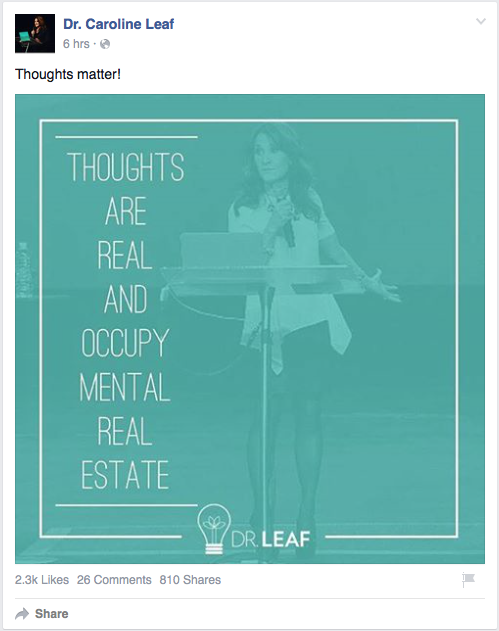
“Thoughts are real and occupy mental real estate.”

Dr Caroline Leaf is a communication pathologist and a self-titled cognitive neuroscientist. Her entire preaching empire rests on her assumption that our thinking is the driving force of not just our mental health but also our physical health, and even physical matter!

No one’s denying that thoughts are real. The key issue is not whether thoughts are real, but what thoughts really are.

Professor Bernard J. Baars is an Affiliate Fellow at The Neurosciences Institute in La Jolla, California. He is a real cognitive neuroscientist. In the late 1980’s, Professor Baars built on Baddeley’s model of working memory by proposed the Global Workspace theory [1]. Together with Professor Stan Franklin, also a real cognitive neuroscientist (and a mathematician and computer scientist) at the University of Memphis, they took the Global Workspace theory further with the Intelligent Distribution Agent model [2]. Central to this model is the “Cognitive Cycle”, a nine-step description of the underlying process from perception through to action. In the model, implicit neural information processing is considered to be a continuing stream of cognitive cycles, overlapping so they act in parallel. The conscious broadcast of our thought stream is limited to a single cognitive cycle at any given instant, so while these thought cycles run in in parallel, our awareness of them is in the serial, sometimes disparate, streams of words or pictures in our minds. Baars and Franklin suggests that about ten cycles could be running per second, and since working-memory tasks occur on the order of seconds, several cognitive cycles may be needed for any given working memory task, especially if it has conscious components such as mental rehearsal [2].

In recent years, the Global Workspace/Intelligent Distribution Agent hypothesis has been updated to help facilitate the quest to create different forms of artificial intelligence. The LIDA (“Learning Intelligent Distribution Agent”) model incorporates the Global Workspace theory with the concepts of memory formation to create a single, broad, systems-level model of the mind.

Franklin et al summarise the process, “During each cognitive cycle the LIDA agent first makes sense of its current situation as best as it can by updating its representation of its current situation, both external and internal. By a competitive process, as specified by Global Workspace Theory, it then decides what portion of the represented situation is the most salient, the most in need of attention. Broadcasting this portion, the current contents of consciousness, enables the agent to chose an appropriate action and execute it, completing the cycle.” [3]

Information within the cognitive cycle is broadcast to our consciousness in order to recruit a wider area of the brain to enhance the processing of that information [2, 4]. It’s the broadcasting of this portion of the information flow that renders it “conscious”.

So thought is nothing more than a broadcast of one part of a deeper flow of information. In the same way that a projection on a movie screen is a real series of images of a historical or fictional event, but not the actual event, so thoughts are a real but are just a projection of the deeper information stream within the brain.

This is very important, as it means that thought is not an instigator or a controlling force. It’s not a case of, “I think, therefore, I am”, but, “I am, therefore, I think.

So Dr Leaf is right, thoughts are real. So what? Thoughts are just a projection, a function of the brain. They are not independent of the brain and they do not control the brain. And they definitely don’t control physical matter.

In posting things like todays meme, Dr Leaf is proving just how far her assumptions are from the work of real cognitive neuroscientists, while misdirecting her audience, duping them into believing that her tenuous speculation is scientific fact.

References

[1]        Baars BJ. A cognitive theory of consciousness. Cambridge England ; New York: Cambridge University Press, 1988.
[2]        Baars BJ, Franklin S. How conscious experience and working memory interact. Trends in cognitive sciences 2003 Apr;7(4):166-72.
[3]        Franklin S, Strain S, McCall R, Baars B. Conceptual Commitments of the LIDA Model of Cognition. Journal of Artificial General Intelligence 2013;4(2):1-22.
[4]        Baars BJ. Global workspace theory of consciousness: toward a cognitive neuroscience of human experience. Progress in brain research 2005;150:45-53.

Dr Caroline Leaf and the Mental Monopoly Myth (Mark II)


Screen Shot 2015-10-02 at 9.27.19 pm

In my last post, I asked the question, “What’s more important to a person’s health and well being?” and I showed that Dr Caroline Leaf proposition that the mind dominates ones mental health and well-being is patently false.

Not to be outdone, Dr Leaf countered today with a tweak to her initial proposition: “Mind-action is actually THE predominant element in mental well-being.”

Dr Caroline Leaf is a communication pathologist and self-titled cognitive neuroscientist. She’s also started calling herself an expert in mental health, despite never having trained in medicine or psychology, or working in counselling.

Dr Leaf may have tightened up her wording from her previous statement, but her claim that mind-action is the predominant element in mental well-being is still wrong, because her fundamental assumption is wrong.

What fundamental assumption? That the brain doesn’t control the mind, but the mind controls the brain.

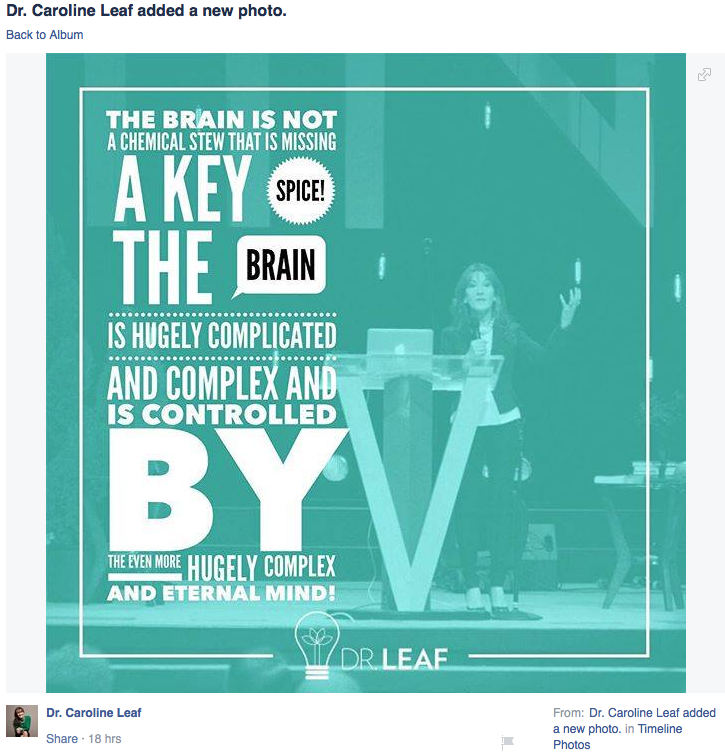
As I discussed in the last post, this idea of the mental monopoly dominates every one of Dr Leaf’s works, and most of her social media memes. Take her most recent meme for example, published just today, “The brain is not a chemical stew that is missing a key spice! The brain is hugely complicated and complex and is controlled by the even more hugely complex and eternal mind!”

Screen Shot 2015-10-02 at 9.26.07 pm

The premise that the mind controls the brain is wrong. Completely and utterly wrong. It is precisely the opposite of what science tells us. The mind is a function of the brain, just like breathing is a function of the lungs. No lungs, no breath. No brain, no mind. (see my posts here, here and here, and others for further discussion)

consistencydemotivator

It’s been said, “Consistency: It’s only a virtue if you’re not a screwup.” Perhaps that’s a little harsh, but it does illustrate the point that just because you say something often enough, doesn’t make it true. So no matter how many times Dr Leaf repeats herself, the fact that the brain controls the mind isn’t going to change.

Even without appealing to the plethora of scientific information out there, Dr Leaf’s claim that mind-action dominates mental well-being is wrong, since mind-action is simply brain-action, which in turn, is influenced by the complex interplay of our genes, our physical health, our uncontrollable external environment, our social networks and our spirituality. Our mental well-being is no different to our general well-being in this regard. It is still part of the complex interplay that is represented by the biopsychosocial (and spiritual) model.

It’s time for Dr Leaf to update her teaching, and abandon her unscientific presuppositions and philosophies.