Does sadness make you sick?

LeafMeme20160107

We’ve all heard of being “homesick”, or “heartsick”, or “lovesick”.   Sometimes when we’re extremely sad, we feel the knot in our stomachs, the pressure in our chests, or the confusion and distraction in our minds as the waves of sadness wash over and discombobulate us.

But can being sad really make you physically ill as well as emotionally distraught?

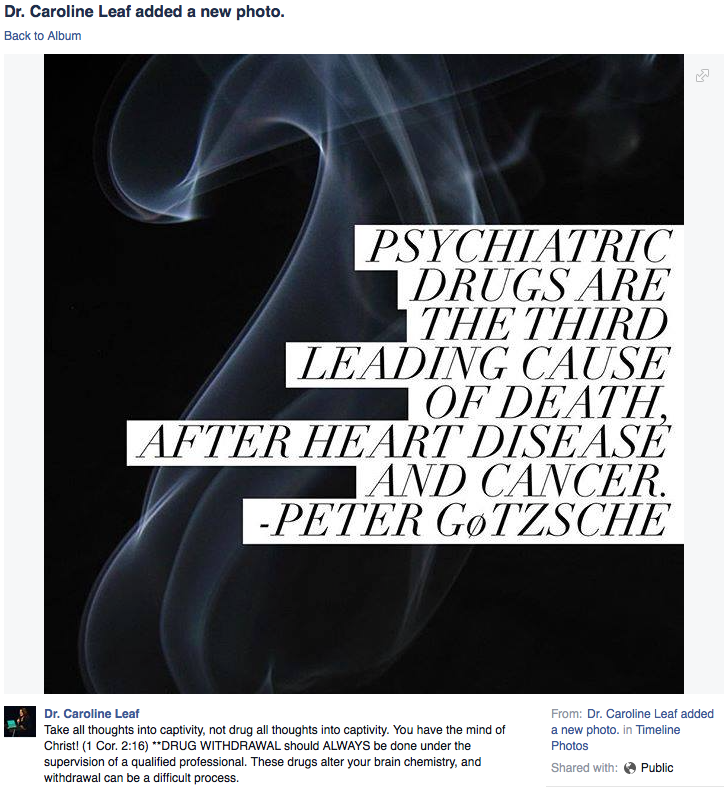
Dr Caroline Leaf declared today on her social media platforms that “Feeling sad can alter levels of stress-related opioids in the brain and increase levels of inflammatory proteins in the blood that are linked to increased risk of comorbid diseases including heart disease, stroke and metabolic syndrome.”

Dr Caroline Leaf is a communication pathologist and a self-titled cognitive neuroscientist.  She believes that our cognitive stream of thought determines our physical and mental health, and can even influence physical matter through the power of our minds.

She also added some further interpretation to her meme: “So this is more evidence that our thoughts do count: they have major epigenetic effects on the brain and body! We need to apply the principles in the Bible and listen to the Holy Spirit – no excuses this year!”

With all due respect to Dr Leaf, the study she quotes doesn’t prove anything of the sort.

Dr Leaf’s meme is a copy and paste of the opening paragraph of a news report published by the university’s PR people to promote their faculty.  This isn’t a scientific summary, it’s a hook to draw attention to an article which amounts to a PR puff piece.  If Dr Leaf had read further into the article, I don’t think she would have been quite so bold in claiming what she did.

The article discussed a study by Prossin and colleagues, published in Molecular Psychiatry [1].  You can read the original study here.  The study specifically measured the change in the level of the activity of the opioid neurotransmitter system and the amount of a pro-inflammatory cytokine IL-18 across two experimental mood states, and in two different groups of volunteers, people with depression, and those without.

For a start, it’s important to note that the study isn’t referring to normal day-to-day sadness.  This was an experimentally induced condition in which a sad memory was rehearsed so that the same feeling could be reproduced in a scanner, and the study was looking at the effect of this sad “mood” on people who were pathologically sad, that is, people diagnosed with major depression.

It’s well known that people with depression are at a higher risk of major illnesses, such as heart attacks, strokes and diabetes [2] The current study by Prossin et al looked experimentally at one possible link in the chain, a link between a neurotransmitter system that’s thought to change with emotional states, and one of the chemical mediators of inflammation.

They found that:

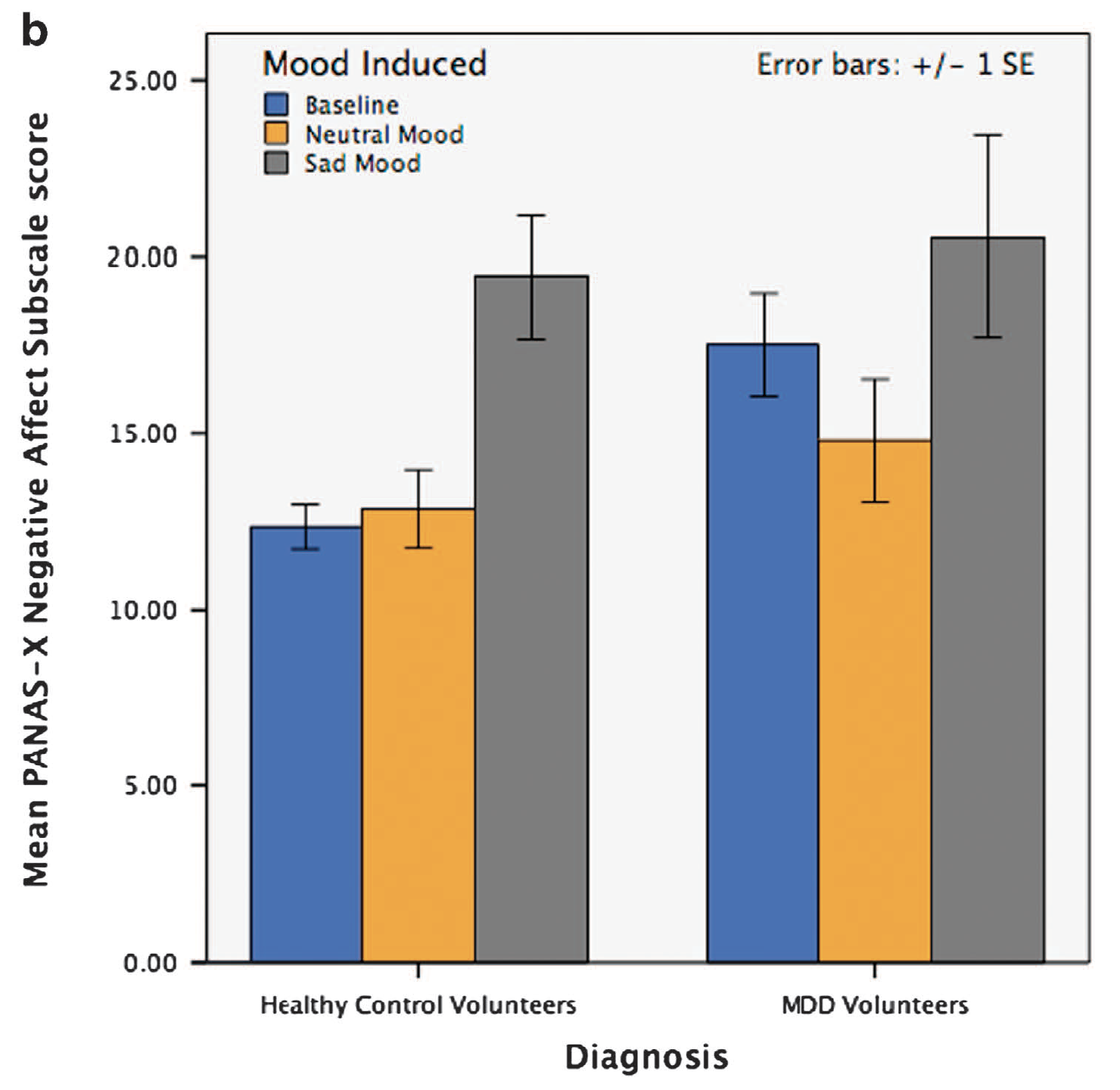
> Depressed people were much sadder to start with, and remained so throughout the different conditions.  The depressed people stayed sadder in the ‘neutral’ phase, and the healthy cohort couldn’t catch them in the ‘sad’ phase.
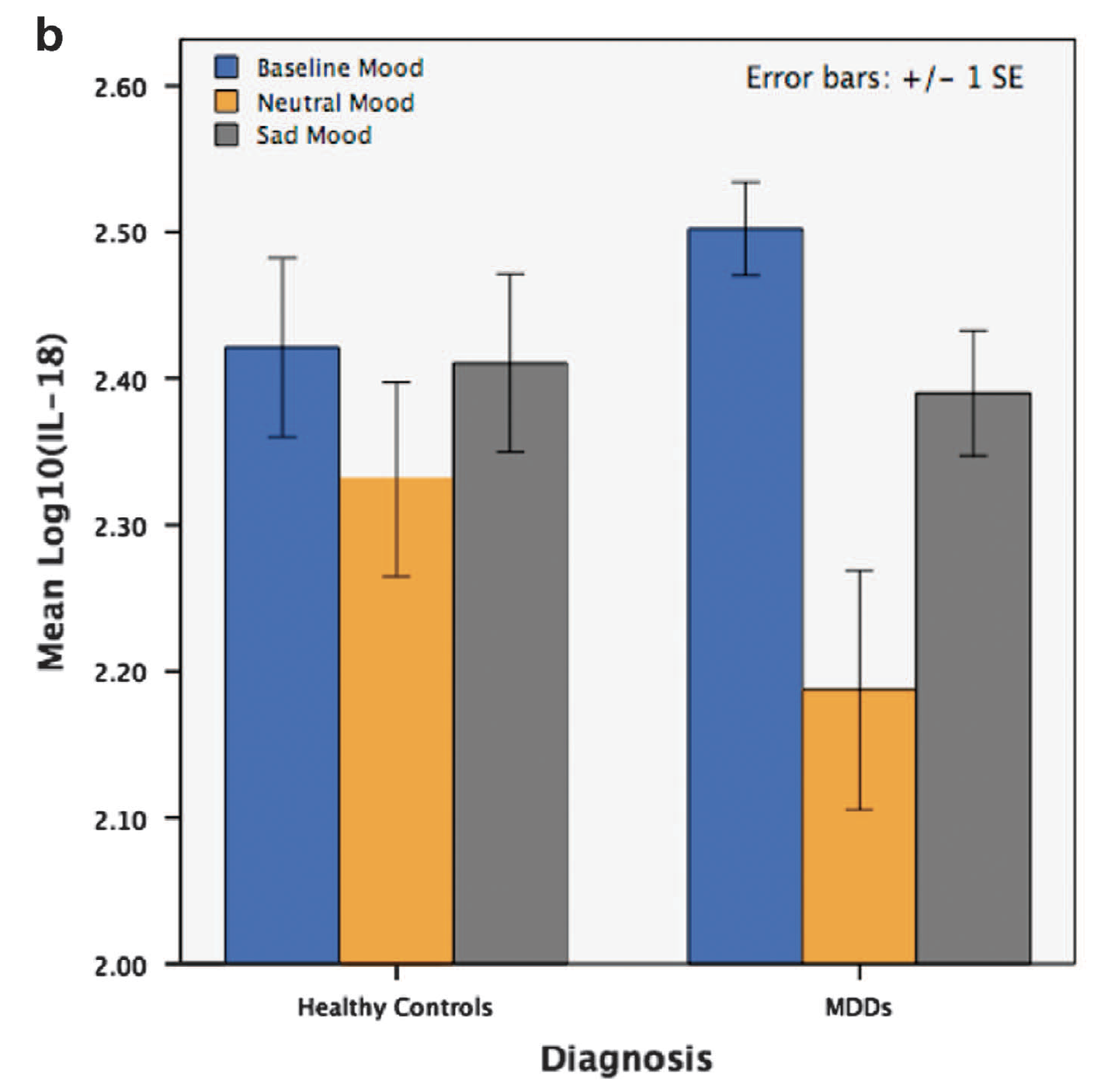
> Depressed people had a much higher level of the inflammatory marker to start with, and interestingly, this level dropped significantly with the induction of the neutral phase and the sad phase.  What was also interesting was that the level of the inflammatory marker was about the same in the baseline and the sad phase for the healthy volunteers.
> A completely different pattern of neurotransmitter release was seen in the two different groups.  People with depression had an increase in the neurotransmitter release over a large number of areas of the brain, whereas in the healthy controls with normal mood, the sad state actually resulted in a decreased amount of neurotransmitter release, and in a much smaller area within the brain.  This suggests that the opioid neurotransmitter system in the brains of depressed people is dysfunctional.

Affect/Sadness Scores - Prossin et al Molecular psychiatry 2015 Aug 18.

Affect/Sadness Scores – Prossin et al Molecular psychiatry 2015 Aug 18.

IL18 v Mood state/diagnosis - Prossin et al Molecular psychiatry 2015 Aug 18.

IL18 v Mood state/diagnosis – Prossin et al Molecular psychiatry 2015 Aug 18.

Effectively, the results of the study reflect what’s already known – the emotional dysregulation seen in people with depression is because of an underlying problem with the brain, not the other way around.  And, sadness in normal people is not associated with a significant change in the evil pro-inflammatory cytokine.

So, according to Prossin’s article,

  1. normal sadness in normal people is not associated with physical illnesses.
  2. sadness is abnormally processed in people who are depressed, which maybe related to an abnormal inflammatory response, which might explain the known link between depression and increased risk of illness

The article is not “more evidence that our thoughts do count.”  If anything, it shows that underlying biological processes are responsible for our thoughts and emotions and their downstream effects, not the thoughts and emotions themselves.

And unfortunately, it appears that Dr Leaf hasn’t got past the opening paragraph of a puff piece article before jumping to a conclusion which only fits her worldview, not the actual science.

References

[1]        Prossin AR, Koch AE, Campbell PL, Barichello T, Zalcman SS, Zubieta JK. Acute experimental changes in mood state regulate immune function in relation to central opioid neurotransmission: a model of human CNS-peripheral inflammatory interaction. Molecular psychiatry 2015 Aug 18.
[2]        Clarke DM, Currie KC. Depression, anxiety and their relationship with chronic diseases: a review of the epidemiology, risk and treatment evidence. Med J Aust 2009 Apr 6;190(7 Suppl):S54-60.

Dr Caroline Leaf – The mystery of he said/she said is no longer a mystery

This weeks edition of New Scientist magazine carried an article entitled “Scans prove there’s no such thing as a ‘male’ or ‘female’ brain” [1].  The article was inspired by a journal article published in the PNAS last month [2], which reviewed the scans of 1400 different people to see if there were specific differences in the neuroanatomy of the brains of men and women (i.e., are there ‘male’ and ‘female’ brains, or are the commonly accepted male/female differences just a myth, or a cultural, not biological phenomenon?)

According to the article, there is an “extensive overlap between the distributions of females and males for all gray matter, white matter, and connections assessed. Moreover, analyses of internal consistency reveal that brains with features that are consistently at one end of the ‘maleness-femaleness’ continuum are rare. Rather, most brains are comprised of unique ‘mosaics’ of features.” [2]

So essentially, there’s no strong biological basis for gender differences after all.  “This means that, averaged across many people, sex differences in brain structure do exist, but an individual brain is likely to be just that: individual, with a mix of features. ‘There are not two types of brain,’ says Joel.” [1]

This news is a blow to one of Dr Leaf’s less renowned books, “Who switched off your brain? Solving the mystery of he said/she said” [3].

Dr Caroline Leaf is a communication pathologist and a self-titled cognitive neuroscientist.  Her ‘he said/she said’ book is based on the idea that there are definitive characteristics of the male and female brain which define each gender.  From her conclusion on page 211,

“Men and women are different.  Both the physical anatomy and functional strategy of our brains are different.  We can’t attribute this to social engineering, cultural norms or our up-bringing.  We’ve been created different – it’s in our fundamental design.  Our parents, our communities, and the cultural context of our childhood and adolescence certainly have a prominent developmental role in each of our lives.  But your brain has been fashioned in a specific way that shapes your ‘true you’ long before any of these other factors have had the opportunity to exercise their influence on you.”

As a quick aside, this quote shows the confusion in Dr Leaf’s teaching.  As I’ve discussed before in other blogs, Dr Leaf contradicts herself by claiming that our brain determines our gifts and our behaviours in some books (like ‘He said/she said’ and ‘The gift in you’) but then claims that our thought life controls our brains and our physical reality in the rest of her teaching.  So which is it?

But this quote also sounds the death knell for her book, in light of the recent scientific evidence to the contrary.  Which is a shame, since out of all of her books, this one initially seemed the most scientifically robust.

Even though the book is based on a now defunct theory, I wonder if the thrust of her book still holds true to a point.  We’ve all been created to be different, and we should celebrate those differences and how they complement other people around us.  It just so happens that those differences aren’t inherent to our gender, but to us as individuals, uniquely designed by God “for good works, which God prepared in advance for us to do” (Ephesians 2:10).

So, yes, the mystery of he said/she said has been solved, but not quite as Dr Leaf envisaged.

References

[1]        Hamzelou J. Scans prove there’s no such thing as a ‘male’ or ‘female’ brain. New Scientist. 2015 Dec 5.
[2]        Joel D, Berman Z, Tavor I, et al. Sex beyond the genitalia: The human brain mosaic. Proceedings of the National Academy of Sciences of the United States of America 2015 Nov 30.
[3]        Leaf CM. Who swithced off your brain: Solving the mystery of he said/she said. Texas, USA: Inprov, Ltd, 2011.

Dr Caroline Leaf and the Me-Too approach to mental health

Screen Shot 2015-11-13 at 3.44.33 pm

Since her recent less-than-successful attempt at portraying herself as a mental health expert, Dr Leaf has been laying low on social media, sticking to bland, innocuous quotes or passages of scripture.

Today, she thought it was safe enough to pop her head up from the trenches to fire off another opinionated volley on mental well-being, with a quote from one of her favourite authors, Peter Kinderman:

“It’s our framework of understanding the world, not our brains and not even the events that happen to us – not nature and not nurture – that determines our thoughts, emotions, behaviours and, therefore, our mental health.”

Dr Leaf is a communication pathologist and self-titled cognitive neuroscientist. Without any training or professional experience in mental illness, she has also taken it upon herself to act as an expert on mental health within the Christian church.

Unfortunately, posting quotes like today’s offering only further destroys her flagging credibility among those with professional psychiatric experience, and adds to the confusion of the rest of the Christian church when it comes to understanding mental illness.

There are two main problems with Dr Leaf’s meme: the quote itself and it’s source.

The quote itself is wafer-thin, unable to stand up to even the most basic interrogation. For example, we know through basic common sense that the brain changes how we think, our moods, our emotions and our behaviours. We change our mood, our emotions and our alertness every time we have a cup of coffee, or a glass of wine. Hallucinogenic medications like LSD definitely change our framework of understanding the world. Coffee, alcohol, and illicit substances like LSD all change the mood or experience of the person using them because they all temporarily alter the function of the users brain.

Though it’s not just external substances that change how we experience our external and internal worlds, but our own internal hormonal ecosystem changes our emotions, our moods, our thoughts and our behaviours. This isn’t so obvious for most men as our hormones are fairly constant, though testicular failure is known to result in reduced energy, vitality, or stamina; depressed mood or diminished sense of well-being; increased irritability; and difficulty concentrating and other cognitive problems. For the female gender, monthly hormonal changes can sometimes result in sudden, marked changes in emotions, moods, thoughts and behaviours.

There are a lot of other reasons why the brain controls the mind, and our mental health, which I’ve also discussed numerous times in other blogs (here, here and here)

If you aren’t satisfied with a common sense approach, then consider the scientific evidence that personality, the name that we give to our inbuilt ‘framework of understanding the world’ is largely genetic, and dependent on the function of various neurotransmitter systems [1-4].

So to suggest that the brain is not responsible for our moods, our emotions, our thoughts and our behaviours isn’t supported by the weight of scientific evidence.

The quote by Kinderman doesn’t stop there, but suggests that “not even the events that happen to us … determines our thoughts, emotions, behaviours”, something that also flies in the face of current scientific evidence. For example, the other forty percent of personality is determined by our environment (specifically the ‘non-shared’ environment, the environment outside of our parental influence) [5, 6]. And common psychiatric illnesses are associated with early childhood adversity, such as schizophrenia [7] and ADHD [8]. So again, the quote is unscientific.

Who then is this Kinderman guy, and why does he disagree with the scientific literature?

Peter Kinderman is a Professor of Psychology at University of Liverpool, and the President-elect of the British Psychological Society. He’s a highly outspoken critic of modern psychiatry and what he perceives to be the medicalisation of normal moods and emotions and overuse of medications to treat these non-existent diagnoses. Kinderman believes that it’s our learning history that shapes the paths that our lives take, and so if we simply understand our personal models of the world and how they were shaped by the events and experiences to which we’ve been exposed, we can simply think our way out of any disease process [9].

Kinderman has come out in favour of talking treatments for psychosis in schizophrenia instead of medication, when there’s no scientific proof of benefit for psychosocial therapies in schizophrenia [10, 11] (and here).

This, and his staunch opposition of the DSM5 as invalid, makes me concerned about his bias against modern psychiatry, despite it’s many advances, scientifically and clinically.

However, I’m surprised that Kinderman would make such a statement because it’s such an asinine argument, I find it hard to believe that it came from a professor of psychology. Kinderman would surely recognise the role of biology in our mental health and wellbeing, even if he doesn’t agree with how it’s managed. Perhaps there’s an alternative explanation. Perhaps Kinderman didn’t say what Dr Leaf has claimed?

The answer is, he does, and he doesn’t.

Dr Leaf has quoted Kinderman correctly. Today’s quote is taken directly out of Kindermans 2014 book, “The New Laws of Psychology” [9], on the penultimate page of his introduction. So he does say that our brains and our experiences aren’t relevant for our mental health. But then again, in a blog on the militant anti-psychiatry blog ‘Mad in America’, Kinderman wrote this:

“I’ve spent much of my professional life studying psychological aspects of mental health problems. Inevitably, this has also meant discussing the role of biology. I hope I’ve made some progress in understanding these issues, in working out how the two relate to each other, and the implications for services. That’s my academic day-job. But it’s not just academic for me. I’m probably not untypical of most people reading this; I can see clear examples of how my experiences may have affected my own mental health, but I can also see reasons to suspect biological, heritable, traits. As in all aspects of human behaviour, both nature and nurture are involved and they have been intimately entwined in a complex interactive dance throughout my childhood and adult life.” http://www.madinamerica.com/2015/03/brain-baked-beans/

So he seems confused, both recognising that biological traits influence psychiatric illness, then denying it.

Personally, I disagree with the quote from his book, although I’m just a suburban GP from Australia, so what would I know, right? Though I think the evidence I’ve cited is on my side, and Kinderman is not without his critics who are more than his academic equal.

It also concerns me because the logical conclusion of this line of thinking is that psychiatric illnesses have no biological basis, and therefore psychiatric medications have no place in treatment of them. But as I outlined previously, there is good evidence for the beneficial effects of medications for schizophrenia and ADHD amongst other mental health disorders.

Dr Leaf continues to ignore the scientific evidence for the biological basis for mental ill-health, medications for their treatment, and even the most basic of all that our mind is a product of our brain. Instead, she’s nailed her colours to her mast and aligned herself with outspoken authors on the fringe of modern neuroscience. Rather than addressing the science behind her opposition to modern psychiatry and neuroscience, she has resorted to hiding behind their quotes, a ‘me-too’ commentator, rather than an actual expert.

Of more importance is the confusion that this brings to the vulnerable Christians who follow her social media “fan sites”. The more Dr Leaf criticises psychiatric medications and condemns their prescription and usage, the more likely it is that someone will come to serious harm when they inappropriately cease their medications. And if Dr Leaf won’t come to her senses, our church leaders are going to have to take action, before it’s too late.

References

[1]        Vinkhuyzen AA, Pedersen NL, Yang J, et al. Common SNPs explain some of the variation in the personality dimensions of neuroticism and extraversion. Translational psychiatry 2012;2:e102.
[2]        Chen C, Chen C, Moyzis R, et al. Contributions of dopamine-related genes and environmental factors to highly sensitive personality: a multi-step neuronal system-level approach. PloS one 2011;6(7):e21636.
[3]        Caspi A, Hariri AR, Holmes A, Uher R, Moffitt TE. Genetic sensitivity to the environment: the case of the serotonin transporter gene and its implications for studying complex diseases and traits. The American journal of psychiatry 2010 May;167(5):509-27.
[4]        Felten A, Montag C, Markett S, Walter NT, Reuter M. Genetically determined dopamine availability predicts disposition for depression. Brain and behavior 2011 Nov;1(2):109-18.
[5]        Krueger RF, South S, Johnson W, Iacono W. The heritability of personality is not always 50%: gene-environment interactions and correlations between personality and parenting. Journal of personality 2008 Dec;76(6):1485-522.
[6]        Johnson W, Turkheimer E, Gottesman, II, Bouchard TJ, Jr. Beyond Heritability: Twin Studies in Behavioral Research. Current directions in psychological science 2010 Aug 1;18(4):217-20.
[7]        Howes OD, Murray RM. Schizophrenia: an integrated sociodevelopmental-cognitive model. Lancet 2014 May 10;383(9929):1677-87.
[8]        Thapar A, Cooper M, Eyre O, Langley K. What have we learnt about the causes of ADHD? Journal of child psychology and psychiatry, and allied disciplines 2013 Jan;54(1):3-16.
[9]        Kinderman P. The New Laws of Psychology: Why Nature and Nurture Alone Can’t Explain Human Behaviour: Robinson, 2014.
[10]      Buckley LA, Maayan N, Soares-Weiser K, Adams CE. Supportive therapy for schizophrenia. The Cochrane database of systematic reviews 2015;4:CD004716.
[11]      Jones C, Hacker D, Cormac I, Meaden A, Irving CB. Cognitive behaviour therapy versus other psychosocial treatments for schizophrenia. The Cochrane database of systematic reviews 2012;4:CD008712.

Dr Caroline Leaf and the Myth of the Chemical Imbalance Myth

Screen Shot 2015-10-27 at 2.49.38 am

There are lots of medical myths that people believe.

“I have acne because I eat too much chocolate, or my face isn’t clean enough”

“Stomach ulcers are because of stress”

“I coughed up some yellow phlegm, so I must need antibiotics right?”

“My baby’s fevers are because of teething.”

Is the “chemical imbalance” theory one of them?

Dr Leaf is a communication pathologist and self-titled cognitive neuroscientist. A couple of weeks ago she opened a proverbial can of worms by quoting the out-spoken Peter Gøtzsche, claiming that psychiatric drugs are the third leading cause of death after heart disease and cancer. This did not go down well, and Dr Leaf had to issue three separate statements on social media to try and justify herself and attempt to rescue her rapidly deteriorating credibility.

Not that she issued an apology, mind you, or retracted her statement.

Today, Dr Leaf published a blog on psychiatric medications … but again, not to apologise but to further justify why she’s right, and nearly every other doctor and scientist in the world is not. Worse than that, she went so far as to accuse doctors of deliberately prescribing “clearly dangerous” drugs, which she claims have no therapeutic effects, just because of some overcooked drug-company sponsored dinner and a few pens. More on that later.

Her post is a defiant deflection, a logically flawed and factually inaccurate criticism of modern psychiatry and psychopharmacology – not fueled by research, but largely based on the books of disgruntled fringe psychiatrists and researchers with an axe to grind.

Dr Leaf doesn’t discuss the actual science of the medications that she’s so against, but simply tries to create a smokescreen of distrust.

A good example of all that is wrong with this post is contained in the opening paragraph.

Today, it has become commonplace to say that people have chemical imbalances in their brain, most notably a disruption in the proper production of dopamine (for “diseases” like ADHD) and serotonin (for “diseases” like depression). These people, it is supposed, need drugs to “cure” these chemical imbalances, hence the terms “antipsychotics” or “antidepressants”.

The first thing to note is how Dr Leaf uses the term “cure”. No doctor ever uses the word “cure”, especially when talking about complex diseases. This is a pejorative term implying that modern medicine is only interested in permanently fixing things. But it’s a straw man fallacy, a false premise that Dr Leaf then uses to cast the medical model as impotent and futile. Nice try, but no one in medicine ever promises cure, and no doctor in their right mind would ever be so narrow-minded as to suggest that drugs are the only treatment for every condition. That doesn’t mean that drugs aren’t useful, nor that the medical model is broken. As we’ll discuss soon, medications are extremely helpful for certain conditions, when used carefully, as are non-drug treatments like CBT.

Dr Leaf also puts inverted commas around the word “diseases” as if to suggest that ADHD and depression aren’t diseases, an act which smacks of petulance and willful ignorance, and is insulting to those who have or who have ever suffered from ADHD and depression.   Last week, Dr Leaf was happy to share that her eldest daughter suffered from bulimia and depression, but now she’s suggesting that depression isn’t really a disease. So what is it then? Malingering? Personal weakness? Bad parenting?

It’s really surprising that someone claiming to be a cognitive neuroscientist would ignore strong scientific evidence.  For example, ADHD is associated with dopamine dysfunction as well as the dysfunction a number of other neurotransmitters [1-3]. And depression is associated with a decrease in the growth factor BDNF, (known as the neurotrophic hypothesis of depression) [4-6]. Schizophrenia, which Dr Leaf conveniently failed to mention, is clearly related to dopamine dysfunction in nerve cells of the pre-frontal cortex and the striatum, two parts of the brain that are incredibly important for how your brain processes incoming and outgoing signals [7-9].

There’s nothing to suppose here .. there’s ample evidence that psychiatric diseases are related to dysfunction within the brain, commonly with the function of neurotransmitters among other things. Call it whatever you like, the truth doesn’t change. “Chemical imbalance” is just an easy phrase for the general public to remember.

Dr Leaf then tries to suggest that psychiatric drugs don’t fix chemical imbalances but create them, citing the 1950’s observations of French researchers Deniker and Delay who noted that the first anti-psychotic, chlorpromazine, caused symptoms of Parkinson’s Disease. And indeed it did, but this wasn’t a new disease, just evidence that it worked.

Psychosis, a pathological state involving hallucinations and delusions, is because of an excess of the neurotransmitter called dopamine. Dopamine is the neurotransmitter that’s used by the nerve cells deep in the brain in a part called the basal ganglia, which acts like a central mail delivery centre for incoming and outgoing signals from other parts of the brain. The function of the nerves in one part of the basal ganglia are responsible for sending sensory signals to the frontal lobes of the brain. In another part, the signals are important for smooth movements of our muscles. Proper function depends on just the right amount of dopamine – too much and you get psychosis. Not enough and you get Parkinson’s disease symptoms.

The French researchers were simply noting the side-effects of too much medication blocking the action of dopamine in the basal ganglia – the psychosis had improved, but the blockade of dopamine was just too much in some patients, who had the opposite symptoms.

Again, Dr Leaf’s position is diametrically opposed to the published science [10, 11], and if anything, her claim contradicts her fundamental argument. After all, if chemical imbalances are myths, then how can chlorpromazine create a “new neurological syndrome” because of a chemical imbalance?

Dr Leaf then launches into a discussion on the history of the DSM and psychiatric medications. This is just the first in her ad hominem attacks on the medical profession –  playing the man, not the ball if you will. If she can discredit the doctors that prescribe the medication, then she indirectly discredits the medications.  This appears desperate and ultimately serves to weaken her case.

“It was just assumed that since these drugs affected brain chemistry in a certain way, the opposite reaction must be the result of the disease, notwithstanding the fact that this has never been adequately proven.”

The history of medicine is littered with cures being found without the disease being fully understood. Take Edward Jenner, for example, who is the founder of the modern technique of vaccination. He didn’t know why his smallpox vaccine worked, only that it did. Electron microscopes and a modern understanding of the immune system were centuries away, but Jenner saved billions of lives through his observation that prior vaccination with a small sample of cowpox virus would protect against smallpox [12].

When amphetamines, known to increase dopamine concentrations in the brain, caused psychotic symptoms and reserpine, a dopamine blocker, improved psychosis, it stood to reason that dopamine was a good candidate as a cause of psychosis and schizophrenia. Decades of research have gone on to further confirm and delineate the link [7]. Again, this is not “an overly simplistic explanation of chemical imbalances”. It is well proven, and rather complex.

Dr Leaf also makes the astounding accusation that psychiatrists inflicted suffering and caused “a public health disaster” by creating the DSM. The DSM, the ‘Diagnostic and Statistical Manual’ is an agreed-upon standard classification for psychiatric diagnoses. It is nothing more than a system of classification. It allows psychiatrists and researchers to speak a common language and attempt some coherence among their diagnoses.

Dr Leaf wrote, “… institutions like the American Psychiatric Association and the DSM would define what is normal, in turn telling us what it means to suffer and, essentially, what it means to be human. They medicalized misery, and today millions are suffering because of their actions, creating a public health disaster.”

That’s like saying that classifying the different types of cancer causes cancer. And that millions of people are suffering from cancer because doctors know to call it ‘cancer’. People have been suffering long before the DSM came along. The DSM doesn’t tell people they’re suffering, and it certainly doesn’t define what it is to be human. Such statements are disingenuous and melodramatic.

But wait, there’s more. “Today a psychiatrist can be praised for drugging a depressed person with mind-altering substances and, if these do not work, institutionalizing them and shocking their brain with ECT (electroconvulsive therapy). It is even an acceptable and commonplace practice to imprison mentally ill persons, drug them and lock them in solitary confinement, compelling them to live their days marinating in their own excrement.”

Dr Leaf is again playing to the fears of the public who have watched too many movies and only think of ‘One Flew Over the Cuckoo’s Nest’, ‘Shutter Island’ or scenes from ’12 Monkeys’. There are more oversight boards and lawyers than there are psychiatric patients, and the only people who are institutionalised are those who are clearly a danger to themselves or others. And while institutionalised, they are not subjected to random bouts of electrical shock as if some doctor is wandering around with a medical grade cattle prod, zapping people and laughing maniacally. Nor is anyone locked in solitary confinement and forced “to live their days marinating in their own excrement”.

The paranoid accusations continue some more. Dr Leaf accuses all psychiatrists of ignorance, and then accuses primary care physicians of negligence, by claiming that we prescribe medications that we do not understand because of the bribes and a pretty smile from a pharmaceutical rep.

Again, Dr Leaf contradicts her own argument:

Despite the recognition amongst many psychiatrists and medical health professionals that the chemical imbalance theory is not valid, drug companies like Eli Lilly still claim that ‘antipsychotic medicines are believed to work by balancing the chemical found naturally in the brain’.

Except that antipsychotic medications DO balance the naturally occurring chemical in the brain (dopamine) as we discussed earlier. What the … a drug company telling doctors how their drug works! How dare they tell the truth!

I find it disturbing that Dr Leaf would stoop so low as to insult the entire medical profession, especially every GP and family physician the world over.

Hey, I’m not above criticism. It’s important to have a good long look at ourselves from time to time, to review our practice, and make sure we’re treating our patients in the best possible way. The RACGP, the peak body of Australian GP’s, invited Prof Gøtzsche to present his opinions on anti-depressant medications so that GP’s could decide for themselves if they should adjust their prescribing.

But to suggest that primary care physicians are stupid, ignorant, incompetent and money hungry … that we would sell our soul for a drug company branded pen … is insulting. Though the irony of her statement, “we do not ask ourselves if these doctors really understand all the implications of using these substances. Not even the psychiatrists understand these drugs” is clearly lost on Dr Leaf.  It’s certainly clear from the rest of her essay that Dr Leaf has no idea how these medications work or what benefits they have for those who suffer from mental ill-health.

There’s a lot more to discuss in response to Dr Leaf’s diatribe, but for the sake of brevity, I’ll try and discuss just a couple of other important themes.

Dr Leaf continues to try to make the medications sound useless and poisonous. She has several paragraphs on the placebo effect, making the false argument that the effect of the medications is just because someone tells you it will work. Of course, the placebo effect is part of the therapeutic effect, but that’s the same for all treatments, even Dr Leaf’s programs … “So, if the pastor or cell-group leader says that these programs are safe and will fix your toxic thinking, even though they get most of their information from the author, we believe wholeheartedly in what he or she may say and are more inclined to believe the program will work for us. These beliefs, which ignore actual scientific results, are buttressed by a flood of distorted and biased news reports, press releases and scientific journal articles on supposed toxic thoughts, and have transformed the theory into church dogma. So, obviously, if we experience negative side effects and do not feel the program is working, it must be something wrong with us, not the program.” Is that a fair statement?

Dr Leaf then plays the fear card again by listing all of the potential side effects from psychiatric medications. Dr Leaf is right in saying that psychiatric medications have serious proven long term side effects, and we should be careful.

For instance, if you knew that thrombocytopenia, anaphylaxis, cutaneous hypersensitivity reactions including skin rashes, angioedema and Stevens Johnson syndrome, bronchospasm and hepatic dysfunction were the potential side effects for a medication, would you take it? Most people wouldn’t.  Reading the list makes that drug sound really dangerous.  We should be up in arms about such a potentially harmful drug being put up for sale … except that this list of side effects isn’t a psychiatric drug at all, but’s actually the side effect profile of paracetamol (acetaminophen in the US). People take paracetamol all the time without even thinking about it.

Saying that we shouldn’t take medications because of potential side effects is a scarecrow argument, a scary sounding straw man fallacy. All drugs have serious proven long term side effects. Licencing and prescribing a medication depends on the overall balance of the good and the harm that a medication does. And no one has ever hidden these side effects from the public as if there is a giant conspiracy from the doctors and the pharmaceutical companies. They’re right there in the product information (here is the product information for fluoxetine. See for yourself).

Whilst it’s true that these side effects do happen, we know that they happen infrequently, just like we know that people win lotteries infrequently. Even so, the medications are not just doled out like sweets at a candy store. You require a minimum of ten years of university level education to be able to prescribe them.

Patients ALWAYS have a right to ask questions about possible benefits and side effects, and in my practice, I tell my patients the pros and the cons before prescribing, and I give them the choice of whether they want them or not. No one is ever forced into taking them.

Finally, Dr Leaf makes a number of irrational statements and flawed arguments in her final page of ranting. Let me quickly go through some of the honourable mentions:

* “Most people recover from depression without antidepressants” – true, because most cases of depression are mild. That doesn’t mean to say that antidepressants shouldn’t be used for severe depression, just like most people recover from upper respiratory infections without antibiotics, but that doesn’t mean that we shouldn’t use antibiotics for severe tonsillitis or pneumonia.
* “Antidepressants are no better than placebos” – It’s a controversial topic right now. There are many pushing the barrow that SSRI medications are no better than a sugar pill. But Dr Leaf has conveniently ignored several Cochrane reviews (the best of medical evidence) that shows anti-depressants work for a variety of disorders [13-15], but that psychological therapy might not [16].
* Equating antidepressants and antipsychotics with illicit drugs, and claiming that “more people die from overdoses of psychiatric drugs than illicit drugs” – This is Reductio ad absurdum – the logical conclusion from this argument is that illicit drugs are safer than psychiatric drugs. And therefore we should not give people psychiatric drugs since we don’t give people the ‘safer’ illicit drugs. But that conclusion is absurd, and when you think about it, the whole thing is based on hidden false premises – people rarely die of illicit drug overdoses because they’re illegal and are hard to come by. And also, people who use illicit drugs are not usually suicidal, whereas those given psychiatric medications sometimes are suicidal, and sometimes use them to try and commit suicide. But modern psychiatric drugs are much less dangerous in overdose than their old counterparts.  It should also be noted here that more overdose suicide attempts are with paracetamol or ibuprofen than with psychiatric medications [19], but I don’t see paracetamol or ibuprofen being demonised.
* Psychiatric medications are part of a neo-liberal capitalist plot to keep the rich, richer and the poor, poorer – To me, this looks like Dr Leaf clutching at straws. Her statement, “By emphasizing that the problem lies within an individual’s biology, we are less inclined to look at their experiences and the social context of why they are feeling the way they feel. We look at the mythical chemical imbalance instead of economic exploitation, violence and inept political structures” is false.   Schizophrenia is often seriously discussed in terms of neurodevelopment and not just ‘chemical imbalances’ [17, 18]. So it’s just plain wrong to suggest that researchers don’t look at the “economic exploitation, violence and inept political structures”. Oh, and Dr Leaf suggests that foster children are abused because they’re all forced to take psychiatric medication, and implies that ADHD children are abused by being force-fed Ritalin because they “move a lot in class”. Again, these are emotional over-generalisations that have no basis in reality.

Dr Leaf seems lost.  She’s ignored solid published medical and scientific evidence in coming to an opinion based on the discontented rumblings of a few vocal but outspoken critics. In order to make her arguments, she has had to resort to borderline-slanderous ad hominem attacks on scientists and the medical profession, and purely emotional arguments based on fear and mistrust.

And this was only part one.  If Dr Leaf’s promised second part is anything like the first, we’re in for a real treat.

Though as if that wasn’t enough, by suggesting that psychiatric drugs cause changes in your brain, cause chemical imbalances, and cause that slew of negative side effects, Dr Leaf is admitting that it’s your brain that changes your thought life, which directly contradicts her most recent teachings. After all, if thought was the dominant force in your neurology and your mind controlled your brain, then the medications would have no effect since they’re physical and aren’t connected to our mind.

So which is it? Because if the brain controls our mind, then her best-seller needs to be pulped and refunds offered to the hundred of thousands of people who bought it. But on the other hand, if the mind really does control the brain, then her entire argument against psychiatric medications implodes.

Dr Leaf has painted herself into a corner and there’s still part two to come.

References

[1]        Prince J. Catecholamine dysfunction in attention-deficit/hyperactivity disorder: an update. J Clin Psychopharmacol 2008 Jun;28(3 Suppl 2):S39-45.
[2]        Del Campo N, Chamberlain SR, Sahakian BJ, Robbins TW. The roles of dopamine and noradrenaline in the pathophysiology and treatment of attention-deficit/hyperactivity disorder. Biological psychiatry 2011 Jun 15;69(12):e145-57.
[3]        Cortese S. The neurobiology and genetics of Attention-Deficit/Hyperactivity Disorder (ADHD): what every clinician should know. European journal of paediatric neurology : EJPN : official journal of the European Paediatric Neurology Society 2012 Sep;16(5):422-33.
[4]        Haase J, Brown E. Integrating the monoamine, neurotrophin and cytokine hypotheses of depression–a central role for the serotonin transporter? Pharmacol Ther 2015 Mar;147:1-11.
[5]        Bus BA, Molendijk ML, Tendolkar I, et al. Chronic depression is associated with a pronounced decrease in serum brain-derived neurotrophic factor over time. Molecular psychiatry 2015 May;20(5):602-8.
[6]        Sousa CN, Meneses LN, Vasconcelos GS, et al. Reversal of corticosterone-induced BDNF alterations by the natural antioxidant alpha-lipoic acid alone and combined with desvenlafaxine: Emphasis on the neurotrophic hypothesis of depression. Psychiatry research 2015 Sep 1.
[7]        Howes OD, Fusar-Poli P, Bloomfield M, Selvaraj S, McGuire P. From the prodrome to chronic schizophrenia: the neurobiology underlying psychotic symptoms and cognitive impairments. Curr Pharm Des 2012;18(4):459-65.
[8]        Williams GV, Castner SA. Under the curve: critical issues for elucidating D1 receptor function in working memory. Neuroscience 2006 Apr 28;139(1):263-76.
[9]        Der-Avakian A, Markou A. The neurobiology of anhedonia and other reward-related deficits. Trends Neurosci 2012 Jan;35(1):68-77.
[10]      Leucht S, Tardy M, Komossa K, et al. Antipsychotic drugs versus placebo for relapse prevention in schizophrenia: a systematic review and meta-analysis. Lancet 2012 Jun 2;379(9831):2063-71.
[11]      Torniainen M, Mittendorfer-Rutz E, Tanskanen A, et al. Antipsychotic treatment and mortality in schizophrenia. Schizophrenia bulletin 2015 May;41(3):656-63.
[12]      Riedel S. Edward Jenner and the history of smallpox and vaccination. Proc (Bayl Univ Med Cent) 2005 Jan;18(1):21-5.
[13]      Arroll B, Elley CR, Fishman T, et al. Antidepressants versus placebo for depression in primary care. The Cochrane database of systematic reviews 2009(3):CD007954.
[14]      Soomro GM, Altman D, Rajagopal S, Oakley-Browne M. Selective serotonin re-uptake inhibitors (SSRIs) versus placebo for obsessive compulsive disorder (OCD). The Cochrane database of systematic reviews 2008(1):CD001765.
[15]      Kapczinski F, Lima MS, Souza JS, Schmitt R. Antidepressants for generalized anxiety disorder. The Cochrane database of systematic reviews 2003(2):CD003592.
[16]      Jakobsen JC, Lindschou Hansen J, Storebo OJ, Simonsen E, Gluud C. The effects of cognitive therapy versus ‘treatment as usual’ in patients with major depressive disorder. PloS one 2011;6(8):e22890.
[17]      van Os J, Linscott RJ, Myin-Germeys I, Delespaul P, Krabbendam L. A systematic review and meta-analysis of the psychosis continuum: evidence for a psychosis proneness-persistence-impairment model of psychotic disorder. Psychological medicine 2009 Feb;39(2):179-95.
[18]      Howes OD, Murray RM. Schizophrenia: an integrated sociodevelopmental-cognitive model. Lancet 2014 May 10;383(9929):1677-87.
[19]     Prescott K, Stratton R, Freyer A, Hall I, Le Jeune I. Detailed analyses of self-poisoning episodes presenting to a large regional teaching hospital in the UK. Br J Clin Pharmacol 2009 Aug;68(2):260-8.

Disclaimer

  1. Do not abruptly stop any medications that you are taking. Talk to your licenced physician first. They’re not all money-hungry, imbecilic drug-company bitches. Most of them actually know what they’re talking about.
  2. For the record, I declare that I have no connection with any pharmaceutical company. I do not accept gratuities of any form from any sales representative. I don’t eat their food, I don’t take their pens, and I don’t listen to their sales pitches

Update – 8 August 2016.

Dr Leaf has since taken the offending post from her blog page, and re-gifted it as an answer on her “Scientific” FAQ page (“Chemical Imbalances and Mental Health” http://drleaf.com/about/scientific-faqs/).  It remains as unbalanced and inaccurate as it’s former iteration.  It’s unfortunate that Dr Leaf continues to make such preposterous claims in the face of overwhelming scientific evidence to the contrary.

Dr Caroline Leaf and the can of worms – UPDATE

Yesterday, Dr Leaf opened a proverbial can of worms with her quote from Gøtzsche, that “Psychiatric Drugs are the third leading cause of death, after heart disease and cancer.”

Dr Caroline Leaf is a communication pathologist and a cognitive neuroscientist. Clearly scrambling, she attempted to placate her growing number of detractors with an unprecedented explanatory statement. But rather than distancing herself from her comments, she still chose to portray psychiatric medications as harmful and ungodly.

Instead of quelling the fire, this seems to have thrown fuel on it. Dr Leaf has continued to try and justify her comments with a further two statements today. Neither of them contain a retraction or an apology.

Earlier today, she wrote:

Screen Shot 2015-10-19 at 7.02.14 pm

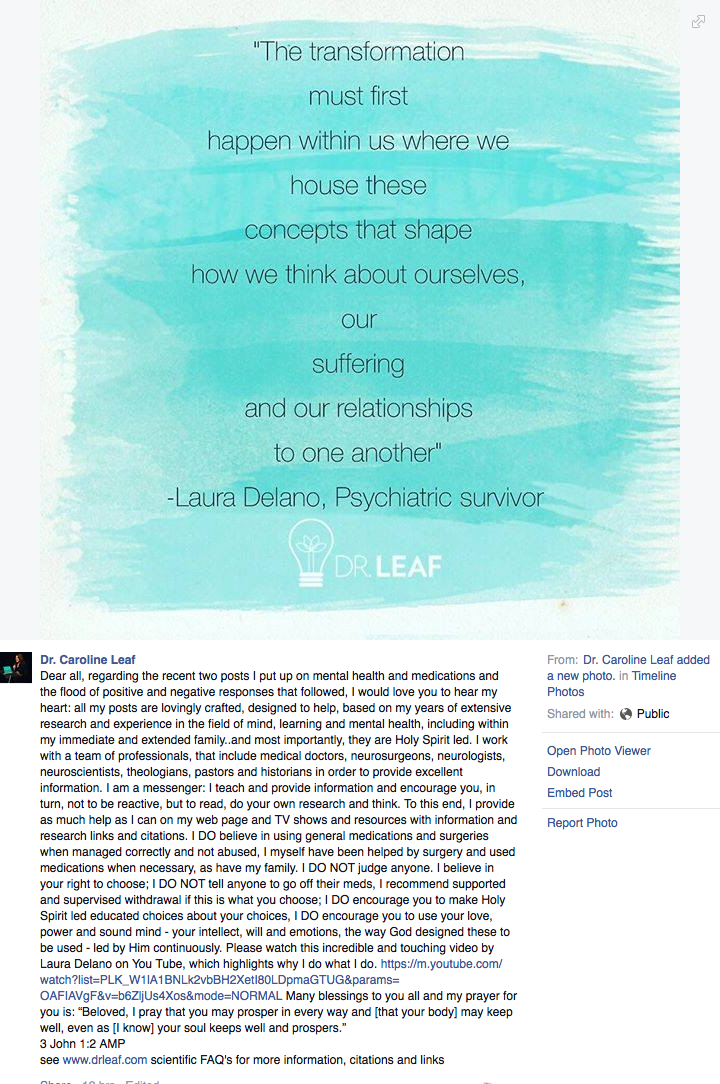
Dear all, regarding the recent two posts I put up on mental health and medications and the flood of positive and negative responses that followed, I would love you to hear my heart: all my posts are lovingly crafted, designed to help, based on my years of extensive research and experience in the field of mind, learning and mental health, including within my immediate and extended family..and {sic} most importantly, they are Holy Spirit led. I work with a team of professionals, that include medical doctors, neurosurgeons, neurologists, neuroscientists, theologians, pastors and historians in order to provide excellent information. I am a messenger: I teach and provide information and encourage you, in turn, not to be reactive, but to read, do your own research and think. To this end, I provide as much help as I can on my web page and TV shows and resources with information and research links and citations. I DO believe in using general medications and surgeries when managed correctly and not abused, I myself have been helped by surgery and used medications when necessary, as have my family. I DO NOT judge anyone. I believe in your right to choose; I DO NOT tell anyone to go off their meds, I recommend supported and supervised withdrawal if this is what you choose; I DO encourage you to make Holy Spirit led educated choices about your choices, I DO encourage you to use your love, power and sound mind – your intellect, will and emotions, the way God designed these to be used – led by Him continuously. Please watch this incredible and touching video by Laura Delano on You Tube, which highlights why I do what I do. https://m.youtube.com/watch?list=PLK_W1lA1BNLk2vbBH2XetI80LDpmaGTUG&params=OAFIAVgF&v=b6ZljUs4Xos&mode=NORMAL Many blessings to you all and my prayer for you is: “Beloved, I pray that you may prosper in every way and [that your body) may keep well, even as [I know) your soul keeps well and prospers.” 3 John 1:2 AMP see http://www.drleaf.com scientific FAQ’s for more information, citations and links

then later in the day:

Screen Shot 2015-10-19 at 7.02.56 pm

Dear all, some of you have questioned whether or not I have ever dealt with people experiencing severe mental health issues. As someone who has specialized in the mind over the past 30 years, I have been given the opportunity to work, first hand, with people experiencing mental and physical pain in the most terrible life situations, from severe traumatic brain injuries to rape, murder and abysmal poverty. I have seen these individuals choose with their minds not to allow their life circumstances to take control over their identity… through the power of God, love and community they overcame what life threw their way. But, on a more personal level, my eldest daughter (@therascalcook) was severely bulimic, suicidal and depressed for most of her early years due to a chronic illness and traumatic bullying. I have been in hospitals, crying beside her bed when she nearly died. I have experienced her pain…I am crying as I write this. But as a family we supported her and loved her through it, as did her friends and many of our loved ones, (it was not easy but it was worth it!). She never took a single medication nor was she institutionalized, even though doctors were telling me she would never recover if she didn’t. Yet today, after rejecting God and life for many years, she is a graduate student in historical theology, whose life goal is to bring a piece of heaven to earth through sustainable farming communities in disadvantaged areas. There is hope, God is greater than anything, and magic bullets are never the answer. You are not a label or a faulty biological machine. You are a child of God, as we all are. Unless all of us realize what it truly means to be the church, to bring heaven to earth as we love our God and people, to be the community of love that this world is so desperately crying out for, people will continue to have mental health issues, be labeled {sic}, face stigma and suffer. We all have this responsibility, and none of us can do it alone. We were created by God to help each other. Jessica used to call me her Sam. We all need a Sam, because we all know what it is like to be Frodo.

Kudos to Dr Leaf for the bravery and vulnerability that sharing such a personal story took. I’m genuinely happy that Jessica found her way through those dark and distressing days and has once again found peace and success. I have been through the same dank and destructive times of depression, and I know what it feels like. I wouldn’t wish it on anyone. When I hear stories of people who have overcome, I truly appreciate their joy.

I also recovered from my depression without ever using medications. What helped me enormously was a psychologist who listened to me without judgement as I unloaded years of emotional turmoil and distress. To this day, I don’t remember what we actually talked about in my first session with him. All I remember is getting ten minutes in and then crying almost uncontrollably for the next forty. Thankfully, I did more talking and less crying over the few months as my mood lifted and I grew to accept my brokenness, just like God does.

Clearly, the story of Jessica Leaf is heart-warming and uplifting. Dr Leaf clearly understands the pain and distress that severe mental illness brings to those who suffer with it, and their families. But all emotions aside, Dr Leaf has still left important issues unresolved. Indeed, those who are more cynical might see such an emotional recollection as a play for sympathy and a distraction from the lingering questions surrounding Dr Leaf’s handling of this issue, and of her expertise in mental health.

Dr Leaf’s expertise, revisited.

Dr Leaf’s experience during those darkest of times may give her a legitimate platform to discuss what worked for her daughter and her family, but however moving, it does not qualify her as an expert in mental health more broadly. Science isn’t about generalising from your personal experience. It’s about looking at the evidence from a number of rigorously designed trials with a minimum of bias, conducted across a broad range of participants.

When women come to see me in the few weeks after giving birth, they’re usually confused. Nearly every woman that’s ever given birth sometime in the last century believes their experience automatically qualifies them as experts in breast feeding and infant health. But their ‘helpful’ advice, given with the best of intentions, often conflicts with the opinion of every other self-proclaimed motherhood expert. By the time the poor new mother comes to see me, they’ve been given so many pieces of conflicting advice that they’re completely lost.

Just living through an experience doesn’t qualify you as an expert. So I don’t claim to be an expert in mental health just because I’ve lived through prolonged periods of anxiety and depression. Nor should Dr Leaf.

Dr Leaf can’t use the fact that she has worked with people who have mental health problems as a claim to expertise either. She may been given the opportunity to work, first hand, with “people experiencing mental and physical pain in the most terrible life situations, from severe traumatic brain injuries to rape, murder and abysmal poverty.” That doesn’t make her an expert in mental health any more than seeing female patients makes me a gynaecologist.

That’s because expertise in medical fields requires specific training. You can read surgical textbooks for thirty years but that doesn’t quality you as a surgeon. You can learn a bit of anatomy and physiology in the same lab as some medical students, but that doesn’t make you equivalent to a medical doctor. You might do some research involving some neurobiology, but that doesn’t make you a neuroscientist.

Dr Leaf is a communication pathologist who completed a PhD which included some educational psychology. She is not a counsellor, she is not a psychologist, she is not a medical doctor and she isn’t even a cognitive neuroscientist. Dr Leaf is not qualified to provide an expert opinion on the risks and harms of psychiatric medication.

Dr Leaf’s heart

Coming back to Dr Leaf’s first statement today, Dr Leaf said that she wanted to share her heart:

all my posts are lovingly crafted, designed to help, based on my years of extensive research and experience in the field of mind, learning and mental health, including within my immediate and extended family..and {sic} most importantly, they are Holy Spirit led

If I were Dr Leaf, I’d be careful about blaming the Holy Spirit for her posts. I have rebutted and debunked scores of Dr Leaf’s memes over the last couple of years. The Holy Spirit is the ‘Spirit of all truth’, not of half-baked facts and misquotes.

Dr Leaf goes on to say

I teach and provide information and encourage you, in turn, not to be reactive, but to read, do your own research and think. To this end, I provide as much help as I can on my web page and TV shows and resources with information and research links and citations.

I respectfully disagree. Dr Leaf rarely references her social media memes, and until recently, her website was bereft of citations. I have never seen her encourage critical thinking before. And if Dr Leaf really wanted to encourage thinking amongst her followers, then why does her team actively block people on social media who dare to disagree with her? That’s not encouraging free thinking, that’s presenting an illusion of conformity.

Dr Leaf’s Do’s and Don’ts

To clarify her position on several issues, Dr Leaf stated:

I DO believe in using general medications and surgeries when managed correctly and not abused, I myself have been helped by surgery and used medications when necessary, as have my family. I DO NOT judge anyone. I believe in your right to choose; I DO NOT tell anyone to go off their meds, I recommend supported and supervised withdrawal if this is what you choose; I DO encourage you to make Holy Spirit led educated choices about your choices, I DO encourage you to use your love, power and sound mind – your intellect, will and emotions, the way God designed these to be used – led by Him continuously.

Dr Leaf may say that she doesn’t tell anyone to go off their meds, but I think that’s a little disingenuous.

Sure, Dr Leaf never directly said to stop taking their medications. She just said that psychiatric medications were unscientific and unbiblical [1: p31-32], that psychiatric medications are the third most common cause of death after heart disease and cancer, and admonished her followers to “Take all thoughts into captivity, not drug all thoughts into captivity.” And just yesterday, she also linked psychiatric medications with evolutionary theory and said that they strip 15-25 years off your lifespan.

So it’s more like, “I DO NOT tell anyone to go off their meds, I just scare them by telling them the drugs are unholy poison”.

That’s not encouraging “Holy Spirit led educated choices”, it’s encouraging fear-driven poor choices.

Dr Leaf’s support team

One last point. Dr Leaf stated,

I work with a team of professionals, that include medical doctors, neurosurgeons, neurologists, neuroscientists, theologians, pastors and historians in order to provide excellent information.

Really? Dr Leaf’s work consistently conflicts with basic medical and psychological science, and she regularly misquotes scripture. Would they be willing to be named? Because either they’re providing Dr Leaf with terrible oversight or Dr Leaf is ignoring everything they say.

Dr Leaf still hasn’t apologised for, or retracted her statements

It’s no secret that I disagree with Dr Leaf’s teaching, and I have outlined why I think some of her statements today are disingenuous. You may agree with me, or not. I don’t mind. Hey, I could be wrong.

Though when you get down to brass tacks, the most important issue is that Dr Leaf remains legally vulnerable.

Since she opened up the can of worms with her Gøtzsche quote, she has made three separate statements, none of which apologise for potentially misleading nearly 150,000 people about the true risks and benefits of psychiatric medications. Nor has she issued any retraction or taken the posts down.

When Dr Leaf says that psychiatric medications are unbiblical and poisonous, people on psychiatric medications will want to come off them. She may not have said the words “Stop your medications”, but people will still want to come off them because they’re afraid, or because of the stigma, or because of their desire to live true to God. And as I discussed yesterday, there is a very real chance that some of those people who were stable on their medications but who unnecessarily cease them because Dr Leaf told them to, may harm themselves or take their own life, since that’s what the studies tell us [2, 3]. At the very least, they are likely to have a shorter life expectancy because of it [4, 5]. This may open Dr Leaf to law suits, as well as the possibility of having someone’s death on her conscience.

No one wants that scenario. But the only way to avoid it is to:

  1. Take the offending posts down
  2. Issue an apology
  3. Specifically direct those of her followers on psychiatric medications to stay on them until they have spoken to their doctors,
  4. In future, provide a balanced view of the benefits of psychiatric medications as well as their harms.
  5. Better yet, unless Dr Leaf gets a medical degree, it may be better not to publically discuss psychiatric medication at all.

Again, I implore Dr Leaf, for her sake and for the sake of her ministry and those who follow her, please unequivocally apologise, retract your statement, and encourage people to see their doctors if they have concerns about their medication, or their mental health.

This is not a game: people’s lives are at stake. I hope that Dr Leaf sees this before it’s too late.

References
[1]        Leaf CM. Switch On Your Brain : The Key to Peak Happiness, Thinking, and Health. Grand Rapids, Michigan: Baker Books, 2013.
[2]        Correll CU, Detraux J, De Lepeleire J, De Hert M. Effects of antipsychotics, antidepressants and mood stabilizers on risk for physical diseases in people with schizophrenia, depression and bipolar disorder. World psychiatry : official journal of the World Psychiatric Association 2015 Jun;14(2):119-36.
[3]        Tiihonen J, Suokas JT, Suvisaari JM, Haukka J, Korhonen P. Polypharmacy with antipsychotics, antidepressants, or benzodiazepines and mortality in schizophrenia. Archives of general psychiatry 2012 May;69(5):476-83.
[4]        Tiihonen J, Lonnqvist J, Wahlbeck K, et al. 11-year follow-up of mortality in patients with schizophrenia: a population-based cohort study (FIN11 study). Lancet 2009 Aug 22;374(9690):620-7.
[5]        Torniainen M, Mittendorfer-Rutz E, Tanskanen A, et al. Antipsychotic treatment and mortality in schizophrenia. Schizophrenia bulletin 2015 May;41(3):656-63.

Remember: This article is a rebuttal of Dr Leaf’s opinion regarding psychiatric medication.  This blog doesn’t constitute individual medical advice.  If you do not like your medication or think you should come off it, please talk to your own GP or psychiatrist.  Do not stop it abruptly or without adequate medical advice.

Dr Caroline Leaf and her can of worms

Screen Shot 2015-10-18 at 12.15.51 pm

Dr Caroline Leaf is a communication pathologist and a self-titled cognitive neuroscientist. She also likes to think that she’s an expert on mental health. So this morning, she felt like she was quite justified in publishing a meme about the evils of psychiatric medications.

She quoted Professor Peter Gøtzsche, stating that “Psychiatric Drugs are the third leading cause of death, after heart disease and cancer.” Then followed it with “Take all thoughts into captivity, not drug all thoughts into captivity. You have the mind of Christ! (1 Cor 2:16) **DRUG WITHDRAWAL should ALWAYS be done under the supervision of a qualified professional. These drugs alter your brain chemistry, and withdrawal can be a difficult process.”

The subsequent comments were primarily made up of the usual sycophantic responses that Dr Leaf has cultivated by blocking anyone that disagrees with her. But there were more than the usual responses confused by her meme, and quite a few that we’re asking for help in weaning off the medications that they were on.

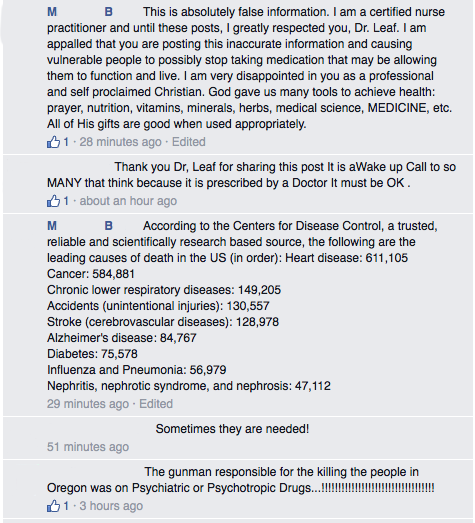
Then there were those who weren’t happy at all. One respondent, a certified Nurse Practitioner, wrote, “I am appalled that you are posting this inaccurate information and causing vulnerable people to possibly stop taking medication that may be allowing them to function and live.” The same person followed up with another comment soon after, quoting the CDC figures for the top ten causes of death in the US, in which the third on the list wasn’t psychiatric drugs at all, but chronic lower respiratory diseases.

LeafWorms02

The overall response must have taken her aback, because Dr Leaf posted a follow-up comment to explain herself, an unusual step for her.

Screen Shot 2015-10-18 at 12.21.12 pm

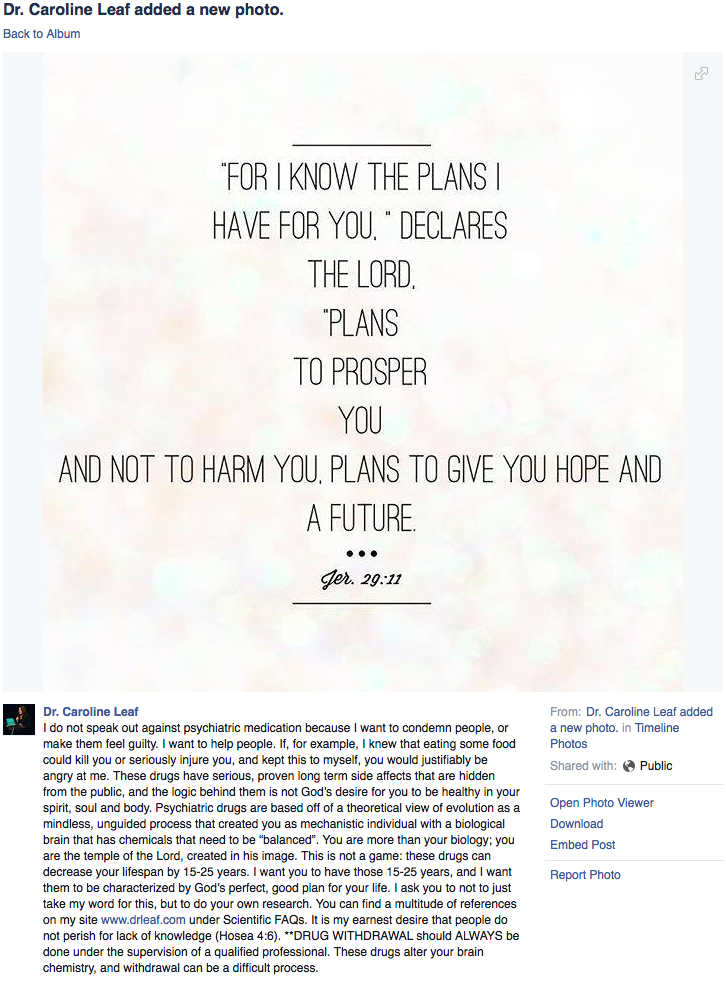
In it, she said, “I do not speak out against psychiatric medication because I want to condemn people, or make them feel guilty. I want to help people. If, for example, I knew that eating some food could kill you or seriously injure you, and kept this to myself, you would justifiably be angry at me. These drugs have serious, proven long term side affects that are hidden from the public, and the logic behind them is not God’s desire for you to be healthy in your spirit, soul and body. Psychiatric drugs are based off of a theoretical view of evolution as a mindless, unguided process that created you as mechanistic individual with a biological brain that has chemicals that need to be “balanced”. You are more than your biology; you are the temple of the Lord, created in his image. This is not a game: these drugs can decrease your lifespan by 15-25 years. I want you to have those 15-25 years, and I want them to be characterized by God’s perfect, good plan for your life. I ask you to not to just take my word for this, but to do your own research. You can find a multitude of references on my site http://www.drleaf.com under Scientific FAQs. It is my earnest desire that people do not perish for lack of knowledge (Hosea 4:6). **DRUG WITHDRAWAL should ALWAYS be done under the supervision of a qualified professional. These drugs alter your brain chemistry, and withdrawal can be a difficult process.”

But it was too late. Dr Leaf had opened a can of worms, and once out, those wriggly little critters are impossible to put back in.

Both her initial offering and her reply shows just how poor Dr Leaf’s understanding of mental health truly is. She is fixated on the notion that the mind controls the brain, and she is unwilling to consider any other notion, instead preferring to accept any opinion that conforms to her world view, no matter how poorly conceived it might be. This includes the work of Gøtzsche, accepting it as gospel even though he has critics of his own.

It’s important to examine Dr Leaf’s reply in more detail as her statement has the potential to cause a great deal of harm to those who are the most vulnerable. Lets break down Dr Leaf’s statement and review each piece, and then I will outline some other important and contradictory considerations of Dr Leaf’s stance.

  1. The safety of psychiatric medications

Dr Leaf claims that “These drugs have serious, proven long term side affects {sic} that are hidden from the public” and “This is not a game: these drugs can decrease your lifespan by 15-25 years.”

Dr Leaf is right in saying that psychiatric medications have serious proven long term side effects. And we should be careful. I mean, if you knew that thrombocytopenia, anaphylaxis, cutaneous hypersensitivity reactions including skin rashes, angioedema and Stevens Johnson syndrome, bronchospasm and hepatic dysfunction were the potential side effects for a medication, would you take it?

Most people wouldn’t.   Reading the list makes that drug sound really dangerous.  We should be up in arms about such a dangerous drug … except that this list of side effects isn’t for a psychiatric drug at all, but is actually the side effect profile of paracetamol (Panadol if you’re in Australia, Tylenol if you’re in the US). People take paracetamol all the time without even thinking about it. Saying that we shouldn’t take medications because of potential side effects is a scarecrow argument, a scary sounding straw man fallacy. All drugs have serious proven long term side effects, and most of the time, those serious long term side effects don’t occur.  Licensing and prescribing a medication depends on the overall balance of the good and the risk of harm that a medication does.

Oh, and no one has ever hidden these side effects from the public as if there’s some giant conspiracy from the doctors and the pharmaceutical companies. The side effects are listed right there in the product information (here is the product information for fluoxetine. See for yourself).

As for Dr Leaf’s assertion that psychiatric medications decrease your lifespan by 10-25 years, I think that’s a red herring. I read through Dr Leaf’s ‘Scientific FAQ’ and I couldn’t find any references that back up these statements, so who knows where she got this figure of ’15-25 years’ from.

On the contrary, what is known is that severe mental illness is associated with a 2 to 3-fold increase in mortality, which translates to an approximately 10-25 year shortening of the lifespan of those afflicted with severe depression, schizophrenia or bipolar disorder [1]. So Dr Leaf has it backwards. It isn’t the medications that cause people who take them to die 25 years earlier than they would have without the illness, but it’s the illness itself.

  1. The benefits of long term psychiatric medications

So psychiatric medications have their side effects, true, but they also have protective benefits which Dr Leaf consistently fails to acknowledge.

Correll and colleagues note in the conclusion to their article that “Although antipsychotics have the greatest potential to adversely affect physical health, it is important to note that several large, nationwide studies providing generalizable data have suggested that all-cause mortality is higher in patients with schizophrenia not receiving antipsychotics.” [1]

More specifically, in one recent study, the use of any anti-psychotic medication for a patient with schizophrenia decreased their mortality by nearly 20% [2]. In another study, the mortality of those with schizophrenia who did not take anti-psychotics was nearly ten times that of the healthy population, but taking anti-psychotic medication cut that back to only four times the risk [3].

These findings are mirrored by other studies on other psychiatric medications. For example, as noted by Correll and colleagues, “clozapine, antidepressants, and lithium, as well as antiepileptics, are associated with reduced mortality from suicide. Thus, the potential risks of antipsychotics, antidepressants and mood stabilizers need to be weighed against the risk of the psychiatric disorders for which they are used and the lasting potential benefits that these medications can produce.” [1]

So psychiatric medications are not useless. Let me be clear, I’m not saying that taking psychiatric medications always makes life a cake-walk – there are still side effects from the medications, and the disease isn’t always fully controlled. But on average, well treated patients with psychiatric conditions clearly do better than patients who are not treated.

Therefore Dr Leaf’s assertion that psychiatric medications are harmful are inaccurate. And given that there are genuine benefits to these medications, particularly in the prevention of suicide, Dr Leaf’s discouragement of these medications has the real potential to result in real harm to those of her followers who take her at her word.

  1. The ‘logic’ behind psychiatric medications

Dr Leaf says in her statement, “the logic behind them (psychiatric medications) is not God’s desire for you to be healthy in your spirit, soul and body. Psychiatric drugs are based off of a theoretical view of evolution as a mindless, unguided process that created you as mechanistic individual with a biological brain that has chemicals that need to be ‘balanced’. You are more than your biology; you are the temple of the Lord, created in his image.”

Dr Leaf’s argument here is that based on a false premise and some straw man fallacies which inevitably leads to a false conclusion.

Evolution is a mindless unguided process
Evolution says that you are just a machine
Psychiatric illness is because of a chemical imbalance in that machine (a false premise)

therefore taking psychiatric medication is accepting evolution (a straw man fallacy)

and

You are more than your biology,
you are the temple of the Lord, created in his image,

therefore evolution is wrong (another straw man fallacy)

therefore psychiatric medications are not God’s desire (false conclusion)

The problem with this logic is that it could be applied to all medications, since modern medicine has predominantly been devised by agnostic scientists within an evolutionary framework, and nearly all disease is defined by an imbalance of one thing or another.

For example, simply rewording Dr Leaf’s statement shows up the distorted logic that it entails:

“Insulin can have serious, proven long term side affects that are hidden from the public, and the logic behind it is not God’s desire for you to be healthy in your spirit, soul and body. Diabetes is based off of a theoretical view of evolution as a mindless, unguided process that created you as mechanistic individual with a biological pancreas that has chemicals that need to be ‘balanced’.”

You can’t have this both ways. If psychiatric medications are against God’s plan, then all medications are against God’s plan. But if we accept medications for physical ailments, then we also have to accept medications for psychological ailments.

  1. The Mind-Brain link

Dr Leaf tried to protect herself with a glib disclaimer at the end of both posts in question today, “**DRUG WITHDRAWAL should ALWAYS be done under the supervision of a qualified professional. These drugs alter your brain chemistry, and withdrawal can be a difficult process.”

Which is interesting, because in her Scientific FAQ, Dr Leaf has this to say about the mind,

“The Brain is part of the Physical Body and therefore is controlled by the Mind. The Mind does not emerge from an accumulation of Brain activity. Brain activity, rather, reflects Mind activity. Even though the Mind controls the Brain, the Brain feeds back to, and influences, the Mind. The Brain seats the Mind, and therefore the Mind influences the Physical world through the Brain.”

So if that’s true, then why is withdrawal from psychiatric medication so difficult? If the mind is outside the physical realm and controls the brain as Dr Leaf proposes, then the medications effect on brain chemistry should make little or no difference to the mind, and withdrawal should be simple.

The fact that withdrawal from these medications is not simple is testament to the fact that the mind is a function of the brain, and does not control the brain as Dr Leaf proposes here and through her books and other written materials.

Issuing the warning is responsible, but shows again just how far Dr Leaf’s teaching is from scientific reality.

  1. Dr Leaf’s motivations

Finally, I want to talk about Dr Leaf’s motivation. In her statement, Dr Leaf said, “I do not speak out against psychiatric medication because I want to condemn people, or make them feel guilty. I want to help people.” And, “I want you to have those 15-25 years, and I want them to be characterized by God’s perfect, good plan for your life … It is my earnest desire that people do not perish for lack of knowledge (Hosea 4:6).”

I want to state, for the record, that I believe Dr Leaf when she says this. I don’t doubt her motives are to try and help people. But good intentions are not enough. What she says has real life consequences.

Dr Leaf is idolised by her followers and portrayed as a mental health expert by the churches she preaches at. People don’t question experts recommended to them by their pastors or their friends. So when she says that psychiatric medications kill people, people on psychiatric medications will want to come off them, because of fear, because of stigma, because of their desire to live true to God and his good and perfect plan. Without wanting to sound melodramatic, there is a very real chance that some of those people who were stable on their medications but who unnecessarily cease them because Dr Leaf told them to, may harm themselves or take their own life, since that’s what the studies tell us [1, 4]. At the very least, they are likely to have a shorter life expectancy because of it [2, 3]. So telling people that psychiatric medications are dangerous is morally and ethically dubious.

There are also potential legal implications too. God forbid, but if a person committed suicide because they went off their medication because of what Dr Leaf wrote, law suits could easily follow. No one wants that situation. Dr Leaf also runs the risk of being accused of practicing medicine without a licence, since some of her followers have asked personal medical questions in the comments, and the reply from Dr Leaf’s Facebook team is to direct them to their programs like the 21-day detox, which depending on the legal interpretation and the mood of a judge, could be seen as giving medical advice, which Dr Leaf is not legally qualified to give.

LeafWorms01

To summarise, I certainly hope that neither of these hypothetical scenarios becomes reality, but Dr Leaf and her social media team are skating on thin ice, and a glib disclaimer at the end of a post won’t necessarily cut it.

I would hope that Dr Leaf and her social media team would reconsider their approach. In fact, I would suggest that Dr Leaf unequivocally apologises for what she’s written, retracts her statement, and encourages people to see their doctors if they have concerns about their medication, or their mental health.

Indeed, I would implore Dr Leaf to step back and re-evaluate the entire breadth of her teaching, and the advice that she is giving. Dr Leaf is obviously a very smart woman and a very engaging speaker. With great power comes great responsibility. If she were to reconsider her teaching and start from a basis of scientific fact, then she could be a major force for the good of the church and its physical and mental health. At the moment, I fear that she is doing the opposite.

This is not a game: people’s lives are at stake. I hope that Dr Leaf sees this before it’s too late.

References

[1]        Correll CU, Detraux J, De Lepeleire J, De Hert M. Effects of antipsychotics, antidepressants and mood stabilizers on risk for physical diseases in people with schizophrenia, depression and bipolar disorder. World psychiatry : official journal of the World Psychiatric Association 2015 Jun;14(2):119-36.
[2]        Tiihonen J, Lonnqvist J, Wahlbeck K, et al. 11-year follow-up of mortality in patients with schizophrenia: a population-based cohort study (FIN11 study). Lancet 2009 Aug 22;374(9690):620-7.
[3]        Torniainen M, Mittendorfer-Rutz E, Tanskanen A, et al. Antipsychotic treatment and mortality in schizophrenia. Schizophrenia bulletin 2015 May;41(3):656-63.
[4]        Tiihonen J, Suokas JT, Suvisaari JM, Haukka J, Korhonen P. Polypharmacy with antipsychotics, antidepressants, or benzodiazepines and mortality in schizophrenia. Archives of general psychiatry 2012 May;69(5):476-83.

Here’s my glib disclaimer: This article is a rebuttal of Dr Leaf’s opinion regarding psychiatric medication.  This blog doesn’t constitute individual medical advice.  If you do not like your medication or think you should come off it, please talk to your own GP or psychiatrist.  Do not stop it abruptly or without adequate medical advice.

The significance of thoughts

Screen Shot 2015-10-13 at 8.53.20 pm

A few days ago, I posted a rebuttal to one of Dr Leaf’s favourite memes, “Thoughts are real and occupy mental real estate.”

In short, I wrote that thoughts are real, but the issue hasn’t ever been whether thoughts are real, but what thoughts really are. The conclusion was that thoughts are just a projection, a function of the brain. They are not independent of the brain and they do not control the brain.

Dr Caroline Leaf is a communication pathologist and a self-titled cognitive neuroscientist. Dr Leaf tried to refine her meme today, saying:

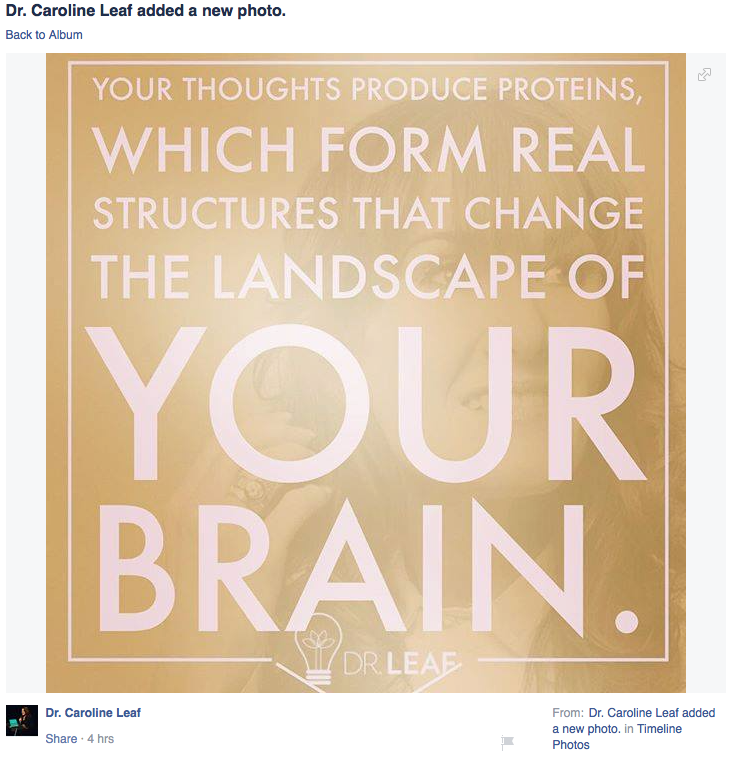
“Your thoughts produce proteins, which form real structures that change the landscape of your brain.”

So, is that true? Do thoughts produce proteins which change the structure of the brain? To answer that, we need to have a look at some basic neurobiology.

The brain is made of nerve cells. Nerve cells have three unique structures that help them do their job. First are dendrites, which are spiny branches that protrude from the main cell body, which receive the signals from other nerve cells. Leading away from the cell body is a long thin tube called an axon which helps carry electrical signal from the dendrites, down to the some tentacle-like processes that end in little pods. These pods, called the terminal buttons of the axon, and then convey the electrical signal to another nerve cell by directing a burst of chemicals towards the dendrites of the next nerve cell in the chain.

In order for the signal to be successfully passed from the first nerve cell to the second, it must successfully traverse a small space called the synapse.

Despite being very close to each other, no nerve cell touches another. Instead, the spray of chemicals that’s released from the terminal button of the axon floats across a space of about 20-40nM (a nanometre is one billionth of a metre).

Combining nerve cells and synapses together creates a nerve pathway, where the input signal is received by specialised nerve endings and is transmitted down the nerve cell across a synapse to the next nerve cell, across the next synapse to the next nerve cell, and on and on until the signal has reached the destination for the output of that signal.

And that’s it. The entire nervous system is just a combination of nerve cells and the synapses between them.

What gives the nervous system and brain the near-infinite flexibility, and air of mystery, is that there are eighty-six billion nerve cells in the average adult (male) brain. Each nerve cell has hundreds to thousands of synapses. It’s estimated that there are about 0.15 quadrillion (that’s 150,000,000,000,000) synapses throughout the average brain [1]. Each of these cells and synapses connect in multiple directions and levels, and transmit signals through the sum of the exciting or inhibiting influences they receive from, and pass on to, other nerve cells.

The brain is a highly plastic organ. When biologists talk about plasticity, they aren’t talking about the chemical plastic that we make everything out of, like plastic cups or bottles, but the ability for the cells, tissues or organs to change or adapt. And the brain does this all of the time. Every stimulus changes one or more of the billions of branches and synapses that the brain has. Branches can be pruned back, or new ones grown. Existing branches can be strengthened or weakened. Each change to the branches of the nerve cells helps the brain to adapt to the ever-changing internal and external stream of signals that the brain is required to process.

So returning to Dr Leaf’s statement: The key part of the meme is, “Your thoughts produce proteins”. This is where Dr Leaf’s statement is wrong. The error is deceptively subtle, but it’s still wrong. When changes are required, new branches are formed, which do indeed require new proteins. But most brain function, including our thoughts, is simply electrical current running along the pathways already formed by the branches of our nerve cells.

Even then, our stream of conscious thought is only a tiny fragment of the billions of nerve impulses our brains produce each and every second of our lives. As I described in my previous post, thought is not dominant. Our thoughts do not control our brains, it’s our brains that control our thoughts. Thoughts are real, but they’re real like an image on a screen is real, but isn’t the real thing.

Thoughts are only significant when they are considered for what they truly are. Our stream of consciousness is simply a selective place of refinement for highly salient parts of our non-conscious information that need further processing before further action is taken with that information. They are like the dials on your dashboard, which give selective important information about the car but they don’t control the car. Thoughts do not control our brains growth, or alter our brains architecture.

Dr Leaf should have said something along the lines of, “The landscape of the brain is created by real structures called neurons and synapses, which have many functions including our thoughts.”

As it is, Dr Leaf’s meme creates a false impression that our thoughts are the critical factor in determining our brains structure and function, when the reality is the exact opposite.

References

[1]        Sukel K. The Synapse – A Primer. 2013 [cited 2013 28/06/2013]; Available from: http://www.dana.org/media/detail.aspx?id=31294

Dr Caroline Leaf and the Mental Monopoly Myth

Screen Shot 2015-09-23 at 7.37.23 pm

What’s more important to a person’s health and well being?

Is it their physical attributes – their genes, their fitness, their diet? Is it their psychological state – their mind, their emotional balance? Is it their social context – how they relate and contribute to the communities that they’re a part of? Or is it their spirituality – the depth of their connections to faith and the supernatural?

According to Dr Caroline Leaf, communication pathologist and self-titled cognitive neuroscientist, it’s the mind that dominates. This is a common theme of her books [1: especially chapter 1] and her social media memes.

Take today’s gem: “Mind action is the predominant element in well being and mental health.”

In other words, it doesn’t really matter what your genes are, where you were born or the depth of your acceptance in your community. It doesn’t matter whether you have a deep faith either. The psychological dominates the physical, the social and the spiritual. As she said in her books,

“Thoughts influence every decision, word, action and physical reaction we make.” [2: p13]
“Our mind is designed to control the body, of which the brain is a part, not the other way around. Matter does not control us; we control matter through our thinking and choosing.” [1: p33]
“Research shows that 75 to 98 percent of mental, physical, and behavioural illness comes from ones thought life.” [1: p33]

Dr Leaf’s philosophy of our wellbeing can be pictured like a pyramid, with our ‘mind action’ (read, ‘choices’) dominating every other facet of our lives.

Leaf Mental Monopoly Model

The problem with this philosophy is that it doesn’t fit with science, scripture, or even common sense.

You don’t have to be a rocket scientist to recognise that Dr Leaf’s assertion doesn’t fit with every day experience. Where you were born and raised, and where you live, significantly impact a persons overall wellbeing, independent of their thoughts and choices.

Does Dr Leaf honestly believe that the wellbeing of a ten year old boy living in rural Sedan, with no access to running water and sewerage systems, living on a subsistence diet and drinking contaminated water from the only well in his village, has the same wellbeing as a ten year old in rural Ohio, who has access to clean water, plentiful food, and an education?

Does Dr Leaf think that the wellbeing of a pregnant woman in Afghanistan, with poor nutrition and limited access to meaningful antenatal care or a trained midwife to deliver her baby, is the same as the wellbeing of a pregnant woman in London, who has access to fresh food, vitamin supplements, GP’s, midwives, and specialist obstetricians in big city hospitals?

These are just two simple examples which demonstrate that the action of your mind has very little to do with your overall wellbeing.

But if you want to be more scientific about it, then look no further than the biopsychosocial model. Modern health professionals moved beyond the idea that only one facet of human existence was responsible for all of your wellbeing way back in the 1980’s. The biopsychosocial model proposes that the overall health of a person was equally dependent not just on the physical, but was part of a broader system of the medical, mental and the social [3]. The model recognised that a person’s overall wellbeing was made worse by social disadvantage as well as physical illness or poor coping skills, and so often, the physical, social and psychological would affect each other in loops – physical illness would often reduce a persons ability to mentally cope, which strained their social connections, making them lonely and reduced the care given to them, which then made them sicker.

Most Christian would recognise that one element is still missing, which is the spiritual. Our faith is a realm beyond rational thinking, and isn’t fairly grouped with the mental, although they are both housed in our brain. Still, faith influences our social interactions, our psychology, and our physical health, as much as each mutually influences our faith.

Putting it altogether, we don’t have a pyramid, but a collection of ponds. Our mind action does not dominate our health and our wellbeing, but is simply one part of a much larger whole, with our health and wellbeing at the centre.

Biopsychosocial spiritual coloured

It’s interesting that a woman with as much influence amongst the western Christian church as Dr Leaf would suggest that the mind is more influential to our wellbeing than our faith. This makes her teaching seem more humanist than holy, more secular than spiritual. It may invite questions about the deepest influences of her ministry – is it humanistic philosophy with a garnish of scripture, or does the Bible really promote thinking over faith? Ultimately, it’s up to each individual to examine the evidence for themselves and make up their own mind.

Irrespective of Dr Leaf’s philosophical foundations, I’d suggest that her hypothesis of the mental monopoly falls down at the level of common sense and good science. Medical science moved beyond the idea of the single dominant facet of humanity more than three decades ago.

It’s time for Dr Leaf to do the same.

References

[1]        Leaf CM. Switch On Your Brain : The Key to Peak Happiness, Thinking, and Health. Grand Rapids, Michigan: Baker Books, 2013.
[2]        Leaf C. Who Switched Off My Brain? Controlling toxic thoughts and emotions. 2nd ed. Southlake, TX, USA: Inprov, Ltd, 2009.
[3]        Borrell-Carrio F, Suchman AL, Epstein RM. The biopsychosocial model 25 years later: principles, practice, and scientific inquiry. Ann Fam Med 2004 Nov-Dec;2(6):576-82.

“Touching the hem of her garment” – A Review of Dr Caroline Leaf at Nexus Church, Brisbane, 2nd August 2015

Dr Caroline Leaf is a communication pathologist and a self-titled cognitive neuroscientist. She’s currently on tour through Queensland and New South Wales in Australia. Her only stop in Brisbane, my home town, was at Nexus, my former home church. Dr Leaf presented a keynote address at Nexus’s annual Designing Women conference yesterday, and was the guest speaker at their two morning services today.

This morning typified Brisbane winter – cloudless azure skies and a refreshingly cool breeze. In contrast to the air temperature, the hospitality at Nexus was warm and friendly. The worship, soulful and uplifting. I really enjoyed being there.

Then it was Dr Leaf’s turn. It’s amazing just how much misinformation one person can fit into a 30 minute sermon.

The main theme for her sermons was an exposition on the parable of the sower, linking the different ways people receive information, with the story of the woman with the issue of blood. Dr Leaf tried to prove that thought and faith are synonymous by linking verses at the beginning and of the story from the gospel of Mark (5:25-34) – “because she thought, ‘If I just touch his clothes, I will be healed.’” (v28) and “He said to her, ‘Daughter, your faith has healed you. Go in peace and be freed from your suffering.’” (v34).

The link is highly tenuous to start with. Faith is an action, whereas thought is not. We assume that action is always preceded by thought, but it is not. Action does not require thought. Many people act without thinking. This is explained in more detail in my discussion on the Cognitive Action Pathways model.

Though to try and make her explanation more plausible, Dr Leaf padded out the story by telling the Nexus crowds that it was only because the woman had spent 12 years in deep intellectual thinking, meditating on the scriptures, that Jesus could heal her. But that’s Dr Leaf’s conjecture. In truth, no one knows exactly what that woman was doing or thinking in the 12 years that preceded her healing. The Bible never says anything else about the woman, in either version of the story in Mark or Luke (8:43-48), other than “She had suffered a great deal under the care of many doctors and had spent all she had, yet instead of getting better she grew worse” (Mark 5:26). If you have to rely on pure speculation to make your sermon work, then that’s story-telling, not preaching.

The other part of her sermon was an attempt to link the parable of the sower to some neuroscience, specifically the role of hippocampal synaptogenesis in the formation of long term memory (or in English, the changes that take place to nerves in the brain when you hear information and try to remember it).

Dr Leaf interpreted the parable as describing four different types of listener – Listener 1, corresponding to the man who hears the word but the devil takes it away, Listener 2, who hears the word and receives it with joy, but it doesn’t take root, Listener 3 who hears the word but it gets choked out by worries, riches or pleasure, and Listener 4 who hears the word and retains it, and the word produces a harvest.

According to Dr Leaf, these types of listener correspond to different levels of nerve branch growth in the formation of long term memory – Listener 1 doesn’t get past 24 hours before the memory dissipates. Listener 2 only lasts about four to seven days but there isn’t enough emotional salience to continue the growth of the nerve branch. Listener 3 doesn’t get past fourteen days, while the 4th Listener makes it through to a full 21 days, Dr Leaf’s magic number for long term memory.

Sounds great … except that the encoding and consolidation of incoming information is much more complex, and doesn’t rely on just new nerve growth [1]. That, and her numbers are completely arbitrary – with some permanent long term memory encoded in a couple of days. In fact, some long-term memory doesn’t need new synaptic growth at all, just a state of high excitation of the nerve network, known as Long-Term Potentiation, which is reliant on a self-reinforcing chemical cascade (if you want more information on the neurobiology of memory, a good place to start is The Brain From Top To Bottom, maintained by McGill University in Canada).

So the bulk of her sermon was based on biblical conjecture and bad science. Dr Leaf also made a myriad of misleading or mistaken statements: we are wired for love not fear, we learn through the quantum zeno effect, every thought effects every one of our 75 trillion cells, your toxic thoughts poison other people in relationship with you because of quantum physics, and many, many others.

I’ve only really got room for a few extra-special mentions.

1. “The mind controls brain”, and “the non-conscious mind is not bound by time and space”

No actual cognitive neuroscientist would be caught dead making those sort of statements. Saying that the mind controls the brain is like saying that air controls your lungs. The mind is a function of the brain, because when the brain is changed in certain ways, structurally or chemically, the mind changes. This has been known about for over a century, at least as far back as Freud who experimented with cocaine and other “mind-altering” substances.

Therefore if the brain controls the mind, then the non-conscious mind must be bound by the physical universe, which includes space and time. To suggest anything otherwise is just science fiction.

Besides, Dr Leaf herself tells us in her book “The Gift In You” [2], that our brain controls our mind. Dr Leaf is simply contradicting her own teaching.

2. “75 to 98% of all physical, mental and emotional illness is caused by your thought life.”

This factoid has been thoroughly debunked. If you would like to read more, you can click here or see chapter 10 in my book [3].

Today, in the second service, Dr Leaf took her fiction a step further and categorically stated that “98% of cancer comes from your thought life”. What nonsense! There is no rational evidence for such a ridiculous statement, and I don’t think there is anything more insensitive to cancer victims and their families than to blame then for causing their own cancer.

3. Mental Health

(a) “Mental illness is worse in the last 50 years than ever before”

To try and prove this is true, Dr Leaf flashed up a slide of ‘horrifying statistics” on mental illness. She claims that,
“35-fold increase in mental illness in children”
“Our children are the first in human history to grow up under the shadow of ‘mental illness'”
“Dramatic increase in the number of mentally ill since 50’s … things are worse not better”
“Mental ill health worst its ever been in history of mankind”

Every one of these statements is patently false. Mental illness has been with humankind for ever. The ancient Egyptians were writing about hysteria in women some two thousand years before Christ [4]. It’s only been in the last century or so that mental illnesses have become seen for the biological entities that they are, and not some form of demon possession, criminal behaviour or sexual deviancy.

Dr Leaf was quick to malign the DSM (the Diagnostic and Statistical Manual of psychiatry), suggesting that it’s unscientific. The DSM isn’t perfect, true, but before the DSM, there was even less science to the diagnosis of mental illness. As Dr Leaf herself pointed out, mental illness was previously viewed philosophically or spiritually. There was no consistency in diagnosis and no collection of statistics.

The DSM, for all its faults, gave a framework for mental health diagnosis, but as the science has become more refined, and with increasing awareness and general acceptance of mental health conditions, more people have qualified and/or accepted a diagnosis.

Mental illness has always been there, but now we know what to look for, it’s no longer hidden or ignored.

(b) “Psychotropic medications cause damage to the brain”

While on the subject of mental health, Dr Leaf made the litigation-attracting statement that psychotropic medications (anti-depressants, anti-psychotics) cause damage to the brain. That’s a particularly bold statement to make without citations, or a medical degree, to back it up.

Rather than ‘causing’ damage to the brain, there is scientific evidence that psychotropic medications increase synaptogenesis (the growth of new nerve branches) [5-7], while the NICE guidelines in the UK reviewed the evidence for anti-depressants and found them to be an effective treatment for depression [8], not harmful as Dr Leaf suggests.

(c) Biological causes for psychiatric illnesses have not been proven.

Dr Leaf also made the preposterous claim that biological causes of psychiatric illness have never been proven, but again, changes to brain structure have been associated with psychiatric symptoms ever since a 13-pound, three-and-a-half foot iron rod went through Phineas Gage’s skull and frontal lobe in 1848, and his personality suddenly changed from pleasant and congenial to depressed and angry [9]. Personality changes represent early symptoms of brain tumours. Use of drugs such as crystal meth can cause paranoia and extreme aggression. You don’t even need to be a doctor to know that, you just need to watch ‘Breaking Bad‘. So examples of the biological basis of psychiatric symptoms are everywhere. There are no grounds for Dr Leaf’s assertion.

4. Toxic thinking causes dementia

Dr Leaf claimed at the end of both sermons that toxic thinking results in the tubular backbone of the new nerve branches becoming contorted, which caused the accumulation of the tau protein in the nerve cells, which was responsible for dementia of every type. This, too, is a fallacy. The accumulation of the tau protein is found only in Alzheimers, not in Lewy Body dementia or in vascular dementia. The abnormal tau protein is likely related to the loss of a intracellular clean-up enzyme system [10], but Alzheimers is more complicated than just tau protein deposition, and has nothing to do with toxic thinking.

At the conclusion of the second service, I was outside the church when Dr Leaf and her entourage left the church auditorium before the rest of the crowd did, and I approached them to shake her hand and introduce myself. It was the mature thing to do after all. When I was about two metres from her presidential detail, a woman stepped out in front of me, blocking my way.

“You can’t follow them,” she said. “They’re going inside” (ie: hiding in the green room).
“Really?” I said, somewhat caught off guard. “I was simply going to introduce myself.”
“No”, was the firm reply. “You’re not allowed.”

By that time, the presidential detail had disappeared into their fortified sanctuary. The woman with the issue of blood may have got to Jesus, but there was no way I was even getting close to Dr Leaf.

This was a common pattern … Dr Leaf made herself deliberately scarce before and after each service, only coming into the church when the service was well underway, and leaving as soon as she preached, under heavy guard. One has to ask why? What’s she got to be afraid of? Is she so insecure about her teaching that she couldn’t possibly risk speaking to someone and being exposed as intellectually brittle? Or is it that she’s so arrogant as to insist on avoiding the rank-and-file church goer?

The pattern of avoidance of anyone other than her devotees, and her tendency to block anyone who disagrees with her from her social media accounts, would strongly suggest the former, although since she is so insistent on hiding from regular people, it’s really anyone’s guess.

Not that it matters. Dr Leaf could be the nicest person in the world.  Her ministry doesn’t rest on her sociability, but its own Biblical and scientific merits, and on that alone, it has been found seriously wanting.

References

[1]        Citri A, Malenka RC. Synaptic plasticity: multiple forms, functions, and mechanisms. Neuropsychopharmacology : official publication of the American College of Neuropsychopharmacology 2008 Jan;33(1):18-41.
[2]        Leaf CM. The gift in you – discover new life through gifts hidden in your mind. Texas, USA: Inprov, Inc, 2009.
[3]        Pitt CE. Hold That Thought: Reappraising the work of Dr Caroline Leaf. 1st ed. Brisbane, Australia: Pitt Medical Trust, 2014.
[4]        Tasca C, Rapetti M, Carta MG, Fadda B. Women and hysteria in the history of mental health. Clinical practice and epidemiology in mental health : CP & EMH 2012;8:110-9.
[5]        Karatsoreos IN, McEwen BS. Resilience and vulnerability: a neurobiological perspective. F1000prime reports 2013;5:13.
[6]        Duric V, Duman RS. Depression and treatment response: dynamic interplay of signaling pathways and altered neural processes. Cellular and molecular life sciences : CMLS 2013 Jan;70(1):39-53.
[7]        Karatsoreos IN, McEwen BS. Psychobiological allostasis: resistance, resilience and vulnerability. Trends in cognitive sciences 2011 Dec;15(12):576-84.
[8]        Anderson I. Depression. The Treatment and Management of Depression in Adults (Update). NICE clinical guideline 90.2009. London: The British Psychological Society and The Royal College of Psychiatrists, 2010.
[9]        Kihlstrom JF. Social neuroscience: The footprints of Phineas Gage. Social Cognition 2010;28:757-82.
[10]      Tai HC, Serrano-Pozo A, Hashimoto T, Frosch MP, Spires-Jones TL, Hyman BT. The synaptic accumulation of hyperphosphorylated tau oligomers in Alzheimer disease is associated with dysfunction of the ubiquitin-proteasome system. The American journal of pathology 2012 Oct;181(4):1426-35.

Dr Caroline Leaf and the tongues trivia tall tales trifecta

Screen Shot 2015-06-06 at 12.23.16 pm

I saw a Facebook factoid from Caroline Leaf today that said, “When we speak in tongues, research shows that the areas involved in discernment in the brain increase in activity, which means we increase in wisdom.”

Dr Caroline Leaf is a communication pathologist and a self-titled cognitive neuroscientist. She has also proclaimed herself as an expert on science and the Bible.

In the opening of her “Scientific Philosophy”, for example, Dr Leaf says that, “God is the Creator of the Universe and is the Author of Science. Since God is the Author of the Bible, the Bible is therefore the ultimate authority in any scientific matters. The study of Science is therefore the study of God’s handiwork and is a way of admiring His Creation. God, the Creator, is the One to be worshipped, not the Creation. The Creation, however, reflects the Glory of God and points to His Divine attributes.”

In order to prove that the Bible is the ultimate scientific authority, Dr Leaf attempts to find scientific studies which support Biblical concepts. One example of this is her teaching on Glossolalia, the scientific term for the Biblical concept ‘speaking in tongues’.

Dr Leaf’s Facebook factoid on the neuroscience of speaking in tongues is at least the second time she has posted it. In November when I first saw Dr Leaf’s proclamation on the science of speaking in tongues, I was fascinated. I went to find the research for myself to see if the areas involved in discernment in the brain really increase in activity when speaking in tongues. As it turns out, there isn’t any.

The only study that I could find about brain functioning during speaking in tongues was by Newberg [1]. As I wrote in my previous blog, the study by Newberg showed the part of the brain that’s involved in both speaking in tongues and discernment, the ventromedial prefrontal cortex, decreases in activity when praying in tongues, not increases, in direct contradiction to Dr Leaf’s meme.

In November, I concluded, “there are really only two reasonable explanations as to why the research contradicts Dr Leaf; either there is another piece of research which supports Dr Leaf’s assertion, or Dr Leaf is simply wrong.”

Today on Facebook, Dr Leaf demonstrated that she can not be swayed from her entrenched idea that speaking in tongues increases discernment … or can she? Her meme and her discussion on glossolalia in her ‘Scientific Philosophy’ seem contradictory.

For example, she writes in her scientific philosophy manifesto, “In 2006 Dr. Andrew Newberg at the University of Pennsylvania, using single-photon emission computerized tomography (SPECT), found that the frontal lobe of individuals who spoke in tongues was less active. This brain profile was in contrast to Franciscan nuns in contemplative prayer and Buddhist monks in meditation, in which frontal lobe activity is increased. Since the frontal lobe activity is increased when we are focused on what we are saying, this finding confirms self-reports of what people who spoke in tongues experienced, implying that the words spoken in glossolalia originate from a source other than the mind of the individual speaking in tongues.”

In this paragraph, Dr Leaf confirms that frontal lobe activity decreases when speaking in tongues, in keeping with her anecdotal evidence of “self-reports of what people who spoke in tongues experienced, implying that the words spoken in glossolalia originate from a source other than the mind of the individual speaking in tongues.” But this is in direct contrast with her social media meme, which suggests that speaking in tongues increases frontal lobe activity – the area of the brain common to glossolalia and discernment is the vmPFC, which decreases with glossolalia and increases with discernment.

Dr Leaf is a confusing enigma. She posts social media memes that are clearly wrong, even disagreeing with the scientific papers she has written about and her own conclusions in her own manifesto.

This only discounts her legitimacy. You can’t continue to contradict your own evidence. It’s like shooting yourself in the foot, or digging your own grave. What’s worse, Dr Leaf teaches this from real pulpits, not just on social media. How is her audience supposed to feel when they hear what she has to say and find it disagrees with her own scientific philosophy?

I sound like a broken record, but Dr Leaf desperately needs to review her teaching and social media memes. It’s bad enough to be contradicted by scientific evidence, but to be in disagreement with your own teaching is embarrassing, and does nothing to preserve trust with your audience.

References

[1]        Newberg AB, Wintering NA, Morgan D, Waldman MR. The measurement of regional cerebral blood flow during glossolalia: a preliminary SPECT study. Psychiatry research 2006 Nov 22;148(1):67-71.