Dr Caroline Leaf and Testimonials – Good marketing, poor evidence

Dr Caroline Leaf is a communication pathologist and self-titled cognitive neuroscientist. She is a pseudoscientist of the highest order. She once wrote a PhD. Now she has episodes of her TV show titled “Surviving cancer by using the Mind”.

This weeks edition of her newsletter started off with some subtle boasting:

“We have received many E-mails over the past years asking for Testimonies with regards to Dr Leaf’s research and teachings. We have summarized eight pages of testimonies received at TESTIMONIES. Be encouraged and feel free to refer them to friends, family, acquaintances, and work colleagues struggling with Mind issues.”

Testimonials are an empty box wrapped in shiny paper and trimmed with a bow. They look really good but offer nothing of substance. They’re simply an old advertising trick.

According to the Market Science Institute, “Testimonial solicitations – in which firms solicit consumers’ personal endorsements of a product or service – represent a popular marketing practice. Testimonials are thought to offer several benefits to firms, among them that participating consumers may strengthen their positive attitudes toward a brand, through the act of writing testimonials.” [1]

Who can argue with a person who says that Dr Leaf helped turn their life around? Saying anything negative just makes you sound like a cynical old boot.

And that’s the real problem, because while publishing a whole bunch of positive stories is good for marketing, it makes it very hard for those who had a genuinely bad experience to say anything. No one wants to listen to those people whom Dr Leaf has confused or mislead – it makes for terrible PR. Those people feel devalued, and sometimes worse, because it seems like everyone else had a good result from Dr Leaf’s teaching, except them.

Testimonials also make for very poor scientific evidence. Indeed, testimonials are considered the lowest form of scientific evidence [2]. It’s all very well and good for a bunch of people to share their positive experiences, but as life changing as the experience may have been, they are not evidence of the effectiveness of Dr Leaf’s teaching. Without specific, well-designed research, no one can say if the testimonials Dr Leaf is publishing are the norm. Recent research demonstrates that self-help literature for depression may not have any benefit over a placebo treatment [3]. So it may be that any improvement attributed to Dr Leaf’s teaching was actually the placebo effect. Dr Leaf can list testimonials until she’s blue in the face, but that doesn’t prove that her work is scientific or therapeutic.

Indeed, selectively publishing testimonials is duplicitous, telling half-truths, positively spinning her own story. How many e-mails has Dr Leaf gotten from people who have found her teaching inaccurate, ineffective, unbiblical or harmful? Dr Leaf’s social media minions deliberately delete any negative comments and block anyone from her sites that disagree with her. And over the years, many people have shared with me how arrogant and dismissive her team has been to polite, genuine concern or criticism. I can personally attest to the same treatment. If Dr Leaf was honest with her followers, she would be openly publishing the brickbats as well as the bouquets.

For her readers and followers, the testimonials need to be seen for what they are: just individual stories. Sure, we should rejoice with those who are rejoicing (Romans 12:15), and so good for those who feel Dr Leaf has helped them. But they do not constitute evidence for the therapeutic efficacy or scientific integrity of the work of Dr Leaf.

For people genuinely struggling with “mind issues”, the last thing they need is testimonials collated by Dr Leaf’s marketing team.  They don’t need to be referred to Dr Leaf’s work, they need to be referred to psychologists and doctors.

And if Dr Leaf really wanted to prove her legitimacy, she would rely on independent peer-reviewed published research, not on the list of vacuous, self-serving cherry-picked testimonials that she is currently offering.

References

[1] Marketing Science Institute. Consumer Testimonials as Self-Generated Advertisements: Evaluative Reconstruction Following Product Usage. [cited 2014, Aug 3]; Available from: http://www.msi.org/reports/consumer-testimonials-as-self-generated-advertisements-evaluative-reconstru/.
[2] Fowler, G., Evidence-based practice: Tools and techniques. Systems, settings, people: Workforce development challenges for the alcohol and other drugs field, 2001: 93-107
[3] Moldovan, R., et al., Cognitive bibliotherapy for mild depressive symptomatology: randomized clinical trial of efficacy and mechanisms of change. Clinical psychology & psychotherapy, 2013. 20(6): 482-93

Dr Caroline Leaf and osteoporosis – Brittle facts on brittle bones

screen-shot-2017-02-23-at-7-47-24-am

In the fifteenth chapter of his gospel account, Matthew described a conversation that Jesus had with his disciples. Jesus had just reprimanded the Pharisees for their hypocrisy, and the disciples came back to Jesus to report that the Pharisees weren’t very happy about it.

“Then the disciples came to him and asked, ‘Do you know that the Pharisees were offended when they heard this?’ He replied, ‘Every plant that my heavenly Father has not planted will be pulled up by the roots. Leave them; they are blind guides. If the blind lead the blind, both will fall into a pit.’” (Matthew 15:12-14)

When it comes to many subjects, Dr Leaf is a blind guide. Dr Caroline Leaf is a communication pathologist and self-titled cognitive neuroscientist. She’s not a medical doctor – her title is academic, an award for her PhD in communication pathology over twenty years ago. She has no medical training whatsoever, which makes it a little offensive when she feels she’s qualified to lecture people about medical conditions like osteoporosis.

In an episode of her TV show broadcast this week, Dr Leaf offered a B-grade attempt at mimicking Dr Oz by trying to use her biased ideology to explain a serious medical condition, and in so doing, gave a performance laden with droll irony, a example of the Dunning-Kruger effect in its purest form.

Her co-host was Dr Avery M. Jackson III, a neurosurgeon in Michigan, who Google confuses with Dr Jackson Avery of Grey Sloan Memorial Hospital fame. Dr Jackson has an impressive bio which is replete with advanced work on osteoporotic crush fractures of the spine. One wonders why a specialist of such high regard would associate himself with a scientific philistine who doesn’t understand how genes work, and who regularly contradicts her own position.

Or why he would allow Dr Leaf to publicly associate him with claims like:
“Osteoporosis can be caused by bad thinking and bad eating”,
Not only is it considered a silent epidemic, but (osteoporosis) has its roots in mind and lifestyle choices”, and
“much can be done on a preventative level like diet and starting young with lifestyle choices and the way we use our minds. Mind is involved in everything!”

Actually, the biggest contributors to the risk of osteoporosis are genetics, ageing and the loss of gonadal function (menopause or low testicular function). Which of these are controlled by the mind, Dr Leaf? It’s not that lifestyle has no influence on osteoporosis, but Dr Leaf overstates the case.

If you want some useful advice on osteoporosis, I’d encourage you to get your information from reputable experts, not wannabe experts like Dr Leaf. To reduce your risk of developing osteoporosis, Osteoporosis Australia recommends
* 3-5 serves of calcium rich food daily
* adequate sunlight
* regular weight bearing exercise
(you can get more specific information here: http://www.osteoporosis.org.au/prevention. For medical advice tailored to your circumstances, see your GP or physician)

Dr Leaf needs to move on from her unscientific premise that the mind is in control of everything. It’s patently false, and it terminally biases nearly everything she says. She needs to open her scientific eyes rather than staying blind to the truth.

Dr Caroline Leaf and her Genesis moment

screen-shot-2017-02-19-at-4-39-16-pm

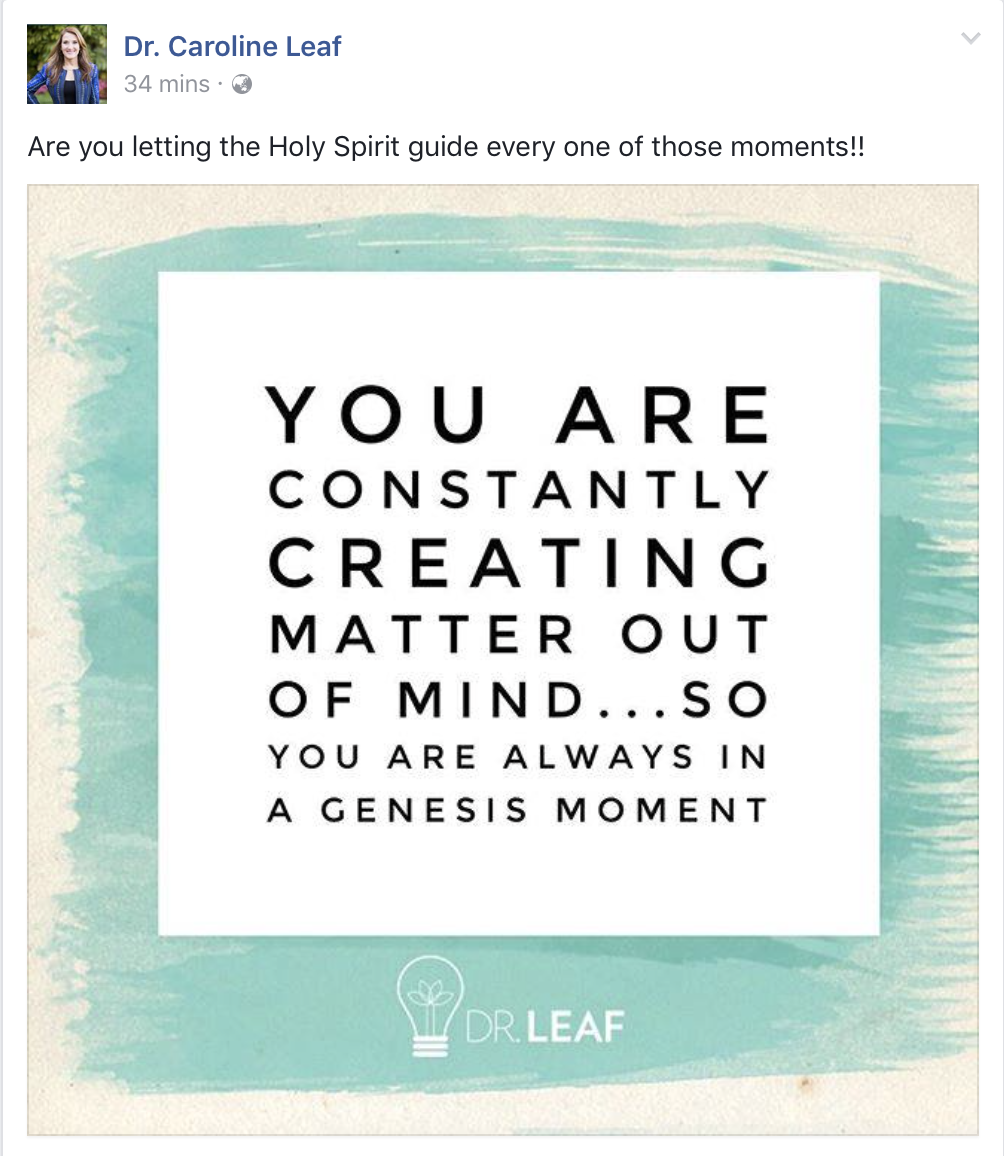
Dr Leaf, communication pathologist and self-titled cognitive neuroscientist, had this to say on social media earlier today: “You are constantly creating matter out of mind … so you are always in a Genesis moment.”

Wow! Just wow! She may not have crossed the line into heresy, but she is pretty much right on top of it.

Because again, she has claimed that we can do with our minds what only God can do. We can not create matter.  The only being that has every created matter is God himself, in Genesis. In adding her little “Genesis moment” comment, she’s essentially equating our mind with God’s.

She might as well just come out and say, “We create matter with our minds, so we are like God”.

There’s a real Genesis moment where people thought they were like God: “‘You will not certainly die,’ the serpent said to the woman. ‘For God knows that when you eat from it your eyes will be opened, and you will be like God, knowing good and evil.’”  We all know how that eventually turned out.

Ultimately it begs the question, where are the church leaders? I don’t hear anyone denouncing Dr Leaf’s comparison of our mind to God’s. How much is too much? When will they say, “Enough’s enough”?

It should have been said already, but sadly, with every unscientific, unscriptural meme that Dr Leaf publishes, the impotence and inaction of the church to becomes more and more painfully obvious.

Please church leadership, please take a stand, before it’s too late.

Dr Caroline Leaf – Mind creates matter

Another day, another factoid. Dr Leaf, communication pathologist and cognitive neuroscientist, says that we create matter with our minds.

screen-shot-2017-02-04-at-8-53-34-am

I’d like her to demonstrate that sometime … Wait, what’s that you say, she can’t do it? Of course she can’t. We cannot create matter with our minds.  We can’t just think something and watch it appear.

Dr Leaf should know better. She is a PhD level scientist after all, and the law of conservation of matter is high school level science.

If Dr Leaf can’t get the most fundamental of facts straight, then she should not be on any pulpit as a scientist, because all she’s doing is embarrassing the church, destroying the church’s credibility with anyone with a shred of scientific knowledge.

The church deserves better than half-baked pseudoscience being passed off as the real deal.  Step up Dr Leaf, or step off.

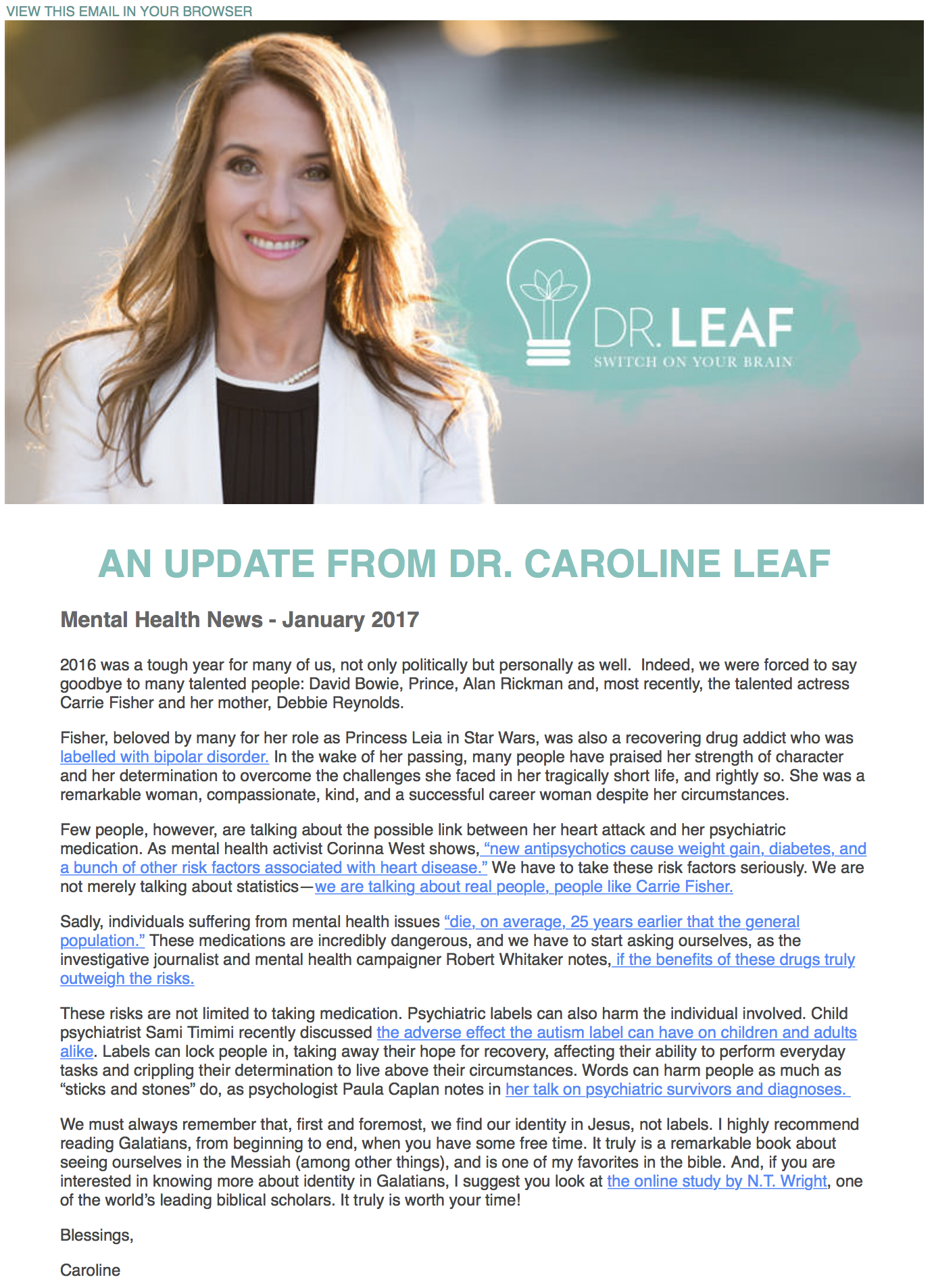
Caroline Leaf – Carrie Fisher killed by bipolar meds

screen-shot-2017-01-13-at-6-23-24-pm

No longer content with just wilful ignorance, Dr Caroline Leaf has stooped even further by using the death of a beloved actress as a sick segue against psychiatric medications.

Dr Caroline Leaf is a communication pathologist and self-titled cognitive neuroscientist.  She markets herself as an expert in neuroscience and mental health despite not knowing how genes work (https://cedwardpitt.com/2014/09/27/dr-caroline-leaf-and-the-genetic-fluctuations-falsehood/ and https://cedwardpitt.com/2017/01/07/dr-caroline-leaf-the-christian-churchs-anti-vaxxer/).

In her latest “Mental Health News – January 2017” e-mail newsletter, Dr Leaf makes some astounding and outlandish statements about mental health.

She starts by claiming that Carrie Fisher’s death was ultimately caused by the psychiatric medications she was taking.

“Few people, however, are talking about the possible link between her heart attack and her psychiatric medication. As mental health activist Corinna West shows, ‘new antipsychotics cause weight gain, diabetes, and a bunch of other risk factors associated with heart disease.’ We have to take these risk factors seriously. We are not merely talking about statistics—we are talking about real people, people like Carrie Fisher.”

Dr Leaf, no one’s talking about the possible link between her heart attack and her psychiatric medication because we respect the Carrie Fisher too much and would rather celebrate her life and achievements, not perform a hypothetical post-mortem motivated by prejudiced speculation.

No one’s talking about the possible link between her heart attack and her psychiatric medication because no one really knows what caused Carrie Fisher’s heart attack.  No one knows if she had any other risk factors for heart attacks, or what medications she was on.  There could be a dozen other reasons why she had a heart attack.  No one else is asking because it’s none of our business.

No one’s talking about the possible link between her heart attack and her psychiatric medication because we know that psychiatric medications do much more good than harm.

No one is talking about the possible link between her heart attack and her psychiatric medication because it’s highly disrespectful to use someone’s death to promote your political or ideological position.  Using Carrie Fisher’s death as a segue to your soapbox about psychiatric medications is like someone using Princess Diana’s death as an opportunity to talk about the dangers of speeding in tunnels.  It’s ungracious, unbecoming, and in poor taste.

What’s even more dishonouring to Carrie Fisher is that Dr Leaf’s claims about psychiatric medications are not accurate.

“Sadly, individuals suffering from mental health issues ‘die, on average, 25 years earlier that the general population.’ These medications are incredibly dangerous, and we have to start asking ourselves, as the investigative journalist and mental health campaigner Robert Whitaker notes, if the benefits of these drugs truly outweigh the risks.”

Notice the giant hole in her argument?  She assumes that the increased risk of death in those with mental illness is the medications they’re on, just like she’s assumed that Carrie Fisher died because she was taking psychiatric medications.

That’s confirmation bias, not science.

Real mental health experts – the ones with training, clinical experience and research acumen – directly contradict Dr Leaf.  Experts like Correll, who say that, “Although antipsychotics have the greatest potential to adversely affect physical health, it is important to note that several large, nationwide studies providing generalizable data have suggested that all-cause mortality is higher in patients with schizophrenia not receiving antipsychotics.” [1]

In other words, the life expectancy of people with schizophrenia is shorter than the rest of the population, but it’s much shorter in schizophrenics not on meds.  Psychiatric medications help people with schizophrenia live longer.

In fact, the use of any anti-psychotic medication for a patient with schizophrenia decreased their risk of dying by nearly 20% [2] whereas the risk of dying for schizophrenics who didn’t take anti-psychotics was nearly ten times that of the healthy population [3].

This is the same for other psychiatric medications as well, “clozapine, antidepressants, and lithium, as well as anti-epileptics, are associated with reduced mortality from suicide.” [1]

Psychiatric drugs aren’t “incredibly dangerous”.  Like any tool, when used in the right way, they can bring radical transformation.  What IS incredibly dangerous is the disingenuous and ill-informed making libellous and inaccurate statements about medications they don’t understand.

Not content to just insult Carrie Fisher’s memory, Dr Leaf went on to claim that psychiatric labels are also as harmful as psychiatric drugs.  “These risks are not limited to taking medication. Psychiatric labels can also harm the individual involved. Child psychiatrist Sami Timimi recently discussed the adverse effect the autism label can have on children and adults alike. Labels can lock people in, taking away their hope for recovery, affecting their ability to perform everyday tasks and crippling their determination to live above their circumstances. Words can harm people as much as “sticks and stones” do, as psychologist Paula Caplan notes in her talk on psychiatric survivors and diagnoses.”

It’s witless to suggest that labels harm people or that they somehow lock people in and take away their hope.  The right label, which doctors call a diagnosis, doesn’t lock people in at all, it does the exact opposite:
* The right diagnosis gives hope – hope that comes from receiving the right treatment and not wasting time, money and energy pursuing the wrong treatment.
* The right diagnosis gives power – it empowers people by giving them the ability to make accurate decisions about what’s best for themselves and their loved ones.
* The right diagnosis gives certainty – in many situations, knowing what the diagnosis is reduces unnecessary anxiety and fear.

Imagine that you had a freckle on your arm, and it started growing suddenly.  You go to the doctor, and the doctor says that the freckle is actually a skin cancer.  Does that label lock you in and take away your hope?  Of course not.  It gives you the certainty of knowing that treatment is needed, and the power to decide if you want that treatment.  And it gives you hope that with the right treatment, you can continue to live a healthy life.

In the same way, a psychiatric diagnosis doesn’t lock people in and remove their hope.  A child who understands that they have autism can stop beating themselves up for being ‘odd’ and instead, they can understand that their different wiring gives them special powers that other kids don’t have.

Psychiatric labels do not harm an individual, it’s the backwards opinions of so-called mental health experts that harm individuals with psychiatric illness.  The stigma of a diagnosis is related to the way in which society treats individuals with that diagnosis, not the diagnosis itself.  Perpetuating the myth that that ‘depression and autism aren’t really diseases’ reduces the acceptance of society for those who suffer from those conditions.  That’s what causes harm.

Dr Leaf should apologise to her followers for showing such disrespect for Carrie Fisher, and to all those who take psychiatric medications.  Carrie Fisher spent her life supporting people with mental illness, trying to break down the stigma of psychiatric illness and treatment.  Her life’s work should be celebrated, not defaced by Dr Leaf and her unscientific opinion.

References

[1]        Correll CU, Detraux J, De Lepeleire J, De Hert M. Effects of antipsychotics, antidepressants and mood stabilizers on risk for physical diseases in people with schizophrenia, depression and bipolar disorder. World psychiatry : official journal of the World Psychiatric Association 2015 Jun;14(2):119-36.
[2]        Tiihonen J, Lonnqvist J, Wahlbeck K, et al. 11-year follow-up of mortality in patients with schizophrenia: a population-based cohort study (FIN11 study). Lancet 2009 Aug 22;374(9690):620-7.
[3]        Torniainen M, Mittendorfer-Rutz E, Tanskanen A, et al. Antipsychotic treatment and mortality in schizophrenia. Schizophrenia bulletin 2015 May;41(3):656-63.

screen-shot-2017-01-12-at-9-05-48-pm

Dr Caroline Leaf – The Christian church’s anti-vaxxer

Well, this is my first post for the new year.  2016 was certainly historic!

In 2016, the Oxford Dictionaries Word of the Year was “post-truth”.  Post-truth describes the concept “in which objective facts are less influential in shaping public opinion than appeals to emotion and personal belief”.

While the popularity of the word rose in step with the popularity of the US President-Elect, post-truth as an idea has been building more and more over the last decade or so.  It’s the driving force behind other cultural phenomena of our modern world, like the alternative health and the anti-vaccination movements.

It’s also the secret to the success of Caroline Leaf.

Dr Caroline Leaf is a communication pathologist and self-titled cognitive neuroscientist.  She’s been riding the wave of our post-truth culture for years.  Dr Leaf has a set of slickly spoken mistruths that form the basis of her ministry, and are repeated constantly (including, but not limited to):

The mind controls the brain
75-98% of all physical, mental and emotional illnesses come from our thought life
The heart is a mini-brain
Our mind changes matter through quantum entanglement
ADHD and depression aren’t diseases
Anti-depressant medications are dangerous placebos

There is no scientific evidence to support any of these claims, but that hasn’t stopped her claiming, because Christians and the leadership of the Christian church believe her without question.

In the last twenty-four hours, Dr Leaf put up two separate social media posts which follow the same pattern – repeated mistruths with no basis in fact.

“What an honor to be speaking at the annual Noiva humanitarian foundation conference in Winterthur, Switzerland, which works actively with the Syrian refugees seeking to broker peace in the Middle East.  I spoke about how showing compassion and helping others improves brain health and increases physical and mental healing by around 63%!”

screen-shot-2017-01-07-at-10-01-34-pm

Showing compassion and helping others improves brain health and increases physical and mental healing by around 63% hey?  I’m assuming she’s referring to the study by Poulin et al [1], because she’s posted this to her social media feed before, and there aren’t any other studies out there that show compassion and helping others increases physical and mental health so much … not that the Poulin study showed it either (not even close – https://cedwardpitt.com/2016/10/27/dr-caroline-leaf-credit-where-credits-due/ and https://cedwardpitt.com/2016/01/16/does-helping-others-help-you/)

On the photo she put up on social media to gloat about her little jaunt to Switzerland, the Powerpoint in the background reads, “Can the mind change the brain?”  Again, the answer is a clear ‘No’!  She tried to argue the same nonsense in her TEDx talk in early 2015 (https://cedwardpitt.com/2015/03/26/the-tedx-users-guide-to-dr-caroline-leaf/).  It was wrong then, and it’s still wrong now.

Unless Dr Leaf’s found some better resources, NOIVA should ask for their money back.  They could have fed a lot of refugees for the wasted cost of hosting Dr Leaf at their conference.

Dr Leaf’s second social media post was even more egregious.

“Our genetic makeup fluctuates by the minute based on what we are thinking and choosing.”

WRONG!  Absolutely wrong.  There is NO scientific evidence that supports this statement at all (https://cedwardpitt.com/2014/09/27/dr-caroline-leaf-and-the-genetic-fluctuations-falsehood/).  DNA is stable.  It doesn’t “fluctuate by the minute”.  It’s not influenced by our thoughts or our choices.

We may be stuck in a post-truth world but science is not, and will never be, post-truth.  Your belief in the cancer-fighting properties of turmeric doesn’t make turmeric cure cancer.  Your opinion that the MMR vaccine causes autism doesn’t change the concrete scientific evidence that it doesn’t.

By the same token, Dr Leaf might believe that our thoughts and choices change our DNA, but it doesn’t matter how many times Dr Leaf repeats the same fiction, it still doesn’t make it fact.  She can repeat ad nauseum her belief that the mind controls the brain, or our mind changes matter through quantum entanglement, or depression isn’t a disease, or all of our illnesses come from thoughts.  None of them were true the first time she made each outrageous claim, and they still aren’t true now. Scientific truth doesn’t change depending on what suits your opinion.

In fact, all Dr Leaf is doing by continually perpetuating her stock of mistruths is to disempower her audience.  Rather than encourage people to follow the facts, they are sucked into a vortex of wasted money and time.  Precious resources are spent chasing wild geese instead of putting them towards something more meaningful.  NOIVA diverting funds to support Dr Leaf’s fees instead of feeding refugees is a perfect case in point.

Worse, Dr Leaf’s teaching discourages people from taking effective medications and seeking effective treatments which can only lead to greater suffering in those who are vulnerable.

In this sense, Dr Leaf is like the anti-vaxxer of the Christian church, discouraging her followers from seeking scientifically sound treatments in favour of belief in erroneous and invalid actions with no proof of efficacy and a real risk of harm.

When will the leadership of the Christian church stand up for their parishioners and stop Dr Leaf’s fictions from infecting their churches?  The answer should be ‘now’, and that’s a fact.

References
[1]        Poulin MJ, Brown SL, Dillard AJ, Smith DM. Giving to others and the association between stress and mortality. Am J Public Health 2013 Sep;103(9):1649-55.

The Perspective of Dawn

screen-shot-2016-12-24-at-10-34-30-pm

Perhaps it was the hypnogogic delirium, but I had an epiphany.

Truthfully, it was probably less epiphany and more of a reminder, that little “oh yeah” sort of moment.

Yesterday I was sitting in an airport lounge at 5am, waiting to be whisked away on my 6am flight to the tropical north to join my family and in-laws for Christmas.

For the life of me, I can’t remember why I decided to book a flight for six in the morning.  I think the flight was cheap, and I thought to myself “6am … that’s not that early …”.  I forgot that to allow for travel time and checking in, I had to get up at 3:30am.  Not even sparrows are awake at half-past three.  In fact, I’m often going to bed at that time of night, so this whole pre-dawn awakening thing was really foreign.

The fact that I was showered, dressed, and sitting at the airport compos mentis was really weird … I think I was slightly delirious.

Still, the whole predawn awakening thing was enlightening. It was a refreshing glimpse of a time of day that I normally spend hibernating. The first thing I noticed was the light. I always thought that dawn and dusk were the same but just lighting from the opposite direction, but there’s a subtle difference in the hue that gives the early morning a softer, fresher glow.

The other thing I noticed was the stillness.  Everyone else in their right mind didn’t book dawn flights and were still snug in their beds, so the usual hustle and busy buzzing that usually fills the streets was absent.

The soft cool breeze on my face, in the midst of the calmed half-light was almost meditative.  It was quite a change to my daily routine of sleeping until I have to drag myself (and the kids) out to our usual daytime occupations.

The stillness and beauty of my new perspective of dawn reminded me of how it’s easy to get stuck in the same pattern.

Our routines are partly a function of necessity – we have to go to work, the kids have to go to school, we have to get groceries, attend social functions, go to church on Sundays.  There isn’t anything necessarily wrong with this repetitive normality.  Still, our brain gets used to the usual patterns and it starts to filter out the same input that it gets continually exposed to, and our brains function on autopilot.  This process of automation, habituation and suppression is an advantage for our brains in terms of efficiency and energy conservation, but this leaves a bit of a cognitive void which our brain fills with the internal monologue of our own confabulation.  We drink our own kool-aid, as it were.

This is what people often think of as “the rut”, that existential inertia and stagnation, the first-world malaise of meaningless repetition.

The antidote to the rut is to break the pattern.  When we have a change to our circumstances and we experience something new, our brain has to process things differently.  More processing power is needed, which involves our working memory and our conscious stream of thought.  One small step outside the comfort zone of our routine, and all of a sudden, the world can seem fresh and new again.

This process is enhanced through mindfulness.  When we practice mindfulness, we fully engage in the present moment.  We can appreciate the detail that we so often filter out and ignore.  We can (and should) practice mindfulness at any time, but when we’re engaging in a new experience, immersing ourselves in it mindfully will only enhance it.

The perspective of dawn that I experienced yesterday helped remind me of the power of stillness in an ever-demanding world over-saturated with stimulation.

I hope that this Christmas and New Year, you can take the time to have your own ‘perspective of dawn’ as it were – step out of your comfort zone and experience something completely new, and engage with the experience fully, mindfully.  I hope you gain a fresh insight that you can help propel you forward into the amazing potential that 2017 holds for us all.

From my family to yours, have a very Merry Christmas and a safe and prosperous New Year.

Free will isn’t free

screen-shot-2016-12-23-at-5-00-21-pm

It’s only two days before Christmas.  I know most people in the last forty-eight hours before the Yuletide would be focussing on last minute shopping for presents or foraging for the ingredients for their Christmas feasts, or making their last minute arrangements for their holiday celebrations.  So now may not be the right time to post something meaty about the philosophy of free will, but hey, it might just make for a welcome distraction.  Come with me, if you’re game, down the rabbit hole of our choices.

Dr Leaf, communication pathologist and self-titled cognitive neuroscientist, posted a quote today from former Regius Professor of Divinity at the University of Oxford, Keith Ward: “Free will is a place where people can decide to do what is right or to do what is wrong and nothing determines their choice – lots of things influence their choice but nothing determines it except them”.

But is it, really?  Clearly Professor Ward is a very learned fellow, but what strikes me about Dr Leaf’s quote of the day is Professor Ward’s false moral dichotomy, and his over-simplistic implication that every choice is a fully conscious choice.  Perhaps his quote is taken out of context by Dr Leaf and his intended message has been skewed.  It wouldn’t be the first time Dr Leaf has cherry-picked and misquoted.

Dr Leaf added in her ‘me too’ comment – “So we are responsible and can be held responsible for our choices – this is confirmed by science and scripture”.

I should say, it’s not that Dr Leaf’s comment is completely wrong – we are held responsible for our choices, but this isn’t confirmed by science or by scripture, it is something that is legal more than it is scientific or scriptural.

As humans, we have a strong feeling of voluntary control over our actions, that everything we do is something that we choose to do.  This sense of control is so fundamental to our existence that much of our social system depends on it, such as our laws and the penalties for breaking them [1].

Except that science has proven that our sense of full control is largely an illusion.

I understand this idea might be hard for some people to accept.  We’re taught that we have full control over our actions or ideas.  We experience this sense of control from the vantage point of our own perception.  It’s hard to believe that we’re not really in full control of our actions and choices.  The dominant paradigm in the Christian church is the idea of free will.  We’re taught that the words we say and things we do are the exclusive product of our will.  Cognitive neuroscience paints a different picture.

The modern neuroscience of the will started with Benjamin Libet.  Professor Libet was a researcher in physiology at the University of California San Francisco.  He was initially studying the electrical properties of different sensations in the brain, but in the early 1980’s, he performed an experiment to look at the electrical readings that take place when a person decides on an action.  His subjects would decide to perform a simple movement of their arm or hand, and say when they were aware of the intention to act.  Electrodes connected to the subject’s heads measured their brain activity before, during, and after their decision to act.

What was remarkable was that there was a clear spike in electrical activity occurring up to a full second before a test subject was consciously aware of the intention to act [2].  Libet suggested that an unconscious process was responsible for the ‘willed’ action.

Other studies since that time have confirmed Libet’s results.  In fact, a study in 2008 showed that predictable brain activity occurred up to eight seconds before a person was aware of their intention to act [3].

This predictable unconscious spike of brain activity prior to awareness of our intention to act has been verified over and over and is beyond doubt, but there’s still lots of debate as to exactly what it means.  Defenders of the idea of free will have tried presenting alternative explanations of the pre-awareness unconscious activity, but none of them line up with the proven, repeatable science.

So if we don’t have full conscious control of our actions, what does go on in our brains when we perform an action?

Again, I won’t go into the fine print, but it’s important to understand that our brain does most of its work at a subconscious level, which includes the planning and execution of our actions [4, 5].  The brain takes the information presented to it, as well as information from memories, and makes a prediction of the best course of action.  This means that our processing of goals, rewards, and actions can be affected by ‘subliminal priming’ (in other words, information we process below our conscious level can affect the decision about the best course of action [5]).

Even though we’re not aware of every process the brain employs in our subconscious to formulate the best plan of action and to prime our system ready for that action, there is a element of awareness that provides real-time monitoring and a veto function [4].  Like if you were about to complain about your job and then suddenly remembered you were talking to your boss, you could stop yourself from saying something you might later regret.

What does it all mean?  The take-away message here is this: We have limited will, not free will.

We still have some capacity to choose, but our conscious choices are dependent on our subconscious brain activity, our experience and knowledge.

We can make choices, or “exercise our will”, if you like, but within the constraints of a number of factors beyond our conscious control.  We can “pull the brake”, so to speak, and stop an action that our subconscious brain activity primed us for, but wasn’t such a good idea when a bit more thought was applied.  Our brain also uses our experience and knowledge to predict the best action to take, and because some of our knowledge and experience comes from exercising our limited choices, we can also say we have some input into our decisions.

So in this sense, Prof Ward is correct – lots of things influence people’s choices and ultimately, the choice someone makes is their choice.  I don’t make your choices for you, they are your choices.  Except that it’s inaccurate and misleading to think of our will as being entirely conscious and thought driven.  We make a lot of subconscious decisions every day, often based on subconscious priming.  Most actions we take, day in and day out, are not influenced by our conscious thought.  They may sometimes make it into our subconscious awareness, and if they do, it’s often after the fact.

Have ever had a “Why did I say that” experiences, where your brain is thinking one thing and your mouth says another?  These are times that demonstrate the difference in the systems at work in our brains, which are usually co-ordinated, but not always.  There are other demonstrations of this as well, like specific brain pathologies leading to conditions such as Alien Hand Syndrome.

These sort of conditions show that intention is not the same as action.

Sure, most of the time they’re aligned, but not always.  And this is the key to Dr Leaf’s quote of the day today – the underlying assumption is that all of our choices are reflected in our actions, when really, our choices are better thought of as our intentions (although again, it’s still not that simple … is it morally wrong if you try to hurt someone but you don’t, or is it morally wrong if you try not to hurt someone, but you do?)

Professor Ward’s quote also sets up a false dichotomy of free will into only right or only wrong, and doesn’t take into account the intellectual or developmental capacity of a person to make a choice.  Would you expect a two-year-old to judge a complex moral life or death situation?  A more practical example is should people with dementia be able to make their own financial and health-related decisions?

Most reasonable people would say, “Well, that depends …” and that’s the correct answer here.  Nothing in the real world of human morality and choice is black or white.  There is always some subtlety, some nuance.

When put in context, the black-and-white thinking and teaching of Dr Leaf is shown up as shallow and inadequate.  Her little quote of the day doesn’t prove that free will is Biblically and scientifically supported, far from it.  All it shows is that Dr Leaf’s views are narrow and blinkered, and aren’t reflective of any scientific or scriptural expertise.

Dr Leaf is welcome to her opinion, but until she gains some actual expertise, she should reconsider her choice to share it.

References

[1]        Haggard P. Human volition: towards a neuroscience of will. Nature reviews Neuroscience 2008 Dec;9(4):934-46.
[2]        Libet B, Gleason CA, Wright EW, Pearl DK. Time of conscious intention to act in relation to onset of cerebral activity (readiness-potential). The unconscious initiation of a freely voluntary act. Brain : a journal of neurology 1983 Sep;26 (Pt 3):623-42.
[3]        Soon CS, Brass M, Heinze HJ, Haynes JD. Unconscious determinants of free decisions in the human brain. Nature neuroscience 2008 May;3(5):543-5.
[4]        Bonn GB. Re-conceptualizing free will for the 21st century: acting independently with a limited role for consciousness. Frontiers in psychology 205;4:920.
[5]        Horga G, Maia TV. Conscious and unconscious processes in cognitive control: a theoretical perspective and a novel empirical approach. Frontiers in human neuroscience 204;6:199.

Small. Local. Organic. Misinformed.

Maize

I like food, probably a little too much. I also value good science and correct information.

There are lots of narrative threads when it comes to the story of food, and their themes have been changing over the last few decades. Food used to be about sustenance, now it’s often about status. Food used to be about the commodity, now the narratives are reflective of food communities. In some parts of the world, the food supply is critical, where as in resource-rich western countries, we are overwhelmed with food selection.

The transition from the modern to the post-modern story of food and farms was served by the Food Movement and it’s lauded oracles like Michael Pollan. Pollen’s book, “The Omnivores Dilemma”, is revered by many as a revolutionary tome. But for every person who accepts the Food Movement mantra of “Small, local, organic”, there are just as many critics who have seen through the Food Movement’s post-truth veneer.

I read one such critique today, a long but revealing article by Marc Brazeau, a former chef and food writer from the US. Once a Food Movement follower, Marc realised that he could no longer support the core tenets and primary position of the Food Movement because of the lack of credible scientific evidence that the Food Movement is built on.

In one telling paragraph, he writes,

“Lazy critiques of industrial agriculture masquerading as critiques of biotech get away with missing the mark or getting the causality backwards because of the mystery surrounding the technology and people’s inchoate intuitions about messing with nature. They get away with sloppy logic and misinformation because most people have sentimental intuitions that farming should somehow be exempt from commerce, from technological change, from legalistic constraints – that it should somehow operate on a more pastoral logic, even as it works to serves a mass, industrialized society.”

In other words, the Food Movement and other pro-organic, anti-conventional, anti-GMO activists get things backwards, but get away with it because most people don’t really understand the technology while having an emotional attachment to “natural” things and an innate aversion to things that “mess with nature”. Even though organic farming is actually no better (and probably worse) than conventional farming, most people have a fear of the unknown and are easily swayed by propaganda that feeds into that fear, even though it’s fundamentally irrational.

“… when you start with a conception of a tomato being crossed with a fish that you got from a cartoon on a picket sign and you wind up finally understanding that it is a single well understood gene out of tens of thousands of genes being transferred from one organism to another, you wonder, why all the drama? When you realize that you share half your DNA with a banana or that an herbicide resistant soybean has been bred to express a different version of a single enzyme so that it is not affected by a single herbicide, the technology becomes a lot less mysterious and a lot less intimidating.

You learn that the Bt gene in insect resistant corn comes from a soil bacterium that’s been used for decades as an organic pesticide. You learn that the proteins that have been bred into the corn and cotton are toxic to insects that eat the plants because the protein is activated by their alkaline gut and binds to a specific receptor to damage their digestive tract. It’s harmless however to humans and other critters because it’s digested in our acidic stomachs like any other protein. And besides, we don’t have that receptor anyways.”

Reading the article reminded me of Dr Leaf’s book “Think and Eat Yourself Smart”. In fact, Brazeau’s post is an eloquent take-down of the first few chapters of “Think and Eat Yourself Smart” without intending to be so, mainly because Caroline Leaf’s book is just a Christianised version of the Omnivore’s Dilemma and the Food Movement gospel mixed with her scientifically dubious ‘cognitive neuroscience’.

Take Caroline Leaf’s definition of “Real Food”, “Real food is food grown the way God intended: fresh and nutritious, predominantly local, seasonal, grass-fed, as wild as possible, free of synthetic chemicals, whole or minimally processed, and ecologically diverse.” (Think and Eat Yourself Smart, p29) This is an appeal to antiquity and authority, an assumption that what was best for the Garden of Eden is God’s desire for how the world should be today. It’s just the “Small, local, organic” philosophy, rebranded with a Christianese slant to appeal to her audience in the western Church.

The Christianised version of the Food Movement’s romanticised post-truth ideals aren’t any better than the originals. Dr Leaf’s aspirational promotion of local, organic, macrobiotic, agro-economic tree-hugging food systems as God’s model for the modern church is idealistic inanity.

It’s time the church moved beyond the Christian rehash of popular secular philosophies and started critically assessing the teaching of those who would promote themselves as ‘experts’. As a church, we deserve the narrative that’s accurate, not the narrative that is simply appealing.

You can read the full essay by Marc Brazeau at http://fafdl.org/blog/2016/11/18/tales-of-a-recovering-pollanite/

References

Leaf CM. Think and Eat Yourself Smart. USA: Baker Books; 2016 (April 5)

The confused teaching of Dr Caroline Leaf

screen-shot-2016-11-03-at-12-53-18-am

Dr Leaf released her latest e-mail newsletter today.  I decided to follow up with a brief review of this week’s instalment after her last e-mail newsletter completely misrepresented Ephesians 4:16, the function of the hypothalamus and the effect of stress on the population,

Dr Leaf was true to her usual form.  Her fundamental assumptions remain subtly skewed, forcing each layer of argument into an unbalanced and unstable alignment, and the more she tried to justify herself, the more unstable her arguments became, until eventually they toppled.

There was the obligatory dig at the medical profession, another smug ad hominem dismissal claiming that doctors have ‘negligible training in nutrition’, so doctors don’t understand the ‘whole approach’ that Dr Leaf and other so-called ‘progressive’ food thinkers have.  In reality, doctors have a lot of nutritional training, a darn-sight more than communication pathologists and self-titled cognitive neuroscientists.

And again, Dr Leaf demonstrates her paucity of knowledge or respect for the scripture by again misquoting Proverbs 23:7.  You don’t need to be a Biblical scholar to be able to read a verse of scripture in context, and in context, “as he thinks in his heart [mind], so is he” has got nothing to do with our mind or our thoughts (as I’ve discussed before https://cedwardpitt.com/2015/05/30/dr-caroline-leaf-manhandling-scriptures-again/).

But the critical error which invalidates Dr Leaf’s essay this week is the intellectual dissonance she creates by making two paradoxical claims.

“Your mind, or soul, has one foot in the door of the spirit and one foot in the door of the body. The mind creates coherence between the spirit of man and the body of man, and therefore influences and controls brain/body function and health, and influences spiritual development. Your mind, with its intellectual ability to choose and its emotional authority, controls all physical aspects.”

and

“Fasting has been shown to enhance brain function, and reduce the risk factors for coronary artery disease, stroke, insulin sensitivity and blood pressure. For instance, restricting calories can support the induction of sirtuin-1 (SIRT1), an enzyme that regulates gene expression and enhances learning and memory.”

Essentially, Dr Leaf is saying in one breath that the mind is separate to the physical brain but controls all of the function of the physical brain and the body, but then moments later says that changes in the body alters the function of the brain which then alters the function of the mind.

So which is it?  You can’t have it both ways?  It’s impossible for the mind to control all physical aspects of the brain if the mind is vulnerable to changes in the brain and body.

The dilemma of Dr Leaf’s mind-brain paradox stems from her defective set of assumptions on the triune being.

“You are intrinsically, brilliantly, and intricately designed with a spirit, soul and body (Genesis 1:26; 1 Thessalonians 5:23). This is known as our triune nature.  Our triune nature is divided into different components. Your spirit is your ‘true you’, or what I call your PerfectlyYou. The spirit has three parts: intuition, conscience and communion (worship). Your soul, which is your mind, also has three parts: intellect, will and emotions. Lastly, your body has three parts: the ectoderm, mesoderm and endoderm, from which the brain and the body form.”

Dr Leaf’s ideas about the triune being are Biblically and scientifically tenuous—more conjecture on Dr Leaf’s part than hard science or solid theology (Read here for more information on this https://cedwardpitt.com/2014/07/25/dr-caroline-leaf-dualism-and-the-triune-being-hypothesis/)  Yet she bases her entire ministry on these shaky assumptions, cherry picking studies and manipulating facts to suit her arguments and ignoring the glaring contradictions that inevitably arise.

So Dr Leaf’s latest offering to her followers again demonstrates the confusion and contradiction that plagues her teaching—layer upon layer of cherry-picked factoids manipulated to prop up her tenuous assumptions. Dr Leaf would do better by listening to scientists and doctors rather than arrogantly dismissing them.