Seven Elements of Good Mental Health: 7. Create social networks – The Prospering Soul

Life shouldn’t just be about avoiding poor health, but also enjoying good health. Our psychological health is no different.

Before we take a look at poor mental health, let’s look at some of the ways that people can enjoy good mental health and wellbeing. This next series of posts will discuss seven elements that are Biblically and scientifically recognised as important to people living richer and more fulfilling lives.

These aren’t the only ways that a person can find fulfilment, nor are they sure-fire ways of preventing all mental health problems either. They’re not seven steps to enlightenment or happiness either.   But applying these principles can improve psychosocial wellbeing, and encourage good mental health.

7. Create social networks

Before 2004, everyone knew what social networks were. Now when you talk about ‘social networks’, people assume you’re referring to Facebook. It seems like virtual social networking has been around forever, whereas in contrast, real social networking actually has.

We know this, because we’re wired for social interaction, with specific areas of the brain devoted to social behaviour, such as the orbitofrontal cortex, and there are neurotransmitters and hormones that are strongly associated with bonding and maintenance of social relationships, like oxytocin and β-endorphins. Research has also shown that both humans and other primates find social stimuli intrinsically rewarding – babies look longer at faces than at non-face stimuli, for example [1].

People who engage in social relationships are more likely to live longer, some estimate by an extra 50% [2]. Certainly it appears that the opposite is true. Loneliness predicts depressive symptoms, impaired sleep and daytime dysfunction, reductions in physical activity, and impaired mental health and cognition. At the biological level, loneliness is associated with altered blood pressure, increased stress hormone secretion, a shift in the balance of cytokines towards inflammation and altered immunity. Loneliness may predict mortality [3].

So what is loneliness, and conversely, what defines good social relationships? Fundamentally, good or bad social relationships are related to the quality of the social interaction. This rule applies equally to real social networks [3] and their on-line equivalents [4]. So quality is fundamentally more important than quantity in terms of friendships, with that quality strongly determined by the connection within those social relationships. For example, loneliness “can be thought of as perceived isolation and is more accurately defined as the distressing feeling that accompanies discrepancies between one’s desired and actual social relationships” [3].

The corollary is that friendship can be thought of as perceived connection within social relationships, or the comforting feeling that accompanies the match between one’s desired and actual social relationships.

So healthy social relationships aren’t defined by the size of your network, but by the strength of the connections that your network contains, relative to what’s important to you. Just because you’re not a vivacious extrovert who’s friends with everyone doesn’t mean that your social network is lacking. It also means that you can have meaningful connections to friends through social media, just as much as you can have meaningful connections through face to face interactions. It’s not the way you interact, but the quality of the connection that counts.

What is it about other people that makes us more likely to be their friends? Connection between friends is often the result of attraction to individuals of similar personalities or skills, although recent research suggests that friendship may be related to a much deeper level. Brent et al notes that “Humans are especially predisposed toward homophily, with recent evidence suggesting this even extends to the genetic level; people are more likely to be friends if they have similar genotypes. Taken together, these findings advocate the need to consider not only an individual’s genome, but also their metagenome, when asking questions about the causes of friendship biases … Unrelated friends are more likely to be genetically similar, equivalent to the level of fourth cousins, compared to unrelated strangers.” [1]

As Christians, we’re encouraged to engage with other Christians on a regular basis, which in our modern world, is through regular church attendance. As the Bible says in Hebrews 10:23-25, “Let us hold unswervingly to the hope we profess, for he who promised is faithful. And let us consider how we may spur one another on towards love and good deeds, not giving up meeting together, as some are in the habit of doing, but encouraging one another – and all the more as you see the Day approaching.” But as the research has shown, it’s not just being part of the crowd, but connecting with those in the church in a meaningful way. It’s very easy to be lonely in a crowded church.

Always remember: “Befriend, and be a friend” – that’s how you’ll find benefit to your spirit, soul and body.

References

[1]        Brent LJ, Chang SW, Gariepy JF, Platt ML. The neuroethology of friendship. Annals of the New York Academy of Sciences 2014 May;1316:1-17.
[2]        Holt-Lunstad J, Smith TB, Layton JB. Social relationships and mortality risk: a meta-analytic review. PLoS medicine 2010 Jul;7(7):e1000316.
[3]        Luo Y, Hawkley LC, Waite LJ, Cacioppo JT. Loneliness, health, and mortality in old age: a national longitudinal study. Social science & medicine 2012 Mar;74(6):907-14.
[4]        Oh HJ, Ozkaya E, LaRose R. How does online social networking enhance life satisfaction? The relationships among online supportive interaction, affect, perceived social support, sense of community, and life satisfaction. Computers in Human Behavior 2014;30:69-78.

Seven Elements of Good Mental Health: 6. Forgiveness – The Prospering Soul

Life shouldn’t just be about avoiding poor health, but also enjoying good health. Our psychological health is no different.

Before we take a look at poor mental health, let’s look at some of the ways that people can enjoy good mental health and wellbeing. This next series of posts will discuss seven elements that are Biblically and scientifically recognised as important to people living richer and more fulfilling lives.

These aren’t the only ways that a person can find fulfilment, nor are they sure-fire ways of preventing all mental health problems either. They’re not seven steps to enlightenment or happiness either.   But applying these principles can improve psychosocial wellbeing, and encourage good mental health.

6. Forgiveness

“You’d think after five months of lying on my back, I would have given up any idea of getting even, just be a nice guy and call it a day. Nice guys are fine: you have to have somebody to take advantage of… but they always finish last.”

Mel Gibson’s character spoke these words as an introduction to the movie “Payback.” It’s plot line sees him maim or kill every person linked in the chain of thugs and organised crime that ripped him off of his seventy thousand dollars. At the end of the movie, after he exacts the final revenge on the last villain, he drives off with a smile on his face, his money and his renewed romance. But if this was real life, would he have been happy, or would he have just been even?

It’s human nature to repay wrong with another wrong. Eye for an eye, tooth for a tooth. If you hurt me, natural justice is fulfilled if I make you feel the same pain in return. So what choices do you have if someone hurts or wrongs you? Well, you could retaliate. You could plan retribution. Ask for recompense. Or simply push for recognition of your pain. Sometimes these strategies lead to resolution, but usually not immediately, and in order to stay motivated to achieve a delayed resolution, you have to keep reminding yourself of the pain caused to you, so that the effort you’re making will be worthwhile.

As the old proverb goes, “Two wrongs don’t make a right.” If you hurt me, hurting you back doesn’t make my pain go away. It just adds more pain to the world, because I’m still in pain and now you’re in pain. Then you’ll want to hurt me back, and the cycle escalates. Francis Bacon said, “A man that studieth revenge keeps his own wounds green, which otherwise would heal and do well.” In other words, you may be able to bring about retribution, but during the process, you’ll end up keeping your own wounds open and festering, instead of letting them close and heal. It’s like someone cut you with a knife, and if order to show them what damage they did to you, you keep reopening the wound every few days. The wound may look open and fresh should they ever care to notice, but you’re the one who had to put up with an open wound for an extended time, and re-live the pain every time you reopened it.

Interestingly, research tend to support this notion. One study showed that when subjects were asked to think of reacting aggressively to a given scenario, parts of the limbic system in their brains increased in activity. This isn’t unsurprising, given that our brain subconsciously prepares us all the time for fight or flight responses when it starts to sense danger, in preparation for possible action. What was more interesting is that it also reduced the activity of the subjects frontal lobes as well. As discussed by Worthington and colleagues, “Thus, one implication might be that negative emotion acts antagonistically toward reasoning. This suggests that reasoning is disrupted by anger and that imaginally rehearsing angry and aggressive mental scenarios (i.e., ruminating angrily) could (a) catapult one into negative emotive responding and (b) shut down rational approach and calm emotions. Imagery as well as verbal rumination might stimulate similar effects.” [1]

The other option is a particular form of acceptance, which we know as forgiveness. Forgiveness, the act of moving on from insult or injustice, a actually a complex psychological process. There have lots of studies looking at different aspects of forgiveness, but without getting bogged down in details, forgiveness helps to rebalance things. People who forgive habitually tend to also have lower systolic, diastolic blood pressure, and individual acts of forgiveness and lower hostility predicted lower stress levels, which in turn predicted lower self-reported illness, a strong mediator being reduced negative affect (a “bad mood”) was the strongest mediator between forgiveness and physical health symptoms, although they also noted other variables such as spirituality, social skills, and lower stress also had a role in the forgiveness-health relationship [2].

I understand that talking about forgiveness can bring up some deep and difficult feelings in some people. Just like physical wounds, some are shallow and heal quickly, but others are inflicted so deep that they’re hard to heal – severe trauma like rape, childhood abuse, domestic violence and other deep psychological insults. It’s important to clarify here that memories of such traumatic events often intrude into your conscious awareness, where it replays in your memory, but not of your own volition. That’s different to unforgiveness and rumination, which are memories which we foster and encourage. Forgiveness is still a part of the healing process of these severe traumas, but the healing process may take longer, and the process of finding that forgiveness may require a professional to help walk through the process. If you’ve been the victim of a severe trauma, you don’t need to go it alone. Find a psychologist or talk to your doctor if you’re not sure.

For the Christian, forgiveness is at the very core of the entire life of faith we lead. God forgave us, and we can enjoy that forgiveness if we choose to move away from a life enslaved to sin. It is through the death of Jesus on the cross that we have this chance, and Jesus himself showed the ultimate in forgiveness when, as he hung dying on the cross, he forgave the soldiers that put him there. Throughout his ministry, he preached the same message – forgiveness is a central text of the Lords prayer, he told Peter that he should forgive someone “seventy times seven”, and he showed grace to those around him such as the woman caught in adultery. There are many more examples of forgiveness in the Bible as well.

I don’t know if there is any one particular best method to forgive. Apologies help [3], but they aren’t necessary to be able to forgive someone. Sometimes people find actually saying the words “I forgive you” to be a powerful release. That can be to a person directly, although that may not always go down well. Saying it internally is valid. Sometimes writing it in a letter, and then tearing it up as an act of finality, can be useful.

I hope that you can find it in your heart to forgive those in your life that have wronged you and continue to move forward. Remember, “To forgive is to set a prisoner free, and discover that the prisoner was you.” (Lewis B. Smedes)

References

[1]        Worthington EL, Jr., Witvliet CV, Pietrini P, Miller AJ. Forgiveness, health, and well-being: a review of evidence for emotional versus decisional forgiveness, dispositional forgivingness, and reduced unforgiveness. Journal of behavioral medicine 2007 Aug;30(4):291-302.
[2]        Lawler KA, Younger JW, Piferi RL, Jobe RL, Edmondson KA, Jones WH. The unique effects of forgiveness on health: an exploration of pathways. Journal of behavioral medicine 2005 Apr;28(2):157-67.
[3]        Strang S, Utikal V, Fischbacher U, Weber B, Falk A. Neural correlates of receiving an apology and active forgiveness: an FMRI study. PloS one 2014;9(2):e87654.

Seven Elements of Good Mental Health: 5. Be grateful – The Prospering Soul

Life shouldn’t just be about avoiding poor health, but also enjoying good health. Our psychological health is no different.

Before we take a look at poor mental health, let’s look at some of the ways that people can enjoy good mental health and wellbeing. This next series of posts will discuss seven elements that are Biblically and scientifically recognised as important to people living richer and more fulfilling lives.

These aren’t the only ways that a person can find fulfilment, nor are they sure-fire ways of preventing all mental health problems either. They’re not seven steps to enlightenment or happiness either.   But applying these principles can improve psychosocial wellbeing, and encourage good mental health.

5. Be grateful

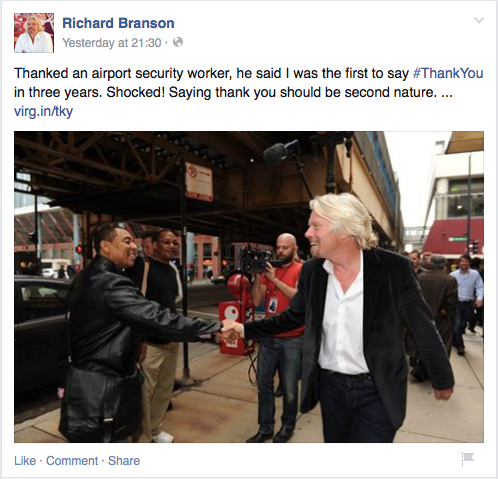
As I was trolling through Facebook the other day, I came across this post by Sir Richard Branson, founder of Virgin: “Thanked an airport security worker, he said I was the first to say #ThankYou in three years. Shocked! Saying thank you should be second nature …”

Richard Branson Thank You

Perhaps the security worker was exaggerating for the billionaire, or perhaps everybody hates airport security at the airport where he works. At any rate, three years is a long time to go without someone saying thanks.

As Sir Richard said, “Saying thank you should be second nature …”. Saying thanks is a small part of the much larger psychology of gratitude, which is “part of a wider life orientation towards noticing and appreciating the positive in the world” [1]. In fact, there are several components to the overall orientation of gratitude, including “(1) individual differences in the experience of grateful affect, (2) appreciation of other people, (3) a focus on what the person has, (4) feelings of awe when encountering beauty, (4) behaviors to express gratitude, (5) focusing on the positive in the present moment, (6) appreciation rising from understanding life is short, (7) a focus on the positive in the present moment, and (8) positive social comparisons.” [1]

The research suggests that people who are naturally grateful tend to be less angry and hostile, less depressed, less emotionally vulnerable, and experienced positive emotions more frequently. Gratitude also correlated with traits like positive social functioning, emotional warmth, gregariousness, activity seeking, trust, altruism, and tender-mindedness. Grateful people also had higher openness to their feeling, ideas, and values, and greater competence, dutifulness, and achievement striving.

However, these effects may be simply an association of gratitude with other personality traits. In other words, people who are naturally optimistic or conscientious are also more likely to be thankful, rather than the thankfulness causing someone to be more optimistic or conscientious. There are a few studies that show gratitude interventions improving self-worth, body image, and anxiety, although the evidence is that while gratitude was better than doing nothing, it was equal to, not superior to, currently accepted psychological interventions.

Even though gratitude may not be better than standard psychological treatments, it’s better than being ungrateful.  It’s also something that the Bible exhorts us to do (“In everything give thanks, for this is the will of God in Christ Jesus, concerning you.” – 1 Thess 5:18).  And let’s face it, it’s pretty easy to do.

The best studied gratitude intervention is a gratitude diary – writing something down every day that you are thankful for [1]. It doesn’t have to be long. A single sentence or phrase is good enough. Not that it has to be written if that’s not your thing. I had a friend who was determined to do a gratitude journal, but she also has a love and a knack for photography. So, she decided to take a photo a day of something that she was grateful for, and post it on Facebook. She had her moments where she doubted herself, struggled to find a subject of her gratitude, or struggled to find something unique, especially after day 300, but the end result was amazing. She grew in her gratitude and her photographic skill, and I often found myself blessed by her beautiful images and insights.

So, be thankful and express it in your own unique way.

References

[1]        Wood AM, Froh JJ, Geraghty AW. Gratitude and well-being: a review and theoretical integration. Clinical psychology review 2010 Nov;30(7):890-905.

Seven Elements of Good Mental Health: 2. Be Kind – The Prospering Soul

Life shouldn’t just be about avoiding poor health, but also enjoying good health.  Our psychological health is no different.

Before we take a look at poor mental health, let’s look at some of the ways that people can enjoy good mental health and wellbeing. This next series of posts will discuss seven elements that are Biblically and scientifically recognised as important to people living richer and more fulfilling lives.

These aren’t the only ways that a person can find fulfilment, nor are they sure-fire ways of preventing all mental health problems either. They’re not seven steps to enlightenment or happiness either.   But applying these principles can improve psychosocial wellbeing, and encourage good mental health.

2. Be kind

One of the best things you can do for your health and happiness is to be kind to other people. In their review of studies on altruism, Lozada et al (2011) showed that altruism activates rewarding neural networks, essentially the same brain regions as those activated when receiving rewards or experiencing pleasure. They also described studies showing that both hormones and the neurotransmitters in the brain involved in helping behaviour and social bonding can lessen stress levels and anxiety. Also, the immune and autonomous nervous systems are positively affected by the quality and extent of social networks, and increased sociability and concern for others’ wellbeing can improve immune system and stress responses [1].

The Bible has always encouraged us to show other people kindness. In Ephesians 4:31-32, Paul tells the church at Ephesus, “Get rid of all bitterness, rage and anger, brawling and slander, along with every form of malice. Be kind and compassionate to one another, forgiving each other, just as in Christ God forgave you.”

And that kindness wasn’t just for other people in the church, but to anyone in need (Matthew 25:34-40).

There are infinite ways to show kindness, but the thing that links them together is unselfishness, the “disinterested and selfless concern for the well-being of others”, or in less formal language, simply giving with no strings attached.

If you’re looking for some ideas on some new ways to show kindness, the Random Acts of Kindness Foundation has plenty of them. Check out https://www.randomactsofkindness.org/kindness-ideas

References

[1]        Lozada M, D’Adamo P, Fuentes MA. Beneficial effects of human altruism. Journal of theoretical biology 2011 Nov 21;289:12-6.

‘Vagina’, and other ‘offensive’ medical terms

Back in my university days, I emceed a 21st birthday party for a friend of mine. One of the games I got everyone to play was the peg game.

The premise is simple enough. Everyone gets a clothes peg at the beginning of the party, and whoever had the most pegs at the end of the party was declared the winner. In order to get other people’s pegs, you had to catch them saying certain words that I arbitrarily chose to be forbidden. The words I banned just happened to be “Happy”, “Birthday” and “Craig”, the name of the party boy. It made singing “Happy Birthday” at the end of the night more challenging, but everyone still had a great time.

The peg game on a cultural scale is the modern scourge of political correctness. Terms like ‘manhole’ are replaced by ‘personal access units’ to avoid upsetting women, while ‘baba black sheep’ has been changed to ‘baba rainbow sheep’ in some schools, in case the nursery rhythm could be deemed racist. Meanwhile, ‘brainstorming’ is unacceptable because it may offend epileptics.

Proving that the centuries-old terminology of medicine is not immune from the PC plague, the Journal of Sexual Medicine has published an article in which the authors declare that the term ‘vulvovaginal atrophy’ should no longer be used because the word ‘vagina’ is not publicly acceptable [1].

Perhaps I’m just old and inflexible now, but to me this smacks of puerility and paternalism (sorry … authoritarianism, just in case I offended fathers). Lets face it, lots of medical terms have stigma attached to them, or are in some way publicly unacceptable. Lets rename herpes for a start … how about ‘Blistering of the Reproductive Parts’ or BoRP for short, unless someone is offended by the term ‘reproductive’. Maybe, ‘Blistering of ones bits’ … damn it, that’s shortened to BooB, which is an offensive reference to mammary glands. ‘Blistering of bits’ … but then that’s shortened to BoB which is offensive to people named Robert. I guess we’re stuck with ‘herpes’ then. In the end, it doesn’t matter what term you use, because the connotation or stigma is in the meaning of the word, not the word itself.

And how childish is it to be offended by the word ‘vagina’ in the first place. Half the planet has one for goodness sake. Refer to it by any other word, and no one cares. Va-jay-jay, flower, pussy, muffin, her ‘Downton Abbey’ … there are too many euphemisms to list. To me, they all sound like they belong in either the playground of a kindergarten, or a high school boys locker room (depending on the term, of course). And yet somehow the neutral, anatomical term is apparently less acceptable.

What really worries me is the example this sets for our children. I went to great pains to teach my children the anatomically correct words for their body parts from an early age, and answer their questions about their ‘private parts’ openly without embarrassment. Why? Not just because I’m a doctor, but because they’ll grow up to view their bodies as normal and natural, not shameful or taboo. This is beneficial for their health and for protection from child-sex predators. From The Atlantic magazine, “Teaching children anatomically correct terms, age-appropriately, says Laura Palumbo, a prevention specialist with the National Sexual Violence Resource Center (NSVRC), promotes positive body image, self confidence, and parent-child communication; discourages perpetrators; and, in the event of abuse, helps children and adults navigate the disclosure and forensic interview process.” [2]

What sort of example does it set when, as has happened in the US, a biology teacher was suspended because he said ‘vagina’ in class, or a Michigan State politician was removed from their parliament because she said ‘vagina’ on the floor of the chamber? What sort of example does it set when major medical journals are advocating that neutral, anatomical words are considered offensive? A poor one, I’d wager. All it achieves is to further stigmatise our bodies while impeding good communication, “reinforcing the culture of secrets and silence perpetrators rely on for cover.”

Rather than stop using the word, we just need to get over it. I’m not suggesting that we go around yelling ‘vagina’ at the top of our lungs, or gratuitously slip it into conversation at every opportunity. Lets be mature adults instead. Lets talk about any parts of our body in an appropriate context, without shame or condemnation. That’s how we protect our most vulnerable, and live in a truly progressive society.

References

  1. Portman, D.J., et al., Genitourinary Syndrome of Menopause: New Terminology for Vulvovaginal Atrophy from the International Society for the Study of Women’s Sexual Health and The North American Menopause Society. J Sex Med, 2014 doi: 10.1111/jsm.12686
  2. Buni, C., The Case for Teaching Kids ‘Vagina,’ ‘Penis,’ and ‘Vulva’. The Atlantic, 2013, Atlantic Monthly Group, Washington USA

Hold That Thought – Reappraising the work of Dr Caroline Leaf

Hold That Thought Cover

It’s been more than a few late nights in the making, but sixteen months and 68,000 words on, the early release of my new book is now available on line through Smashwords: https://www.smashwords.com/books/view/466848.  Apple iBook, Kindle, and a number of other platforms will come online soon.

Dr Caroline Leaf is a South African communication pathologist and self-titled cognitive neuroscientist, now based in the USA.  This book is an in-depth look at the current scientific understanding of thought, stress, free will and choice, as well as a thorough critique of Dr Leaf’s foundational teachings and the evidence she provides as proof of her hypotheses.

In the coming few days, I will make the text of the book available on this blog as well.  If you have any questions, send them in.  I’m happy to put up a FAQ page.  And as always, I’m happy to answer any legitimate criticism of my work, so long as it’s constructive and evidence based, not personal.

And as always, Dr Leaf herself is welcome to comment.  Indeed, I would value her feedback, and I’m sure any comment she wishes to make would be welcome by the Christian community as a whole.

Dr Caroline Leaf, Dualism, and the Triune Being Hypothesis

Executive Summary

The idea that humans have an immaterial soul, separate to the body, has spanned history and culture. This idea is known as dualism. The concept of the spirit is fundamental to the Christian church. Christians are usually taught that humans are a spirit, having a soul and living in a body (the Triune Being Hypothesis). The concept permeates the work of Dr Caroline Leaf, forming the basis for her assumptions that our minds can control matter.

However, the Bible does not state that the spirit and soul are separate to the body, only that they are linked in the earthly and supernatural realms. Over the last few decades, cognitive neuroscience has demonstrated that definable neural networks within the human brain mediate the components of the traditional soul. Religious belief and spiritual experiences are also heavily reliant on the human brain.

These findings, along with a number of other philosophical objections, prove that dualism is not compatible with science or philosophy. Dr Leaf’s reliance on the concept of dualism creates an intellectual dissonance between her teaching and neuroscience.

The notion that the soul and the spirit are separate to the body is also incorrect. However, quantum physics, and String Theory in particular, suggest that other dimensions and other universes exist, which may provide a scientifically plausible explanation of both natural and supernatural realms. It may be that our earthly body houses our natural spirit and soul within the brain, but that these are translocated to the celestial realm upon death. The challenge for the Christian church now is to unite the evidence of cognitive neuroscience with the description of the spirit, soul and body from scripture and further delineate the doctrine of humans as triune beings.

(Word count: 7256, including references)

Introduction

Are we a body with a mind, or a mind with a body?

It sounds a bit like the age-old chicken and the egg conundrum. In Ancient Greece, Plato proposed that human beings have an immaterial soul distinct from the material body while Descartes reinvigorated the idea in the 17th century. But the idea of the distinct immaterial soul is also found throughout different religions, and seems to be interwoven through the Bible as well.

For Dr Caroline Leaf, Communication Pathologist and self-titled Cognitive Neuroscientist, dualism is fundamental to her theory of “Mind over Matter”. In her 2013 book, “Switch On Your Brain”, Dr Leaf states that, “Our mind is designed to control the body, of which the brain is a part, not the other way around. Matter does not control us; we control matter through our thinking and choosing.” [1: p33] She has also made several similar public statements via her social media feeds, such as, “Don’t blame your physical brain for your decisions and actions. You control your brain!” (6/6/2014) and “Your mind is all powerful! Your brain simply captures what your mind dictates! 2 Timothy 1:7.” (11/5/2014)

I have previously blogged about the scriptural and scientific voracity of Dr Leaf’s various statements on the Mind-Body problem (see also “Dr Caroline Leaf and the Myth of the Blameless Brain“, and others). But when she published, “Your mind will adjust your body’s biology and behaviour to fit with your beliefs” (21/6/2014) I thought enough was enough. The concept of dualism not only permeates the teachings of Dr Leaf, but also significantly influences the current understanding of the Biblical principles of the soul and spirit. So, this topic deserves an in-depth review, to ensure that the thinking within the church aligns with both scripture and science.

The Triune Being Hypothesis

On the 9th of June 2014, Dr Leaf published another meme on her social media feeds, “We are triune beings designed to be lead by the Holy Spirit … who speaks to our spirit. Our spirit controls our soul/mind and our soul/mind controls our body.”

By virtue of growing up in a Christian family, going to a Christian school, and digesting thousands of sermons during my lifetime, I’m very familiar with the concept of humans as a triune being (“triune”, meaning “three in one”). The concept I’ve been taught is similar to Dr Leaf’s view: that humans consist of three separate but interlinked components, the ethereal spirit and soul, and the physical body. The soul, in turn, consists of the mind, will and emotions. The three-part design reflects the image of God who is, of course, a triune being (the Holy Trinity: Father, Son and Holy Spirit). The hypothesis proposes that the body is just an earthly dwelling for a being that is fundamentally spirit in nature, the soul being the intermediary between the two.

In keeping with the theme, this essay will be in three parts! First, I review the Biblical evidence relating to the body, soul and spirit. Second, I review the scientific evidence relating to the spirit and soul. And finally, I discuss how the scriptural and scientific evidence relates to our current understanding of dualism, the triune being hypothesis and the implications for Dr Leaf and Christianity more broadly.

The Bible on the Triune Being Hypothesis

One of the fundamental arguments used by those who support the idea of man as a triune being is the way the Apostle Paul used distinct words to describe body, soul and spirit within the same sentence. For example, in 1 Thessalonians 5:23, Paul wrote, “And the very God of peace sanctify you wholly; and I pray God your whole spirit and soul and body be preserved blameless unto the coming of our Lord Jesus Christ” (emphasis added).

The three words used in ancient Greek were pneuma (‘spirit’), psyche (‘soul’) and soma (‘body’). According to Thayer’s Greek Lexicon, the words pneuma (‘spirit’) and psyche (‘soul’) were often used indiscriminately. So although the Apostle Paul distinctly used the word pneuma separately to the word psyche as in 1 Thessalonians 5:23, most of the other New Testament writers weren’t so precise.

James wrote that without the spirit (pneuma), the body (soma) would die (James 2:26). This also suggests that the spirit is different to the body, but still integral to the whole person, although given the interchangeable use of the terms, James may have also been referring to the soul.

However, Jesus told the disciples in Matthew 10:28, “And fear not them which kill the body (soma), but are not able to kill the soul (psyche): but rather fear him which is able to destroy both soul (psyche) and body (soma) in hell.” This suggests that both the soul and the body maybe found in hell, a post-death spiritual dimension (see also Luke 12:5). So it seems that at least in some form, our supernatural selves also possess a body and mind.

This idea seems to have some backing in the form of the description given in the Bible of the resurrected body of Jesus. After Jesus was crucified and buried, scripture describes the empty tomb, and the multiple sightings of Jesus by the disciples up until the time that he ascended into heaven (Luke 24). He walked along the road to Emmaus with two disciples, Cleopas and probably Cleopas’ wife Mary (see also John 19:25). He then appeared in the middle of the group of disciples within an instant. He still possessed the defects caused by the crucifixion. He ate some broiled fish and some honeycomb (see Luke 24:42-43). He said to the disciples at this meeting with them, “Behold my hands and my feet, that it is I myself: handle me, and see; for a spirit hath not flesh and bones, as ye see me have.” (Luke 24:39) Not only did he have the same physical characteristics as his pre-resurrected body (same appearance, same gender etc), but he also had similar mental traits, such as self-awareness, memory of his pre-resurrection life, and emotions and connection to the people around him. However, he was not subject to the natural laws of physics, twice suddenly appearing in a closed room (John 20:19 and 26).

Therefore it appears that rather than being a spirit housed in a body and furnished with a soul, we are instead an inseparable combination of body, soul and spirit – three unique but indivisible parts – but in different dimensions depending on which side of eternity we currently reside.

1 Thessalonians 5:23 confirms, rather than precludes, this view. Reviewing the scripture again, Paul wrote, “And the very God of peace sanctify you wholly; and I pray God your whole spirit and soul and body be preserved blameless unto the coming of our Lord Jesus Christ.” Paul chooses to emphasize all three components of our triune being equally in his prayers and wishes. If only our spirit was to pass into the celestial realm, then Paul wouldn’t have needed to delineate the three parts of our triune composition, but could have instead written “And the very God of peace sanctify you wholly; and I pray God your whole spirit be preserved blameless unto the coming of our Lord Jesus Christ”. By penning, “whole spirit and soul and body be preserved blameless”, Paul seems to treat all three parts as equally important to our future with Christ.

It follows that if we believe that our heavenly body is an integral part with our spirit and soul on the celestial side of eternity, then it should follow that our spirit and our soul are part of, and dependent on, our earthly body on this side of eternity.

This proposal differs from the conventional wisdom at two fundamental points:

1. I suggest that the spirit is integral to, and dependent on our earthly body whilst we live on the earth,
and
2. I suggest that the whole person is translated across from the earthly realm to the celestial, rather than just the spirit.

Such suggestions are compatible with current scientific understanding. There is ample evidence of spiritual neural networks that complement the emotional and moral parts of our brain (this will be discussed further in a future section).

String Theory provides a plausible explanation of other dimensions and worlds in parallel with our own which could very easily explain a spiritual dimension. String Theory is the theory that the very fabric of the cosmos is made up of tiny vibrating loops of energy, which physicists call “strings”. These strings are almost impossibly small. Physicist Brian Greene said that, “Each of these strings is unimaginably small. In fact, if an atom were enlarged to the size of the solar system, a string would only be as large as a tree!” [2] It’s the shape and vibrational pattern of each of these strings that gives subatomic particles their properties, which in turn combine to make up everything we see in the universe, including ourselves.

In order for these strings to vibrate and move the way they are predicted to, String Theory postulates that there are actually 11 dimensions of space. In one of these dimensions, a string could become stretched out into a membrane, or a “brane” for short. I’ll let Brian Greene and colleagues explain it further.

BRIAN GREENE: The existence of giant membranes and extra dimensions would open up a startling new possibility, that our whole universe is living on a membrane, inside a much larger, higher dimensional space. It’s almost as if we were living inside … a loaf of bread? Our universe might be like a slice of bread, just one slice, in a much larger loaf that physicists sometimes call the “bulk.” And if these ideas are right, the bulk may have other slices, other universes, that are right next to ours, in effect, “parallel” universes. Not only would our universe be nothing special, but we could have a lot of neighbours. Some of them could resemble our universe, they might have matter and planets and, who knows, maybe even beings of a sort. Others certainly would be a lot stranger. They might be ruled by completely different laws of physics. Now, all of these other universes would exist within the extra dimensions of M-theory, dimensions that are all around us. Some even say they might be right next to us, less than a millimetre away. But if that’s true, why can’t I see them or touch them?
BURT OVRUT: If you have a brane living in a higher dimensional space, and your particles, your atoms, cannot get off the brane, it’s like trying to reach out, but you can’t touch anything. It might as well be on the other end of the universe.
JOSEPH LYKKEN: It’s a very powerful idea because if it’s right it means that our whole picture of the universe is clouded by the fact that we’re trapped on just a tiny slice of the higher dimensional universe.” [3]

Although it sounds preposterous, String Theory isn’t a fantasy of a few physicists who have watched too many sci-fi shows. String Theory is mathematically proven, and accepted by the majority of scientists.

What if our physical reality was one brane, the supernatural realm was a different brane, and heaven was another? Angels could be all around us, in a different dimension of space that we cannot ordinarily perceive, but who have the ability to move into our dimension if required. When we die, it’s possible that our whole person is transformed into a different dimension – the supernatural or celestial brane. The physical body remains like a snakeskin left after the snake has shed it.

My theory is only one of many possible theories. Ultimately, they all remain scientifically unprovable. While String Theory is well accepted by physicists all over the world, and the predictions of extra dimensions and branes are mathematically robust, my hypothesis that the supernatural realm is a dimension of space on a brane is conjecture, and would be impossible to test mathematically or scientifically. The concept of extra dimensions and branes is one way of explaining the Bible’s description that our spirit, soul and body remain together, but in a different realm to the physical reality that we currently experience.

Science on the Triune Being Hypothesis

So if it’s possible that we can live as a whole person, spirit, soul and body, in a celestial dimension, what makes up our spirit, soul and body in the physical dimension?

Biological science and neuroscience have uncovered many of the previously mysterious qualities that define us as human beings, although there is still much more to be uncovered.

  1. THE BODY

The body is our physical selves – our flesh and blood, sealed by our coating of skin. The body is so ultimately universal, I don’t want to waste space justifying the case for the normal. The obvious physical separation makes each person easy to delineate, although there are rare exceptions that challenge the division of body and soul/spirit.

In May 2014, Faith and Hope Howie were born in Sydney (Australia) [4]. They were born with two separate faces and two brains which merged into one brain stem. They had one body. While they were considered to be conjoined twins, in the strictest medical sense, they had a condition called disrosopus, resulting from the over-expression of a protein involved in the formation of the cranial structures [5]. The condition is extremely rare, and most children with the condition are either stillborn, or don’t survive for more than 24 hours after birth. That Faith and Hope survived for 19 days is a miracle in itself.

Strictly speaking, Faith and Hope were one baby that developed two brains, rather than being twins who failed to adequately separate. So did they have two souls or one? I don’t propose to answer this question here, but it will be worth pondering as we review the concept of the soul.

  1. THE SOUL

The soul is traditionally considered to consist of the mind, will and emotions. In the earthly realm, there is overwhelming evidence that all the parts of the traditional soul are found in the human brain.

a. The Mind

The mind is considered to be “a person’s ability to think and reason; the intellect.” [6] As we will discuss in more detail later, dualism suggests that the mind is an ethereal force separate to the body. But modern neuroscience has accumulated decades of evidence to the contrary. Our stream of consciousness is linked to the function of our working memory [7, 8]. Working memory in turn is heavily dependent on the part of the brain called the pre-frontal cortex and on a neurotransmitter called dopamine [9]. When dopamine-secreting nerve cells are damaged in the pre-frontal cortex, conditions involving disordered thought such as schizophrenia occur [9, 10]. Schizophrenia is best known for hallucinations, essentially hearing and/or seeing things that are not there. These symptoms are reversed by medications that enhance the dopamine response [11]. Lesions of the frontal lobe can also result in the loss of abstract thinking [9]. So it is fair to say that the function of the mind is dependent on the brain, specifically the pre-frontal cortex. If the function of the pre-frontal cortex is disrupted, either by damage to a group of cells, or by impairment of the signaling of those cells via disruption of the neurotransmitter dopamine, the patterns of thought change. These changes in the patterns of thought can be reversed if the impairment can be reversed. Therefore the mind is dependent on the brain. If the mind were independent of the brain, then the function of the mind would not be affected by damage or impairment to the physical brain.

Our stream of thought is a function of our working memory utilizing a wider area of the brains cortex to better process important information. Baars [7, 12] noted that the conscious broadcast comes into working memory which then engages a wider area of the cerebral cortex necessary to most efficiently process the information signal.

We perceive thought most commonly as either pictures or sounds in our head (“the inner monologue”), which corresponds to the slave systems of working memory. When you “see” an image in your mind, that’s the visuospatial sketchpad. When you listen to your inner monologue, that’s your phonological loop. When a song gets stuck in your head, that’s your phonological loop as well, but on repeat mode.

There is another slave system that Baddeley included in his model of working memory called the episodic buffer, “which binds together complex information from multiple sources and modalities. Together with the ability to create and manipulate novel representations, it creates a mental modeling space that enables the consideration of possible outcomes, hence providing the basis for planning future action.” [13]

Deep thinking is a projection from your brains executive systems (attention or the default mode network) to the central executive of working memory, which then recalls the relevant information from long-term memory and directs the information through the various parts of the slave systems of working memory to process the complex details involved. For example, visualizing a complex scene of a mountain stream in your mind would involve the executive brain directing the central executive of working memory to recall information about mountains and streams and associated details, and project them into the visuospatial sketchpad and phonological loop and combine them via the episodic buffer. The episodic buffer could also manipulate the scene if required to create plans, or think about the scene in new or unexpected ways (like imagining an elephant riding a bicycle along the riverbank).

Even though the scene appears as one continuous episode, it is actually broken up into multiple cognitive cycles, in the same way that images in a movie appear to be moving, but are really just multiple still frames played in sequence.

So our mind, also called our stream of thought, is simply a projection of information from our working memory, broadcast to our cerebral cortex, and our consciousness, for extra processing power. It is dependent on our pre-frontal cortex. When the pre-frontal cortex is damaged, our mind can experience defective output, as is the case in thought disorders such as schizophrenia.

b. The Will

The second part of our soul is our will, “the faculty by which a person decides on and initiates action.” [6] Like our mind, the feeling that we have free will is a ubiquitous human trait. Haggard observed, “Most adult humans have a strong feeling of voluntary control over their actions, and of acting ‘as they choose’. The capacity for voluntary action is so fundamental to our existence that social constraints on it, such as imprisonment and prohibition of certain actions, are carefully justified and heavily regulated.” [14]

Again, like the mind, our feeling of our will comes from our brain. Over three decades ago, Libet performed an experiment that demonstrated measurable neural activity occurring up to a full second before a test subject was consciously aware of the intention to act [15]. More recently, a study by Soon et al showed that predictable brain activity occurred up to eight seconds before a person was aware of their intention to act [16].  Haggard again, “Modern neuroscience rejects the traditional dualist view of volition as a causal chain from the conscious mind or ‘soul’ to the brain and body. Rather, volition involves brain networks making a series of complex, open decisions between alternative actions.” [14]

These brain networks initially involve the basal ganglia deep in the brain along with the dopamine rewards system, which provide a flexible interaction between the person’s current situation and the memory of previous similar situations. Also important are the frontal lobes in general, and the pre-Supplementary Motor Area (pre-SMA) in particular, which have crucial roles in keeping actions focused and ‘on task’, or in “binding intention and action”. Parts of the pre-SMA are also active in voluntary selection between alternative tasks and in switching between the selections. An area of the anterior frontomedian cortex, near the pre-SMA, was activated in veto trials more than in trials on which participants made an action. This brain activity might have a key role in self-control [14].

Damage to different areas of the frontal cortex and the other parts of the motor system can result in a number of different conditions, highlighting the role of the brain in our “voluntary” actions. For example, blockage of a small artery in the brain called the artery of Huebner may cause a stroke of the head of the Caudate Nucleus, resulting in the loss of voluntary movement, loss of motivation and loss of speech [17]. Psychosis and ADHD are also disorders of action output of the brain, both of which improve with medications that improve the function of the frontal lobes of the brain. In children with ADHD, the change can be dramatic in a short space of time, and research across the last few decades proves the effect is more than placebo [18, 19].

The feelings of intention and the sense of agency (planning to do or being about to do something, and the sense that one’s action has indeed caused a particular external event) are so fundamental to human experience that it’s hard to consider the alternative: that our ‘free will’ is by-and-large an illusion. Our brain has already reviewed a number of alternative actions for any particular situation, and by the time that our consciousness becomes aware of the decision our brain has made, our motor area of our brain has already primed the neuromuscular circuit in preparation to perform the action. At best, our ‘free will’ is more like a veto function rather than a full conscious control of our behaviour [20]. Multiple parts of our brain are involved in the planning and execution of our actions, especially the basal ganglia and the pre-SMA.

c. The Emotions

Emotions are a difficult concept to define. Despite being studied as a concept for more than a century, the definition of what constitutes an emotion remains elusive. Some academics and researchers believe that the term is so ambiguous that it’s useless to science and should be discarded [21]. I use a concept of emotions described by Dr Alan Watkins [22], which thinks of our emotional state as the sum total of the state of our different physiological systems, while feelings are the awareness, or the perception of our emotional state. However, I should stress that this is only one concept. Often the terms “emotion” and “feelings” are used interchangeably.

That said, neurobiology has still mapped specific feelings/emotions to different parts of the brain. The amygdala is often considered the seat of our fears, the anterior insula is responsible for the feeling of disgust, and the orbitofrontal and anterior cingulate cortex are involved in a broad range of different emotions [23].

Different moods have been linked to specific neurotransmitter systems in the physical brain. A predisposition to anxiety is often linked to variations in the genes for serotonin transport [24] while positive and negative affect (“joy / sadness”) are linked to the dopaminergic system [25].

What is clear is that scientifically speaking, our emotions and the perception of them is dependent on our physical brain.

Summarizing the Soul

Dualism’s view that the soul is an ethereal force separate to the body is redundant. The evidence from the scientific study of the brain makes it clear that every aspect of the traditional ‘soul’ – the mind, will and emotions – is housed in the brain.

3. THE SPIRIT

The scientific study of spirituality is on the leading edge of scientific progress.

Whether a spiritual realm exists is not something that can be tested scientifically. I’ve discussed the Biblical view of the triune being hypothesis earlier in this essay, and suggested that a spiritual realm is at least scientifically plausible depending on your interpretation of String Theory. Ultimately, it remains a matter of faith.

The existence of the spiritual realm may be debatable, but what’s well accepted is that human beings are fundamentally spiritual. Spiritual or mystical experiences are reported across all cultures [26], and throughout history, religions in various forms have spanned the globe, integral to civilizations and the forming of cultural identity. It’s therefore not surprising to find that the brain is a focal point for spiritual experience. Just as hunger, laughter, anger and many other characteristic human traits have their own unique pathways in the brain, so does the experience of the divine.

Spirituality can be defined as “an individual’s experience of and relationship with a fundamental, nonmaterial aspect of the universe that may be referred to in many ways – God, Higher Power, the Force, Mystery and the Transcendent and forms the way by which an individual finds meaning and relates to life, the universe and everything.” [27] On consideration, spirituality encompasses both episodic mystical experiences and ongoing religious beliefs.

Spiritual experiences involve multiple brain regions, and are mediated by a number of different neurotransmitters. In a study of Carmelite Nuns reliving a spiritual experience, Beauregard and Paquette observed activation of the right medial orbitofrontal cortex, the right medial prefrontal cortex, the right dorsal anterior cingulate cortex, the right middle temporal cortex and the left superior and inferior parietal lobes [26]. There is also evidence that dopamine and serotonin are important neurotransmitters in the religious experience [27]. More recent work on the function and connectivity of the medial orbitofrontal cortex shows all of these brain regions have strong connections to each other [28], and that together they function to encode and determine the predicted and real values of our choices. In particular, the medial orbitofrontal cortex helps to encode the anticipated rewards of incoming stimuli. The anticipated and actual values for the perceived stimuli are compared to give a prediction error, which serves as a teaching signal that can be used to improve future value assignments at the time of decision-making [29]. This is intrinsically linked to the limbic rewards system via dopamine, which partially explains the increase in dopamine during intense religious experiences.

Yet spiritual experiences are more than the rewards processing of incoming stimuli. Intense religious experiences have been reported during the aura of temporal lobe epilepsy, especially on the right side [27, 30]. It maybe that the right temporal lobe is largely responsible for the sensed presence of a higher being, and for the more intense religious experiences. Some scientists even went so far as to claim that complex weak magnetic stimulation of the right temporal cortex produced intense religious experiences [31], although this maybe more related to the suggestibility of the subjects rather than the temporal lobe “stimulation” [32]. Therefore, while it is likely that the right temporal lobe is involved in experiences of spirituality, there is no lab-based repeatable evidence to confirm or delineate it.

However, the cognitive and neuroanatomical correlates of religious belief have been delineated. Kapogiannis and colleagues summarized their work by stating that, “religious belief engages well-known brain networks performing abstract semantic processing, imagery, and intent-related and emotional theory of mind, processes known to occur at both implicit and explicit levels. Moreover, the process of adopting religious beliefs depends on cognitive-emotional interactions within the anterior insulae, particularly among religious subjects. The findings support the view that religiosity is integrated in cognitive processes and brain networks used in social cognition, rather than being sui generis.” [33]

If spirituality is indeed solely based on the structure and function of the human brain, what are the implications for organized religion?

To start with, it would mean that those with deficits in certain cognitive functions would experience spirituality to a lesser degree, or at least experience it to a different degree. In keeping with this hypothesis, Canadian researchers have shown that those people with mentalization deficits (reduction in the ability to understand the mental state of oneself and others which underlies overt behaviour), such as people on the Autism spectrum, are less likely to believe in a personal God [34]. On the flipside, other people would be naturally wired to the divine: intuitive and sensitive to the experience of the spiritual.

Moreover, even if a person is not naturally spiritual, one can train oneself to become more spiritual. The brain increases the neural connections within regions that are recurrently stimulated, which leads to expertise. For example, the mid-posterior hippocampus of London taxi drivers is much larger compared to London bus drivers. London taxi drivers are required to drive anywhere in London without maps, and so develop a much larger region of spatial knowledge than the bus drivers, who drive pre-determined routes [35]. Similarly, novices who meditate show increased growth of neural networks involved in the regulation of emotion [36]. It would follow that brain regions involved in the processing of spiritual experience would increase with regular spiritual practice, resulting in a greater sense of the presence of God and his joy.

On the other hand, if acceptance of God is dependent on the function of certain networks within our brain, then how does that affect the foundational principle of salvation? Is it justice if one is condemned to eternal damnation when one has less capacity to believe in the first place?

I cannot offer a definitive answer to that question. Maybe there is no definitive answer? Given that Jesus told Nicodemus, “For God sent not his Son into the world to condemn the world; but that the world through him might be saved” (John 3:17), and that Peter says about God, “The Lord is not slow in keeping his promise, as some understand slowness. Instead he is patient with you, not wanting anyone to perish, but everyone to come to repentance” (2 Peter 3:9), I trust that God will judge everyone fairly, but I’m not sure how the capacity of a person to accept salvation is judged. Perhaps that’s something that someone who’s theologically trained can comment on.

The Triune Being Hypothesis – A New Approach

In summary, while the Bible makes a distinction between body, soul and spirit, it maintains that they are inseparable parts of the same whole person. In the earthly realm, our spirit and the various aspects that traditionally constitute our soul are all enabled though various networks within our physical brain. The Bible also offers evidence that in the transition from the terrestrial to the celestial dimensions, the whole person is translocated and transformed, not just the spirit or soul. Like a reptile shedding its skin, our earthly body and brain remain after death but the person has been translocated into the celestial realm.

Dualism

Psychoneural or Cartesian dualism is the premise that matter and mind are distinct entities or substances; that the one can exist without the other; and that they may interact, but that neither can help explain the other.

Dualism appears self-evident. It seems to explain behavior; and it accounts for the survival of the soul after death. Our mind and our body also appear separate. We have direct knowledge of our mental states, but we do not have direct knowledge of our brain states, so by simple logic, our mental states are not identical with our brain states. Dualism seems to be the obvious model of choice.

Despite claiming to be a cognitive neuroscientist, Dr Leaf embraces dualism, expanding the original concept of a soul into the broader idea of the soul and spirit of the triune being hypothesis, complete with its own hierarchy, “We are triune beings designed to be lead by the Holy Spirit … who speaks to our spirit. Our spirit controls our soul/mind and our soul/mind controls our body.” (Dr Leaf social media post, 9/6/2014)

However, we know that executive functions, emotions and even spiritual experiences can be induced or improved by stimulating the responsible brain networks (electrically in the lab, or with medications). And pathological changes to the brain, such as tumours, strokes, or brain injuries, all have the capacity to change the emotional or cognitive function of the sufferer, depending on the location of the lesion within the brain. If the mind were truly separate to the brain, then changes to the physical brain would not influence the mind or soul. Therefore, medicine and cognitive neuroscience have shown that dualism is false.

Philosophically, dualism is also fatally flawed. According to Bunge [37], dualism fails on a number of counts:

1. Dualism is conceptually fuzzy: “the expression ‘mind-body interaction’ is an oxymoron because, by hypothesis, the immaterial mind is impregnable to physical stimuli, just as matter cannot be directly affected by thoughts or emotions. The very concept of an action is well defined only with reference to material things.”
2. Dualism is experimentally irrefutable: “since one cannot manipulate a nonmaterial thing, as the soul or mind is assumed to be, with material implements, such as lancets and pills.”
3. Dualism considers only the adult mind: “Hence it is inconsistent with developmental psychology, which shows how cognitive, emotional and social abilities develop (grow and decay) along with the brain and the individual’s social context.”
4. Dualism is inconsistent with cognitive ethology: “in particular primatology … comparative psychology and cognitive archaeology”.
5. Dualism violates physics: “in particular the law of conservation of energy. For instance, energy would be created if a decision to take a walk were an event in the nonmaterial soul. Moreover, dualism is inconsistent with the naturalistic ontology that underpins all of the factual sciences.”
6. Dualism confuses even investigators who are contributing to its demise: “in the cognitive, affective and social neuroscience literature one often reads sentences of the forms ‘N is the neural substratum (or correlate) of mental function M,’ and ‘Organ O subserves (or mediates, or instantiates) mental function M’ – as if functions were accidentally attached to organs, or were even prior to them, and organs were means in the service of functions … Why not say simply that the brain feels, emotes, cognizes, intends, plans, wills, and so on? Talk of substratum, correlate, subservience and mediation is just a relic of dualism, and it fosters the idea (functionalism) that what matters is function, which can be studied independently of stuff. But there is neither walking without legs nor breathing without lungs. In general, there is neither function without organ nor organ without functions.”
7. Dualism isolates psychology from most other disciplines: “insofar as none of them admits the stuff/function dichotomy.”
8. Dualism is barren at best, and counterproductive at worst, “In fact, it has spawn superstitions and pseudosciences galore … (and) has slowed down the progress of all the disciplines dealing with the mind.”

Bunge sums up the concept of dualism, “In short, psychoneural dualism is scientifically and philosophically untenable. Worse, it continues to be a major obstacle to the scientific investigation of the mind, as well as to the medical treatment of mental disorders.”

In short, dualism is dead.

Dualism and Dr Leaf

This damning evaluation of dualism poses significant ongoing problems for Dr Leaf and her teaching. Her proposition that “Our spirit controls our soul/mind and our soul/mind controls our body” is not supported by either science or by scripture. This significantly weakens her standing as a biblical and scientific authority, and highlights an intellectual dissonance between science, scripture, and her published work.

Unless Dr Leaf is prepared to review her position and change her teaching on the subject, the gap between her teaching and the accepted scientific position will only continue to widen, and her authority and respect will continue to weaken.

The New Triune Being Hypothesis and the Christian Church

For the Christian church, the Triune Being Hypothesis in its current form is now redundant. The review of the biblical evidence, and the current evidence from neuroscience, has disproven the triune being hypothesis insofar as there is no Biblical or scientific proof that the spirit, soul and body are separate entities. However, it’s reasonable to consider the spirit, soul and body as inseparable parts of the whole being, which are translocated together into the celestial realm upon death.

At the very least, the position of the Christian church on the nature of the soul/spirit requires review, and topic should be brought back to the table to be appropriately debated. It’s clear that the old, generally accepted hypothesis of the separate, immaterial soul/spirit is untenable with current scientific evidence. In this essay, I have proposed one theory which is at least plausible with current scientific understanding. However, there are many other theories that may be just as valid, and warrant consideration.

It’s my hope that with academic honesty and divine guidance, the truth of our triune nature can be further delineated.

References

  1. Leaf, C.M., Switch On Your Brain : The Key to Peak Happiness, Thinking, and Health. 2013, Baker Books, Grand Rapids, Michigan:
  2. Greene, B. The Elegant Universe: Part 2. [Transcript] 2003 [cited 2013, November 4]; Available from: http://www.pbs.org/wgbh/nova/physics/elegant-universe.html – elegant-universe-string.
  3. Greene, B. The Elegant Universe: Part 3. [Transcript] 2003 [cited 2014, June 28]; Available from: http://www.pbs.org/wgbh/nova/physics/elegant-universe.html – elegant-universe-dimensions.
  4. Lyons, K. and Mills, D., ‘Gone to play with the angels’: Conjoined twins Faith and Hope are laid to rest after family’s tearful memorial service in Sydney. Daily Mail, UK, 2014 June 2 http://www.dailymail.co.uk/news/article-2645824/Gone-play-angels-Faith-trying-attention-Hope-happy-just-hold-finger-rest-Family-conjoined-twins-pay-tearful-tributes-Sydney-memorial-service.html
  5. Zaghloul, N.A. and Brugmann, S.A., The emerging face of primary cilia. Genesis, 2011. 49(4): 231-46 doi: 10.1002/dvg.20728
  6. Oxford Dictionary of English – 3rd Edition, 2010, Oxford University Press: Oxford, UK.
  7. Baars, B.J. and Franklin, S., How conscious experience and working memory interact. Trends Cogn Sci, 2003. 7(4): 166-72 http://www.ncbi.nlm.nih.gov/pubmed/12691765 ; http://bit.ly/1a3ytQT
  8. Franklin, S., et al., Conceptual Commitments of the LIDA Model of Cognition. Journal of Artificial General Intelligence, 2013. 4(2): 1-22
  9. Arnsten, A.F., The neurobiology of thought: the groundbreaking discoveries of Patricia Goldman-Rakic 1937-2003. Cereb Cortex, 2013. 23(10): 2269-81 doi: 10.1093/cercor/bht195
  10. Goghari, V.M., et al., The functional neuroanatomy of symptom dimensions in schizophrenia: a qualitative and quantitative review of a persistent question. Neurosci Biobehav Rev, 2010. 34(3): 468-86 doi: 10.1016/j.neubiorev.2009.09.004
  11. Melnik, T., et al., Efficacy and safety of atypical antipsychotic drugs (quetiapine, risperidone, aripiprazole and paliperidone) compared with placebo or typical antipsychotic drugs for treating refractory schizophrenia: overview of systematic reviews. Sao Paulo Medical Journal, 2010. 128: 141-66 http://www.scielo.br/scielo.php?script=sci_arttext&pid=S1516-31802010000300007&nrm=iso
  12. Baars, B.J., Global workspace theory of consciousness: toward a cognitive neuroscience of human experience. Progress in brain research, 2005. 150: 45-53
  13. Repovs, G. and Baddeley, A., The multi-component model of working memory: explorations in experimental cognitive psychology. Neuroscience, 2006. 139(1): 5-21 doi: 10.1016/j.neuroscience.2005.12.061
  14. Haggard, P., Human volition: towards a neuroscience of will. Nat Rev Neurosci, 2008. 9(12): 934-46 doi: 10.1038/nrn2497
  15. Libet, B., et al., Time of conscious intention to act in relation to onset of cerebral activity (readiness-potential). The unconscious initiation of a freely voluntary act. Brain, 1983. 106 (Pt 3): 623-42 http://www.ncbi.nlm.nih.gov/pubmed/6640273
  16. Soon, C.S., et al., Unconscious determinants of free decisions in the human brain. Nat Neurosci, 2008. 11(5): 543-5 doi: 10.1038/nn.2112
  17. Espay, A.J. Frontal Lobe Syndromes. Medscape eMedicine 2012 [cited 2014, July 1]; Available from: http://emedicine.medscape.com/article/1135866-clinical – showall.
  18. Castells, X., et al., Amphetamines for Attention Deficit Hyperactivity Disorder (ADHD) in adults. Cochrane Database Syst Rev, 2011(6): CD007813 doi: 10.1002/14651858.CD007813.pub2
  19. Hodgkins, P., et al., The Pharmacology and Clinical Outcomes of Amphetamines to Treat ADHD. CNS drugs, 2012. 26(3): 245-68
  20. Bonn, G.B., Re-conceptualizing free will for the 21st century: acting independently with a limited role for consciousness. Front Psychol, 2013. 4: 920 doi: 10.3389/fpsyg.2013.00920
  21. Dixon, T., “Emotion”: The History of a Keyword in Crisis. Emot Rev, 2012. 4(4): 338-44 doi: 10.1177/1754073912445814
  22. Watkins, A. Being brilliant every single day – Part 1. 2012 [cited 2 March 2012]; Available from: http://www.youtube.com/watch?v=q06YIWCR2Js.
  23. Tamietto, M. and de Gelder, B., Neural bases of the non-conscious perception of emotional signals. Nat Rev Neurosci, 2010. 11(10): 697-709 doi: 10.1038/nrn2889
  24. Caspi, A., et al., Genetic sensitivity to the environment: the case of the serotonin transporter gene and its implications for studying complex diseases and traits. Am J Psychiatry, 2010. 167(5): 509-27 doi: 10.1176/appi.ajp.2010.09101452
  25. Felten, A., et al., Genetically determined dopamine availability predicts disposition for depression. Brain Behav, 2011. 1(2): 109-18 doi: 10.1002/brb3.20
  26. Beauregard, M. and Paquette, V., Neural correlates of a mystical experience in Carmelite nuns. Neurosci Lett, 2006. 405(3): 186-90 doi: 10.1016/j.neulet.2006.06.060
  27. Mohandas, E., Neurobiology of spirituality. Mens Sana Monogr, 2008. 6(1): 63-80 doi: 10.4103/0973-1229.33001
  28. Kahnt, T., et al., Connectivity-based parcellation of the human orbitofrontal cortex. J Neurosci, 2012. 32(18): 6240-50 doi: 10.1523/JNEUROSCI.0257-12.2012
  29. Plassmann, H., et al., Appetitive and aversive goal values are encoded in the medial orbitofrontal cortex at the time of decision making. J Neurosci, 2010. 30(32): 10799-808 doi: 10.1523/JNEUROSCI.0788-10.2010
  30. Devinsky, O. and Lai, G., Spirituality and religion in epilepsy. Epilepsy Behav, 2008. 12(4): 636-43 doi: 10.1016/j.yebeh.2007.11.011
  31. Persinger, M.A., et al., The electromagnetic induction of mystical and altered states within the laboratory. Journal of Consciousness Exploration & Research, 2010. 1(7)
  32. Granqvist, P., et al., Sensed presence and mystical experiences are predicted by suggestibility, not by the application of transcranial weak complex magnetic fields. Neurosci Lett, 2005. 379(1): 1-6 http://www.ncbi.nlm.nih.gov/pubmed/15849873
  33. Kapogiannis, D., et al., Cognitive and neural foundations of religious belief. Proc Natl Acad Sci U S A, 2009. 106(12): 4876-81 doi: 10.1073/pnas.0811717106
  34. Norenzayan, A., et al., Mentalizing deficits constrain belief in a personal God. PLoS One, 2012. 7(5): e36880 doi: 10.1371/journal.pone.0036880
  35. Maguire, E.A., et al., London taxi drivers and bus drivers: a structural MRI and neuropsychological analysis. Hippocampus, 2006. 16(12): 1091-101 doi: 10.1002/hipo.20233
  36. Holzel, B.K., et al., Mindfulness practice leads to increases in regional brain gray matter density. Psychiatry Res, 2011. 191(1): 36-43 doi: 10.1016/j.pscychresns.2010.08.006
  37. Bunge, M., The Mind-Body Problem, in Matter and Mind. 2010, Springer Netherlands. p. 143-57.

Postscript: There is a lot more to String Theory, and anyone interested in knowing more would be well served by reviewing the transcripts or watching the PBS series “The Elegant Universe”, hosted by Brian Greene.

The Discovery of Aspie

The Discovery of Aspie

Carol Gray and Tony Attwood

Some of this century’s best discoveries were creative and determined efforts to answer “What if…?” questions. What if people could fly? What if electrical energy could be harnessed to produce light? What if there was an easily accessible, international communication and information network? The answers have resulted in permanent changes: air travel, light bulbs, the Internet. These discoveries have rendered their less effective counterparts to relative extinction from use: gone is the stagecoach, gas lighting, and multi-volume hardbound encyclopedias. These improvements remind us of our option and ability to experiment, re-mold, re-think, and imagine. In that spirit, this article submits a new question: What if Asperger’s Syndrome was defined by its strengths? What changes might occur?

Moving from diagnosis to discovery
Making any diagnosis requires attention to weaknesses, the observation and interpretation of signs and symptoms that vary from typical development or health. Certainly it would be a little disarming to visit a doctor for a diagnosis, only to have her inquire, “So, what feels absolutely great?” The DSM 5 (American Psychiatric Association, 2013) assists in the identification of a variety of disorders. It is used by psychiatrists and psychologists to match observed weaknesses, symptoms and behaviors to text. In DSM 5 Autism Spectrum Disorder, which includes Asperger’s Syndrome, is identified by specific diagnostic criteria, a constellation of observed social and communication characteristics. Once diagnosed, a child or adult with the diagnosis is referred to with politically correct “people first” terminology, i.e. a person with Autistic Spectrum Disorder.

Unlike diagnosis, the term discovery often refers to the identification of a persons strengths or talents. Actors are discovered. Artists and musicians are discovered. A great friend is discovered. These people are identified by an informal combination of evaluation and awe that ultimately concludes that this person – more than most others – possesses admirable qualities, abilities, and/or talents. It’s an acknowledgment that, “… you know, he’s better than me at …”. In referring to people with respect to their talents or abilities, politically correct “people first” terminology is not required; labels like musician, artist, or poet are welcomed and considered complimentary.

If Asperger’s syndrome was identified by observation of strengths and talents, it would no longer be in the DSM 5, nor would it be referred to as a syndrome. After all, a reference to someones special strengths or talents does not use terms with negative connotations (it’s artist and poet, not Artistically Arrogant or Poetically Preoccupied), nor does it attach someones proper name to the word syndrome (it’s vocalist or soloist, not Sinatra’s Syndrome).

New ways of thinking of thinking often lead to discoveries that consequently discard their outdated predecessors. It could result in typical people rethinking their responses and rescuing a missed opportunity to take advantage of the contributions of those with autism to culture and knowledge.

Discovery Criteria for Aspergers Syndrome, by Attwood and Gray

A. A qualitative advantage in social interaction, as manifested by a majority of the following:

1. peer relationships characterised by an absolute loyalty and impeccable dependability
2. free of sexist, “age-ist”, or cultural biases; ability to regard others at “face value”
3. speaking one’s mind irrespective of social context or adherence to personal beliefs
4. ability to personal theory or perspective despite conflicting evidence
5. seeking an audience or friends capable of: enthusiasm for unique interests and topics; consideration of details; spending time discussing a topic that may not be of primary interest to others
6. listening without continual judgement or assumption
7. Interested primarily in significant contributions to conversation; preferring to avoid “ritualistic small talk” or socially trivial statements and superficial conversation
8. seeking sincere, positive, genuine friends with an unassuming sense of humour.

B. Fluent in autism, a social language characterised by at least three of the following:

1. a determination to seek the truth
2. conversation free of hidden meaning or agenda
3. advanced vocabulary and interest in words
4, fascination with word-based humour, such as puns
5. advanced use of pictorial metaphor

C. Cognitive skills characterised by at least four of the following:

1. strong preference for detail
2. original, often unique perspective in problem solving
3. exceptional memory and/or recall of details often forgotten or disregarded by others, for example: names, dates, schedules, routines
4. avid perseverance in gathering and cataloguing information on a topic of interest
5. persistence of thought
6. encyclopaedic or digital knowledge of one or more topics
7. knowledge of routines and a focused desire to maintain order, consistency and accuracy
8. clarity of values/decision making unaltered by political or financial factors

D. Additional possible features

1. acute sensitivity to specific sensory experiences and stimuli, for example: hearing, touch, vision, and/or smell
2. strength in individual sports and games, particularly those involving endurance, visual accuracy or intellect, including rowing, swimming, bowling or chess
3. “social unsung hero” with trusting optimism: frequent victim of social weakness and prejudices other others, while steadfast in the belief of the possibility of genuine friendship
4. increased probability over general population of attending university after high school
5. often take care of others outside the range of typical development

Perhaps we have discovered the next stage of human evolution?

(c) Tony Attwood and Carol Gray 2014 All Rights Reserved
Republished with permission from the author (TA)

My patient, Kev

I meet a lot of people in my job. Some are not particularly memorable, and some I truly wish to forget. But every now and then, I meet a person who’s memorable for all the right reasons. Kev was one of those people.

Once upon a time, Kev was a business man, a corporate manager who started in the postal service in his late teens, but got more experience and moved into the Commonwealth Bank, where he quickly moved through their ranks and became a regional manager. Towards the end of his career, he moved industries to become the CEO of one of the smaller private hospitals in Brisbane in the 1980’s.

After he retired, his wife developed dementia, and he cared for her at home for many years, before he became too weak. They both moved into a nursing home, but his wife succumbed a couple of years later.

When I met Kev in early 2013, he was dying. His heart and his lungs were failing, and he couldn’t walk ten metres without gasping or needing oxygen. He was gaunt and frail, and extremely thin. I was worried that if he fell, he might snap.

But his intellect remained untouched by the disease ravaging the rest of his body. He was quick-witted, jovial, and always polite. He was the consummate professional – always showing respect, and earning it. I could see why he was so good as a businessman. He was a pleasure to be around – so much so that I spent extra time with him every week just chatting, when I should have been finishing off my work.

In the week before he died, the last time I saw him, as I sat in his room listening to some more of his stories, he looked me in the eye and said,

“Don’t sweat the small stuff. You don’t have to do everything. Let people flow in the things they can do. There are more important things in life.”

He smiled as he looked at the photos on his wall of his wife and kids.

I smiled and shook his hand. “I’ll see you later, Kev”, I said. I never did see him again.

I still remember him now, skinny and breathless, but with a big smile on his face and a sparkle in his eyes every time I entered his room. And I remember his advice on living a life driven by values.

New Years Day is a time to start afresh, a celebration of new beginnings, a focal point to take stock and refocus. But if we’ve learnt anything at all from our previous attempts at New Years resolutions, it is that they don’t work. Don’t be mislead by the occasional partial successes. I sometimes hit a golf ball straight, but that still doesn’t mean my golf swing is any good. New Years resolutions are the same – they are fundamentally flawed, in spite of the accidental successes that we sometimes have.

The truth is that etherial statements, or short term goals for self-improvement don’t help us. We don’t need New Years resolutions, we need New Years re-evaluations.

Values are different to goals. A goal is like a destination, where as a value is like a direction. Our individual values are like the direction of the breeze. It’s easier to sail with the breeze of our values than against it.

We often get goals and values confused. Goal orientation means that we move from place to place, sometimes travelling in the same direction as our values, but sometimes against them. When we live according to our values, the goals seem to set themselves as we live according to what we truly believe in, what truly motivates us.

A few things can acts as guides to help us learn what our values are. What are your passions or what makes you mad? Is it justice, or injustice? Is it relationships? Is it children, or family? The environment? What is it that gets your juices flowing?

Another way of understanding your values is to do the eulogy exercise. It’s a little morbid, perhaps. But simply, the eulogy exercise involves writing your own eulogy. What is it that you want others to remember you for? What do you want your epitaph to say?

The eulogy exercise helps us to plan our lives with the end in mind. When you’re on your death bed, will you regret not finishing that report, or will you regret whether you lived according to your values, your deepest desires. Putting your values into perspective makes it much easier to let things go that aren’t truly important. It’s a lesson I’m continually working at too.

May 2014, and the rest of your life, be about the important things. Don’t sweat the small stuff.

I hope you have a happy new year.

Cheers, Kev.

Autism Series 2013 – Part 3: The Autism “Epidemic”

Weintraub, K., Autism counts. Nature, 2011. 479(7371): 22-4.

Weintraub, K., Autism counts. Nature, 2011. 479(7371): 22-4.

It seems that autism is on the rise.  Once hidden away in institutions or just dismissed as odd, society is now faced with a condition that it is yet to come to grips with.  Some out in the community believe that it must be a toxin, or vaccines or mercury.  Others accuse doctors of simply giving in to the unreasonable demands of pushy parents to defraud the system of money – “Things have reached the point these days where any kid that’s not a charming little extrovert will be accused of being, ‘on the spectrum.’”[1]

So is there an epidemic of kids who are “not charming little extroverts”?  It depends on who you ask.

Take, for example, two articles written in the year 2000.  In the first, titled “The autism epidemic, vaccinations, and mercury”, Rimland said,

“While there are a few Flat-Earthers who insist that there is no real epidemic of autism, only an increased awareness, it is obvious to everyone else that the number of young children with autism spectrum disorders (ASD) has risen, and continues to rise, dramatically.”[2]

The other, written by Professor Tony Attwood, a world authority on Aspergers Syndrome, said,

“… is there an epidemic of people being diagnosed as having Asperger’s Syndrome? At present we cannot answer the question, as we are unsure of the diagnostic criteria, the upper and lower levels of expression and the borders with other conditions. Nevertheless, we are experiencing a huge increase in diagnosis but this may be the backlog of cases that have been waiting so long for an explanation.”[3]

I don’t think it’s very often Prof Attwood is lumped with ‘flat-earthers’.  But you can see the change in perspective from one side looking objectively to the other who need for there to be an “epidemic” of autism in order to strengthen their case.

So who’s right?  To see if this autism “epidemic” hypothesis has any real merit, we need to delve into some numbers.

First, some basic epidemiology – because part of the confusion in looking at the autism numbers is defining exactly what those numbers represent.  Here are some important epidemiology terms from the “Physicians Assistant Exam for Dummies”[4]:

Incidence: For any health-related condition or illness, incidence refers to the number of people who’ve newly acquired this condition.

Prevalence: Prevalence concerns the number of people who have this condition over a defined time interval.

Most autism figures are for prevalence, or often more specifically, point prevalence – “the number of people who have this condition at any given point in time.”

The other thing to remember from my last blog is that initially autism was only diagnosed on the strict rules of Kanner, and was considered to be a single disease caused mainly by bad parenting [5].  So through the 1960’s and 1970’s, only the most severe children were diagnosed as having autism because the high-functioning autism would not have met Kanners criteria, and even if they did, most parents didn’t want the label for fear of the social stigma.

So then, what are the numbers?  The early prevalence was estimated to be less than 5/10,000 or 1 in 2000[6], although in surveys done after 1987, the numbers began to rise past 7/10,000[7].  In the 1990’s, Autism prevalence climbed into the teens and the latest prevalence has been documented for autism is 20.6/10,000[7].

But that’s only about 1 in 485.  The CDC estimated a prevalence of 1 in 88 (113/10,000)[8].  Where did the other 400 people go?

This is where the importance of definitions is highlighted.  Autism is considered part of a spectrum, and at the time of the surveys reviewed by Fombonne, DSM III then DSM IV considered conditions like Pervasive Developmental Disorder and then Aspergers Disorder to be part of that spectrum.  Adding in the rate of PDD and you have a figure of 57.7/10,000 and adding in Aspergers gives you a combined rate of 63.7/10,000, or 1 in 157 people surveyed[7].

And yet even then, who you measure and how you measure makes much more of a difference, because a recent, rigorous study targeting all 7 to 12 year old children in a large South Korean populous found a prevalence of 2.64%, which is 264/10,000 or 1 child in every 38.  The authors noted that, “Two-thirds of ASD cases in the overall sample were in the mainstream school population, undiagnosed and untreated. These findings suggest that rigorous screening and comprehensive population coverage are necessary to produce more accurate ASD prevalence estimates and underscore the need for better detection, assessment, and services.”[9]

So if there has been a fifty-fold change in prevalence (from 5 to 264 cases per 10,000 people) in just thirty years, isn’t that an epidemic?

Well, no.  As much as some might ignorantly deny it, there is no real evidence for it.  Remember the definitions from the “Physicians Assistant Exam for Dummies”[4]:

Incidence: For any health-related condition or illness, incidence refers to the number of people who’ve newly acquired this condition.

Prevalence: Prevalence concerns the number of people who have this condition over a defined time interval.

It’s the rapid rise in the number of new cases diagnosed that defines an epidemic, which is the incidence and not the prevalence[10].  While the prevalence has changed a lot, the incidence has been fairly stable.  From Nature, “Christopher Gillberg, who studies child and adolescent psychiatry at the University of Gothenburg in Sweden, has been finding much the same thing since he first started counting cases of autism in the 1970s. He found a prevalence of autism of 0.7% among seven-year-old Swedish children in 1983 and 1% in 1999. ‘I’ve always felt that this hype about it being an epidemic is better explanation’, he said.”[11]

Fombonne agrees. “As it stands now, the recent upward trend in estimates of prevalence cannot be directly attributed to an increase in the incidence of the disorder.”[7]  He said later in the article that a true increase in the incidence could not be ruled out, but that the current epidemiological data which specifically studied the incidence of autism over time was not strong enough to draw conclusions.

While there’s no epidemic, there is the real issue of the genuinely increasing prevalence.  Why the rise in those numbers?  Fombonne went on to explain, “There is good evidence that changes in diagnostic criteria, diagnostic substitution, changes in the policies for special education, and the increasing availability of services are responsible for the higher prevalence figures.”[7]  Nature published a graph from the work of Professor Peter Bearman, showing that 54% of the rise in the prevalence of autism could be explained by the refining of the diagnosis, greater awareness, an increase in the parental age, and clustering of cases in certain geographic areas.

Weintraub, K., Autism counts. Nature, 2011. 479(7371): 22-4. (Adapted from King, M. and Bearman, P., Diagnostic change and the increased prevalence of autism. International Journal of Epidemiology, 2009. 38(5): 1224-34 AND King, M.D. and Bearman, P.S., Socioeconomic Status and the Increased Prevalence of Autism in California. Am Sociol Rev, 2011. 76(2): 320-46.)

Weintraub, K., Autism counts. Nature, 2011. 479(7371): 22-4. (Adapted from King, M. and Bearman, P., Diagnostic change and the increased prevalence of autism. International Journal of Epidemiology, 2009. 38(5): 1224-34 AND King, M.D. and Bearman, P.S., Socioeconomic Status and the Increased Prevalence of Autism in California. Am Sociol Rev, 2011. 76(2): 320-46.)

From Nature: “The fact that he still cannot explain 46% of the increase in autism doesn’t mean that this ‘extra’ must be caused by new environmental pollutants, Bearman says. He just hasn’t come up with a solid explanation yet. ‘There are lots of things that could be driving that in addition to the things we’ve identified,’ he says.”[11]

There is no autism epidemic, just medical science and our population realising just how common autism is as the definition becomes more refined, people become more aware, and some other biosocial factors come into play.

What can we take from the numbers?  That we’re being overtaken by Sheldon clones?  That soon there will be no more “charming little extroverts”?  If the CDC figure is accurate, then one person in every hundred is on the spectrum, so the world is hardly being overtaken by autism.  But the take home message is that Autism Spectrum Disorders are more common that we ever thought, and there are more people on the spectrum “hiding in plain sight”.  If the study from South Korea is accurate then one person in every thirty-eight is on the spectrum, but two thirds of them are undiagnosed.

Should there be more funding, more resources, or more political representation for people on the spectrum?  Perhaps, although the public and research funds are not unlimited, and other health concerns should also be treated fairly.  But since autism is life long and impacts on so many areas of mental health and education, understanding autism and managing it early could save governments billions of dollars into the future.

Rather, I think that the climbing prevalence of ASD is a clarion call for understanding and tolerance.  If we learn to tolerate differences and practice discretionary inclusion, then both the autistic and the neuro-typical can benefit from the other.  That’s a world which we’d all like to live.

REFERENCES

1. Bolt, A. If the autistic don’t get full cover, where’s the money going? 2013  2013 May 11]; Available from: http://blogs.news.com.au/heraldsun/andrewbolt/index.php/heraldsun/comments/if_the_autistic_dont_get_full_cover_wheres_the_money_going/.

2. Rimland, B., The autism epidemic, vaccinations, and mercury. Journal of Nutritional and Environmental Medicine, 2000. 10(4): 261-6.

3. Attwood, T., The Autism Epidemic: Real or Imagined, in Autism Aspergers Digest2000, Future Horizons Inc: Arlington, TX.

4. Schoenborn, B. and Snyder, R., Physician Assistant Exam For Dummies. 2012: John Wiley & Sons.

5. Pitt, C.E. Autism Series 2013 – Part 2: The History Of Autism. 2013  [cited 2013 2013 Aug 15]; Available from: https://cedwardpitt.com/2013/08/15/autism-series-2013-part-2-the-history-of-autism/.

6. Rice, C.E., et al., Evaluating Changes in the Prevalence of the Autism Spectrum Disorders (ASDs). Public Health Reviews. 34(2).

7. Fombonne, E., Epidemiology of pervasive developmental disorders. Pediatric research, 2009. 65(6): 591-8.

8. Baio, J., Prevalence of Autism Spectrum Disorders: Autism and Developmental Disabilities Monitoring Network, 14 Sites, United States, 2008. Morbidity and Mortality Weekly Report. Surveillance Summaries. Volume 61, Number 3. Centers for Disease Control and Prevention, 2012.

9. Kim, Y.S., et al., Prevalence of autism spectrum disorders in a total population sample. American Journal of Psychiatry, 2011. 168(9): 904-12.

10. “Epidemic vs Pandemic”. 2013  [cited 2013 Sept 03]; Available from: http://www.diffen.com/difference/Epidemic_vs_Pandemic.

11. Weintraub, K., Autism counts. Nature, 2011. 479(7371): 22-4.