Dr Caroline Leaf and the can of worms – UPDATE

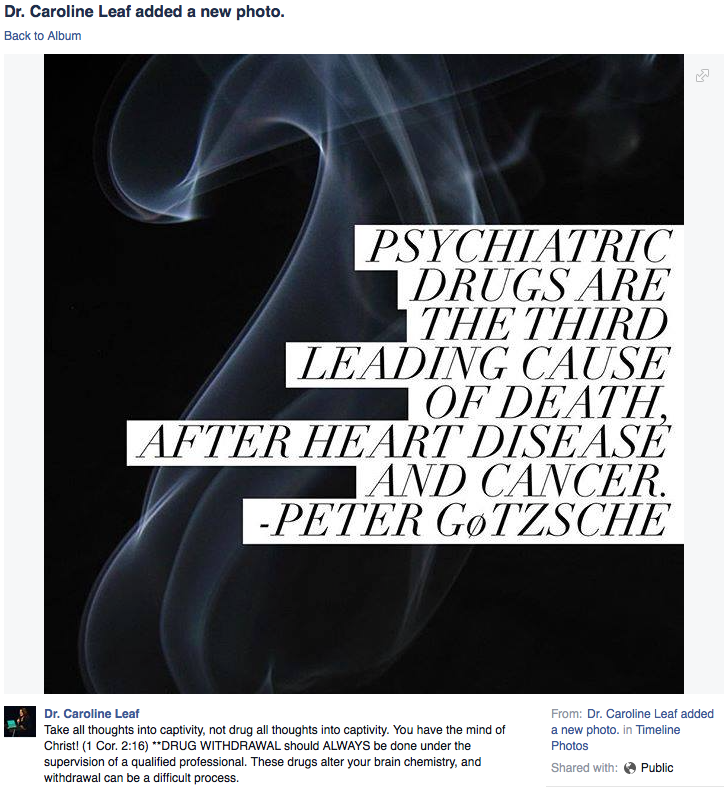
Yesterday, Dr Leaf opened a proverbial can of worms with her quote from Gøtzsche, that “Psychiatric Drugs are the third leading cause of death, after heart disease and cancer.”

Dr Caroline Leaf is a communication pathologist and a cognitive neuroscientist. Clearly scrambling, she attempted to placate her growing number of detractors with an unprecedented explanatory statement. But rather than distancing herself from her comments, she still chose to portray psychiatric medications as harmful and ungodly.

Instead of quelling the fire, this seems to have thrown fuel on it. Dr Leaf has continued to try and justify her comments with a further two statements today. Neither of them contain a retraction or an apology.

Earlier today, she wrote:
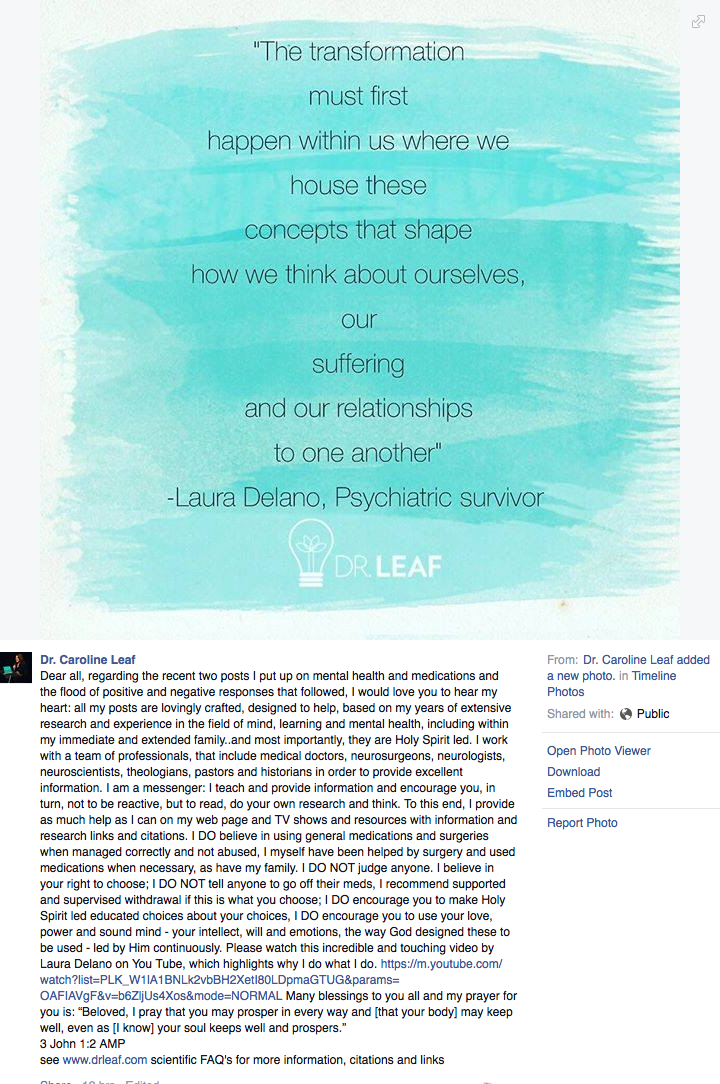
Screen Shot 2015-10-19 at 7.02.14 pm

Dear all, regarding the recent two posts I put up on mental health and medications and the flood of positive and negative responses that followed, I would love you to hear my heart: all my posts are lovingly crafted, designed to help, based on my years of extensive research and experience in the field of mind, learning and mental health, including within my immediate and extended family..and {sic} most importantly, they are Holy Spirit led. I work with a team of professionals, that include medical doctors, neurosurgeons, neurologists, neuroscientists, theologians, pastors and historians in order to provide excellent information. I am a messenger: I teach and provide information and encourage you, in turn, not to be reactive, but to read, do your own research and think. To this end, I provide as much help as I can on my web page and TV shows and resources with information and research links and citations. I DO believe in using general medications and surgeries when managed correctly and not abused, I myself have been helped by surgery and used medications when necessary, as have my family. I DO NOT judge anyone. I believe in your right to choose; I DO NOT tell anyone to go off their meds, I recommend supported and supervised withdrawal if this is what you choose; I DO encourage you to make Holy Spirit led educated choices about your choices, I DO encourage you to use your love, power and sound mind – your intellect, will and emotions, the way God designed these to be used – led by Him continuously. Please watch this incredible and touching video by Laura Delano on You Tube, which highlights why I do what I do. https://m.youtube.com/watch?list=PLK_W1lA1BNLk2vbBH2XetI80LDpmaGTUG&params=OAFIAVgF&v=b6ZljUs4Xos&mode=NORMAL Many blessings to you all and my prayer for you is: “Beloved, I pray that you may prosper in every way and [that your body) may keep well, even as [I know) your soul keeps well and prospers.” 3 John 1:2 AMP see http://www.drleaf.com scientific FAQ’s for more information, citations and links

then later in the day:

Screen Shot 2015-10-19 at 7.02.56 pm

Dear all, some of you have questioned whether or not I have ever dealt with people experiencing severe mental health issues. As someone who has specialized in the mind over the past 30 years, I have been given the opportunity to work, first hand, with people experiencing mental and physical pain in the most terrible life situations, from severe traumatic brain injuries to rape, murder and abysmal poverty. I have seen these individuals choose with their minds not to allow their life circumstances to take control over their identity… through the power of God, love and community they overcame what life threw their way. But, on a more personal level, my eldest daughter (@therascalcook) was severely bulimic, suicidal and depressed for most of her early years due to a chronic illness and traumatic bullying. I have been in hospitals, crying beside her bed when she nearly died. I have experienced her pain…I am crying as I write this. But as a family we supported her and loved her through it, as did her friends and many of our loved ones, (it was not easy but it was worth it!). She never took a single medication nor was she institutionalized, even though doctors were telling me she would never recover if she didn’t. Yet today, after rejecting God and life for many years, she is a graduate student in historical theology, whose life goal is to bring a piece of heaven to earth through sustainable farming communities in disadvantaged areas. There is hope, God is greater than anything, and magic bullets are never the answer. You are not a label or a faulty biological machine. You are a child of God, as we all are. Unless all of us realize what it truly means to be the church, to bring heaven to earth as we love our God and people, to be the community of love that this world is so desperately crying out for, people will continue to have mental health issues, be labeled {sic}, face stigma and suffer. We all have this responsibility, and none of us can do it alone. We were created by God to help each other. Jessica used to call me her Sam. We all need a Sam, because we all know what it is like to be Frodo.

Kudos to Dr Leaf for the bravery and vulnerability that sharing such a personal story took. I’m genuinely happy that Jessica found her way through those dark and distressing days and has once again found peace and success. I have been through the same dank and destructive times of depression, and I know what it feels like. I wouldn’t wish it on anyone. When I hear stories of people who have overcome, I truly appreciate their joy.

I also recovered from my depression without ever using medications. What helped me enormously was a psychologist who listened to me without judgement as I unloaded years of emotional turmoil and distress. To this day, I don’t remember what we actually talked about in my first session with him. All I remember is getting ten minutes in and then crying almost uncontrollably for the next forty. Thankfully, I did more talking and less crying over the few months as my mood lifted and I grew to accept my brokenness, just like God does.

Clearly, the story of Jessica Leaf is heart-warming and uplifting. Dr Leaf clearly understands the pain and distress that severe mental illness brings to those who suffer with it, and their families. But all emotions aside, Dr Leaf has still left important issues unresolved. Indeed, those who are more cynical might see such an emotional recollection as a play for sympathy and a distraction from the lingering questions surrounding Dr Leaf’s handling of this issue, and of her expertise in mental health.

Dr Leaf’s expertise, revisited.

Dr Leaf’s experience during those darkest of times may give her a legitimate platform to discuss what worked for her daughter and her family, but however moving, it does not qualify her as an expert in mental health more broadly. Science isn’t about generalising from your personal experience. It’s about looking at the evidence from a number of rigorously designed trials with a minimum of bias, conducted across a broad range of participants.

When women come to see me in the few weeks after giving birth, they’re usually confused. Nearly every woman that’s ever given birth sometime in the last century believes their experience automatically qualifies them as experts in breast feeding and infant health. But their ‘helpful’ advice, given with the best of intentions, often conflicts with the opinion of every other self-proclaimed motherhood expert. By the time the poor new mother comes to see me, they’ve been given so many pieces of conflicting advice that they’re completely lost.

Just living through an experience doesn’t qualify you as an expert. So I don’t claim to be an expert in mental health just because I’ve lived through prolonged periods of anxiety and depression. Nor should Dr Leaf.

Dr Leaf can’t use the fact that she has worked with people who have mental health problems as a claim to expertise either. She may been given the opportunity to work, first hand, with “people experiencing mental and physical pain in the most terrible life situations, from severe traumatic brain injuries to rape, murder and abysmal poverty.” That doesn’t make her an expert in mental health any more than seeing female patients makes me a gynaecologist.

That’s because expertise in medical fields requires specific training. You can read surgical textbooks for thirty years but that doesn’t quality you as a surgeon. You can learn a bit of anatomy and physiology in the same lab as some medical students, but that doesn’t make you equivalent to a medical doctor. You might do some research involving some neurobiology, but that doesn’t make you a neuroscientist.

Dr Leaf is a communication pathologist who completed a PhD which included some educational psychology. She is not a counsellor, she is not a psychologist, she is not a medical doctor and she isn’t even a cognitive neuroscientist. Dr Leaf is not qualified to provide an expert opinion on the risks and harms of psychiatric medication.

Dr Leaf’s heart

Coming back to Dr Leaf’s first statement today, Dr Leaf said that she wanted to share her heart:

all my posts are lovingly crafted, designed to help, based on my years of extensive research and experience in the field of mind, learning and mental health, including within my immediate and extended family..and {sic} most importantly, they are Holy Spirit led

If I were Dr Leaf, I’d be careful about blaming the Holy Spirit for her posts. I have rebutted and debunked scores of Dr Leaf’s memes over the last couple of years. The Holy Spirit is the ‘Spirit of all truth’, not of half-baked facts and misquotes.

Dr Leaf goes on to say

I teach and provide information and encourage you, in turn, not to be reactive, but to read, do your own research and think. To this end, I provide as much help as I can on my web page and TV shows and resources with information and research links and citations.

I respectfully disagree. Dr Leaf rarely references her social media memes, and until recently, her website was bereft of citations. I have never seen her encourage critical thinking before. And if Dr Leaf really wanted to encourage thinking amongst her followers, then why does her team actively block people on social media who dare to disagree with her? That’s not encouraging free thinking, that’s presenting an illusion of conformity.

Dr Leaf’s Do’s and Don’ts

To clarify her position on several issues, Dr Leaf stated:

I DO believe in using general medications and surgeries when managed correctly and not abused, I myself have been helped by surgery and used medications when necessary, as have my family. I DO NOT judge anyone. I believe in your right to choose; I DO NOT tell anyone to go off their meds, I recommend supported and supervised withdrawal if this is what you choose; I DO encourage you to make Holy Spirit led educated choices about your choices, I DO encourage you to use your love, power and sound mind – your intellect, will and emotions, the way God designed these to be used – led by Him continuously.

Dr Leaf may say that she doesn’t tell anyone to go off their meds, but I think that’s a little disingenuous.

Sure, Dr Leaf never directly said to stop taking their medications. She just said that psychiatric medications were unscientific and unbiblical [1: p31-32], that psychiatric medications are the third most common cause of death after heart disease and cancer, and admonished her followers to “Take all thoughts into captivity, not drug all thoughts into captivity.” And just yesterday, she also linked psychiatric medications with evolutionary theory and said that they strip 15-25 years off your lifespan.

So it’s more like, “I DO NOT tell anyone to go off their meds, I just scare them by telling them the drugs are unholy poison”.

That’s not encouraging “Holy Spirit led educated choices”, it’s encouraging fear-driven poor choices.

Dr Leaf’s support team

One last point. Dr Leaf stated,

I work with a team of professionals, that include medical doctors, neurosurgeons, neurologists, neuroscientists, theologians, pastors and historians in order to provide excellent information.

Really? Dr Leaf’s work consistently conflicts with basic medical and psychological science, and she regularly misquotes scripture. Would they be willing to be named? Because either they’re providing Dr Leaf with terrible oversight or Dr Leaf is ignoring everything they say.

Dr Leaf still hasn’t apologised for, or retracted her statements

It’s no secret that I disagree with Dr Leaf’s teaching, and I have outlined why I think some of her statements today are disingenuous. You may agree with me, or not. I don’t mind. Hey, I could be wrong.

Though when you get down to brass tacks, the most important issue is that Dr Leaf remains legally vulnerable.

Since she opened up the can of worms with her Gøtzsche quote, she has made three separate statements, none of which apologise for potentially misleading nearly 150,000 people about the true risks and benefits of psychiatric medications. Nor has she issued any retraction or taken the posts down.

When Dr Leaf says that psychiatric medications are unbiblical and poisonous, people on psychiatric medications will want to come off them. She may not have said the words “Stop your medications”, but people will still want to come off them because they’re afraid, or because of the stigma, or because of their desire to live true to God. And as I discussed yesterday, there is a very real chance that some of those people who were stable on their medications but who unnecessarily cease them because Dr Leaf told them to, may harm themselves or take their own life, since that’s what the studies tell us [2, 3]. At the very least, they are likely to have a shorter life expectancy because of it [4, 5]. This may open Dr Leaf to law suits, as well as the possibility of having someone’s death on her conscience.

No one wants that scenario. But the only way to avoid it is to:

  1. Take the offending posts down
  2. Issue an apology
  3. Specifically direct those of her followers on psychiatric medications to stay on them until they have spoken to their doctors,
  4. In future, provide a balanced view of the benefits of psychiatric medications as well as their harms.
  5. Better yet, unless Dr Leaf gets a medical degree, it may be better not to publically discuss psychiatric medication at all.

Again, I implore Dr Leaf, for her sake and for the sake of her ministry and those who follow her, please unequivocally apologise, retract your statement, and encourage people to see their doctors if they have concerns about their medication, or their mental health.

This is not a game: people’s lives are at stake. I hope that Dr Leaf sees this before it’s too late.

References
[1]        Leaf CM. Switch On Your Brain : The Key to Peak Happiness, Thinking, and Health. Grand Rapids, Michigan: Baker Books, 2013.
[2]        Correll CU, Detraux J, De Lepeleire J, De Hert M. Effects of antipsychotics, antidepressants and mood stabilizers on risk for physical diseases in people with schizophrenia, depression and bipolar disorder. World psychiatry : official journal of the World Psychiatric Association 2015 Jun;14(2):119-36.
[3]        Tiihonen J, Suokas JT, Suvisaari JM, Haukka J, Korhonen P. Polypharmacy with antipsychotics, antidepressants, or benzodiazepines and mortality in schizophrenia. Archives of general psychiatry 2012 May;69(5):476-83.
[4]        Tiihonen J, Lonnqvist J, Wahlbeck K, et al. 11-year follow-up of mortality in patients with schizophrenia: a population-based cohort study (FIN11 study). Lancet 2009 Aug 22;374(9690):620-7.
[5]        Torniainen M, Mittendorfer-Rutz E, Tanskanen A, et al. Antipsychotic treatment and mortality in schizophrenia. Schizophrenia bulletin 2015 May;41(3):656-63.

Remember: This article is a rebuttal of Dr Leaf’s opinion regarding psychiatric medication.  This blog doesn’t constitute individual medical advice.  If you do not like your medication or think you should come off it, please talk to your own GP or psychiatrist.  Do not stop it abruptly or without adequate medical advice.
Dr Caroline Leaf and her can of worms

Screen Shot 2015-10-18 at 12.15.51 pm

Dr Caroline Leaf is a communication pathologist and a self-titled cognitive neuroscientist. She also likes to think that she’s an expert on mental health. So this morning, she felt like she was quite justified in publishing a meme about the evils of psychiatric medications.

She quoted Professor Peter Gøtzsche, stating that “Psychiatric Drugs are the third leading cause of death, after heart disease and cancer.” Then followed it with “Take all thoughts into captivity, not drug all thoughts into captivity. You have the mind of Christ! (1 Cor 2:16) **DRUG WITHDRAWAL should ALWAYS be done under the supervision of a qualified professional. These drugs alter your brain chemistry, and withdrawal can be a difficult process.”

The subsequent comments were primarily made up of the usual sycophantic responses that Dr Leaf has cultivated by blocking anyone that disagrees with her. But there were more than the usual responses confused by her meme, and quite a few that we’re asking for help in weaning off the medications that they were on.

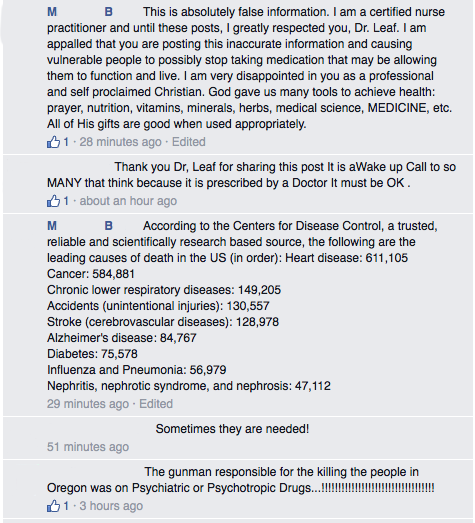
Then there were those who weren’t happy at all. One respondent, a certified Nurse Practitioner, wrote, “I am appalled that you are posting this inaccurate information and causing vulnerable people to possibly stop taking medication that may be allowing them to function and live.” The same person followed up with another comment soon after, quoting the CDC figures for the top ten causes of death in the US, in which the third on the list wasn’t psychiatric drugs at all, but chronic lower respiratory diseases.

LeafWorms02

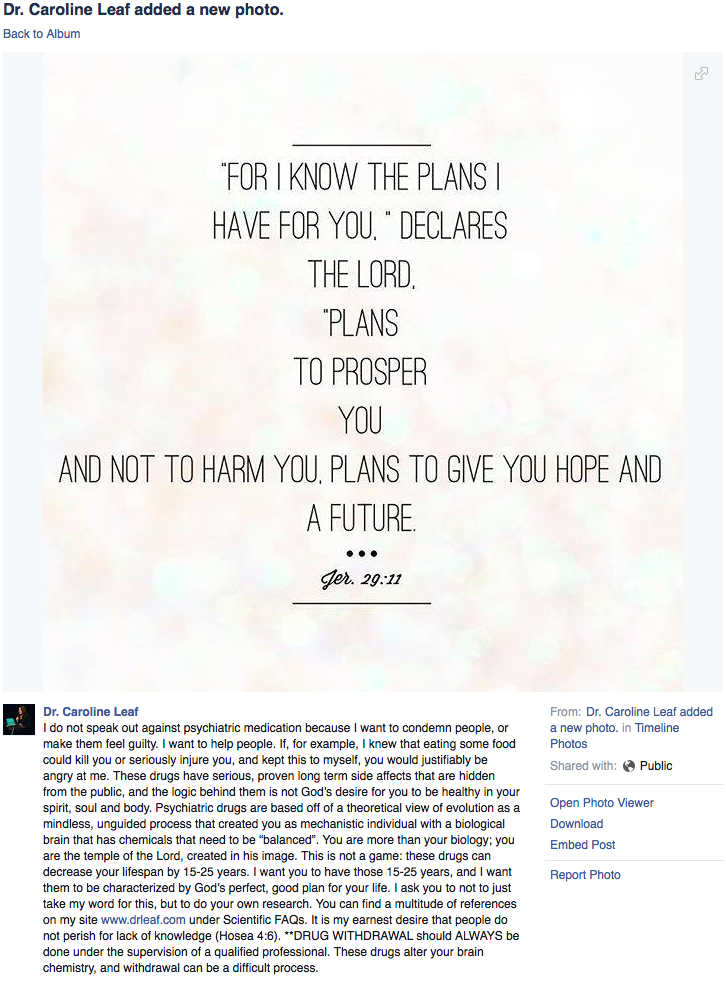
The overall response must have taken her aback, because Dr Leaf posted a follow-up comment to explain herself, an unusual step for her.

Screen Shot 2015-10-18 at 12.21.12 pm

In it, she said, “I do not speak out against psychiatric medication because I want to condemn people, or make them feel guilty. I want to help people. If, for example, I knew that eating some food could kill you or seriously injure you, and kept this to myself, you would justifiably be angry at me. These drugs have serious, proven long term side affects that are hidden from the public, and the logic behind them is not God’s desire for you to be healthy in your spirit, soul and body. Psychiatric drugs are based off of a theoretical view of evolution as a mindless, unguided process that created you as mechanistic individual with a biological brain that has chemicals that need to be “balanced”. You are more than your biology; you are the temple of the Lord, created in his image. This is not a game: these drugs can decrease your lifespan by 15-25 years. I want you to have those 15-25 years, and I want them to be characterized by God’s perfect, good plan for your life. I ask you to not to just take my word for this, but to do your own research. You can find a multitude of references on my site http://www.drleaf.com under Scientific FAQs. It is my earnest desire that people do not perish for lack of knowledge (Hosea 4:6). **DRUG WITHDRAWAL should ALWAYS be done under the supervision of a qualified professional. These drugs alter your brain chemistry, and withdrawal can be a difficult process.”

But it was too late. Dr Leaf had opened a can of worms, and once out, those wriggly little critters are impossible to put back in.

Both her initial offering and her reply shows just how poor Dr Leaf’s understanding of mental health truly is. She is fixated on the notion that the mind controls the brain, and she is unwilling to consider any other notion, instead preferring to accept any opinion that conforms to her world view, no matter how poorly conceived it might be. This includes the work of Gøtzsche, accepting it as gospel even though he has critics of his own.

It’s important to examine Dr Leaf’s reply in more detail as her statement has the potential to cause a great deal of harm to those who are the most vulnerable. Lets break down Dr Leaf’s statement and review each piece, and then I will outline some other important and contradictory considerations of Dr Leaf’s stance.

  1. The safety of psychiatric medications

Dr Leaf claims that “These drugs have serious, proven long term side affects {sic} that are hidden from the public” and “This is not a game: these drugs can decrease your lifespan by 15-25 years.”

Dr Leaf is right in saying that psychiatric medications have serious proven long term side effects. And we should be careful. I mean, if you knew that thrombocytopenia, anaphylaxis, cutaneous hypersensitivity reactions including skin rashes, angioedema and Stevens Johnson syndrome, bronchospasm and hepatic dysfunction were the potential side effects for a medication, would you take it?

Most people wouldn’t.   Reading the list makes that drug sound really dangerous.  We should be up in arms about such a dangerous drug … except that this list of side effects isn’t for a psychiatric drug at all, but is actually the side effect profile of paracetamol (Panadol if you’re in Australia, Tylenol if you’re in the US). People take paracetamol all the time without even thinking about it. Saying that we shouldn’t take medications because of potential side effects is a scarecrow argument, a scary sounding straw man fallacy. All drugs have serious proven long term side effects, and most of the time, those serious long term side effects don’t occur.  Licensing and prescribing a medication depends on the overall balance of the good and the risk of harm that a medication does.

Oh, and no one has ever hidden these side effects from the public as if there’s some giant conspiracy from the doctors and the pharmaceutical companies. The side effects are listed right there in the product information (here is the product information for fluoxetine. See for yourself).

As for Dr Leaf’s assertion that psychiatric medications decrease your lifespan by 10-25 years, I think that’s a red herring. I read through Dr Leaf’s ‘Scientific FAQ’ and I couldn’t find any references that back up these statements, so who knows where she got this figure of ’15-25 years’ from.

On the contrary, what is known is that severe mental illness is associated with a 2 to 3-fold increase in mortality, which translates to an approximately 10-25 year shortening of the lifespan of those afflicted with severe depression, schizophrenia or bipolar disorder [1]. So Dr Leaf has it backwards. It isn’t the medications that cause people who take them to die 25 years earlier than they would have without the illness, but it’s the illness itself.

  1. The benefits of long term psychiatric medications

So psychiatric medications have their side effects, true, but they also have protective benefits which Dr Leaf consistently fails to acknowledge.

Correll and colleagues note in the conclusion to their article that “Although antipsychotics have the greatest potential to adversely affect physical health, it is important to note that several large, nationwide studies providing generalizable data have suggested that all-cause mortality is higher in patients with schizophrenia not receiving antipsychotics.” [1]

More specifically, in one recent study, the use of any anti-psychotic medication for a patient with schizophrenia decreased their mortality by nearly 20% [2]. In another study, the mortality of those with schizophrenia who did not take anti-psychotics was nearly ten times that of the healthy population, but taking anti-psychotic medication cut that back to only four times the risk [3].

These findings are mirrored by other studies on other psychiatric medications. For example, as noted by Correll and colleagues, “clozapine, antidepressants, and lithium, as well as antiepileptics, are associated with reduced mortality from suicide. Thus, the potential risks of antipsychotics, antidepressants and mood stabilizers need to be weighed against the risk of the psychiatric disorders for which they are used and the lasting potential benefits that these medications can produce.” [1]

So psychiatric medications are not useless. Let me be clear, I’m not saying that taking psychiatric medications always makes life a cake-walk – there are still side effects from the medications, and the disease isn’t always fully controlled. But on average, well treated patients with psychiatric conditions clearly do better than patients who are not treated.

Therefore Dr Leaf’s assertion that psychiatric medications are harmful are inaccurate. And given that there are genuine benefits to these medications, particularly in the prevention of suicide, Dr Leaf’s discouragement of these medications has the real potential to result in real harm to those of her followers who take her at her word.

  1. The ‘logic’ behind psychiatric medications

Dr Leaf says in her statement, “the logic behind them (psychiatric medications) is not God’s desire for you to be healthy in your spirit, soul and body. Psychiatric drugs are based off of a theoretical view of evolution as a mindless, unguided process that created you as mechanistic individual with a biological brain that has chemicals that need to be ‘balanced’. You are more than your biology; you are the temple of the Lord, created in his image.”

Dr Leaf’s argument here is that based on a false premise and some straw man fallacies which inevitably leads to a false conclusion.

Evolution is a mindless unguided process
Evolution says that you are just a machine
Psychiatric illness is because of a chemical imbalance in that machine (a false premise)

therefore taking psychiatric medication is accepting evolution (a straw man fallacy)

and

You are more than your biology,
you are the temple of the Lord, created in his image,

therefore evolution is wrong (another straw man fallacy)

therefore psychiatric medications are not God’s desire (false conclusion)

The problem with this logic is that it could be applied to all medications, since modern medicine has predominantly been devised by agnostic scientists within an evolutionary framework, and nearly all disease is defined by an imbalance of one thing or another.

For example, simply rewording Dr Leaf’s statement shows up the distorted logic that it entails:

“Insulin can have serious, proven long term side affects that are hidden from the public, and the logic behind it is not God’s desire for you to be healthy in your spirit, soul and body. Diabetes is based off of a theoretical view of evolution as a mindless, unguided process that created you as mechanistic individual with a biological pancreas that has chemicals that need to be ‘balanced’.”

You can’t have this both ways. If psychiatric medications are against God’s plan, then all medications are against God’s plan. But if we accept medications for physical ailments, then we also have to accept medications for psychological ailments.

  1. The Mind-Brain link

Dr Leaf tried to protect herself with a glib disclaimer at the end of both posts in question today, “**DRUG WITHDRAWAL should ALWAYS be done under the supervision of a qualified professional. These drugs alter your brain chemistry, and withdrawal can be a difficult process.”

Which is interesting, because in her Scientific FAQ, Dr Leaf has this to say about the mind,

“The Brain is part of the Physical Body and therefore is controlled by the Mind. The Mind does not emerge from an accumulation of Brain activity. Brain activity, rather, reflects Mind activity. Even though the Mind controls the Brain, the Brain feeds back to, and influences, the Mind. The Brain seats the Mind, and therefore the Mind influences the Physical world through the Brain.”

So if that’s true, then why is withdrawal from psychiatric medication so difficult? If the mind is outside the physical realm and controls the brain as Dr Leaf proposes, then the medications effect on brain chemistry should make little or no difference to the mind, and withdrawal should be simple.

The fact that withdrawal from these medications is not simple is testament to the fact that the mind is a function of the brain, and does not control the brain as Dr Leaf proposes here and through her books and other written materials.

Issuing the warning is responsible, but shows again just how far Dr Leaf’s teaching is from scientific reality.

  1. Dr Leaf’s motivations

Finally, I want to talk about Dr Leaf’s motivation. In her statement, Dr Leaf said, “I do not speak out against psychiatric medication because I want to condemn people, or make them feel guilty. I want to help people.” And, “I want you to have those 15-25 years, and I want them to be characterized by God’s perfect, good plan for your life … It is my earnest desire that people do not perish for lack of knowledge (Hosea 4:6).”

I want to state, for the record, that I believe Dr Leaf when she says this. I don’t doubt her motives are to try and help people. But good intentions are not enough. What she says has real life consequences.

Dr Leaf is idolised by her followers and portrayed as a mental health expert by the churches she preaches at. People don’t question experts recommended to them by their pastors or their friends. So when she says that psychiatric medications kill people, people on psychiatric medications will want to come off them, because of fear, because of stigma, because of their desire to live true to God and his good and perfect plan. Without wanting to sound melodramatic, there is a very real chance that some of those people who were stable on their medications but who unnecessarily cease them because Dr Leaf told them to, may harm themselves or take their own life, since that’s what the studies tell us [1, 4]. At the very least, they are likely to have a shorter life expectancy because of it [2, 3]. So telling people that psychiatric medications are dangerous is morally and ethically dubious.

There are also potential legal implications too. God forbid, but if a person committed suicide because they went off their medication because of what Dr Leaf wrote, law suits could easily follow. No one wants that situation. Dr Leaf also runs the risk of being accused of practicing medicine without a licence, since some of her followers have asked personal medical questions in the comments, and the reply from Dr Leaf’s Facebook team is to direct them to their programs like the 21-day detox, which depending on the legal interpretation and the mood of a judge, could be seen as giving medical advice, which Dr Leaf is not legally qualified to give.

LeafWorms01

To summarise, I certainly hope that neither of these hypothetical scenarios becomes reality, but Dr Leaf and her social media team are skating on thin ice, and a glib disclaimer at the end of a post won’t necessarily cut it.

I would hope that Dr Leaf and her social media team would reconsider their approach. In fact, I would suggest that Dr Leaf unequivocally apologises for what she’s written, retracts her statement, and encourages people to see their doctors if they have concerns about their medication, or their mental health.

Indeed, I would implore Dr Leaf to step back and re-evaluate the entire breadth of her teaching, and the advice that she is giving. Dr Leaf is obviously a very smart woman and a very engaging speaker. With great power comes great responsibility. If she were to reconsider her teaching and start from a basis of scientific fact, then she could be a major force for the good of the church and its physical and mental health. At the moment, I fear that she is doing the opposite.

This is not a game: people’s lives are at stake. I hope that Dr Leaf sees this before it’s too late.

References

[1]        Correll CU, Detraux J, De Lepeleire J, De Hert M. Effects of antipsychotics, antidepressants and mood stabilizers on risk for physical diseases in people with schizophrenia, depression and bipolar disorder. World psychiatry : official journal of the World Psychiatric Association 2015 Jun;14(2):119-36.
[2]        Tiihonen J, Lonnqvist J, Wahlbeck K, et al. 11-year follow-up of mortality in patients with schizophrenia: a population-based cohort study (FIN11 study). Lancet 2009 Aug 22;374(9690):620-7.
[3]        Torniainen M, Mittendorfer-Rutz E, Tanskanen A, et al. Antipsychotic treatment and mortality in schizophrenia. Schizophrenia bulletin 2015 May;41(3):656-63.
[4]        Tiihonen J, Suokas JT, Suvisaari JM, Haukka J, Korhonen P. Polypharmacy with antipsychotics, antidepressants, or benzodiazepines and mortality in schizophrenia. Archives of general psychiatry 2012 May;69(5):476-83.

Here’s my glib disclaimer: This article is a rebuttal of Dr Leaf’s opinion regarding psychiatric medication.  This blog doesn’t constitute individual medical advice.  If you do not like your medication or think you should come off it, please talk to your own GP or psychiatrist.  Do not stop it abruptly or without adequate medical advice.
The significance of thoughts

Screen Shot 2015-10-13 at 8.53.20 pm

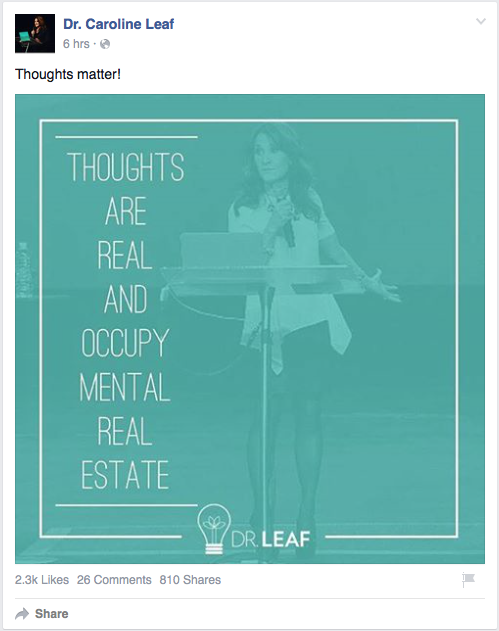
A few days ago, I posted a rebuttal to one of Dr Leaf’s favourite memes, “Thoughts are real and occupy mental real estate.”

In short, I wrote that thoughts are real, but the issue hasn’t ever been whether thoughts are real, but what thoughts really are. The conclusion was that thoughts are just a projection, a function of the brain. They are not independent of the brain and they do not control the brain.

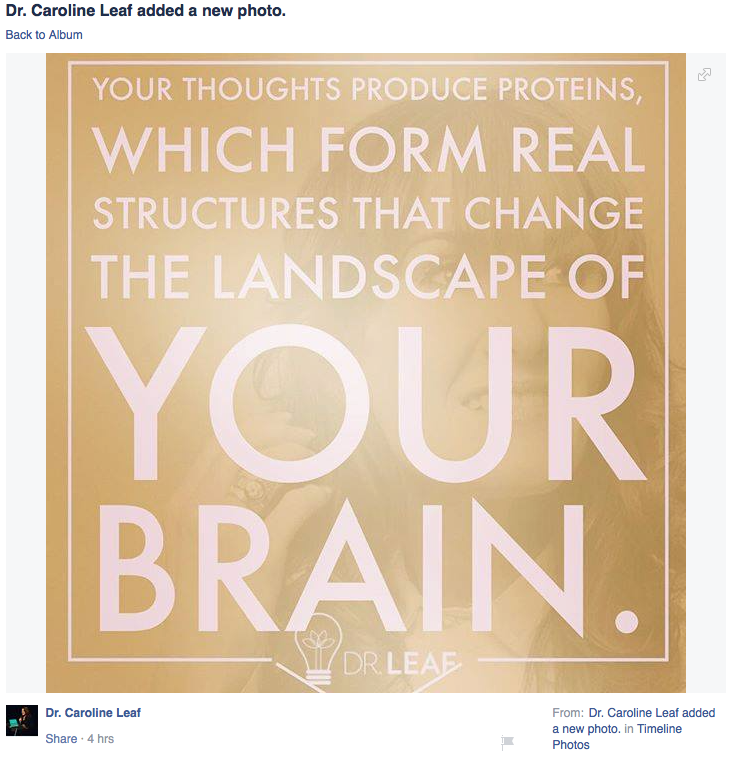
Dr Caroline Leaf is a communication pathologist and a self-titled cognitive neuroscientist. Dr Leaf tried to refine her meme today, saying:

“Your thoughts produce proteins, which form real structures that change the landscape of your brain.”

So, is that true? Do thoughts produce proteins which change the structure of the brain? To answer that, we need to have a look at some basic neurobiology.

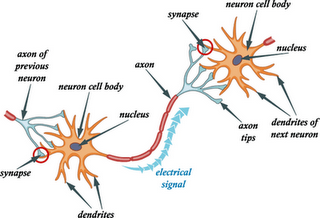
The brain is made of nerve cells. Nerve cells have three unique structures that help them do their job. First are dendrites, which are spiny branches that protrude from the main cell body, which receive the signals from other nerve cells. Leading away from the cell body is a long thin tube called an axon which helps carry electrical signal from the dendrites, down to the some tentacle-like processes that end in little pods. These pods, called the terminal buttons of the axon, and then convey the electrical signal to another nerve cell by directing a burst of chemicals towards the dendrites of the next nerve cell in the chain.

In order for the signal to be successfully passed from the first nerve cell to the second, it must successfully traverse a small space called the synapse.

Despite being very close to each other, no nerve cell touches another. Instead, the spray of chemicals that’s released from the terminal button of the axon floats across a space of about 20-40nM (a nanometre is one billionth of a metre).

Combining nerve cells and synapses together creates a nerve pathway, where the input signal is received by specialised nerve endings and is transmitted down the nerve cell across a synapse to the next nerve cell, across the next synapse to the next nerve cell, and on and on until the signal has reached the destination for the output of that signal.

And that’s it. The entire nervous system is just a combination of nerve cells and the synapses between them.

What gives the nervous system and brain the near-infinite flexibility, and air of mystery, is that there are eighty-six billion nerve cells in the average adult (male) brain. Each nerve cell has hundreds to thousands of synapses. It’s estimated that there are about 0.15 quadrillion (that’s 150,000,000,000,000) synapses throughout the average brain [1]. Each of these cells and synapses connect in multiple directions and levels, and transmit signals through the sum of the exciting or inhibiting influences they receive from, and pass on to, other nerve cells.

The brain is a highly plastic organ. When biologists talk about plasticity, they aren’t talking about the chemical plastic that we make everything out of, like plastic cups or bottles, but the ability for the cells, tissues or organs to change or adapt. And the brain does this all of the time. Every stimulus changes one or more of the billions of branches and synapses that the brain has. Branches can be pruned back, or new ones grown. Existing branches can be strengthened or weakened. Each change to the branches of the nerve cells helps the brain to adapt to the ever-changing internal and external stream of signals that the brain is required to process.

So returning to Dr Leaf’s statement: The key part of the meme is, “Your thoughts produce proteins”. This is where Dr Leaf’s statement is wrong. The error is deceptively subtle, but it’s still wrong. When changes are required, new branches are formed, which do indeed require new proteins. But most brain function, including our thoughts, is simply electrical current running along the pathways already formed by the branches of our nerve cells.

Even then, our stream of conscious thought is only a tiny fragment of the billions of nerve impulses our brains produce each and every second of our lives. As I described in my previous post, thought is not dominant. Our thoughts do not control our brains, it’s our brains that control our thoughts. Thoughts are real, but they’re real like an image on a screen is real, but isn’t the real thing.

Thoughts are only significant when they are considered for what they truly are. Our stream of consciousness is simply a selective place of refinement for highly salient parts of our non-conscious information that need further processing before further action is taken with that information. They are like the dials on your dashboard, which give selective important information about the car but they don’t control the car. Thoughts do not control our brains growth, or alter our brains architecture.

Dr Leaf should have said something along the lines of, “The landscape of the brain is created by real structures called neurons and synapses, which have many functions including our thoughts.”

As it is, Dr Leaf’s meme creates a false impression that our thoughts are the critical factor in determining our brains structure and function, when the reality is the exact opposite.

References

[1]        Sukel K. The Synapse – A Primer. 2013 [cited 2013 28/06/2013]; Available from: http://www.dana.org/media/detail.aspx?id=31294

The Prospering Soul – Christians and Depression Part 2

For most church-goers, putting the terms “Christian” and “depression” in the same sentence just doesn’t seem natural. In part 1, we looked at what depression is and why depression affects a lot more of the church than the church is aware of.

In this instalment, we’ll look at some general ways to handle depression, and what the Bible says about being depressed.

In the first blog, I explained how I understood depression as the end result of the brains capacity to deal with the demands of life. Too many demands or not enough resources overwhelms the brain and low mood is the end result.

So how do you manage depression? Well, if the system is failing because of increased demand or decreased capacity to cope, then it’s logical to manage depression by decreasing demand and increasing capacity to cope.

We can increase our capacity to cope by increasing our brains capacity to grow new nerve branches, and to make the cells more efficient at doing their job.

Increasing the growth of new nerve cell branches (in science speak – ‘synaptogenesis’) involves increasing the growth factors. BDNF has been proven to be increased by anti-depressant medications [1, 2] and by exercise [3, 4]. There may be some evidence that diet might improve depression in a similar way although the evidence is weak [5], so we should take that with a grain of salt.

The next way of managing depression is to increase the capacity to cope. The way we do that is through psychological therapies. There are several styles of psychological therapies, too many for me to discuss them all here. In the real world, most psychologists use a mix of a number of techniques that they tailor to the needs of their patient. I’m going to quickly outline the two most commonly used therapies.

Cognitive Behavioural Therapy, or CBT for short, is “based on the theory that emotional problems result from distorted attitudes and ways of thinking that can be corrected. The aim is to treat difficulties by problem solving, finding better strategies for coping, and overcoming irrational fears.” [6] Essentially it’s the combination of two different therapies, Cognitive therapy, and Behavioural therapy. Cognitive therapy, as the name suggests, assumes that people have mental health problems because of patterns of irrational thinking. Behavioural therapy is quite broad, but looks to challenge the thinking patterns with action (for example: gradual exposure to something a person is afraid of).

CBT is the most well researched form of psychotherapy, and has a lot of evidence for it’s effectiveness [7]. Though there is good evidence that it’s the behavioural arm that gives it any clout [8, 9]. Trying to change your mental health just by trying to change your thoughts is generally ineffective.

In the last couple of decades, a new wave of psychological therapies has emerged from this idea that Cognitive Behavioural Therapy is just Behavioural Therapy with bling. The most notable is Acceptance and Commitment Therapy, or ACT for short. ACT is different to CBT in that ACT doesn’t rely on the idea of changing thoughts, but on simply accepting them. ACT “is a psychological therapy that teaches mindfulness (‘paying attention in a particular way: on purpose, in the present moment, non-judgementally’) and acceptance (openness, willingness to sustain contact) skills for responding to uncontrollable experiences and thereby increased enactment of personal values.” [10]

According to ACT, you don’t have to change your thoughts, because thoughts aren’t that powerful to begin with – they’re just words. Sometimes they’re true, and sometimes they’re helpful, but if we spent all of our time trying to fight them, we miss out on experiencing the joy in the present moment, and we can lose sight of the values that guide us into our future fulfilment.

The common link between good psychotherapy is that their therapeutic effect comes from improving skills in different areas that the patient lacks. That is, psychological therapies increase the capacity of the patient to cope with things that would have otherwise wouldn’t have handled well and would have caused distress.

The last way to manage depression is to limit the excessive demands that have been placed on the system in the first place, or in other words, reduce the unnecessary stressors. People who are depressed tend to be bad at this, but there are a few basic skills that are common to all stress management techniques that can form the platform of ongoing better skills in this area. The full list will be a blog for another time, but the simplest technique is to breathe!

It’s really simple. Sit in a comfortable position. Take slow, deep breaths, right to the bottom of your lungs and expanding your chest forward through the central “heart” area. Count to five as you breathe in (five seconds, not one to five as quickly as possible) and then count to five as you breathe out. Keep doing this, slowly, deeply and rhythmically, in and out. Pretty simple! This will help to improve the efficiency of your heart and lungs, and reduce your stress levels.

Remember, B.R.E.A.T.H.E. = Breathe Rhythmically Evenly And Through the Heart Everyday.

To recap, there are three main ways to manage depression – increase the brains ability to process the incoming information, increase the capacity to cope, and decrease the amount of stress that our brains have to process.

The fourth way to help manage depression is prayer. There is limited scientific information on the effects of prayer on depression, although a small randomised controlled trial did show that prayer with a prayer counsellor over a period of a number of weeks was more effective than no treatment [11]. But the Bible encourages us, “Do not be anxious about anything, but in every situation, by prayer and petition, with thanksgiving, present your requests to God. And the peace of God, which transcends all understanding, will guard your hearts and your minds in Christ Jesus.” (Philippians 4:6-7)

And Jesus himself called to those heavy in heart, “Come to me, all you who are weary and burdened, and I will give you rest. Take my yoke upon you and learn from me, for I am gentle and humble in heart, and you will find rest for your souls. For my yoke is easy and my burden is light.” (Matthew 11:28-30)

One final thought. It’s sometimes hard to understand how strong Christians can become depressed in the first place. After all, the Bible says that the fruit of the Spirit is joy (Galatians 5:22). 1 Peter 1:8 seems to suggest that every Christian should be “filled with an inexpressible and glorious joy.”

So when you’re filled with the opposite, it makes you feel like a faithless failure, and Christians without depression assume a similar thing for Christians they know who are suffering from depression. It’s the logical conclusion to draw after all – if the fruit of the Spirit is joy, and you are not filled with joy, then you mustn’t be full of the Spirit.

But when you look through the greatest heroes in the Bible, you see a pattern where at one point or another in their lives, they went through physical and emotional destitution. Sure, their lives had some pretty amazing highs, but they often experienced some amazing lows as well. Moses spent forty years in the wilderness, and when God appeared to him in the burning bush, he argued with God about how weak and timid he was (Exodus 3 and 4).

In 1 Kings 18, Elijah had just seen God rain down fire to supernaturally consume his sacrifice, capture and kill four hundred and fifty prophets of Baal, and watched God break the drought over Israel. At the height of this run of amazing connection to God, Jezebel the evil queen threatened him, and he ran for his life in a panic and asked God to kill him, twice, over the period of a couple of months (1 Kings 19).

Peter had spent three years with Jesus, the Messiah himself, hearing him speak and watching him perform miracle after miracle after miracle. Peter even saw the empty tomb first hand on the very first Easter Sunday, but still, he gave up on life with God and went back to his former occupation, which turned out to be lots of hard work for very little reward (John 21:1-3).

The same pattern is also seen in King David, Gideon, and a number of other great leaders through the Bible. The take home message is this: it’s human nature to suffer from disease and dysfunction. Sometimes it’s physical dysfunction. Sometimes it’s emotional dysfunction. It’s not a personal or spiritual failure to have a physical illness. Why should mental illness be treated any different?

As the stories of Moses, Elijah and Peter testify, being a strong Christian doesn’t make you impervious to low mood or emotional fatigue. Hey, we’re all broken in some way, otherwise why would we need God’s strength and salvation! Having depression simply changes your capacity to experience the joy and love of God. Closing your eyes doesn’t stop the light, it just stops you experiencing the light. Being depressed makes it hard to experience God’s love, but it doesn’t stop God’s love.

In the 80’s and 90’s, a popular Christian musician was a man named Carmen. One of his best known songs had these words,

“When problems try to bury you and make it hard to pray, it may seem like Friday night, but Sunday’s on the way!”

It’s really hard when you’re afflicted by the dank darkness of depression. But nothing will separate us from the love of God (Romans 8:35-39), including depression. You may not feel it, but God’s love is there, and Sunday’s on the way.

Remember:

  1. Depression is a common mental health condition that can have prolonged and devastating consequences. Depression is characterised by either a sadness or a lack of joy which are abnormal in their intensity and their duration, but also affects sleep, appetite and motivation. It’s caused by abnormalities in genes which affect the brains ability to grow new nerve cell branches, and which also affect in-built coping mechanisms, so stress is both more likely to occur in people who are more prone to depression, and the stress is then handled poorly, overloading their emotional capacity.
  1. The management of depression is three-pronged: to improve the brains ability to grow new nerve cells through exercise and/or medication, to learn new ways to cope with distress, and to decrease the amount of stress in the first place.
  1. Christians are not immune from depression, and it’s important for Christians to understand that Christians suffering from depression are not weak, or failing in their spiritual walk, or are unloved by God. The love of God is always present, even if they are unable to process it properly. As dark and dismal as depression can become, there is hope. It may seem like Friday night, but Sunday’s on the way.

References

[1]        Duman RS, Li N. A neurotrophic hypothesis of depression: role of synaptogenesis in the actions of NMDA receptor antagonists. Philosophical transactions of the Royal Society of London Series B, Biological sciences 2012 Sep 5;367(1601):2475-84.
[2]        Anderson I. Depression. The Treatment and Management of Depression in Adults (Update). NICE clinical guideline 90.2009. London: The British Psychological Society and The Royal College of Psychiatrists, 2010.
[3]        Karatsoreos IN, McEwen BS. Resilience and vulnerability: a neurobiological perspective. F1000prime reports 2013;5:13.
[4]        Rimer J, Dwan K, Lawlor DA, et al. Exercise for depression. The Cochrane database of systematic reviews 2012;7:CD004366.
[5]        Lai JS, Hiles S, Bisquera A, Hure AJ, McEvoy M, Attia J. A systematic review and meta-analysis of dietary patterns and depression in community-dwelling adults. The American journal of clinical nutrition 2014 Jan;99(1):181-97.
[6]        NowOK. Cognitive Behavioural Therapy. Dictionary of Psychotherapy 2015 [cited; Available from: http://www.dictionary.nowok.co.uk/cognitive-behavioural-therapy-cbt.php
[7]        Ruiz FJ. Acceptance and Commitment Therapy versus Traditional Cognitive Behavioral Therapy: A Systematic Review and Meta-analysis of Current Empirical Evidence. International journal of psychology and psychological therapy 2012;12(3):333-58.
[8]        Longmore RJ, Worrell M. Do we need to challenge thoughts in cognitive behavior therapy? Clinical psychology review 2007 Mar;27(2):173-87.
[9]        Dobson KS, Hollon SD, Dimidjian S, et al. Randomized trial of behavioral activation, cognitive therapy, and antidepressant medication in the prevention of relapse and recurrence in major depression. Journal of consulting and clinical psychology 2008 Jun;76(3):468-77.
[10]      Smout M. Acceptance and commitment therapy – pathways for general practitioners. Aust Fam Physician 2012 Sep;41(9):672-6.
[11]      Boelens PA, Reeves RR, Replogle WH, Koenig HG. A randomized trial of the effect of prayer on depression and anxiety. Int J Psychiatry Med 2009;39(4):377-92.

If you’re suffering from depression or any other mental health difficulties and need help, see your GP or a psychologist, or if you’re in Australia, 24 hour telephone counselling is available through:

Lifeline = 13 11 14 – or – Beyond Blue = 1300 22 4636

The Prospering Soul – Christians and Depression Part 1

In the average charismatic church, from the time you park your car in the parking lot, to the time the music starts at the beginning of the service, the smiles of at least a hundred people beam at you, and at least one third of those smiles are also attached to enthusiastic handshakes and exhortations like, “Isn’t it great to be in church this morning!”

When you’re a Christian, especially at the happy-clappy end of the church spectrum, you’re supposed to be constantly full of the Holy Spirit and experiencing the joy of the Lord.

Which is why for most church-goers, putting the terms “Christian” and “depression” in the same sentence just doesn’t seem natural, even though depression affects a lot more of the church than the church is aware of.

So, how much of the church is affected by depression? The lifetime prevalence (how likely you are to suffer from depression at one stage through your life) is about twenty-five percent, or about one in four people. The point prevalence (those who are suffering from clinical depression at any particular time) is about six percent.

I used to attend a church which had a regular congregation of about 2500 people. So statistically, one hundred and fifty people in that congregation are suffering from depression every Sunday, and more than 600 will experience depression in their lifetime.

And by ‘depression’, we’re not talking about feeling a little sad … that Bill Shorten might become Prime Minister one day, or Ben Hunt can’t catch, or that One Direction isn’t the same without Zayn. Sadness for genuine reasons … you broke up with a long term partner, someone stole your purse out of your bag, or there’s the threat of redundancies at your office … also doesn’t mean you’re depressed.

The DSM5 is the current standard for psychiatric diagnoses around the world. I’ve included the full definition of depression at the end of this blog, but suffice to say, depression is more than just unhappiness. Proper depression symptoms “cause clinically significant distress or impairment in social, occupational or other important areas of functioning.” In other words, you’re so low that your social life or work is affected, and for more than two whole weeks. It’s also important to know that depression isn’t just low mood but can also be experienced as “Markedly diminished interest or pleasure in all, or almost all, activities most of the day, nearly every day”.

Depression has a number of causes and correlations. People who are chronically unwell, be that from chronic pain, long term illness such as cancer or autoimmune disease, or life threatening illnesses such as those who’ve suffered from heart attacks or meningitis, have a higher rate of depression. People who have experienced significant physical or psychological trauma also have a higher rate of depression. In fact, stress of any form is highly correlated with depression (that is, people who suffer from any severe stress are more likely to develop depression).

This observation led to a theory about the development of depression, called the Stress Exposure Model of depression [1] – You develop depression because you’ve suffered from stress. This is one of the most common assumptions about depression in our society, and there are some important consequences from this line of thinking. Like, if being stressed is the cause of depression then the cure for depression is simply reducing stress. This is probably why most people assume that depression is a choice, or a simple weakness, and why depressed people are often told just to snap out of it.

But there’s more to depression than just better dealing with stress. Fundamentally, I understand depression as the end result of the brains capacity to deal with the demands of life. Too many demands or not enough resources overwhelms the brain and low mood is the end result.

Some depression is predominantly biological. People with biological depression can’t effectively deal with even a normal amount of demand on their system, because their brain doesn’t have the resources to process the incoming signals correctly or efficiently. The main biological cause is a deficiency of a growth factor called BDNF, which is needed for the nerve cells to grow new branches, which enable the brain to process new information. This theory is called the Neurotrophic Hypothesis of Depression [2] (‘neuro’ = nerve and ‘trophic’ = growth). BDNF isn’t the only critical factor in the biological story of depression. There are many others, including the stress hormone system [3], the serotonin system [4] and the dopamine/rewards system [5].

Some depression is predominantly psychological. There are certain situations in which there’s so much going on and so much change and adaptation is required, and the brains coping systems simply can’t cope. So, severe and sudden stressors would fit into this category. For example, people trying to cope with natural disasters, or a tragedy like a massive house fire.

Most of the time, depression is a combination of both biological and psychological. Genetic factors change our capacity to handle the incoming. The nerve cells don’t have enough BDNF and are slow to grow new branches. Genetics are also important in determining other mechanisms of resilience, and people with poor resilience are also more prone to depression [6-8]. Genetic factors also determine other factors involved in the way we process the incoming stream of sensory input – our personality. People with the neurotic personality type, the classical introverts/pessimists, are more prone to depression, because of the way their brain naturally biases the flavour of the incoming information [9]. What’s also very interesting is that these tendencies to depression also tend to create more stress [1, 10]. So stress is important to the risk of depression, but ironically, it is the risk of depression which influences the risk of stress.

The risk of depression is related to an increased tendency towards stress, and poor processing of that stress because of personality factors and a reduced capacity to cope. All three of these factors are influenced by a broad array of genetic factors.

What’s also important to see here is that being depressed isn’t because of “toxic thinking” or because of “negative confessions”. What we say and what we think are signs of what is going on underneath, not the cause of it. And more importantly, you can make as many faith-filled confessions as you like, but if they don’t help you to change your capacity to cope, then they’re just hot air.

In the next instalment, we’ll look at ways to handle depression, and what the Bible says about being depressed.

References

[1]        Liu RT, Alloy LB. Stress generation in depression: A systematic review of the empirical literature and recommendations for future study. Clinical psychology review 2010 Jul;30(5):582-93.
[2]        Duman RS, Li N. A neurotrophic hypothesis of depression: role of synaptogenesis in the actions of NMDA receptor antagonists. Philosophical transactions of the Royal Society of London Series B, Biological sciences 2012 Sep 5;367(1601):2475-84.
[3]        Hauger RL, Risbrough V, Oakley RH, Olivares-Reyes JA, Dautzenberg FM. Role of CRF receptor signaling in stress vulnerability, anxiety, and depression. Annals of the New York Academy of Sciences 2009 Oct;1179:120-43.
[4]        Caspi A, Hariri AR, Holmes A, Uher R, Moffitt TE. Genetic sensitivity to the environment: the case of the serotonin transporter gene and its implications for studying complex diseases and traits. The American journal of psychiatry 2010 May;167(5):509-27.
[5]        Felten A, Montag C, Markett S, Walter NT, Reuter M. Genetically determined dopamine availability predicts disposition for depression. Brain and behavior 2011 Nov;1(2):109-18.
[6]        Karatsoreos IN, McEwen BS. Resilience and vulnerability: a neurobiological perspective. F1000prime reports 2013;5:13.
[7]        Wu G, Feder A, Cohen H, et al. Understanding resilience. Frontiers in behavioral neuroscience 2013;7:10.
[8]        Russo SJ, Murrough JW, Han M-H, Charney DS, Nestler EJ. Neurobiology of resilience. Nature neuroscience 2012 November;15(11):1475-84.
[9]        Hansell NK, Wright MJ, Medland SE, et al. Genetic co-morbidity between neuroticism, anxiety/depression and somatic distress in a population sample of adolescent and young adult twins. Psychological medicine 2012 Jun;42(6):1249-60.
[10]      Boardman JD, Alexander KB, Stallings MC. Stressful life events and depression among adolescent twin pairs. Biodemography and social biology 2011;57(1):53-66.

The DSM5 Formal Diagnostic Criteria for Depression

A. Five (or more) of the following symptoms have been present during the same 2- week period and represent a change from previous functioning; at least one of the symptoms is either (1) depressed mood or (2) loss of interest or pleasure.

(Note: Do not include symptoms that are clearly due to a general medical condition, or mood-incongruent delusions or hallucinations.)

  • Depressed mood most of the day, nearly every day, as indicated by either subjective report (e.g., feels sad or empty) or observation made by others (e.g., appears tearful). Note: In children and adolescents, can be irritable mood.
  • Markedly diminished interest or pleasure in all, or almost all, activities most of the day, nearly every day (as indicated by either subjective account or observation made by others).
  • Significant weight loss when not dieting or weight gain (e.g., a change of more than 5 percent of body weight in a month), or decrease or increase in appetite nearly every day. Note: In children, consider failure to make expected weight gains.
  • Insomnia or hypersomnia nearly every day.
  • Psychomotor agitation or retardation nearly every day (observable by others, not merely subjective feelings of restlessness or being slowed down).
  • Fatigue or loss of energy nearly every day.
  • Feelings of worthlessness or excessive or inappropriate guilt (which may be delusional) nearly every day (not merely self-reproach or guilt about being sick).
  • Diminished ability to think or concentrate, or indecisiveness, nearly every day (either by subjective account or as observed by others).
  • Recurrent thoughts of death (not just fear of dying), recurrent suicidal ideation without a specific plan, or a suicide attempt or a specific plan for committing suicide.

B. The symptoms cause clinically significant distress or impairment in social, occupational or other important areas of functioning.
C. The symptoms are not due to the direct physiological effects of a substance (e.g., a drug of abuse, a medication) or a general medical condition (e.g., hypothyroidism).

Dr Caroline Leaf – Thoughts are real. So what?

Screen Shot 2015-10-05 at 12.53.02 pm

Today’s meme from Dr Leaf is one of her favourite, often repeated phrases:

“Thoughts are real and occupy mental real estate.”

Dr Caroline Leaf is a communication pathologist and a self-titled cognitive neuroscientist. Her entire preaching empire rests on her assumption that our thinking is the driving force of not just our mental health but also our physical health, and even physical matter!

No one’s denying that thoughts are real. The key issue is not whether thoughts are real, but what thoughts really are.

Professor Bernard J. Baars is an Affiliate Fellow at The Neurosciences Institute in La Jolla, California. He is a real cognitive neuroscientist. In the late 1980’s, Professor Baars built on Baddeley’s model of working memory by proposed the Global Workspace theory [1]. Together with Professor Stan Franklin, also a real cognitive neuroscientist (and a mathematician and computer scientist) at the University of Memphis, they took the Global Workspace theory further with the Intelligent Distribution Agent model [2]. Central to this model is the “Cognitive Cycle”, a nine-step description of the underlying process from perception through to action. In the model, implicit neural information processing is considered to be a continuing stream of cognitive cycles, overlapping so they act in parallel. The conscious broadcast of our thought stream is limited to a single cognitive cycle at any given instant, so while these thought cycles run in in parallel, our awareness of them is in the serial, sometimes disparate, streams of words or pictures in our minds. Baars and Franklin suggests that about ten cycles could be running per second, and since working-memory tasks occur on the order of seconds, several cognitive cycles may be needed for any given working memory task, especially if it has conscious components such as mental rehearsal [2].

In recent years, the Global Workspace/Intelligent Distribution Agent hypothesis has been updated to help facilitate the quest to create different forms of artificial intelligence. The LIDA (“Learning Intelligent Distribution Agent”) model incorporates the Global Workspace theory with the concepts of memory formation to create a single, broad, systems-level model of the mind.

Franklin et al summarise the process, “During each cognitive cycle the LIDA agent first makes sense of its current situation as best as it can by updating its representation of its current situation, both external and internal. By a competitive process, as specified by Global Workspace Theory, it then decides what portion of the represented situation is the most salient, the most in need of attention. Broadcasting this portion, the current contents of consciousness, enables the agent to chose an appropriate action and execute it, completing the cycle.” [3]

Information within the cognitive cycle is broadcast to our consciousness in order to recruit a wider area of the brain to enhance the processing of that information [2, 4]. It’s the broadcasting of this portion of the information flow that renders it “conscious”.

So thought is nothing more than a broadcast of one part of a deeper flow of information. In the same way that a projection on a movie screen is a real series of images of a historical or fictional event, but not the actual event, so thoughts are a real but are just a projection of the deeper information stream within the brain.

This is very important, as it means that thought is not an instigator or a controlling force. It’s not a case of, “I think, therefore, I am”, but, “I am, therefore, I think.

So Dr Leaf is right, thoughts are real. So what? Thoughts are just a projection, a function of the brain. They are not independent of the brain and they do not control the brain. And they definitely don’t control physical matter.

In posting things like todays meme, Dr Leaf is proving just how far her assumptions are from the work of real cognitive neuroscientists, while misdirecting her audience, duping them into believing that her tenuous speculation is scientific fact.

References

[1]        Baars BJ. A cognitive theory of consciousness. Cambridge England ; New York: Cambridge University Press, 1988.
[2]        Baars BJ, Franklin S. How conscious experience and working memory interact. Trends in cognitive sciences 2003 Apr;7(4):166-72.
[3]        Franklin S, Strain S, McCall R, Baars B. Conceptual Commitments of the LIDA Model of Cognition. Journal of Artificial General Intelligence 2013;4(2):1-22.
[4]        Baars BJ. Global workspace theory of consciousness: toward a cognitive neuroscience of human experience. Progress in brain research 2005;150:45-53.

Dr Caroline Leaf and the Mental Monopoly Myth (Mark II)


Screen Shot 2015-10-02 at 9.27.19 pm

In my last post, I asked the question, “What’s more important to a person’s health and well being?” and I showed that Dr Caroline Leaf proposition that the mind dominates ones mental health and well-being is patently false.

Not to be outdone, Dr Leaf countered today with a tweak to her initial proposition: “Mind-action is actually THE predominant element in mental well-being.”

Dr Caroline Leaf is a communication pathologist and self-titled cognitive neuroscientist. She’s also started calling herself an expert in mental health, despite never having trained in medicine or psychology, or working in counselling.

Dr Leaf may have tightened up her wording from her previous statement, but her claim that mind-action is the predominant element in mental well-being is still wrong, because her fundamental assumption is wrong.

What fundamental assumption? That the brain doesn’t control the mind, but the mind controls the brain.

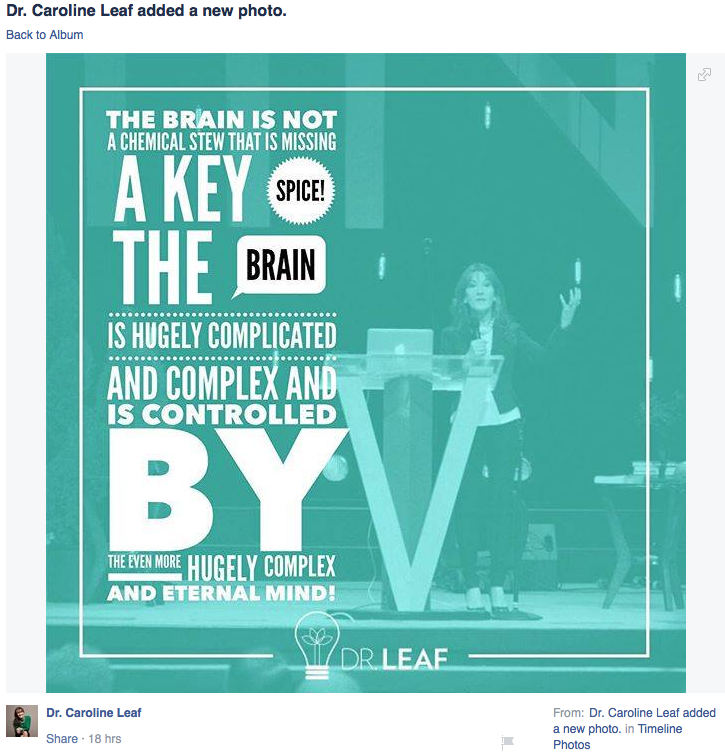
As I discussed in the last post, this idea of the mental monopoly dominates every one of Dr Leaf’s works, and most of her social media memes. Take her most recent meme for example, published just today, “The brain is not a chemical stew that is missing a key spice! The brain is hugely complicated and complex and is controlled by the even more hugely complex and eternal mind!”

Screen Shot 2015-10-02 at 9.26.07 pm

The premise that the mind controls the brain is wrong. Completely and utterly wrong. It is precisely the opposite of what science tells us. The mind is a function of the brain, just like breathing is a function of the lungs. No lungs, no breath. No brain, no mind. (see my posts here, here and here, and others for further discussion)

consistencydemotivator

It’s been said, “Consistency: It’s only a virtue if you’re not a screwup.” Perhaps that’s a little harsh, but it does illustrate the point that just because you say something often enough, doesn’t make it true. So no matter how many times Dr Leaf repeats herself, the fact that the brain controls the mind isn’t going to change.

Even without appealing to the plethora of scientific information out there, Dr Leaf’s claim that mind-action dominates mental well-being is wrong, since mind-action is simply brain-action, which in turn, is influenced by the complex interplay of our genes, our physical health, our uncontrollable external environment, our social networks and our spirituality. Our mental well-being is no different to our general well-being in this regard. It is still part of the complex interplay that is represented by the biopsychosocial (and spiritual) model.

It’s time for Dr Leaf to update her teaching, and abandon her unscientific presuppositions and philosophies.

Dr Caroline Leaf and the Mental Monopoly Myth

Screen Shot 2015-09-23 at 7.37.23 pm

What’s more important to a person’s health and well being?

Is it their physical attributes – their genes, their fitness, their diet? Is it their psychological state – their mind, their emotional balance? Is it their social context – how they relate and contribute to the communities that they’re a part of? Or is it their spirituality – the depth of their connections to faith and the supernatural?

According to Dr Caroline Leaf, communication pathologist and self-titled cognitive neuroscientist, it’s the mind that dominates. This is a common theme of her books [1: especially chapter 1] and her social media memes.

Take today’s gem: “Mind action is the predominant element in well being and mental health.”

In other words, it doesn’t really matter what your genes are, where you were born or the depth of your acceptance in your community. It doesn’t matter whether you have a deep faith either. The psychological dominates the physical, the social and the spiritual. As she said in her books,

“Thoughts influence every decision, word, action and physical reaction we make.” [2: p13]
“Our mind is designed to control the body, of which the brain is a part, not the other way around. Matter does not control us; we control matter through our thinking and choosing.” [1: p33]
“Research shows that 75 to 98 percent of mental, physical, and behavioural illness comes from ones thought life.” [1: p33]

Dr Leaf’s philosophy of our wellbeing can be pictured like a pyramid, with our ‘mind action’ (read, ‘choices’) dominating every other facet of our lives.

Leaf Mental Monopoly Model

The problem with this philosophy is that it doesn’t fit with science, scripture, or even common sense.

You don’t have to be a rocket scientist to recognise that Dr Leaf’s assertion doesn’t fit with every day experience. Where you were born and raised, and where you live, significantly impact a persons overall wellbeing, independent of their thoughts and choices.

Does Dr Leaf honestly believe that the wellbeing of a ten year old boy living in rural Sedan, with no access to running water and sewerage systems, living on a subsistence diet and drinking contaminated water from the only well in his village, has the same wellbeing as a ten year old in rural Ohio, who has access to clean water, plentiful food, and an education?

Does Dr Leaf think that the wellbeing of a pregnant woman in Afghanistan, with poor nutrition and limited access to meaningful antenatal care or a trained midwife to deliver her baby, is the same as the wellbeing of a pregnant woman in London, who has access to fresh food, vitamin supplements, GP’s, midwives, and specialist obstetricians in big city hospitals?

These are just two simple examples which demonstrate that the action of your mind has very little to do with your overall wellbeing.

But if you want to be more scientific about it, then look no further than the biopsychosocial model. Modern health professionals moved beyond the idea that only one facet of human existence was responsible for all of your wellbeing way back in the 1980’s. The biopsychosocial model proposes that the overall health of a person was equally dependent not just on the physical, but was part of a broader system of the medical, mental and the social [3]. The model recognised that a person’s overall wellbeing was made worse by social disadvantage as well as physical illness or poor coping skills, and so often, the physical, social and psychological would affect each other in loops – physical illness would often reduce a persons ability to mentally cope, which strained their social connections, making them lonely and reduced the care given to them, which then made them sicker.

Most Christian would recognise that one element is still missing, which is the spiritual. Our faith is a realm beyond rational thinking, and isn’t fairly grouped with the mental, although they are both housed in our brain. Still, faith influences our social interactions, our psychology, and our physical health, as much as each mutually influences our faith.

Putting it altogether, we don’t have a pyramid, but a collection of ponds. Our mind action does not dominate our health and our wellbeing, but is simply one part of a much larger whole, with our health and wellbeing at the centre.

Biopsychosocial spiritual coloured

It’s interesting that a woman with as much influence amongst the western Christian church as Dr Leaf would suggest that the mind is more influential to our wellbeing than our faith. This makes her teaching seem more humanist than holy, more secular than spiritual. It may invite questions about the deepest influences of her ministry – is it humanistic philosophy with a garnish of scripture, or does the Bible really promote thinking over faith? Ultimately, it’s up to each individual to examine the evidence for themselves and make up their own mind.

Irrespective of Dr Leaf’s philosophical foundations, I’d suggest that her hypothesis of the mental monopoly falls down at the level of common sense and good science. Medical science moved beyond the idea of the single dominant facet of humanity more than three decades ago.

It’s time for Dr Leaf to do the same.

References

[1]        Leaf CM. Switch On Your Brain : The Key to Peak Happiness, Thinking, and Health. Grand Rapids, Michigan: Baker Books, 2013.
[2]        Leaf C. Who Switched Off My Brain? Controlling toxic thoughts and emotions. 2nd ed. Southlake, TX, USA: Inprov, Ltd, 2009.
[3]        Borrell-Carrio F, Suchman AL, Epstein RM. The biopsychosocial model 25 years later: principles, practice, and scientific inquiry. Ann Fam Med 2004 Nov-Dec;2(6):576-82.

Dr Caroline Leaf – Better graphics, same content

Screen Shot 2015-09-04 at 2.08.15 pm

In the world of marketing, visual media is king. Humans are sight based creatures. About thirty percent of our brains cortex is dedicated to vision , compared to 8 percent for touch and 2 percent for hearing http://channel.nationalgeographic.com/brain-games/articles/brain-games-watch-this-perception-facts/)

It’s no wonder then that sites like Pinterest and Instagram have so rapidly become such dominant sites on the social media landscape. And why billions of dollars are invested in visual advertising on TV and billboards.

Dr Caroline Leaf is a communication pathologist and self titled cognitive neuroscientist. In the last few weeks, she’s gone for a new look for her Instagram and Facebook posts – gone are the simple lines, plain text and stand alone logo. Her posts have gone glam, with backgrounds of her photo treated with coloured layering and shading, overlaid with Dr Leafs favourite text. Sometimes the text is pretty easy to read. Other times it looks like a 4th grade class got to take turns picking the font and text size for each different word. But hey, it’s edgy, it’s happening, it’s so hot right now.

It’s a real shame that she only chose to update the look and not the actual content of her social media memes. Take today’s offering as an example: “The mind processes. The brain reflects this processing.” (The unsaid conclusion being that, “The mind controls the brain.”)

I’ve written about this meme a few times (here, here, here and here, as a small sample). But let’s relook at it again, since Dr Leaf is unwilling to reconsider the statements lack of validity.

Does the mind really control the brain, or does the brain control the mind? Well, if the mind was separate from the brain and controlled the brain, then the mind would be able to function independently of the brain. And also, if the mind was separate to the brain, then changes to the brain would not influence the function of the mind.

It’s difficult to show that a person has a mind without a brain. You can’t really remove someone’s brain and then put it back again, so not many people are keen to volunteer for that study. But anecdotally, have you ever heard of a person who has woken from a coma having spend all that time in deep thought?

What IS much easier to study, and has been proven over the course of centuries, is the change to our cognitive function when our brain is changed, physically or functionally.

The mind changes when the function of the brain is changed by medications.
The mind changes when the function of the brain is changed by illicit drugs.
The mind changes when the function of the brain is changed by electrical stimulation.
The mind changes then the structure of the brain is changed by tumours or injuries.

In 1848, a man named Phineas Gage was packing gunpowder in some rock when an accidental detonation blasted a foot-long iron rod through the left face and forehead, severely damaging the left frontal lobe of his brain. History records that his personality changed from polite, well mannered, and well spoken to fitful, irreverent, impatient of restraint or advice, obstinate and capricious [1].

Whilst Phineas Gage was is most famous, other brain injuries can also change the way in which someone thinks. For example, lesions of the parietal lobe of the brain changes the way people see their own bodies. Baars writes, “Patients suffering from right parietal neglect can have disturbing alien experiences of their own bodies, especially of the left arm and leg. Such patients sometimes believe that their left leg belongs to someone else (often a relative), and can desperately try to throw it out of bed. Thus, parietal regions seem to shape contextually both the experience of the visual world and of one’s own body.” [2]

Some might argue that the mechanism of injury might be the variable that could change someone’s personality. After all, if an iron rod was blasted through my skull, I might be a little antsy too. But other structural change to the brain, not associated with a sudden traumatic event, can also result in personality changes – it’s well recognised that personality changes can be the first presenting symptom of brain tumours, for example.

Though the brain doesn’t have to be horribly distorted for the mind to change. In the last couple of decades, a tool has been developed called TMS – short for transcranial magnetic stimulation. A magnetic pulse is delivered over a part of the skull, passing through the bone to reach the brain, causing changes to the electrical current running through the nerve cells. Stimulation of different intensities can either turn off the nerve cells or excite them. TMS has become a great tool for studying cognitive neuroscience because it directly changes the function of the brain in a well localised and temporary manner. It’s also easy for scientists to blind the subjects to whether they’re receiving the treatment or a sham treatment, so the results are reliable. Research shows that when the frontal lobes of the brain are changed by the electrical signals, their executive function also changes [3].

Changes to the function of the brain are known to change the function of the mind and have been known to do so for centuries. From religious hallucinogens to Woodstock hippies, drugs of various forms have been used to alter mood, thought, and perceptions of reality. But there’s a drug that’s much more common, that’s known for its ability to alter our brains thinking ability the world over, and even Dr Leaf enjoys it.

Like most people, my morning doesn’t really start until after my first cup of coffee. Sure, I’m functional, but barely. Fifteen minutes after the first short black is in my system, I find that I’m much more alert and my thinking is clearer.

What’s changed? Is it my mind changing the function of my brain, or is it the coffee, specifically the caffeine in it, that’s changing my brain which is in turn is making my mind clearer and sharper? I think the answer is obvious. Caffeine is the most commonly used recreational drug in the history of mankind, and every cup of java (real coffee that is, not the travesty that is decaf) is more proof against Dr Leaf’s dogmatic misrepresentation of basic science.

So, if the mind is changed by alterations to the structure and/or function of our physical brain, it follows that our mind must be a function of our brain. Therefore, the mind does not process, while the brain simply hangs on for the ride. Rather, the brain processes, and our mind reflects this processing.

Dr Leaf can tart up her memes all she likes, but until she changes the content of her memes to match some actual science, it’s all just smoke and mirrors. The truth doesn’t need visual pimping. It is simply the truth.

References

[1]        Fumagalli M, Priori A. Functional and clinical neuroanatomy of morality. Brain : a journal of neurology 2012 Jul;135(Pt 7):2006-21.
[2]        Baars BJ. Global workspace theory of consciousness: toward a cognitive neuroscience of human experience. Progress in brain research 2005;150:45-53.
[3]        Guse B, Falkai P, Wobrock T. Cognitive effects of high-frequency repetitive transcranial magnetic stimulation: a systematic review. J Neural Transm 2010 Jan;117(1):105-22.

I’ve got a brain, revisited.

Nearly three weeks ago, I published a post on critical thinking in the church. I briefly discussed what critical thinking was, and I posed a number of possible reasons why we didn’t see more critical thinking in the church.

Having thought some more about the issue of critical thinking in the church over the last three weeks, I wanted to devote one more blog post to it – to add some more to the discussion, and round it out a little.

But first, I want to offer an apology to the church. In the last three weeks, I’ve come across research where experts have looked at the issue of critical thinking across our society, and their conclusion is that critical thinking is hard, and is poorly done across the board. The church, therefore, isn’t necessarily worse than the rest of the community at large, so I may have been a little harsh on account of some unrealistic expectations.

Still, I would suggest that if the Christian church is to be salt and light, we shouldn’t rest on our laurels and think it’s ok to be as undiscerning as everyone else. Instead, we should be looking to lead our community, in our love for God, our love for people, and our love of the truth.

In the essay, “Teaching Critical Thinking: Lessons from Cognitive Science” [1], Tim van Gelder outlines a number of lessons from cognitive neuroscience on the nature of critical thinking, how we learn, and why we don’t learn critical thinking. These have important implications for critical thinking in the church.

  1. Critical thinking doesn’t come naturally to us

    “Humans are not naturally critical thinkers; indeed, like ballet, it is a highly contrived activity. Running is natural; nightclub ‘dancing’ is natural enough; but ballet is something people can only do well with many years of painful, expensive, dedicated training. Evolution didn’t intend us to walk on the ends of our toes, and whatever Aristotle (“Man is a rational animal”) might have said, we weren’t designed to be all that critical either. Evolution doesn’t waste effort making things better than they need to be, and homo sapiens evolved to be just logical enough to survive while competitors such as Neanderthals and mastodons died out.”

    Instead of thinking critically, humans tend to be “pattern-seeking, story telling”. Problems occur because we naturally tend to accept the first account that “seems right” and don’t challenge whether that account is actually true. The test of truth for most humans is not intellectual but intuitive.

  2. Practice makes perfect.
    Critical thinking is a higher order cognitive skill. If you don’t practice the skills, you won’t become good at them or eventually master them. So learning the theory of critical thinking won’t make someone better at critical thinking any more than watching a sport on TV will make you better at it. Though if you want to become really good at something, one needs to engage in deliberate practice of the skills of critical thinking on a regular basis, as well as broadly practicing critical thinking.
  3. Transfer.
    Transfer refers to the difficulty in transferring skills applied in one area and applying them broadly. This is an issue across all learning, not just critical thinking. The mind is a cluster of specialised independent capacities, and a skill learnt in one capacity isn’t easily transferred to the rest.
    Of course, if it were impossible to transfer skills across to our broader knowledge, there would be no point in teaching anything.   So it’s not impossible to broaden critical thinking skills, but this skill must also be learned. It’s unlikely to happen on its own.
  4. Practical theory.
    Australian is a nation of coffee drinkers. Even though we consume a lot of God’s wake-up juice, most coffee drinkers don’t know much about the coffee they consume. They have practical coffee knowledge (what they like), but little theoretical knowledge (why they like it). Improving in critical thinking mastery, just like increasing the depth of coffee enjoyment, involves learning a little more theory. Better theoretical knowledge improves your perception of what’s going on, which then improves insight enabling better self-monitoring and correction, as well as enabling better improvement from external coaching. Better understanding of critical thinking comes from better understanding some of the theory of critical thinking.
  5. Belief Preservation
    Sir Francis Bacon said,

    “The mind of man is far from the nature of a clear and equal glass, wherein the beams of things should reflect according to their true incidence; nay, it is rather like an enchanted glass, full of superstition and imposture, if it be not delivered and reduced.”

    Or in other words, the human mind is prone to illusion, distortion and error, both because of innate hardwiring, and social learning. These cognitive beliefs and blind spots are many, and sometimes subtle. In this discussion, belief preservation is important. It is the tendency “to use evidence to preserve our opinions”. Humans seek out evidence which supports what we believe and avoid or ignore evidence which goes against it. We also rate evidence as good or bad depending on whether it supports or conflicts with our beliefs, and we tend to stick with our beliefs even in the face of overwhelming evidence against them, so long as there is a sliver of evidence in support.
    Critical thinking requires us to work against this bias, and doing so feels very unnatural, so while it might be challenging, it’s nevertheless, very important.

  6. Map it out
    The core of critical thinking is argument (the connected series of statements intended to establish a definite proposition, not an angry dispute).  We tend to handle arguments by expressing them in either writing or speaking. But there concept of an argument map in which the statements that make up the premises and the conclusion of the argument are drawn diagrammatically. Critical thinking skills improve faster when taught with argument mapping.

So how do we apply these lessons to critical thinking and the church?

  1. Critical thinking is hard but not impossible.

Critical thinking doesn’t come naturally to most people. Hence, why I apologised earlier in this essay – I was wrong to expect that critical thinking should come naturally to everyone.

But that doesn’t mean that the church should shy away from it either. At the very least, all Christians should be aware of the most fundamental basics of critical thinking – that we naturally tend to believe what’s intuitive, not necessarily what’s right. And, it’s ok to ask questions. No topic should be taboo.

  1. Those who can, should.

We’re all members of Christ’s body (Romans 12:3-8, 1 Corinthians 12:12-31). Some are more gifted in hospitality or leadership – the hands and feet. Some people are intercessors – the heart. So it’s not really a stretch to think that there are some members of the church whose gifts lie in the academic or the intellectual – the “brain”.

So those who want to think about God and their faith on a much deeper level should be encouraged to do so. If there aren’t any already, courses could be developed to teach the interested Christian how interpret Biblical Hebrew and Greek to increase the understanding of scripture. Courses in critical thinking can be added to every Bible college and seminary, and courses in critical thinking can be encouraged or taught by churches, along side courses in ministry and the supernatural.

At the end of my last post, I said that I would do an idiots guide to critical thinking so that we could all have the skills if we wanted them. Actually I don’t need to, since there are very good courses in critical thinking online already: http://philosophy.hku.hk/think/

  1. Be aware of our limitations

Lastly, pastors and leaders should be aware of their own limitations and their potential for cognitive biases.  Our pastors work hard, and do a very good job on the whole.  But they’re not all like Solomon.  Just because something seems right to them, doesn’t mean that it is. Sometimes there will be people who will legitimately question what they say, or a ministry or minister that they’ve endorsed.

Rather than taking this as an affront to their authority, they need to consider that the alternative view might be right. If they’re not in a position to weigh up the evidence for themselves, there’s no reason why they can’t ask for assistance from trusted elders who do have the knowledge.  If Moses can delegate, then so can they.

The same goes for Christian leaders all the way to the highest levels of church leadership. Our church leadership can’t plead ignorance when significant issues are raised. Burying your head in the sand just makes your arse a target.

Critical thinking is an important yet unrecognised major issue for the Christian church. If I have missed anything, or if you would like to further the conversation, I welcome your comments.

Happy thinking everyone.

References

[1]        van Gelder T. Teaching Critical Thinking: Lessons from Cognitive Science. College Teaching 2005;53(1):41-46.