The Prospering Soul – Christians and Anxiety

When you say the word “anxiety”, it can mean different things to different people. To a lot of people, anxiety is the same as being a little frightened. To others, it’s being really scared, but with good reason (like if you have to give a speech and you’re afraid of public speaking).

Medically speaking, anxiety isn’t just being frightened or stressed. After all, it’s normal to be frightened or stressed. God made us so that we could experience fear, because a little bit of fear is actually protective. There are dangers all around us, and if we had no fear at all, we’d end up becoming lunch for a wild animal, or road-kill. So there’s nothing wrong with a little bit of anxiety – in the right amount, for the right reason.

But anxiety in the wrong amount or for the wrong reason, can disrupt our day-to-day tasks and make it hard to live a rich and fulfilling life. That’s the anxiety that we’ll be talking about today.

The official description of anxiety reflects this idea of the wrong amount of anxiety about the wrong things: “… marked symptoms of anxiety accompanied by either general apprehension (i.e. ‘free-floating anxiety’) or worry focused on multiple everyday events, most often concerning family, health, finances, and school or work, together with additional symptoms such as muscular tension or motor restlessness, sympathetic autonomic over-activity, subjective experience of nervousness, difficulty maintaining concentration, irritability, or sleep disturbance. The symptoms are present more days than not for at least several months and result in significant distress or significant impairment in personal, family, social, educational, occupational, or other important areas of functioning.” (This is taken from the beta-version of the latest WHO diagnostic guidelines, the ICD-11, but has yet to be formally ratified).

There are six main disorders that come under the “anxiety disorders” umbrella, reflecting either an abnormal focus of anxiety or an abnormal intensity:
1. Panic Disorder (abnormally intense anxiety episodes)
2. Social Anxiety Disorder (abnormal anxiety of social interactions)
3. Post-traumatic Stress Disorder (abnormally intense episodes of anxiety following trauma)
4. Obsessive-Compulsive Disorder (abnormally intense and abnormally focussed anxiety resulting in compulsive behaviours)
5. Specific phobias (abnormally focussed anxiety on one particular trigger), and
6. Generalised Anxiety Disorder (abnormal anxiety of everything)

The common underlying theme of anxiety is uncertainty. Grupe and Nitschke wrote, “Anxiety is a future-orientated emotion, and anticipating or ‘pre-viewing’ the future induces anxiety largely because the future is intrinsically uncertain.” [1]

The dysfunctional approach to uncertainty that underlies anxiety is in turn related to genetic changes which affect the structure and function of the brain, primarily in the regions of the amygdala and the pre-frontal cortex, which then alters the processing of our brain in five different areas:
> Inflated estimates of threat cost and probability
> Hypervigilance
> Deficient safety learning
> Behavioural and cognitive avoidance
> Heightened reactivity to threat uncertainty

In simpler language:
> the brain thinks that threats are more likely and will be worse than they are
> the brain spends more time looking for possible threats
> the brain fails to learn what conditions are safe, which is aggravated by
> the brain over-using avoidance as a coping mechanism, and
> the brain assumes that unavoidable uncertainty is more likely to be bad.

It’s important to understand at this point that anxiety disorders aren’t the result of poor personal choices. They are the result of a genetic predisposition to increased vulnerability to early life stress, and to chronic stress [2].

The other way of looking at it is that some people are blessed with amazing tools for resilience [3, 4].

It’s not to say that our choices have no impact at all, but we need to be realistic about this. Everyone will experience stressful situations at some point in their lives, and everyone will also make dumb choices in their lives. Some people are naturally better equipped to handle this, whereas some people have genes that make them more vulnerable. It’s wrong to blame yourself, or allow other people to blame you, for experiencing anxiety, just as it’s wrong for other people to assume that if one person can cope with the same level of stress, then everyone else should too.

It’s not to say that you shouldn’t fight back though. Just because your facing a mountain doesn’t mean to say you can’t climb it. It will be hard work, and you’ll need good training and support, but you can still climb that mountain.

Managing anxiety is very similar to managing depression like we discussed in a previous post. Following the tap model, there’s overflow when there is too much going into the system, the system is too small to handle it, and the processing of the input is too slow. So managing anxiety involves reducing the amount of stress going into the system, increasing the systems capacity through learning resilience and coping skills, and sometimes by improving the systems processing power with medications.

Reducing the input – stress management

Sometimes the best way of coping with anxiety is to reduce the stress that’s fanning the flames. It mightn’t seem to come naturally, but as we discussed in the last chapter, there are a few basic skills that are common to all stress management techniques that can form the platform of ongoing better skills in this area.

Engaging the “vagal brake” as proposed by the “Polyvagal Theory” [5] is as important in anxiety as it is in depression. By performing these techniques, the activity of the vagus nerve on the heart via the parasympathetic “rest-and-digest” nervous system is increased, which not only slows down the heart, but enhances the activity of other automatic parts of our metabolism. Some of the techniques allow a relaxed body to have a relaxed brain which can cope better with whatever is confronting it. The full list will be a blog for another time, but the simplest technique is to breathe!

It’s really simple. Sit in a comfortable position. Take slow, deep breaths, right to the bottom of your lungs and expanding your chest forward through the central “heart” area. Count to five as you breathe in (five seconds, not one to five as quickly as possible) and then count to five as you breathe out. Keep doing this, slowly, deeply and rhythmically, in and out. Pretty simple! This will help to improve the efficiency of your heart and lungs, and reduce your stress levels.

Remember, B.R.E.A.T.H.E. = Breathe Rhythmically Evenly And Through the Heart Everyday.

Increasing capacity – coping and resilience

Like with depression, anxiety responds well to psychological therapies which help to increase coping skills and enhance our innate capacity for resilience. And like depression, anxiety improves with CBT and ACT [6, 7], which enhance the activity of the pre-frontal regions of the brain [8]. For anxiety, CBT teaches new skills to handle uncertain situations, and to re-evaluate the chances of bad things happening and what would happen if they do. ACT puts the train of anxious thoughts and feelings in their place, and teaches engagement with the present moment, and a future focusing on values, and accepting the discomfort of uncertainty by removing the distress associated with it.

Practicing each of these skill sets is like practicing any other skill. Eventually, with enough practice, they start to become more like a reflex, and we start to cope with stress and anxiety better automatically.

Increased processing – Medications

Sometimes, to achieve long-term successful management of anxiety, a little extras help is needed in the form of medication. Like depression, the main group of medications used are the Selective Serotonin Reuptake Inhibitors (or SSRI’s for short). Medications appear to reduce the over-activity of a number of brain regions collectively called the limbic system [8], which are involved with many innate and automatic functions, but in its simplest form, the limbic system controls many of our emotions and motivations, including fear, anger and certain aspects of pleasure-seeking [9]. So essentially, SSRI’s help the anxious brain to make better sense of the incoming signals.

There are other medications commonly used for anxiety treatment, collectively called benzodiazepines. Most people wouldn’t have heard that term before, but would have heard of the most famous member of the benzo family, Valium. Benzos are like having a bit too much alcohol – they slow down the activity of the brain, and induce a feeling of relaxation. When used appropriately (i.e.: in low doses and in the short term), they can be helpful in taking the edge off quite distressing feelings of anxiety or panic. But benzos are not a cure, and after a while, the body builds a tolerance to them, where a higher dose is required to achieve the same effect. Continued long term use eventually creates dependence where a person finds it difficult to cope without them.

The final way to help manage anxiety is prayer. Like for depression, there is limited scientific information on the effects of prayer on, although a small randomised controlled trial did show that prayer with a prayer counsellor over a period of a number of weeks was more effective than no treatment [10].

Though given that anxiety is a future orientated emotion, excessively anticipating possible unwelcome scenarios and consequences, it’s easy to see why prayer should work well for anxiety. Trusting that God has the future in hand and knowing “that in all things God works for the good of those who love him, who have been called according to his purpose” (Romans 8:28) means that the future is less uncertain. The Bible also encourages us, “Do not be anxious about anything, but in every situation, by prayer and petition, with thanksgiving, present your requests to God. And the peace of God, which transcends all understanding, will guard your hearts and your minds in Christ Jesus.” (Philippians 4:6-7) When we give the future to God, he will give us peace in return.

Again, like in the case of depression, it’s sometimes hard for Christians to understand how strong Christians can suffer from anxiety in the first place. After all, we’ve just read how God gives us peace. And the Bible says that the fruit of the Spirit is peace (Galatians 5:22).

So when you’re filled with the opposite, when all you feel is overwhelming fear, it makes you feel like a faithless failure. Christians without anxiety assume that Christians with anxiety aren’t living in the Spirit. And it’s the logical conclusion to draw after all – if the fruit of the Spirit is peace, and you’re not filled with peace, then you mustn’t be full of the Spirit.

But like depression, when you look through the greatest heroes in the Bible, you see a pattern where at one point or another in their lives, they went through physical and emotional destitution, including mind-numbing fear … Moses argued with God about how weak and timid he was (Exodus 3 and 4), Elijah ran for his life in panic and asked God to kill him, twice, over the period of a couple of months after Queen Jezebel threatened him (1 Kings 18 and 19). Peter had spent three years with Jesus, the Messiah himself, hearing him speak and watching him perform miracle after miracle after miracle. But Peter denied his Messiah three times when he was confronted with possible arrest (John 18).

For the same pattern is also seen in King David, Gideon, and a number of other great leaders through the Bible. The take home message is this: it’s human nature to suffer from disease and dysfunction. Sometimes it’s physical dysfunction. Sometimes it’s emotional dysfunction. It’s not a personal or spiritual failure to have a physical illness. Why should mental illness be treated any different?

As the stories of Moses, Elijah and Peter testify, being a strong Christian doesn’t make you impervious to fear and anxiety. Hey, we’re all broken in some way, otherwise why would we need God’s strength and salvation? Having anxiety simply changes your capacity to experience God’s peace. As I said in the last chapter, closing your eyes doesn’t stop the light, it just stops you experiencing the light. Being anxious doesn’t stop God’s peace, it just makes it harder to experience God’s peace.

In summary some anxiety, at the right time and at the right intensity, is normal. It’s not unhealthy or sinful to experience some anxiety. Anxiety at the wrong time or at the wrong intensity, can disrupt our day-to-day tasks and make it hard to live a rich and fulfilling life. Anxiety related to a dysfunctional approach to uncertainty, and is a future-orientated emotion because anticipating or ‘pre-viewing’ the future induces anxiety largely because the future is intrinsically uncertain. Anxiety disorders can be debilitating.

Like depression, anxiety disorders can be managed in four main ways, by reducing the amount of stress coming in with stress management techniques, by increasing capacity to cope with psychological therapies like CBT and ACT, and sometimes by using medications, which help the brain to process the uncertainty of each situation more effectively. Prayer is can also useful to helping to manage anxiety.

Christians are not immune from anxiety disorders, and it’s important for the church to understand that Christians who suffer from anxiety are not weak, backsliding or faith-deficient. Having anxiety is not because of making poor choices. Though if you have anxiety, trust in the promises of the Bible, that God has the future under control.

References

[1]        Grupe DW, Nitschke JB. Uncertainty and anticipation in anxiety: an integrated neurobiological and psychological perspective. Nature reviews Neuroscience 2013 Jul;14(7):488-501.
[2]        Duman EA, Canli T. Influence of life stress, 5-HTTLPR genotype, and SLC6A4 methylation on gene expression and stress response in healthy Caucasian males. Biol Mood Anxiety Disord 2015;5:2.
[3]        Wu G, Feder A, Cohen H, et al. Understanding resilience. Frontiers in behavioral neuroscience 2013;7:10.
[4]        Russo SJ, Murrough JW, Han M-H, Charney DS, Nestler EJ. Neurobiology of resilience. Nature neuroscience 2012 November;15(11):1475-84.
[5]        Porges SW. The polyvagal perspective. Biological psychology 2007 Feb;74(2):116-43.
[6]        James AC, James G, Cowdrey FA, Soler A, Choke A. Cognitive behavioural therapy for anxiety disorders in children and adolescents. The Cochrane database of systematic reviews 2013;6:CD004690.
[7]        Swain J, Hancock K, Hainsworth C, Bowman J. Acceptance and commitment therapy in the treatment of anxiety: a systematic review. Clinical psychology review 2013 Dec;33(8):965-78.
[8]        Quide Y, Witteveen AB, El-Hage W, Veltman DJ, Olff M. Differences between effects of psychological versus pharmacological treatments on functional and morphological brain alterations in anxiety disorders and major depressive disorder: a systematic review. Neuroscience and biobehavioral reviews 2012 Jan;36(1):626-44.
[9]        Sokolowski K, Corbin JG. Wired for behaviors: from development to function of innate limbic system circuitry. Frontiers in molecular neuroscience 2012;5:55.
[10]      Boelens PA, Reeves RR, Replogle WH, Koenig HG. A randomized trial of the effect of prayer on depression and anxiety. Int J Psychiatry Med 2009;39(4):377-92.

If you’re suffering from anxiety or any other mental health difficulties and if you want help, see your GP or a psychologist, or if you’re in Australia, 24 hour telephone counselling is available through:

 Lifeline = 13 11 14 – or – Beyond Blue = 1300 22 4636

The Prospering Soul – Christians and Depression Part 2

For most church-goers, putting the terms “Christian” and “depression” in the same sentence just doesn’t seem natural. In part 1, we looked at what depression is and why depression affects a lot more of the church than the church is aware of.

In this instalment, we’ll look at some general ways to handle depression, and what the Bible says about being depressed.

In the first blog, I explained how I understood depression as the end result of the brains capacity to deal with the demands of life. Too many demands or not enough resources overwhelms the brain and low mood is the end result.

So how do you manage depression? Well, if the system is failing because of increased demand or decreased capacity to cope, then it’s logical to manage depression by decreasing demand and increasing capacity to cope.

We can increase our capacity to cope by increasing our brains capacity to grow new nerve branches, and to make the cells more efficient at doing their job.

Increasing the growth of new nerve cell branches (in science speak – ‘synaptogenesis’) involves increasing the growth factors. BDNF has been proven to be increased by anti-depressant medications [1, 2] and by exercise [3, 4]. There may be some evidence that diet might improve depression in a similar way although the evidence is weak [5], so we should take that with a grain of salt.

The next way of managing depression is to increase the capacity to cope. The way we do that is through psychological therapies. There are several styles of psychological therapies, too many for me to discuss them all here. In the real world, most psychologists use a mix of a number of techniques that they tailor to the needs of their patient. I’m going to quickly outline the two most commonly used therapies.

Cognitive Behavioural Therapy, or CBT for short, is “based on the theory that emotional problems result from distorted attitudes and ways of thinking that can be corrected. The aim is to treat difficulties by problem solving, finding better strategies for coping, and overcoming irrational fears.” [6] Essentially it’s the combination of two different therapies, Cognitive therapy, and Behavioural therapy. Cognitive therapy, as the name suggests, assumes that people have mental health problems because of patterns of irrational thinking. Behavioural therapy is quite broad, but looks to challenge the thinking patterns with action (for example: gradual exposure to something a person is afraid of).

CBT is the most well researched form of psychotherapy, and has a lot of evidence for it’s effectiveness [7]. Though there is good evidence that it’s the behavioural arm that gives it any clout [8, 9]. Trying to change your mental health just by trying to change your thoughts is generally ineffective.

In the last couple of decades, a new wave of psychological therapies has emerged from this idea that Cognitive Behavioural Therapy is just Behavioural Therapy with bling. The most notable is Acceptance and Commitment Therapy, or ACT for short. ACT is different to CBT in that ACT doesn’t rely on the idea of changing thoughts, but on simply accepting them. ACT “is a psychological therapy that teaches mindfulness (‘paying attention in a particular way: on purpose, in the present moment, non-judgementally’) and acceptance (openness, willingness to sustain contact) skills for responding to uncontrollable experiences and thereby increased enactment of personal values.” [10]

According to ACT, you don’t have to change your thoughts, because thoughts aren’t that powerful to begin with – they’re just words. Sometimes they’re true, and sometimes they’re helpful, but if we spent all of our time trying to fight them, we miss out on experiencing the joy in the present moment, and we can lose sight of the values that guide us into our future fulfilment.

The common link between good psychotherapy is that their therapeutic effect comes from improving skills in different areas that the patient lacks. That is, psychological therapies increase the capacity of the patient to cope with things that would have otherwise wouldn’t have handled well and would have caused distress.

The last way to manage depression is to limit the excessive demands that have been placed on the system in the first place, or in other words, reduce the unnecessary stressors. People who are depressed tend to be bad at this, but there are a few basic skills that are common to all stress management techniques that can form the platform of ongoing better skills in this area. The full list will be a blog for another time, but the simplest technique is to breathe!

It’s really simple. Sit in a comfortable position. Take slow, deep breaths, right to the bottom of your lungs and expanding your chest forward through the central “heart” area. Count to five as you breathe in (five seconds, not one to five as quickly as possible) and then count to five as you breathe out. Keep doing this, slowly, deeply and rhythmically, in and out. Pretty simple! This will help to improve the efficiency of your heart and lungs, and reduce your stress levels.

Remember, B.R.E.A.T.H.E. = Breathe Rhythmically Evenly And Through the Heart Everyday.

To recap, there are three main ways to manage depression – increase the brains ability to process the incoming information, increase the capacity to cope, and decrease the amount of stress that our brains have to process.

The fourth way to help manage depression is prayer. There is limited scientific information on the effects of prayer on depression, although a small randomised controlled trial did show that prayer with a prayer counsellor over a period of a number of weeks was more effective than no treatment [11]. But the Bible encourages us, “Do not be anxious about anything, but in every situation, by prayer and petition, with thanksgiving, present your requests to God. And the peace of God, which transcends all understanding, will guard your hearts and your minds in Christ Jesus.” (Philippians 4:6-7)

And Jesus himself called to those heavy in heart, “Come to me, all you who are weary and burdened, and I will give you rest. Take my yoke upon you and learn from me, for I am gentle and humble in heart, and you will find rest for your souls. For my yoke is easy and my burden is light.” (Matthew 11:28-30)

One final thought. It’s sometimes hard to understand how strong Christians can become depressed in the first place. After all, the Bible says that the fruit of the Spirit is joy (Galatians 5:22). 1 Peter 1:8 seems to suggest that every Christian should be “filled with an inexpressible and glorious joy.”

So when you’re filled with the opposite, it makes you feel like a faithless failure, and Christians without depression assume a similar thing for Christians they know who are suffering from depression. It’s the logical conclusion to draw after all – if the fruit of the Spirit is joy, and you are not filled with joy, then you mustn’t be full of the Spirit.

But when you look through the greatest heroes in the Bible, you see a pattern where at one point or another in their lives, they went through physical and emotional destitution. Sure, their lives had some pretty amazing highs, but they often experienced some amazing lows as well. Moses spent forty years in the wilderness, and when God appeared to him in the burning bush, he argued with God about how weak and timid he was (Exodus 3 and 4).

In 1 Kings 18, Elijah had just seen God rain down fire to supernaturally consume his sacrifice, capture and kill four hundred and fifty prophets of Baal, and watched God break the drought over Israel. At the height of this run of amazing connection to God, Jezebel the evil queen threatened him, and he ran for his life in a panic and asked God to kill him, twice, over the period of a couple of months (1 Kings 19).

Peter had spent three years with Jesus, the Messiah himself, hearing him speak and watching him perform miracle after miracle after miracle. Peter even saw the empty tomb first hand on the very first Easter Sunday, but still, he gave up on life with God and went back to his former occupation, which turned out to be lots of hard work for very little reward (John 21:1-3).

The same pattern is also seen in King David, Gideon, and a number of other great leaders through the Bible. The take home message is this: it’s human nature to suffer from disease and dysfunction. Sometimes it’s physical dysfunction. Sometimes it’s emotional dysfunction. It’s not a personal or spiritual failure to have a physical illness. Why should mental illness be treated any different?

As the stories of Moses, Elijah and Peter testify, being a strong Christian doesn’t make you impervious to low mood or emotional fatigue. Hey, we’re all broken in some way, otherwise why would we need God’s strength and salvation! Having depression simply changes your capacity to experience the joy and love of God. Closing your eyes doesn’t stop the light, it just stops you experiencing the light. Being depressed makes it hard to experience God’s love, but it doesn’t stop God’s love.

In the 80’s and 90’s, a popular Christian musician was a man named Carmen. One of his best known songs had these words,

“When problems try to bury you and make it hard to pray, it may seem like Friday night, but Sunday’s on the way!”

It’s really hard when you’re afflicted by the dank darkness of depression. But nothing will separate us from the love of God (Romans 8:35-39), including depression. You may not feel it, but God’s love is there, and Sunday’s on the way.

Remember:

  1. Depression is a common mental health condition that can have prolonged and devastating consequences. Depression is characterised by either a sadness or a lack of joy which are abnormal in their intensity and their duration, but also affects sleep, appetite and motivation. It’s caused by abnormalities in genes which affect the brains ability to grow new nerve cell branches, and which also affect in-built coping mechanisms, so stress is both more likely to occur in people who are more prone to depression, and the stress is then handled poorly, overloading their emotional capacity.
  1. The management of depression is three-pronged: to improve the brains ability to grow new nerve cells through exercise and/or medication, to learn new ways to cope with distress, and to decrease the amount of stress in the first place.
  1. Christians are not immune from depression, and it’s important for Christians to understand that Christians suffering from depression are not weak, or failing in their spiritual walk, or are unloved by God. The love of God is always present, even if they are unable to process it properly. As dark and dismal as depression can become, there is hope. It may seem like Friday night, but Sunday’s on the way.

References

[1]        Duman RS, Li N. A neurotrophic hypothesis of depression: role of synaptogenesis in the actions of NMDA receptor antagonists. Philosophical transactions of the Royal Society of London Series B, Biological sciences 2012 Sep 5;367(1601):2475-84.
[2]        Anderson I. Depression. The Treatment and Management of Depression in Adults (Update). NICE clinical guideline 90.2009. London: The British Psychological Society and The Royal College of Psychiatrists, 2010.
[3]        Karatsoreos IN, McEwen BS. Resilience and vulnerability: a neurobiological perspective. F1000prime reports 2013;5:13.
[4]        Rimer J, Dwan K, Lawlor DA, et al. Exercise for depression. The Cochrane database of systematic reviews 2012;7:CD004366.
[5]        Lai JS, Hiles S, Bisquera A, Hure AJ, McEvoy M, Attia J. A systematic review and meta-analysis of dietary patterns and depression in community-dwelling adults. The American journal of clinical nutrition 2014 Jan;99(1):181-97.
[6]        NowOK. Cognitive Behavioural Therapy. Dictionary of Psychotherapy 2015 [cited; Available from: http://www.dictionary.nowok.co.uk/cognitive-behavioural-therapy-cbt.php
[7]        Ruiz FJ. Acceptance and Commitment Therapy versus Traditional Cognitive Behavioral Therapy: A Systematic Review and Meta-analysis of Current Empirical Evidence. International journal of psychology and psychological therapy 2012;12(3):333-58.
[8]        Longmore RJ, Worrell M. Do we need to challenge thoughts in cognitive behavior therapy? Clinical psychology review 2007 Mar;27(2):173-87.
[9]        Dobson KS, Hollon SD, Dimidjian S, et al. Randomized trial of behavioral activation, cognitive therapy, and antidepressant medication in the prevention of relapse and recurrence in major depression. Journal of consulting and clinical psychology 2008 Jun;76(3):468-77.
[10]      Smout M. Acceptance and commitment therapy – pathways for general practitioners. Aust Fam Physician 2012 Sep;41(9):672-6.
[11]      Boelens PA, Reeves RR, Replogle WH, Koenig HG. A randomized trial of the effect of prayer on depression and anxiety. Int J Psychiatry Med 2009;39(4):377-92.

If you’re suffering from depression or any other mental health difficulties and need help, see your GP or a psychologist, or if you’re in Australia, 24 hour telephone counselling is available through:

Lifeline = 13 11 14 – or – Beyond Blue = 1300 22 4636
The Prospering Soul – Christians and Depression Part 1

In the average charismatic church, from the time you park your car in the parking lot, to the time the music starts at the beginning of the service, the smiles of at least a hundred people beam at you, and at least one third of those smiles are also attached to enthusiastic handshakes and exhortations like, “Isn’t it great to be in church this morning!”

When you’re a Christian, especially at the happy-clappy end of the church spectrum, you’re supposed to be constantly full of the Holy Spirit and experiencing the joy of the Lord.

Which is why for most church-goers, putting the terms “Christian” and “depression” in the same sentence just doesn’t seem natural, even though depression affects a lot more of the church than the church is aware of.

So, how much of the church is affected by depression? The lifetime prevalence (how likely you are to suffer from depression at one stage through your life) is about twenty-five percent, or about one in four people. The point prevalence (those who are suffering from clinical depression at any particular time) is about six percent.

I used to attend a church which had a regular congregation of about 2500 people. So statistically, one hundred and fifty people in that congregation are suffering from depression every Sunday, and more than 600 will experience depression in their lifetime.

And by ‘depression’, we’re not talking about feeling a little sad … that Bill Shorten might become Prime Minister one day, or Ben Hunt can’t catch, or that One Direction isn’t the same without Zayn. Sadness for genuine reasons … you broke up with a long term partner, someone stole your purse out of your bag, or there’s the threat of redundancies at your office … also doesn’t mean you’re depressed.

The DSM5 is the current standard for psychiatric diagnoses around the world. I’ve included the full definition of depression at the end of this blog, but suffice to say, depression is more than just unhappiness. Proper depression symptoms “cause clinically significant distress or impairment in social, occupational or other important areas of functioning.” In other words, you’re so low that your social life or work is affected, and for more than two whole weeks. It’s also important to know that depression isn’t just low mood but can also be experienced as “Markedly diminished interest or pleasure in all, or almost all, activities most of the day, nearly every day”.

Depression has a number of causes and correlations. People who are chronically unwell, be that from chronic pain, long term illness such as cancer or autoimmune disease, or life threatening illnesses such as those who’ve suffered from heart attacks or meningitis, have a higher rate of depression. People who have experienced significant physical or psychological trauma also have a higher rate of depression. In fact, stress of any form is highly correlated with depression (that is, people who suffer from any severe stress are more likely to develop depression).

This observation led to a theory about the development of depression, called the Stress Exposure Model of depression [1] – You develop depression because you’ve suffered from stress. This is one of the most common assumptions about depression in our society, and there are some important consequences from this line of thinking. Like, if being stressed is the cause of depression then the cure for depression is simply reducing stress. This is probably why most people assume that depression is a choice, or a simple weakness, and why depressed people are often told just to snap out of it.

But there’s more to depression than just better dealing with stress. Fundamentally, I understand depression as the end result of the brains capacity to deal with the demands of life. Too many demands or not enough resources overwhelms the brain and low mood is the end result.

Some depression is predominantly biological. People with biological depression can’t effectively deal with even a normal amount of demand on their system, because their brain doesn’t have the resources to process the incoming signals correctly or efficiently. The main biological cause is a deficiency of a growth factor called BDNF, which is needed for the nerve cells to grow new branches, which enable the brain to process new information. This theory is called the Neurotrophic Hypothesis of Depression [2] (‘neuro’ = nerve and ‘trophic’ = growth). BDNF isn’t the only critical factor in the biological story of depression. There are many others, including the stress hormone system [3], the serotonin system [4] and the dopamine/rewards system [5].

Some depression is predominantly psychological. There are certain situations in which there’s so much going on and so much change and adaptation is required, and the brains coping systems simply can’t cope. So, severe and sudden stressors would fit into this category. For example, people trying to cope with natural disasters, or a tragedy like a massive house fire.

Most of the time, depression is a combination of both biological and psychological. Genetic factors change our capacity to handle the incoming. The nerve cells don’t have enough BDNF and are slow to grow new branches. Genetics are also important in determining other mechanisms of resilience, and people with poor resilience are also more prone to depression [6-8]. Genetic factors also determine other factors involved in the way we process the incoming stream of sensory input – our personality. People with the neurotic personality type, the classical introverts/pessimists, are more prone to depression, because of the way their brain naturally biases the flavour of the incoming information [9]. What’s also very interesting is that these tendencies to depression also tend to create more stress [1, 10]. So stress is important to the risk of depression, but ironically, it is the risk of depression which influences the risk of stress.

The risk of depression is related to an increased tendency towards stress, and poor processing of that stress because of personality factors and a reduced capacity to cope. All three of these factors are influenced by a broad array of genetic factors.

What’s also important to see here is that being depressed isn’t because of “toxic thinking” or because of “negative confessions”. What we say and what we think are signs of what is going on underneath, not the cause of it. And more importantly, you can make as many faith-filled confessions as you like, but if they don’t help you to change your capacity to cope, then they’re just hot air.

In the next instalment, we’ll look at ways to handle depression, and what the Bible says about being depressed.

References

[1]        Liu RT, Alloy LB. Stress generation in depression: A systematic review of the empirical literature and recommendations for future study. Clinical psychology review 2010 Jul;30(5):582-93.
[2]        Duman RS, Li N. A neurotrophic hypothesis of depression: role of synaptogenesis in the actions of NMDA receptor antagonists. Philosophical transactions of the Royal Society of London Series B, Biological sciences 2012 Sep 5;367(1601):2475-84.
[3]        Hauger RL, Risbrough V, Oakley RH, Olivares-Reyes JA, Dautzenberg FM. Role of CRF receptor signaling in stress vulnerability, anxiety, and depression. Annals of the New York Academy of Sciences 2009 Oct;1179:120-43.
[4]        Caspi A, Hariri AR, Holmes A, Uher R, Moffitt TE. Genetic sensitivity to the environment: the case of the serotonin transporter gene and its implications for studying complex diseases and traits. The American journal of psychiatry 2010 May;167(5):509-27.
[5]        Felten A, Montag C, Markett S, Walter NT, Reuter M. Genetically determined dopamine availability predicts disposition for depression. Brain and behavior 2011 Nov;1(2):109-18.
[6]        Karatsoreos IN, McEwen BS. Resilience and vulnerability: a neurobiological perspective. F1000prime reports 2013;5:13.
[7]        Wu G, Feder A, Cohen H, et al. Understanding resilience. Frontiers in behavioral neuroscience 2013;7:10.
[8]        Russo SJ, Murrough JW, Han M-H, Charney DS, Nestler EJ. Neurobiology of resilience. Nature neuroscience 2012 November;15(11):1475-84.
[9]        Hansell NK, Wright MJ, Medland SE, et al. Genetic co-morbidity between neuroticism, anxiety/depression and somatic distress in a population sample of adolescent and young adult twins. Psychological medicine 2012 Jun;42(6):1249-60.
[10]      Boardman JD, Alexander KB, Stallings MC. Stressful life events and depression among adolescent twin pairs. Biodemography and social biology 2011;57(1):53-66.

The DSM5 Formal Diagnostic Criteria for Depression

A. Five (or more) of the following symptoms have been present during the same 2- week period and represent a change from previous functioning; at least one of the symptoms is either (1) depressed mood or (2) loss of interest or pleasure.

(Note: Do not include symptoms that are clearly due to a general medical condition, or mood-incongruent delusions or hallucinations.)

  • Depressed mood most of the day, nearly every day, as indicated by either subjective report (e.g., feels sad or empty) or observation made by others (e.g., appears tearful). Note: In children and adolescents, can be irritable mood.
  • Markedly diminished interest or pleasure in all, or almost all, activities most of the day, nearly every day (as indicated by either subjective account or observation made by others).
  • Significant weight loss when not dieting or weight gain (e.g., a change of more than 5 percent of body weight in a month), or decrease or increase in appetite nearly every day. Note: In children, consider failure to make expected weight gains.
  • Insomnia or hypersomnia nearly every day.
  • Psychomotor agitation or retardation nearly every day (observable by others, not merely subjective feelings of restlessness or being slowed down).
  • Fatigue or loss of energy nearly every day.
  • Feelings of worthlessness or excessive or inappropriate guilt (which may be delusional) nearly every day (not merely self-reproach or guilt about being sick).
  • Diminished ability to think or concentrate, or indecisiveness, nearly every day (either by subjective account or as observed by others).
  • Recurrent thoughts of death (not just fear of dying), recurrent suicidal ideation without a specific plan, or a suicide attempt or a specific plan for committing suicide.

B. The symptoms cause clinically significant distress or impairment in social, occupational or other important areas of functioning.
C. The symptoms are not due to the direct physiological effects of a substance (e.g., a drug of abuse, a medication) or a general medical condition (e.g., hypothyroidism).

Seven Elements of Good Mental Health: 7. Create social networks – The Prospering Soul

Life shouldn’t just be about avoiding poor health, but also enjoying good health. Our psychological health is no different.

Before we take a look at poor mental health, let’s look at some of the ways that people can enjoy good mental health and wellbeing. This next series of posts will discuss seven elements that are Biblically and scientifically recognised as important to people living richer and more fulfilling lives.

These aren’t the only ways that a person can find fulfilment, nor are they sure-fire ways of preventing all mental health problems either. They’re not seven steps to enlightenment or happiness either.   But applying these principles can improve psychosocial wellbeing, and encourage good mental health.

7. Create social networks

Before 2004, everyone knew what social networks were. Now when you talk about ‘social networks’, people assume you’re referring to Facebook. It seems like virtual social networking has been around forever, whereas in contrast, real social networking actually has.

We know this, because we’re wired for social interaction, with specific areas of the brain devoted to social behaviour, such as the orbitofrontal cortex, and there are neurotransmitters and hormones that are strongly associated with bonding and maintenance of social relationships, like oxytocin and β-endorphins. Research has also shown that both humans and other primates find social stimuli intrinsically rewarding – babies look longer at faces than at non-face stimuli, for example [1].

People who engage in social relationships are more likely to live longer, some estimate by an extra 50% [2]. Certainly it appears that the opposite is true. Loneliness predicts depressive symptoms, impaired sleep and daytime dysfunction, reductions in physical activity, and impaired mental health and cognition. At the biological level, loneliness is associated with altered blood pressure, increased stress hormone secretion, a shift in the balance of cytokines towards inflammation and altered immunity. Loneliness may predict mortality [3].

So what is loneliness, and conversely, what defines good social relationships? Fundamentally, good or bad social relationships are related to the quality of the social interaction. This rule applies equally to real social networks [3] and their on-line equivalents [4]. So quality is fundamentally more important than quantity in terms of friendships, with that quality strongly determined by the connection within those social relationships. For example, loneliness “can be thought of as perceived isolation and is more accurately defined as the distressing feeling that accompanies discrepancies between one’s desired and actual social relationships” [3].

The corollary is that friendship can be thought of as perceived connection within social relationships, or the comforting feeling that accompanies the match between one’s desired and actual social relationships.

So healthy social relationships aren’t defined by the size of your network, but by the strength of the connections that your network contains, relative to what’s important to you. Just because you’re not a vivacious extrovert who’s friends with everyone doesn’t mean that your social network is lacking. It also means that you can have meaningful connections to friends through social media, just as much as you can have meaningful connections through face to face interactions. It’s not the way you interact, but the quality of the connection that counts.

What is it about other people that makes us more likely to be their friends? Connection between friends is often the result of attraction to individuals of similar personalities or skills, although recent research suggests that friendship may be related to a much deeper level. Brent et al notes that “Humans are especially predisposed toward homophily, with recent evidence suggesting this even extends to the genetic level; people are more likely to be friends if they have similar genotypes. Taken together, these findings advocate the need to consider not only an individual’s genome, but also their metagenome, when asking questions about the causes of friendship biases … Unrelated friends are more likely to be genetically similar, equivalent to the level of fourth cousins, compared to unrelated strangers.” [1]

As Christians, we’re encouraged to engage with other Christians on a regular basis, which in our modern world, is through regular church attendance. As the Bible says in Hebrews 10:23-25, “Let us hold unswervingly to the hope we profess, for he who promised is faithful. And let us consider how we may spur one another on towards love and good deeds, not giving up meeting together, as some are in the habit of doing, but encouraging one another – and all the more as you see the Day approaching.” But as the research has shown, it’s not just being part of the crowd, but connecting with those in the church in a meaningful way. It’s very easy to be lonely in a crowded church.

Always remember: “Befriend, and be a friend” – that’s how you’ll find benefit to your spirit, soul and body.

References

[1]        Brent LJ, Chang SW, Gariepy JF, Platt ML. The neuroethology of friendship. Annals of the New York Academy of Sciences 2014 May;1316:1-17.
[2]        Holt-Lunstad J, Smith TB, Layton JB. Social relationships and mortality risk: a meta-analytic review. PLoS medicine 2010 Jul;7(7):e1000316.
[3]        Luo Y, Hawkley LC, Waite LJ, Cacioppo JT. Loneliness, health, and mortality in old age: a national longitudinal study. Social science & medicine 2012 Mar;74(6):907-14.
[4]        Oh HJ, Ozkaya E, LaRose R. How does online social networking enhance life satisfaction? The relationships among online supportive interaction, affect, perceived social support, sense of community, and life satisfaction. Computers in Human Behavior 2014;30:69-78.

The pain and gain of grief

Floral tribute to the Sydney siege victims, at Martin Place, Sydney

Floral tribute to the Sydney siege victims, at Martin Place, Sydney

In many ways, 2014 hasn’t been the best of years, unless you’re a florist.

A dear friend of mine recently went through an unimaginable personal loss, but politely requested that no one send her flowers, because the unintentional metaphor of receiving something beautiful that soon withered and died simply reminded her of what she had lost. Not that I could have given her flowers anyway – it seems like all of Australia’s bouquets have been laid in Martin Place.

The siege in the Lindt Cafe was an assault on Australia’s national psyche as much as it was an attack on a small café in the CBD of Sydney, and marks a highpoint of suffering in the midst of several tragedies back to back. Soon after the tragic events in Martin Place, news came of the murder of eight children from the one family in Cairns. Two weeks before, we were rocked by the sudden death of cricketer, Phil Hughes.

Like many, many others in the last few weeks, I’ve felt that discombobulating mix of sadness, compassion, anxiety, and numbness (and many other feelings) that accompanies loss. I was grieving.

Grief is not fun. There are a wide variety of ways in which people grieve, of course, though grief is rarely described as joyous. Rather than being the five stages of grief that used to be dutifully learned by every medical and psychology student, grief is now considered a mish-mash of nearly every different emotion that a human can experience, for different lengths of time, at different intensities, in different patterns. Like your fingerprint, your emotional pattern of adapting to loss is as individual as you are. I felt helpless at the news from my close friend, shock at the death of Phil Hughes, and anxious when thinking about the Lindt Café. Each tragedy was also accompanied by a deep sadness.

As well as being emotionally draining, the process of grieving can have physical effects as well, associated with high levels of pro-inflammatory cytokine release and the changes that are associated with that (O’Connor, Irwin & Wellisch, 2009). Pro-inflammatory cytokines are also released because of physical stress or infection, so grief would physically feel like you have the flu, which is probably why grieving makes you feel physically awful as well as mentally distraught.

As awful as these feelings are, they are important to our healing and restoration. Grief functions as a way of helping us adjust to life on the other side of our loss. Like our body has to heal and adapt to physical wounds, grief helps us heal and adapt emotionally. Grief is not a disease, but a normal process that everyone experiences at one point or another.

Some authors teach that negative feelings and emotions are toxic, or that the outcome of different stresses in our life is dependent on our personal choices. If there was ever a case-in-point of the benefit of “negative” emotions, and why the outcome of stressful events is not entirely under our control, it’s grief. Grieving is a process which, by definition, is distressing. The storms of painful emotion roll through us, triggered and controlled by our subconscious brain, with our conscious mind along for the ride. As distressing as those emotions can be, they are not ‘negative’ emotions, but the process of healing,

At times of intense sorrow, we can try and ‘help’ those who are grieving by telling them how they should feel, or what they should do, but during times of grief, being too directional is usually not helpful. The blog today is more general in nature because I don’t want to try and push one particular way of grieving over another. There is no right or wrong way to grieve.

My Physical Education teacher often used to say, “No pain, no gain.” Actually, it was more barking through his megaphone, trying to make me run faster in my cross-country race. It may seem an odd match, but the principle applies here too. If you are feeling the sadness and loss over the Lindt Café, Phil Hughes, Robin Williams, or any other personal loss you may have experienced, it’s ok to feel the distress. The pain is hard. The feelings are raw, and they are real. But you will get through them, and they will help you to experience the joy in life again.

I am coming to terms with each of these different tragedies in my own way. Lets pray that 2015 is a much better year.

If you are struggling and don’t know where to go to talk or find assistance, see your GP or psychologist, visit BeyondBlue (http://www.beyondblue.org.au), or the Australian Centre for Grief and Bereavement (http://www.grief.org.au).

If you want to donate to the funds or foundations set up in honour of the Sydney siege victims, please go to http://www.beyondblue.org.au/get-involved/make-a-donation or http://thekatrinadawsonfoundation.org.

References

O’Connor, M.-F., Irwin, M. R., & Wellisch, D. K. (2009). When grief heats up: Proinflammatory cytokines predict regional brain activation. NeuroImage, 47(3), 891–896. doi:10.1016/j.neuroimage.2009.05.049

Don’t stress about stress – Part 4: Stress breaking bad

This is the last blog post in my brief series on stress. Today, we’re going to look at what happens when we do hit stress overload, and a few simple methods that may be able to help you through a tough situation.

One of my favourite shows of all time was Breaking Bad. Breaking Bad told the story of Walter White, a high school chemistry teacher and average family man, who is diagnosed with terminal lung cancer. To support his wife and disabled son after he’s gone, he uses his knowledge of chemistry to launch himself into an underworld career manufacturing crystal meth.

Allostatic overload is the term modern scientists use for stress breaking bad. Stress moves from an agent of growth and change to an agent of disease and death.

In the last few blogs, we discussed that stress is actually more of a positive than a negative. It’s not that stress can’t be bad, because we know from the stress-productivity curve and from the Yerkes-Dodson Law that too much stress overwhelms our capacity to cope with it. The model used to describe the balance of stress on our body is the theory of Allostasis.

Allostasis

All living things maintain a complex dynamic equilibrium – a balancing act of the many different physiological systems that all rely on the other systems working at an optimal range. Imagine trying to stack ten spinning tops on top of each other while trying to keep them spinning. The body does the chemical equivalent of this very difficult combination of balance and dexterity every day. It’s called homeostasis. This balancing act is constantly challenged by internal or external events, termed stressors. Both the amount of stress and amount of time that the stressor is applied is important. When any stressor exceeds a certain threshold (“too strong, or too long”), the adaptive homeostatic systems of the living thing activate responses that compensate.

The theory of allostasis is related to these homeostatic mechanisms, although not just in terms of stress, but broadly to the concept of any change of the optimal range of these homeostatic balancing processes, in response to a change in the environment or life cycle of an organism [1].

McEwen and Wingfield give an example of some bird species, which change their stress response to facilitate their breeding capacity during mating season. They note that the benefit of the increased chance of breeding is important to the bird, but also comes at a cost of increased susceptibility to some diseases because of the weakening of the stress response at the time [1].

When it comes to stress, we adapt in a similar way. A lack of stress, or an excess of a stressor in some way (either too long or too strong) results in adaptation, which is beneficial, but can come at a cost. This is demonstrated by that broadly applicable U-curve, the stress productivity curve.

Chrousos wrote, “The interaction between homeostasis disturbing stressors and stressor activated adaptive responses of the organism can have three potential outcomes. First, the match may be perfect and the organism returns to its basal homeostasis or eustasis; second, the adaptive response may be inappropriate (for example, inadequate, excessive and/or prolonged) and the organism falls into cacostasis; and, third, the match may be perfect and the organism gains from the experience and a new, improved homeostatic capacity is attained, for which I propose the term ‘hyperstasis’.” [2] And as noted by McEwen, “Every system of the body responds to acute challenge with allostasis leading to adaptation.” [3]

More often than not, we adapt to the stressor, either the same as before, or possibly better. It’s only if the response to the stressor is inadequate, excessive and/or prolonged that stress ends up causing us trouble. This is what people normally think of when they think of stress – called allostatic overload – simply stress breaking bad.

Keeping stress in check

To ensure that we keep our stress levels at the optimum to ensure maximum productivity and growth, here are a few simple techniques. Remember, everyone handles stress differently, and so which of these techniques works best for you will be something you’ll have to learn by trying them.

Breathing

The simplest tool is breathing. Sounds a little silly really, since you obviously breathe all of the time! But we usually take shallow breaths, so our lungs are not being used to their full capacity. When we focus on our breathing and deliberately take slow, deep breaths we increase the amount of air going in, and therefore allow more oxygen to enter the blood stream. This better fuels our cells and helps them do their job more efficiently. However, it also sets in motion a physiological mechanism that slows our heart rate.

Our heart pumps blood from our body, through the lungs to get oxygenated. As we take a deep breath, more blood is sucked up into our chest cavity from our veins, because breathing in causes a temporary vacuum in our chest cavity. The extra blood then fills our heart more efficiently. A more efficient heart beat reduces the need for the body to stimulate the heart to pump harder. This promotes more of the parasympathetic “rest-and-digest” nervous system activity, and less of the sympathetic “fight-or-flight” nervous system, via the vagal brake mechanism.

So, to slow your breathing down simply sit in a comfortable position. Take slow, deep breaths, right to the bottom of your lungs and expanding your chest forward through the central “heart” area. Count to five as you breathe in (five seconds, not one to five as quickly as possible) and then count to five as you breathe out. Keep doing this, slowly, deeply and rhythmically, in and out. Pretty simple! This will help to improve the efficiency of your heart and lungs, and reduce your stress levels.

Remember, B.R.E.A.T.H.E. = Breathe Rhythmically Evenly And Through the Heart Everyday.

Meditation

Meditation takes the techniques of breathing one step further, in that meditation involves deliberately switching your brain’s focus to something simple, and in the present. Focussing on nothing – just breathing and turning off your thinking for while – does take some practice. Concentrating on something in the present (not thinking about the past or the future), tends to be easier and requires less practice, although ignoring all the other thoughts that routinely clamour for your attention might be hard when you first try it.

Focusing on the present moment is part of the practice of Mindfulness. Mindfulness meditation has been studied quite extensively over the last few decades, and has been shown to have benefits over a large number of psychological symptoms and disease states [4].

Sometimes it is easier to focus on something visual, that you can see easily in your field of view, or listen to something constant, like the ocean, or a metronome. The easiest thing to do is to again, focus on your breathing. Concentrate on the sound, rhythm and feeling of your breathing, but don’t engage your thoughts, or allow others to creep in. Meditation quietens the mind, which is excellent for reducing stress, and can help to revitalise and refresh your mind.

Guided Imagery

Guided imagery is a step along from meditation. Instead of focussing on something tangible, guided imagery lets you imagine that you are somewhere pleasant, relaxing, or rejuvenating. Some people describe it as a vivid daydream.

Get comfortable, close your eyes and start to breathe slowly and deeply. Once you begin to relax, imagine your favourite scene. It could be at the beach, or in a log cabin in the snow-capped mountains, or swimming in the cool waters in a tropical rain-forest. Whatever you choose, try to imagine the scene in as much detail as possible, and involve all five of your senses if you can, like, for example, the cool water of the waterfall on your bare skin, the sounds of the birds in the trees, the smell of the moss-covered rocks, the canopy of tall trees and vines split by the waterfall and stream allowing the sunlight to spill in to the forest floor. Enjoy the details and the relaxation that this brings. To “come back”, some recommend counting back from ten or twenty, and to tell yourself that when you reach one, you will feel calm and refreshed.

Guided imagery allows you to actively replace the harassing thoughts of your daily routine with pleasant soothing thoughts. There is some early scientific literature suggesting effectiveness, although more research is required [5, 6]. Again, with practice, this can be done anywhere, and can be done quickly if you need a short break to unwind.

Visualisations

Visualisations build on the techniques of guided imagery, but instead of the rain-forest or tropical paradise, you imagine yourself achieving goals, which again could be anything from improving your health, closing that deal, or hitting that perfect drive from the first tee. Again, try and imagine the scene in as much detail as you can, and involve all of your senses.

PMR

Progressive Muscle Relaxation, or PMR for short, is similar to meditation, except that you contract, hold, and then relax your muscle groups in turn. You concentrate on the feel of the tightening and relaxing of the muscles instead of, or as well as, your breathing. Like meditation, it can be done anywhere and involves very little training.

The contraction of the muscle groups, beginning in your feet – working your way up the calves and thighs, tummy, chest, arms and neck, sequentially pumps all of the blood back towards your heart, giving you a boost of blood flow to your lungs. The deep breathing oxygenates this extra blood and hence, gives your brain a burst of oxygen.

Using PMR to meditate helps engage the vagal brake, and there is some evidence that it helps to reduce persistent pain [7, 8].

Exercise

Exercise releases stress and enhances your physical health [9, 10]. It is flexible and easily adaptable – it is usually free and can often be done without any equipment. The downside is that it is not possible everywhere (you can’t go jogging in a plane), but as a daily discipline, it will enhance your physical and emotional wellbeing.

The benefits of exercise are firstly physical. It gets your heart pumping, the blood flowing and your lungs working to their full capacity. It builds physical fitness, which is important to enable the heart and lungs to work efficiently at all times. Exercise has effects on mood, improving depression [11] and anxiety [12].

It can also act as a form of meditation – the solitude of a run or swimming a few laps, concentrating only on the splash of your strokes or the pounding of your feet on the ground – is similar to meditation except that you’re moving (whereas meditation proper involves being still and relaxed). But the outcome is the same, and stress is often reduced by a session of physical exercise.

Music

Music is almost as fundamental to human existance as breathing, and it’s almost as diverse as mankind itself. Listening to ones favourite music can enhance feelings of control and can increase pain tolerance and improve short term anxiety (stress) [13]. The common characteristics of ‘therapeutic’ music was music which had less tonal (pitch) variation, less prominent chord changes, bass lines, or strong melodies [14].

But the key element was personal preference overall, as some of the participants in the study chose music like Metallica. So enjoy music. Make it part of your day. Even Country and Western may be considered therapeutic!

Yoga

Yoga is an ancient practice that has several components including physical postures (asanas), controlled breathing (pranayama), deep relaxation, and meditation.

It’s not for everyone, but it has clearly defined and scientifically validated benefits to your physical and psychological well-being. “It is hypothesized that yoga combines the effects of physical postures, which have been independently associated with mood changes and meditation which increases the levels of Brain-derived neurotrophic factor (BDNF). Other effects that have been noted include increased vagal tone, increased gamma-amino butyric acid (GABA) levels, increase in serum prolactin, downregulation of the hypothalamic-pituitary-adrenal axis and decrease in serum cortisol, and promotion of frontal electroencephalogram (EEG) alpha wave activity which improves relaxation.” [15] So, translated: Yoga is good for stress relief!

Most gyms and community centres will have yoga instructors, so go ahead and make some enquiries.

Massage

I love massage! The first time I had a proper massage was in the small city of Launceston in the tiny Australian state of Tasmania. After just 30 minutes of the therapist kneading my muscles with her fingers of iron, I felt pretty good, but when I sat up, I was actually light-headed for a little while. My heart rate and blood pressure had reduced so much that it took me a while before I could stand up properly!

Deep pressure massage has also been shown to help release the vagal brake enhancing the activity of the parasympathetic (rest-and-digest) part of the autonomic nervous system. There is good evidence of this effect in pre-term infants [16]. The evidence for adults isn’t so strong, although that’s probably because of a lack of quality research [17]. The good studies that have been done show a reduction of cortisol, blood pressure and heart rate after massage, with some studies showing small persistent effects [17].

The data might be thin, but there is enough evidence to make it worth trying at least once.

Probiotics

I add probiotics to this list as a reference for the future. There is good evidence of the anxiolytic effect of having a friendly bacteria garden in your intestines that interacts with your gut and your immune system in positive ways. But there is, at this point, very little in the way of good quality human clinical trials. And we still don’t know exactly which strains of probiotics are the most helpful for different conditions [18, 19]. But given that they are unlikely to be harmful, it may be worth trailing a course of probiotics, and see how you feel in 30 days.

The bottom line – stress is not the enemy. Sure, if it isn’t handled right, stress can overwhelm us and make us sick, but most of the time, stress makes us productive and strong, and helps us to grow. So, don’t stress about stress.

References

  1. McEwen, B.S. and Wingfield, J.C., What is in a name? Integrating homeostasis, allostasis and stress. Horm Behav, 2010. 57(2): 105-11 doi: 10.1016/j.yhbeh.2009.09.011
  2. Chrousos, G.P., Stress and disorders of the stress system. Nat Rev Endocrinol, 2009. 5(7): 374-81 doi: 10.1038/nrendo.2009.106
  3. McEwen, B.S., Stressed or stressed out: what is the difference? J Psychiatry Neurosci, 2005. 30(5): 315-8 http://www.ncbi.nlm.nih.gov/pubmed/16151535
  4. Keng, S.L., et al., Effects of mindfulness on psychological health: a review of empirical studies. Clin Psychol Rev, 2011. 31(6): 1041-56 doi: 10.1016/j.cpr.2011.04.006
  5. Jallo, N., et al., The biobehavioral effects of relaxation guided imagery on maternal stress. Adv Mind Body Med, 2009. 24(4): 12-22 http://www.ncbi.nlm.nih.gov/pubmed/20671330
  6. Trakhtenberg, E.C., The effects of guided imagery on the immune system: a critical review. Int J Neurosci, 2008. 118(6): 839-55 doi: 10.1080/00207450701792705
  7. Baird, C.L. and Sands, L., A pilot study of the effectiveness of guided imagery with progressive muscle relaxation to reduce chronic pain and mobility difficulties of osteoarthritis. Pain Manag Nurs, 2004. 5(3): 97-104 doi: 10.1016/j.pmn.2004.01.003
  8. Morone, N.E. and Greco, C.M., Mind-body interventions for chronic pain in older adults: a structured review. Pain Med, 2007. 8(4): 359-75 doi: 10.1111/j.1526-4637.2007.00312.x
  9. Fletcher, G.F., et al., Statement on exercise: benefits and recommendations for physical activity programs for all Americans. A statement for health professionals by the Committee on Exercise and Cardiac Rehabilitation of the Council on Clinical Cardiology, American Heart Association. Circulation, 1996. 94(4): 857-62 http://www.ncbi.nlm.nih.gov/pubmed/8772712
  10. Warburton, D.E., et al., Health benefits of physical activity: the evidence. CMAJ, 2006. 174(6): 801-9 doi: 10.1503/cmaj.051351
  11. Rimer, J., et al., Exercise for depression. Cochrane Database Syst Rev, 2012. 7: CD004366 doi: 10.1002/14651858.CD004366.pub5
  12. DeBoer, L.B., et al., Exploring exercise as an avenue for the treatment of anxiety disorders. Expert Rev Neurother, 2012. 12(8): 1011-22 doi: 10.1586/ern.12.73
  13. MacDonald, R.A., Music, health, and well-being: a review. Int J Qual Stud Health Well-being, 2013. 8: 20635 doi: 10.3402/qhw.v8i0.20635
  14. Knox, D., et al., Acoustic analysis and mood classification of pain-relieving music. J Acoust Soc Am, 2011. 130(3): 1673-82 doi: 10.1121/1.3621029
  15. Balasubramaniam, M., et al., Yoga on our minds: a systematic review of yoga for neuropsychiatric disorders. Front Psychiatry, 2012. 3: 117 doi: 10.3389/fpsyt.2012.00117
  16. Field, T., et al., Preterm infant massage therapy research: a review. Infant Behav Dev, 2010. 33(2): 115-24 doi: 10.1016/j.infbeh.2009.12.004
  17. Moraska, A., et al., Physiological adjustments to stress measures following massage therapy: a review of the literature. Evid Based Complement Alternat Med, 2010. 7(4): 409-18 doi: 10.1093/ecam/nen029
  18. Bested, A.C., et al., Intestinal microbiota, probiotics and mental health: from Metchnikoff to modern advances: Part II – contemporary contextual research. Gut Pathog, 2013. 5(1): 3 doi: 10.1186/1757-4749-5-3
  19. Bested, A.C., et al., Intestinal microbiota, probiotics and mental health: from Metchnikoff to modern advances: part III – convergence toward clinical trials. Gut Pathog, 2013. 5(1): 4 doi: 10.1186/1757-4749-5-4

Dr Caroline Leaf and the law of great power

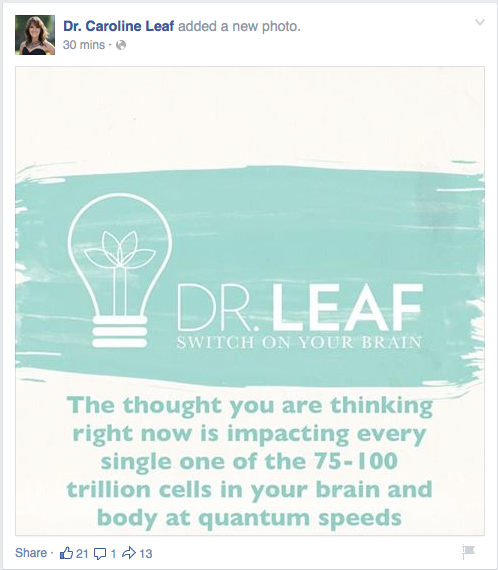
Screen Shot 2014-12-05 at 12.37.55 am

Tonight as I was flicking through Facebook one last time, a post caught my eye. It read,

“The thought you are thinking right now is impacting every single one of the 75-100 trillion cells in your brain and body at quantum speeds”

Dr Leafs social media gem gave me an eerie sense of deja vu. It was only the end of October when she posted the same factoid on social media. Today’s version has been tweaked slightly, although in all fairness, I can’t describe it as an upgrade.

Dr Caroline Leaf is a communication pathologist and self-titled cognitive neuroscientist. On the 23rd of October 2014, she posted this on her social media stream, “Every thought you think impacts every one of the 75-100 trillion cells in your body at quantum speeds!”

On comparing the pair, Dr Leaf has added “brain” into the number of cells under the influence, and then massaged the opening slightly. I already had significant concern about the scientific validity of the previous meme in October. That hasn’t changed. Rather than improving the accuracy of her meme, Dr Leaf’s changes have left it missing the mark.

The fundamental fallacy that thoughts are the main controlling influence on our brain is still there. Thought is simply a conscious projection of one part of the overall function of our brain. Our brains function perfectly well without thought. Thought, on the other hand, doesn’t exist without the brain. Our brain cells influence our thoughts, not the other way around.

The myth of “quantum speeds” is still there. Our neurones interact with each other via electrochemical mechanisms. Like all other macroscopic objects, our brains follow the laws of classical physics. It’s not that quantum physics doesn’t apply to our brains, because quantum mechanics applies to all particles, but if you think you can explain macroscopic behaviour using quantum physics, then you should also try and explain Schrodingers Cat (see also chapter 13 of my book [1] for a longer discussion on quantum physics). Dr Leaf is particularly brave to make such bold statements about quantum physics when even quantum physicists find it mysterious.

What made me slightly embarrassed for Dr Leaf is the new part of her statement. In my blog on Dr Leaf’s previous attempt at this meme, I pointed out that Dr Leaf’s estimate of the number of cells in our body was more than three times that of the estimate of scientists at the Smithsonian (http://www.smithsonianmag.com/smart-news/there-are-372-trillion-cells-in-your-body-4941473/?no-ist). The fact that Dr Leaf so badly estimated, when all she needed to do was a one line Google search, suggested that she just made the number up. Failing to cite her source eroded at her credibility as a scientist.

Today, Dr Leaf still claims that there are 75-100 trillion cells in the brain and the body. The Smithsonian still hasn’t changed its estimate. Dr Leaf still hasn’t cited her source, and has ignored a world-renowned scientific institution. Perhaps Dr Leaf believes she knows more than the scientists at the Smithsonian? Perhaps she has a better reference? We’ll never know unless she cites it.

Taken as a whole, her meme is no closer to the truth than it was six weeks ago. Some may ask if it really matters. “Who cares if we have 37.2 trillion cells or 100 trillion cells or even 100 billion trillion”. “So what if our thoughts influence us or not.” If this was just a matter of a pedantic argument between some scientists over a coffee one morning,then I’d agree, it wouldn’t be so important. But Dr Leaf claims to be an expert, and more than 100,000 people read her memes on Facebook and many more on Twitter, Instagram, and the various other forms of social media she is connected to. Nearly every one of those people take Dr Leaf at her word. Ultimately the issue is trust.

If Dr Leaf can misreport such a simple, easily sourced fact, and not just once but twice now, then what does that mean for her other factoids and memes that she regularly posts on social media? If Dr Leaf incorrectly says that every thought we think impacts every cell in our body, then hundreds of thousands of people are wasting their mental and physical energy on trying to control their thoughts when it makes no real difference, and if anything might make their mental health worse [2, 3].

This is more than just a pedantic discussion over a trivial fact.  These memes matter to people, and can potentially influence the health and wellbeing of many thousands of lives.

Peter Parker, quoting Voltaire, said, “With great power comes great responsibility.”  Just because Spiderman said it doesn’t diminish the profundity of that statement.  This law of great power applies to Dr Leaf as much as it does to Spiderman.  I hope and pray that she gives this law of great power the consideration it deserves.

References

  1. Pitt, C.E., Hold That Thought: Reappraising the work of Dr Caroline Leaf, 2014 Pitt Medical Trust, Brisbane, Australia, URL http://www.smashwords.com/books/view/466848
  2. Garland, E.L., et al., Thought suppression, impaired regulation of urges, and Addiction-Stroop predict affect-modulated cue-reactivity among alcohol dependent adults. Biol Psychol, 2012. 89(1): 87-93 doi: 10.1016/j.biopsycho.2011.09.010
  3. Kavanagh, D.J., et al., Tests of the elaborated intrusion theory of craving and desire: Features of alcohol craving during treatment for an alcohol disorder. Br J Clin Psychol, 2009. 48(Pt 3): 241-54 doi: 10.1348/014466508X387071

Don’t stress about stress – Part 3: Coping

In our last two blogs, we’ve been looking at stress, and why stress is usually more helpful than harmful.

It’s not that stress can never be harmful. Stress can be a trigger to some illnesses (although not as many as the popular media often portrays). What is it that makes the difference between helpful and harmful? What is it that causes one person to surf the tsunami of sewerage that often confronts us in life, while another person sinks?

The answer lies in resilience.

WHAT IS RESILIENCE?

Resilience is the term given to the individual’s capacity to cope.

Researchers in the field of psychiatry often use the term resilience, which “is the capacity and dynamic process of adaptively overcoming stress and adversity while maintaining normal psychological and physical functioning” [1] although psychologists and social science researchers would use the term “coping”, which is defined by Compas et al as, “conscious and volitional efforts to regulate emotion, cognition, behavior, physiology, and the environment in response to stressful events or circumstances.” [2] Skinner and Zimmer-Gembeck define coping as, “action regulation under stress.” [3]

Considering the definitions used, the terms are essentially interchangeable. The other observation to be made here is that coping/resilience is an active process. It’s not something that happens despite of us – we actively cope with stress. In the face of a situation involving emotional arousal (danger or stress), we take steps to deal with our inner and outer environments (the physiological processes of our body, as well as the environment around us). Sometimes these steps are conscious and/or under our control. But theorists also consider automatic, unconscious, and involuntary responses to also be part of the coping spectrum [4].

WHAT CONTRIBUTES TO RESILIENCE?

Coping Strategies

What makes up those actions? What influences the action steps?

Psychologists have described hundreds of individual methods of coping through recent research, although there have been efforts to consolidate the plethora of individual coping strategies into “family” clusters, based on function. For example, a primary tier is to “Coordinate actions and contingencies in the environment” which involves “finding additional contingencies” which on the third level involves “reading, observation, and asking others.” [3] Table 1 in the paper by Skinner and Zimmer-Gembeck [3] summarize the many ways of coping and how they can be grouped together into families, and their corresponding adaptive process.

Personality factors

Coping strategies follow along the lines of personality type [5], as well as the stage of development in children [3]. Personality types such as Neuroticism and Openness have been well studied, with Neuroticism associated with maladaptive coping strategies, and Openness correlated with adaptive coping (in marital relationships [6] and in public speaking tasks [5]).

Further research has shown how personality significantly influences coping, with the severity of the stress, and the age and culture of a person influencing the strategy and strength of the coping response [4]. Of course, personality traits like neuroticism sound bad, but they confer their own strengths. For example, negative affect has protective benefits by enhancing the detection of deception [7].

Biological factors

The shared connection that personality types and coping responses have is in their shared genetics, with personality and coping styles influenced by common genes [8]. This makes perfect sense as it has been shown that changes in individual genes effect the ability of the brain to associate the correct value to rewards [9], which then influences both mood [10], and learning [11]. Even though environmental variables are important in determining personality and learning aspects of coping with stress, the brains underlying capacity to process the incoming signals correctly will significantly influence the direction and outcome of the learning process, which includes learning which coping strategies work best for each individual.

On a deeper level, there are several biological processes that make up the features of resilience. Animal studies on resilience, as a whole, have shown that resilience “is mediated not only by the absence of key molecular abnormalities that occur in susceptible animals to impair their coping ability, but also by the presence of distinct molecular adaptations that occur specifically in resilient individuals to help promote normal behavioral function.” [12] That is, resilient individuals have the full complement of critical components in the resilience pathway, and have some extra tools too.

Human studies thus far have shown strong links to genetic changes that affect the proteins in the stress system. Epigenetic mechanisms are involved, and the role of the environment is also significant, especially uncontrollable early childhood trauma. Wu et al list the current studies of genetic changes that effect resilience in humans [1: Table 1]. The proteins involved are responsible for the growth of new nerve pathways (BDNF), and for their function, especially within the stress system (CRHR1, FKBP5) and in control of mood and reward systems (COMT, DAT1, DRD2/4, 5-HTTLPR, the HTR group).

Wu et al [1] also summarised the currently known facts about epigenetic factors in resilience. Interestingly, they noted an animal study in which chronic stressors increased an epigenetic marker called histone acetylation in the hippocampus in mice, which enhanced the protective effects of the stress (epigenetics will be the subject of a future blog)

Resilience on a personal level

So coping and resilience are known protective factors for stress, and are more commonly deployed than most people realize. Despite all of the publicity that stress has generated, human beings remain remarkably unscathed. It’s estimated that, “in the general population, between 50 and 60% experience a severe trauma, yet the prevalence of illness is estimated to be only 7.8%.” [12] (Note: By ‘illness’, the authors were referring to Post Traumatic Stress Disorder, not all of human sickness).

But when it comes to recommending different coping strategies on an individual level, it is a much harder thing to do. What is adaptive in some situations and for some people is maladaptive in other situations and for other people.

For example, in animal studies, “stressed females tend to perform better than males on non-aversive cognitive or memory tasks … Conversely, in tests of acute stress or aversive conditioning, stress enhances learning in males and impairs it in females … the literature suggests that in cognitive domains females cope better with chronic forms of stress, whereas males tend to cope better with acute stress.” [12] So animal studies confirm a difference in the biological stress response between men and women. If these studies in animals can be extended to humans, it may explain the tendency for men to engage in “fight-or-fight” responses to stress where women usually move to “tend-and-befriend” mode [13].

Human studies on coping also demonstrate that what is good for one is not necessarily good for another. Connor-Smith and Flachsbart confirm that, “In particular, daily report and laboratory studies suggest that individuals high in sensitivity to threat may either benefit from disengagement or be harmed by engagement in the short term, with the opposite pattern appearing for individuals low in threat sensitivity.” [4]

So in other words, just because engaging may be a positive method of coping does not mean that it should be recommended to everyone. Some people will have more harm from trying to engage. Care should be taken when giving people advice about how to manage their stress. Ill-informed instructions can actually make things worse.

SUMMARY

It’s well established that stress can have negative impacts on your physical and mental health. But contrary to the popular view, stress is not always bad. As a number of authors point out, most people go through significant stress at some point in their lives, but only a fraction succumb to that stress.

The difference is the factors that make up resilience. Where we are along the stress spectrum (that is, whether you are wired to be more stressed, or more resistant to stress) depends on our genetic predisposition, which determines the physiology of our stress system and our personality, and the ways we learn to cope.

How we cope best depends on our individual traits and the situation. There is no one-size-fits-all. Pushing a person into a form of coping that’s not suitable can actually cause a lot of harm.

Remember, we normally find what coping strategies work for us automatically as our resilience is mostly innate, and we all go through severe stress at some point or another in our lives, but only a small fraction of us will succumb to that stress.

In the last blog in the series, we’ll have a brief look at what happens when stress overwhelms us … when stress is breaking bad.

References

  1. Wu, G., et al., Understanding resilience. Front Behav Neurosci, 2013. 7: 10 doi: 10.3389/fnbeh.2013.00010
  2. Compas, B.E., et al., Coping with stress during childhood and adolescence: problems, progress, and potential in theory and research. Psychol Bull, 2001. 127(1): 87-127 http://www.ncbi.nlm.nih.gov/pubmed/11271757
  3. Skinner, E.A. and Zimmer-Gembeck, M.J., The development of coping. Annu Rev Psychol, 2007. 58: 119-44 doi: 10.1146/annurev.psych.58.110405.085705
  4. Connor-Smith, J.K. and Flachsbart, C., Relations between personality and coping: a meta-analysis. Journal of personality and social psychology, 2007. 93(6): 1080
  5. Penley, J.A. and Tomaka, J., Associations among the Big Five, emotional responses, and coping with acute stress. Personality and individual differences, 2002. 32(7): 1215-28
  6. Bouchard, G., Cognitive appraisals, neuroticism, and openness as correlates of coping strategies: An integrative model of adptation to marital difficulties. Canadian Journal of Behavioural Science/Revue canadienne des sciences du comportement, 2003. 35(1): 1
  7. Forgas, J.P. and East, R., On being happy and gullible: Mood effects on skepticism and the detection of deception. Journal of Experimental Social Psychology, 2008. 44: 1362-7 http://bit.ly/Jm66a7
  8. Kato, K. and Pedersen, N.L., Personality and coping: A study of twins reared apart and twins reared together. Behavior Genetics, 2005. 35(2): 147-58 http://link.springer.com/article/10.1007%2Fs10519-004-1015-8
  9. Dreher, J.-C., et al., Variation in dopamine genes influences responsivity of the human reward system. Proceedings of the National Academy of Sciences, 2009. 106(2): 617-22
  10. Felten, A., et al., Genetically determined dopamine availability predicts disposition for depression. Brain Behav, 2011. 1(2): 109-18 doi: 10.1002/brb3.20
  11. Ullsperger, M., Genetic association studies of performance monitoring and learning from feedback: the role of dopamine and serotonin. Neuroscience & Biobehavioral Reviews, 2010. 34(5): 649-59
  12. Russo, S.J., et al., Neurobiology of resilience. Nature neuroscience, 2012. 15(11): 1475-84
  13. Verma, R., et al., Gender differences in stress response: Role of developmental and biological determinants. Ind Psychiatry J, 2011. 20(1): 4-10 doi: 10.4103/0972-6748.98407

Don’t stress about stress, part 2

ThatWhichDoesNotKillUs

In the last blog post, we looked at some of the different ways of looking at stress outside of the medical field – the stress on a guitar string, the power band of the car engine, and the action of gravity on our bodies. In this post, I want to expand on those metaphors, using them to help us understand how we can respond to stress, and why stress isn’t our enemy, but it actually brings out our best if managed in the right way.

One of the reasons why gravity gives you strong muscles and bones, and zero gravity gives you weak muscles and bones, is because of resistance.

Movement involves work. We do “work” everyday in simple everyday activities, because our muscles and bones have to apply a certain amount of force in order to overcome gravity. Our muscles adapt by growing the muscle fibres to provide that force, and bones remodel themselves to provide the maximum resistance to the loads that gravity and the muscles put through them. We’re not aware of this day-to-day because we never experience prolonged changes in our gravitational fields.

But when we need to do more work than our muscles are accustomed to, our muscle fibres increase in strength, first as the nerve networks that supply the muscles become more efficient, after about two weeks of ongoing training, the fibres themselves increase in size [1, 2]. The growth in muscle fibres is caused by three related factors: mechanical tension, muscle damage and metabolic stress [2]. Mechanical tension involves “force generation and stretch”. In other words, the muscle fibres are stretched just beyond their usual capacity, and they actively fight against the resistance. This damages the weaker muscle fibres, which are repaired. The remaining muscle fibres are forced to adapt by growing larger because of the stimulation of growth factors [2].

One of my favorite “Demotivator” posters says, “That which does not kill me postpones the inevitable” [3]. Of course, the phrase that they’ve parodied is, “That which does not kill us makes us stronger.” Why is there truth to that idiom? Adversity occurs when life circumstances come against us. In other words, adversity resists us. In the arm wrestle between adversity and overcoming, work is involved. We have to fight back.

In a similar way, we grow when adversity pushes us just beyond what we have done before, stretching us. We may sustain some damage in the process, but that helps to reduce our weaknesses, and forces us into growth as we heal. When we push back against adversity, the “cells” of our character grow.

Of course, we all know examples where muscles fail under intense or prolonged loads. I vividly remember the pictures of the UK’s Paula Radcliffe, succumbing to the grueling hills and scorching Athens heat with only four miles left in the 2004 Olympic Marathon. Muscle failure from excessive stretch or excessive endurance parallels the allostatic load response, which is what people commonly referred to as ‘stress’.

Scientific evidence that stress is positive

There have been recent studies in animals that demonstrate that stress is physically as well as mentally enhancing.

Neurogenesis is the process of new nerve cell formation. Studies of rodents placed under intermittent predictable stressors showed an increase in neurogenesis within the hippocampus, which is the part of the brain related to learning and memory. Along with this enhancement of neurogenesis, the function of the hippocampus increased, specifically hippocampal-dependent memory, with a reduction in depression and anxiety-like behaviours.

As Petrik et al noted in their review, “Contrary to stress always being ‘bad’, it has long been appreciated that stress has an important biological role, and recent research supports that some amount of stress at the right time is actually useful for learning and memory.” [4]

Lessons from stress

So what can we learn from stress? How do we use the stress that we are exposed to every day to make us grow strong and durable?

Firstly, like the guitar string, we need to learn when we are in tune, at the peak of our productivity. Or like the car engine, what it feels like to be in the power band. When we know where our sweet spot is, we can operate within it, achieving our best in life without doing ourselves harm. This is the first point that we need to identify on our own personal stress/productivity curve. This is the point of maximum productivity.

The other life principle to be gained from the car engine analogy is that not all of us are high performance engines. I would love to think that I’m a F1 racing engine – highly tuned, supreme power – but I recognise my limitations. I would even settle for a 5-litre V8, but I know that I’m probably more like a well-tuned V6. We are what we are. Sometimes we apply the most stress to ourselves when we try to drive in the power band of someone else’s engine. We need to accept who we are.

It seems logical that if too much stress is bad for us, then having little or no stress is good for us. But like the new guitar string, minimal stress makes us unproductive. Like zero gravity on the body, little or no stress makes us weak.

And we need to understand that a bit more stress is ok. It’s inevitable that we are going to be stressed beyond what we usually cope with at times. But without that challenge, there would be no growth. Challenges usually hurt. You can’t have growth without pain. In the muscle analogy, at the stretch at which peak growth occurs, muscle fibres tear and the lactic acid build up in the remaining cells can be very uncomfortable. The key is learning how far we can push ourselves before we start to falter and fail. This is the second point we need to discover on our personal stress/productivity curve. This is the point of maximum growth.

Once we understand our own individual points of maximum productivity and growth, we can use them as guides to our personal growth and achievement. Actually, I should specify that these are our starting points, since as we face challenges and experience growth, the points will change slightly. We can remap those points and continue in our pattern of growth and development.

Pushing ourselves into just enough stress to achieve growth, then pulling back to rest and restore, is a pattern of growth that is seen in many facets of the natural world and the human body. Body builders and athletes use this method all the time in their training. They push themselves with more repetitions and heavier weights, or longer or faster runs, then they pull back to consolidate their gains. During our adolescence, our bodies naturally go through growth spurts – periods of rapid growth followed by a plateau, before the next burst of growth hormone hits us again. Even tree rings demonstrate that growth and consolidation occur all the way through the natural world.

This is the Stressed-Rest cycle. The studies in animals on neurogenesis strengthen the theory, because it was the animals that experienced bursts of stress that showed enhanced neurogenesis, memory and reduced depression/anxiety behaviours.

If you want maximum personal growth, constant stress does not help. There has to be times of rest. Some people think that rest time is wasted time, reducing productivity. But as explained, without rest time, productivity rapidly falls away. Without rest, stress goes bad, leading to allostatic overload.

So in summary, excessive stress is bad. But if all stress were bad, then we would all crumple any time that something became difficult. So stress is not a force for evil. Stress is part of our normal everyday lives, and is vital if we are to see ongoing personal growth.

We know from living life that we all don’t fall in a heap when things go wrong. We have in-built ways of coping that help us to absorb troubles and adversities and like emotional photosynthesis – turn them into fuel for growth.

This is the science of resilience, the counterbalance to the forces of stress that help us cope and adapt in a rapidly changing natural and social environment, the Yang to allostatic overload’s Yin. A discussion on the science of stress is not complete without a discussion of resilience, which I’ll discuss in the next blog in this series.

References

  1. Hortobagyi, T. and Maffiuletti, N.A., Neural adaptations to electrical stimulation strength training. Eur J Appl Physiol, 2011. 111(10): 2439-49 doi: 10.1007/s00421-011-2012-2
  2. Schoenfeld, B.J., The mechanisms of muscle hypertrophy and their application to resistance training. J Strength Cond Res, 2010. 24(10): 2857-72 doi: 10.1519/JSC.0b013e3181e840f3
  3. Adversity. Demotivators [cited July 2013]; Available from: http://www.despair.com/adversity.html.
  4. Petrik, D., et al., The neurogenesis hypothesis of affective and anxiety disorders: are we mistaking the scaffolding for the building? Neuropharmacology, 2012. 62(1): 21-34 doi: 10.1016/j.neuropharm.2011.09.003

Don’t stress about stress – Part 1

Stress gets a bad rap. Everywhere you look, stress seems to be getting the blame. Though as Richard Shweder wrote in the New York Times, “Imprecise and evasive language may be a disaster for science but it is a boon in everyday life. ‘I am stressed out’ is non-accusatory, apolitical and detached. It is a good way to keep the peace and, at the same time, a low-cost way to complain.” [1]

Selye said that, “Everybody knows what stress is, but no one really knows.” [2] Hans Selye is considered the father of modern stress research. He was one of the first scientists to conceptualise and measure this ethereal force.

As with some of the most important discoveries in the history of science, Selye came upon the discovery of what he termed the “alarm reaction” incidentally when he was injecting rats with impure ovarian extract, and noted that they became sick. He looked further at the physical changes in the rats and noted an unusual cluster of changes to their adrenal glands, thymus, spleen and gut [3]. He was able to reproduce the same responses by exposing the rats to cold temperatures, surgical injury, spinal shock, excessive muscular exercise, or intoxications with sublethal doses of drugs such as adrenaline, morphine or formaldehyde [4]. After years of research, he confirmed that ongoing exposure to the same physical conditions or drugs would follow the same three-stage process of initial physical changes, recovery and adaptation, then eventually exhaustion (and death). He called this model the “General Adaptation Syndrome.” [4]

The General Adaptation model was groundbreaking, and the sheer volume of work done by Selye brought his theories to the forefront of the scientific community. With time, the theory slowly descended from its place of adulation as other evidence came to light [5], but it has remained foundational, and Selye is still revered as the father of modern stress research.

The term stress “generally refers to experiences that cause feelings of anxiety and frustration because they push us beyond our ability to successfully cope.” [6] Scientifically, stress has been difficult to define. Different researchers often use different definitions of stress depending on what they’re studying or what field of psychology or science they belong to [7].

I wanted to look at stress from a different perspective. In the next series of posts, I want to look at the basic concepts of stress and its functions in nature. I will spend some time looking at different ways of conceptualising stress, and look at how they offer is life lessons on how to approach our stress. I’ll then have a look at what it is that helps us cope with stress.

A broad concept of stress

To gain a better understanding of stress, it’s useful to step away from the medical concept of stress, and think about what the term means in other fields.

When an engineer thinks about stress, it’s usually in relation to a physical force on a material object. My son is a huge Mythbusters fan. He was watching an episode the other day where the Mythbusters were testing the myth of Pykrete, a material that was nothing but wood shavings and ice. They were testing to see whether it was more durable than ice alone, whether it was bulletproof, and whether it could be used to build a boat! [8] In order to test out these crazy claims, they made some in their workshop and compared it with normal ice. How did they test it? By stressing it – placing weights on the end of the block of the ice/pykrete until it broke. (In the end, pykrete was ten times stronger than ice, was bulletproof, and they made a fully operational motor-boat from it!)

So the mechanical definition of stress is, “pressure or tension exerted on a material object.” [9] There are a few illustrations of mechanical stress, in our bodies and in everyday life, that are good metaphors for stress in our lives.

The Classical Stress/Productivity Curve

I confess I am NOT a musician. I’ve never learnt to read music or play an instrument. But I do know that when you first put a new string on the guitar, it’s unstretched – there is literally no force on it at all. If all you did was tied the two ends of the string to the tone peg and the tuning peg, the string would remain limp and lifeless. It wouldn’t be able to do anything useful. It certainly wouldn’t play a note.

When the tuning peg is twisted a few times, there is some tightness in the wire. The string is now under tension (i.e. stress). It is now able to play a note of some form, so it can do some work and fulfill some of the function of a guitar string. But the pitch isn’t good enough – the note is out of tune.

With a small adjustment, the string reaches its optimal tension and can play the correct note! This is the point where the string is fulfilling its designed purpose. Optimal stress equals optimal function.

With further tightening of the string, the perfect pitch is lost, but the string can still produce a sound of some form. With more tension, the string can still make a noise, but it sounds awful, and the fibres inside the cord are starting to tear. If the string were wound further and further, it would eventually break.

If this ratio of the tension of the string versus the usefulness of the string were to be plotted as a graph, it would look like an upside down “U”. This is the classic stress/productivity curve.

StressProductivityCurve_Final

The Exponential Stress/Productivity Curve

The second metaphor that I think illustrates a different concept of the stress/productivity relationship is a car.

As well not being a musician, I am also NOT a mechanic! I know the important things like where the petrol goes, and how to drive them, but otherwise cars are very mysterious and powerful devices, their mystery is only exceeded by their power.

What I do know is that the engine is very much like the guitar string. As more petrol is fed into the engine, the engine gets more powerful. Soon, the engine finds its “power band”, a zone of maximum torque that can be achieved at moderate revolutions. As the engine is given more gas, the power output declines from the middle of the power band. If the engine was maxed out then the amount of functional power coming out is reduced.

This would plot as a similar graph to the U-curve of the stress/productivity curve. But cars not only have engines, but also a gearbox. The gears allow for multiplication of the work done (the productivity) for the same stress on the engine.

G-Force!

As a child, I didn’t dream of becoming an astronaut, but I was interested in space. The beauty of our night sky is as stunning as any forest, river or mountain. I would read of the astronauts in rockets and in space stations, floating around in zero gravity, swimming through the “air”. That sounded like a lot of fun.

But zero gravity isn’t particularly good for you. Some early astronauts had to be carried off their landing craft on stretchers because the effect of zero gravity would render these men weak and atrophied. They boarded the spacecraft at the peak of their physical strength and fitness, but after only a few weeks without gravity, their bodies resembled that of the elderly (although without the wrinkles) [10].

It’s a general principle of the human body that any tissue that isn’t needed shrinks in size – a process called atrophy. In zero gravity, the body doesn’t need as much muscle, so the muscles shrink. The body doesn’t need as much bone strength, so the bones weaken. There is no gravity to pull their blood away from their head, so the blood volume decreases. Because there is less muscle to pump blood to, and less blood to pump, the heart doesn’t work as hard, so the heart muscle atrophies. The net effect of zero gravity is to make you physically weak [10].

On the other hand, too much gravity is not great either. Animals can adapt to small amounts of hypergravity [11]. But large amounts aren’t so good. During astronaut training, NASA subjects the rookie spacemen to rigorous tests including placing them in a large centrifuge and spinning it very fast. The result is an increase in the gravitational forces applied to their bodies. The increased gravity makes everything in the body heavier and their blood is pulled towards the legs and away from the brain, which leads to what is known as G-LOC (Gravity-induced Loss Of Consciousness). In other words, the heart can’t fight the increased force of gravity and the brain loses its blood supply, which makes you pass out. Josh McHugh did an entertaining piece on his experience with G-LOC and the centrifuge in Wired (2003) [12].

In this sense, gravity is to us physically like stress is to us mentally. Without gravity, our physical bodies turn to mush as we slowly weaken from the inside. Too much gravity, and our physical bodies are slowly squashed by the invisible weight of the extra G’s. Our bodies work best at 1G.

In the next post in this series, I’ll look at how these different models of stress apply to our everyday.

References

  1. Shweder, R.A., America’s Latest Export: A Stressed-Out World. The New York Times, New York, 26 January 1997 http://www.nytimes.com/1997/01/26/weekinreview/america-s-latest-export-a-stressed-out-world.html
  2. What Is Stress. [cited 2013, July]; Available from: http://www.stress.org/what-is-stress/.
  3. Half a century of stress research: a tribute to Hans Selye by his students and associates. Experientia, 1985. 41(5): 559-78 http://www.ncbi.nlm.nih.gov/pubmed/3888652
  4. Selye, H., A syndrome produced by diverse nocuous agents. 1936. J Neuropsychiatry Clin Neurosci, 1998. 10(2): 230-1 http://www.ncbi.nlm.nih.gov/pubmed/9722327
  5. Fink, G., Encyclopedia of stress. 1st ed. 2000, Academic Press, San Diego:
  6. McEwen, B.S., Protective and damaging effects of stress mediators: central role of the brain. Dialogues Clin Neurosci, 2006. 8(4): 367-81 http://www.ncbi.nlm.nih.gov/pubmed/17290796
  7. Hackney, A.C., Stress and the neuroendocrine system: the role of exercise as a stressor and modifier of stress. Expert Rev Endocrinol Metab, 2006. 1(6): 783-92 doi: 10.1586/17446651.1.6.783
  8. Beyond Entertainment / Discovery Channel, The Alaska Special 2 (Season 7, Episode 2), Mythbusters: 2009 Discovery Channel, 44min. http://www.imdb.com/title/tt1427433/
  9. Oxford Dictionary of English – 3rd Edition, 2010, Oxford University Press: Oxford, UK.
  10. Gravity Hurts (So Good). NASA Science | Science News 2001 [cited July 2013]; Available from: http://science1.nasa.gov/science-news/science-at-nasa/2001/ast02aug_1/.
  11. van Loon, J.J., Hypergravity studies in the Netherlands. J Gravit Physiol, 2001. 8(1): P139-42 http://www.ncbi.nlm.nih.gov/pubmed/12650205
  12. McHugh, J., Surviving 7G. Wired, 2003. November(11),