Dr Caroline Leaf and the Myth of the Blameless Brain

Screen Shot 2014-06-06 at 4.10.33 pm

When I came back to Facebook this morning, I found this from Dr Leaf on my feed,

“Don’t blame your physical brain for your decisions and actions. You control your brain!”

Dr Caroline Leaf is a Communication Pathologist and a self-titled Cognitive Neuroscientist. Her post follows her theme of the last couple of weeks, the premise that the mind is the dominant cognitive force, controlling the physical brain, and indeed, all matter. I have written about the Myth of Mind Domination in a previous blog. But Dr Leaf’s latest offering here deserves special attention.

Lets think about her statement in more detail:

“Don’t blame your physical brain for your decisions and actions.”

What Dr Leaf is really saying is that the physical brain has no role in your choices or behaviour whatsoever, because if your physical brain had a role in the decisions and actions you make, it would also carry some blame for your poor decisions and actions.

“You control your brain.”

The question to ask here is, “Which part of ‘you’ controls your brain?” Her answer would be, “Your mind”, although she never says where the mind is. Certainly not in the physical brain or even in our physical body, since “Our mind is designed to control the body, of which the brain is a part, not the other way around.” [1: p33].

So an ethereal, disembodied force is in full control of our physical body, such that our brain has no role in the decisions we make or actions we take. Even at this stage of analysis, Dr Leaf’s statement is ludicrous. But wait, there’s more.

Dr Leaf’s statement puts her at odds with real Cognitive Neuroscientists. Professor Patrick Haggard is the Deputy Director of the Institute of Cognitive Neuroscience at the University College London. He has authored or co-authored over 350 peer-reviewed articles on the neuroscience of making choices. He writes, “Modern neuroscience rejects the traditional dualist view of volition as a causal chain from the conscious mind or ‘soul’ to the brain and body. Rather, volition involves brain networks making a series of complex, open decisions between alternative actions.” [2] Strike one for Dr Leaf.

Dr Leaf’s statement puts her at odds with herself. Two weeks ago when misinterpreting James 1:21, Dr Leaf wrote, “How you react to events and circumstances of your life is based upon your perceptions.” Perception is classically defined in neurobiology as conscious sensory experience [3: p8] although the work of cognitive neuroscientists has shown that perception can also be non-conscious [4, 5]. Either way, perception is based entirely on processing within the brain [3: p6-11]. So one week, Dr Leaf is saying that our brain determines how we behave, and then ten days later, she is telling us that our brain does not determine how we behave. Which is it? Strike two for Dr Leaf.

Finally, Dr Leaf’s statement is borderline insulting to the sufferers of congenital or acquired brain disorders. Would you tell a stroke patient that they shouldn’t blame their physical brain for their immobility, because they’re mind is in control of their brain? What about a child with Cerebral Palsy? Would you tell a mother of a child with Downs Syndrome that their child is having recurrent seizures because they aren’t using their mind properly to control their brain? Dr Leaf is doing exactly that. I find it incredible that she could be so insensitive, given her background as a speech pathologist working with patients with Acquired Brain Injury.

I imagine that her defence would be something along the lines of, “What I meant was, ‘don’t blame your normal physical brain for your decisions and actions. You control your functional brain.’” That sort of explanation would be less insulting to people with strokes or brain injuries, but it then undermines her whole premise. The hierarchy of the brain and the mind doesn’t change just because a part of the brain is damaged.

Besides, changes to brain function at any level can change the way a person thinks and behaves. The classic example was Phineas Gage, who in 1848, accidentally blasted an iron rod through his skull, damaging his left frontal lobe. History records that Gage’s well-mannered, pleasant demeanour changed suddenly into a fitful, irreverent, obstinate and capricious man whose workmates could no longer stand him [6]. Medical science has documented numerous cases of damage to the right ventromedial prefrontal cortex causing acquired sociopathy [7]. How can the mind be in control of the brain when an injury to the brain causes a sudden change in thought pattern and behaviour? Clearly one CAN blame the physical brain for one’s decisions and actions. Strike three. You’re out.

Dr Leaf is welcome to comment here. Perhaps she meant something completely different by her post, although there’s only so many ways that such a statement can be interpreted.

Ultimately, Dr Leaf’s love of posting pithy memes of dubious quality is now getting embarrassing. Being so far behind the knowledge of a subject in which she claims expertise is ignominious. Undermining her own premise and contradicting herself is just plain embarrassing. But to be so insensitive to some of the most vulnerable is poor form. I think she’d be well served by re-examining her facts and adjusting her teaching.

References

  1. Leaf, C.M., Switch On Your Brain : The Key to Peak Happiness, Thinking, and Health. 2013, Baker Books, Grand Rapids, Michigan:
  2. Haggard, P., Human volition: towards a neuroscience of will. Nat Rev Neurosci, 2008. 9(12): 934-46 doi: 10.1038/nrn2497
  3. Goldstein, E.B., Sensation and perception. 8th ed. 2010, Wadsworth, Cengage Learning, Belmont, CA:
  4. Kouider, S. and Dehaene, S., Levels of processing during non-conscious perception: a critical review of visual masking. Philos Trans R Soc Lond B Biol Sci, 2007. 362(1481): 857-75 doi: 10.1098/rstb.2007.2093
  5. Tamietto, M. and de Gelder, B., Neural bases of the non-conscious perception of emotional signals. Nat Rev Neurosci, 2010. 11(10): 697-709 doi: 10.1038/nrn2889
  6. Fumagalli, M. and Priori, A., Functional and clinical neuroanatomy of morality. Brain, 2012. 135(Pt 7): 2006-21 doi: 10.1093/brain/awr334
  7. Mendez, M.F., The neurobiology of moral behavior: review and neuropsychiatric implications. CNS Spectr, 2009. 14(11): 608-20 http://www.ncbi.nlm.nih.gov/pubmed/20173686

 

Dr Caroline Leaf and the Brain Changes Meme

Screen Shot 2014-06-06 at 9.09.20 am

I swore on the Bible once.

One of my patients needed my testimony in a court case, and when I went to the lawyer’s offices to supply my statement, before they accepted it as official testimony, they asked me to swear on their Bible.  I’m not sure if the surprise I felt showed on my face.  I wasn’t expecting it, that’s for sure, since the only time I have seen people swear on the Bible was in cheesy American TV courtroom dramas.

It was a simple, but oddly surreal moment.  I placed my hand on the Bible and said, “I solemnly swear that I will tell the truth, the whole truth and nothing but the truth.”

We have heard it said so many times that we become blasé to the importance of those words.  But the truth is only true if it is, ”the whole truth and nothing but the truth”.

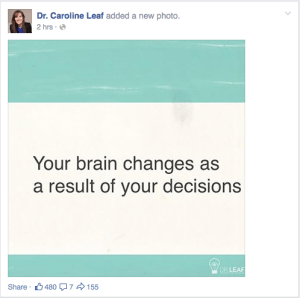
When Dr Leaf published her latest meme this morning, she was telling the truth.  She said via social media,

“Your brain changes as a result of your decisions.”

Dr Caroline Leaf is a Communication Pathologist and self-titled Cognitive Neuroscientist.  The on-going theme of her recent social media offerings is the “Mind over matter” meme: essentially our mind leads and our brain follows.  This was a fundamental argument in her most recent book too (see reference [1], pages 33 and 38).

The main problem for Dr Leaf is that real cognitive neuroscientists disagree, like Haggard,

“Modern neuroscience rejects the traditional dualist view of volition as a causal chain from the conscious mind or ‘soul’ to the brain and body.  Rather, volition involves brain networks making a series of complex, open decisions between alternative actions.” [2]

But didn’t I say in the beginning of this blog that Dr Leaf was telling the truth?  Yes, I did say that.  And she is telling the truth … she’s just not telling the whole truth.

It’s true that our brains change as a result of our decisions.  But the brain changes as a result of hundreds of different inputs and signals.  Our brain is constantly changing – growing new branches and pruning others.  Most of these changes occur subconsciously.  Only the tiniest fraction would be due to our conscious decision-making.  The true limiting factor of our brains ability to change is genetics, specifically the genes that code for the proteins that are integral to the nerve cells ability to grow the branches it needs to make the right connections.

So while it’s not technically untrue, if you take Dr Leaf’s meme at face value, you would get the impression that the mind controls the brain, which was her intention.

In actual fact, our psychology is dependent on our biology, and the brain is in control of the mind, not the other way around.

References

1.         Leaf, C.M., Switch On Your Brain : The Key to Peak Happiness, Thinking, and Health. 2013, Baker Books, Grand Rapids, Michigan:
2.         Haggard, P., Human volition: towards a neuroscience of will. Nat Rev Neurosci, 2008. 9(12): 934-46 doi: 10.1038/nrn2497

Dr Caroline Leaf on James 1:21 – Redux

So, we’ve all heard the saying, “If at first you don’t succeed, try and try again.”  Dr Leaf has certainly done that.

Dr Caroline Leaf is a Communication Pathologist and self-titled Cognitive Neuroscientist.  Not content to completely misinterpret James 1:21 only once, she posted on social media today, “James 1:21.  Our thoughts and perceptions have a direct and overwhelmingly significant effect on the cells of our body.”

If for nothing else, Dr Leaf at least gets points for persistence.  A week and a half ago, Dr Leaf again used James 1:21 to attempt to justify a meme on perception.  I’d love to know what version of the Bible that she’s using, because it seems that in her Bible, James 1:21 can be interpreted any way that one wants.

Lets recap: James 1:21 says,

“Wherefore lay apart all filthiness and superfluity of naughtiness, and receive with meekness the engrafted word, which is able to save your souls.” (KJV)

There are too many big words there for my liking, so I went through an on-line, widely used Greek lexicon, to look at the meanings of the words.  Then I translated them into something more understandable, to make sure that I didn’t miss the bit about perception.

Using the Strong’s dictionary and concordance built in to the Blue Letter Bible site (http://www.blueletterbible.org/Bible.cfm?b=Jas&c=1&v=21&t=KJV#s=1147021) I was able to translate the original Greek into something more manageable.

“Therefore shed all the morally defiling wickedness and excess malice, and, with meekness, embrace the teaching that is implanted by your mentors, which has the power to rescue your eternal soul.”

Wait … where did James talk about perception, and how our cells react to our thoughts?  Reviewing the scripture and its translation the second time around didn’t change anything, because there is nothing in James 1:21 that is in any way remotely connected to perception, thinking and our cells biological functioning.

Scripture is the inspired word of God, and “is useful for teaching, rebuking, correcting and training in righteousness, so that the servant of God may be thoroughly equipped for every good work.” (2 Tim 3:16-17, NIV)  What James is writing about is essential, and Christians need to embrace what he was teaching.

Which is why it is so important for Dr Leaf to interpret scripture correctly.  For the second time in two weeks, Dr Leaf has completely misapplied a scripture to one of her memes.  As if that isn’t concerning enough for a woman than regularly interprets scripture to audiences in the thousands every week, there isn’t any scientific evidence to back up her claim either.  As I have written about before, there is no evidence that the mind controls the brain.  Rather, our psychology is dependant on our biology.  More on this in future posts.  But the onus is on Dr Leaf to provide evidence to back up her claim.  I encourage her to publish specific evidence that she believes justifies her claims that our thoughts alter our cellular biology.

Otherwise, I think another popular phrase would better apply: “Quit while you’re ahead”.

UPDATE (17/6/2014)

Screen Shot 2014-06-17 at 10.45.44 pm

I was reviewing Dr Leaf’s posts tonight, and I came across this response that Dr Leaf posted on the 5th of June.  Clearly I wasn’t the only person who wondered exactly how James 1:21 applied to her meme.

Dr Leaf’s explained: “By ‘implanting the word of God your soul will be saved’ (James 1:21) – so by memorizing God’s Word we build healthy thoughts into our brain that improve the health of our cells.”

I’m sure that Dr Leaf thought she was climbing out of a hole, although I think she’s only dug herself deeper.

Firstly, while I’m not a trained theologian, I can read.  Dr Leaf reinterprets this long-suffering scripture again, “By ‘implanting the word of God your soul will be saved’.”  But that’s not what it says at all.  From the KJV which I originally quoted: ” … receive with meekness the engrafted word, which is able to save your souls.” (Emphasis added)  It’s a subtle but important difference.  My understanding is that salvation comes confession and repentance (Romans 10:9-10, 2 Corinthians 7:10).  The word of God is able to save souls, but as the Parable of the Sower (Luke 8:4-15) shows, it doesn’t always bear fruit.  Satan himself knows the Bible inside out, but he certainly isn’t saved.  Perhaps someone who is theologically trained can confirm the points here.  I’d certainly appreciate it.  But for now, I propose that Dr Leaf has misinterpreted this scripture again.

Dr Leaf goes on to claim that by memorizing scripture, “we build healthy thoughts in our brain that improve the health of our cells.”  Dr Leaf is really grasping at straws here.  The “soul” that James is referring to is psyche in the Greek, translated as “the seat of the feelings, desires, affections, aversions (our heart, soul etc.); the (human) soul in so far as it is constituted that by the right use of the aids offered it by God it can attain its highest end and secure eternal blessedness, the soul regarded as a moral being designed for everlasting life; the soul as an essence which differs from the body and is not dissolved by death (distinguished from other parts of the body)”. (http://www.blueletterbible.org/lang/lexicon/lexicon.cfm?Strongs=G5590&t=KJV)  So the word that James used has nothing to do with the body.

Dr Leaf has to apply her own set of assumptions to the scripture, that a saved soul must be healthy thoughts, and that healthy thoughts leads to healthy cells.  Its a myth that healthy thoughts lead to healthy cells (more on this in a future post).  To suggest that salvation and healthy thoughts are one and the same is also an assumption on Dr Leaf’s part, which I don’t think the scripture supports in any way.

So in short, Dr Leaf’s explanation really hasn’t helped her cause.  Her meme is still scripturally and scientifically baseless.

Dr Caroline Leaf on James 1:21

Screen Shot 2014-05-26 at 10.24.24 pm

What causes you to react to things the way you do? According to Dr Leaf, we react to things because of our perceptions, because James 1:21 says so.

Dr Caroline Leaf is a Communication Pathologist and self-titled Cognitive Neuroscientist. She posted on social media today that,

“James 1:21. How you react to events and circumstances of your life is based upon your perceptions.”

Just like her other social media memes, we’re supposed to smile and nod, and accept that it must be right on face value alone. Remember, “Trust me, I’m a cognitive neuroscientist”.

Ironically, Dr Leaf is on the right track with her meme. Perception is very important to how our brains process incoming information, although it is only one small part in a much larger picture. But that is for a future post.

What made me scratch my head about her post was the scripture reference that she tags onto the meme, as if it gives her factoid some automatic level of credibility. I never knew that James made any reference to reacting to life circumstances, so I looked up the scripture.

James 1:21 says, “Wherefore lay apart all filthiness and superfluity of naughtiness, and receive with meekness the engrafted word, which is able to save your souls.” (KJV)

There are too many big words there for my liking. But I also thought it would be a useful exercise to look at the meanings of the words to translate them into something more understandable, to make sure that I didn’t miss the bit about perception.

Using the Strong’s dictionary and concordance built in to the Blue Letter Bible site (http://www.blueletterbible.org/Bible.cfm?b=Jas&c=1&v=21&t=KJV#s=1147021) I was able to translate the original Greek into something more manageable.

“Therefore shed all the morally defiling wickedness and excess malice, and, with meekness, embrace the teaching that is implanted by your mentors, which has the power to rescue your eternal soul.”

Hmmm … perhaps I mistranslated, but I missed the part where James talked about perception, and how we react to circumstances.

Or more likely, it wasn’t in this scripture at all.

Scripture is the inspired word of God, and “is useful for teaching, rebuking, correcting and training in righteousness, so that the servant of God may be thoroughly equipped for every good work.” (2 Tim 3:16-17, NIV) What James is writing about is essential, and Christians need to embrace what he was teaching.

Unfortunately for Dr Leaf, her imprecise application of scripture doesn’t help anyone. It confuses her readers who look more deeply into either the scripture or the science, and are lost as to why they don’t meet up. Or it damages her reputation as a scientist or a teacher, since it isn’t clear exactly what she is trying to say or how she arrived at her conclusions.

I have not doubt that if Dr Leaf has something to share on social media many people that would like to hear it. But it has to be referenced properly if it is going to carry any weight.

Dr Caroline Leaf and the Myth of Mind Domination

Screen Shot 2014-05-08 at 8.02.30 pm


“You control your brain … your brain does not control you!”

So says Dr Caroline Leaf, Communication Pathologist and self-titled Cognitive Neuroscientist.

You’d hope that Dr Leaf would know. She says on her website that “Since the early 1980‘s she has studied and researched the Mind-Brain connection.” And if you take what she says at face value, it sure sounds right. Of course we’re in control. My brain does what I tell it to do. Except that it actually doesn’t. Our brain has a lot more control over us than we realize.

First of all, our “free” will isn’t actually free at all, but constrained by a number of unseen, subconscious processes that are entirely dependent on our brain. It may seem like we’re in complete control of our choices, but our subconscious brain has already done most of the work for us. Even if we had complete freedom over our choices, our “free” will would still require an intact brain in order to carry out its wishes.

The “control” of our brain is very similar to our “control” when we drive a car. When we say that we’re “controlling” the car, what we actually mean is that we are controlling the speed and direction of the car. But there are thousands of electrical and mechanical actions that take place each second that are vital for the running of the car, and that we have absolutely no direct control over. It just takes one loose nut or faulty fuse to make the car steer wildly out of control, or stop functioning entirely, and then we’re not in control at all.

In the same way, various diseases or lesions in the brain show that brain is really in control. The fact we don’t see all of the underlying processes in a fully functional brain simply provides the illusion of control.

For example, there are a number of lesions of the parietal lobes within the brain that give rise to some unusual but intriguing conditions. One of which is a condition called “Alien Hand Syndrome”. Wegner describes two patients with Alien Hand Syndrome, a lady whose “left hand would tenaciously grope for and grasp any nearby object, pick and pull at her clothes, and even grasp her throat during sleep … She slept with the arm tied to prevent nocturnal misbehavior”, and a man who, “While playing checkers on one occasion, the left hand made a move he did not wish to make, and he corrected the move with the right hand; however, the left hand, to the patient’s frustration, repeated the false move. On other occasions, he turned the pages of the book with one hand while the other tried to close it; he shaved with the right hand while the left one unzipped his jacket” [1]. Alien Hand Syndrome demonstrates that our decision-making and our action sequences are controlled by two separate systems in our brains.

There are other conditions that also show that our brains control us more than we control them. A more common example are the tic disorders, such as simple motor tics (sudden involuntary movements) and complex tic disorders, such as Tourette’s (best known for the involuntary tendencies to utter obscenities). Even more common are parasomnias – a group of disorders in which people perform complex behaviours during their sleep – sleep talking, sleep walking, sleep eating. One of my patients once drove her car while asleep (Honestly, that’s no exaggeration!).

So at best, we only have partial control of our brain. Our brain is driving, our mind just steers it a little, but it doesn’t take much for that veneer of control that we think we possess.

The other way in which we appear to have control over our brain is through free will. Free will has been debated for years on philosophical grounds, but over three decades ago, Libet performed an experiment that demonstrated measurable and predictable brain activity occurring up to a full second before a test subject was consciously aware of the intention to act [2]. More recently, a study by Soon et al showed that predictable brain activity occurred up to eight seconds before a person was aware of their intention to act [3]. As Bonn says, “the gist of these findings is that our feeling of having consciously willed an act is illusory in many ways. It seems that the conscious awareness of intention that we place so much weight upon, that we naively think of as causal, is, in fact, a narrative construction that is formed well after the train of causation has been set in motion.” [4]

The Oracle explained it to Neo, “… you didn’t come here to make the choice. You’ve already made it. You’re here to try to understand why you made it.” (Matrix Reloaded, 2003)

Haggard concludes, “Modern neuroscience rejects the traditional dualist view of volition as a causal chain from the conscious mind or ‘soul’ to the brain and body. Rather, volition involves brain networks making a series of complex, open decisions between alternative actions.” [5]

This does not eliminate our capacity to choose, but frames it in a more realistic fashion. As Bonn points out, “Although we are not consciously aware of what is going on at every stage of the chain of neural events leading to action, there is room for a degree of conscious involvement if only to pull the emergency brake before it is too late. Thus, although it may not be the initial source of motivations and behavioral impulses, the part of the mind that is self-reflective; that can envision the self in causal and narrative contexts, may serve important monitoring and control functions.” [4]

Again, we have less control over our brain than we realize. We feel like we have made a choice, but more often than not, our brain already made the choice for us up to eight seconds beforehand, and the feeling of intention that we have is simply our conscious mind catching up – not making the choice, but finding a reason for why we made the choice.

It’s always nice when people who call themselves neuroscientists tell us what feels intuitively correct. In the cold, hard light of day, actual neuroscientists don’t tell us what’s intuitively correct, but what’s actually correct. It may seem like our mind is in control of our brain, but modern neuroscience confirms that our brain is the dominant force, while our mind just helps to steer a little.

References

  1. Wegner, D.M., Precis of the illusion of conscious will. Behavioral and Brain Sciences, 2004. 27(5): 649-59
  2. Libet, B., et al., Time of conscious intention to act in relation to onset of cerebral activity (readiness-potential). The unconscious initiation of a freely voluntary act. Brain, 1983. 106 (Pt 3): 623-42 http://www.ncbi.nlm.nih.gov/pubmed/6640273
  3. Soon, C.S., et al., Unconscious determinants of free decisions in the human brain. Nat Neurosci, 2008. 11(5): 543-5 doi: 10.1038/nn.2112
  4. Bonn, G.B., Re-conceptualizing free will for the 21st century: acting independently with a limited role for consciousness. Front Psychol, 2013. 4: 920 doi: 10.3389/fpsyg.2013.00920
  5. Haggard, P., Human volition: towards a neuroscience of will. Nat Rev Neurosci, 2008. 9(12): 934-46 doi: 10.1038/nrn2497


Dr Caroline Leaf and the myth of optimism bias

“What are little girls are made of?  Sugar and spice, and all things nice.”

It sounds sweet doesn’t it?  We like to connect with these rosy little memes that warm our cockles and make us feel good about the world and ourselves.  We think of all of the examples in our own experience, which seems to confirm the saying.  We may think of a few examples that don’t quite fit, but they’re just the exception that proves the rule.

It doesn’t seem to matter what the saying or proverb is, we usually just assume it’s true.  Think of some other examples:
“Blondes have more fun.”
“Women can’t read maps.”
“White guys can’t dance.”

In all of these things, we tend to experience what psychologists call confirmation bias (Princeton University, 2014), our own mini-delusion in which we fool ourselves into believing a half-truth.  It looks right on first glance, and we can easily think of a few confirming examples, so without deeper inspection, we assume it must be true.

When Dr Leaf proclaims that,

“Science shows we are wired for love with a natural optimism bias”

the same process kicks in.  But in truth, science doesn’t show anything of the sort.  What science shows is that we learn love and fear, and our genetics influences the way we see the world, our personality.

We are prewired to LEARN to love and fear.  It doesn’t come naturally.  We require exposure to both love and to fear for these emotions to develop.  The Bucharest Early Intervention Project is a study looking at the long-term psychological and physical health of children in Bucharest, one group who remained in an orphanage, and the other, a group of children that were eventually adopted.  Analysis of the cohort of the two groups of children showed that negative affect was the same for both groups.  However positive affect and emotional reactivity was significantly reduced in the institutionalised children (Bos et al., 2011).  This shows that children who lived in an institution all of their lives and given limited emotional stimulation had lower levels of positive affect (ie: love, happiness) compared to a child that was adopted.

The children in the institution did not have high positive affect because they were not shown love.  Those children who were adopted were higher on positive affect because they were shown love by their adopted parents.  Both groups were exposed to distress and fear during their time in the orphanage, so their negative affect was the same across both groups.  Thus, love and fear don’t come naturally.  They need to be learned.

Personality is “the combination of characteristics or qualities that form an individuals distinctive character.” (“Oxford Dictionary of English – 3rd Edition,” 2010) As Professor Greg Henriques wrote in psychology today, “Personality traits are longstanding patterns of thoughts, feelings, and actions which tend to stabilize in adulthood and remain relatively fixed. There are five broad trait domains, one of which is labeled Neuroticism, and it generally corresponds to the sensitivity of the negative affect system, where a person high in Neuroticism is someone who is a worrier, easily upset, often down or irritable, and demonstrates high emotional reactivity to stress.” (Henriques, 2012) Personality is heavily influenced by genetics, with up to 60% of our personality pre-determined by our genes (Vinkhuyzen et al., 2012), expressed through the function of the serotonin and dopamine transporter systems in our brain (Caspi, Hariri, Holmes, Uher, & Moffitt, 2010; Chen et al., 2011; Felten, Montag, Markett, Walter, & Reuter, 2011).

So some people *ARE* natural optimists – their genetic heritage blessed them with a rosy outlook and their early life experiences cemented it in.  These naturally optimistic people, and the people who know them, are the ones who take Dr Leaf’s word as truth because they see it in themselves or their friends.  But the fact that some people are naturally wired for pessimism or a neurotic personality disproves Dr Leaf’s assertion.

Its important that Dr Leaf’s misleading meme is seen for what it is.  If we assume that we’re all pre-wired for love and optimism, then those who are pessimistic must be deficient or deviant, and the fact they can’t change must mean they are incompetent or lazy.  If we know the truth, those who are less optimistic won’t be unnecessarily judged or marginalised.

I should point out that what I’ve said isn’t a free licence to be cranky or sullen all the time.  The natural pessimist still needs to be able to negotiate their way through life, and being a misery-guts makes it hard to get what you need from other people in any business, social or interpersonal relationship.  We have the ability to learn, and the person with a neurotic personality can still learn ways of dealing with people in a positive way.

But if you naturally see the glass half-empty, don’t tell yourself that you’re abnormal, or that you aren’t good enough.  You are who you are.  Accept who you are, because while there are weaknesses inherent to having neurotic personality traits, there are also strengths, such as the enhanced awareness of deception, or protection from gullibility (Forgas & East, 2008).

A good thing to have when searching for the truth.

 References

Bos, K., Zeanah, C. H., Fox, N. A., Drury, S. S., McLaughlin, K. A., & Nelson, C. A. (2011). Psychiatric outcomes in young children with a history of institutionalization. Harv Rev Psychiatry, 19(1), 15-24. doi: 10.3109/10673229.2011.549773

Caspi, A., Hariri, A. R., Holmes, A., Uher, R., & Moffitt, T. E. (2010). Genetic sensitivity to the environment: the case of the serotonin transporter gene and its implications for studying complex diseases and traits. Am J Psychiatry, 167(5), 509-527. doi: 10.1176/appi.ajp.2010.09101452

Chen, C., Chen, C., Moyzis, R., Stern, H., He, Q., Li, H., . . . Dong, Q. (2011). Contributions of dopamine-related genes and environmental factors to highly sensitive personality: a multi-step neuronal system-level approach. PLoS One, 6(7), e21636. doi: 10.1371/journal.pone.0021636

Felten, A., Montag, C., Markett, S., Walter, N. T., & Reuter, M. (2011). Genetically determined dopamine availability predicts disposition for depression. Brain Behav, 1(2), 109-118. doi: 10.1002/brb3.20

Forgas, J. P., & East, R. (2008). On being happy and gullible: Mood effects on skepticism and the detection of deception. Journal of Experimental Social Psychology, 44, 1362-1367.

Henriques, G. (2012). (When) Are You Neurotic?  Retrieved from http://www.psychologytoday.com/blog/theory-knowledge/201211/when-are-you-neurotic

Oxford Dictionary of English – 3rd Edition. (2010)   (3rd edition ed.). Oxford, UK: Oxford University Press.

Princeton University. (2014). Confirmation bias.   Retrieved January 10, 2014, from http://www.princeton.edu/~achaney/tmve/wiki100k/docs/Confirmation_bias.html

Vinkhuyzen, A. A., Pedersen, N. L., Yang, J., Lee, S. H., Magnusson, P. K., Iacono, W. G., . . . Wray, N. R. (2012). Common SNPs explain some of the variation in the personality dimensions of neuroticism and extraversion. Transl Psychiatry, 2, e102. doi: 10.1038/tp.2012.27