Caroline Leaf – Carrie Fisher killed by bipolar meds

screen-shot-2017-01-13-at-6-23-24-pm

No longer content with just wilful ignorance, Dr Caroline Leaf has stooped even further by using the death of a beloved actress as a sick segue against psychiatric medications.

Dr Caroline Leaf is a communication pathologist and self-titled cognitive neuroscientist.  She markets herself as an expert in neuroscience and mental health despite not knowing how genes work (https://cedwardpitt.com/2014/09/27/dr-caroline-leaf-and-the-genetic-fluctuations-falsehood/ and https://cedwardpitt.com/2017/01/07/dr-caroline-leaf-the-christian-churchs-anti-vaxxer/).

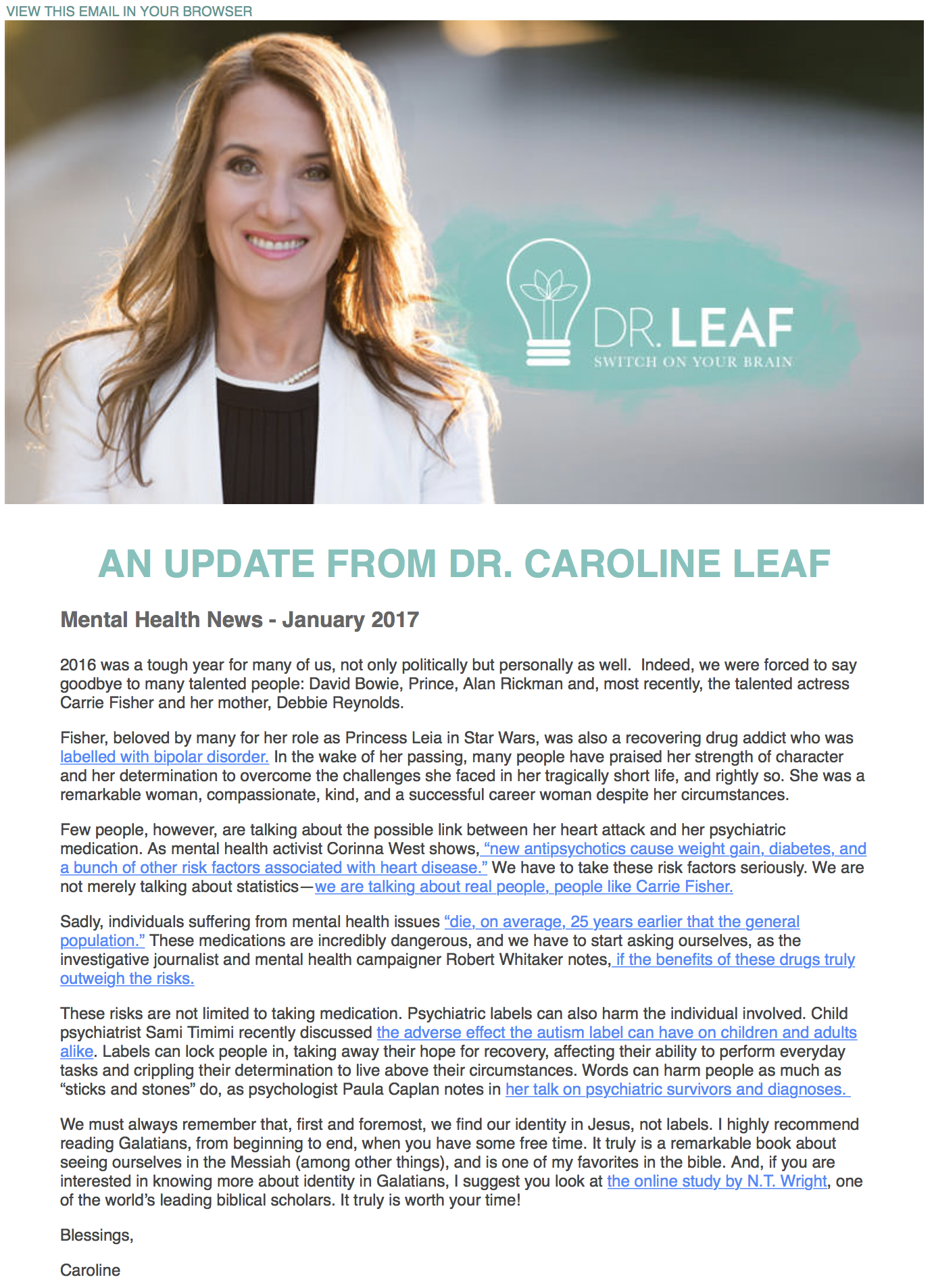
In her latest “Mental Health News – January 2017” e-mail newsletter, Dr Leaf makes some astounding and outlandish statements about mental health.

She starts by claiming that Carrie Fisher’s death was ultimately caused by the psychiatric medications she was taking.

“Few people, however, are talking about the possible link between her heart attack and her psychiatric medication. As mental health activist Corinna West shows, ‘new antipsychotics cause weight gain, diabetes, and a bunch of other risk factors associated with heart disease.’ We have to take these risk factors seriously. We are not merely talking about statistics—we are talking about real people, people like Carrie Fisher.”

Dr Leaf, no one’s talking about the possible link between her heart attack and her psychiatric medication because we respect the Carrie Fisher too much and would rather celebrate her life and achievements, not perform a hypothetical post-mortem motivated by prejudiced speculation.

No one’s talking about the possible link between her heart attack and her psychiatric medication because no one really knows what caused Carrie Fisher’s heart attack.  No one knows if she had any other risk factors for heart attacks, or what medications she was on.  There could be a dozen other reasons why she had a heart attack.  No one else is asking because it’s none of our business.

No one’s talking about the possible link between her heart attack and her psychiatric medication because we know that psychiatric medications do much more good than harm.

No one is talking about the possible link between her heart attack and her psychiatric medication because it’s highly disrespectful to use someone’s death to promote your political or ideological position.  Using Carrie Fisher’s death as a segue to your soapbox about psychiatric medications is like someone using Princess Diana’s death as an opportunity to talk about the dangers of speeding in tunnels.  It’s ungracious, unbecoming, and in poor taste.

What’s even more dishonouring to Carrie Fisher is that Dr Leaf’s claims about psychiatric medications are not accurate.

“Sadly, individuals suffering from mental health issues ‘die, on average, 25 years earlier that the general population.’ These medications are incredibly dangerous, and we have to start asking ourselves, as the investigative journalist and mental health campaigner Robert Whitaker notes, if the benefits of these drugs truly outweigh the risks.”

Notice the giant hole in her argument?  She assumes that the increased risk of death in those with mental illness is the medications they’re on, just like she’s assumed that Carrie Fisher died because she was taking psychiatric medications.

That’s confirmation bias, not science.

Real mental health experts – the ones with training, clinical experience and research acumen – directly contradict Dr Leaf.  Experts like Correll, who say that, “Although antipsychotics have the greatest potential to adversely affect physical health, it is important to note that several large, nationwide studies providing generalizable data have suggested that all-cause mortality is higher in patients with schizophrenia not receiving antipsychotics.” [1]

In other words, the life expectancy of people with schizophrenia is shorter than the rest of the population, but it’s much shorter in schizophrenics not on meds.  Psychiatric medications help people with schizophrenia live longer.

In fact, the use of any anti-psychotic medication for a patient with schizophrenia decreased their risk of dying by nearly 20% [2] whereas the risk of dying for schizophrenics who didn’t take anti-psychotics was nearly ten times that of the healthy population [3].

This is the same for other psychiatric medications as well, “clozapine, antidepressants, and lithium, as well as anti-epileptics, are associated with reduced mortality from suicide.” [1]

Psychiatric drugs aren’t “incredibly dangerous”.  Like any tool, when used in the right way, they can bring radical transformation.  What IS incredibly dangerous is the disingenuous and ill-informed making libellous and inaccurate statements about medications they don’t understand.

Not content to just insult Carrie Fisher’s memory, Dr Leaf went on to claim that psychiatric labels are also as harmful as psychiatric drugs.  “These risks are not limited to taking medication. Psychiatric labels can also harm the individual involved. Child psychiatrist Sami Timimi recently discussed the adverse effect the autism label can have on children and adults alike. Labels can lock people in, taking away their hope for recovery, affecting their ability to perform everyday tasks and crippling their determination to live above their circumstances. Words can harm people as much as “sticks and stones” do, as psychologist Paula Caplan notes in her talk on psychiatric survivors and diagnoses.”

It’s witless to suggest that labels harm people or that they somehow lock people in and take away their hope.  The right label, which doctors call a diagnosis, doesn’t lock people in at all, it does the exact opposite:
* The right diagnosis gives hope – hope that comes from receiving the right treatment and not wasting time, money and energy pursuing the wrong treatment.
* The right diagnosis gives power – it empowers people by giving them the ability to make accurate decisions about what’s best for themselves and their loved ones.
* The right diagnosis gives certainty – in many situations, knowing what the diagnosis is reduces unnecessary anxiety and fear.

Imagine that you had a freckle on your arm, and it started growing suddenly.  You go to the doctor, and the doctor says that the freckle is actually a skin cancer.  Does that label lock you in and take away your hope?  Of course not.  It gives you the certainty of knowing that treatment is needed, and the power to decide if you want that treatment.  And it gives you hope that with the right treatment, you can continue to live a healthy life.

In the same way, a psychiatric diagnosis doesn’t lock people in and remove their hope.  A child who understands that they have autism can stop beating themselves up for being ‘odd’ and instead, they can understand that their different wiring gives them special powers that other kids don’t have.

Psychiatric labels do not harm an individual, it’s the backwards opinions of so-called mental health experts that harm individuals with psychiatric illness.  The stigma of a diagnosis is related to the way in which society treats individuals with that diagnosis, not the diagnosis itself.  Perpetuating the myth that that ‘depression and autism aren’t really diseases’ reduces the acceptance of society for those who suffer from those conditions.  That’s what causes harm.

Dr Leaf should apologise to her followers for showing such disrespect for Carrie Fisher, and to all those who take psychiatric medications.  Carrie Fisher spent her life supporting people with mental illness, trying to break down the stigma of psychiatric illness and treatment.  Her life’s work should be celebrated, not defaced by Dr Leaf and her unscientific opinion.

References

[1]        Correll CU, Detraux J, De Lepeleire J, De Hert M. Effects of antipsychotics, antidepressants and mood stabilizers on risk for physical diseases in people with schizophrenia, depression and bipolar disorder. World psychiatry : official journal of the World Psychiatric Association 2015 Jun;14(2):119-36.
[2]        Tiihonen J, Lonnqvist J, Wahlbeck K, et al. 11-year follow-up of mortality in patients with schizophrenia: a population-based cohort study (FIN11 study). Lancet 2009 Aug 22;374(9690):620-7.
[3]        Torniainen M, Mittendorfer-Rutz E, Tanskanen A, et al. Antipsychotic treatment and mortality in schizophrenia. Schizophrenia bulletin 2015 May;41(3):656-63.
screen-shot-2017-01-12-at-9-05-48-pm

Dr Caroline Leaf – The Christian church’s anti-vaxxer

Well, this is my first post for the new year.  2016 was certainly historic!

In 2016, the Oxford Dictionaries Word of the Year was “post-truth”.  Post-truth describes the concept “in which objective facts are less influential in shaping public opinion than appeals to emotion and personal belief”.

While the popularity of the word rose in step with the popularity of the US President-Elect, post-truth as an idea has been building more and more over the last decade or so.  It’s the driving force behind other cultural phenomena of our modern world, like the alternative health and the anti-vaccination movements.

It’s also the secret to the success of Caroline Leaf.

Dr Caroline Leaf is a communication pathologist and self-titled cognitive neuroscientist.  She’s been riding the wave of our post-truth culture for years.  Dr Leaf has a set of slickly spoken mistruths that form the basis of her ministry, and are repeated constantly (including, but not limited to):

The mind controls the brain
75-98% of all physical, mental and emotional illnesses come from our thought life
The heart is a mini-brain
Our mind changes matter through quantum entanglement
ADHD and depression aren’t diseases
Anti-depressant medications are dangerous placebos

There is no scientific evidence to support any of these claims, but that hasn’t stopped her claiming, because Christians and the leadership of the Christian church believe her without question.

In the last twenty-four hours, Dr Leaf put up two separate social media posts which follow the same pattern – repeated mistruths with no basis in fact.

“What an honor to be speaking at the annual Noiva humanitarian foundation conference in Winterthur, Switzerland, which works actively with the Syrian refugees seeking to broker peace in the Middle East.  I spoke about how showing compassion and helping others improves brain health and increases physical and mental healing by around 63%!”

screen-shot-2017-01-07-at-10-01-34-pm

Showing compassion and helping others improves brain health and increases physical and mental healing by around 63% hey?  I’m assuming she’s referring to the study by Poulin et al [1], because she’s posted this to her social media feed before, and there aren’t any other studies out there that show compassion and helping others increases physical and mental health so much … not that the Poulin study showed it either (not even close – https://cedwardpitt.com/2016/10/27/dr-caroline-leaf-credit-where-credits-due/ and https://cedwardpitt.com/2016/01/16/does-helping-others-help-you/)

On the photo she put up on social media to gloat about her little jaunt to Switzerland, the Powerpoint in the background reads, “Can the mind change the brain?”  Again, the answer is a clear ‘No’!  She tried to argue the same nonsense in her TEDx talk in early 2015 (https://cedwardpitt.com/2015/03/26/the-tedx-users-guide-to-dr-caroline-leaf/).  It was wrong then, and it’s still wrong now.

Unless Dr Leaf’s found some better resources, NOIVA should ask for their money back.  They could have fed a lot of refugees for the wasted cost of hosting Dr Leaf at their conference.

Dr Leaf’s second social media post was even more egregious.

“Our genetic makeup fluctuates by the minute based on what we are thinking and choosing.”

WRONG!  Absolutely wrong.  There is NO scientific evidence that supports this statement at all (https://cedwardpitt.com/2014/09/27/dr-caroline-leaf-and-the-genetic-fluctuations-falsehood/).  DNA is stable.  It doesn’t “fluctuate by the minute”.  It’s not influenced by our thoughts or our choices.

We may be stuck in a post-truth world but science is not, and will never be, post-truth.  Your belief in the cancer-fighting properties of turmeric doesn’t make turmeric cure cancer.  Your opinion that the MMR vaccine causes autism doesn’t change the concrete scientific evidence that it doesn’t.

By the same token, Dr Leaf might believe that our thoughts and choices change our DNA, but it doesn’t matter how many times Dr Leaf repeats the same fiction, it still doesn’t make it fact.  She can repeat ad nauseum her belief that the mind controls the brain, or our mind changes matter through quantum entanglement, or depression isn’t a disease, or all of our illnesses come from thoughts.  None of them were true the first time she made each outrageous claim, and they still aren’t true now. Scientific truth doesn’t change depending on what suits your opinion.

In fact, all Dr Leaf is doing by continually perpetuating her stock of mistruths is to disempower her audience.  Rather than encourage people to follow the facts, they are sucked into a vortex of wasted money and time.  Precious resources are spent chasing wild geese instead of putting them towards something more meaningful.  NOIVA diverting funds to support Dr Leaf’s fees instead of feeding refugees is a perfect case in point.

Worse, Dr Leaf’s teaching discourages people from taking effective medications and seeking effective treatments which can only lead to greater suffering in those who are vulnerable.

In this sense, Dr Leaf is like the anti-vaxxer of the Christian church, discouraging her followers from seeking scientifically sound treatments in favour of belief in erroneous and invalid actions with no proof of efficacy and a real risk of harm.

When will the leadership of the Christian church stand up for their parishioners and stop Dr Leaf’s fictions from infecting their churches?  The answer should be ‘now’, and that’s a fact.

References
[1]        Poulin MJ, Brown SL, Dillard AJ, Smith DM. Giving to others and the association between stress and mortality. Am J Public Health 2013 Sep;103(9):1649-55.

Free will isn’t free

screen-shot-2016-12-23-at-5-00-21-pm

It’s only two days before Christmas.  I know most people in the last forty-eight hours before the Yuletide would be focussing on last minute shopping for presents or foraging for the ingredients for their Christmas feasts, or making their last minute arrangements for their holiday celebrations.  So now may not be the right time to post something meaty about the philosophy of free will, but hey, it might just make for a welcome distraction.  Come with me, if you’re game, down the rabbit hole of our choices.

Dr Leaf, communication pathologist and self-titled cognitive neuroscientist, posted a quote today from former Regius Professor of Divinity at the University of Oxford, Keith Ward: “Free will is a place where people can decide to do what is right or to do what is wrong and nothing determines their choice – lots of things influence their choice but nothing determines it except them”.

But is it, really?  Clearly Professor Ward is a very learned fellow, but what strikes me about Dr Leaf’s quote of the day is Professor Ward’s false moral dichotomy, and his over-simplistic implication that every choice is a fully conscious choice.  Perhaps his quote is taken out of context by Dr Leaf and his intended message has been skewed.  It wouldn’t be the first time Dr Leaf has cherry-picked and misquoted.

Dr Leaf added in her ‘me too’ comment – “So we are responsible and can be held responsible for our choices – this is confirmed by science and scripture”.

I should say, it’s not that Dr Leaf’s comment is completely wrong – we are held responsible for our choices, but this isn’t confirmed by science or by scripture, it is something that is legal more than it is scientific or scriptural.

As humans, we have a strong feeling of voluntary control over our actions, that everything we do is something that we choose to do.  This sense of control is so fundamental to our existence that much of our social system depends on it, such as our laws and the penalties for breaking them [1].

Except that science has proven that our sense of full control is largely an illusion.

I understand this idea might be hard for some people to accept.  We’re taught that we have full control over our actions or ideas.  We experience this sense of control from the vantage point of our own perception.  It’s hard to believe that we’re not really in full control of our actions and choices.  The dominant paradigm in the Christian church is the idea of free will.  We’re taught that the words we say and things we do are the exclusive product of our will.  Cognitive neuroscience paints a different picture.

The modern neuroscience of the will started with Benjamin Libet.  Professor Libet was a researcher in physiology at the University of California San Francisco.  He was initially studying the electrical properties of different sensations in the brain, but in the early 1980’s, he performed an experiment to look at the electrical readings that take place when a person decides on an action.  His subjects would decide to perform a simple movement of their arm or hand, and say when they were aware of the intention to act.  Electrodes connected to the subject’s heads measured their brain activity before, during, and after their decision to act.

What was remarkable was that there was a clear spike in electrical activity occurring up to a full second before a test subject was consciously aware of the intention to act [2].  Libet suggested that an unconscious process was responsible for the ‘willed’ action.

Other studies since that time have confirmed Libet’s results.  In fact, a study in 2008 showed that predictable brain activity occurred up to eight seconds before a person was aware of their intention to act [3].

This predictable unconscious spike of brain activity prior to awareness of our intention to act has been verified over and over and is beyond doubt, but there’s still lots of debate as to exactly what it means.  Defenders of the idea of free will have tried presenting alternative explanations of the pre-awareness unconscious activity, but none of them line up with the proven, repeatable science.

So if we don’t have full conscious control of our actions, what does go on in our brains when we perform an action?

Again, I won’t go into the fine print, but it’s important to understand that our brain does most of its work at a subconscious level, which includes the planning and execution of our actions [4, 5].  The brain takes the information presented to it, as well as information from memories, and makes a prediction of the best course of action.  This means that our processing of goals, rewards, and actions can be affected by ‘subliminal priming’ (in other words, information we process below our conscious level can affect the decision about the best course of action [5]).

Even though we’re not aware of every process the brain employs in our subconscious to formulate the best plan of action and to prime our system ready for that action, there is a element of awareness that provides real-time monitoring and a veto function [4].  Like if you were about to complain about your job and then suddenly remembered you were talking to your boss, you could stop yourself from saying something you might later regret.

What does it all mean?  The take-away message here is this: We have limited will, not free will.

We still have some capacity to choose, but our conscious choices are dependent on our subconscious brain activity, our experience and knowledge.

We can make choices, or “exercise our will”, if you like, but within the constraints of a number of factors beyond our conscious control.  We can “pull the brake”, so to speak, and stop an action that our subconscious brain activity primed us for, but wasn’t such a good idea when a bit more thought was applied.  Our brain also uses our experience and knowledge to predict the best action to take, and because some of our knowledge and experience comes from exercising our limited choices, we can also say we have some input into our decisions.

So in this sense, Prof Ward is correct – lots of things influence people’s choices and ultimately, the choice someone makes is their choice.  I don’t make your choices for you, they are your choices.  Except that it’s inaccurate and misleading to think of our will as being entirely conscious and thought driven.  We make a lot of subconscious decisions every day, often based on subconscious priming.  Most actions we take, day in and day out, are not influenced by our conscious thought.  They may sometimes make it into our subconscious awareness, and if they do, it’s often after the fact.

Have ever had a “Why did I say that” experiences, where your brain is thinking one thing and your mouth says another?  These are times that demonstrate the difference in the systems at work in our brains, which are usually co-ordinated, but not always.  There are other demonstrations of this as well, like specific brain pathologies leading to conditions such as Alien Hand Syndrome.

These sort of conditions show that intention is not the same as action.

Sure, most of the time they’re aligned, but not always.  And this is the key to Dr Leaf’s quote of the day today – the underlying assumption is that all of our choices are reflected in our actions, when really, our choices are better thought of as our intentions (although again, it’s still not that simple … is it morally wrong if you try to hurt someone but you don’t, or is it morally wrong if you try not to hurt someone, but you do?)

Professor Ward’s quote also sets up a false dichotomy of free will into only right or only wrong, and doesn’t take into account the intellectual or developmental capacity of a person to make a choice.  Would you expect a two-year-old to judge a complex moral life or death situation?  A more practical example is should people with dementia be able to make their own financial and health-related decisions?

Most reasonable people would say, “Well, that depends …” and that’s the correct answer here.  Nothing in the real world of human morality and choice is black or white.  There is always some subtlety, some nuance.

When put in context, the black-and-white thinking and teaching of Dr Leaf is shown up as shallow and inadequate.  Her little quote of the day doesn’t prove that free will is Biblically and scientifically supported, far from it.  All it shows is that Dr Leaf’s views are narrow and blinkered, and aren’t reflective of any scientific or scriptural expertise.

Dr Leaf is welcome to her opinion, but until she gains some actual expertise, she should reconsider her choice to share it.

References

[1]        Haggard P. Human volition: towards a neuroscience of will. Nature reviews Neuroscience 2008 Dec;9(4):934-46.
[2]        Libet B, Gleason CA, Wright EW, Pearl DK. Time of conscious intention to act in relation to onset of cerebral activity (readiness-potential). The unconscious initiation of a freely voluntary act. Brain : a journal of neurology 1983 Sep;26 (Pt 3):623-42.
[3]        Soon CS, Brass M, Heinze HJ, Haynes JD. Unconscious determinants of free decisions in the human brain. Nature neuroscience 2008 May;3(5):543-5.
[4]        Bonn GB. Re-conceptualizing free will for the 21st century: acting independently with a limited role for consciousness. Frontiers in psychology 205;4:920.
[5]        Horga G, Maia TV. Conscious and unconscious processes in cognitive control: a theoretical perspective and a novel empirical approach. Frontiers in human neuroscience 204;6:199.

The confused teaching of Dr Caroline Leaf

screen-shot-2016-11-03-at-12-53-18-am

Dr Leaf released her latest e-mail newsletter today.  I decided to follow up with a brief review of this week’s instalment after her last e-mail newsletter completely misrepresented Ephesians 4:16, the function of the hypothalamus and the effect of stress on the population,

Dr Leaf was true to her usual form.  Her fundamental assumptions remain subtly skewed, forcing each layer of argument into an unbalanced and unstable alignment, and the more she tried to justify herself, the more unstable her arguments became, until eventually they toppled.

There was the obligatory dig at the medical profession, another smug ad hominem dismissal claiming that doctors have ‘negligible training in nutrition’, so doctors don’t understand the ‘whole approach’ that Dr Leaf and other so-called ‘progressive’ food thinkers have.  In reality, doctors have a lot of nutritional training, a darn-sight more than communication pathologists and self-titled cognitive neuroscientists.

And again, Dr Leaf demonstrates her paucity of knowledge or respect for the scripture by again misquoting Proverbs 23:7.  You don’t need to be a Biblical scholar to be able to read a verse of scripture in context, and in context, “as he thinks in his heart [mind], so is he” has got nothing to do with our mind or our thoughts (as I’ve discussed before https://cedwardpitt.com/2015/05/30/dr-caroline-leaf-manhandling-scriptures-again/).

But the critical error which invalidates Dr Leaf’s essay this week is the intellectual dissonance she creates by making two paradoxical claims.

“Your mind, or soul, has one foot in the door of the spirit and one foot in the door of the body. The mind creates coherence between the spirit of man and the body of man, and therefore influences and controls brain/body function and health, and influences spiritual development. Your mind, with its intellectual ability to choose and its emotional authority, controls all physical aspects.”

and

“Fasting has been shown to enhance brain function, and reduce the risk factors for coronary artery disease, stroke, insulin sensitivity and blood pressure. For instance, restricting calories can support the induction of sirtuin-1 (SIRT1), an enzyme that regulates gene expression and enhances learning and memory.”

Essentially, Dr Leaf is saying in one breath that the mind is separate to the physical brain but controls all of the function of the physical brain and the body, but then moments later says that changes in the body alters the function of the brain which then alters the function of the mind.

So which is it?  You can’t have it both ways?  It’s impossible for the mind to control all physical aspects of the brain if the mind is vulnerable to changes in the brain and body.

The dilemma of Dr Leaf’s mind-brain paradox stems from her defective set of assumptions on the triune being.

“You are intrinsically, brilliantly, and intricately designed with a spirit, soul and body (Genesis 1:26; 1 Thessalonians 5:23). This is known as our triune nature.  Our triune nature is divided into different components. Your spirit is your ‘true you’, or what I call your PerfectlyYou. The spirit has three parts: intuition, conscience and communion (worship). Your soul, which is your mind, also has three parts: intellect, will and emotions. Lastly, your body has three parts: the ectoderm, mesoderm and endoderm, from which the brain and the body form.”

Dr Leaf’s ideas about the triune being are Biblically and scientifically tenuous—more conjecture on Dr Leaf’s part than hard science or solid theology (Read here for more information on this https://cedwardpitt.com/2014/07/25/dr-caroline-leaf-dualism-and-the-triune-being-hypothesis/)  Yet she bases her entire ministry on these shaky assumptions, cherry picking studies and manipulating facts to suit her arguments and ignoring the glaring contradictions that inevitably arise.

So Dr Leaf’s latest offering to her followers again demonstrates the confusion and contradiction that plagues her teaching—layer upon layer of cherry-picked factoids manipulated to prop up her tenuous assumptions. Dr Leaf would do better by listening to scientists and doctors rather than arrogantly dismissing them.

The soul, stress, sugar and spin

screen-shot-2016-10-29-at-11-27-52-am

Stress and sugar.  In our post-modern society’s orthorexic narrative, these are two of the biggest villains.  So combining them into a diabolical duo reinforces their evil even more.

Dr Caroline Leaf is a communication pathologist, self-titled cognitive neuroscientist and Christian life coach.  In her latest newsletter to her adoring fans, Dr Leaf has accused sugar and stress of mass murder, with our soul’s approach to stress as their accomplice.

I’m sure Dr Leaf means well, but just because she’s not trying to frighten sales out of the gullible and vulnerable doesn’t mean she gets a free pass on the accuracy of her information.

To boil it down, Dr Leaf’s argument goes something like this:

Our choices turn good stress into bad stress
Bad stress releases excess cortisol which leads to disease and death
Therefore our choices to stress causes disease and death

We control our choices through our minds
Therefore, our mind is the key to stress illness
(oh, and sugar …)

The arguments seem plausible on the surface.  Most people have heard enough about stress to know about ‘good’ stress and ‘bad’ stress.  It doesn’t seem too much of a stretch to say that ‘bad’ stress is a significant cause of disease and death.  In the middle of her essay, Dr Leaf jumps from stress to sugar with no preceding link, but again, most people have heard that sugar is unhealthy, so they would probably just accept that statement too.

Unfortunately for Dr Leaf, her article has several critical errors which turn her well-meaning educational essay into a science-fiction short story.

To start with, her essay is built on the dysfunctional premise that the mind controls the brain, so each higher argument or premise is fundamentally skewed from the outset, and in doing so, Dr Leaf simply creates a circular argument of distorted factoids.

For example, her opening sentence: “The hypothalamus is a central player in how the mind (soul) controls the body’s reaction to stress and foods.”  The hypothalamus is a part of the limbic system deep in the brain.  It’s the main pathway from the brain to the endocrine system as Dr Leaf goes on to correctly assert, but essentially it runs on auto-pilot, responding automatically to information already being processed at a level beyond the reach of our conscious awareness and control.  For example, the hypothalamus regulates our body temperature, but it does so without our conscious control.  We can not consciously will our body temperature up or down just with our minds.

It’s the same with the stress response – there are many times where people have a subconscious stress response, where their mind feels like there’s nothing to be afraid of, but their hypothalamus is still priming their system for fight or flight.  White coat hypertension is a prime example.  White coat hypertension, or “White Coat Syndrome” is the phenomenon of people having high blood pressure in their doctor’s office but not at home.  Patients will say to me all the time, “I don’t know why my blood pressure is so high in here.  I feel fine.  I know there’s nothing to be afraid of here.”  But while their conscious mind is relaxed, their deeper subconscious brain remembers those injections that hurt, or that one time a doctor stuck the tongue depressor too far down their throat and they felt like they choked on it, and their hypothalamus is preparing them for whatever nastiness the doctor has for them this time.

Dr Leaf’s statement fails because she wrongly equates our brain with our mind, a subtle perversion which doesn’t just invalidate her premise, but significantly skews the essay as a whole.

As a quick aside, Dr Leaf also says that the hypothalamus “integrates signals from the mind and body, sending them throughout our bodies so that we can react in an appropriate and functional manner, ‘so that the whole body is healthy and growing and full of love’ (Eph. 4:16 NLT)”.  Ephesians 4:16 isn’t talking about the physical body, but about the body of Christ.  You don’t need to be a Biblical scholar to know this, you just have to be able to read.  Here is what the Bible says, “And He Himself gave some to be apostles, some prophets, some evangelists, and some pastors and teachers, for the equipping of the saints for the work of ministry, for the edifying of the body of Christ, till we all come to the unity of the faith and of the knowledge of the Son of God, to a perfect man, to the measure of the stature of the fullness of Christ; that we should no longer be children, tossed to and fro and carried about with every wind of doctrine, by the trickery of men, in the cunning craftiness of deceitful plotting, but, speaking the truth in love, may grow up in all things into Him who is the head — Christ — from whom the whole body, joined and knit together by what every joint supplies, according to the effective working by which every part does its share, causes growth of the body for the edifying of itself in love.” (Ephesians 4:11-16, emphasis added).

There’s no subtlety about this misuse of scripture.  Even non-Christians would be able to figure out that this verse has nothing to do with the physical body.  Dr Leaf has demonstrated that she either doesn’t read the Bible or doesn’t understand it.  Either way, this is a shameful indictment on Dr Leaf’s claim that she’s a “Biblical expert”, and should be ringing alarm bells for every pastor that is considering letting her get behind the pulpit of their church.

Dr Leaf rolls on with her list of medical misinformation.  Some of it is subtle (the “stages of stress”, also termed the General Adaptation Model, is an outdated model of the stress response [1], and CRF and ACTH are released during all stages of stress, not just stage 1).  Some of it is outlandish, like her claim that high levels of stress leads to Cushing’s Syndrome (see http://emedicine.medscape.com/article/2233083-overview#a4 for a list of the causes of Cushing’s Syndrome and note that stress isn’t on the list).

Dr Leaf’s also suggested that it was solely our perception of stress that was the key factor in the outcome of stress, making reference to “a study” showing a 43% increase in mortality if you thought stress was bad.  This is an example of cherry-picking at it’s finest, where one study’s findings are misrepresented to try and support one’s pre-existing position.  Dr Leaf didn’t bother to list her references at the end of the article, instead expecting people to find it for themselves, but I’ve previously seen the study she’s referring to.  Keller and colleagues published the study in 2012 [2].  Their survey suggested a correlation between overall mortality and the combination of lots of stress and the belief that stress is bad.  But remember, correlation does not equal causation, a golden rule which Dr Leaf is quick to ignore when the correlation suits her argument.  The Keller study, while interesting, did not control for the impact of neuroticism, the “negative” personality type which is largely genetically determined and is independently associated with a higher mortality [3-9].  It does not prove that thinking about your stress in a better way makes you live longer.

Dr Leaf went on to claim that “the researchers estimated that the 18,200 people who died, died from the belief that stress is bad for you—that is more than two thousand deaths a year.”  Even here, Dr Leaf manages to get her facts wrong.  The authors actually wrote, “Using these cumulative hazards at the end of the study follow-up period under the assumption of causality, it was estimated that the excess deaths attributable to this combination of stress measures over the study period was 182,079 (controlling for all other covariates), or about 20,231 deaths per year (over 9 years).”

Dr Leaf can’t even get her vexatious arguments right.  Not that the number really matters, because notice how the authors described the magic number as an “assumption of causality”.  Basically the authors said, ‘Well, IF this was the cause of death, then these would be the numbers of deaths attributable.’  They NEVER said that anyone actually died because of their beliefs about stress.  Indeed, the results showed that just believing that stress was bad didn’t make any difference to the mortality rate as Dr Leaf suggested – it was the interaction of high stress AND the belief it was bad that was associated with a higher mortality.  But why let pesky issues like methodological rigour get in the way of sensationalist hyperbole.

Then in the penultimate paragraph, Dr Leaf suddenly decides to throw sugar into the mix.  Somehow without justification, stress is bad and therefore sugar is also bad, and they both throw the hypothalamus and the rest of the body into toxicity.

Dr Caroline Leaf is promoted, by herself and by many in the Christian church, as a Biblical and scientific expert, but in one short promotional essay, Dr Leaf makes multiple critical scientific and exegetical errors.  In other words, her errors in discussing scientific findings and basic Biblical text are so massive that they are incongruent with her claim to be an expert.

Something needs to change – either Dr Leaf revises her knowledge and improves her accuracy, or she needs to stop misleading people from pulpits, both virtual and real.

References

[1]        McEwen BS. Stressed or stressed out: what is the difference? Journal of psychiatry & neuroscience : JPN 2005 Sep;30(5):315-8.
[2]        Keller A, Litzelman K, Wisk LE, et al. Does the perception that stress affects health matter? The association with health and mortality. Health Psychol 2012 Sep;31(5):677-84
[3]        Okbay A, Baselmans BM, De Neve JE, et al. Genetic variants associated with subjective well-being, depressive symptoms, and neuroticism identified through genome-wide analyses. Nature genetics 2016 Apr 18.
[4]        Servaas MN, Riese H, Renken RJ, et al. The effect of criticism on functional brain connectivity and associations with neuroticism. PloS one 2013;8(7):e69606.
[5]        Hansell NK, Wright MJ, Medland SE, et al. Genetic co-morbidity between neuroticism, anxiety/depression and somatic distress in a population sample of adolescent and young adult twins. Psychological medicine 2012 Jun;42(6):1249-60.
[6]        Koelsch S, Enge J, Jentschke S. Cardiac signatures of personality. PloS one 2012;7(2):e31441.
[7]        Vinkhuyzen AA, Pedersen NL, Yang J, et al. Common SNPs explain some of the variation in the personality dimensions of neuroticism and extraversion. Translational psychiatry 2012;2:e102.
[8]        Gonda X, Fountoulakis KN, Juhasz G, et al. Association of the s allele of the 5-HTTLPR with neuroticism-related traits and temperaments in a psychiatrically healthy population. Eur Arch Psychiatry Clin Neurosci 2009 Mar;259(2):106-13.
[9]        Lahey BB. Public health significance of neuroticism. Am Psychol 2009 May-Jun;64(4):241-56.

Dr Caroline Leaf – credit where credit’s due

screen-shot-2016-10-27-at-10-24-44-pm

It’s not often I see something positive in Dr Leaf’s work, but today was one such occasion.

I’m often (legitimately) critical of Dr Leaf’s paucity of references and citations for her Facebook posts and social media memes.  Today was different – Dr Leaf made a statement and backed it up with an easily obtainable peer-reviewed journal article.  It’s a shame it wasn’t backed up by an accurate interpretation, but it’s a positive step none-the-less.

Dr Leaf claimed that “People who served others experienced a 68% increase in healing compared to those who only got treatment for themselves.”

Since the article was so easy to find, I decided to look it up.  The article was by Poulin et al, “Giving to others and the association between stress and mortality”, in the American Journal of Public Health [1].  Actually, the article was familiar, because Dr Leaf has written about the same article before, but her social media post that time was more nebulous.

So does the study by Poulin and his colleagues show that people who served others experienced a 68% increase in healing compared to those who only got treatment for themselves?  In a word … no.

First of all, the study wasn’t looking at healing, it was looking at mortality.  They may seem similar, but getting better from something (“healing”) is not the same as not dying from something (“mortality”).

Second, no one in the study was being “treated”.  I’m not sure where Dr Leaf got the idea that the control group was getting “treatment”.  The study compared those who self-reported “helping behavior directed toward close others … in any of 4 unpaid helping activities directed toward friends, neighbors, or relatives who did not live with them” versus those that did not.

Thirdly, there’s no mention of a 68% improvement anywhere in the article.  The article gives its results as hazard ratios.  For the non-statisticians, the hazard ratio is “the ratio of the particular event taking place in treatment group compared to control group.”  The simplest (probably over-simplified way) way of thinking about hazard ratios is to do a simple sum – the hazard ratio minus 1 is the percentage increase or decrease in risk, where a positive number is an increased risk and a negative number is a decreased risk.  So a hazard ratio of 1.13 means that a person in the exposure group has a 13% increased risk compared to the control group (=1.13 – 1).  And a hazard ratio of 0.7 means a 30% decreased risk (0.7 – 1 = -0.3).  So for the helping group to have a 68% decreased risk of dying, the hazard ratio would be 0.32 (0.32 – 1 = -0.68).

If you’re lost in the numbers, don’t stress.  The point is that Dr Leaf was very specific about the helping group increasing in healing by 68%, but there’s nothing in the results to suggest this.  The study authors wrote, “When we adjusted for age, baseline health and functioning, and key psychosocial variables, Cox proportional hazard models for mortality revealed a significant interaction between helping behavior and stressful events (hazard ratio [HR] = 0.58; P < .05; 95% confidence interval [CI] = 0.35, 0.98). Specifically, stress did not predict mortality risk among individuals who provided help to others in the past year (HR = 0.96; 95% CI = 0.79, 1.18), but stress did predict mortality among those who did not provide help to others (HR = 1.30; P < .05; 95% CI = 1.05, 1.62).”  Unless I’m missing something, there’s nothing in the results that remotely suggests a 68% improvement in anything.

And for what it’s worth, the study shows very weak associations anyway (in statistical terms, the confidence intervals are broad, and almost cross 1), so even if the study really did say something about a “68% increase in healing”, it’s something that is only slightly more likely to occur than by chance alone.  Then there’s other evidence that contradicts this particular study’s findings, so in all fairness, this study shouldn’t be used to base social media memes on in the first place.

Overall, it’s good that Dr Leaf cited an article in her social media meme, but her interpretation of the study was poor, something more at the level of a university freshman than a supposed expert in her field.  And it reflects badly on the Christian church that this is the level of ‘expertise’ that the church accepts and then promotes.

I would encourage Dr Leaf to continue to cite references for her memes, but she really needs to learn how to interpret clinical studies if she and the church are going to continue to promote her as some sort of expert.

References

[1]        Poulin MJ, Brown SL, Dillard AJ, Smith DM. Giving to others and the association between stress and mortality. Am J Public Health 2013 Sep;103(9):1649-55.

Dr Caroline Leaf – Not a mental health expert

screen-shot-2016-09-27-at-8-30-32-pm

Dr Caroline Leaf is a communication pathologist and self-titled cognitive neuroscientist.  She wrote a PhD on a learning program developed for an educational setting.  She is not a medical doctor.  She is not a psychologist.  She has no experience or training in the diagnosis and management of mental illness.  She is no more qualified to give advice on mental illness than my hairdresser is.

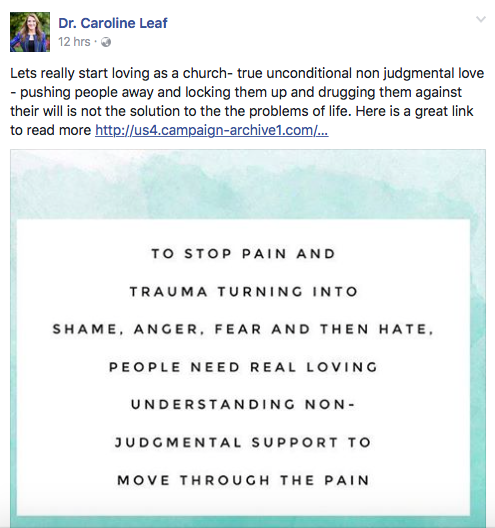
And it shows in her latest social media post: “Lets really start loving as a church- true unconditional non judgmental love – pushing people away and locking them up and drugging them against their will is not the solution to the the problems of life.”

Her statements is a nonsense, nothing more than a scarecrow fallacy.  Yes, pushing people away and locking them up and drugging them against their will is not the solution to the problems of life, that’s why no one does it.  If people were locked up or drugged against their will because of “the problems of life” then we’d all be locked up and drugged.

The only people that are forcibly treated are those with the most serious of mental illnesses whose condition has deprived them of the insight they need to make the decision for themselves.  Even then, the consent for treatment is given by the next of kin, and if no next of kin can provide consent, then the consent is usually made by a independent statutory body so there’s no conflict of interest.

That Dr Leaf continues to make such inane statements about mental illness confirms that she is not fit to give the church, or anyone else for that matter, any advice on mental health.  She may have a PhD in communication pathology but that is a highly specialised field that doesn’t even begin to cross over to clinical knowledge of mental illness.

Dr Leaf has chosen to fill her vacuum of mental health experience with the opinions of Mad In America, a group that’s irrationally biased against modern mental health care.  She regurgitates their creed almost verbatim – mental illness is over diagnosed, psychiatric medications are useless and dangerous, and Dr Leaf also claims that psychiatric medications are only prescribed to bring the cabal of the American Psychiatric Association and the pharmaceutical companies more power and money.

Psychiatric medications are more helpful than harmful (Leucht et al, 2012, Torniainen et al, 2015).  I’ve discussed this in blog posts in the past.  Yes, they’re not without their side effects, and they’re not for every patient, but they have their place in psychiatric care.  That Dr Leaf can’t or won’t review this evidence is just another indictment against her ministry.  That she actively promotes the idea that pharmaceutical companies and the APA are actively attempting to harm people for their own power and riches is scandalous.

If Dr Leaf was serious about promoting good mental health through the church, she should stop promoting baseless anti-psychiatric propaganda, and start encouraging Christians with mental illness to seek the best treatment available, whether that be medications or counselling or both.  She should also start teaching the church the truth about mental illness … That mental illness isn’t caused by poor choices or toxic thoughts, but because of genetic abnormalities that make the affected persons brain more vulnerable to external stress.

Because to stop turning pain and trauma into shame, anger, fear and then hate, people need correct information to allow them to offer real loving understanding and nonjudgmental support to move through the pain.  At the moment, Dr Leaf isn’t offering the church anything even close to that.

References

Leucht S, Tardy M, Komossa K, et al. Antipsychotic drugs versus placebo for relapse prevention in schizophrenia: a systematic review and meta-analysis. Lancet 2012 Jun 2;379(9831):2063-71.
Torniainen M, Mittendorfer-Rutz E, Tanskanen A, et al. Antipsychotic treatment and mortality in schizophrenia. Schizophrenia bulletin 2015 May;41(3):656-63.

Dr Caroline Leaf and those three little words

mind-creates-matter-james-1_2

Dr Caroline Leaf, communication pathologist and self-titled cognitive neuroscientist, broke the most fundamental rules of both science and Christian teaching in her social media post today.

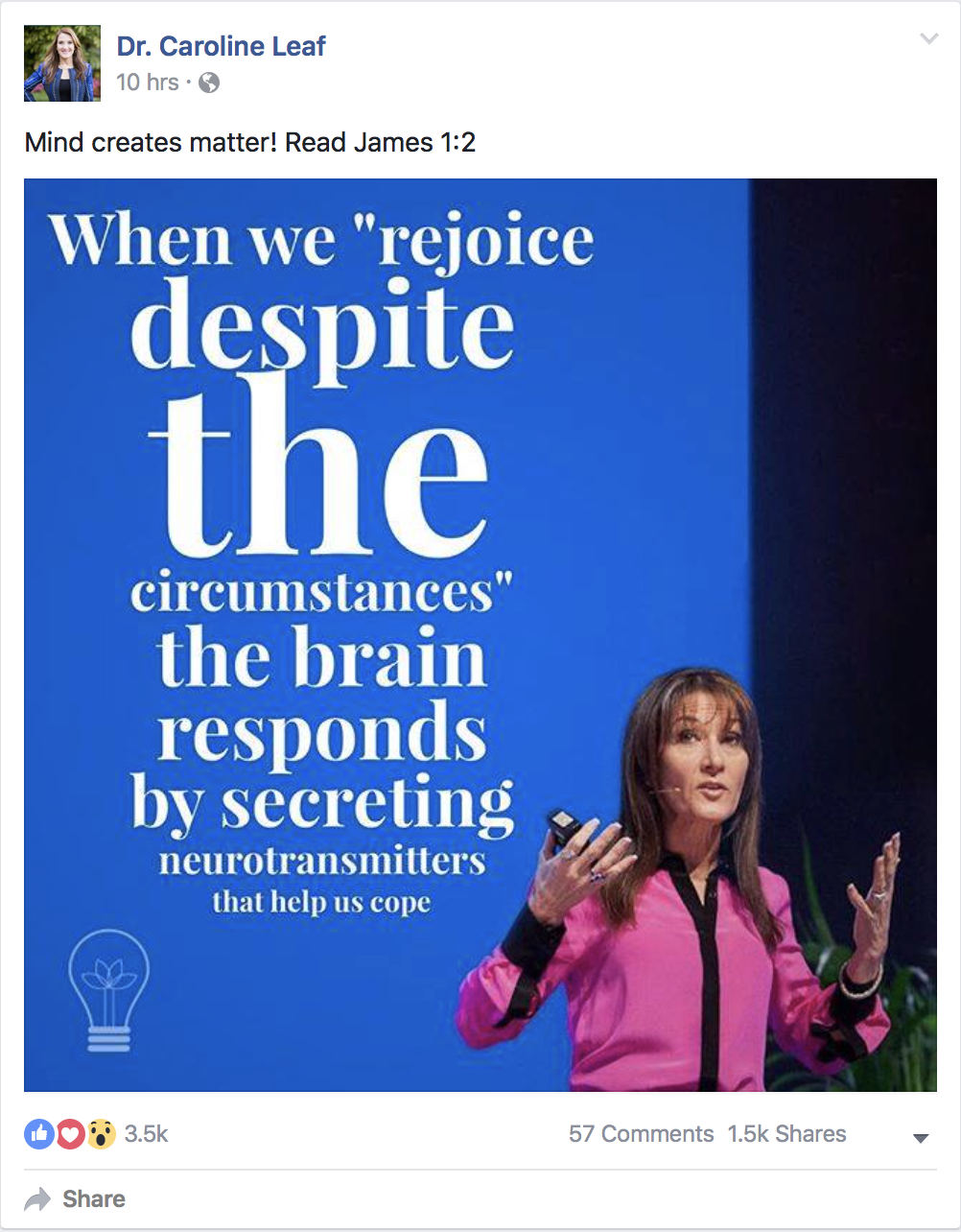
“Mind creates matter!  Read James 1:2”

Dr Leaf’s statement not only violates the laws of physics, but it also contradicts the Bible by elevating the human mind to the level of God himself.

  1. In our physical universe, matter, like energy, is conserved. It can not be created or destroyed.  The amount of matter that goes in to a chemical reaction is the same amount at the end of a chemical reaction.  Suggesting that our mind ‘creates’ matter violates this basic law known by every high school chemistry student.
    http://www.youtube.com/watch?v=2S6e11NBwiw
  2. There are only two explanations for the creation of matter – the Big Bang or God’s creation. Most Christians believe the second explanation, that God was the only being to create matter which he did during the six days of creation.  By saying that our minds create matter, Dr Leaf is saying that our minds have the same amount of power that God does, a suggestion that’s incongruent with basic Biblical truth.

So much for being a scientific and Biblical expert.  In just three little words, Dr Leaf manages to violate the most basic principles of science and Christianity.

To add salt to the wound, Dr Leaf tries to justify her unscientific heresy by referencing James 1:2, as if tagging a scripture will somehow vindicate her.  Except James 1:2 says, “My brethren, count it all joy when you fall into various trials”.  Well, that’s awkward … James 1:2 has nothing to do with matter or the mind.

Her meme is just as irrelevant and unscientific.

“When we ‘rejoice despite the circumstances’, the brain responds by secreting neurotransitters that help us cope.”

Ummm … the brain does everything by releasing neurotransmitters.  That’s how the brain works.  It releases neurotransmitters when awake or asleep, active or resting.  There are no specific neurotransmitters just for coping, or for when we ‘rejoice despite the circumstances’.   Her statement is meaningless.

There would many in Dr Leaf’s camp that would try and defend her statement by claiming that it was a poor choice of words perhaps, or that it was meant to be taken metaphorically not literally.  Sure, if that’s how you want to continue to delude yourself, then be my guest, but really there isn’t much wriggle room here.  How else can you interpret the words ‘create’ and ‘matter’?  You can’t really misrepresent it as matters of fact, or matters of law, or a state of affairs.  Dr Leaf meant it as the mass noun form of the word, “physical substance in general, as distinct from mind and spirit; (in physics) that which occupies space and possesses rest mass”.  And the word ‘create’ … we all know the meaning of that word, “to bring (something) into existence”.  It wouldn’t make any sense to say that the mind causes matter to happen as a result of one’s actions, or that the mind invests matter with a title of nobility.  It might be common to metaphorically say, “mind over matter” but there’s no metaphorical meaning for “mind creates matter”.

And so with just three little words, Dr Leaf contradicts the most basic of all principles of science and Christianity, and aptly demonstrates the irreconcilable deviation of her teaching from reality.  She has shown how willing she is to take an irrelevant scripture and try to use it to justify a misguided pseudoscientific proclamation.  Today’s meme calls her claim as a Biblical and scientific expert into serious question.

Dr Caroline Leaf and the Maligned Master Mind Meme

14390840_10153772607306078_5099113402756590438_n

On Facebook today, Dr Leaf published a menagerie of memes, a full house of five of her favourite little nuggets of wisdom that comprise the pillars of her teaching.  For example, “Everything you first do and say is first a thought.” And, “You alone are responsible and can be held responsible for how you react to what happens in your life: your future is open, filled with an eternity of possible situations and choices.”  Too bad that our genes, which are not the result of our choices, are the biggest influence of our personality and our capacity to cope with our external environment (Vinkhuyzen et al, 2012), and that we often do and sometimes say things without thinking (https://cedwardpitt.com/2014/11/08/dr-caroline-leaf-putting-thought-in-the-right-place/).

But the most interesting meme in today’s trick is “The mind controls the brain … the brain influences but does not control the mind.”

For years, Dr Leaf has taught that the mind is separate from and controls the brain through social media and through her books.  Take a meme she posted to social media in May 2016.  It said, “As triune beings made in God’s image, we are spirit, mind (soul) and body – and our brain being part of the body does the bidding of the mind …”, and “God has designed the mind as separate from the brain. The brain simply stores the information from the mind and your mind controls your brain.”

With the weight of scientific evidence bearing down on her, Dr Leaf has finally given a little and made a concession.  Now the brain influences, but is still controlled by, the mind.

While it’s a step in the right direction, Dr Leaf’s meme is still wrong.  It doesn’t matter what small changes Dr Leaf makes to the window dressing of her teaching, her ministry is so structurally unsound that it’s derelict.

This is because the mind is a product of the brain.  Yes, the brain influences the mind, because the brain creates the mind.  Actual neuroscientists like Professor Bernard Baars in collaboration with mathematician and computer scientist Professor Stan Franklin have shown that the mind is simply a small projection of a much greater stream of unconscious brain activity (Baars and Franklin, 2003; Franklin, 2013; Baars, 2005)

The relationship of the brain to the mind is a little like the relationship of our cars dashboard to the engine.  We don’t see all of the actions of the engine under the hood of our car, but it powers our car nonetheless.  What we do see is the dashboard.  We can see our speed, and depending on the make and model of the car you drive, the dashboard also shows the engine temperature, revs, fuel and the warning lights for our engine and our electrics.

In the same way, our brain powers us.  It’s the engine purring along under the surface.  Our mind is the dashboard, giving us a tiny glimpse at a much greater process underneath the surface.  Suggesting that our mind is in control of our brain is like suggesting that our dashboard is in control of our engine.  The mind is a product of our brain designed to give us conscious awareness of a small portion of a much deeper stream of activity that senses our environment, alters our moods, plans our actions and then executes them.

By basing her entire ministry on such science fiction, Dr Leaf makes a mockery out of every church that hosts her, of everyone that buys her books, and of everyone who subscribes to her programs.  She also makes a mockery of herself, which is the saddest part of this whole story.  I hope that she stops making changes to the window dressings of her ministry, and starts to make the necessary changes to her foundations before it’s too late and the whole thing comes crashing down.

References

Baars, B.J., Global workspace theory of consciousness: toward a cognitive neuroscience of human experience. Progress in brain research, 2005. 150: 45-53

Baars, B.J. and Franklin, S., How conscious experience and working memory interact. Trends Cogn Sci, 2003. 7(4): 166-72  http://www.ncbi.nlm.nih.gov/pubmed/12691765 ; http://bit.ly/1a3ytQT

Franklin, S., et al., Conceptual Commitments of the LIDA Model of Cognition. Journal of Artificial General Intelligence, 2013. 4(2): 1-22

Vinkhuyzen, A.A., et al., Common SNPs explain some of the variation in the personality dimensions of neuroticism and extraversion. Transl Psychiatry, 2012. 2: e102 doi: 10.1038/tp.2012.27

60 seconds – Dr Leaf and Anxiety

Screen Shot 2016-08-22 at 9.32.03 PM

Dr Caroline Leaf, communication pathologist and self-titled cognitive neuroscientist, says that “A chaotic mind filled with rogue thoughts of anxiety and worry sends out the wrong signals and affects you right down to the level of your DNA!” She also says that “Toxic thinking destroys the brain!”

In other words:

Anxiety → Toxic thought → DNA changes +  Brain damage

But that’s not what science says. According to modern research, anxiety disorders are the result of a genetic predisposition to increased vulnerability to early life stress, and to chronic stress [1]. The other way of looking at it is that people who don’t suffer from anxiety disorders have a fully functional capacity for resilience [2,3].

In other words:

DNA changes + External stress → Anxiety

Dr Leaf’s teaching is backwards. Perhaps it’s time she turned it around.

References

[1] Duman EA, Canli T. Influence of life stress, 5-HTTLPR genotype, and SLC6A4 methylation on gene expression and stress response in healthy Caucasian males. Biol Mood Anxiety Disord 2015;5:2
[2] Wu G, Feder A, Cohen H, et al. Understanding resilience. Frontiers in behavioral neuroscience 2013;7:10
[3] Russo SJ, Murrough JW, Han M-H, Charney DS, Nestler EJ. Neurobiology of resilience. Nature neuroscience 2012 November;15(11):1475-84

Dr Leaf and Anxiety