Seven Elements of Good Mental Health: 5. Be grateful – The Prospering Soul

Life shouldn’t just be about avoiding poor health, but also enjoying good health. Our psychological health is no different.

Before we take a look at poor mental health, let’s look at some of the ways that people can enjoy good mental health and wellbeing. This next series of posts will discuss seven elements that are Biblically and scientifically recognised as important to people living richer and more fulfilling lives.

These aren’t the only ways that a person can find fulfilment, nor are they sure-fire ways of preventing all mental health problems either. They’re not seven steps to enlightenment or happiness either.   But applying these principles can improve psychosocial wellbeing, and encourage good mental health.

5. Be grateful

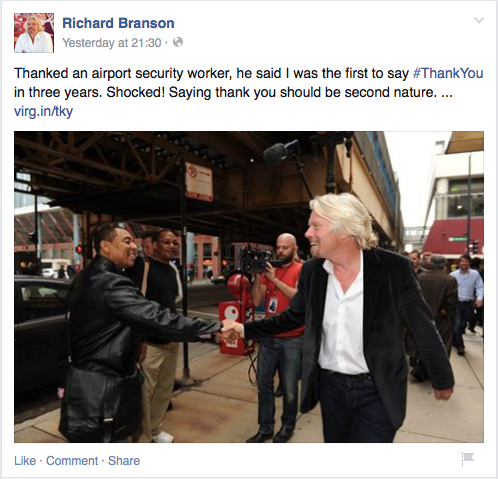
As I was trolling through Facebook the other day, I came across this post by Sir Richard Branson, founder of Virgin: “Thanked an airport security worker, he said I was the first to say #ThankYou in three years. Shocked! Saying thank you should be second nature …”

Richard Branson Thank You

Perhaps the security worker was exaggerating for the billionaire, or perhaps everybody hates airport security at the airport where he works. At any rate, three years is a long time to go without someone saying thanks.

As Sir Richard said, “Saying thank you should be second nature …”. Saying thanks is a small part of the much larger psychology of gratitude, which is “part of a wider life orientation towards noticing and appreciating the positive in the world” [1]. In fact, there are several components to the overall orientation of gratitude, including “(1) individual differences in the experience of grateful affect, (2) appreciation of other people, (3) a focus on what the person has, (4) feelings of awe when encountering beauty, (4) behaviors to express gratitude, (5) focusing on the positive in the present moment, (6) appreciation rising from understanding life is short, (7) a focus on the positive in the present moment, and (8) positive social comparisons.” [1]

The research suggests that people who are naturally grateful tend to be less angry and hostile, less depressed, less emotionally vulnerable, and experienced positive emotions more frequently. Gratitude also correlated with traits like positive social functioning, emotional warmth, gregariousness, activity seeking, trust, altruism, and tender-mindedness. Grateful people also had higher openness to their feeling, ideas, and values, and greater competence, dutifulness, and achievement striving.

However, these effects may be simply an association of gratitude with other personality traits. In other words, people who are naturally optimistic or conscientious are also more likely to be thankful, rather than the thankfulness causing someone to be more optimistic or conscientious. There are a few studies that show gratitude interventions improving self-worth, body image, and anxiety, although the evidence is that while gratitude was better than doing nothing, it was equal to, not superior to, currently accepted psychological interventions.

Even though gratitude may not be better than standard psychological treatments, it’s better than being ungrateful.  It’s also something that the Bible exhorts us to do (“In everything give thanks, for this is the will of God in Christ Jesus, concerning you.” – 1 Thess 5:18).  And let’s face it, it’s pretty easy to do.

The best studied gratitude intervention is a gratitude diary – writing something down every day that you are thankful for [1]. It doesn’t have to be long. A single sentence or phrase is good enough. Not that it has to be written if that’s not your thing. I had a friend who was determined to do a gratitude journal, but she also has a love and a knack for photography. So, she decided to take a photo a day of something that she was grateful for, and post it on Facebook. She had her moments where she doubted herself, struggled to find a subject of her gratitude, or struggled to find something unique, especially after day 300, but the end result was amazing. She grew in her gratitude and her photographic skill, and I often found myself blessed by her beautiful images and insights.

So, be thankful and express it in your own unique way.

References

[1]        Wood AM, Froh JJ, Geraghty AW. Gratitude and well-being: a review and theoretical integration. Clinical psychology review 2010 Nov;30(7):890-905.

Seven Elements of Good Mental Health: 4. Show some SSAS – The Prospering Soul

Life shouldn’t just be about avoiding poor health, but also enjoying good health. Our psychological health is no different.

Before we take a look at poor mental health, let’s look at some of the ways that people can enjoy good mental health and wellbeing. This next series of posts will discuss seven elements that are Biblically and scientifically recognised as important to people living richer and more fulfilling lives.

These aren’t the only ways that a person can find fulfilment, nor are they sure-fire ways of preventing all mental health problems either. They’re not seven steps to enlightenment or happiness either.   But applying these principles can improve psychosocial wellbeing, and encourage good mental health.

4. Show some SSAS

SSAS stands for Supple, Strong and Skilful. This applies physically and mentally.

Physical fitness is good for us. This isn’t the main point of the blog, but I have never seen a study that shows exercise to be a bad thing. Ultimately, it’s not how fat you are that’s important for your longevity, it’s how fit you are [1, 2]. And the way to get fit is to exercise.

Physical exercise is not just good for the body but good for the brain as well. While the exact pathways are still being determined, there’s good evidence that moderate regular physical activity improves the balance of pro- and anti-inflammatory mediators in the body and in the brain. In the brain, this improves the overall function of our brain cells and their ability to form new pathways, which in turn, has been shown to improve mood disorders like anxiety and depression [3].

But being SSAS isn’t just about what being physically fit and active can do for your mood, but it also relates to being psychologically flexible and using psychological skills to leverage your strengths rather than just fighting with your weaknesses. One of the keys here is acceptance. Remembering your values that we spoke about in key 1 as your guide, exploit the things that you’re good at, using them to gain some self-confidence and momentum. Accept the things that can’t be changed in your life. Then when you have some momentum, learn some new skills to increase your resilience and strengthen your weaknesses.

I say this because sometimes we spend so much time focussing on all the bad things in our lives that we forget about the good things that we already have or can already do. It would be like an athlete spending all their time in the gym, getting really fit and strong, but never getting onto the field or court. It’s important that we courageously challenge ourselves to turn our weak points into strong points, but it’s more important to do what we can to help others around us.

References

[1]        Barry VW, Baruth M, Beets MW, Durstine JL, Liu J, Blair SN. Fitness vs. fatness on all-cause mortality: a meta-analysis. Progress in cardiovascular diseases 2014 Jan-Feb;56(4):382-90.
[2]        Lavie CJ, McAuley PA, Church TS, Milani RV, Blair SN. Obesity and cardiovascular diseases: implications regarding fitness, fatness, and severity in the obesity paradox. Journal of the American College of Cardiology 2014 Apr 15;63(14):1345-54.
[3]        Moylan S, Eyre HA, Maes M, Baune BT, Jacka FN, Berk M. Exercising the worry away: how inflammation, oxidative and nitrogen stress mediates the beneficial effect of physical activity on anxiety disorder symptoms and behaviours. Neuroscience and biobehavioral reviews 2013 May;37(4):573-84.

Seven Elements of Good Mental Health: 3. Mindfulness – The Prospering Soul

Life shouldn’t just be about avoiding poor health, but also enjoying good health. Our psychological health is no different.

Before we take a look at poor mental health, let’s look at some of the ways that people can enjoy good mental health and wellbeing. This next series of posts will discuss seven elements that are Biblically and scientifically recognised as important to people living richer and more fulfilling lives.

These aren’t the only ways that a person can find fulfilment, nor are they sure-fire ways of preventing all mental health problems either. They’re not seven steps to enlightenment or happiness either.   But applying these principles can improve psychosocial wellbeing, and encourage good mental health.

3. Mindfulness

Mindfulness is a practice that we can all become better at.

Mindfulness involves directing our attention towards things in the present moment, and away from those thoughts that drag us into the faults of the past or the fear of the future [1]. Between the various disciplines of psychology and a number of different religions, there are many ways in which mindfulness has been defined. The way I consider mindfulness is similar to that in the ACT framework, which is simply non-judgemental awareness of one’s moment-to-moment experience. In other words, mindfulness involves accepting the experience our internal and external realities simply as they are, without judging them as good or bad, positive or negative. Mindfulness accepts the experience of events fully, without resorting to excessive preoccupation or suppression of the experience.

People who are naturally mindful are more likely to have higher levels of life satisfaction, agreeableness, conscientiousness, vitality, self esteem, empathy, sense of autonomy, competence, optimism, and pleasant affect, and are less likely to have depression, neuroticism, absent-mindedness, dissociation, rumination, cognitive reactivity, social anxiety, difficulties in emotion regulation, experiential avoidance and general psychological symptoms.

So mindfulness is obviously a good thing to have, though before we get too carried away, it may be that mindfulness isn’t the cause of all of these positive effects, but simply a common association. In other words, it might be that people who are psychologically health naturally tend to be more mindful.

For the most part, this is probably the case, but there is evidence for mindfulness as a psychological intervention for those who are not so naturally mindful.  Those who are taught to practice mindfulness skills also demonstrate an increased ability to cope with habitual urges (like a desire to smoke), feelings of anxiety, low mood, and fearfulness [2].

Mindfulness has some overlap with the psychological skill of acceptance. In mindfulness, we not only stop fighting with our feelings and thoughts, but we take a step back to pay attention to them and observe them in a non-judgemental way. With acceptance, we acknowledge the thoughts and feelings, but divert our attention to other things.

To clarify, mindfulness is non-judgementally observing our thoughts, feelings and emotions, not fighting with them to suppress them, or passively allowing our thoughts and feelings to overwhelm us. If our thoughts or feelings were like a hungry lion, mindfulness is standing outside of the cage, observing the different characteristics of the lion, rather than staying in the cage to try and fight it, or passively stand in the cage waiting to become lunch.

Mindfulness doesn’t need special training. Being mindful is simply being aware of your thoughts, feelings and emotions, and accepting them for what they are. Are you happy at the moment? What does that feel like in your body? What does anxiety feel like? Describe the feeling … hot or cold, squeezing, searing, heavy or light? Do you have an urge to do something, like have some chocolate or smoke a cigarette? What is that urge like? Can you put it into words?

Only one word of warning. It would be fair to assume that someone will be reading this who has experienced some severe trauma in their lives. Both acceptance and mindfulness will help to manage the feelings that your trauma will inevitably cause, but if the severity of that trauma causes you to be overwhelmed by your feelings, don’t try and tackle those memories and emotions on your own. Work with a psychologist or doctor who is experienced in mindfulness-based therapies, so there is someone to assist you through the process so you’re not overwhelmed, until you get better and stronger.

Often mindfulness is taught as a contemplative activity, that is, we think about the feelings as we observe them. However, there is nothing wrong with expressing your mindfulness in other ways, like drawing, painting or movement. You can also write them down. I often read through the Psalms that King David wrote, and wonder if he was modelling mindfulness for us in the way he acknowledged and described his feelings in the words that he wrote as prayer and poetry. Find what works best for you as you grow in the skill of mindfulness.

References

[1]        Harris R. The happiness trap : how to stop struggling and start living. Boston: Trumpeter, 2008.
[2]        Keng SL, Smoski MJ, Robins CJ. Effects of mindfulness on psychological health: a review of empirical studies. Clinical psychology review 2011 Aug;31(6):1041-56.

Seven Elements of Good Mental Health: 2. Be Kind – The Prospering Soul

Life shouldn’t just be about avoiding poor health, but also enjoying good health.  Our psychological health is no different.

Before we take a look at poor mental health, let’s look at some of the ways that people can enjoy good mental health and wellbeing. This next series of posts will discuss seven elements that are Biblically and scientifically recognised as important to people living richer and more fulfilling lives.

These aren’t the only ways that a person can find fulfilment, nor are they sure-fire ways of preventing all mental health problems either. They’re not seven steps to enlightenment or happiness either.   But applying these principles can improve psychosocial wellbeing, and encourage good mental health.

2. Be kind

One of the best things you can do for your health and happiness is to be kind to other people. In their review of studies on altruism, Lozada et al (2011) showed that altruism activates rewarding neural networks, essentially the same brain regions as those activated when receiving rewards or experiencing pleasure. They also described studies showing that both hormones and the neurotransmitters in the brain involved in helping behaviour and social bonding can lessen stress levels and anxiety. Also, the immune and autonomous nervous systems are positively affected by the quality and extent of social networks, and increased sociability and concern for others’ wellbeing can improve immune system and stress responses [1].

The Bible has always encouraged us to show other people kindness. In Ephesians 4:31-32, Paul tells the church at Ephesus, “Get rid of all bitterness, rage and anger, brawling and slander, along with every form of malice. Be kind and compassionate to one another, forgiving each other, just as in Christ God forgave you.”

And that kindness wasn’t just for other people in the church, but to anyone in need (Matthew 25:34-40).

There are infinite ways to show kindness, but the thing that links them together is unselfishness, the “disinterested and selfless concern for the well-being of others”, or in less formal language, simply giving with no strings attached.

If you’re looking for some ideas on some new ways to show kindness, the Random Acts of Kindness Foundation has plenty of them. Check out https://www.randomactsofkindness.org/kindness-ideas

References

[1]        Lozada M, D’Adamo P, Fuentes MA. Beneficial effects of human altruism. Journal of theoretical biology 2011 Nov 21;289:12-6.

Seven Elements of Good Mental Health: 1. Temet Nosce – The Prospering Soul

Life shouldn’t just be about avoiding poor health, but also enjoying good health. Our psychological health is no different.

Before we take a look at poor mental health, let’s look at some of the ways that people can enjoy good mental health and wellbeing. This next series of posts will discuss seven elements that are Biblically and scientifically recognised as important to people living richer and more fulfilling lives.

These aren’t the only ways that a person can find fulfilment, nor are they sure-fire ways of preventing all mental health problems either. They’re not seven steps to enlightenment or happiness either.   But applying these principles can improve psychosocial wellbeing, and encourage good mental health.

1. Temet nosce – “Know thyself”

Generally speaking, there are two ways that a person can live their lives, as a boat or as a buoy – those who set out to find life or to let life find them.

Some people are quite content to be buoys – to stay in the same place and let the social currents and tides bring different elements to them. They’re more passive in their approach, content to just accept that life will just come and go as it will.

Then there are those who don’t want to stay in the one place, but want to chart their own course, discover what life is for themselves. Whose to say what’s best for each individual person? We all have our own choices to make.

For those people who are boats, who want to set their course and discover life, it helps a lot in the journey to know where you’re going.

This may seem obvious enough. In fact, it seems too obvious – we often think we know where we’re going when in reality, we haven’t a clue where we really want to go or how to get there.

For starters, it helps to know where you want to go. Some of us are gifted with an amazing confidence, self-assurance and motivation, and have the ten year plan all mapped out, but those people are the minority. It’s fine if we don’t know where exactly we want to go, but what would help every since person is to at least know the direction you wish to sail in, which are our values.

The word ‘values’ can mean different things to different people, but in the Acceptance and Commitment framework, values refer to “Leading principles that can guide us and motivate us as we move through life”, “Our heart’s deepest desires: how we want to be, what we want to stand for and how we want to relate to the world around us.” [1] Values help define us, and living by our values is an ongoing process that never really reaches an end. Living according to your values is like sailing due west. No matter how far you travel, there is always further west you can go. While travelling west, there will be stops a long the way, stop-overs along our direction of travel like islands or reefs. These are like our goals in life.

The difference between goals and values is important. You could set yourself a whole list of different goals, and achieve every one of them, but not necessarily find meaning or fulfilment in their accomplishment if they’re all against the underlying values that you have. So goals are empty and unfulfilling if they aren’t undergirded by your deeper values.

How can you understand your values? There are a couple of ways. Ask yourself: “What do I find myself really passionate about? What things irk me? If I could do anything I wanted, and money was no object, what would I do?” Is there a recurrent theme running through your answers? I have always found myself irritated by mass-marketing, and more recently by disingenuous social media memes and unscientific health messages. The theme – ‘truth’. I know, it sounds a bit trite, like some second-rate comic book hero, but I’ve mulled over this a lot, and for me, ‘truth’ is one of my deepest values.

There are other ways to discover what your values are. Some people have suggested writing your own eulogy (the speech someone gives about you at your funeral). It sounds a bit morbid, and it’s only a figurative exercise, but it tends to sharply clarify what you want your life to be like. What do you want your legacy to be? Think about the things that you want to be known for at the end of your life, and see if there is a word that best describes those desires.

If that’s a bit too confronting, there are some on-line tools that can also give you an idea. There is only so much a long list of questions can discover about you, but results of the survey can provide a starting point for further thought. There is a couple of free resources that may be helpful (though you will have to register):
* https://www.authentichappiness.sas.upenn.edu – and click on the drop-down menu in the “Questionnaires” section, and select “Brief strengths test”
* http://www.viacharacter.org/Survey/Account/Register

One final note on the buoys and the boats – whether you’re a buoy or a boat, you’re still going to encounter large waves, strong currents, and wild storms, as well as peaceful weather. As a buoy, those adverse conditions will simply find you where you are. You can’t escape from them. You’re also going to experience those same large waves, strong currents and wild storms as a boat. The difference is that buoys have no choice but to ride out the adverse conditions. Boats, on the other hand, can use the power of the difficult circumstances to power them to their destinations if they can harness them correctly. Boats can’t outrun bad weather all the time. Adversity is inevitable. Happiness, contentment, enlightenment, or whatever you’re seeking, isn’t found in avoiding or controlling our adverse circumstances, but about learning how to follow our values in the midst of the calm weather or the wild.

As Christians, one of our primary values is our love for God and our desire to follow Jesus. Scripture teaches that each of us has our own unique path to follow. Ephesians 2:10, “For we are God’s workmanship, created in Christ Jesus to do good works, which God prepared in advance for us to do.” ‘Workmanship’ in the Greek is ‘poiema’ from which we get our English word ‘poem’. We are not a meaningless jumble of letters that makes no sense. We are a beautifully crafted blend of rhythm, harmony and meaning. You are a sonnet from the mouth of God. I believe that our individual purpose stems from our common purpose and values, like leaves are dependant on the branches, trunk and roots of the tree. I heard a brilliant summary of the purpose of the Christian life, which was simply “To know Christ, and to make Christ known.” I believe that it’s from this common value, shared by all Christians, that our direction in life stems from.

In knowing our values, we can know ourselves, and engage in life in it’s fullness.

References

[1]        Harris R. The happiness trap : how to stop struggling and start living. Boston: Trumpeter, 2008.

Dr Caroline Leaf and the tongues trivia tall tales trifecta

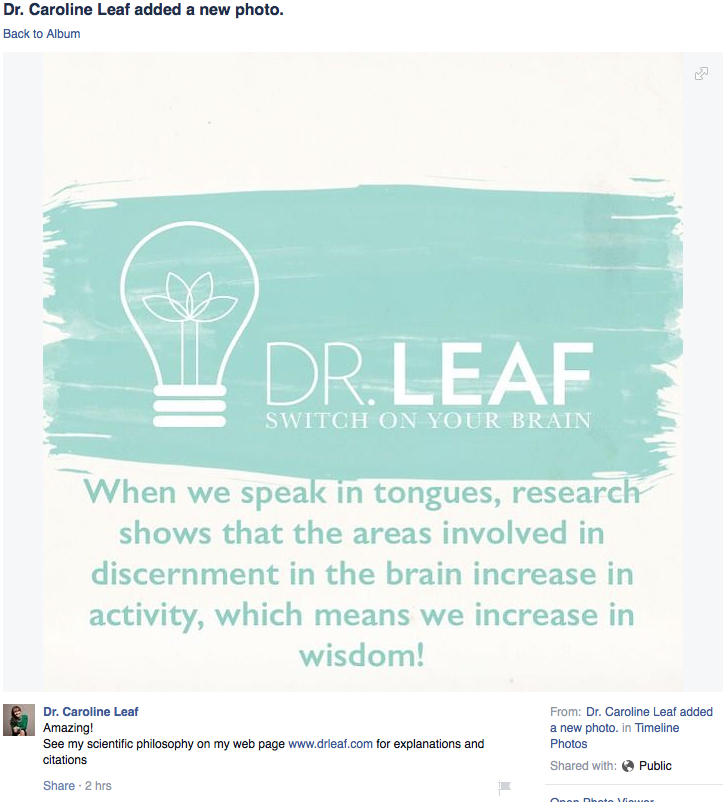
Screen Shot 2015-06-06 at 12.23.16 pm

I saw a Facebook factoid from Caroline Leaf today that said, “When we speak in tongues, research shows that the areas involved in discernment in the brain increase in activity, which means we increase in wisdom.”

Dr Caroline Leaf is a communication pathologist and a self-titled cognitive neuroscientist. She has also proclaimed herself as an expert on science and the Bible.

In the opening of her “Scientific Philosophy”, for example, Dr Leaf says that, “God is the Creator of the Universe and is the Author of Science. Since God is the Author of the Bible, the Bible is therefore the ultimate authority in any scientific matters. The study of Science is therefore the study of God’s handiwork and is a way of admiring His Creation. God, the Creator, is the One to be worshipped, not the Creation. The Creation, however, reflects the Glory of God and points to His Divine attributes.”

In order to prove that the Bible is the ultimate scientific authority, Dr Leaf attempts to find scientific studies which support Biblical concepts. One example of this is her teaching on Glossolalia, the scientific term for the Biblical concept ‘speaking in tongues’.

Dr Leaf’s Facebook factoid on the neuroscience of speaking in tongues is at least the second time she has posted it. In November when I first saw Dr Leaf’s proclamation on the science of speaking in tongues, I was fascinated. I went to find the research for myself to see if the areas involved in discernment in the brain really increase in activity when speaking in tongues. As it turns out, there isn’t any.

The only study that I could find about brain functioning during speaking in tongues was by Newberg [1]. As I wrote in my previous blog, the study by Newberg showed the part of the brain that’s involved in both speaking in tongues and discernment, the ventromedial prefrontal cortex, decreases in activity when praying in tongues, not increases, in direct contradiction to Dr Leaf’s meme.

In November, I concluded, “there are really only two reasonable explanations as to why the research contradicts Dr Leaf; either there is another piece of research which supports Dr Leaf’s assertion, or Dr Leaf is simply wrong.”

Today on Facebook, Dr Leaf demonstrated that she can not be swayed from her entrenched idea that speaking in tongues increases discernment … or can she? Her meme and her discussion on glossolalia in her ‘Scientific Philosophy’ seem contradictory.

For example, she writes in her scientific philosophy manifesto, “In 2006 Dr. Andrew Newberg at the University of Pennsylvania, using single-photon emission computerized tomography (SPECT), found that the frontal lobe of individuals who spoke in tongues was less active. This brain profile was in contrast to Franciscan nuns in contemplative prayer and Buddhist monks in meditation, in which frontal lobe activity is increased. Since the frontal lobe activity is increased when we are focused on what we are saying, this finding confirms self-reports of what people who spoke in tongues experienced, implying that the words spoken in glossolalia originate from a source other than the mind of the individual speaking in tongues.”

In this paragraph, Dr Leaf confirms that frontal lobe activity decreases when speaking in tongues, in keeping with her anecdotal evidence of “self-reports of what people who spoke in tongues experienced, implying that the words spoken in glossolalia originate from a source other than the mind of the individual speaking in tongues.” But this is in direct contrast with her social media meme, which suggests that speaking in tongues increases frontal lobe activity – the area of the brain common to glossolalia and discernment is the vmPFC, which decreases with glossolalia and increases with discernment.

Dr Leaf is a confusing enigma. She posts social media memes that are clearly wrong, even disagreeing with the scientific papers she has written about and her own conclusions in her own manifesto.

This only discounts her legitimacy. You can’t continue to contradict your own evidence. It’s like shooting yourself in the foot, or digging your own grave. What’s worse, Dr Leaf teaches this from real pulpits, not just on social media. How is her audience supposed to feel when they hear what she has to say and find it disagrees with her own scientific philosophy?

I sound like a broken record, but Dr Leaf desperately needs to review her teaching and social media memes. It’s bad enough to be contradicted by scientific evidence, but to be in disagreement with your own teaching is embarrassing, and does nothing to preserve trust with your audience.

References

[1]        Newberg AB, Wintering NA, Morgan D, Waldman MR. The measurement of regional cerebral blood flow during glossolalia: a preliminary SPECT study. Psychiatry research 2006 Nov 22;148(1):67-71.

Dr Caroline Leaf – Manhandling scriptures again

Screen Shot 2015-05-30 at 7.49.02 pm Screen Shot 2015-05-30 at 7.50.30 pm

I recently heard a great quote, “If you take the text out of context, all you’re left with is a con.” It’s a quote that seems to describe Dr Leaf’s social media pings quite nicely over the last twenty-four hours.

Dr Caroline Leaf is a communication pathologist and a self-titled cognitive neuroscientist. She is also a self-titled theologian.

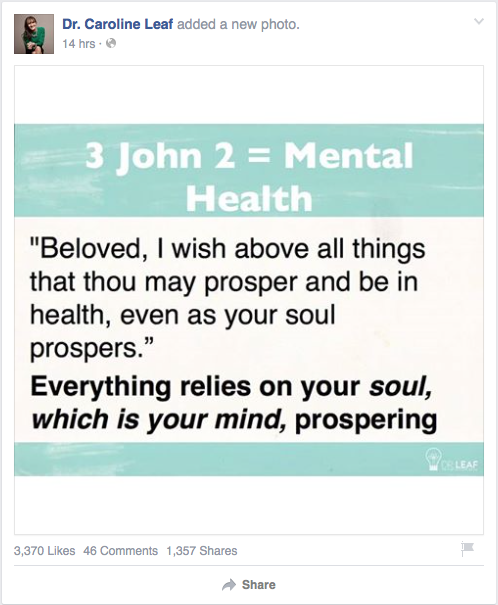
Today she posted, “3 John 2 = Mental Health ‘Beloved, I wish above all things that thou may prosper and be in health, even as your soul prospers.’ Everything relies on your soul, which is your mind, prospering” (original emphasis).

Except that her statement is blatantly false. The soul isn’t just the mind. A simple search of an on-line Bible dictionary reveals that there are a number of ways in which the word ‘soul’ is used, but more specifically to the meaning in 3 John 2, “the (human) soul in so far as it is constituted that by the right use of the aids offered it by God it can attain its highest end and secure eternal blessedness, the soul regarded as a moral being designed for everlasting life”. (http://goo.gl/AjhvNO)

It should also be noted that the two words used in ancient Greek that referred to our inner reality were pneuma (‘spirit’) and psyche (‘soul’). According to Thayer’s Greek Lexicon, the words pneuma (‘spirit’) and psyche (‘soul’) were often used indiscriminately. The Apostle Paul distinctly used the word pneuma separately to the word psyche in 1 Thessalonians 5:23, but nearly every other New Testament writer wasn’t so precise.

Thus, John wasn’t referring to the mind at all, but probably our spirit, or at the very least, our generic soul, not specifically to our mental faculties or our thoughts. The scripture in 3 John 2 doesn’t have anything to do with our mental health.

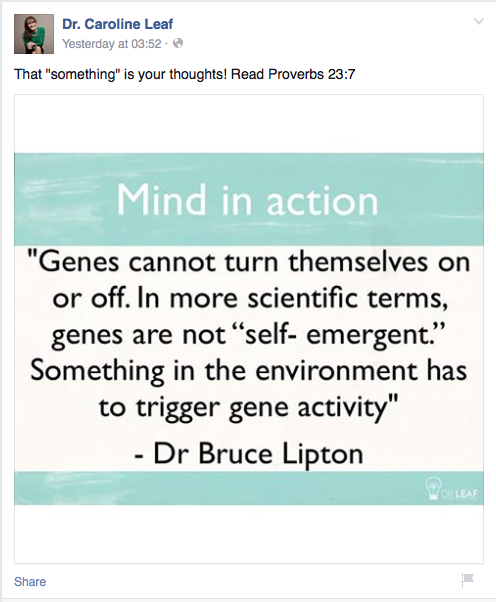
Yesterday, Dr Leaf tried to merge one of her favourite authors views with scripture. She posted a quote from Dr Bruce Lipton, “Genes cannot turn themselves on or off. In more scientific terms, genes are not ‘self-emergent’. Something in the environment has to trigger gene activity.” Dr Leaf added, “That ‘something’ is your thoughts! Read Proverbs 23:7”.

So I did.   Proverbs 23:7 in the King James Version says, “For as he thinketh in his heart, so is he: Eat and drink, saith he to thee; but his heart is not with thee.”

So what is it with the second half of the verse? If this scripture is all about our thought life, then what’s the eating and drinking half of the verse got to do with our thought life?

The explanation is that this verse has nothing to do with our thought life at all. Dr Leaf has simply been misquoting it for years, and no one checked to see if she’s right. According to the Pulpit commentary found on the Bible Hub website, “The verb here used is שָׁעַר (shaar), ‘to estimate … to calculate’, and the clause is best rendered, ‘For as one that calculates with himself, so is he’. The meaning is that this niggardly host watches every morsel which his guest eats, and grudges what he appears to offer so liberally … He professes to make you welcome, and with seeming cordiality invites you to partake of the food upon his table. But his heart is not with thee. He is not glad to see you enjoy yourself, and his pressing invitation is empty verbiage with no heart in it.” (http://goo.gl/nvSYUh)

The other half of her meme comes from Dr Bruce Lipton, an agnostic pseudoscientist who was a cell biologist before he flamed out, and now teaches chiropractic in New Zealand. He believes that there is a metaphysical link between our thoughts and our cell function [1]. He’s ignored by real scientists (http://goo.gl/cX7Aeg).

As for his quote, it’s a misdirection. Sure, genes aren’t self-emergent – they don’t think for themselves. DNA is just a long chemical string which just carries a code, the biological equivalent to your DVD discs. Like a DVD, DNA isn’t worth anything if it doesn’t have a machine to read it. In every cell, there are hundreds of proteins that read and translate DNA. Those machines respond to the external environment, but they also respond to the cells internal environment, and to other genes themselves. Simply put, DNA is decoded by intracellular proteins, but intracellular proteins are only made by the expression of DNA, which happens all the time. A single-celled embryo becomes a baby because of DNA self-copying and expression that happens a trillion times over by the end of pregnancy. So while a single gene can’t turn itself on and off, the genome as a whole is essentially self-controlling, only being partly modulated by the external environment. Genes are turned on and off all the time by other genes through the proteins those genes make. Lipton’s assertion that “something in the environment has to trigger gene activity” is simply nonsense.

So Dr Leaf uses a flawed quote from a pseudoscientist to try and back up her specious interpretation of an out-of-context verse of scripture.

Somewhat poor from an “expert” theologian and cognitive neuroscientist really.

These memes speak to the issues of trust and legitimacy. Dr Leaf can call herself whatever she likes, but how can church leaders continue to endorse her to their congregations as an expert when she consistently misinterprets science and scripture? Can they honestly look their parishioners in the eye and say that Dr Leaf’s teaching is accurate? Can they stand at their pulpits and confidently support her book sales at their back of their churches?

Dr Leaf needs to re-evaluate. She needs to re-evaluate her claims to be an expert in cognitive neuroscience and the Bible. She needs to re-evaluate the quality of information that she relies on. She needs to re-evaluate what she’s trying to achieve in posting to social media, and re-evaluate the accuracy of her memes.

Because ultimately it’s the truth that sets people free, not errant opinions and misinterpretations.

References

[1]        Lipton BH. The biology of belief: Unleashing the power of consciousness, matter and miracles: Hay House, Inc, 2008.

Addit: Dr Leaf’s social media post in between the two memes mentioned above was also a doozy. A repeat offender, as it were, since she has posted it several times before, and I have blogged about it here.

A Dissertation on the Uterus

When one thinks of Mothers Day, one tends to think of flowers, chocolates, perfume, presents in pink paper, and breakfast in bed … you know, “sugar and spice and all things nice.”

But the unsung hero of Mothers Day is the uterus.  It’s concealed inside every woman, yet never given the accolades that it deserves.  After all, without the uterus, none of us would be here today.  So I would like to share some observations on the humble uterus, and I hope, add a new dimension to the celebration of Mothers Day.

The uterus resides in the female pelvis, nestled between the bladder in the front and the rectum at the back.  It is a pear-shaped, hollow, and very muscular, and measures three inches long, two inches wide and about one inch thick.  All up, it weighs about 60 grams.  It has two tubes leading to the ovaries, and the lower part opens into the upper vagina.

Two ligaments are responsible for holding the uterus in place and carrying the vital blood vessels and innervation.  The round ligaments attach to the top of the uterus and curve around the wall of the pelvis like two arms extended to give a hug.  The broad ligaments hang from the fallopian tubes and round ligaments like a curtain, and attach the uterus to the floor and sides of the pelvis.

While the uterus is very small in a woman before she becomes pregnant, it has an amazing capacity to stretch.  A uterus in late pregnancy actually takes up most of the abdominal cavity (thus measuring over a foot in length) and can weigh a couple of kilograms.  The uterus just keeps growing to whatever size it needs to be to accommodate the baby inside of it.  The uterus is also very strong – uterine contractions during labour can produce between 30 and 60 pounds per square inch of pressure.

Before pregnancy, the uterus gets itself ready every month to receive a new life.  The womb lining is thick and nurturing, and is ready and waiting when ovulation takes place each month, just in case it’s needed.  If it’s not, then it renews itself, ready for the next time it might be called upon.

From the moment of conception, the uterus is providing for the baby.  In fact, the baby literally takes over, modulating the responses of the uterus.  It secretes hormones to bring more blood flow to the uterus to support its own growth and make the uterus stronger, while at the same time making the ligaments around it to relax so that it can grow.  The uterus completely envelops the growing baby, protecting it with the thick layer of muscle.  So protective is the uterus that babies in the womb can survive trauma from high speed car crashes or heavy blows to the mothers abdomen, with no noticeable trauma.

Finally, after 40 weeks of stretching and growth, of protecting and nurturing, the baby must leave the uterus.  If the baby stays any longer than two weeks over, both the baby and the mother are at risk of dying.  It goes without saying that the process of separation is painful – labour is synonymous with pain and travail.

There are two causes of labour pains, stretching and pushing.  I don’t think I can really do justice to the pain from childbirth, but I will do my best for those who will never, or have not yet, experienced labour.  The birth canal in ordinary life has a maximal diameter of about four centimetres.  During parturition, the birth canal has to accommodate a baby’s head which is usually between ten and eleven centimetres in diameter.  So imagine taking your lower lip and trying to pull it up over your eyebrows.  This would be the rough equivalent to the stretching that occurs during delivery.  The muscular contractions are different again.  Think of the pain of a muscle cramp in your calf, then imagine that across your whole lower abdomen and lasting for two minutes.  You may have a now have an idea why childbirth is painful.

While it may seem that the process is pretty easy for the baby, it also goes through some pretty intense stress.  The intensive squeezing through the already overstretched birth canal actually wrings the excess fluid out of the babies lungs, which were previously filled with amniotic fluid.  It is because of this squeezing, and the very rude shock of the cold air of the outside world on it’s face, that the baby takes it’s first breath.  The average time that it takes to get the baby through the four inches of the birth canal is about 30 minutes. It may not be physically far, but the journey of separation is very strenuous.

When God made man and woman, he had already been creating for five and a half days, so he was in the groove (see Genesis 1:24-31).  He made man, and the things that define man he placed on the outside, like his “defining organs”, and his physical strength.  But man wasn’t complete.  So God made woman, the pinnacle of his creation.  She complements and completes the man.  God made her so that which defines her was internal – the uterus, her defining organ, and the emotional strength and nurturing which the uterus represents.

Even before they are mothers themselves, most women will cultivate relationships and help the people in their life to flourish.  Women, like the uterus, have a remarkable capacity to stretch and nowhere it is better demonstrated than motherhood.  Like a foetus to the womb, so a child literally takes over the life of it’s mother, constantly demanding in every aspect of life.  But the selfless care results in growth and stretching – the baby fostering a type of inner strength that is rarely found in women who have not raised a baby of their own.

The protective instinct of a mother is amazing, sometimes going beyond rational explanation to the level of absolute self-sacrifice.  Like the uterus, enclosing the baby with an almost impenetrable layer of thick, strong muscle, a mothers love cocoons her child and so often takes the physical and psychological blows that were meant for her child.  And mothers are very strong, with an inner force that can push through physical obstacles, social barriers and psychological pain in order to find what is best for their children.

The transition from dependence to independence, like the process of labour, is painful.  Pushing a child away requires emotional strength as much as caring and protecting does, but children eventually need to move on and start living on their own, “breathing for themselves” so to speak.  They may not move very far physically, but in terms of emotional separation, it is often a long and stressful journey.  The cold air of the real world and the stress of the transition can make them gasp and scream for a while, but it makes them stronger, and able to live on their own.

Finally the uterus is, anatomically speaking, like an angel, with the round ligaments extending out in front like arms reaching out to hug, and the broad ligaments flowing down from them like wings.  It goes without saying that mothers are angels.  Constantly reaching out to give love and protecting by enveloping in their wings, mothers personify the spiritual ministry of angels.  They also reflect God’s likeness, as it says in Psalm 91:4, “He will cover you with his feathers, and under his wings you will find refuge; his faithfulness will be your shield and rampart.”

So we owe a lot to the uterus.  An amazing yet understated organ, it reflects the amazing traits that God placed inside women everywhere, which are brought to the fore by the journey of motherhood.  Without the uterus, there would be no mothers, or Mothers Day.  On Mothers Day, when you give your mum a hug and a kiss on the cheek, don’t forget to thank God for his amazing creation of the humble uterus and the special traits it shares with the pinnacle of Gods creation.

Dr Caroline Leaf – Contradicted by Dr Caroline Leaf

“Who am I?”

It’s one of life’s most fundamental questions. It’s such a quintessentially human question, one that speaks to the importance of our identity as individuals.

It’s a question that Dr Leaf thinks she has the answer to.

Dr Caroline Leaf is a communication pathologist and self-titled cognitive neuroscientist. Recently she launched an on-line program called “Perfectly You”, based on her 2009 book, “The Gift In You” [1]. In “The Gift In You”, Dr Leaf promised that by using her program, you could enable your gift and increase your intelligence to the level that you desire. According to Dr Leaf, your gift is something that’s hardwired into your brain, which makes your gift uniquely yours. For example, she wrote:

“Your gift lies in something so profound yet so simple that we tend to overlook it: the combination of your life experiences with the measurable structure of how your brain has been wired to think and process information.” (p24)

“Neurologically, you are not wired for someone else’s gift. You can try as hard as you want. You can listen to as many teachings as you possibly can. You can buy all the books with an instant formula for a business mogul’s success. You can adopt all of the popular motivational sayings. But even then, you will never have someone else’s gift.” (p11-12)

“You were not built to struggle. Your brain is wired to function according to a specific sequence. When you discover that sequence, that structure, you unlock great potential.” (p13)

“When you know how your gift is structured, how your brain is uniquely wired, and how to achieve lasting success, you will unlock your truth-value – your gift.” (p17)

“The exciting result of this plasticity of the brain that we hold power over is that no two brains are alike: We are uniquely, fearfully and wonderfully made (Psalm 139:14). There is diversity in brain structure and organisation and function, which results in the way we think and approach life.” (p18)

So according to Dr Leaf, our gifts are something that is uniquely hardwired into our brain, something that we cannot change even if we wanted to, and that brain structure gives rise to the way in which we think and the actions that we take.

Then, as I was rereading this book, I came across a sentence that I must have read before when I first got it, but which I hadn’t fully appreciated the significance of until now.

On page 47, Dr Leaf said,

The mind is what the brain does, and we see the uniqueness of each mind through our gifts. This, in itself is delightful and, intriguing because, as you work out your gift and find out who you are, you will be developing your soul and spirit.” (Emphasis added)

This quote in and of itself isn’t actually that significant until we compare it to a quote from the first chapter of Dr Leaf’s 2013 book, “Switch On You Brain.” [2]

“The first argument proposes that thoughts come from your brain as though your brain is generating all aspects of your mental experience. People who hold this view are called materialists. They believe that it is the chemicals and neurons that create the mind and that relationships between your thoughts and what you do can just be ignored.
So essentially, their perspective is that the brain creates what you are doing and what you are thinking. The mind is what the brain does, they believe, and the ramifications are significant. Take for example, the treatment of depression. In this reductionist view, depression is a chemical imbalance problem of a machinelike brain; therefore, the treatment is to add in the missing chemicals.
This view is biblically and scientifically incorrect.” [2: p31-32] (Emphasis added)

So … Dr Leaf believes that the mind is not what the brain does. So our gifts aren’t uniquely hardwired into our brain, and we should be able to change our gifting if we want to, since it isn’t our brain structures that give rise to the way in which we think and the actions that we take, but it’s all related to our choices.

This must be really embarrassing for Dr Leaf, to so directly call your own beliefs biblically and scientifically incorrect, and then not to notice.

Now, we all make innocent mistakes. No one is perfectly congruent in everything they say. But this isn’t just getting some minor facts wrong. These statements form the foundation for Dr Leaf’s teaching, and are in print in two best selling books, from which she has used to present to countless churches and seminars around the globe.

Which makes her major self-contradiction important for three reasons:

  1. It calls her self-titled expertise as a cognitive neuroscientist into question.
  2. It calls her teaching into question.
  3. It calls her ministry into question.

Firstly, in majorly contradicting herself, Dr Leaf shows desperately little basic knowledge about cognitive neuroscience. Even first year neuroscience students consistently know how the brain works, and are able to build on this to grow their knowledge about the brain. The fact that Dr Leaf can’t get her basic facts straight on something so fundamental as the relationship of the mind and the brain clearly demonstrates that she is not the expert in cognitive neuroscience that she claims to be.

Secondly, in majorly contradicting herself, Dr Leaf undermines all of her teaching. If she can’t be trusted to consistently state basic facts on which she is supposed to have high level training, then how can she be trusted with anything more complicated scientifically. Indeed, how can she be trusted to interpret scripture, in which she has no formal training. Thus, her whole ministry is now thrown into doubt. Dr Leaf may get some facts right in the rest of her writing and in her teaching, but unless you’re an expert in the field, it would be impossible to know. And since she doesn’t reference her work properly, it makes it impossible for the average person to go back to her sources and validate her teaching.

Thirdly, in majorly contradicting herself, Dr Leaf makes it very difficult for churches who have her ministering from their pulpits. Pastors aren’t experts in neuroscience or medicine. How are they supposed to have confidence that what Dr Leaf is saying? How can they be sure that what Dr Leaf is teaching to their congregations is factual or is contradicted by real scientists or her own teaching? How can they be sure that Dr Leaf is not causing some of their more vulnerable parishioners unnecessary harm because her teaching is contradicted by modern science and medicine?

Dr Leaf may believe that she has many answers, and is motivated by the best of intentions. However, to call your own beliefs “biblically and scientifically incorrect” does not instil confidence. Dr Leaf needs to take a serious look at her teaching and the quality of the science that undergirds it, and until that happens, the churches that have invited Dr Leaf to minister from their pulpits should seriously reconsider that decision.

References

  1. Leaf, C.M., The gift in you – discover new life through gifts hidden in your mind. 2009, Inprov, Inc, Texas, USA:
  2. Leaf, C.M., Switch On Your Brain : The Key to Peak Happiness, Thinking, and Health. 2013, Baker Books, Grand Rapids, Michigan:

Scars

I’ve spent a lot of time in trees.

When I grew up, there was no such thing as video games. In those days, we were lucky to have a colour TV and four channels, but watching it was a privilege. Instead, I would usually be outside, bare foot and naive, exploring the creek behind my house and the thin ribbon of bushland that guarded it, or climbing the tree in my backyard, or picking up sticks from the ground and using them as weapons so I could fight off pretend villains like the superheroes I aspired to.

Eventually I discovered cricket and learnt to ride my bike, which changed my outdoor pass times. If I wasn’t practising my cricket skills, I would ride for hours on the footpaths and bikeways that criss-crossed my neighbourhood. There were no bike helmets in those days, and still no shoes. It was an innocent time.

My adventurous spirit and lack of protective equipment invariably resulted in injuries. Once when playing with a stick in the front yard, I somehow managed to dig the sharp end into my right leg, gouging a chunk out of my lower thigh. A few years later when riding my bike, the handlebars of my BMX came loose and trapped my legs so I was unable to peddle. It also stopped me from using the footbrake and steering properly, and there was nowhere else for me to go except into a pole next to a low concrete bridge over the creek, and then over the handlebars and onto a causeway which was covered in large rocks and debris. Amongst the injuries sustained was a large graze to my elbow, which my teenage sister helped tend and dress for me. Unfortunately no one had taught her that the dressing needed to go cotton side up, not onto the wound. A few days later, the scab had to be torn off to remove the dressing.

Several decades later, I would also find myself being thrown off a bike, but this time after a man driving a 4-Wheel Drive didn’t notice that I was riding on the footpath and kept coming out of the driveway he was in. Thankfully this time I was wearing shoes and a helmet, though it still didn’t help much when face smacked into the bitumen after bouncing of his windscreen and sprawling five metres through the air. I wasn’t that beautiful to start with, so my bitumen face didn’t matter too much and the scars eventually healed. But three weeks later when I couldn’t move my arm properly, I suspected that there was something wrong and the MRI showed a fracture of the head of my left radius (bone near my elbow).

The common link in each of my war stories was the eventual outcome – scars. I’ve now got a collection of scars ranging from small to obvious, internal and external. Scars are an interesting though rarely considered part of our normal function. Our body faces assault in various forms all the time. Usually we’re able to stop infections before they take hold. Sometimes, an infection or injury will still get the better of us, but our body will be able to heal our tissues completely, fully restoring our function and appearance as if nothing ever happened. Sometimes, there’s just too much damage, and our body has to do the best it can. It has to fill in the gap left by the irreparable tissue to maximise the structure and function of that tissue. To do that, it uses a scar.

Microscopically, scar tissue is made up of collagen, a dense fibrous tissue that’s also found in tendons. When a breach in the tissue occurs, there are three distinct phases that are followed to create a scar: the inflammatory phase, the fibroplastic phase, and the remodelling phase. The boring, intricate scientific details don’t matter for this essay, but essentially the phases are needed for cleaning up the debris, laying the scaffolding, and reinforcing the scar.

What’s more interesting are some other characteristics of scars that we don’t often appreciate. Firstly, scars hurt. Ok, so that sounds obvious … it always hurts when the injury first happens. The inflammatory phase is the time that a wound hurts the most, but in physiological terms, this phase only lasts about 48 hours. As time goes on, the scar hurts less and less, and in most scars, the pain eventually goes away completely. However, there are a few scars that are still sensitive when touched, sometimes for years.

Some people have a tendency to form bigger scars than others. This is called keloid scarring, and is a process of excessive inflammation of the forming scar tissue which causes too much collagen to be laid down. Keloid scars can be large, itchy and painful. Keloid scarring is thought to have a genetic component to it.

Even if you’re lucky to avoid keloid scarring, scars are usually considered ugly and unwanted. Maybe it’s because they’re associated with pain, or they ruin our otherwise perfect skin. Either way, many people don’t like their scars.

Scars are also weaker than normal tissue, though not by much. By the time a wound has completely healed, the scar strength is about 98% of that of the normal tissue.

Sometimes we’re afraid of getting scars, probably for the same reasons I’ve described. Doing things that are risky might lead to getting hurt, and those scars are a permanent reminder of how we not only failed but also how we hurt ourselves in the process.

Although, I think we have the wrong ideas about scarring. Sure, sometimes scars can be ugly, or painful, or weak. But scars can also tell us a lot about ourselves if we’re willing to look past the superficial and see what they really represent.

Scars can show our bravery to others, remind us of our courage, help us learn from our mistakes, and remember our successes. They can enable empathy, and remind us of our vulnerability and our humanity. They prove that we’ve overcome adversity. Altogether, they tell us our history.

When I see my scars, I remember how I should be careful with sharp objects, or to dress wounds carefully, or to watch out for 4-Wheel Drives. The caesarean scar on my wife’s abdomen reminds me of the mix of fear and joy at the birth of my two children. My scars help me to remember what others are going through in their journey. They remind me that I’m not invincible. When I ask my patients about their scars, they often tell me of how they overcame desperate illness and survived.

At Easter time, we often focus on the power of the resurrection, and so we should. Through the resurrection, we have the opportunity to embrace eternal life with a loving God, who sacrificed his own son to give us that chance.

But one thing that always intrigued me about the Easter story was that after Jesus was resurrected, in his glorious new body, he still bore the scars of the crucifixion. John gives a clear account in the gospel of John 20:24-27, “Now Thomas (also known as Didymus), one of the Twelve, was not with the disciples when Jesus came. So the other disciples told him, ‘We have seen the Lord!’ But he said to them, ‘Unless I see the nail marks in his hands and put my finger where the nails were, and put my hand into his side, I will not believe.’ A week later his disciples were in the house again, and Thomas was with them. Though the doors were locked, Jesus came and stood among them and said, ‘Peace be with you!’ Then he said to Thomas, ‘Put your finger here; see my hands. Reach out your hand and put it into my side. Stop doubting and believe.’”

Before I fully understood the significance of this verse, I had assumed that Jesus’s resurrected body was supernaturally perfect. He had just experienced the power of the resurrection after all. It sort of threw me when I realised that Jesus’s supernatural body was still scarred. And if scars are considered ugly, painful and weak, then it doesn’t seem to make sense.

I’ve come to realise that God knew exactly what he was doing. Those scars on Jesus’s hands, feet and side demonstrate that he gave up his deity to embrace humanity. They show his amazing sacrifice by taking our place on the cross. They prove that that he overcame the power of sin and death. They will remind us of his amazing love for us for the rest of eternity.

Yes, our scars seem ugly, painful and weak on the outside, but they are signs of our struggles, our strength, our victories – things that we have learnt from, and things that we can be proud of.

Scars aren’t a sign of weakness, but of our humanity. Scars are evidence that we’ve overcome adversity, that we are strong. Scars are a permanent reminder of the gift of God to man. Scars are nothing to be ashamed of.

Don’t look at your scars as a sign of weakness and shame, but instead, see your strengths through the story of your scars.

Bibliography

Gauglitz, G. G., Korting, H. C., Pavicic, T., Ruzicka, T., & Jeschke, M. G. (2011). Hypertrophic scarring and keloids: pathomechanisms and current and emerging treatment strategies. Mol Med, 17(1-2), 113-125. doi: 10.2119/molmed.2009.00153

Hardy, M. A. (1989). The biology of scar formation. Phys Ther, 69(12), 1014-1024.