Dr Caroline Leaf – Rogue Notion

Screen Shot 2016-02-12 at 7.26.25 AM

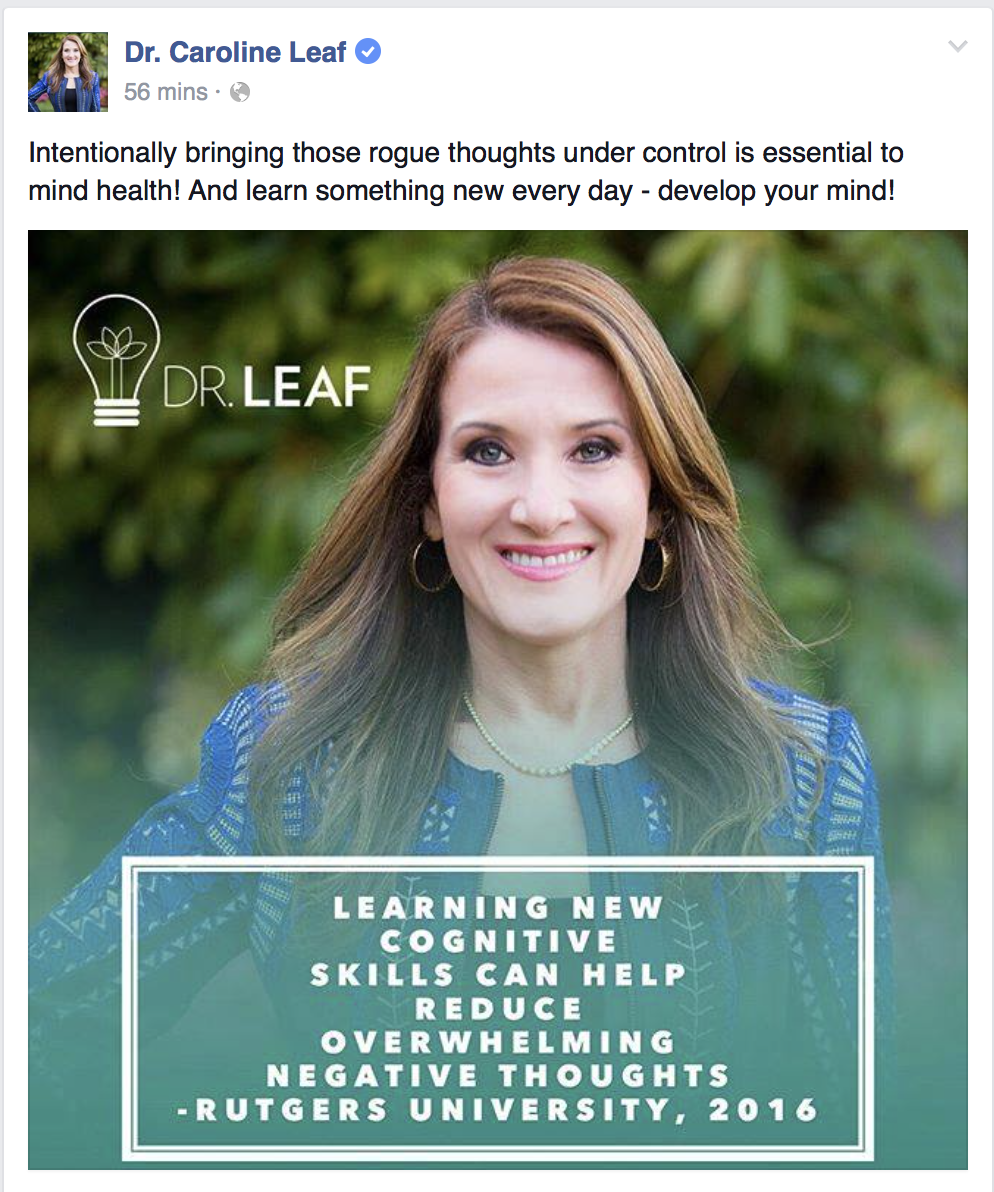
According to a new study by Rutgers University, “Learning new cognitive skills can help reduce overwhelming negative thoughts”. So said Dr Caroline Leaf, communication pathologist and self-titled cognitive neuroscientist. She also advised that “Intentionally bringing those rogue thoughts under control is essential to mind health! And learn something new every day – develop your mind!”

So … negative thoughts are what, like an evil spy organisation, running around causing wanton destruction, overwhelming your capacity to function?

If that’s the case, then new cognitive skills must be like Tom Cruise, running, jumping, shooting and kicking their way through the negative thoughts, saving the world and getting the girl.

It’s a popular concept. As I discussed in my previous post, the power of positive thinking is culturally sanctioned Western folk psychology. We implicitly accept the idea that we have to harness positive thoughts and stop negative thoughts if we’re to overcome life’s obstacles.

However, the only rogue notions here are Dr Leaf’s.

Dr Leaf’s post sounds authoritative and sciency, but is nothing else. It’s vague, and with a bit of deeper palpation, it’s actually wrong.

Dr Leaf has gone back to her bad habit of obfuscating her references, maybe because she’s getting lost in her own hubris, or more likely, it’s much easier for her audience to see that she’s just cut-and-pasted the opening by-line of a press release again if she actually disclosed her source.

Screen Shot 2016-02-12 at 4.17.09 PM

In fact, the article is about a study from Rutgers which studied two behavioural interventions (not cognitive ones), a form of mindfulness meditation and aerobic exercise. The original publication is in the journal Translational Psychiatry [1], if you want to check it out for yourself. This article isn’t about learning cognitive skills at all. Exercise and mindfulness meditation are tried and true behavioural methods of improving mood disorders like depression, which the authors combined to assess the benefit or otherwise. Neither intervention involved challenging or fighting thoughts, or suppressing ‘negative’ thoughts, or “intentionally bringing those rogue thoughts under control”.

Indeed, the mindfulness meditation used involves “the practice of attending to the present moment and allowing thoughts and emotions to pass without judgment.” [1] Mindfulness doesn’t try to control anything.  Rather than supporting Dr Leaf’s declaration that intentionally bringing thoughts under control is essential to mind health, this study contradicts it.

Cutting and pasting doesn’t make you an expert. It’s easy to take a sciency-sounding tag line and put it in a pretty little graphic. Everyone does it. 90% of Instagram and Facebook posts these days are faux-authoritative pseudo-science memes that aren’t worth the bytes they’re made of.

Junk science is like junk food. If that’s all you consume, then you eventually become an intellectual blob of lard, stuffed full of mistruths and logical fallacies, and incapable of understanding scientific truth for yourself. Dr Leaf’s audience deserves better than junk science and it’s about time that Dr Leaf stopped pretending to be an expert, and started acting like one.

Reference

[1]  Alderman BL, Olson RL, Brush CJ, Shors TJ. MAP training: combining meditation and aerobic exercise reduces depression and rumination while enhancing synchronized brain activity. Transl Psychiatry 2016;6:e726.

Dr Caroline Leaf and the nonsense of ‘negative’ thinking.

Screen Shot 2016-02-09 at 7.08.49 PM

The power of positive thinking. It’s like rust on our collective consciousness, an idea that’s seems virtually impossible to eradicate, slowly eating away at our collective psyche. The idea has become so ingrained in our culture that it’s part of our folklore and our idiom, and it continues to be deliberately perpetuated by success coaches, business leaders and others who make a very tidy living by peddling baseless optimism. It’s been repeated so often that the ‘power of positive thinking’ has become an Availability Cascade (a self-reinforcing process by which an idea gains plausibility through repetition).

Herbert and Forman summarise it nicely, “The ideas that thoughts and beliefs lead directly to feelings and behavior, and that to change one’s maladaptive behavior and subjective sense of well-being one must first change one’s cognitions, are central themes of Western folk psychology. We encourage friends to ‘look on the bright side’ of difficult situations in order to improve their distress. We seek to cultivate “positive attitudes” in our children in the belief that this will lead to better academic or athletic performance. Traditional cognitively-oriented models of CBT (e.g., CT, stress inoculation training, and rational emotive behavior therapy) build on these culturally sanctioned ideas by describing causal effects of cognitions on affect and behavior, and by interventions targeting distorted, dysfunctional, or otherwise maladaptive cognitions.” [1]

Dr Caroline Leaf is a communication pathologist and a self-titled cognitive neuroscientist. She is one of the many that continue to perpetuate the myth of positive and negative thinking.

Today’s social media meme was yet another promotion of this misguided idea, and to top it off, she misquoted scripture again in an attempt to reinforce it.

“If you randomly allow any negative thought into your mind damage can ensue on a mental & physical level. ‘We destroy every proud obstacle that keeps people from knowing God. We capture their rebellious thoughts and teach them to obey Christ.’ 2 Corinthians 10:5 NLT”

Lets quickly break meme down to see exactly why Dr Leaf is, yet again, misleading her audience.

1. The mind does not control the brain

Dr Leaf’s meme implies that negative thought damages us mentally and physically. The problem with that is that the mind doesn’t control our brain or our body, so negative thought can’t damage us mentally or physically.

Instead, it’s our brain that gives rise to, and controls our thoughts and feelings. We don’t see what goes on ‘under the hood’ so to speak, we only experience our thoughts and feelings, so we assume that regulate each other. But it’s our brain and a number of other processes that are responsible for generating both our thoughts and feelings (CAP blog).

‘Negative’ thoughts can sometimes be the result of damage to our brain, but ‘negative’ thoughts don’t damage the brain.

In fact, often the so-called ‘negative’ thoughts are actually good for us.

2. Negative thinking is normal and healthy

Dr Leaf’s meme also implies that we control the content of our thoughts by suggesting that we ‘allow’ negative thoughts into our minds. But negative thoughts are meant to be there, which is why we have them. ‘Negative’ thoughts have a positive function. We need them to survive.

For example, we have a fear response to prevent us from continually putting ourselves in danger. We have an anger response to motivate us through difficult obstacles. We have feelings of embarrassment to help maintain social cohesion. As Skinner and Zimmer-Gembeck state, “adaptive coping does not rely exclusively on positive emotions nor on constant dampening of emotional reactions. In fact, emotions like anger have important adaptive functions, such as readying a person to sweep away an obstacle, as well communicating these intentions to others. Adaptive coping profits from flexible access to a range of genuine emotions as well as the ongoing cooperation of emotions with other components of the action system.” [2]

Dr Leaf isn’t helping anyone with her meme today. She’s simply promoting an outdated and unscientific notion, encouraging her audience to suppress normal, helpful adaptive functions for fear of harm that’s not scientifically possible.

Then as if to add insult to injury, she follows up her misleading meme with an equally misleading misrepresentation of 2 Corinthians 10:5.

3. Taking every thought captive?

2 Corinthians 10:5 is Pauls famous scripture about taking every thought captive, a concept which seems to support Dr Leaf’s ideas, except that Paul isn’t speaking generally to us, but specifically about the Corinthian church. Look at the verse in context:

“By the humility and gentleness of Christ, I appeal to you – I, Paul, who am ‘timid’ when face to face with you, but ‘bold’ towards you when away! I beg you that when I come I may not have to be as bold as I expect to be towards some people who think that we live by the standards of this world. For though we live in the world, we do not wage war as the world does. The weapons we fight with are not the weapons of the world. On the contrary, they have divine power to demolish strongholds. We demolish arguments and every pretension that sets itself up against the knowledge of God, and we take captive every thought to make it obedient to Christ. And we will be ready to punish every act of disobedience, once your obedience is complete.
You are judging by appearances. If anyone is confident that they belong to Christ, they should consider again that we belong to Christ just as much as they do. So even if I boast somewhat freely about the authority the Lord gave us for building you up rather than tearing you down, I will not be ashamed of it. I do not want to seem to be trying to frighten you with my letters. For some say, ‘His letters are weighty and forceful, but in person he is unimpressive and his speaking amounts to nothing.’ Such people should realise that what we are in our letters when we are absent, we will be in our actions when we are present.” (NIV UK, 2 Corinthians 10:1-11)

This chapter is a specific rebuke to some of the Christians within the church at Corinth, and also a defence against some of the murmurings and accusations that some in that church were levelling at Paul. For example, in verse 2, “I beg you that when I come I may not have to be as bold as I expect to be towards some people who think that we live by the standards of this world.”

Verses 3-6 are a specific and authoritative rebuttal against the accusations levelled at Paul, paraphrased as, “You may speak against us and the church, but we have weapons that smash strongholds, and we’re coming to take down those pretensions of yours and take every thought of yours captive to make it obedient to Christ, and punish every act of disobedience …”

The specific nature of the verse is also supported by some Bible commentary: “But how does St. Paul meet the charge of being carnally minded in his high office? “Though we walk in the flesh [live a corporeal life], we do not war after the flesh,” or “according to the flesh,” the contrast being in the words “in” and “according.” And forthwith he proceeds to show the difference between walking in the flesh and warring according to the flesh. A warrior he is, an open and avowed warrior – a warrior who was to cast down imaginations and every high thing that exalteth itself against the knowledge of God, and bring into captivity every thought to the obedience of Christ; a warrior too who would punish these Judaizers if they continued their disorganizing work; but a prudent and considerate warrior, deferring the avenging blow till “I am assured of your submission” (Stanley) “that I may not confound the innocent with the guilty, the dupes with the deceivers.” What kind of a preacher he was he had shown long before; what kind of an apostle he was among apostles as to independence, self-support, and resignation of official rights in earthly matters, he had also shown; further yet, what kind of a sufferer and martyr he was had been portrayed.” (C. Lipscomb – http://biblehub.com/commentaries/homiletics/2_corinthians/10.htm)

Similarly, the translation from the original text is more specific than general. The verb used for “bringing into captivity” is aichmalōtízō, “to make captive: – lead away captive, bring into captivity” which is in the Present Active Participle form of the verb. The present tense represents a simple statement of fact or reality viewed as occurring in actual time. The active voice represents the subject as the doer or performer of the action. The Greek participle corresponds for the most part to the English participle, reflecting “-ing” or “-ed” being suffixed to the basic verb form. Actions completed but ongoing or commands are different verb tenses (see https://www.blueletterbible.org/help/greekverbs.cfm for a better explanation). So Paul wasn’t making a general statement, but a specific statement about what he would do in his present time, not the future.

So, Paul isn’t telling us to “bring every thought captive into obedience to Christ”. Dr Leaf is perpetuating a common scriptural misunderstanding.

A verse which better clarifies what God wants for our thought life is Paul’s exhortation to the Philippian church in Philippians 4:8, “Finally, brothers and sisters, whatever is true, whatever is noble, whatever is right, whatever is pure, whatever is lovely, whatever is admirable – if anything is excellent or praiseworthy – think about such things.” Both the context, and the form of the verb, suggest that this is an ongoing command. And it makes better sense too. If we spend all of our time trying to fight against every thought that comes into our head, we’d become exhausted, but we can divert attention to those things that are worthy of our attention. And in many ways, what Paul is encouraging is what would be considered now as simple meditation, which is more scientific than the power of positive thinking.

The moral of this story … ‘negative’ thoughts and feelings don’t do us damage, but trying to unnecessarily suppress them does.

References

[1]     Herbert, J.D. and Forman, E.M., The Evolution of Cognitive Behavior Therapy: The Rise of Psychological Acceptance and Mindfulness, in Acceptance and Mindfulness in Cognitive Behavior Therapy. 2011, John Wiley & Sons, Inc. p. 1-25.
[2]     Skinner EA, Zimmer-Gembeck MJ. The development of coping. Annual review of psychology 2007;58:119-44.

Does helping others help you?

John Holmes wrote “There is no exercise better for the heart than reaching down and lifting people up.”

We all know that exercise is good for us, but is the exercise of the heart, “reaching down and lifting people up” just as good for us?

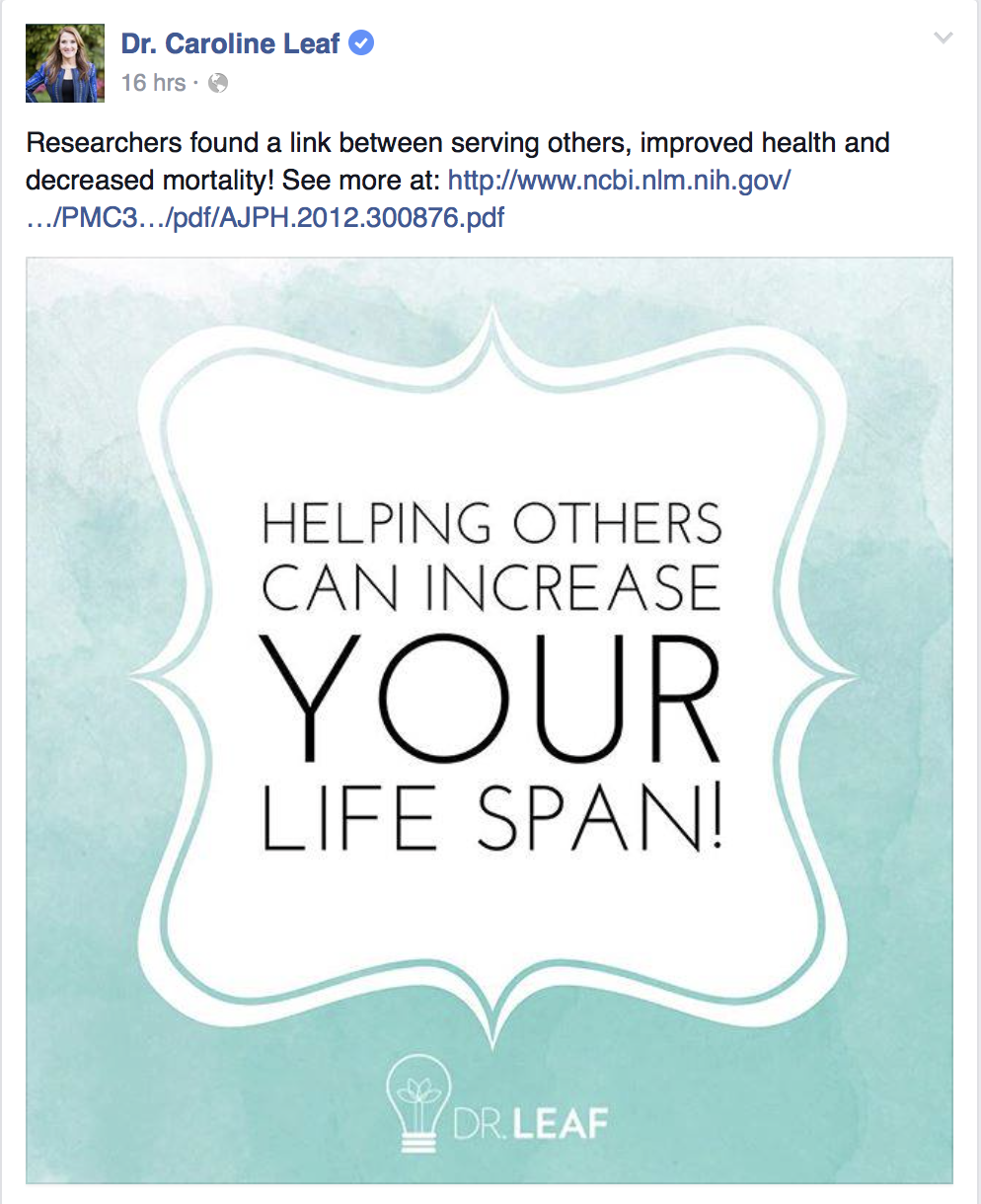
Dr Caroline Leaf is a communication pathologist and self-titled cognitive neuroscientist.  Her meme of the day today was a claim that “Helping others can increase your lifespan.”  She explained that “Researchers found a link between serving others, improved health and decreased mortality! See more at: http://www.ncbi.nlm.nih.gov/pmc/articles/PMC3780662/pdf/AJPH.2012.300876.pdf”.

Screen Shot 2016-01-16 at 6.28.07 PM

The journal she referenced was a 2013 article by Poulin et al in the American Journal of Public Health [1].  Poulin and his colleagues examined data from nearly 850 people in the Detroit area.  At the start of their study, they asked their participants about stressful life events in the last year and whether they provided tangible assistance to friends or family members.  They then followed their participants for five years and analysed the characteristics of who died in that time.

According to the study by Poulin, those who helped others were younger, healthier, more likely to be White, of higher socioeconomic status, and higher in social support and social contact than those who didn’t help, all factors that have been shown to influence mortality.  They also noted that 70% of their cohort didn’t experience any stressful life events.  While they adjusted for these variables, their statistics would still be affected by them.  As it turns out, while their results were significant, their numbers had broad confidence intervals, so the effect they found is very weak.

What about other studies looking at the same question but in a different way?  Well, there are mixed findings.  Roth and colleagues published a study in 2013 in the American Journal of Epidemiology which also showed that care-givers had better life expectancy than matched controls [1] but then a number of other studies show the opposite.  The Caregiver Health Effects Study found that those who were providing care to a disabled spouse and who reported some strain associated with that care had a 63% elevated risk of death compared with non-caregiving spouses [2]. Other studies suggest that caregivers have poorer mental and physical health status than non-caregivers [3], and caregiving has been widely portrayed as a serious public health problem in the professional literature [4, 5].

So while Poulin found a loose association between helping others and decreased mortality, Dr Leaf has taken that a step too far:

> Firstly, correlation does not equal causation.  Just because a study found those who helped others had a decreased mortality doesn’t mean that the reverse, helping others increases your lifespan, necessarily holds.  There may be other explanations.
> Secondly, other studies show conflicting results, so Poulin’s study may be a statistical hiccough.

It’s not clear that helping others is actually good for our health.  That doesn’t mean to say we shouldn’t help others. I think we should, if for no other reason than the golden rule, “Do unto others as you would have them do unto you.”  But we can’t definitively say that helping others will help us directly by making us live longer.  That’s scientifically still up in the air.

References

[1]        Poulin MJ, Brown SL, Dillard AJ, Smith DM. Giving to others and the association between stress and mortality. Am J Public Health 2013 Sep;103(9):1649-55.
[2]        Schulz R, Beach SR. Caregiving as a risk factor for mortality: the Caregiver Health Effects Study. JAMA : the journal of the American Medical Association 1999 Dec 15;282(23):2215-9.
[3]        Pinquart M, Sorensen S. Differences between caregivers and noncaregivers in psychological health and physical health: a meta-analysis. Psychol Aging 2003 Jun;18(2):250-67.
[4]        Talley RC, Crews JE. Framing the public health of caregiving. Am J Public Health 2007 Feb;97(2):224-8.
[5]        Centre for Disease Control and Prevention. Caregiving, A Public Health Priority.  2010, 7 Dec 2010 [cited 2016 Jan 16]; Available from: http://www.cdc.gov/aging/caregiving/index.htm

Mobile phone mothering – one more thing for mums to feel unnecessarily guilty about

Mothers.  They are probably the single most important group of people in the world.

It’s not that I’m belittling the role of fatherhood, or demeaning the amazing work that fathers do for their children, but simply put, we wouldn’t be here if it wasn’t for the tireless patience and sacrifice of our mums.  Nine months of nausea, sore breasts, swollen appendages and having your organs used as punching bags.  Then there’s the trauma of birth itself, which is rewarded with the full-time care of a screaming, incessantly ravenous alimentary canal which has taken the form of a baby.  Over the years, the screaming and the pooping become slightly more manageable, but most mothers remain the head chef, playmate, laundromat, ironing lady, teacher, taxi-driver, nurse and drill sergeant for their offspring.

Despite these daily feats of amazement, most mothers are haunted by this nagging sense of not being good enough – Mother Guilt.  As author Mia Redrick wrote,

“Mother’s guilt is real. Nearly all of us experience it. We are racked with guilt, feeling that our best isn’t good enough. We struggle when work commitments prevent us from attending school events and we are crushed by the looks of disappointment on our children’s faces. We wonder if choices we have made, such as what school to send our kids to, have not had far-reaching negative consequences, if a different path would have resulted in happier, more well-adjusted kids. We moms might feel guilty when we can’t afford something for our kids or are nagged by the feeling that we simply don’t spend enough time with them.”

Mothers seems to feel guilty about anything, and everything, for the whole day …

“The kids are in the bed again. I was sure I shushed them back to their beds at 2am, they must have snuck in during the wee hours. Tonight I will make sure they sleep all night in their own beds. How will they ever learn to sleep if I keep letting them come in to my bed?”
“Whose children get only eight hours of sleep a night? I am sure at this age they are meant to be getting 12 – 14 hours sleep. I am going to damage then for life. Maybe I should let them sleep in my bed so they get more sleep?”
“Oh so much sugar in EVERYTHING.  Don’t you read the articles? Don’t you hear the “experts”? Don’t you see those diagrams with spoonful upon spoonful of the deadly substance displayed, a visual representation of poison imprinted on your mind each and every time you take the bran flakes from the cupboard?”

And so it goes on.

Today, Dr Leaf added one more thing for mothers to feel guilty about – smartphones.

Screen Shot 2016-01-09 at 1.58.46 PM

“Mothers, put down your smartphones when caring for your babies! That’s the message from researchers, who have found that fragmented and chaotic maternal care can disrupt proper brain development, which can lead to emotional disorders later in life.”

She then exhorted her followers, “Lets get some real eye-to-eye contact going – dads included!”

Dr Caroline Leaf is a communication pathologist and self-titled cognitive neuroscientist.  Credit where credit’s due – in the past, Dr Leaf has pathologically avoided citing her references, but today, she cited the article itself and the news story that promoted it.

But again, like the meme she posted a couple of days ago about sadness making people sick, Dr Leaf has posted the opening paragraph of a promotional PR puff piece and made it sound like a scientific pronouncement.  When you actually read the journal article that the news story is promoting, it has nothing to do with smartphones.  Or indeed, human beings.

The research was performed entirely on rats.

The research itself, by Molet and colleagues [1], seemed entirely legitimate.  The rat pups raised in a more chaotic way appeared to have higher levels of anhedonia, because they didn’t engage as much in the things that rats normally find pleasurable, namely, drinking sugar water or playing with their rat buddies.

I’m not sure if you’ve ever seen a mother rat on a smartphone.  I certainly haven’t, which means that news article Dr Leaf took her meme from, the one published on Science Direct, made some pretty tenuous assumptions:

  1. Chaotic mothering to rat pups is the cause of rat anhedonia
  2. Rat mothering and human mothering have similar outcomes
  3. Smartphone use causes fragmented and chaotic maternal care
  4. Not using smartphones would improve outcomes.

There’s no evidence from this study, or any work that I know of, that definitively proves any one of these things.  There are a number of alternative explanations as to why those rat pups weren’t as happy as the control group, but even if the chaotic nurturing of the rat babies was THE cause of their unhappiness, human beings are completely different to rats in cages.  And there are many things, other than smartphones, that can strain the mother-baby relationship.  Excessive mother guilt for one.

Dr Leaf’s meme is a good example of just how misinformation can spread quickly through the internet.  The PR department of a university writes a puff piece on the article to promote the university and its research.  But no one wants to read about depressed rats – they need a better hook.  There’s a love-hate relationship with smartphones in our culture, and lots of Mommy-guilt, so they use a sentence about smartphones and mothering to grab people’s attention, even though the journal article had nothing to do with either.

Science Direct then simply republished the press release from the university without filtering it, where it’s then picked up by wannabe scientists and self-titled experts like Dr Leaf, who pass on the misinformation to hundreds of thousands of their followers.  Pretty soon, mothers everywhere are feeling guilty about looking at their phone instead of their children’s eyes, when it probably doesn’t make a blime bit of difference.

The take home messages:

  1. Unless you’re a rat, there’s no evidence that using your smartphone makes you a bad mother.
  2. Be wary of social media memes, and what you read on the internet.
  3. Dr Leaf is hurting her own credibility by reposting the opening paragraphs of sciencey promotional PR articles instead of reading the actual article first. We need experts to reduce the amount of misinformation clogging the internet, not increase it.

References

[1]        Molet J, Heins K, Zhuo X, et al. Fragmentation and high entropy of neonatal experience predict adolescent emotional outcome. Translational psychiatry 2016;6:e702.

Does sadness make you sick?

LeafMeme20160107

We’ve all heard of being “homesick”, or “heartsick”, or “lovesick”.   Sometimes when we’re extremely sad, we feel the knot in our stomachs, the pressure in our chests, or the confusion and distraction in our minds as the waves of sadness wash over and discombobulate us.

But can being sad really make you physically ill as well as emotionally distraught?

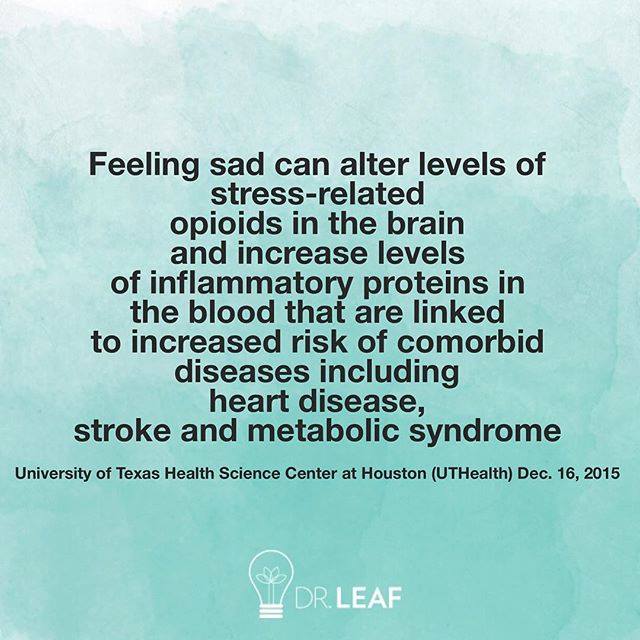
Dr Caroline Leaf declared today on her social media platforms that “Feeling sad can alter levels of stress-related opioids in the brain and increase levels of inflammatory proteins in the blood that are linked to increased risk of comorbid diseases including heart disease, stroke and metabolic syndrome.”

Dr Caroline Leaf is a communication pathologist and a self-titled cognitive neuroscientist.  She believes that our cognitive stream of thought determines our physical and mental health, and can even influence physical matter through the power of our minds.

She also added some further interpretation to her meme: “So this is more evidence that our thoughts do count: they have major epigenetic effects on the brain and body! We need to apply the principles in the Bible and listen to the Holy Spirit – no excuses this year!”

With all due respect to Dr Leaf, the study she quotes doesn’t prove anything of the sort.

Dr Leaf’s meme is a copy and paste of the opening paragraph of a news report published by the university’s PR people to promote their faculty.  This isn’t a scientific summary, it’s a hook to draw attention to an article which amounts to a PR puff piece.  If Dr Leaf had read further into the article, I don’t think she would have been quite so bold in claiming what she did.

The article discussed a study by Prossin and colleagues, published in Molecular Psychiatry [1].  You can read the original study here.  The study specifically measured the change in the level of the activity of the opioid neurotransmitter system and the amount of a pro-inflammatory cytokine IL-18 across two experimental mood states, and in two different groups of volunteers, people with depression, and those without.

For a start, it’s important to note that the study isn’t referring to normal day-to-day sadness.  This was an experimentally induced condition in which a sad memory was rehearsed so that the same feeling could be reproduced in a scanner, and the study was looking at the effect of this sad “mood” on people who were pathologically sad, that is, people diagnosed with major depression.

It’s well known that people with depression are at a higher risk of major illnesses, such as heart attacks, strokes and diabetes [2] The current study by Prossin et al looked experimentally at one possible link in the chain, a link between a neurotransmitter system that’s thought to change with emotional states, and one of the chemical mediators of inflammation.

They found that:

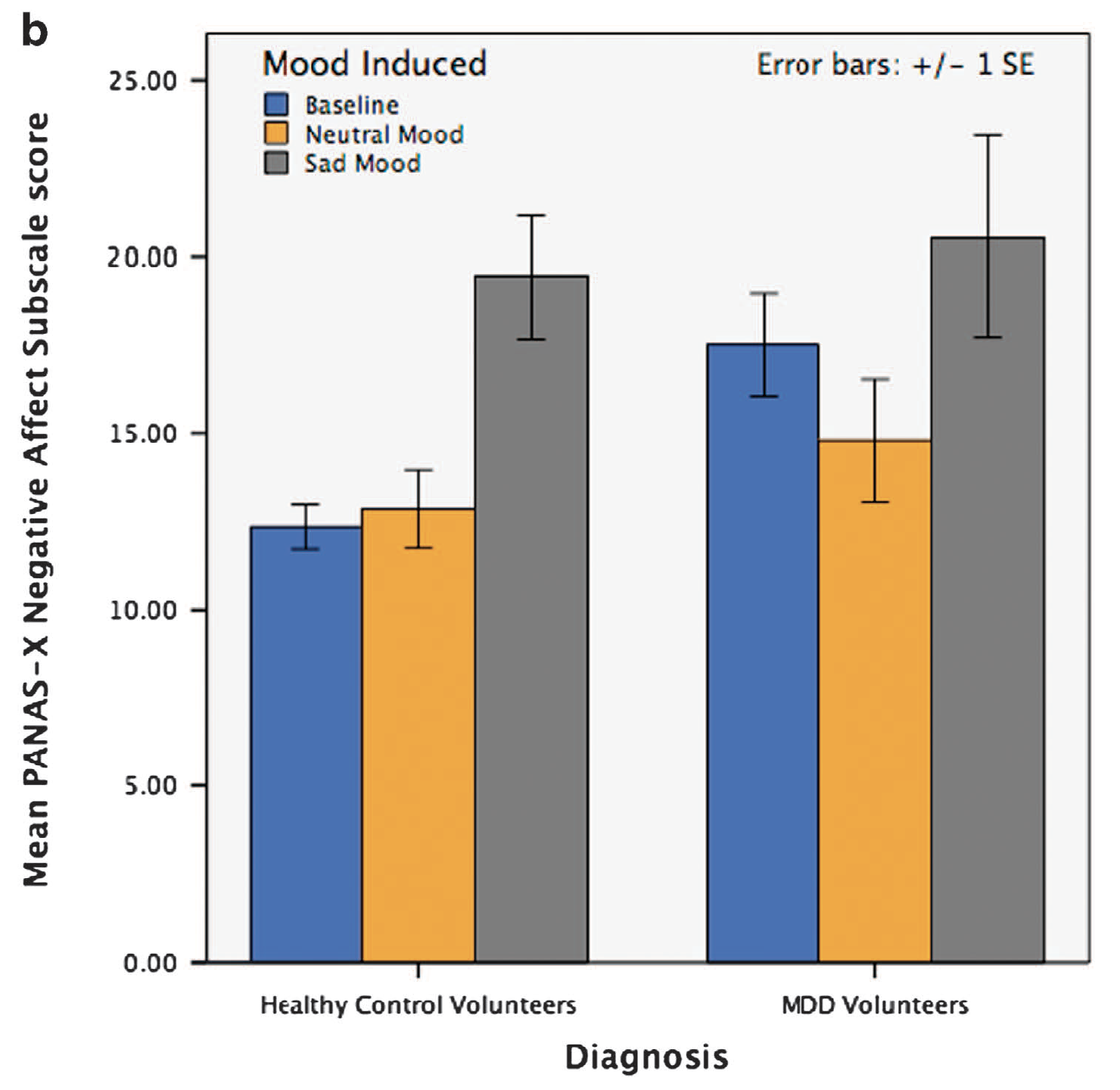
> Depressed people were much sadder to start with, and remained so throughout the different conditions.  The depressed people stayed sadder in the ‘neutral’ phase, and the healthy cohort couldn’t catch them in the ‘sad’ phase.
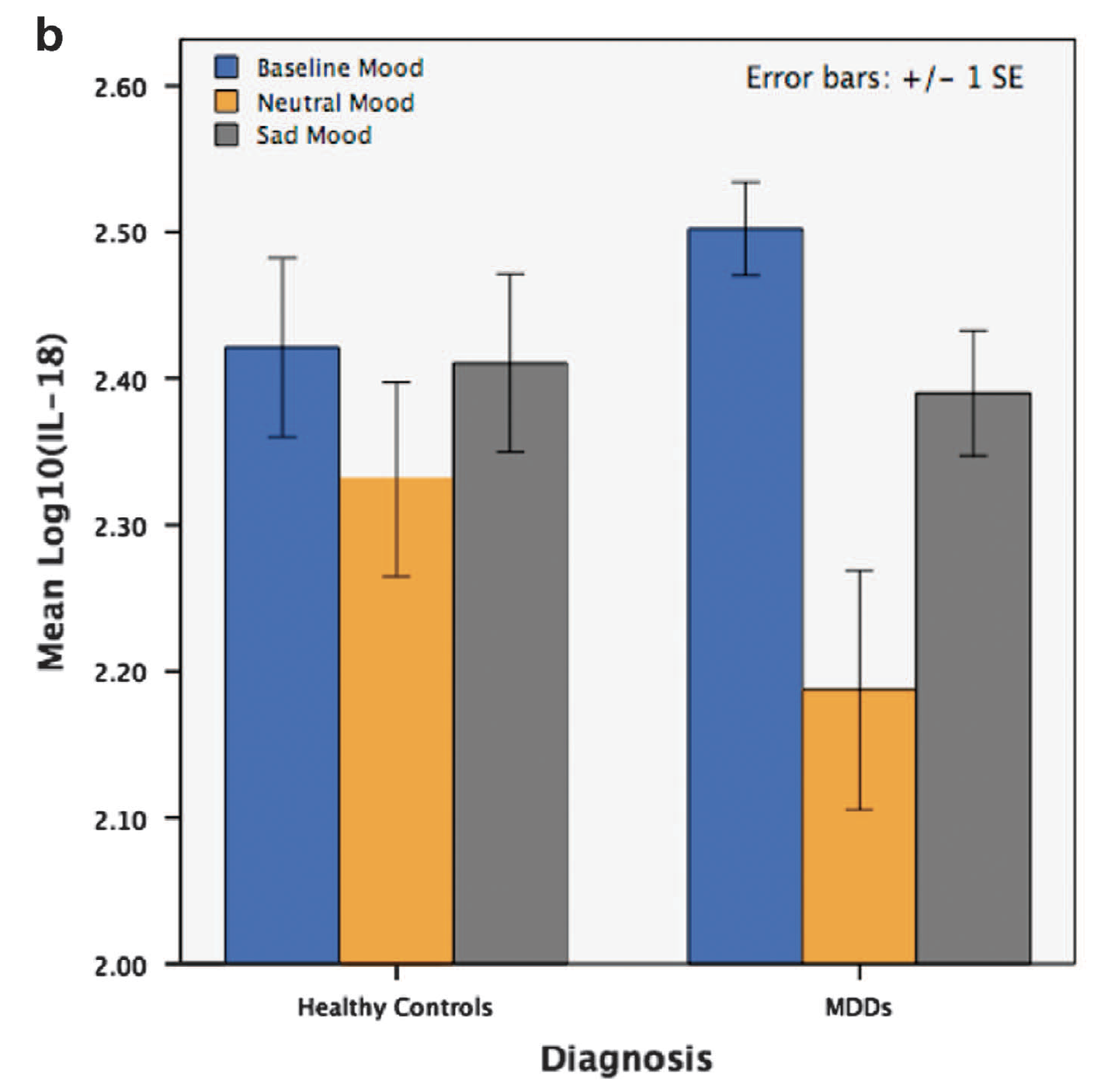
> Depressed people had a much higher level of the inflammatory marker to start with, and interestingly, this level dropped significantly with the induction of the neutral phase and the sad phase.  What was also interesting was that the level of the inflammatory marker was about the same in the baseline and the sad phase for the healthy volunteers.
> A completely different pattern of neurotransmitter release was seen in the two different groups.  People with depression had an increase in the neurotransmitter release over a large number of areas of the brain, whereas in the healthy controls with normal mood, the sad state actually resulted in a decreased amount of neurotransmitter release, and in a much smaller area within the brain.  This suggests that the opioid neurotransmitter system in the brains of depressed people is dysfunctional.

Affect/Sadness Scores - Prossin et al Molecular psychiatry 2015 Aug 18.

Affect/Sadness Scores – Prossin et al Molecular psychiatry 2015 Aug 18.

IL18 v Mood state/diagnosis - Prossin et al Molecular psychiatry 2015 Aug 18.

IL18 v Mood state/diagnosis – Prossin et al Molecular psychiatry 2015 Aug 18.

Effectively, the results of the study reflect what’s already known – the emotional dysregulation seen in people with depression is because of an underlying problem with the brain, not the other way around.  And, sadness in normal people is not associated with a significant change in the evil pro-inflammatory cytokine.

So, according to Prossin’s article,

  1. normal sadness in normal people is not associated with physical illnesses.
  2. sadness is abnormally processed in people who are depressed, which maybe related to an abnormal inflammatory response, which might explain the known link between depression and increased risk of illness

The article is not “more evidence that our thoughts do count.”  If anything, it shows that underlying biological processes are responsible for our thoughts and emotions and their downstream effects, not the thoughts and emotions themselves.

And unfortunately, it appears that Dr Leaf hasn’t got past the opening paragraph of a puff piece article before jumping to a conclusion which only fits her worldview, not the actual science.

References

[1]        Prossin AR, Koch AE, Campbell PL, Barichello T, Zalcman SS, Zubieta JK. Acute experimental changes in mood state regulate immune function in relation to central opioid neurotransmission: a model of human CNS-peripheral inflammatory interaction. Molecular psychiatry 2015 Aug 18.
[2]        Clarke DM, Currie KC. Depression, anxiety and their relationship with chronic diseases: a review of the epidemiology, risk and treatment evidence. Med J Aust 2009 Apr 6;190(7 Suppl):S54-60.

2016: A New Hope

“Hope, it is the quintessential human delusion, simultaneously the source of your greatest strength, and your greatest weakness.” The Architect, Matrix Reloaded

I confess, sometimes I can be a little bit rigid.  And grumpy.

Every New Years Eve, I get a tinsy bit frustrated by the vague aspirations that adorn social media statuses everywhere.  From the self-realisation types …

“Lets make 2016 the best year ever / I’m gonna take 2016 to the next level / Be the love, feel the power, live the life, bask in the light”

through to the typical vague self-improvement ones …

“This year I’m gonna lose weight / stop smoking / be nicer to people / save more / give more / love more / exercise more / eat less …”

It’s all a bit too much for my inner cynic.

My pragmatic cynic dismissed them as pointless. “These aspirations that people post are just pathetic, they won’t benefit anyone.  Goals need to be SMART – Specific, Measurable, Attractive, Realistic and Time-Framed.  Why bother with anything else.”

The activist cynic chimed in, “Honestly, there are so many other more important things … who cares about ‘going to the next level’ when you’re being conned everyday by charlatans and snake-oil salesmen.”

My core cynic was like, “What’s the fuss anyway? The transition into 2016 ‘holds no more meaning that the silent segue from March 14th into March 15th, or the almost imperceptible movement of the minute hand as 2:38pm becomes 2:39pm. If we’re going to celebrate one meaningless moment passing, then shouldn’t we extend the same courtesy to all other moments too? Why does the passage of time matter so much more at the stroke of midnight? I bet 11:58pm feels a bit miffed.’”

I thought about letting my sceptical trinity loose on this post today, but somehow I felt like it wasn’t quite right.  And then I had a small epiphany – each aspiration represents more than vague self-affirmation and cyclical mediocrity.  Together, they represent hope, and who am I to stifle the incredible power of hope.

The power of hope is being realised in secular psychology in recent times.  Hope involves having goals, along with the desire and plan to achieve them.  Dr Shane Lopez, a leading expert on the psychology of hope, describes hope as “the golden mean between euphoria and fear. It is a feeling where transcendence meets reason and caution meets passion.”

Hope leads to everything from better performance in school to more success in the workplace to greater happiness overall.  There may also be a role for teaching hopefulness in the treatment of depression.

So how can we harness the power of hope?  How can we use hope to make 2016 a better year than 2015?  Hopeful people share four core beliefs:
1. The future will be better than the present.
2. I have the power to make it so.
3. There are many paths to my goals.
4. None of them is free of obstacles.

So if we’re going to engage the power of hope, we need to believe that the future is brighter and it’s within our grasp, so long as we keep moving toward it, in spite of the expected obstacles.

Of course, like the Architect noted in the Matrix Reloaded, hope can sometimes be a weakness.  Like Lopez noted, hope needs the right mix of caution and reason, not just passion and transcendence.  If you want to move forward into a better future, you have to keep your feet on the ground.  You need to be aware of those that would take advantage of blind trust.

The conclusion: I’m glad to have my sceptical inner trinity on board, so long as I temper them with a bit more optimism, and maybe an occasional self-affirmation or two.

I hope that 2016 would bring you new hope, along with prosperity and peace.

Happy new year everyone!

Bibliography

http://psychcentral.com/blog/archives/2013/03/21/the-psychology-of-hope/

http://psychcentral.com/news/2008/08/19/hope-therapy-for-depression/2778.html

http://wonkyperfectionism.blogspot.com.au/2015/01/new-years-vague-sort-of-aspirations.html

Should pregnant women still take antidepressants if they’re depressed? – SSRI’s and the risk of autism

As is my usual habit, I sat down tonight to do something useful and wound up flicking though Facebook instead.  Procrastination … avoidance behaviour … yeah, probably.  But at least this time it turned out to be rather useful procrastination, because I came across a science news story on Science Daily about a study linking the use of anti-depressants in pregnancy with an 87% increased risk of autism.

Actually, this is old news.  Other studies have linked the use of some anti-depressants with an increased risk of autism, such as Rai et al in 2013 [1].

The latest study to come out used data from a collaboration called the Quebec Pregnancy Cohort and studied 145,456 children between the time of their conception up to age ten.  In total, 1,045 children in that cohort were diagnosed with autism of some form, which sounds like a lot, but it was only 0.72%, which is actually lower than the currently accepted prevalence of autism in the community of 1%.

What the researchers got excited about was the risk of developing autism if the mother took an antidepressant medication at least at one time during her pregnancy.  Controlling for other variables like the age, wealth, and other health of the mothers, a woman who took an anti-depressant during pregnancy had a 1.87 times greater chance that her baby would end up with ASD, compared to women who did not take an anti-depressant [2].

An 87% increase sounds like an awful lot.  In fact, it sounds like another reason why anti-depressants should be condemned … right?

Well, like all medical research, you’ve got to consider it all in context.

First, you’ve always got to remember that correlation doesn’t always equal causation.  In this particular study, there was a large number of women being followed, and their children were followed for a long enough time to capture all of the likely diagnoses.  So that’s a strength.  They also tried to control for a large number of variable when calculating the risk of anti-depressants, which also adds more weight to the numbers.

Although the numbers are strong, studies like these can’t prove that one thing causes another, merely that they’re somehow linked.  It might be that taking anti-depressants causes the brain changes of autism in the foetus, but this sort of study can’t prove that.

Even if the relationship between anti-depressants and ASD was cause-and-effect, what’s the absolute risk?  Given the numbers in the study, probably pretty small.  With a generous assumption that ten percent of the study population was taking anti-depressants, the increase in the absolute risk of a women taking anti-depressants having a child with ASD is about 0.5%.  Or, there would be one extra case of autism for every 171 that took anti-depressants.

Hmmm … when you think of it that way, it doesn’t sound as bad.

You also have to consider the increase in risk to women and their offspring when they have depression that remains untreated, or in women that stop their anti-depressant medications.  There is some evidence that babies born to women with untreated depression are at risk of prematurity, low birth weight, and growth restriction in the womb, as well as higher impulsivity, poor social interaction, and behavioural, emotional and learning difficulties.  For the mother, pregnant women with depression are more at risk of developing postpartum depression and suicidality, as well as pregnancy complications such as preeclampsia, and an increase in high-risk health behaviour such as smoking, drug and alcohol abuse, and poor nutrition.  Women who discontinued their antidepressant therapy relapsed significantly more frequently compared with women who maintained their antidepressant use throughout pregnancy (five times the rate) [3].

So the take home messages:

  1. Yes, there’s good evidence that taking anti-depressants in pregnancy is linked to an increased risk of a child developing autism.
  2. But the overall risk is still small. There is one extra case of autism for every 171 women who take anti-depressants through their pregnancy.
  3. And this should always be balanced out by the risks to the mother and child by not adequately treating depression through pregnancy.
  4. If you are pregnant or you would like to become pregnant, and you are taking anti-depressants, do not stop them suddenly. Talk to your GP, OBGYN or psychiatrist and work out a plan that’s best for you and your baby.

References

[1]       Rai D, Lee BK, Dalman C, Golding J, Lewis G, Magnusson C. Parental depression, maternal antidepressant use during pregnancy, and risk of autism spectrum disorders: population based case-control study. Bmj 2013;346:f2059.
[2]       Boukhris T, Sheehy O, Mottron L, Bérard A. Antidepressant use during pregnancy and the risk of autism spectrum disorder in children. JAMA Pediatrics 2015:1-8.
[3]       Chan J, Natekar A, Einarson A, Koren G. Risks of untreated depression in pregnancy. Can Fam Physician 2014 Mar;60(3):242-3.

Dr Caroline Leaf’s war on drugs

Today, Dr Leaf posted this on her social media feeds.  It’s clearly meant to shock and enrage her followers.

Screen Shot 2015-12-12 at 11.56.44 AM

Dr Caroline Leaf is a communication pathologist and a self-titled cognitive neuroscientist.  She’s also cast herself as an expert on mental health.

To the detriment of her followers, and sadly, to the rest of the Christian church, most people believe her.

Her most recent book, and her social media memes for the last couple of months, have made it clear that Dr Leaf is pursuing her own personal war on drugs … but prescription psychiatric drugs not the illicit kind.

Unfortunately, her attacks on prescription psychiatric drugs have amounted to nothing more than a hysterically illogical smear campaign under the guise of her concern for public safety.

Today’s offering follows the same pattern of narrow-minded hysteria.

Her main quote from was from Robert Whitaker, “Twenty years ago, our society began regularly prescribing psychiatric drugs to children and adolescents, and now one out of every fifteen Americans enters adulthood with a ‘serious mental illness’.”

Whitaker, like Dr Leaf, is an outspoken critic of modern psychiatric treatment with a poor understanding of how psychiatric medications actually work.  The statement that Dr Leaf quotes is remarkable for it’s poor logic.  The quote implies that the rise in childhood mental health is because of the rise in psychotropic medication use in children.  But correlation does not equal causation.  Even if one in fifteen Americans enters adulthood with a ‘serious mental illness’, and twenty years ago our society began regularly prescribing psychiatric drugs to children and adolescents, there’s no evidence that the psychiatric medications are actually causing the psychiatric problems.

Then there’s Dr Leaf’s emotionally charged statement that “They are even prescribing these psychoactive substances to infants!”

The New York Times article that she linked to discusses the case of Andrew Rios, a child suffering from severe epilepsy, having his first seizure at 5 months.  Though it’s clearly more complicated than just “simple” epilepsy – he’s pictured wearing a helmet which suggests that he has myoclonic epilepsy which is clearly uncontrolled. It’s also clear from the article that the child was having mood swings and violent behaviour before the anti-psychotic was given. The history of early seizures with ongoing poor control and violent behavior means that this unfortunate young boy likely has a severe and complicated neurological syndrome, quite possibly because of an underlying abnormality of his brain. And the symptoms he had which the mother claimed were from the antipsychotic were just as likely to have been night terrors, a common problem in two year olds.

In the end, who really knows?  But there’s certainly not enough in this article to clearly convict antipsychotics of being toxic or evil.

Neither is the use of antipsychotics for infants widespread.  20,000 prescriptions for antipsychotic medications sounds like a travesty, but according to the article, the real numbers are probably much less, or about 10,000, since not every prescription is filled.  Even 10,000 sounds like a lot, but that represents 0.0002% of all prescriptions in the US, and most of those scripts are not actually being taken by the child, but by their uninsured parent(s).

Indeed, as the article itself said, “In interviews, a dozen experts in child psychiatry and neurology said that they had never heard of a child younger than 3 receiving such medication, and struggled to explain it.”

So the prescribing of antipsychotics to infants is extremely rare, almost unheard of, and is only likely to be done in extreme cases where all other options have been exhausted.

That’s certainly not the impression you get from Dr Leaf’s post, which is just another misinformed smear against anti-psychotic medications.

Dr Leaf’s war against psychiatric medications is reckless.  When people who need psychiatric medications don’t take them, suffering increases, as do suicides.

It’s time Dr Leaf stopped spreading needless fear about these medications.  They help more people than they harm, people who already suffer from the stigma of having a severe mental illness.  They don’t need any more suffering stemming from Dr Leaf’s so-called “expertise”.

Does our attitude towards aging increase Alzheimer Dementia?

“I think I’m forgetting something …”
Does our attitude towards aging increase Alzheimer Dementia?

For the last few years, I’ve worked as a doctor for a number of my local nursing homes.  On my morning rounds, I would literally reintroduce myself to every second patient, because even though I’d seen them every week for the previous few months, they still couldn’t remember who I was.

And it’s not just because I have a less than memorable face.  Most of my nursing home residents had dementia.

While there are many different causes for dementia, the one first described by Mr Alzheimer in the (early 1900’s) is the best known and most feared.  It is also the most common, and is a significant drain on the nation’s economy as well as the quality of life in the twilight of years.

Recently, an article was published by a group of researchers from Yale University in the US which claimed to show that the attitude a person had towards aging contributes to their chances of Alzheimer Disease.  I first saw it yesterday on the social media feed of Dr Caroline Leaf, communication pathologist and self-titled cognitive neuroscientist.  Dr Leaf is known for her scientifically dubious assumptions that the mind changes the brain, not the other way around, and has previously publically stated that dementia was caused by toxic thinking.  This article seems to vindicate her assumptions.

Screen Shot 2015-12-10 at 6.08.55 PM

However, this article also made it onto Facebook’s trending list ands was picked up by news site all over the world (such as this article in the Australian http://goo.gl/RavbMl), so the interest wasn’t just from Dr Leaf, but also from the broader public.  And I can understand why.  No one wants to ‘grow old and senile’, or to ‘lose our marbles’.  Any potential cure or prevention for Alzheimer Dementia is worth paying attention to.

I admit, the headline intrigued me too, both personally and professionally.  I wasn’t aware that one’s attitude towards aging would contribute to Alzheimers, since Alzheimers is predominantly genetic, and the other associated risk factors have more to do with physical health (like diabetes, high blood pressure etc).  Psychological stress is a risk factor for Alzheimers in mice, but good evidence in humans has been lacking [1].

So, does negative attitudes to aging really cause stress which then leads to Alzheimers as the report suggested, or is there a much better explanation?

The scientific article that the news reports were based on is A Culture-Brain Link: Negative Age Stereotypes Predict Alzheimer’s Disease Biomarkers [2].  This study was done in two stages.  Volunteers were recruited from a larger study called the Baltimore Longitudinal Study of Aging.  At entry point, the participants answered a questionnaire about their attitudes towards aging.  This was about 25 years before the participants were actively studied.

The first study examined the change in volume of a part of the brain called the hippocampus (which plays an essential part in our memory system).  The second part of the study examined the volunteers’ brains at autopsy for markers of Alzheimer Dementia, namely ‘plaques’ and ‘tangles’.  The number of plaques tangles were combined to form a single composite score, which was then compared to the baseline attitude towards aging score.

In the first study, the researchers reported that those people who held negative views of aging were more likely to have a smaller hippocampus which more rapidly decreased in size over time.

In the second study, the researchers reported that those people who held negative views of aging were more likely to have more plaques and tangles in their brain.

On the surface, this seems to suggest that people who hold negative views on aging contribute to the development of Alzheimer Dementia, and certainly this is how the different news agencies seemed to interpret the outcomes of the study.  Though on deeper palpation, a number of questions arise about how the researchers did the study and chose to interpret the results.

For example, the aging attitude survey was only done once, which means there’s a 25 year gap or longer between the questionnaire and the active studies. That’s a long time, and the attitudes of the volunteers may have improved or worsened in that time, but that doesn’t seem to have been considered

Levy and her researchers also report that the average size of the hippocampus changed significantly when they averaged the size of the left and the right hippocampus.  But when they analyzed the two sides separately, there was no significant change over time.  So this makes me wonder about the validity of their analysis too – if the volume of each side separately doesn’t change much at all, then how can the average volume of the two sides change so much?

I’m not much of a statistician, but I wonder if the secret’s in their modeling.  They used a linear regression model to compare their data to their hypothesis, a legitimate statistical method, but which involves adjustment for other variables.  If you do enough adjusting, you can get a significant result statistically, but according to their numbers, their Cohen’s d was 0.29, which is considered a weak effect overall.

Then there’s the question of clinical significance.  Even if the hippocampus did shrink in those who thought aging was negative two decades ago, was the shrinkage enough to contribute to the cognitive impairment seen in Alzheimer Dementia?  When compared to other studies, probably not.  Looking at Levy’s graph, the “negative” attitudes group changed about 150mm3 over the 10 year follow up period, or about 5%.  A recent study also showed that the the hippocampal size of subjects with mild memory loss is about 12% less than a healthy age matched control [3].

The same problems are seen in study 2 – Levy and her researchers reported an increase in the number of plaques and tangles in the “aging is bad” group.  But her numbers are small, and not statistically strong.  And again, the question of clinical significance arises.  Plaques and tangles represent biomarkers of Alzheimer Dementia, not necessarily a diagnosis.  Normal aging brains without dementia also have plaques and tangles, and it’s the number of tangles that seem more significant for developing cognitive impairment [4, 5], not the combined score that they used in this study.

And when all is said and done, all Levy and colleagues have shown is a correlation between attitude to aging and changes in the brain.  But correlation does not equal causation.  Just because two things are associated does not mean that one causes the other.  There maybe another variable or factor that causes both observations to co-occur.

In Levy’s case, the common connecting cause could easily be neuroticism, which they discussed as a co-variant but did not say if or how they corrected for it.  The other thing they did not examine in this study is the ApoE gene subtypes, which contribute significantly to the onset of Alzheimer Dementia [6].  The action of ApoE subtypes in the brain may contribute to both negative attitudes and Alzheimers changes?

The bottom line is that Levy’s study shows a weak correlation between a single historical sample of attitude towards aging, and some changes in the brain that are known to be markers for Alzheimer Dementia some three decades later.

They’ve certainly NOT shown that stress, or a person’s attitude to aging, in anyway causes Alzheimer Dementia.  They did not correct for genetics in this study which is the major contributor to the risk of developing Alzheimers.  So the results mean very little as it stands, and further research is required to delineate the cause and effect relationship here.

So don’t stress.  It’s not definitely proven that how you view the aging process determines your risk of dementia.  There will be those like Dr Leaf who will trot out this cherry-picked little titbit of information in the future to try and justify their pretense that thought can change our brain and impact our mental health, but what the press release says and what the study shows appear to be two different things altogether.

References

[1]       Reitz C, Brayne C, Mayeux R. Epidemiology of Alzheimer disease. Nat Rev Neurol 2011 Mar;7(3):137-52.
[2]       Levy BR, Slade MD, Ferrucci L, Zonderman AB, Troncoso J, Resnick SM. A Culture-Brain Link: Negative Age Stereotypes Predict Alzheimer’s Disease Biomarkers. Psychology and Aging 2015;30(4).
[3]       Apostolova LG, Green AE, Babakchanian S, et al. Hippocampal atrophy and ventricular enlargement in normal aging, mild cognitive impairment (MCI), and Alzheimer Disease. Alzheimer Dis Assoc Disord 2012 Jan-Mar;26(1):17-27.
[4]       Nelson PT, Alafuzoff I, Bigio EH, et al. Correlation of Alzheimer disease neuropathologic changes with cognitive status: a review of the literature. J Neuropathol Exp Neurol 2012 May;71(5):362-81.
[5]       Jansen WJ, Ossenkoppele R, Knol DL, et al. Prevalence of cerebral amyloid pathology in persons without dementia: a meta-analysis. JAMA : the journal of the American Medical Association 2015 May 19;313(19):1924-38.
[6]       Liu CC, Kanekiyo T, Xu H, Bu G. Apolipoprotein E and Alzheimer disease: risk, mechanisms and therapy. Nat Rev Neurol 2013 Feb;9(2):106-18.

Dr Caroline Leaf – The mystery of he said/she said is no longer a mystery

This weeks edition of New Scientist magazine carried an article entitled “Scans prove there’s no such thing as a ‘male’ or ‘female’ brain” [1].  The article was inspired by a journal article published in the PNAS last month [2], which reviewed the scans of 1400 different people to see if there were specific differences in the neuroanatomy of the brains of men and women (i.e., are there ‘male’ and ‘female’ brains, or are the commonly accepted male/female differences just a myth, or a cultural, not biological phenomenon?)

According to the article, there is an “extensive overlap between the distributions of females and males for all gray matter, white matter, and connections assessed. Moreover, analyses of internal consistency reveal that brains with features that are consistently at one end of the ‘maleness-femaleness’ continuum are rare. Rather, most brains are comprised of unique ‘mosaics’ of features.” [2]

So essentially, there’s no strong biological basis for gender differences after all.  “This means that, averaged across many people, sex differences in brain structure do exist, but an individual brain is likely to be just that: individual, with a mix of features. ‘There are not two types of brain,’ says Joel.” [1]

This news is a blow to one of Dr Leaf’s less renowned books, “Who switched off your brain? Solving the mystery of he said/she said” [3].

Dr Caroline Leaf is a communication pathologist and a self-titled cognitive neuroscientist.  Her ‘he said/she said’ book is based on the idea that there are definitive characteristics of the male and female brain which define each gender.  From her conclusion on page 211,

“Men and women are different.  Both the physical anatomy and functional strategy of our brains are different.  We can’t attribute this to social engineering, cultural norms or our up-bringing.  We’ve been created different – it’s in our fundamental design.  Our parents, our communities, and the cultural context of our childhood and adolescence certainly have a prominent developmental role in each of our lives.  But your brain has been fashioned in a specific way that shapes your ‘true you’ long before any of these other factors have had the opportunity to exercise their influence on you.”

As a quick aside, this quote shows the confusion in Dr Leaf’s teaching.  As I’ve discussed before in other blogs, Dr Leaf contradicts herself by claiming that our brain determines our gifts and our behaviours in some books (like ‘He said/she said’ and ‘The gift in you’) but then claims that our thought life controls our brains and our physical reality in the rest of her teaching.  So which is it?

But this quote also sounds the death knell for her book, in light of the recent scientific evidence to the contrary.  Which is a shame, since out of all of her books, this one initially seemed the most scientifically robust.

Even though the book is based on a now defunct theory, I wonder if the thrust of her book still holds true to a point.  We’ve all been created to be different, and we should celebrate those differences and how they complement other people around us.  It just so happens that those differences aren’t inherent to our gender, but to us as individuals, uniquely designed by God “for good works, which God prepared in advance for us to do” (Ephesians 2:10).

So, yes, the mystery of he said/she said has been solved, but not quite as Dr Leaf envisaged.

References

[1]        Hamzelou J. Scans prove there’s no such thing as a ‘male’ or ‘female’ brain. New Scientist. 2015 Dec 5.
[2]        Joel D, Berman Z, Tavor I, et al. Sex beyond the genitalia: The human brain mosaic. Proceedings of the National Academy of Sciences of the United States of America 2015 Nov 30.
[3]        Leaf CM. Who swithced off your brain: Solving the mystery of he said/she said. Texas, USA: Inprov, Ltd, 2011.