Kintsukuroi Christians

When I was a kid growing up, there wasn’t much that my father couldn’t repair.

Dad was extremely gifted with his hands, a talent that I certainly didn’t inherit. He was able to take a problem, come up with a practical solution in his mind’s eye, then build it out of whatever scraps of wood, metal or plastic he could lay his hands on. It was the ultimate expression of frugality and recycling that comes from a limited income and four growing children.

Dad was also able to resurrect nearly everything that broke in our house. Plates, cups, teapots, toys, tools … it seemed there wasn’t anything that couldn’t be fixed by the careful application of Araldite.

Araldite, for those unfamiliar with it, is some sort of epoxy resin that, in the right hands, possesses mystical properties of adhesion. It would stick anything to anything.

Dad’s gift for repairing things with Araldite meant that a lot of our things were patched up. Some of our most loved possessions were the most cracked. Despite being glued together several times, each item was still functional. Maybe not as pretty as it may have once been, but still useful, and more importantly, still treasured. Each time the Araldite came out, it taught me that whilst all things have the capacity to be broken, they also have the capacity for redemption.

There’s an ancient Japanese tradition that shares the same principles. For more than 400 years, the Japanese people have practiced kintsukuroi. Kintsukuroi (pronounced ‘kint soo koo ree’) is the art of repairing broken pottery with gold or silver lacquer, and the deep understanding that the piece is more beautiful for having been broken.

The edges of the broken fragments are coated with the glue made from Japanese lacquer resin and are bonded back into place. The joints are rubbed with an adhesive until the surface is perfectly smooth again. After drying, more lacquer is applied. This process is repeated many times, and gold dust is also applied. In kintsukuroi, the gold lacquer accentuates the fracture lines, and the breakage is honoured as part of that piece’s history.
Mental illness is a mystery to most people, shrouded by mythology, stigma, gossip or Hollywood hype. It’s all around us, affecting a quarter of the population every year, but so often those with mental illness hide in plain sight. Mental illness doesn’t give you a limp, a lump, or a lag. It affects feelings and thoughts, our most latent personal inner world, the iceberg underneath the waters.

On the front line of medicine, I see people with mental health problems every day, but mental health problems don’t limit themselves to the doctor’s office. They’re spread throughout our everyday lives. If one in four people have a mental health problem of one form or another, then one in four Christians have a mental health problem of one form or another. If your church experience is anything like mine, you would shake hands with at least ten people from the front door to your seat. Statistically speaking, two or three of them will have a mental illness. Could you tell?

It’s a fair bet that most people wouldn’t know if someone in their church had a mental illness. Christians battling with mental illness learn to present a happy façade, or face the judgment if they don’t), so they either hide their inner pain, or just avoid church altogether.
Experiencing a mental illness also makes people feel permanently broken. They feel like they’re never going to be whole again, or good enough, or useful, or loved. They’re often treated that way by well-meaning but ill-informed church members whose idea’s and opinions on mental illness is out-of-date.

The truth is that Christians who have experienced mental ill-health are like a kintsukuroi pot.

Mental illness may break them, sure. But they don’t stay broken. The dark and difficult times, and their recovery from their illness is simply God putting lacquer on their broken pieces, putting them back together, and rubbing gold dust into their cracks.
We are all kintsukuroi Christians – we’re more beautiful and more honoured than we were before, because of our brokenness, and our recovery.

I’m pleased to announce that my book, Kintsukuroi Christians, is now available. I’ve written this book to try and bring together the best of the medical and spiritual.
Unfortunately, good scientific information often bypasses the church. The church is typically misled by Christian ‘experts’ that preach a view of mental health based on a skewed or outdated understanding of mental illness and cognitive neuroscience. I want to present a guide to mental illness and recovery that’s easy for Christians to digest, adopting the best spiritual AND scientific perspective.

In the book, I look at some scientific basics. Our mental world is based on the physical world. Our mind is a function of the brain, just like breathing is a function of our lungs. Just as we can’t properly understand our breathing without understanding our lungs, so it is that if we’re going to understand our thinking and our minds, we are going to have to understand the way our brain works. So the first part of this book will be an unpacking of the neurobiology of thought.

We’ll also look at what promotes good mental health. Then we’ll look at what causes mental illness, specifically looking at the most common mental health disorders. I will only look at some of the most common disorders to demonstrate some general principles of psychiatric illnesses and treatments. This book won’t be an encyclopaedia, and it doesn’t need to be. I hope to provide a framework so that common and uncommon mental health disorders can be better understood. I also discuss suicide, which is sadly more common than most people realise, and is rarely discussed.

I know mental illness is difficult, and we often look at ourselves or others as though the brokenness is abhorrent, ugly and deforming.
My hope is that through Kintsukuroi Christians, you’ll see the broken pieces are mended with gold, and realise that having or recovering from a mental illness doesn’t render someone useless or broken, but that God turns our mental brokenness into beauty.

Kintsukuroi Christians is available to purchase from good Christian bookstores around the world including:

Kooyong = https://www.koorong.com/search/product/kintsukuroi-christians-christopher-pitt/9780994596895.jhtml

Amazon US = https://www.amazon.com/Kintsukuroi-Christians-TURNING-MENTAL-BROKENNESS/dp/0994596898/

Amazon UK = https://www.amazon.co.uk/Kintsukuroi-Christians-TURNING-MENTAL-BROKENNESS/dp/0994596898/

Smashwords = https://www.smashwords.com/books/view/720425

~~

Mental illness can be challenging. Sometimes learning about mental illness can bring up difficult feelings or emotions, either things that you’ve been through yourself, or because you develop a better understanding of what a loved one is going through or has been through. Sometimes old issues that have been suppressed or not properly dealt with can bubble up to the surface. If at any point you feel distressed, I strongly encourage you to talk to your local doctor, psychologist, or pastor. If the feelings are so overwhelming that you need to talk to someone quickly, then please don’t delay, but reach out to a crisis service in your country

In Australia
Lifeline 13 11 14, or
BeyondBlue
Call 1300 22 4636
Daily web chat (between 3pm–12am) and email (with a response provided within 24 hours)  https://www.beyondblue.org.au/about-us/contact-us.

USA = National Suicide Prevention Lifeline 1-800-273-TALK (8255)

New Zealand = Lifeline Aotearoa 24/7 Helpline 0800 543 354

UK = Samaritans (24 hour help line) 116 123

For other countries, Your Life Counts maintains a list of crisis services across a number of countries: http://www.yourlifecounts.org/need-help/crisis-lines.
Hollywood knows more about cognitive neuroscience than Dr Caroline Leaf

Anyone ever watched the Will Smith movie, “Concussion”?

The movie is based on the true story of Dr Bennet Omalu who is a Nigerian-born pathologist (a pathologist is a forensic specialist who is able to determine the cause of a person’s disease and death).  Dr Omalu became curious as to why otherwise healthy middle-aged men were displaying changes to their behaviour and memory before dying at a young age.

What he found was changes to the brain of these NFL players similar to that seen in Alzheimer’s Disease.  The recurrent physical head trauma sustained by those football players was resulting in abnormal proteins in their brain cells.  The abnormal proteins resulted in the destruction of those brain cells.  As a result of the destruction of those brain cells, the thinking and behaviour of those players changed.

After initially denying the link, the NFL was forced to change their policy on repetitive head trauma under the weight of the avalanche of confirmatory data that followed in support of Dr Omalu’s findings and it’s been reported that “as of the summer of 2015, more than 5,000 former players were involved in a consolidated lawsuit, with a settlement figure of $765 million deemed insufficient by a judge”.

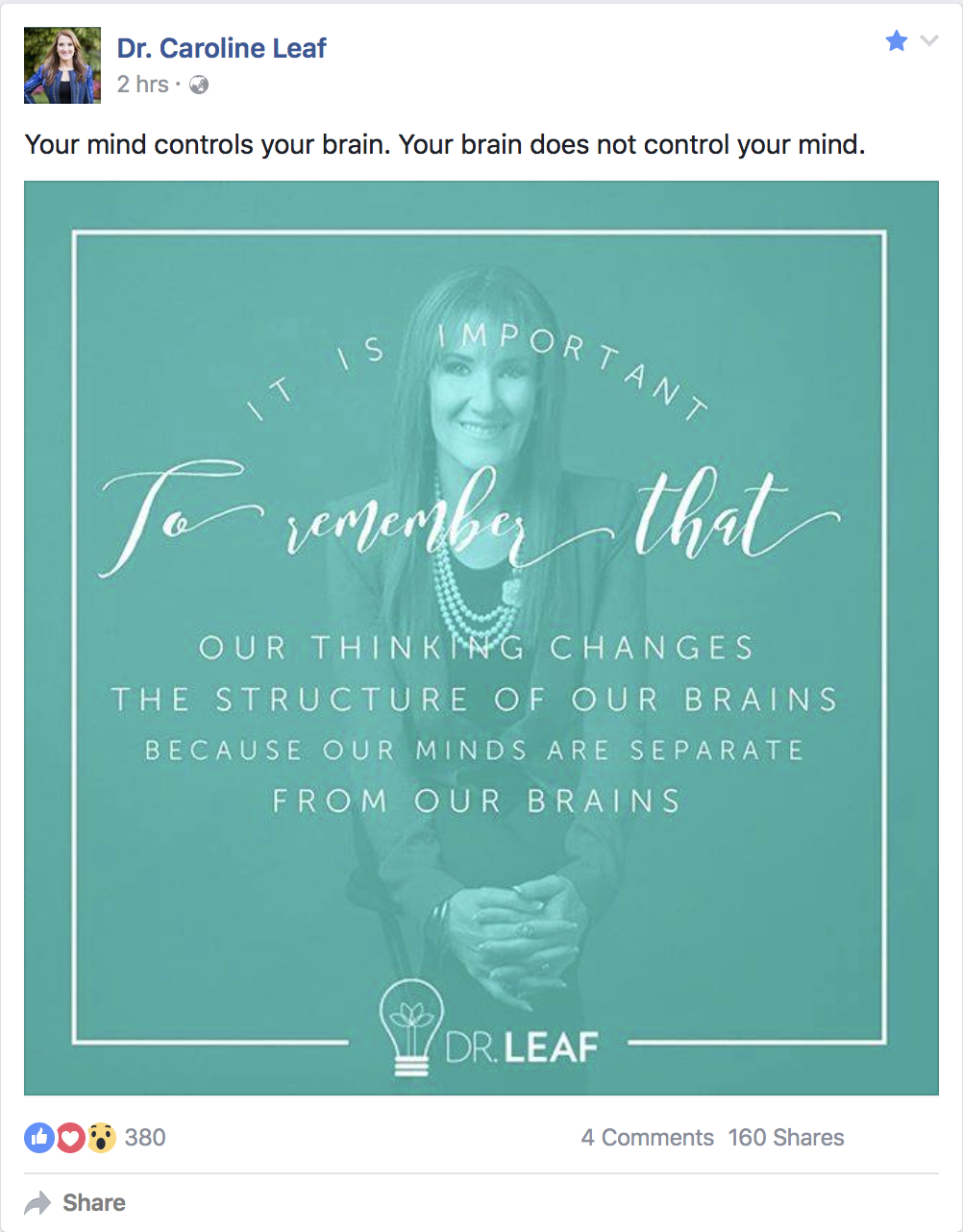
But good news for the NFL … self-titled cognitive neuroscientist Dr Caroline Leaf reassures us that “Your mind controls your brain.  Your brain does not control your mind.”

Maybe she can act for the NFL as their star witness.

But if I were her, I wouldn’t be holding my breath.  After all, it’s not like she’s able to mount particularly strong logical arguments.  Today she wrote on Facebook, “It’s important to remember that our thinking changes the structure of our brains because our minds are separate from our brains.”

How is the mind going to control the brain if they’re separate?  Suggesting that one thing controls another carries the implication that they are intrinsically linked.  If your hands are separated from the steering wheel of your car, are you in control of your car?

The other reason why Dr Leaf won’t be getting a call from Roger Goodell any time soon is because she isn’t really an expert on cognitive neuroscience as much as she’s convinced the Christian church otherwise.

Oh, and then there’s that minor detail that even Hollywood knows more about cognitive neuroscience than she does.  The whole point of “Concussion” is that brain damage results in disordered thinking which is the exact opposite of what Dr Leaf is trying to claim, and it’s hard to withstand any real scrutiny when your hypothesis has been trumped by a Hollywood screenplay.

The mind is a function of the brain, it does not control the brain.  The fact that Dr Leaf can not or will not bow to the weight of the undeniable scientific evidence means that she is either delusional, ignorant or utterly obstinate.  The fact that the western church is still willing to deify Dr Leaf in spite of these qualities is a stain on the reputation of the church and a blight on it’s witness to a world which only needs to look to Hollywood to find more credible information than what’s coming from Dr Leaf’s pulpit.

Black is the new black – Mental illness touches more of us than we realise (or want to admit)

I rarely get sick.

I say this while superstitiously touching my wooden desk to try and avoid putting the mockers on myself.  Thankfully, I have a fairly robust immune system and, after years or working in hospital paediatrics and general practice, and having been sneezed at or coughed on multiple times a day, I have been exposed to just about every variation of the cold virus and influenza possible.

Even for those of us with an immune system as solid as a prize bull, we still get sick every now and then.  We all get upper respiratory viruses so commonly that we just consider it a normal part of life.  Most people will take some paracetamol or ibuprofen and keep going.  Some people will go to their GP, and while a most will (… should …) come away some simple reassurance, occasionally some will need a prescription medication for a nastier bacterial infection.  An even smaller percentage will need admission to hospital because of a much more severe infection.

I read an interesting blog this week on Psychology Today by Dr David Rettew.  Its provocative title was, “Is Mental Illness the Rule Rather Than the Exception?”

The blog discussed the study being carried on in Dunedin which has been following a cohort of a thousand people for the last thirty-five years.  This particular study looked for common factors that were shared by those people who had never been affected by a certifiable psychiatric disorder.  What was interesting was that only seventeen percent of the people in that cohort had NOT been affected by a mental illness at some point in that thirty-five-year time frame.

Now for the average Australian, there are some obvious kiwi jokes going begging here (like, I’d be depressed too if I had to live in New Zealand, or how can someone tell if a sheep is really depressed or not, etc. etc.).  All jokes aside, seventeen percent of people not affected … that’s a remarkable figure.  In researching my latest book (soon to be released …) I had come across the figure of fifty percent of people had a lifetime prevalence of any mental illness.  That’s one in every two, and chances are that if you weren’t the person affected, you would know someone who was affected, but the Dunedin figures are even higher.  If you can accurately extrapolate them, four out of every five people will be affected by mental illness at some point in their lives.

The inevitable response from modern psychiatry’s critics is entirely predictable – there will be claims that the DSM5 is simply making diseases out of normal human life experiences, that our humanity is being pathologised and over-medicated for the benefit of big Pharma.

But as Rettew points out in a separate blog post, something may be such a common occurrence as to be considered part of the normal human experience but it can still be a pathology.  The common cold is so common that it’s a normal part of life, but it’s still a disease.

Whether four out of every five people will be affected by mental illness or one out of two, whatever the number, the idea that most of our population will be afflicted with a mental illness at some point in their lives isn’t necessarily a negative thing.  As Rettew also discusses, we don’t arbitrarily change the definitions of physical illnesses to match how many people we think should suffer from them, and neither should we arbitrarily change the diagnostic boundaries of mental illness so less people appear mentally unwell.

We need to accept that, at times, people will be functionally impaired to varying degrees because of mental illness just like people will be functionally impaired by physical illness.  We need to treat mental illness with the same respect as we would physical illness.

In the same way that not all physical illnesses require medication, neither do all mental illnesses.  By and large, most mental illnesses that people suffer from will be short lived and self-limiting, the psychiatric equivalent of having a cold.  Some people will need treatment for their mental illness, but usually this takes the form of structured behavioural therapy like ACT or CBT.  Occasionally, people will need to take a medication and very occasionally, some people will need to be hospitalised because of their mental illness.

For too long, mental illness has been viewed from an extreme perspective – mental illness is uncommon and severe. The nuances of mental illness have been lost or ignored in the white noise of ignorance and sanctimony.  The lack of subtlety and understanding has failed us as a community.  When treated early, mental illness has a much better prognosis, but the stigma, fear and misunderstanding perpetuated by the all-or-nothing approach has left a lot of people without treatment and therefore with worse outcomes overall.

If people were to realise that most of us will be touched by mental illness at some point, then perhaps there would be more understanding and less judgement, something that would lead to less suffering because of mental illness.

That would only be a good thing.

~~~~~

If you think you might be affected by mental illness or if you would like to know more, see your local GP, family physician or psychologist.  On line information can be found at many reputable sites including Beyond Blue – https://www.beyondblue.org.au

Dr Caroline Leaf on Drugs

We all have a drug problem.

Well, we do according to communication pathologist and self-titled cognitive neuroscientist-come-health guru, Dr Caroline Leaf.  She’s pretty chirpy for a woman with essentially no health credentials.  She did a PhD two decades ago on a specialized area of educational psychology, but she has no medical training or experience.  Essentially she is the Christian equivalent of the health and relationships section of a tabloid newspaper.  Her information lurches between unfounded and the bleeding obvious.

Today’s e-mail newsletter, “Mental Health News March 2017” is a mixture of both. It’s more moderate than usual in its tone, but it’s still inspired by her open rejection of pharmaceuticals, especially medications for mental health which she has railed against many times.

Her second paragraph is a specific case in point.  “Although many medications have saved lives and can help us, we cannot have a quick-fix-pop-a-pill mentality for everything in life, and we should not denigrate alternative methods of health and healing, such as diet, exercise, human relationship, love, compassion and therapy, particularly when it comes to mental health.”

She’s right – we shouldn’t have a quick-fix-pop-a-pill mentality, but she overstates her case.  Most people don’t want pills for everything – people want good care and good treatment.  Sometimes that involves a pill, sometimes it just involves reassurance.  This is bread and butter for any good GP, and I’d love to show Dr Leaf what the front-line of medicine looks like if she ever wanted to see (seriously, the offer’s open).

And who’s denigrating diet and exercise?  Diet and exercise aren’t “alternative” health, they’re mainstream.  Is Dr Leaf so out of touch that she can’t see this?

Her bias against pharmaceuticals is more obvious in their third paragraph.  Pharmaceutical medications are not a major cause of death. According to the Centre of Disease Control, the top ten causes of death in the US are:

* Heart disease
* Cancer (malignant neoplasms)
* Chronic lower respiratory disease
* Accidents (unintentional injuries)
* Stroke (cerebrovascular diseases)
* Alzheimer’s disease
* Diabetes
* Influenza and pneumonia
* Kidney disease (nephritis, nephrotic syndrome, and nephrosis)
* Suicide

Notice how medications do not feature on that list.  Dr Leaf is so biased against medications that she is willing to ignore official government data in favour of her own bias.

But the truth is, pharmaceutical grade medications have revolutionised our lives.  When used in the right way, for the right people, they improve our quality and quantity of life. They give people independence.  They give people choice.   They help people work, spend time with their family and care for others where that may not have been possible otherwise.

Do medications have side effects? Can people feel worse sometimes while taking them? Of course! We need to be realistic. Pharmaceutical medications are powerful agents and we have to use them respectfully.  Prescription drugs are like power tools.  In the right hands they can do wonders, but they can also be very dangerous when used incorrectly.  But while medications can be used incorrectly, using that as a reason why we should use less drugs is like arguing that we should use less knives because sometimes they cut people, or that we should drive less cars because there are car accidents.

Oh, and what was that about the widespread manipulation of data and results in the world of science?  Dr Leaf would never misrepresent the results of her studies, or misrepresent the results of other people’s research, in order to make her products look better than they are?

Lifestyle is important, and in some cases, lifestyle is more important than medication, but there is much more nuance involved.  You need different tools for different jobs.  Imagine a surgeon going into surgery and the scrub nurse passed over a nerf scalpel.  It wouldn’t be particularly helpful would it.  Or what if the scrub nurse passed over a butter knife?  The surgeon might get the job done but with great difficulty, without the precision needed.

What a surgeon needs to perform surgery is an extremely sharp stainless steel scalpel blade.  It is more effective and more precise.  It might occasionally do some unintentional harm, but it will be a lot more effective than a butter knife (and a nerf scalpel!)

There are three different levels of treatment in health – “alternative” medicines, lifestyle treatments, and pharmaceuticals.  “Alternative” medicines are, by definition, useless.  As comedian Tim Minchin says, “Do you know what they call alternative medicine that’s been proven to work? Medicine.”  Alternative medicines are probably not going to cause a lot of harm other than making their user poorer for wasting their time, but they’re highly unlikely to do any good.

Lifestyle treatments are the equivalent of the butter knife.  They work, but their effect is non-specific and cumulative.  Hear me right, “non-specific and cumulative” is not code for “ineffective”.  Exercise is one of the most effective non-pharmacological health strategies with clearly proven benefits, but like all lifestyle changes, the effect is fairly general, and the benefit accumulates.

And sometimes, despite doing everything right, people still get sick, and this is where pharmaceuticals have their place.  They are like the scalpel – they might have some unwanted effects, but in the right hands, when used correctly, they make a specific and tangible difference to a person’s life and health.

Dr Leaf then goes on to assert that “Changing your lifestyle and, significantly, the way you THINK can have dramatic effects on your health”.  That’s a furphy.  Thoughts make no difference to our health (I’ve shown how little difference thought makes to our health in my review of Dr Leaf’s book “Think and Eat Yourself Smart”).  Some scientists may have recommended produce over Prozac, but that doesn’t mean to say they’re right.

And Dr Leaf has trotted out the same worn, tired old factoid about loving and serving others that I’ve shown to be inaccurate as well.

If you want to improve your health without medications, then start walking.  Eat vegetables.  Drink water.  Don’t waste your time and money buying into Dr Leaf’s inaccurate teaching.

On sperm and common sense

I’ve been thinking the last few days about critical thinking, or more specifically, the lack of it.

I’ve written about critical thinking before.  I realise that critical thinking can be difficult, and it doesn’t always come naturally to us humans.  And in discussing it here, I don’t want to give the false impression that I expect everyone to suddenly become Aristotle or Francis Bacon, but I’d like to think we can all have enough critical thinking skills to have some basic common sense.

A case in point came across my Facebook feed tonight.  A Facebook friend had laryngitis and was about to embark on a speaking engagement and was asking the hive mind for some advice.

Now I know that this was a question posed to lay people, and I wasn’t expecting anyone to be giving specific medical advice … but it was interesting that the answers, by and large, didn’t even pass the common sense test.  Most of the answers recommended either gargling or drinking various home-made potions.  Except, when you gargle something or drink something, it doesn’t go anywhere near the voice box – we know that because we know what happens when you get liquid into your voice box, you cough or choke.  So clearly, no matter what you’re gargling or drinking, it isn’t going to affect your vocal cords one bit.  You don’t need a medical degree to know that, you just have to use a little bit of common sense.

The same deficiency in entry-level critical thinking is seen in the church all the time.  It afflicts everyone from pew-warmer to pastor.  Common sense so often escapes us when it comes to understanding scripture.  Christian celebrities skew the text of the Bible to suit their own agendas all the time, and most Christians are too gullible and just accept the incorrect interpretation.  Sometimes a scriptural misinterpretation can be passed down from generation to generation because people don’t question the orthodoxy for fear of appearing divisive or ignorant.

A funny example of how the scripture can be taught with all sincerity but without much understanding is in relation to sperm.  When I was in my final year of high school at a prominent Christian school, one of the male teachers took it on himself to get all the boys together from our year level for a chat about important man things.

One of the things that was mentioned was that we shouldn’t masturbate, because of the story of Onan.  In Genesis 38, Onan ejaculated on the ground rather than in his sister-in-law and God smote him.  Somehow, that was taken to mean that semen is precious, therefore it shouldn’t be wasted.  This lead to a historical view, expressed by Clement of Alexandria who wrote, “Because of its divine institution for the propagation of man, the seed is not to be vainly ejaculated, nor is it to be damaged, nor is it to be wasted. To have coitus other than to procreate children is to do injury to nature.”  This lead to the concept that masturbation is evil because it is seminal genocide, which eventually lead to the Monty Python parody “Every sperm is sacred” (https://youtu.be/fUspLVStPbk?list=RDfUspLVStPbk).

Anyway, back to my high school – the teacher wasted our entire morning tea time talking about Onan, and about how we should be chaste and not masturbate because every sperm is sacred.  But he clearly didn’t read the actual scripture, nor did he or anyone else ever consider why, if God was so stressed about wasting semen, He would create men to have wet dreams.  I really wanted to make this point, but didn’t because it was morning tea time and everyone wanted to get out of there, and I also didn’t want to be mercilessly harassed about being pro-masturbation by every guy in my grade.

My high school teacher and the story of Onan is an example of how people can be well meaning and still misguided, and why we need to apply common sense to scripture.  It doesn’t take a great deal of biological knowledge to know that men have nocturnal emissions of semen, yet for centuries, the story of Onan was about how he was smitten because of his treatment of his sperm, not about how he was disobedient.

Another example of how well-meaning but misguided teaching can be perpetuated comes from the Christian course, “Valiant Man” by Australian pastor, Dr Allen Meyer.  The “Valiant Man” program was a ten-week series of small group sessions designed with the intention of helping men develop their Christian character in the area of sex.  In week three, Dr Meyer (not a medical doctor) tried to show that men should respect women more because we all started off in the womb as females, and the Y-chromosome eventually turned us from a girl into a boy.

This little factoid wasn’t the only significant defect in the Valiant Man program, but it was one of the most memorable.   “We all start off female” was one of the things that the other participants in the program all remembered, and it even made it to Sunday morning church as part of a testimonial one of the men gave about the program.  And yet, it was one of the most clearly inaccurate parts of the program – all embryos have the structures to be either male or female.  We didn’t all start off as women.  Men aren’t an aberration of the female default setting*.

In week one of the program, all participants were required to agree to some ground-rules in order to keep going on the program.  Point 2 of this ‘contract’ said, “intellectual opinions play no part in our discussion, except where they are relevant to our growth.”  In other words, don’t challenge the material gentlemen, and don’t think for yourselves.  While this might be conducive to running a smooth program, it meant that gross errors and distortions were left unchallenged.

This pattern of unquestioning acceptance of misguided teaching continues throughout the church.  This is something that Dr Leaf does all the time.  It doesn’t take theological training to see that her use of scripture is inaccurate (like her interpretation of Proverbs 23:7, for example), but the vast majority of Christians simply accept her misguided interpretation and theologically trained church leaders also accept it, or don’t correct it (both of which are just as heinous).

I know that critical thinking is sometimes tricky, but I’m not advocating for anything more than common sense.  Entry level critical thinking doesn’t take much effort but it can be particularly life changing.  Like with “Valiant Man”, a little bit of critical thinking can stop bad teaching from being accepted as truth.  Like the story of Onan, a little bit of critical thinking can stop centuries of incorrect teaching being perpetuated.  Like with my friends Facebook status, a little bit of critical thinking can help a person make the best choice for their own personal health.

As Christians, we need to have some self-respect and stop being so gullible, just accepting something as the truth because some Christian celebrity says it from the pulpit.

Ultimately it’s the truth that sets us free, not some gilded assumption.

* In fairness, I did the program in 2010 and it may have been updated since then … here’s hoping.

Dr Caroline Leaf and Testimonials – Good marketing, poor evidence

Dr Caroline Leaf is a communication pathologist and self-titled cognitive neuroscientist. She is a pseudoscientist of the highest order. She once wrote a PhD. Now she has episodes of her TV show titled “Surviving cancer by using the Mind”.

This weeks edition of her newsletter started off with some subtle boasting:

“We have received many E-mails over the past years asking for Testimonies with regards to Dr Leaf’s research and teachings. We have summarized eight pages of testimonies received at TESTIMONIES. Be encouraged and feel free to refer them to friends, family, acquaintances, and work colleagues struggling with Mind issues.”

Testimonials are an empty box wrapped in shiny paper and trimmed with a bow. They look really good but offer nothing of substance. They’re simply an old advertising trick.

According to the Market Science Institute, “Testimonial solicitations – in which firms solicit consumers’ personal endorsements of a product or service – represent a popular marketing practice. Testimonials are thought to offer several benefits to firms, among them that participating consumers may strengthen their positive attitudes toward a brand, through the act of writing testimonials.” [1]

Who can argue with a person who says that Dr Leaf helped turn their life around? Saying anything negative just makes you sound like a cynical old boot.

And that’s the real problem, because while publishing a whole bunch of positive stories is good for marketing, it makes it very hard for those who had a genuinely bad experience to say anything. No one wants to listen to those people whom Dr Leaf has confused or mislead – it makes for terrible PR. Those people feel devalued, and sometimes worse, because it seems like everyone else had a good result from Dr Leaf’s teaching, except them.

Testimonials also make for very poor scientific evidence. Indeed, testimonials are considered the lowest form of scientific evidence [2]. It’s all very well and good for a bunch of people to share their positive experiences, but as life changing as the experience may have been, they are not evidence of the effectiveness of Dr Leaf’s teaching. Without specific, well-designed research, no one can say if the testimonials Dr Leaf is publishing are the norm. Recent research demonstrates that self-help literature for depression may not have any benefit over a placebo treatment [3]. So it may be that any improvement attributed to Dr Leaf’s teaching was actually the placebo effect. Dr Leaf can list testimonials until she’s blue in the face, but that doesn’t prove that her work is scientific or therapeutic.

Indeed, selectively publishing testimonials is duplicitous, telling half-truths, positively spinning her own story. How many e-mails has Dr Leaf gotten from people who have found her teaching inaccurate, ineffective, unbiblical or harmful? Dr Leaf’s social media minions deliberately delete any negative comments and block anyone from her sites that disagree with her. And over the years, many people have shared with me how arrogant and dismissive her team has been to polite, genuine concern or criticism. I can personally attest to the same treatment. If Dr Leaf was honest with her followers, she would be openly publishing the brickbats as well as the bouquets.

For her readers and followers, the testimonials need to be seen for what they are: just individual stories. Sure, we should rejoice with those who are rejoicing (Romans 12:15), and so good for those who feel Dr Leaf has helped them. But they do not constitute evidence for the therapeutic efficacy or scientific integrity of the work of Dr Leaf.

For people genuinely struggling with “mind issues”, the last thing they need is testimonials collated by Dr Leaf’s marketing team.  They don’t need to be referred to Dr Leaf’s work, they need to be referred to psychologists and doctors.

And if Dr Leaf really wanted to prove her legitimacy, she would rely on independent peer-reviewed published research, not on the list of vacuous, self-serving cherry-picked testimonials that she is currently offering.

References

[1] Marketing Science Institute. Consumer Testimonials as Self-Generated Advertisements: Evaluative Reconstruction Following Product Usage. [cited 2014, Aug 3]; Available from: http://www.msi.org/reports/consumer-testimonials-as-self-generated-advertisements-evaluative-reconstru/.
[2] Fowler, G., Evidence-based practice: Tools and techniques. Systems, settings, people: Workforce development challenges for the alcohol and other drugs field, 2001: 93-107
[3] Moldovan, R., et al., Cognitive bibliotherapy for mild depressive symptomatology: randomized clinical trial of efficacy and mechanisms of change. Clinical psychology & psychotherapy, 2013. 20(6): 482-93

Dr Caroline Leaf – The Christian church’s anti-vaxxer

Well, this is my first post for the new year.  2016 was certainly historic!

In 2016, the Oxford Dictionaries Word of the Year was “post-truth”.  Post-truth describes the concept “in which objective facts are less influential in shaping public opinion than appeals to emotion and personal belief”.

While the popularity of the word rose in step with the popularity of the US President-Elect, post-truth as an idea has been building more and more over the last decade or so.  It’s the driving force behind other cultural phenomena of our modern world, like the alternative health and the anti-vaccination movements.

It’s also the secret to the success of Caroline Leaf.

Dr Caroline Leaf is a communication pathologist and self-titled cognitive neuroscientist.  She’s been riding the wave of our post-truth culture for years.  Dr Leaf has a set of slickly spoken mistruths that form the basis of her ministry, and are repeated constantly (including, but not limited to):

The mind controls the brain
75-98% of all physical, mental and emotional illnesses come from our thought life
The heart is a mini-brain
Our mind changes matter through quantum entanglement
ADHD and depression aren’t diseases
Anti-depressant medications are dangerous placebos

There is no scientific evidence to support any of these claims, but that hasn’t stopped her claiming, because Christians and the leadership of the Christian church believe her without question.

In the last twenty-four hours, Dr Leaf put up two separate social media posts which follow the same pattern – repeated mistruths with no basis in fact.

“What an honor to be speaking at the annual Noiva humanitarian foundation conference in Winterthur, Switzerland, which works actively with the Syrian refugees seeking to broker peace in the Middle East.  I spoke about how showing compassion and helping others improves brain health and increases physical and mental healing by around 63%!”

screen-shot-2017-01-07-at-10-01-34-pm

Showing compassion and helping others improves brain health and increases physical and mental healing by around 63% hey?  I’m assuming she’s referring to the study by Poulin et al [1], because she’s posted this to her social media feed before, and there aren’t any other studies out there that show compassion and helping others increases physical and mental health so much … not that the Poulin study showed it either (not even close – https://cedwardpitt.com/2016/10/27/dr-caroline-leaf-credit-where-credits-due/ and https://cedwardpitt.com/2016/01/16/does-helping-others-help-you/)

On the photo she put up on social media to gloat about her little jaunt to Switzerland, the Powerpoint in the background reads, “Can the mind change the brain?”  Again, the answer is a clear ‘No’!  She tried to argue the same nonsense in her TEDx talk in early 2015 (https://cedwardpitt.com/2015/03/26/the-tedx-users-guide-to-dr-caroline-leaf/).  It was wrong then, and it’s still wrong now.

Unless Dr Leaf’s found some better resources, NOIVA should ask for their money back.  They could have fed a lot of refugees for the wasted cost of hosting Dr Leaf at their conference.

Dr Leaf’s second social media post was even more egregious.

“Our genetic makeup fluctuates by the minute based on what we are thinking and choosing.”

WRONG!  Absolutely wrong.  There is NO scientific evidence that supports this statement at all (https://cedwardpitt.com/2014/09/27/dr-caroline-leaf-and-the-genetic-fluctuations-falsehood/).  DNA is stable.  It doesn’t “fluctuate by the minute”.  It’s not influenced by our thoughts or our choices.

We may be stuck in a post-truth world but science is not, and will never be, post-truth.  Your belief in the cancer-fighting properties of turmeric doesn’t make turmeric cure cancer.  Your opinion that the MMR vaccine causes autism doesn’t change the concrete scientific evidence that it doesn’t.

By the same token, Dr Leaf might believe that our thoughts and choices change our DNA, but it doesn’t matter how many times Dr Leaf repeats the same fiction, it still doesn’t make it fact.  She can repeat ad nauseum her belief that the mind controls the brain, or our mind changes matter through quantum entanglement, or depression isn’t a disease, or all of our illnesses come from thoughts.  None of them were true the first time she made each outrageous claim, and they still aren’t true now. Scientific truth doesn’t change depending on what suits your opinion.

In fact, all Dr Leaf is doing by continually perpetuating her stock of mistruths is to disempower her audience.  Rather than encourage people to follow the facts, they are sucked into a vortex of wasted money and time.  Precious resources are spent chasing wild geese instead of putting them towards something more meaningful.  NOIVA diverting funds to support Dr Leaf’s fees instead of feeding refugees is a perfect case in point.

Worse, Dr Leaf’s teaching discourages people from taking effective medications and seeking effective treatments which can only lead to greater suffering in those who are vulnerable.

In this sense, Dr Leaf is like the anti-vaxxer of the Christian church, discouraging her followers from seeking scientifically sound treatments in favour of belief in erroneous and invalid actions with no proof of efficacy and a real risk of harm.

When will the leadership of the Christian church stand up for their parishioners and stop Dr Leaf’s fictions from infecting their churches?  The answer should be ‘now’, and that’s a fact.

References
[1]        Poulin MJ, Brown SL, Dillard AJ, Smith DM. Giving to others and the association between stress and mortality. Am J Public Health 2013 Sep;103(9):1649-55.

The Perspective of Dawn

screen-shot-2016-12-24-at-10-34-30-pm

Perhaps it was the hypnogogic delirium, but I had an epiphany.

Truthfully, it was probably less epiphany and more of a reminder, that little “oh yeah” sort of moment.

Yesterday I was sitting in an airport lounge at 5am, waiting to be whisked away on my 6am flight to the tropical north to join my family and in-laws for Christmas.

For the life of me, I can’t remember why I decided to book a flight for six in the morning.  I think the flight was cheap, and I thought to myself “6am … that’s not that early …”.  I forgot that to allow for travel time and checking in, I had to get up at 3:30am.  Not even sparrows are awake at half-past three.  In fact, I’m often going to bed at that time of night, so this whole pre-dawn awakening thing was really foreign.

The fact that I was showered, dressed, and sitting at the airport compos mentis was really weird … I think I was slightly delirious.

Still, the whole predawn awakening thing was enlightening. It was a refreshing glimpse of a time of day that I normally spend hibernating. The first thing I noticed was the light. I always thought that dawn and dusk were the same but just lighting from the opposite direction, but there’s a subtle difference in the hue that gives the early morning a softer, fresher glow.

The other thing I noticed was the stillness.  Everyone else in their right mind didn’t book dawn flights and were still snug in their beds, so the usual hustle and busy buzzing that usually fills the streets was absent.

The soft cool breeze on my face, in the midst of the calmed half-light was almost meditative.  It was quite a change to my daily routine of sleeping until I have to drag myself (and the kids) out to our usual daytime occupations.

The stillness and beauty of my new perspective of dawn reminded me of how it’s easy to get stuck in the same pattern.

Our routines are partly a function of necessity – we have to go to work, the kids have to go to school, we have to get groceries, attend social functions, go to church on Sundays.  There isn’t anything necessarily wrong with this repetitive normality.  Still, our brain gets used to the usual patterns and it starts to filter out the same input that it gets continually exposed to, and our brains function on autopilot.  This process of automation, habituation and suppression is an advantage for our brains in terms of efficiency and energy conservation, but this leaves a bit of a cognitive void which our brain fills with the internal monologue of our own confabulation.  We drink our own kool-aid, as it were.

This is what people often think of as “the rut”, that existential inertia and stagnation, the first-world malaise of meaningless repetition.

The antidote to the rut is to break the pattern.  When we have a change to our circumstances and we experience something new, our brain has to process things differently.  More processing power is needed, which involves our working memory and our conscious stream of thought.  One small step outside the comfort zone of our routine, and all of a sudden, the world can seem fresh and new again.

This process is enhanced through mindfulness.  When we practice mindfulness, we fully engage in the present moment.  We can appreciate the detail that we so often filter out and ignore.  We can (and should) practice mindfulness at any time, but when we’re engaging in a new experience, immersing ourselves in it mindfully will only enhance it.

The perspective of dawn that I experienced yesterday helped remind me of the power of stillness in an ever-demanding world over-saturated with stimulation.

I hope that this Christmas and New Year, you can take the time to have your own ‘perspective of dawn’ as it were – step out of your comfort zone and experience something completely new, and engage with the experience fully, mindfully.  I hope you gain a fresh insight that you can help propel you forward into the amazing potential that 2017 holds for us all.

From my family to yours, have a very Merry Christmas and a safe and prosperous New Year.

Free will isn’t free

screen-shot-2016-12-23-at-5-00-21-pm

It’s only two days before Christmas.  I know most people in the last forty-eight hours before the Yuletide would be focussing on last minute shopping for presents or foraging for the ingredients for their Christmas feasts, or making their last minute arrangements for their holiday celebrations.  So now may not be the right time to post something meaty about the philosophy of free will, but hey, it might just make for a welcome distraction.  Come with me, if you’re game, down the rabbit hole of our choices.

Dr Leaf, communication pathologist and self-titled cognitive neuroscientist, posted a quote today from former Regius Professor of Divinity at the University of Oxford, Keith Ward: “Free will is a place where people can decide to do what is right or to do what is wrong and nothing determines their choice – lots of things influence their choice but nothing determines it except them”.

But is it, really?  Clearly Professor Ward is a very learned fellow, but what strikes me about Dr Leaf’s quote of the day is Professor Ward’s false moral dichotomy, and his over-simplistic implication that every choice is a fully conscious choice.  Perhaps his quote is taken out of context by Dr Leaf and his intended message has been skewed.  It wouldn’t be the first time Dr Leaf has cherry-picked and misquoted.

Dr Leaf added in her ‘me too’ comment – “So we are responsible and can be held responsible for our choices – this is confirmed by science and scripture”.

I should say, it’s not that Dr Leaf’s comment is completely wrong – we are held responsible for our choices, but this isn’t confirmed by science or by scripture, it is something that is legal more than it is scientific or scriptural.

As humans, we have a strong feeling of voluntary control over our actions, that everything we do is something that we choose to do.  This sense of control is so fundamental to our existence that much of our social system depends on it, such as our laws and the penalties for breaking them [1].

Except that science has proven that our sense of full control is largely an illusion.

I understand this idea might be hard for some people to accept.  We’re taught that we have full control over our actions or ideas.  We experience this sense of control from the vantage point of our own perception.  It’s hard to believe that we’re not really in full control of our actions and choices.  The dominant paradigm in the Christian church is the idea of free will.  We’re taught that the words we say and things we do are the exclusive product of our will.  Cognitive neuroscience paints a different picture.

The modern neuroscience of the will started with Benjamin Libet.  Professor Libet was a researcher in physiology at the University of California San Francisco.  He was initially studying the electrical properties of different sensations in the brain, but in the early 1980’s, he performed an experiment to look at the electrical readings that take place when a person decides on an action.  His subjects would decide to perform a simple movement of their arm or hand, and say when they were aware of the intention to act.  Electrodes connected to the subject’s heads measured their brain activity before, during, and after their decision to act.

What was remarkable was that there was a clear spike in electrical activity occurring up to a full second before a test subject was consciously aware of the intention to act [2].  Libet suggested that an unconscious process was responsible for the ‘willed’ action.

Other studies since that time have confirmed Libet’s results.  In fact, a study in 2008 showed that predictable brain activity occurred up to eight seconds before a person was aware of their intention to act [3].

This predictable unconscious spike of brain activity prior to awareness of our intention to act has been verified over and over and is beyond doubt, but there’s still lots of debate as to exactly what it means.  Defenders of the idea of free will have tried presenting alternative explanations of the pre-awareness unconscious activity, but none of them line up with the proven, repeatable science.

So if we don’t have full conscious control of our actions, what does go on in our brains when we perform an action?

Again, I won’t go into the fine print, but it’s important to understand that our brain does most of its work at a subconscious level, which includes the planning and execution of our actions [4, 5].  The brain takes the information presented to it, as well as information from memories, and makes a prediction of the best course of action.  This means that our processing of goals, rewards, and actions can be affected by ‘subliminal priming’ (in other words, information we process below our conscious level can affect the decision about the best course of action [5]).

Even though we’re not aware of every process the brain employs in our subconscious to formulate the best plan of action and to prime our system ready for that action, there is a element of awareness that provides real-time monitoring and a veto function [4].  Like if you were about to complain about your job and then suddenly remembered you were talking to your boss, you could stop yourself from saying something you might later regret.

What does it all mean?  The take-away message here is this: We have limited will, not free will.

We still have some capacity to choose, but our conscious choices are dependent on our subconscious brain activity, our experience and knowledge.

We can make choices, or “exercise our will”, if you like, but within the constraints of a number of factors beyond our conscious control.  We can “pull the brake”, so to speak, and stop an action that our subconscious brain activity primed us for, but wasn’t such a good idea when a bit more thought was applied.  Our brain also uses our experience and knowledge to predict the best action to take, and because some of our knowledge and experience comes from exercising our limited choices, we can also say we have some input into our decisions.

So in this sense, Prof Ward is correct – lots of things influence people’s choices and ultimately, the choice someone makes is their choice.  I don’t make your choices for you, they are your choices.  Except that it’s inaccurate and misleading to think of our will as being entirely conscious and thought driven.  We make a lot of subconscious decisions every day, often based on subconscious priming.  Most actions we take, day in and day out, are not influenced by our conscious thought.  They may sometimes make it into our subconscious awareness, and if they do, it’s often after the fact.

Have ever had a “Why did I say that” experiences, where your brain is thinking one thing and your mouth says another?  These are times that demonstrate the difference in the systems at work in our brains, which are usually co-ordinated, but not always.  There are other demonstrations of this as well, like specific brain pathologies leading to conditions such as Alien Hand Syndrome.

These sort of conditions show that intention is not the same as action.

Sure, most of the time they’re aligned, but not always.  And this is the key to Dr Leaf’s quote of the day today – the underlying assumption is that all of our choices are reflected in our actions, when really, our choices are better thought of as our intentions (although again, it’s still not that simple … is it morally wrong if you try to hurt someone but you don’t, or is it morally wrong if you try not to hurt someone, but you do?)

Professor Ward’s quote also sets up a false dichotomy of free will into only right or only wrong, and doesn’t take into account the intellectual or developmental capacity of a person to make a choice.  Would you expect a two-year-old to judge a complex moral life or death situation?  A more practical example is should people with dementia be able to make their own financial and health-related decisions?

Most reasonable people would say, “Well, that depends …” and that’s the correct answer here.  Nothing in the real world of human morality and choice is black or white.  There is always some subtlety, some nuance.

When put in context, the black-and-white thinking and teaching of Dr Leaf is shown up as shallow and inadequate.  Her little quote of the day doesn’t prove that free will is Biblically and scientifically supported, far from it.  All it shows is that Dr Leaf’s views are narrow and blinkered, and aren’t reflective of any scientific or scriptural expertise.

Dr Leaf is welcome to her opinion, but until she gains some actual expertise, she should reconsider her choice to share it.

References

[1]        Haggard P. Human volition: towards a neuroscience of will. Nature reviews Neuroscience 2008 Dec;9(4):934-46.
[2]        Libet B, Gleason CA, Wright EW, Pearl DK. Time of conscious intention to act in relation to onset of cerebral activity (readiness-potential). The unconscious initiation of a freely voluntary act. Brain : a journal of neurology 1983 Sep;26 (Pt 3):623-42.
[3]        Soon CS, Brass M, Heinze HJ, Haynes JD. Unconscious determinants of free decisions in the human brain. Nature neuroscience 2008 May;3(5):543-5.
[4]        Bonn GB. Re-conceptualizing free will for the 21st century: acting independently with a limited role for consciousness. Frontiers in psychology 205;4:920.
[5]        Horga G, Maia TV. Conscious and unconscious processes in cognitive control: a theoretical perspective and a novel empirical approach. Frontiers in human neuroscience 204;6:199.

The confused teaching of Dr Caroline Leaf

screen-shot-2016-11-03-at-12-53-18-am

Dr Leaf released her latest e-mail newsletter today.  I decided to follow up with a brief review of this week’s instalment after her last e-mail newsletter completely misrepresented Ephesians 4:16, the function of the hypothalamus and the effect of stress on the population,

Dr Leaf was true to her usual form.  Her fundamental assumptions remain subtly skewed, forcing each layer of argument into an unbalanced and unstable alignment, and the more she tried to justify herself, the more unstable her arguments became, until eventually they toppled.

There was the obligatory dig at the medical profession, another smug ad hominem dismissal claiming that doctors have ‘negligible training in nutrition’, so doctors don’t understand the ‘whole approach’ that Dr Leaf and other so-called ‘progressive’ food thinkers have.  In reality, doctors have a lot of nutritional training, a darn-sight more than communication pathologists and self-titled cognitive neuroscientists.

And again, Dr Leaf demonstrates her paucity of knowledge or respect for the scripture by again misquoting Proverbs 23:7.  You don’t need to be a Biblical scholar to be able to read a verse of scripture in context, and in context, “as he thinks in his heart [mind], so is he” has got nothing to do with our mind or our thoughts (as I’ve discussed before https://cedwardpitt.com/2015/05/30/dr-caroline-leaf-manhandling-scriptures-again/).

But the critical error which invalidates Dr Leaf’s essay this week is the intellectual dissonance she creates by making two paradoxical claims.

“Your mind, or soul, has one foot in the door of the spirit and one foot in the door of the body. The mind creates coherence between the spirit of man and the body of man, and therefore influences and controls brain/body function and health, and influences spiritual development. Your mind, with its intellectual ability to choose and its emotional authority, controls all physical aspects.”

and

“Fasting has been shown to enhance brain function, and reduce the risk factors for coronary artery disease, stroke, insulin sensitivity and blood pressure. For instance, restricting calories can support the induction of sirtuin-1 (SIRT1), an enzyme that regulates gene expression and enhances learning and memory.”

Essentially, Dr Leaf is saying in one breath that the mind is separate to the physical brain but controls all of the function of the physical brain and the body, but then moments later says that changes in the body alters the function of the brain which then alters the function of the mind.

So which is it?  You can’t have it both ways?  It’s impossible for the mind to control all physical aspects of the brain if the mind is vulnerable to changes in the brain and body.

The dilemma of Dr Leaf’s mind-brain paradox stems from her defective set of assumptions on the triune being.

“You are intrinsically, brilliantly, and intricately designed with a spirit, soul and body (Genesis 1:26; 1 Thessalonians 5:23). This is known as our triune nature.  Our triune nature is divided into different components. Your spirit is your ‘true you’, or what I call your PerfectlyYou. The spirit has three parts: intuition, conscience and communion (worship). Your soul, which is your mind, also has three parts: intellect, will and emotions. Lastly, your body has three parts: the ectoderm, mesoderm and endoderm, from which the brain and the body form.”

Dr Leaf’s ideas about the triune being are Biblically and scientifically tenuous—more conjecture on Dr Leaf’s part than hard science or solid theology (Read here for more information on this https://cedwardpitt.com/2014/07/25/dr-caroline-leaf-dualism-and-the-triune-being-hypothesis/)  Yet she bases her entire ministry on these shaky assumptions, cherry picking studies and manipulating facts to suit her arguments and ignoring the glaring contradictions that inevitably arise.

So Dr Leaf’s latest offering to her followers again demonstrates the confusion and contradiction that plagues her teaching—layer upon layer of cherry-picked factoids manipulated to prop up her tenuous assumptions. Dr Leaf would do better by listening to scientists and doctors rather than arrogantly dismissing them.