The lost art of joy – Loving yourself again

How many doctors does it take to change a lightbulb?

That depends on whether it has health insurance.

None of the lightbulbs in my house have health insurance, but that’s not why I don’t like changing them. I’m just not the handy-man type, that likes to climb around on ladders, pulling off light covers, changing the bulbs and putting everything back together. It’s not that it’s particularly difficult, but unless all of the lightbulbs in a room are broken, I’m not going to go through all of the bother. I would much rather have lightbulbs that never die.

Of course, lightbulbs inevitably burn out. Some will work for an hour and then stop, others will last for years before finally giving out. An engineer who designed the light bulb would have an idea about how long the light bulb should work, and according to their tests, the light bulb would be expected to work for a certain time. For instance, say that I put a light bulb into my office lamp that is rated to last for 2500 hours, and it lasts for 2600 hours before it finally gives out. It’s lasted 100 hours longer than it’s rated for, and so to the engineer who designed it, the bulb is a success. But it’s still stopped working, and I’m in the dark. To me, it has still failed.

It’s interesting that failure is as much about the standards that people set, either individually or collectively, than anything else. My standards for light bulbs are probably unrealistic – I want them to work forever because I hate replacing them.

Sometimes we judge ourselves by an unrealistic standard, or we allow others to judge us by an unrealistic standard.

It’s easy to look at the people on magazine covers or on TV who look so perfect, and use that as our yardstick for self-comparison. We yearn for their perfect figure, or their talent, or their business acumen.

We compare ourselves to our ‘friends’ on social media and wonder why our lives aren’t as good.

We remember the criticism from our parents or our teachers – who wanted us to be skinnier, or smarter, or stronger – and strive to please them.

There’s nothing wrong with striving with the right motivation, but when our goal is unattainable or unrealistic, the energy we expend for no perceived gain just sucks the life from our soul, resulting in cognitive overload, resentment, anger and despair. None of these things helps us build joy in our lives.

The antidote is to love yourself again. We need to forgive ourselves and set goals that are realistic and attainable.

Setting realistic and attainable goals first comes from understanding our values and living by them, sailing in the direction that our particular breeze is taking us, not fighting against it.

We also need to understand our own capacity based on our own particular skills and talents. If you’re a Ferrari, you’re not going to be driving up rough mountain tracks, through rivers and around sand dunes. If you’re a Land Rover, you’re not going to be carving up a race track. Use the talents that you have to set your own course, not try to drive someone else’s.

It’s also ok to fail. We succeed because we fail. It’s ok to set some seemingly attainable goals and still not attain them. Beating yourself doesn’t help anyone, all it does is leave you bruised and bloodied. Love yourself even when you fail, and forgive yourself. Remember, “To forgive is to set a prisoner free, and discover that the prisoner was you.” (Lewis B. Smedes)

This Christmas, love yourself.  Don’t try to live up to the unrealistic standards of others, but set your own goals based on your values, even if you don’t always attain them.  And, forgive yourself. That will allow joy to flourish.

The lost art of joy – The freedom of now

How do drive your car?

We all have our own particular styles – cautious, sedate, zippy, or kamikazi. There are some drivers that drive like a tortoise on tranquillisers. I always seem to get stuck behind them at traffic lights. I would describe my driving style as ‘confident’, though when I quickly nip around them at the lights, I’m sure they would think I’m in too much of a hurry.

Whether we’re on a perpetual Sunday drive or we go like a bat out of hell, there are some commonalities to how we all drive. No one drives the whole journey looking in the rearview mirror and no one crawls along in first gear all the way just in case there might be a red light or a stop sign up ahead. When we’re in control of our car, we drive according to the conditions around us at the time.

In the first two posts of this series, we looked at acceptance and values, or as the Serenity Prayer says, “give me grace to accept with serenity the things that cannot be changed, Courage to change the things which should be changed, and the Wisdom to distinguish the one from the other.” Acceptance and values intersect in the present moment, the ‘now’.

We can’t change what has happened in the past, and we can’t control what is going to happen in our future. We can advance in the direction set by our values and embrace the freedom of living in the now.

Living in the now is just like driving. There’s no point looking in the rearview mirror the whole way. We can’t change the past. Getting lost in the if-only’s of the past means we don’t get to experience what is going on around us, and it effectively stops us moving forward because we’re looking the wrong way. We become stagnant and the lack of lack of forward progress makes it hard for joy to flourish. Neither can we control the future. Sometimes we allow the what-if’s of the inherently uncertain future to slow our progress and hold us back. We don’t know what’s around the bend, and after a while we prefer the familiarity of our rut.

When we move beyond the past and leave the future to our destiny, we can focus on the richness of the present moment. Living in the present moment is both liberating and invigorating – we are no longer being held captive by what has been or what might be, and we can allow our attention to absorb all of the plentiful and pleasing details that are going on all around us, every moment of our lives.

Living in the now is part of the practice of mindfulness. Mindfulness is a skill, and like every other skill, it takes some practice to get good at it. But the practice is worth it, as mindfulness is associated with higher levels of life satisfaction, agreeableness, conscientiousness, vitality, self esteem, empathy, sense of autonomy, competence, optimism, and pleasant affect.

There are many ways to practice mindfulness, but if you’re a novice, then a good place to start is through some apps like Smiling Mind or Headspace.  As you get better at living in the present moment, you will start to enjoy the richness and freedom that comes with it. If you start now, you won’t have to live haunted by the ghosts of Christmas-Past or Christmas-Future, but can have a marry and a mindful Christmas, living in the freedom of now.

The lost art of joy – Just what is joy?

Robin Williams is my favourite all time comedian. At his best, his jokes would come flying out faster than what my brain could process them, but I still found myself laughing pre—cognitively and only understanding why I was laughing once my brain had a chance to catch up. He was famous for his talent for improvisational comedy, something he demonstrated one night for a group of budding actors, using nothing but a pink scarf.

And yet, despite being one of the funniest people in history, he was plagued by depression and drug abuse and died by suicide in 2014.

In an interview after his death, James Lipton poignantly described Robin Williams,

“In the end, Robin is Pagliacci. He is Pagliacci, the cliche of the clown who cries – that was there every single minute, every single minute of his life, and what he did was he spared us the hard part, and he gave us the joy. What an extraordinary gift that was.”

It’s hard to understand how someone can be so seemingly full of joy, or at the very least, give so much joy to others, and still be so plagued with melancholy and psychological pain. The life and death of Robin Williams certainly challenges our understanding of the true meaning of joy.

So it’s pertinent to ask: What is joy?

Is joy laughter? Is it pleasure? Is joy the same as happiness? Is joy the absence of sadness? Is it the absence of suffering? Is joy within us, or outside our control? The answer is probably a combination of all of these things.

My dictionary explains that joy is “a feeling of great pleasure and happiness”. The ancient Greeks considered that joy had two different parts – physical pleasures associated with biological needs, and feelings of higher pleasure. Physical pleasures, such as eating and sex, are known as ‘hedonia’ while the higher feelings of pleasure, associated with the appreciation of art, music, et cetera, as ‘eudaimonia’ (‘a life well lived’) after the distinction that Aristotle made in his writings on the subject.

Is joy the same as happiness or pleasure? C. S. Lewis didn’t think so, “I call it Joy, which is here a technical term and must be sharply distinguished both from Happiness and Pleasure. Joy (in my sense) has indeed one characteristic, and one only, in common with them; the fact that anyone who has experienced it will want it again … I doubt whether anyone who has tasted it would ever, if both were in his power, exchange it for all the pleasures in the world. But then Joy is never in our power and Pleasure often is.”

George Bernard Shaw considered joy to be something greater than oneself, “This is the true joy in life, the being used for a purpose recognized by yourself as a mighty one; the being thoroughly worn out before you are thrown on the scrap heap; the being a force of Nature instead of a feverish selfish little clod of ailments and grievances complaining that the world will not devote itself to making you happy.”

It’s certainly true that depressed people can still laugh, and like Robin Williams, can make others laugh, so joy can certainly be both superficial and deep, and neither are mutually exclusive.

To add something else into the mix, the Christmas message of joy comes from the birth of the Saviour (Luke 2:10-12), so one of the Biblical meanings of joy stems from hope.

So the single definitive concept of true joy is elusive. Perhaps trying to define joy is like trying to define the ocean. We have all experienced the ocean and its beauty, and many of us have felt the coolness on our bodies as we have swam in it, or felt the awesome power of its currents and waves. Yet the ocean is so deep, so powerful and so mysterious that no one can ever truely comprehend it for itself.

We have all experienced the wonder and beauty of joy, although it is so deep, so powerful and so mysterious that no one can ever truely comprehend joy.

Not that it will every stop us from trying.

~~~
If you are struggling with mental illness and you need urgent assistance, please talk to someone straight away:

In Australia:
Lifeline ~ 13 11 14
BeyondBlue ~ 1300 22 4636 or https://www.beyondblue.org.au/about-us/contact-us
Suicide Callback Service ~ 1300 659 467 or https://www.suicidecallbackservice.org.au

USA:
National Suicide Prevention Lifeline ~ 1-800-273-TALK (8255)

New Zealand:
Lifeline Aotearoa 24/7 Helpline ~ 0800 543 354

UK:
Samaritans ~ 116 123

For other countries: Your Life Counts maintains a list of crisis services across a number of countries: http://www.yourlifecounts.org/need-help/crisis-lines.

The lost art of joy – Values

“Wait … what are you doing?”

There’s a deep part of our consciousness that acts as our inner emergency brake. You know, when you’re about to call your boss a jerk, or drunk text someone, or post something narky on social media, there’s that little voice inside your head that says, “Uh, do you really think that’s a good idea?”

Thankful most of us don’t end up drunk-texting our boss and would never let ourselves get in a position to do so. Still, it’s a good idea every now and then to reevaluate our general day-to-day decisions, our routines and patterns, to say to ourselves, “Wait … what are you doing?”

Yesterday we talked about the Serenity Prayer – “grace to accept with serenity the things that cannot be changed, Courage to change the things which should be changed, and the Wisdom to distinguish the one from the other”. We talked about acceptance – accepting the things we can not change because fighting with things we can’t change wastes our energy and gets us nowhere. We can also waste a lot of energy and not get to where we want to go by using all our energy going to the wrong place – either we drift on autopilot, doing what we’ve always done because, you know, it’s what we’ve always done, or we can deliberately set sail in the wrong direction, thinking that we’re doing the right thing.

One way that we can build our joy is to live rich and meaningful lives in service of our values. In knowing our values, we can know ourselves, and engage in life in its fullness. ’Values’ can mean different things to different people, but in the Acceptance and Commitment framework, values refer to “Leading principles that can guide us and motivate us as we move through life”, “Our heart’s deepest desires: how we want to be, what we want to stand for and how we want to relate to the world around us.”

Values help define us, and living by our values is an ongoing process that never really reaches an end. Living according to your values is like sailing due west. No matter how far you travel, there is always further west you can go. While travelling west, there will be stops along the way, stopovers along our direction of travel like islands or reefs. These are like our goals in life.

The difference between goals and values is important. You could set yourself a whole list of different goals, and achieve every one of them, but not necessarily find meaning or fulfilment if they all go against the underlying values that you have. So goals are empty and unfulfilling if they aren’t undergirded by your deeper values.

How can you understand your values? There are a couple of ways. Ask yourself: “What do I find myself really passionate about? What things irk me? If I could do anything I wanted, and money was no object, what would I do?” Is there a recurrent theme running through your answers?

There are other ways to discover what your values are. Some people have suggested writing your own eulogy (the speech someone gives about you at your funeral). It sounds a bit morbid, and it’s only a figurative exercise, but it tends to sharply clarify what you want your life to be like. What do you want your legacy to be? Think about the things that you want to be known for at the end of your life, and see if there’s a word that best describes those desires.

Understanding our values can help us to navigate the seasonal madness without becoming overwhelmed. When you understand what’s truly important to you, it’s much easier to focus on what’s really important and say no to the things that aren’t. For example, Your boss invites you to exclusive Christmas drinks are her house, with some of the regional executives. It’s on at the same time as the Christmas Carols concert your sister is performing in. If your core values are career success, then the choice is easy. If you know your values are family first, then the choice is easy. You can make the choice that will bring you the most joy, and enrich your life.

So before the malaise of merriment takes hold, say to yourself, “Wait … what are you doing?” Ensure that what you’re doing is aligned with your deepest values to maximise your joy this Christmas season, and beyond.

The lost art of joy – Acceptance

“’Tis the season to be jolly”

The auditory froth of tinny Christmas melody bubbled away in the background as I was trying to enjoy my sushi. I usually filter the incessant stream of Christmas carols from my consciousness as these days, they have become ever-increasingly cliche.

But once upon a time, Christmas carols were more than just shopping centre noise pollution. Once upon a time, Christmas carols had meaning. Even if you’re not inclined to celebrate the birth of the Saviour, there are still some Christmas themes we can all agree on, like peace on Earth, goodwill to all (women and) men, and joy to the world.

Joy. Christmas’s modern irony. In amongst the glitter and tinsel lies a season of despair for many people as the over-commercialised happiness hype and expectations of cheer amplify the sense of loneliness and pain that slowly abrades them. Then there’s the Yuletide exhaustion, the inevitable outcome of the frenetic push to shop, wrap, clean, decorate, travel to or host party after party after party – celebraters gonna celebrate! Joy is supposed to fit in your schedule or to-do list somewhere.

’Tis the season to be jolly? Yes, it is, but sometimes we work so hard to be joyful that joy itself has been lost along the way.

This year, with one thing or another, my writing has taken a bit of a backseat. I’m going to try and change that. I’m going to set myself a challenge to write one post a day for December celebrating the lost art of joy. What it’s going to look like is still anyone’s guess, with form and inspiration to be free and flowing. I’m not promising an exhaustive exposition … more a free-form exploration. Neither am I suggesting that I am an expert in such matters. I’m preaching to myself as much as anything. As someone who still battles depression, joy is often elusive to me.

Still, please come along for the ride. Together, let’s explore the many facets of one of the deepest of all emotions and how it’s an integral part of the Christmas season, and also our collective soul.

Many moons ago, I was a cub scout (which for those who don’t know, is Scouts for 8-10 year old boys). Once a week, we would get together and do outdoorsy type activities and games as part of learning about the seemingly antithetical values of teamwork and self-reliance, earning merit badges, dibbing and dobbing and all things scout.

One time I remember they divided the group into two and had us battle it out in a tug-o-war dual. Our parade area-come-battle zone was not particularly well lit, with the area just behind the scout hall in complete shadow, save for the occasional moonlight.

It was a gripping contest and during the battle, the other team managed to swing themselves around and pull their end of the rope into the inky darkness beside the scout hall. Our side doubled our effort, but despite what felt like an eternity of vigorous straining, we weren’t moving anywhere. We understood why when the other team started peeling away one by one and laughing at us – in the cover of darkness, they had managed to tie the tug-o-war rope to one of the poles supporting the balcony of the scout hall. We were struggling when we were fighting against human opposition, but we were clearly no chance at ever beating the scout hall in tug-o-war.

What do my #cubscoutfails have to do with joy? The scout hall tug-o-war episode is a good analogy for acceptance.

The self-help industry has, at one point or another, made us all want to better ourselves … which is fine, but only if what we wanted to change was actually changeable. By trying to change some part of us that is difficult to the point of being insurmountable, we expend huge amounts of energy to get nowhere. And it changes nothing, except for diminished motivation, volition and resistance to the thing we wanted to change in the first place. How many diets have ended in a flurry of ice-cream or Mars bars? We figuratively try to beat the scout hall in tug-o-war. The futile fighting with things that can not be changed makes it hard for joy to flourish.

The Serenity Prayer, made famous by Alcoholics Anonymous and other 12-step programs, is simple but profound. It starts by saying, “God, give me grace to accept with serenity the things that cannot be changed, Courage to change the things which should be changed, and the Wisdom to distinguish the one from the other.”

Accepting those things that can not be changed is life-changing! The frustration of constant failure destroys the soul and steals away any joy. It we want to protect our joy, we can start by accepting that there are things in life we can’t change. In the immortal words of that other modern ear worm – “let it go”. Don’t sweat and strain, heaving and pulling on something that can’t be moved.

Of course, acceptance isn’t the whole story, but the other aspects of the serenity prayer (wisdom and courage) might be topics for another day.

Suffice to say, picking our battles can make a profound difference to our life, and acceptance is the key to that.

Thanks for reading, and I hope we can talk more tomorrow.

Guns cause mass shootings, not psychiatric drugs

Las Vegas, Nevada – the latest of many places in America joined by the shared ignominy of senseless mass violence.

Each victim (and there are so many [1]) deserve respect – their lives, their stories, their memory, honoured. Their families should be allowed to mourn, their community given space to heal.

Their loss should not be used as an ideological segue to opportunistically push an unrelated viewpoint. To do so would be obnoxious, like someone attending a wake so they could try and sell life insurance to those who are grieving.

And yet, Dr Caroline Leaf has done just that, using the deaths of nearly five-dozen people as an opportunity to push the idea that psychiatric medications are somehow to blame for the actions of those who perpetrate mass murder (http://drleaf.com/blog/mental-health-news-october-2017/).

“One factor that is rarely discussed in both the mainstream media and among politicians is psychiatric drug-induced violence. It is too easy to label the perpetrator as an evil maniac with mental health problems without looking at the correlation between psychotropic drugs and violence.”

In my opinion, I think it’s abhorrent that Dr Leaf would be so callous as to use such an abject tragedy to push her ideological barrow, but sadder still that she is simply wrong.

The key factor in gun-related deaths isn’t psychiatric medications, but guns.

From 1996 to 2011, the use of any psychotropic medication in Australia roughly doubled (from about 55 to 130 ‘defined daily doses per 1000 population per day’ [2: p234, 3]). In the same period, Australia’s number of mass shootings fell to zero. Australia’s gun-related homicide and suicide rate also fell [4].

Why? Because after the tragedy of Port Arthur in 1996, the Australian government introduced gun law reform, drastically reducing the number of guns available within the general population. Admittedly, experts argue whether the gun law reform was a decisive factor or just one of many in the reduction of gun-related deaths in Australia [4].

But irrespective, the statistics decimate Dr Leaf’s irrational hypothesis on psychiatric medications. There is no link to psychiatric medications and mass murder. Indeed, those who suffer from mental illness are more likely to be the victims of violence, not the cause of it [5, 6].

Dr Leaf attempts to soften the blow at the end of her newsletter. “That is not to say everyone who takes these medications will become violent – we should not fear or isolate people that are suffering from mental health disorders”. But her repeated claim that these egregious acts of violence are caused by psychiatric medications makes her words ring hollow.

In publishing her latest blog, Dr Leaf’s motives may have been benevolent, but her actions have left much to be desired. She has dishonoured the victims of Vegas. She has targeted the wrong cause. Her actions have created many more victims of what is already a senseless tragedy.

References

[1] Berkowitz B, Gamio L, Lu D, Uhrmacher K, Lindeman T. The math of mass shootings. 2015 [cited 2017 October 12]; Available from: https://www.washingtonpost.com/graphics/national/mass-shootings-in-america/
[2] Australian Statistics on Medicines 1997. In: Commonwealth Department of Health and Family Services, editor. Canberra: Commwealth of Australia, 1998.
[3] Stephenson CP, Karanges E, McGregor IS. Trends in the utilisation of psychotropic medications in Australia from 2000 to 2011. Aust N Z J Psychiatry 2013 Jan;47(1):74-87.
[4] Fact check: Have firearm homicides and suicides dropped since Port Arthur as a result of John Howard’s reforms? RMIT ABC Fact Check 2016 [cited 2017 October 12]; Available from: http://www.abc.net.au/news/factcheck/2016-04-28/fact-check-gun-homicides-and-suicides-john-howard-port-arthur/7254880
[5] Mental Health Myths and Facts. 2017 [cited 2017 October 12]; Available from: https://www.mentalhealth.gov/basics/myths-facts/index.html
[6] Metzl JM, MacLeish KT. Mental illness, mass shootings, and the politics of American firearms. Am J Public Health 2015 Feb;105(2):240-9.

Post script: A picture says a thousand words:

http://www.canberratimes.com.au/world/heres-why-australia-will-never-understand-the-us-obsession-with-guns-20171003-gyt7ys.html

If you have been distressed by the Las Vegas shooting or you have concerns about your mental health, please talk to your general practitioner or psychologist.

If you need urgent assistance, please talk to someone straight away:
In Australia:
Lifeline ~ 13 11 14
BeyondBlue ~ 1300 22 4636 or https://www.beyondblue.org.au/about-us/contact-us
Suicide Callback Service ~ 1300 659 467 or https://www.suicidecallbackservice.org.au

USA:
National Suicide Prevention Lifeline ~ 1-800-273-TALK (8255)

New Zealand:
Lifeline Aotearoa 24/7 Helpline ~ 0800 543 354

UK:
Samaritans ~ 116 123

For other countries: Your Life Counts maintains a list of crisis services across a number of countries: http://www.yourlifecounts.org/need-help/crisis-lines.

ASD and GP

“You see, but you do not observe. The distinction is clear.” ~ Sherlock Holmes (A Scandal in Bohemia)

Autism. It’s a condition that we see weekly as general practitioners. The question is, do we observe it? And if we do, what do we see it as, a series of deficits, or as a set of different strengths that can be celebrated?

For the last few days, I’ve enjoyed being a delegate at the Asia-Pacific Autism Conference in Sydney, a series of some cognitively stimulating discussions covering the full spectrum of being on the spectrum.

There’s always so much that can be gleaned from conferences like these, but for me, the take-home messages as a GP came at the book-ends of the first session and the last.

One of the first keynote presentations came from researchers at the Olga Tennison Autism Research Centre (http://www.latrobe.edu.au/otarc). Prof Cherl Dissanayake and Dr Josephine Barbaro presented their research on a tool they developed called SACS-R, an early detection tool to screen for infants at higher risk for developmental disorders.

Early detection of children on the autism spectrum is very important, something recognised by the AMA in their position statement late last year (https://ama.com.au/position-statement/autism-spectrum-disorder-2016). Despite being important, early detection can also be tricky, and many children on the autism spectrum who are relatively high functioning are often missed in general practice.

Barbaro and Dissanayake have previously tested this tool, training community child health nurses to use it as part of the standard infant health checks. The results of their work showed that the tool was robust (Estimated sensitivity ranged from 69% to 83.8%, and estimated specificity ranged from 99.8% to 99.9% for babies between 12 and 24 months – Barbaro and Dissanayake, 2010).

Barbaro and Dissanayake have continued to develop the tool, but more importantly, they have refined the tool to utilise only the factors that had the highest sensitivity, and then turned the tool into a free app, untethering the initial assessment process from the domain of professionals and potentially putting it in the hands of every parent anywhere in the world via a smart phone. The results of their study are still being finalised, but they claim that the SACS-R tool on the app has a positive predictive value of 82%, a negative predictive value of 97%, a specificity of 99.58% and a sensitivity of 72%.

The power shift that an app like this brings is important for us as GP’s. In time, parents will be doing their own assessments at home and coming in to their GP with a recommendation to have a further assessment, and we need to be prepared for this and take the recommendation seriously. But there’s also a prime opportunity here, to use the app to enhance early screening for developmental disorders in general practice, by sending a link to the parents booking in for their baby’s 12 and 18-month immunisations and discussing the results of the assessment with them when they come in. This could also be in addition to the professional version of the program that Barbaro and Dissanayake are in the process of developing.

Given the preliminary results of their longitudinal study (not yet published but in its final stages) showing a prevalence of up to 1 in 43 children, it’s likely that we will be picking up several new cases a year.

If you want to review the app yourself or consider recommending it to your patients, it’s called ASDetect and it’s available from the App Store or Google Play.

At the other end of the conference, Dr Barry Prizant presented a keynote address on “Uniquely Human: a different way of seeing autism”, based on his book of the same name and his decades of work with people on the autism spectrum.

His theme was that most people see autism as a negative. In times gone by, children on the autism spectrum were seen as profoundly deficient, to the point that they weren’t considered a person. Even today, some pundits have said that “autism is a lost, hellish world” while others have likened having autism to being a victim of the holocaust.

On the other hand, self-advocacy is growing amongst those with autism, who are working to try and change the social view that autism is a series of weaknesses to overcome, but differences to be celebrated. Not only that, but more people on the spectrum are designing research projects to understand the condition better and to translate those advances into tangible benefits, taking self-advocacy to a whole new level.

Prizant not only promoted autism self-advocacy, but also discussed the concept of neuroharmony – that there is no such thing as autistic behaviour, but only human behaviour; that so many people with autism have succeeded in their chosen fields and have made lasting contributions to the benefit of our society. He championed the notion that rather than expecting autistic people to be ‘normal’, ‘normal’ society should be embracing the differences that those on the spectrum have. As one father of a child on the spectrum told him, “You don’t grow out of autism, you grow into autism.” As John Elder Robison wrote, “Asperger’s is not a disease. It’s a way of being. There is no cure, nor is there a need for one. There is, however, a need for knowledge.”

As GP’s, when we see those children on the spectrum picked up by the enhanced early screening tools, we need to ensure we give their parents the balanced view. It’s easy to look at the negatives and the weaknesses inherent in a diagnosis of ASD. I’m not suggesting that we sugar-coat things and tell only the positive side of the story, but we need to balance out any concerns the parents have with a generous serving of hope. As one father put it, “The people who have been the most helpful to us have are those who do not take away our hope. We have learned to keep away from the ‘doom and gloom’ crowd”, while one mother wrote, “Some call it autism, others call it despair and sorrow. I happen to call it hope, beauty and fascination.”

For ASD and the average GP, change is coming – good change that will empower parents to get an earlier diagnosis, and for those with ASD to get the early intervention that will benefit their weaknesses, complement their strengths and accept who they are as people. As GP’s, we need to be flexible and accepting, observing the strengths that autism can bring to our patients, not just seeing the weaknesses.

References

Barbaro J. and Dissanayake C., “Prospective identification of autism spectrum disorders in infancy and toddlerhood using developmental surveillance: the social attention and communication study.” J Dev Behav Pediatr. 2010 Jun;31(5):376-85

Post-script, 21 September 2017

I received an e-mail from Erin from La Trobe today:

  “My name is Erin and I am a Research Assistant at La Trobe University. Currently, I am working with Dr. Josephine Barbaro on the ASDetect project.
   We would also like you and your readers to know that we’re currently seeking parents/caregivers of young children aged 11-30 months for our research study looking at how ASDetect identifies early signs of Autism (Australia only). You can register at asdetect.org/app or SMS 0409 758 602. You must register via this website to be eligible for study, so just downloading the app won’t enrol you.”

If you can, please get involved.  This is important research that has the potential to have profound benefits for some of our most vulnerable patients ~ CEP

Dr Caroline Leaf – stop spreading ADHD stigma and ignorance

“Nothing in all the world is more dangerous than sincere ignorance and conscientious stupidity.” ~ Martin Luther King Jnr.

Sincere ignorance … conscientious stupidity – I’m struggling to know which category to put Dr Leaf’s latest e-mail newsletter into.

Dr Caroline Leaf is a communication pathologist and self-titled cognitive neuroscientist and self-titled mental health expert.  She is not a doctor.  She is not a psychologist.  She does not work for a university.  She hasn’t published any peer reviewed medical papers for two decades.  She is not accountable to any peak professional body.

Yet the Christian church gives her unfettered access to their pulpits despite the ignorance and stigma she enthusiastically promotes.

Take the “Mental Health News” e-mail that she posted today for example.  Dr Leaf seamlessly moves from one misrepresentation to another, weaving a narrative that unfairly undermines scientifically proven treatments for mental illness, eroding confidence and destroying hope.

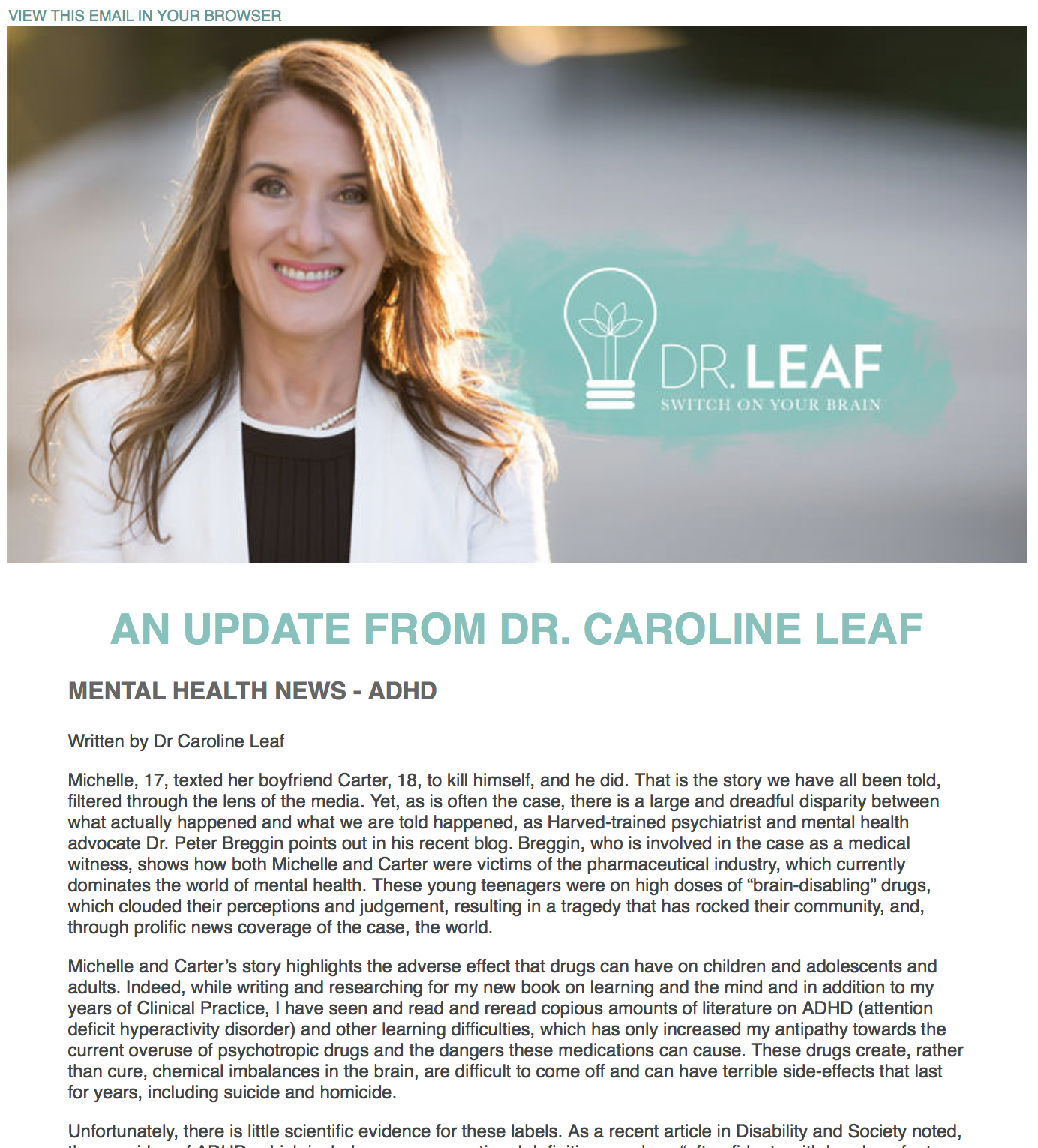
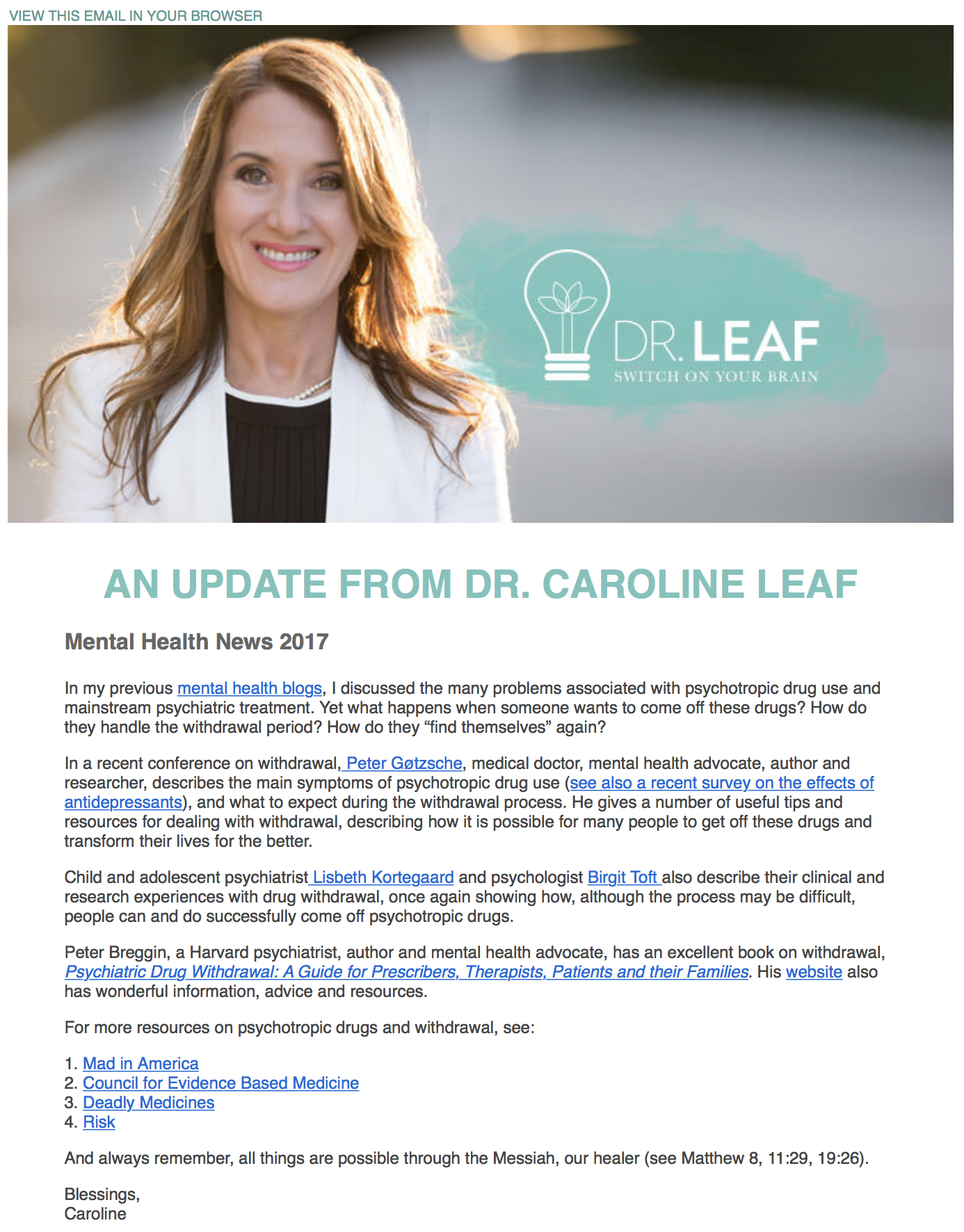
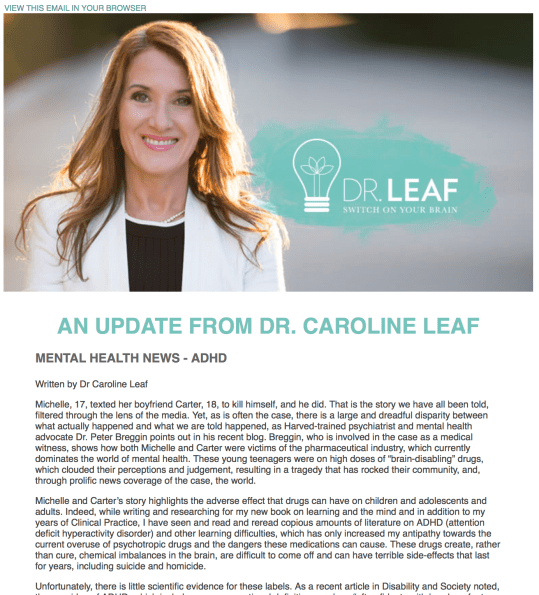
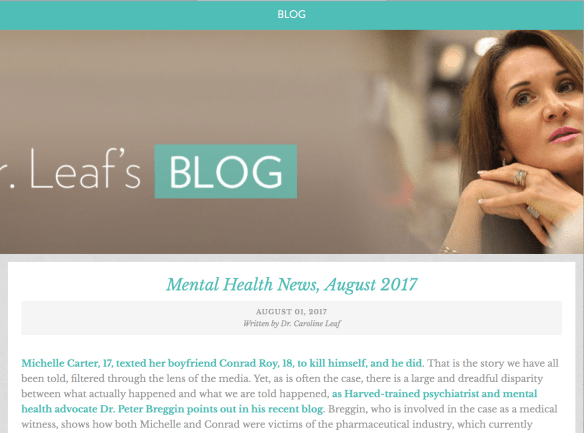
She starts with the story of Michelle and Carter, although it wasn’t Michelle and Carter as her e-mail newsletter stated. It was Michelle Carter and Conrad Roy, something which Dr Leaf got right in her blog post dated 1 August 2017 (see the image at the bottom of the page), but then got wrong in her e-mail newsletter on 30 August 2017. Dr Leaf says that Michelle texted Conrad to kill himself, and he did. Michelle and Conrad were on “brain-disabling” (psychiatric) drugs. Therefore, psychiatric drugs killed Michelle and Conrad. In my opinion, that Dr Leaf would stoop so low as to use the suicide of a teenager to try and push her own ideological barrow says much about her character, but then I shouldn’t be surprised as she did the same thing when Carrie Fisher died earlier this year. It’s sick, and it’s low, and it’s something that Dr Leaf should apologise for.

It’s also incredibly disingenuous, drawing a conclusion from incomplete evidence. Dr Leaf has no experience with the case. Instead, the source of this information is Dr Peter Breggin, himself an outspoken and discredited critic of psychiatric medication with a penchant for cherry picking and bias. Dr Leaf has used the story of Michelle and Conrad based on the tainted recall of half a story. She has no idea what really contributed to Michelle and Conrad’s tragedy. Her statement, “Yet, as is often the case, there is a large and dreadful disparity between what actually happened and what we are told happened” is therefore sadly ironic.

Dr Leaf then moves on to ADHD and drugs. Dr Leaf treats the concepts of ADHD and its treatment with the same respect as she gave Michelle and Conrad. She makes statement after misleading statement which do nothing but demonstrate her myopic bias.

Let’s just take one sentence: “These drugs create, rather than cure, chemical imbalances in the brain, are difficult to come off and can have terrible side-effects that last for years, including suicide and homicide.”

ADHD is often misunderstood and almost always stigmatised.  ADHD is more than just being an active child who likes to play.  ADHD is a dysfunctional lack of control that’s abnormal compared to other children the same stage of development, is long standing and affects their entire lives.

ADHD is caused by an abnormal pattern of genes, the expression of which are triggered by environmental conditions in pregnancy and early childhood, resulting in slower maturation of the brain and an uncoordinated network of “connectomes”, which disrupts the attention and planning processes of the brain.

We know that children with ADHD have slower maturation of the grey matter [1] and structural changes in the frontal regions and deeper parts of the brain [2].  In more recent times, modern brain imaging techniques have been able to show differences in the way that the regions of the brain link together to form networks.

Think of the brain networks as a tug-o-war team.  When all the members of a tug-o-war team work in unison, they increase their collective strength, but if the different team members don’t co-ordinate their efforts properly, the strength is lost.  The same goes for the brain.  Modern neuroscientists have discovered that the function of the brain relies on physical networks within the brain, called “connectomes” and how these connectomes co-ordinate with each other.

In the ADHD brain, the connections between the different connectomes are immature [3].  These immature connections weaken the collective strength of the network, because they aren’t synchronously “pulling” together.

What’s better understood is that the neurotransmitter called dopamine is crucial to the ADHD disease process [4].  Medications such as Ritalin which enhance the dopamine signals in the brain significantly reduce the symptoms of ADHD [5].

So Ritalin and other drugs like it actually balance the neurotransmitters in the brain.  Dr Leaf’s argument that they “create … chemical imbalances in the brain” is as misleading as trying to argue that diabetic treatments are creating an “insulin imbalance”.

“These drugs … are difficult to come off” is also misleading.  Once the brain eventually matures as it does in most children with ADHD, the drug is simply weaned.  Dr Leaf doesn’t seem to understand that some children with ADHD will grow into adults with ADHD who will still need medication.  This isn’t because the drugs are hard to come off, they are simply treating an ongoing condition.

“These drugs … can have terrible side-effects that last for years, including suicide and homicide.”  Actually, the effects of Ritalin last less than a day because the drug is rapidly metabolised, and ‘homicide’ is not listed anywhere in the official product information.  Suicide has been reported in patients taking the Ritalin although the official product information notes that, “Adverse events reported since market introduction in patients taking methylphenidate include suicide, suicide attempt and suicidal ideation. No causal relationship between methylphenidate and these events has been established.”  Even so, medications like Ritalin are not meant to be given to people who have severe depression, anorexia, psychotic symptoms or suicidal tendency, just in case Ritalin might worsen these conditions.

Indeed, a Cochrane Review as recently as November 2015 said, “The evidence in this review of RCTs suggests that methylphenidate does not increase the risk of serious (life threatening) harms when used for periods of up to six months. However, taking methylphenidate is associated with an increased risk of non-serious harms such as sleeping problems and decreased appetite.” [6]

So “these drugs” don’t have side effects for years, don’t make people homicidal, don’t make people addicted and don’t unbalance their brain chemicals.  It’s amazing how much profound mistruth Dr Leaf was able to pack into one littlesentence.

Then Dr Leaf goes on to attack the concept of ADHD itself – “Unfortunately, there is little scientific evidence for these labels … the very idea of ADHD, which includes vague operational definitions such as ‘often fidgets with hands or feet or squirms in seat,’ is subjective and defined by what society currently deems as ‘normal’ or ‘abnormal’”.

Denying the existence of ADHD is an old trick used by medication critics and the ignoranti for decades, but it’s like denying the existence of rain so you don’t have to buy an umbrella.  Dr Leaf’s assertion that the diagnosis of ADHD includes ‘vague operational definitions’ is just a strawman, because ADHD diagnosis is rigorous and relies on more than just a single characteristic like fidgeting.  I have listed the diagnostic criteria for ADHD at the end of this post, or you can look it up here: http://www.cdc.gov/ncbddd/adhd/diagnosis.html

In all of Dr Leaf’s railing against medications for ADHD, she fails to cite the evidence that shows that medications for ADHD improves the lives of those with ADHD [6], more than restrictive diets or cognitive retraining or neurofeedback [7].

Dr Leaf may like to think of herself as an expert, but her claims on ADHD and it’s treatment do not hold up under scrutiny.  She may think she’s acting benevolently but the promotion of her Dunning-Kruger style ignorance erodes the enormous hope that medications like Ritalin give to people who, without it, are held back by the mental and physical chaos that ADHD causes.

Dr Leaf, please, stop spreading the ADHD stigma and ignorance.  We already have to put up with enough suffering from the disease itself and the social stigma without you adding to it.

References

[1]       Shaw P, Lerch J, Greenstein D, et al. Longitudinal mapping of cortical thickness and clinical outcome in children and adolescents with attention-deficit/hyperactivity disorder. Archives of general psychiatry 2006 May;63(5):540-9.
[2]       Cortese S. The neurobiology and genetics of Attention-Deficit/Hyperactivity Disorder (ADHD): what every clinician should know. European journal of paediatric neurology : EJPN : official journal of the European Paediatric Neurology Society 2012 Sep;16(5):422-33.
[3]       Cao M, Shu N, Cao Q, Wang Y, He Y. Imaging functional and structural brain connectomics in attention-deficit/hyperactivity disorder. Mol Neurobiol 2014 Dec;50(3):1111-23.
[4]       Wu J, Xiao H, Sun H, Zou L, Zhu LQ. Role of dopamine receptors in ADHD: a systematic meta-analysis. Mol Neurobiol 2012 Jun;45(3):605-20.
[5]       Reichow B, Volkmar FR, Bloch MH. Systematic review and meta-analysis of pharmacological treatment of the symptoms of attention-deficit/hyperactivity disorder in children with pervasive developmental disorders. Journal of autism and developmental disorders 2013 Oct;43(10):2435-41.
[6]       Storebo OJ, Ramstad E, Krogh HB, et al. Methylphenidate for children and adolescents with attention deficit hyperactivity disorder (ADHD). The Cochrane database of systematic reviews 2015 Nov 25;11:CD009885.
[7]       Sonuga-Barke EJ, Brandeis D, Cortese S, et al. Nonpharmacological interventions for ADHD: systematic review and meta-analyses of randomized controlled trials of dietary and psychological treatments. The American journal of psychiatry 2013 Mar 1;170(3):275-89.

ADHD Diagnostic Criteria

The current criteria that must be matched to qualify for a diagnosis of ADHD is:

(1) Inattention: Six or more symptoms of inattention for children up to age 16, or five or more for adolescents 17 and older and adults; symptoms of inattention have been present for at least 6 months, and they are inappropriate for developmental level:
* Often fails to give close attention to details or makes careless mistakes in schoolwork, at work, or with other activities.
* Often has trouble holding attention on tasks or play activities.
* Often does not seem to listen when spoken to directly.
* Often does not follow through on instructions and fails to finish schoolwork, chores, or duties in the workplace (e.g., loses focus, side-tracked).
* Often has trouble organizing tasks and activities.
* Often avoids, dislikes, or is reluctant to do tasks that require mental effort over a long period of time (such as schoolwork or homework).
* Often loses things necessary for tasks and activities (e.g. school materials, pencils, books, tools, wallets, keys, paperwork, eyeglasses, mobile telephones).
* Is often easily distracted
* Is often forgetful in daily activities.

(2) Hyperactivity and Impulsivity: Six or more symptoms of hyperactivity-impulsivity for children up to age 16, or five or more for adolescents 17 and older and adults; symptoms of hyperactivity-impulsivity have been present for at least 6 months to an extent that is disruptive and inappropriate for the person’s developmental level:
* Often fidgets with or taps hands or feet, or squirms in seat.
* Often leaves seat in situations when remaining seated is expected.
* Often runs about or climbs in situations where it is not appropriate (adolescents or adults may be limited to feeling restless).
* Often unable to play or take part in leisure activities quietly.
* Is often “on the go” acting as if “driven by a motor”.
* Often talks excessively.
* Often blurts out an answer before a question has been completed.
* Often has trouble waiting his/her turn.
* Often interrupts or intrudes on others (e.g., butts into conversations or games)

In addition, the following conditions must be met:
– Several inattentive or hyperactive-impulsive symptoms were present before age 12 years.
– Several symptoms are present in two or more setting, (e.g., at home, school or work; with friends or relatives; in other activities).
– There is clear evidence that the symptoms interfere with, or reduce the quality of, social, school, or work functioning.
– The symptoms do not happen only during the course of schizophrenia or another psychotic disorder.
– The symptoms are not better explained by another mental disorder (e.g. Mood Disorder, Anxiety Disorder, Dissociative Disorder, or a Personality Disorder).
(http://www.cdc.gov/ncbddd/adhd/diagnosis.html)
The power of trust

“If you want to go fast, go alone. If you want to go far, go in a team.” ~ African Proverb

Melbourne … rain.  It’s so cliché, but here I am in Melbourne, staring out at the dismal misty greyness enveloping the city, displacing all warmth and joy.

Perhaps it was the dreariness combined with the light stupor that comes from being in a meeting all day, but as I was watching the incessant drizzling, I drifted into a contemplative trance, pondering the power of water.

By itself, one drop of water can do very little.  No one notices the effect of one drop of rain.  Though with more and more drops comes more and more change.  Wet ground grows puddles, then tiny rivulets, then streams of water which, when they combine, can form a raging torrent strong enough to change entire landscapes in a day.

And then I wondered, what allows something so individually weak to be so forceful en masse?  I don’t want to sound like a B-grade motivational speaker, but I think this is so important for any single person or organisation that wants to achieve anything of significance.

There are two properties that give a stream of water its power.
* A common direction
* A strong bond

As the sheer might of a violent surge so aptly demonstrates, there is immense power when small drops all combine to move together in one direction.  Yet the former property is only possible because of the latter.  Without the strong molecular bonds between them, water molecules would simply dissipate, along with all of their power.

So how can we apply this analogy to an organisation?  Well, if an organisation wants to be successful in achieving whatever plans it has, each part of that organisation needs to be moving together in the same direction.

Ok, that’s rather trite, but bear with me, because my cathartic discourse isn’t about the power of common direction, but about the bonds that confer the power to the forward momentum.

The molecular bond of any powerful organisation is trust.

Stephen Covey wrote that, “Trust is the glue of life. It’s the most essential ingredient in effective communication. It’s the foundational principle that holds all relationships.”

Peg Streep, writing in Psychology Today, wrote, “Trust is the foundation of all human connections, from chance encounters to friendships and intimate relationships. It governs all the interactions we have with each other. No one would drive a car or walk down a sidewalk, or board a train or an airplane, if we didn’t ‘trust’ that other people took their responsibilities seriously, and would obey whatever rules applied to the endeavour at hand. We trust that other drivers will stay in their lanes, that conductors and pilots will be sober and alert. And that people will generally do their best to discharge their obligations toward us. Culture, civilization, and community all depend on such trust.”

Trust means that we have confidence in the intentions and motives of others.  For example, patients trust doctors because they have confidence that the doctor knows what they’re doing and has the patient’s best interest at heart.  A recent meta-analysis showed that patients were more likely to have more beneficial health behaviours, less symptoms, higher satisfaction with treatment and a higher quality of life when they had higher trust in their doctor.  Trust enables positive progress.

Trust brings cohesiveness organizationally as well as socially.  If employees don’t trust each other or their managers then all sorts of problems start to arise: collaboration and communication stagnates, innovation ceases, employee engagement declines, productivity falls, and in general the workplace becomes unsuitable to be around.

Paul J. Zak is a neuroscientist that has studied the neuroscience and value of trust in the employees of Fortune 500 companies and in mountain tribesman.  His data shows that employees who feel trusted perform better at work, stay with employers longer, and are significantly more innovative.

In order to foster trust, organisations have to build confidence in the intentions and motives of others – between workers and managers and between the workers themselves.  When you have the confidence that your co-workers are going to pull their weight and do their jobs, it makes it easier to get on with yours.  When you know management aren’t going to make arbitrary, selfish or irrational decisions, it’s much easier to follow their lead.

So how do you build trust within a relationship or an organisation?  There are many ways to inspire confidence, but conflict resolution expert, Dr Aldo Civico suggests five different strategies:

  1. Trust generously – or in other words, trust first.
  2. Be patient and flexible. Trust is built over time.
  3. Be dependable and be reliable. Take your own words very seriously. Don’t make up excuses, take responsibility for mistakes.  Don’t be afraid to apologise.
  4. Be consistent.
  5. Be open and transparent in your communication. Don’t undermine or backstab.

The rain has stopped here, now it’s just cold!  I hope that you can grow trust in within your organisation so that you and your team can move forward with strength and purpose.

Bibliography

Streep, P., (2014) “The Trouble With Trust”, Psychology Today, https://www.psychologytoday.com/blog/tech-support/201403/the-trouble-trust

Birkhäuer J, Gaab J, Kossowsky J, Hasler S, Krummenacher P, et al. (2017) “Trust in the health care professional and health outcome: A meta-analysis”, PLOS ONE 12(2): e0170988. https://doi.org/10.1371/journal.pone.0170988

Smallwood, A., (2017) “This neuroscientist says work culture can’t thrive without trust”, Collective Hub. https://collectivehub.com/2017/06/this-neuroscientist-says-work-culture-cant-thrive-without-trust/

Civico, A., (2014) “5 Strategies to Build Trust and Increase Confidence”, Psychology Today, https://www.psychologytoday.com/blog/turning-point/201404/5-strategies-build-trust-and-increase-confidence


But I’m normally a rational person …

She shifted uncomfortably in her seat, her uneasy hands fidgeting together, her eyes flitting around as she tried to focus on the wall across from her, unable to find a target for her empty gaze.

“But … I’m normally a rational person,” she said, finally putting words to the thought that had been evading her for half a minute.

She was a woman in her mid thirties, with a comfortable job, a family and a mortgage in the suburbs.  We were halfway through a standard GP consult, and we had already discussed and resolved something trivial before she finally plucked up the courage to change tack and reveal the hidden agenda she’d hoped to discuss all along.

“I’m anxious all the time.  I try so hard, but I can’t seem to stop thinking about all the things that could go wrong.”

I empathised.  I’ve been there too – I’ve lived through times when my anxiety disorder was so debilitating that I wouldn’t call someone on the phone for fear of dialling the wrong number.  Or when I was so depressed that I couldn’t see anything positive for the future, when nearly every thought I had was saturated with moribund darkness.

I was anxious as a teenager, but I was depressed as an adult.  I’d been through medical school and I had attained by GP fellowship when my depression took hold.  During the four years or so that I spent with the black dog, I was constantly haunted by the same narrative that now haunted my patient … “I’m a rational person, why am I thinking like this?”

The fact I had fellowship level medical training intensified my mental self-flagellation, “I know all about depression.  I understand CBT.  I know I’m ruminating on catastrophic thoughts.  So why can’t I stop them?  If only I could think more positively, I’d be so much better.”

I found myself in a self-defeating spiral, often called the struggle switch, where I thought I knew how to climb out of my psychological mire, but all I achieved in trying to climb out was to sink further in, making me feel more defeated, even more of a failure.  It was a very difficult time which I thought would never end.

Eventually it lifted, like a heavy fog thinning in the morning sunlight, but it certainly wasn’t the result of anything clever I did.  So why did my rational brain keep filling my mind with irrational thoughts?

The answer lay in a paradigm shift away from the long held beliefs that we were taught at medical school and in our general practice training.  We’ve been lead to believe for so many years that our thoughts were the key driver of our behaviour, but it turns out that it’s actually the other way around, our behaviour is but one of a number of key driver of our thoughts.

The foundation of CBT is the notion that challenging maladaptive thoughts helps to empower behavioural change.  Except that research suggests that cognitive therapy specifically targeting problem thoughts offers no extra improvement over behavioural therapy alone.

Herbert and Forman confirm this when they point out that, “proponents of behavioral activation point to the results of component control studies of CT, in which behavioral activation or exposure alone is compared to behavioral activation (or exposure) plus cognitive restructuring. The majority of these studies have failed to demonstrate incremental effects of cognitive restructuring strategies.” [1]

This fact has been further confirmed by a number of meta-analyses [2] and by a large randomised controlled trial comparing behavioural therapy and cognitive therapy side by side with medication for depression [3].

So therapies aimed at fixing thinking works equally as well as therapies aimed only at promoting therapeutic action.  However, when thinking therapies are added to behaviour therapies, they add no extra benefit over and above the behaviour therapies alone [2].  This suggests that action is the driver of the therapeutic effects of psychological therapy.  If thinking were the driving force of psychological change, the addition of cognitive therapy to behaviour therapy should have an incremental effect.

That cognitive therapy works equally well as behavioural therapy may be related to their fundamental similarities. Dobson et al explains, “Behavioural Activation is implemented in a manner that is intended to both teach coping skills and to reduce future risk. The same is true for Cognitive Therapy, which adds an emphasis on cognitive change, but otherwise takes a similar skills-training approach.” [3]  In other words, cognitive behavioural therapy is just behavioural therapy with bling.

Herbert and Forman summarise it nicely, “The ideas that thoughts and beliefs lead directly to feelings and behavior, and that to change one’s maladaptive behavior and subjective sense of well-being one must first change one’s cognitions, are central themes of Western folk psychology.  We encourage friends to ‘look on the bright side’ of difficult situations in order to improve their distress. We seek to cultivate ‘positive attitudes’ in our children in the belief that this will lead to better academic or athletic performance. Traditional cognitively-oriented models of CBT (e.g., CT, stress inoculation training, and rational emotive behavior therapy) build on these culturally sanctioned ideas by describing causal effects of cognitions on affect and behavior, and by interventions targeting distorted, dysfunctional, or otherwise maladaptive cognitions.” [1]

I understand this is going to ruffle some feathers, and not everyone is going to be keen to dispense with CBT just yet, but I hope this gets us thinking about thinking at the very least.

For me, coming to an understanding that my thoughts were just the dashboard and not the engine helped me to pay less attention to them and to focus my healing energies on what was really important, taking values based action rather than just fighting with my stream of thoughts.

And it’s helped me to empathise differently with my patients and reassure them that you can still be a rational person even if your thoughts don’t always seem to follow suit.

References
[1]       Herbert JD, Forman EM. The Evolution of Cognitive Behavior Therapy: The Rise of Psychological Acceptance and Mindfulness. Acceptance and Mindfulness in Cognitive Behavior Therapy: John Wiley & Sons, Inc., 2011;1-25.
[2]       Longmore RJ, Worrell M. Do we need to challenge thoughts in cognitive behavior therapy? Clinical psychology review 2007 Mar;27(2):173-87.
[3]       Dobson KS, Hollon SD, Dimidjian S, et al. Randomized trial of behavioral activation, cognitive therapy, and antidepressant medication in the prevention of relapse and recurrence in major depression. Journal of consulting and clinical psychology 2008 Jun;76(3):468-77.


KINTSUKUROI CHRISTIANS – Available at Koorong, Amazon, iBooks and other good book retailers